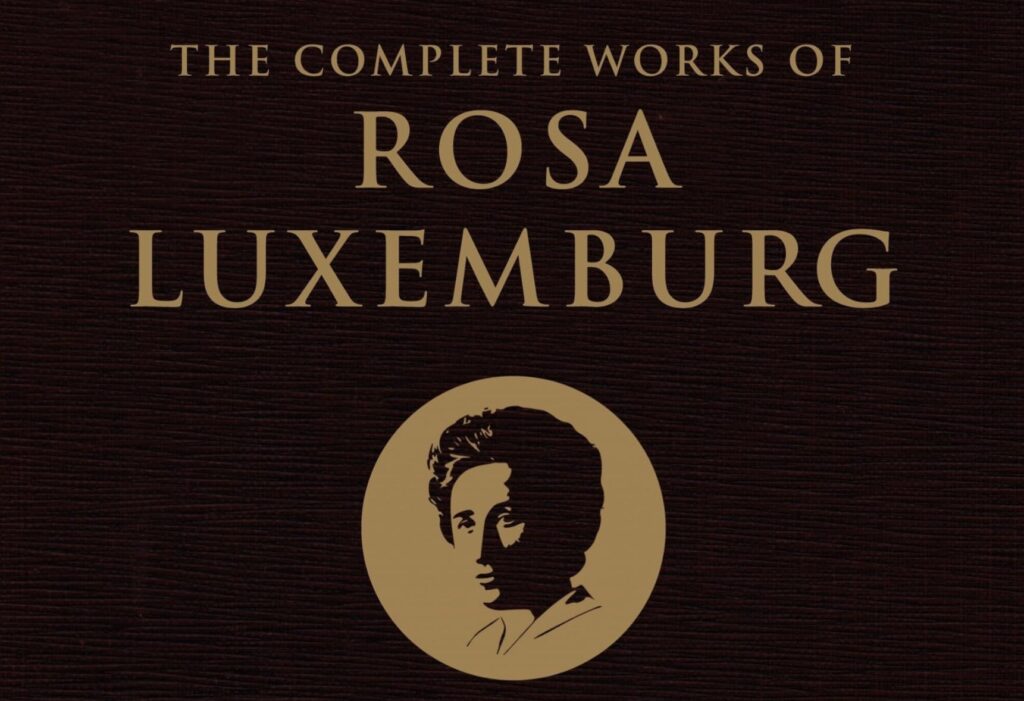
Rosa Luxemburg, The Complete Works of Rosa Luxemburg, Volume III: Political Writings 1, On Revolution, 1897-1905, eds. Peter Hudis and Sandra Rein; trans. George Shriver, Alicja Mann, and Henry Holland (London and New York: Verso Books, 2019, paperback, 2022). 592 pp.; Volume IV: Political Writings 2, On Revolution, 1906-1909, eds. Peter Hudis and Sandra Rein; trans. Jacob Blumenfeld, Nicholas Grey, Henry Holland, Zachary King, Manuella Kölke, and Joseph Muller (London and New York: Verso Books, 2022; paperback, 2023). 576 pp; Volume V: Political Writings 1, On Revolution, 1910-1919, eds. Paul Le Blanc and Helen C. Scott; trans. Jacob Blumenfeld, Mathias Foit, Nicholas Gray, Henry Holland, Zachary King and Manuela Kölke (London and New York: Verso Books, 2024; paperback, 2026). 512 pp.
Reviewed by Ronald Grigor Suny[1]
Truly a labour of love, as well as sincere political and scholarly commitment, dedicated investigators of the history of revolutionary Social Democracy have been working for decades collecting, translating, and publishing the writings of one of the most prolific and insightful Marxist thinkers of the twentieth century, Rosa Luxemburg (1871-1919). These documents not readily available to English readers began to appear in large volumes in 2013 and have now reached the third volume of the political writings in a paperback edition. Reading through these weighty tomes, it becomes clear that Luxemburg, born in the aftermath of one revolution, the Paris Commune, and murdered in another revolutionary upsurge, was a woman of strong views never reluctant to express them no matter the effect on personal relationships. The red thread through her work on revolution was her deep commitment to the initiative of the working class to carry out the revolutions against the hegemony of capitalism. Her articles vibrate with her energy and passion for the labour movement and vividly demonstrate that a major shift in Marxist perceptions occurred with the explosion of worker activity in the most backward of European powers, Russia, beginning in late 1904 and through the next several years.
In the aftermath of the struggles against the revisionism of Eduard Bernstein and the pervasive parliamentarism of the majority of German Social Democrats, Luxemburg and other critics of gradualist reformism were recharged by the men and — she emphasises – proletarian women fighting for democracy in Russia. “The starting point for the next wave of revolution had shifted from the west to east” (III, p. 50). What has been called “the revolution of 1905” was revolutionary in the intensity and duration of labour activity that forced the autocrat to concede a kind of limited “constitution” granting some rights to his people in October 1905. But the regime was not overthrown and would rebound, unwilling to give up its claim to be autocratic and searching desperately to take back what it had been forced to grant.
Before Lenin, who came late to appreciate the spontaneity that workers would display, Luxemburg celebrated the spontaneous uprising of the Russian proletariat and its “accidental leader”, the priest Father Georgii Gapon. Social Democrats both inspired and led the movement, she agreed, but they had been surprised by the independent action of the proletariat. While “it was the spirit of Marx that struck the first great blow in the streets of Petersburg”, Russian Social Democrats “had to adjust themselves everywhere to pressure from the workers” (III, pp. 58, 45). Marxists had to rethink their ideas about Russia and learn the lesson of revolutionary optimism presented by the Russian proletariat. Russia was showing both the necessity and meaning of the “bourgeois revolution”, for “the working class is not the means to an end – political liberty – but political liberty is a means to the end of the emancipation of the working class” (III, p. 50). The “cause of freedom and of social progress everywhere now lies with the class-conscious proletariat,” she proclaimed. “And it is in good hands!” (III, p. 63).
Even as the revolution succumbed to brutal repression by the tsarist government, Luxemburg lauded the strategic innovations of the Russian workers. They had moved a bourgeois-democratic revolution toward a proletarian-socialist one by transcending from parliamentary struggles to the creation of “a new method of struggle”, “the revolutionary mass strike” (III, p. 475). The great dilemma of the Russian Revolution, both in 1905 and 1917, was that the proletariat was the instrument that would open the way for the bourgeois-democratic revolution, but a truly socialist revolution was impossible in Russia without a long period of capitalist development. Socialism could not be imposed by a minority; only by an immense majority. As the editors of volume IV point out, “Herein lay the dual character of the Russian Revolution. It was proletarian in form, but bourgeois-democratic in content” (IV, p. xxvi). The proletariat fought for the maximal democracy in order that it could instrumentalise bourgeois liberties for the struggle against the bourgeoisie. Luxemburg understood a great truth in European history, that the reaching toward democracy was, in fact, the achievement not only of the limited political advances of the liberal bourgeoisie but of the sustained struggle of the working people.[2]
An early critic of Lenin’s controversial pamphlet What Is to Be Done? (1902), Luxemburg had grown critical of Georgii Plekhanov’s labelling the Bolshevik leader a Blanquist, that is, someone favouring the seizure of power by a small clique in a conspiratorial coup d’état. Life, and a revolution, had intervened, and Lenin had responded enthusiastically to the self-activisation of Russian, Polish, Georgian, and other workers. He was himself annoyed by the dogmatic adherence of some his comrades to what they believed was his formulation of the party leading the workers since they were unable to come to revolutionary consciousness without the help of party intellectuals. Whereas, in 1902, he emphasised the power of bourgeois cultural hegemony that pushed workers toward accommodation with capitalism, impressed by the militancy of Petersburg, Baku, and other workers, Lenin wrote three years later, “The working class is instinctively, spontaneously Social-Democratic, and the more than ten years of work of Social Democracy has done a great deal to turn this spontaneity into consciousness.”[3] In the heat of the revolution, many Social Democrats papered over their differences and adopted more radical strategies.
After a stint in prison and long conversations with Lenin and other leading Bolsheviks then living in Finland, Luxemburg composed her major theoretical and strategic intervention into the debates with the long essay, “The Mass Strike, the Political Parties, and the Trade Unions”, which later was praised by leading Bolsheviks. She set out to analyse what the Russian Revolution had taught Social Democrats about the current usefulness of the mass strike, which Marx and Engels had derided as an apolitical, anarchist method of struggle. Her audience was primarily in Germany, where she hoped to convince her comrades and the workers that, in the moment, 1906, when the revolutionary wave appeared to recede, the struggle must combine both politics and mass action. In her speeches to the congress of Russian Social Democrats later that year, she sided more with the Bolsheviks in their suspicions about the bourgeoisie than with the Mensheviks ready to temper their radicalism in order not to frighten the liberals. While most German Social Democrats were suspicious of her militancy, she remained confident that the role of Social Democrats was to develop the class consciousness that was inherent in the spontaneous actions of the proletariat. Workers might make the wrong choices at times, but their required goal is the broadest democracy in which their consciousness can flourish. Where she would differ from the Bolsheviks a little over a decade later was that she objected to the idea that there were alternative, non-democratic paths to socialism. The anticipated proletarian majority, however, never manifested itself in the history of the next century, except in small fleeting occasions and on the local rather than national level.
Her faith in the “masses”, as she referred to working people, never faltered, her optimism rooted in a vision of the future.
There is nothing more changeable than human psychology. That’s especially because the psyche of the masses, like … the eternal sea, always bears within it every latent possibility: deathly stillness and raging storm, the basest cowardice and the wildest heroism. The masses are always what they must be according to the circumstances of the times, and they are always on the verge of becoming something totally different from what they seem to be. (V, p. xvii.)
The mass strike was a weapon in the arsenal of Social Democracy that would accompany the parliamentarism of her more moderate comrades like Karl Kautsky but represented the revolutionary expression of the working people’s instinctual resistance against the mute compulsions and overt repressions of capitalism. Luxemburg focused on the maximum programme of Social Democracy, the socialist revolution, in anticipation that moments would unexpectedly arise to jump beyond the minimum programme of reform.
Socialists in the years before World War I, like those in the present day, were faced by the dilemma that the state and capital were powerful enough to crush the working class should it seriously threaten the social order. August Bebel, Friedrich Engels, and Kautsky all cautioned against insurrectionism. 1848 and 1871 were in the past, and 1917 was not yet on the horizon. Observing the technological advances in military science that served to strengthen the repressive power of the bourgeois state, Engels warned that “‘the powers-that-be’ positively want to get us to go where the guns shoot and the sabers slash” (V, p. xxiii). Luxemburg, however, had come to realise the leadership of the German Social-Democratic Party had become an obstacle to the revolution, and this would be culminate in its capitulation to the imperial regime on 4 August 1914, when the majority voted to support the war effort.
The fateful decision of Social-Democratic parties on both sides of the War to act in concert with their governments rather than fulfil the promises repeated in international congresses that the workers’ opposition would prevent war irrevocably fractured the unity of the Left. In the next few years, the radical Left gained support as the War dragged on, and Luxemburg greeted the outbreak of revolution in Russia in February 1917, as “the first conspicuous expression of proletarian class politics since the bankruptcy of international socialism at the outbreak of the World War, and thus the first advance for peace of world-historical significance” (V, p. 151). By August, she had essentially adopted the Bolshevik position on state power in Russia, writing in Spartacus that the coalition government in Russia, which allied bourgeois representatives with socialists, was “a compromise that, like all compromises, is condemned to ultimate fiasco. The new coalition ministry will, by virtue of internal logical development, sooner or later have to give way to a purely socialist government, that is to say, the actual and formal dictatorship of the proletariat” (V, p. 154).
Two months later, the most dedicatedly anti-war party, the Bolsheviks, basing their right to rule on the democratically-elected soviets, came to power. With a militant workers’ party at the helm of the largest country on the globe, a definitive dye had been cast. Luxemburg focused primarily on the issue of ending the War, which would begin with the Russians but required the German workers to complete. At the time of Germany’s triumphs in the East, on the eve of the Treaty of Brest-Litovsk in 1918 and the creation of German satellite statelets governed by anti-Bolsheviks, she wrote, “The German workers are now called upon to carry the tidings of the revolution and of peace from East to West. Here, no pursing of the lips will do—here, you have to blow the whistle” (V, p. 169). She framed the Russian Revolution as the clearest evidence of the failure of German Social Democracy led by those like Kautsky who had functioned “as an ideological cover for German imperialism’s campaign of conquest” (V, p. 215).
Late in 1918, just months before she was assassinated in Berlin during the Spartacist revolt, Luxemburg worked on an unfinished manuscript that represents her last musings on the Russian Revolution and the policies of the Bolsheviks. She began by linking the origins and potential success of the revolution to the international conjuncture of the War, its continuity with the lessons of the revolution of 1905, and its growth from bourgeois revolution to a socialist revolution that extended beyond the boundaries of Russia. She rejected the overly-cautious Mensheviks, who allied with bourgeois parties. “Lenin’s party was thus the only one in Russia that had a grasp of the true interests of the revolution in this initial period,” she wrote, “it was the element that drove the revolution forward, being in this sense the only party to pursue a socialist politics” (V, p. 221). Within a few months, the “actual situation in which the Russian Revolution found itself came down… to the following alternative: victory of the counterrevolution or dictatorship of the proletariat—i.e., Kaledin or Lenin…. Their October uprising not only salvaged the Russian Revolution, it also salvaged the honor of international socialism” (V, p. 221).
Along with defending a democratic road to socialism, she focused on crucial errors that she claimed were made by the Bolsheviks. “Lenin’s agrarian reform has engendered in the countryside a new and powerful popular stratum of adversaries of socialism, whose resistance will be much more dangerous and tenacious than that previously offered by the aristocratic owners of large estates” (V, p. 237). Concessions to the peasants were matched by his policy toward non-Russian peoples. A fierce opponent of nationalisms, Luxemburg rejected Lenin’s slogan of national self-determination of nations.
On the one hand, they have displayed their profound disdain for the Constituent Assembly, for universal suffrage, for freedom of the press and freedom of assembly—in short, for the entire apparatus of basic democratic freedoms of the popular masses that, taken together, formed the “right of self-determination” in Russia itself. On the other hand, however, they have treated the right of self-determination of nations as a jewel of democratic politics, for the sake of which all practical considerations of real critique were to be silenced. (V, p. 228.)
In contrast to Trotsky’s defence of non-democratic methods, Luxemburg singled out the importance of democracy for the education and advancement of the proletariat. Trotsky, she wrote, held that:
Owing to the open and direct struggle for power, the working people acquire much political experience in a short time and pass rapidly from one stage to the next in their development. The ponderous machinery of democratic institutions lags behind this evolution all the more, the bigger the country and the less perfect its technical apparatus. (V, p. 235.)
She passionately disagreed:
the remedy that Trotsky and Lenin have discovered—the elimination of democracy as such—is worse than the evil that it is supposed to prevent, for it occludes the very living source alone from which any correction of all the deficiencies inherent within social institutions can emanate. That source is none other than the active, uninhibited, vigorous political life of the broadest masses of the people. (V, p. 237.)
Luxemburg understood that the resistance of the bourgeoisie had to be smashed “with an iron fist,” as the Bolsheviks had done following the October Revolution, but such temporary measures did not then eliminate the need for the expansion of democracy enfranchising all. Lenin and Trotsky’s choices, in Luxemburg’s formulation, were detrimental to the creation of a public sphere essential for the education and development of the proletariat (V, p. 239). Democracy was not a luxury but a necessity.
[I]t is evident that, by its very nature, socialism cannot be imposed—it cannot be introduced by ukase. It has as its prerequisite a series of coercive measures—against property, etc. The negative—the dismantling of what exists—can be decreed; the positive cannot. It is a terra incognita…. [Lenin] errs completely in the means that he employs… Decrees, the dictatorial powers of factory supervisors, draconian punishments, the reign of terror — these are all mere palliatives. The only way to a renaissance is the school of public life itself, the most unrestricted and broadest democracy, public opinion. In contrast, the very reign of terror itself has a demoralizing effect. (V, p. 242.)
She predicted correctly that, “with the stifling of political life in the country as a whole, vitality within the soviets will also necessarily tend to wane. Without general elections, without unrestricted freedom of the press and of assembly, without a free struggle of opinions, vitality withers away in each public institution—it becomes a pseudo-vitality in which bureaucracy is the only remaining active element” (V, p. 243). And then, powerfully, she points to a future that she will not live to see.
Public life gradually falls into a slumber, a few dozen party leaders with inexhaustible energy and boundless idealism direct and govern; among the latter, a dozen outstanding minds are, in reality, the ones that lead, and an elite from within the working class is occasionally mustered in order to applaud the speeches of the leaders and to show unanimous approval for the resolutions drafted by them. (V, p. 243.)
Ending her essay, Luxemburg praised the Bolsheviks for demonstrating that they “could achieve everything that a genuinely revolutionary party is capable of accomplishing within the limits of historical possibilities. They should attempt to perform miracles…. In Russia, the problem could be posed; it could not be solved there. And, in this sense, the future everywhere belongs to ‘Bolshevism’” (V, p. 245).
Luxemburg’s faith in the spontaneity of working people appears to have proven even more prescient in our own time. Engels’s warning about the state-capital hegemon’s brutality suggests that alternative avenues to undermining the structures of power are required along with political participation in whatever democratic practices remain. Gramsci’s war of manoeuvre involving revolutionary political struggles, even direct attacks against the state, must be accompanied by a war of position, that is, the seemingly more tedious, gradual building up of the labour movement, its organisations, and its hegemony in the public and social spheres. Even in the most entrenched capitalist monolith, the United States, spontaneity without warning erupts – in occupations of Wall Street, Black Lives Matter, climate change activists, the streets of Minnesota, and pro-Palestinian encampments. Democratic socialists challenge the pusillanimous Democratic Party establishment. The state appears bewildered and turns to novel forms of repression. Liberals fret that the institutions will not hold, the rule of law will be undercut. Confused by their visceral reformism, they cannot face up to the lessons learned from the last century. The Soviet experiment taught us that there is no socialism without democracy, and the impasse of American neoliberal capitalism and bourgeois democracy teaches us, there is no democracy without socialism. At the supposed end of history, Luxemburg remains right.
[1] Ronald Grigor Suny is William H. Sewell Jr. Distinguished University Professor Emeritus of History and Political Science at the University of Michigan and Professor Emeritus of History and Political Science at the University of Chicago. He is the author of, among many works, The Baku Commune, 1917-1918: Class and Nationality in the Russian Revolution (Princeton University Press, 1972); The Revenge of the Past: Nationalism, Revolution, and the Collapse of the Soviet Union (Stanford University Press, 1993); The Soviet Experiment: Russia, the USSR, and the Successor States (Oxford University Press, 1998, 2011); “They Can Live in the Desert But Nowhere Else”: A History of the Armenian Genocide (Princeton University Press, 2015); Stalin: Passage to Revolution (Princeton: Princeton University Press, 2020).
[2] The importance of workers, the labor movement, and Social Democracy in the struggle of democracy is the central argument of Geoff Eley’s Forging Democracy: The History of the Left in Europe, 1850-2000 (New York: Oxford University Press, 2002).
[3] V.I. Lenin, “O reorganizatsii partii,” Polnoe sobranie sochinenii (5th edition: Moscow: Izdatel’stvo politicheskoi literatury, 1958–1965), XII, p. 86.