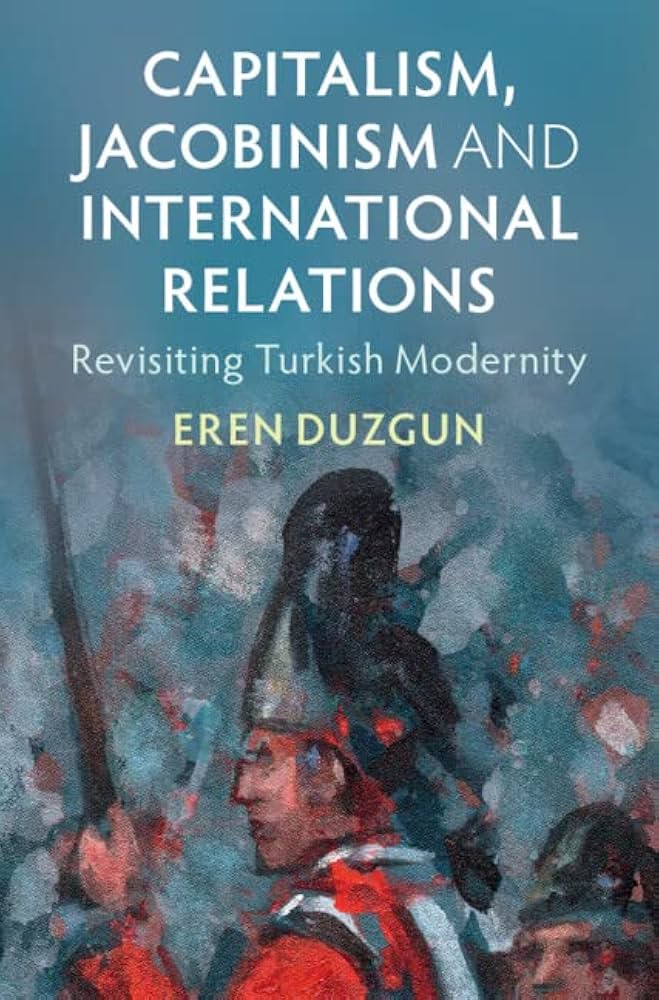
Reviewed by Stephen Miller
Eren Duzgun, graduate of the elite Middle East Technical University in Ankara Turkey, earned a PhD from York University, Canada, which has employed and trained outstanding scholars such as Samuel Knafo, Colin Mooers, George Comninel, Ellen Meiksins Wood and David McNally, to name but a few. Inspired by Robert Brenner’s work on the transition from feudalism to capitalism, these scholars have developed Political Marxism (PM), an intellectual current, which has reinvigorated historical materialism in the twenty-first century. Duzgun, a member of the Political Science faculty at the University of Cyprus, has written dozens of articles and book chapters and is perhaps best known—before the publication of Capitalism, Jacobinism and International Relations: Revisiting Turkish Modernity, under review in this essay—for ‘The Political Economy of the Transition to Capitalism in the Ottoman Empire and Turkey: Towards a New Interpretation’, one of several PM essays assembled by Charles Post and Xavier Lafrance and published in 2019.
Summarising PM, Duzgun argues, in Capitalism, Jacobinism and International Relations, that the transition to capitalism cannot be understood quantitatively as the expansion of trade, markets, private property or wage-labour. Rather, customary conditions of social reproduction had to change qualitatively for the market to become the basis for holding and expanding the means of life. The transition required a political intervention to eliminate nonmarket survival strategies and transform land and labour into commodities. By dint of such an intervention, people could no longer regard the market as an ‘opportunity’ to buy and sell goods for profit and, instead, faced it as an ‘imperative’ to which they had to conform for economic survival. Under capitalism, workers, confronted with competition for jobs, and investors, with competitive commodity prices of rival enterprises, must ceaselessly transform the conditions of production according to market imperatives. Capitalism, in this way, subsumes society to the law of value, compelling producers and employers to improve labour productivity. In Marxist terms, this improvement means the increase in the ratio of unpaid to paid labour or the reduction in the socially necessary labour time needed to generate surplus value. PM’s conception of the transition focuses attention on ‘the ruptural process of building market-dependent societies’ (p. 32).
Duzgun, like PM in general, holds that England experienced this ruptural process in the fourteenth and fifteenth centuries and became a capitalist country subject to the law of value; France did not. His thesis is that the geopolitical rivalry between the two countries over subsequent centuries sharpened this contrast and made possible the emergence of Jacobinism, ‘a qualitatively different regime of property and modernization in France’. The Jacobin regime, which crystallised during the French Revolution in 1793, represented ‘a new form of sociality and political economy,’ neither absolutist nor capitalist, and unleashed ‘novel social, economic and geopolitical dynamics’ (p. 55).
For Duzgun, this new society, economy and geopolitics was based on universal citizenship. By defending equality before the law, the Jacobins could make the citizenry serve in the military and defend France’s international position against Britain, a country of superior firepower thanks to its capitalist transition and the resultant wealth at its disposal to fund the armed forces. Jacobin citizenship had two features: the right to subsistence (principally household farms) and access to education. Duzgun writes that the Jacobin network of regulation known as the Maximum—based on a law passed in September 1793 to limit prices and punish price gouging—stood in contrast to capitalism as a new moral economy of reciprocity and unity. The Jacobins freed property from those said to abuse it and turned it into a political entitlement for those seen as socially and geopolitically useful to the nation. Service to the nation, rather than market competition, gave access to the means of social reproduction (pp. 84-7).
The facts for this case are as follows: in December 1792, Maximilien Robespierre, Louis de Saint-Just and other allies argued in the Convention—elected three months earlier to write a new constitution after the overthrow of the monarchy on 10 August 1792—that the Republic’s duty to assure the subsistence of its citizens came before its duty to protect the liberty of owners to use property as they saw fit. This issue and others divided Girondins and Jacobins into adversarial camps. In the summer of 1793, after the Jacobins gained control of the Convention, they implemented agrarian reform in response to the demands of many communes, especially ones pressured by poor peasants with insufficient land to see to their subsistence. The law of 3 June 1793 permitted the sale, in small lots, of national land seized from émigrés who fled the country in opposition to the Revolution. The law of 10 June turned common land over to village administrators, authorising them to divide and distribute it, an act welcomed by landless peasants and smallholders. Legislation liquidated royal parks to the advantage of peasants seeking the division of common land. The government removed about 1,568 arpents (an arpent equals about an acre) of cultivable land from the Grand Parc and distributed them to 1,546 peasant and artisan households in 25 of the 84 communes of the Versailles district. The law of 17 July abolished feudal dues without compensation, thus assuring the peasants full rights over their customary plots, together amounting to anywhere from 30 to 50 percent of the country’s farmland.[1]
In 1793 and 1794, some local administrators supported the families of soldiers with funds from common lands, obligatory contributions from the well-to-do classes, income from émigré property and voluntary taxes. The prosecutor of the second district of the Army of the North publicised a proclamation that soldiers and their families would cultivate fields abandoned to the Republic by émigrés. The Jacobin Convention replaced Old Regime medals for combatants with gifts of money and in kind to show republican solidarity. The regime repeatedly proposed to set aside a billion livres worth of nationalised properties as farms, or the cash equivalent, for soldiers or their surviving family members. Saint-Just and other representatives of the Convention, sent with a mission to the provinces, distributed cash to soldiers and their families. The Directory, at the end of the 1790s, implemented a law granting pensions to retired soldiers.[2]
Nevertheless, for years after 1794, the Convention and Directory heard grievances about the unfulfilled pledge to set aside a billion livres from the nationalised properties for soldiers. Moreover, although the Republic managed to feed the armed forces in the face of myriad challenges, it could not overcome hunger. In 1795 and 1796, food shortages became so bad that soldiers pillaged civilians while fighting on foreign soil. Even the law on pensions, which retired soldiers could rely on after 1799, gave them less income than the funds set aside for them at the beginning of the Revolution.[3]
One should also bear in mind that the Constituent Assembly declared property a natural, inviolable, imprescriptible and sacred right in the Declaration of the Rights of Man in September 1789. In December 1792, before the Jacobins controlled the Convention, this body imposed martial law to enforce economic liberty and, amid general and almost hysterical enthusiasm, decreed the death penalty for proposing ‘the agrarian law’, which, to the legislators, meant the forcible redivision of property. Even during the Year II (22 September 1793 to 27 July 1794, the date the Convention turned against Robespierre), villagers seeking a plot of land needed surveyors amenable to subdividing meadows and arable land, sympathetic Jacobin district authorities, and crowd pressure to deter substantial landowners and non-resident proprietors from outbidding peasants at land auctions. In any event, 9 Thermidor (27 July 1794) put a brutal end to experiments with distributing land and guaranteeing rights of subsistence. The law of 31 May 1795 revoked all the Convention’s agrarian legislation.[4]
Far more than the redistribution of property and guarantee of subsistence, the legacy of the French Revolution was the establishment of civic equality through the elimination of seigneurial rights and privileges. The French Revolution, unlike its Russian counterparts of 1905 and 1917, was not preceded by a half century of socialist agitation in favour of turning the land over to the peasants who worked it. French peasants mobilised in much larger numbers against an aristocratic plot than the unequal distribution of property. They had centuries of experience to see that the lords meant to keep their manorial dues and preserve their social superiority. The peasants expected the lords to manipulate the king or fight on their own to maintain seigneurial privileges. The peasants thus felt justified in taking things into their own hands in uprisings from 1789 through 1792. These revolts paved the way for constitutional government and individual rights, especially equality before the law without which liberty would have been another privilege of the powerful. When peasants cheered the conquest of liberty, they saw the disappearance of the manorial lords’ authority and the reduction of the privileged orders to the status of citizen, like everyone else.[5]
As for education, the second facet of Jacobin citizenship, Duzgun emphasises the revolutionaries’ intention, after August 1793, to establish a national system of primary schools. He recognises that the costs of war hindered progress in this regard. Duzgun’s argument is that—given widespread peasant property ownership, and much of the population’s independence from the discipline of the labour market—the Jacobins saw public education as an alternative mechanism to channel minds and bodies toward the goals of the dominant classes, in this case toward military service. What is more, when education became accessible to the citizenry, it removed exclusions, at least in principle, from the state and state-generated income. The French citizen-army and public schools demonstrated the geopolitical viability of an alternative model of mobilising the population, one different from the peculiarities of British history. France bypassed Britain’s capitalist transformation and proved that dissolving particularistic interests into a radicalised abstract collectivity could improve geopolitical competitiveness. The French model of army and school created a new standard for measuring the modernity or backwardness of the governments of Europe and the rest of the world (pp. 91-7).
The main evidence for this argument comes from the Jacobin Constitution of 1793, written after the Girondins had been removed from the Convention, which guaranteed a basic education. The Convention, of course, immediately suspended the Constitution until the Republic could impose peace on Europe. In the meantime, constitutional provisions, in the same way as land reform, depended on local administrators. Georges Couthon, for instance, an ally of Robespierre in the Committee of Public Safety, went on mission in September 1793 to quell opposition to the Convention in eastern France and the department of Puy-de-Dôme, where he levied a tax on suspected opponents and wealthy inhabitants to fund the local Jacobin society, succour the indigent, and support the schools. The Bouquier plan, passed by the Convention three months later, became France’s first educational law, stipulating free universal education for children in elementary schools. Parents faced a financial penalty for non-compliance. The law specified a minimum salary of 500 francs a year for teachers.[6]
Nevertheless, in the summer of 1794, only about a quarter of the schools, which should have appeared in accordance the Bouquier plan, actually saw the light of day. Unofficial schools, existent since the Old Regime, survived revolutionary officials and legislation, as the Convention failed to recruit enough teachers and provide enough textbooks. Administrators had more success in the army, for which Robespierre, Saint-Just and other Jacobins introduced a political education instilling the glory of forming the revolutionary vanguard of the nation. [7]
Needless to say, this political education did not offer much instruction in reading, writing and arithmetic. ‘For the mass of the population, at the level of elementary schooling, very little had changed; the rate of basic literacy in 1820 … stood about where it might have been expected without the Revolution.’[8] The reason education made so little progress was that, like agrarian reforms and rights to subsistence, it formed part of a thoroughgoing revolution against age-old political and religious structures. The National Assembly famously expropriated the Church and subordinated it to the state. The Convention took the registration of births, deaths and marriages from the Church in the fall of 1792. A year later, Jacobins and revolutionary militants made clergymen renounce the priesthood, closed all the churches in Paris, and turned places of worship into temples of reason. Enthusiastic representatives on mission and revolutionary armies collaborated with ambitious local officials to dechristianise the provinces and combat the centuries-old culture of the peasants. Up to 100,000 bells from 60,000 church towers were melted down for about 50,000 tons of metal for the war effort. Members of the lower classes, in this process, were caught up in movements for liberation and justice, and came to embrace hitherto unfathomable ideas such as the legitimacy of insurrection, shared labour, ‘perfect equality’, and the abolition of property and poverty promoted by Gracchus Babeuf between 1793 and his execution by the Directory elite on 27 May 1797.[9]
To combat the spread of such ideas, the landed classes discouraged the opening of schools, which only existed in 23,000 of France’s 38,000 communes under the Bourbon Restoration (1815-1830). The Orleanist monarchy (1830-1848) doubled expenditures on schools, and in 1833, François Guizot, as minister of public instruction, obliged every commune to set up a primary school and expand the facilities for training teachers. The law did not create free compulsory public schools but represented a step in the direction of mass education and improving the status of the teaching profession. During the Second Republic (1848-1852), however, the landed classes cracked down on socialists and republicans by passing the Falloux Laws, which made teachers instruct Catholicism in primary and secondary schools, allowed the Church to operate secondary schools, and gave priests ex officio membership on school boards. Peasants became more educated by 1870, though 30 percent of conscripts still could not write their name.[10]
Duzgun’s argument, however, does not hinge on rights to education and subsistence so much as on peasant proprietorship, which was confirmed, rather than created, by the Jacobin legislation of 1793 definitively abolishing seigneurial rights without compensation. The peasants’ plots of land existed thanks to their own efforts, from the feudal period through the modern era, rather than from Jacobin policy. Serfs, in the thirteenth century, won manumission in contracts spelling out fixed rents owed to the lords. They did so through threats to leave for other estates or untilled lands and thereby to depopulate the manors. Peasants thus enjoyed de facto property rights, and the lords’ demesnes covered only ten to twelve percent of the land of northern France, before the fourteenth-century crisis. With the long fitful emergence of the absolutist state from the end of the Hundred Years’ War to the eighteenth century, nobles and members of the bourgeoisie used the tribunals of the monarchy to recover land from the peasantry. Yet these tribunals also confirmed the legality of the peasants’ plots. Ensconced in this way on the land—and with the help of the long-term rise in prices after about 1740—the peasants used additional labour from family members to scrape together funds and acquire additional plots at the expense of the nobility and bourgeoisie. The extent of peasant property varied from region to region and overall amounted to 30 or 40 percent of the total in the decade before the French Revolution. [11]
The most comprehensive study of Church and émigré properties, expropriated and sold at auction during the Revolution, shows a continuation of this trend, as the peasants came up with the funds to purchase 30 to 40 percent of them. Moreover, many speculators and members of the bourgeoisie bought lands and resold them to the peasantry at higher prices over the following years and decades. When the dust settled at the beginning of the nineteenth century, the peasants held about 50 percent of the land for subsistence purposes. This reality resulted from the peasants’ indefatigable work and struggles, not Jacobin policy.[12] The world-historical innovation of Jacobinism, Duzgun rightly stresses, was to enfranchise the peasant small holders, turn them into citizens, and make them serve in the military, a model for subsequent regimes of Europe and the world to emulate.
Jacobinism, regarded thusly, no doubt represented a turning point in history. But did it constitute ‘the socio-institutional foundations of a new regime of political economy and property relations’ (p. 7)? Duzgun, it should be noted, describes early modern France as a feudal society from which the lords could no longer increase income by imposing additional labour services on the peasantry or by transforming the customary conditions of peasant land tenures and common rights. Lords, instead, gravitated toward a new mode of political appropriation, securing positions in the tax/office structure of the monarchy. A massive network of patronage and privilege, built on a market for venal offices, underpinned the absolutist state. Hereditary and saleable offices in the administration and judiciary, as well as fiscal privileges, joined the nobility to the crown. Large numbers of the bourgeoisie used gains from financial and commercial enterprises to purchase offices and privileges (pp. 60-1).
This absolutist form of feudal appropriation not only emerged, in the foregoing manner, out of conflict between lords and peasants. It also emerged out of conflicts pitting lords against one another and, once reorganised under monarchs, against the nobles of other states. Prior to the 1300s, the separation and autonomy of manors led the lords to use the surpluses taken from the peasantry for political accumulation, to build up their military and political capacity through stronger communities of knights able to control the peasants and wage wars against other communities of knights. Political accumulation, to control peasants and wage war, seemed the common-sense way to increase lordly income. It weeded out the nobles unable to stand up to military pressure in a process of elimination and centralisation from the period of rudimentary political communities of the year 1000 right up through the fully-fledged absolutist warfare states of the early modern period. The geopolitical system of the sixteen and seventeenth centuries entailed the dynastic strategies of empire building, political marriages, wars of succession, and an inter-dynastic compensatory equilibrium, often at the expense of weaker kingdoms, all in the service of political accumulation for nobles within absolutist states.[13]
After 1688, international relations underwent a process of modernisation under the pressure of capitalist Britain. French absolutism attained its highest intellectual and cultural achievements, and extended greater control over its subjects, at the very moment its international power began to wane. Louis XIV presided over the same defective, incomplete and anomalous state of his predecessors. His consolidated and stabilised monarchy, with an unprecedentedly large army, failed to impose itself on Europe. Britain, thanks to capitalist development across the sixteenth and seventeenth centuries, and to the consolidation of a modern state after 1688, became the world imperial power during the War of the Spanish Succession (1701-14). Henceforth, Britain forced old regimes, through revolutions from below and above, to adapt their economic and political systems to its superior economic performance and military power.[14]
Looked at in the foregoing manner, Jacobinism, as ‘universal conscription and the citizen-army’ did not represent ‘the socio-institutional foundations of a new regime of political economy and property relations’. It represented, rather, the continuation of the centuries-old economic and property relations in a finalised form, much like absolutist states had reorganised the domination over the peasantry imposed by feudal lords around the year 1000. Jacobinism rallied France’s non-capitalist society and state for military competition in a more rational form than had absolutism and feudalism.
After all, from the Old Regime to the revolutionary years and Napoleonic period, the labour force continued to consist of peasant subsistence farmers, and the land remained within their sphere of production, which underwent little change. The fundamental relations of exploitation consisted of overlapping forms of sharecropping and tenancy (métayage and fermage) across the diverse regions of France in accordance with their long histories of wars, class struggles and demographic cycles. Many peasants had no, or insufficient, land to cover their subsistence and had to farm as sharecroppers. Many others accepted paid labour in addition to subsistence farming. Tenant farmers on property of the landed classes, including members of the nobility and bourgeoisie, organised production in a manner consistent with the rights and obligations of the peasant community. They counted on subsistence production and common rights to hold down wages. Relations of exploitation discouraged large-scale agricultural improvement and capital accumulation.[15]
The Bourbon and Orleanist monarchies, as well as the Second Empire (1852 to 1870), enjoyed the support of landed notables determined to maintain this status quo and prevent political participation. Nevertheless, the Second Empire included a faction of the ruling class interested in putting industry on a capitalist foundation so that it could support France’s international position in the face of Britain’s imperial advantage. The rapid maturation of British capitalism bolstered this faction relative to monarchists keen on preserving the traditional social relations. Administrators favourable to industrial growth used the new executive powers of Napoleon III to liberalise foreign trade, economically integrate the country, and eradicate customary regulations in manufacturing. They imposed new social property relations and new forms of surplus appropriation to revolutionise patterns of investment and industrial growth. The Second Empire, to be sure, made no effort to dispossess the peasantry, which represented the bulwark of social stability. Agricultural production and a mass consumer market developed slowly, limiting growth rates relative to those of France’s economic and political rivals.[16]
With social relations in manufacturing on a capitalist footing, the government of the Third Republic (1870-1940) became partially democratic and appeared neutral and autonomous. The state depended upon, and thus actively supported, the accumulation of capital so that it could function and retain legitimacy. Studies of great fortunes show that, by 1900, the bourgeoisie no longer depended entirely on land, as they had in 1848. More and more upper-class graduates from the grandes écoles (France’s higher education establishment) abandoned state service for business and made fortunes in industry, joining boards of directors of industrial firms.[17]
It was in this context that the state went forward with a comprehensive system of obligatory secular education. The Ferry Laws, passed from 1879 to 1886 by the Third Republic, made public education mandatory and non-religious and eventually prohibited members of the Catholic orders from teaching in the schools. The Ferry Laws at last embodied Jacobinism as theorised by Duzgun. The schools taught the young to accept their station in life, not for religious reasons, but because it made one happier than to strive to rise out of one’s circumstances. Books taught the inevitability of social inequality but also stressed individual and critical thinking, and especially one’s duty to the community as a soldier. The curriculum taught about the thinkers and soldiers of the national past, but did not accord much importance to religion.[18] Notables, over subsequent decades, came to tolerate universal citizenship and education on the Third Republic’s terms at a time capitalist relations took hold of industrial areas, and education no longer had to serve ‘as a substitute mechanism [for the imperatives of the labour market] of disciplining and appropriating peasant bodies’ (p. 92).
Jacobinism, paradoxically, though pioneered in France, had a much longer and far-reaching influence on the development of the Ottoman Empire and Turkey. As regards Turkish modernity, Duzgun maintains that Marxian accounts of the Ottoman Empire assume the existence of capitalism, in a peripheral form, as a function of the growing commercial relations with Western Europe and the capitalist world-system in the nineteenth century. These commercial relations took hold in 1838-41 thanks to the Tanzimat project, as the Ottomans, to strengthen their fiscal base and secure British support vis-à-vis Muhammad Ali in Egypt, signed free trade agreements lifting state monopolies on foreign trade and reducing tariffs on exports. Commercial agriculture grew exponentially, and manufacturing spread to the countryside (pp. 100, 110).
The project also had a Jacobin dynamic, as it pledged to defend life, equality, and property for all subjects with the purpose of binding non-Turkish subjects to the state and pre-empting European intervention, dismemberment and annexation. Whereas peasants, traditionally, had formed part of the body politic as members of localised and personalised political communities, the Tanzimat project began to turn them into citizen-soldiers endowed with universal rights and duties. Ruling elites, to maintain power in the face of imperial threats, had to drop restrictions on carrying swords and mounting horses (pp. 110-12).
Nevertheless, Duzgun shows, integration into, and production for, the world market did lead to capitalist development. The subsistence of most Ottoman peasants did not depend on their ability to improve production according to market imperatives. The peasants relentlessly cleared uncultivated land and divided it among additional peasant households. Landlords relied on indebted sharecroppers to retain labour on their lands. Investing in means of production and improving the land might have given the peasants the ability to pay debts and become independent, thus depleting the only pool of labour. (pp. 110, 122-5)
The Ottoman Constitution of 1876 introduced free education as a right and obligation, and, by the 1880s, students from relatively modest families, trained in provincial public schools, entered the ranks of the military and bureaucracy. These lower-ranking officers, known as the Young Turks, founded the Committee of Union and Progress (CUP) under the slogans of justice and liberty to pry the state loose from the sultane’s associates and open government careers to talent. (pp. 127-8, 134) In contrast to France, ‘the Ottoman Empire’ never adopted ‘the Jacobin … antireligious modernity … From the Tanzimat to the Young Turks (then to the early Republican period) … a public space engrained in an Islamic vocabulary could mediate the tension between the rights and duties of the modern individual’ (p. 136). Though not immune to revolutionary upheaval, the Ottoman Empire and Turkey never saw a mass liberatory assault on political and religious structures like what took place in France from 1789 to 1794. Social and political elites espoused Jacobinism—citizenship, land and education—without unleashing movements liable to overturn the relations of exploitation.
This bureaucratic, landed and merchant elite, which obtained positions in the military and administration in the last decades of the nineteenth century, faced the abyss, when the allies partitioned Anatolia and granted parts of it to non-Turkish subjects of the empire at the end of the First World War. The treaties threatened the wartime wealth and property accumulated by the social strata of Turks who had begun to enjoy the benefits of state careers a few decades earlier. These military officers and bureaucrats organised in the CUP as a network of resistance organisations and held an Ankara-based assembly to contest the sultan’s acceptance of the annexation of Western Anatolia by Greece and the creation of Armenian and Kurdish states in the east. (p. 163)
In the 1920s, the Kemalist republic, which emerged from this resistance, did not divorce the peasants from the land or impose market imperatives on them. Fiscal incentives and limited land redistribution prevented dispossession, hindered labour mobility and retained the centuries-old sharecropping relations (pp. 161-2). In the absence of a capitalist economic sphere, educated politically loyal citizens, who had completed military service, sought rights to participate in the political and economic establishment. The increased number of these citizens, with the legal qualifications to share in state-generated rents, made it impossible for the government to accommodate all of them. ‘The institutionalization of military service and public education … would inevitably lead to … “exclusions” from the theoretically universalized political space, most notably of Kurds and non-Muslims’ (p. 181).
Duzgun argues that the Turkish Republic, built in Jacobin fashion on extensive peasant agriculture and sharecropping, began to change with the beginnings of a capitalist transition in the 1950s, when land clearances could go no further, and future growth depended on an intensive increase in yields. The peasants gradually came to rely on market sales. Agricultural productivity increased in the 1960s and 1970s, as rural inhabitants migrated to the towns and plot sizes grew. Farmers, with government credit and price supports, and especially US food aid, purchased industrial inputs and turned rural Anatolia into a large market for agricultural machines, textiles, processed food, consumer durables, and cars. Seeing the opportunities created by the emergence of labour and consumer markets, landlords drove sharecroppers off the land and reorganised the labour process to improve their holdings and generate profit (pp. 199-200).
After the 1960s, Duzgun argues, industrial profits resulted from protectionism and state investment into firms producing chemicals, rubber, and electricity for the internal market, not from exports. Large industries, enjoying noncompetitive prices in the domestic market, slowed down capitalist development. Much of the profit benefited the military. Increased pay scales, pensions, subsidised accommodations and consumer goods, and professional opportunities for retired officers in the upper levels of the bureaucracy and private sector turned the armed forces into pillars of the economic structure. The military no longer harboured dissenters prone to mobilise the population around Jacobin programmes for equality (pp. 214-15).
Duzgun shows that manufacturers of the Anatolian hinterlands never obtained as much public investment as did the protected oligopolies of Istanbul and Izmir. This internal bourgeoisie, which did not depend on imports for production and consumption, had access to cheaper, non-union labour outside the industrial relations regulated by the government. They exported to less competitive Middle Eastern markets which expanded in the 1970s thanks to rising oil prices (p. 225). This domestic bourgeoisie has provided the core constituency of the Justice and Development Party (AKP), which has dominated Turkish politics in the twenty-first century. The AKP has overseen the decline of trade union density from 20 percent of the workforce in 1998 to 6.3 percent in 2013. Collective-bargaining agreements fell by half to cover only 4 percent of the workforce in 2015. The AKP increased welfare expenditures, amid the growing insecurity and flexibility of the labour market, thus weakening opposition to neoliberal policies and deepening capitalist social relations. Whereas the first generation of neoliberal reforms of the 1980s and 1990s, imposed by foreign creditors, decreased formal employment and increased social exclusion and insecurity, the second ones begun in the 2000s contained social policies beneficial to the poor and socially excluded groups, thus enhancing support for the AKP and its leader Recep Tayyip Erdoğan.
Put briefly, Capitalism, Jacobinism, and International Relations amounts to a brilliant book, showing that, in France and the Ottoman Empire, universal citizenship, equality before the law, and mass conscription did not represent components of nascent capitalism but of an alternative Jacobin form of strengthening the state. The citizen army of Jacobinism made it possible for states with non-capitalist populations of peasant smallholders to compete geopolitically. Jacobinism lost support in France in the nineteenth century after a thoroughgoing anti-clerical revolution precipitated the emergence of socialist movements and made the landed classes hostile to republican politics. It lasted much longer in the Ottoman Empire and Turkey where it could incorporate Islam and mobilise peasant citizens until a capitalist transition after the 1950s led the dominant classes and military establishment to dispense with Jacobin methods of mobilising the population.
[1] Gauthier 1985, pp. 278-9, 286-8; Jones 1991 pp. 108-9, 113, 117, 121, 132.
[2] Bertaud 1988, pp. 123, 196-7, 203-4, 299.
[3] Bertaud 1988, pp. 249, 286, 291, 298-9.
[4] Rose 1984, pp. 113, 121; Gauthier 1985, pp. 278-9, 288; Jones 1991, pp. 121, 126.
[5] Lefebvre 1988, pp. 144, 209.
[6] Woloch 2012, p. 448; Palmer 1985, p. 181; Palmer 1989, pp. 148-9.
[7] Palmer 1985, pp. 182-3; Bertaud 1988, pp. 191-3.
[8] Palmer 1985, p. 332.
[9] Palmer 1989, pp. 119-20; Hufton 1992, pp. 100, 107; Jones 2003, p. 490; Aston 2004, p. 116; McPhee 2016, p. 229; Mason 2022, pp. 63-73, 173, 180-1, 230.
[10] Wright 1995, pp. 113, 132, 148, 167, 229-30; Popkin 2013, pp. 90, 99, 122.
[11] Bloch 1966, pp. 107-9, 115, 128-48; Brenner 1987, p. 243; Meuvret 1987, pp. 76, 124; Lefebvre 1962, pp. 329-30; Brennan 2006, pp. 183, 186, 189–90, 193, 197–8; Labrousse 1966, pp. 48–51; Béaur 1984, pp. 270, 336, 339; Tulippe 1934, pp. 110, 161–3, 241, 318–9.
[12] Bodinier, Teyssier and Antoine 2000, pp. 220, 223, 443.
[13] Brenner 2007, p. 71; Teschke 2003, p. 218.
[14] Teschke 2003, p. 250; Anderson 1979, pp. 105-6.
[15] Comninel 1987, pp. 185-94; Halkier 1990, p. 325; Lafrance and Miller 2024, pp. 16-40.
[16] Teschke 2003, p. 265; Lafrance 2020, pp. 10, 248.
[17] Lafrance 2020, pp. 249-50.
[18] Wright 1995, pp. 229-30, 313; Popkin 2013, pp. 147-8, 152-3.
BIBLIOGRAPHY
Anderson, Perry 1979 [1974], Lineages of the Absolutist State, London: Verso.
Aston, Nigel 2004, The French Revolution 1789-1804: Authority, Liberty and the Search for Stability, Houdmills, Baingstoke, Hampshire: Palgrave Macmillan.
Béaur, Gérard 1984, Le marché foncier à la veille de la Révolution: les mouvements de propriété beaucerons dans les régions de Maintenon et de Janville de 1761 à 1790, Paris: Éditions de l’EHESS.
Bertaud, Jean-Paul 1988, The Army of the French Revolution: From Citizen-Soldiers to Instrument of Power, translated by R. R. Palmer, Princeton: Princeton University Press.
Bloch, Marc 1966 [1931], French Rural History: An Essay on its Basic Characteristics, translated by Janet Sondheimer, Berkeley: University of California Press.
Bodinier, Bernard, Éric Teyssier and François Antoine 2000, L’événement le plus important de la Révolution. La vente des biens nationaux (1789-1867), Paris: Société des études robespierristes.
Brennan, Thomas 2006, ‘Peasants and Debt in Eighteenth-Century Champagne,’ Journal of Interdisciplinary History, 37, 2: 175-200.
Brenner, Robert 1987, ‘The Agrarian Roots of European Capitalism,’ in The Brenner Debate: Agrarian Class Structure and Economic Development in Pre-Industrial Europe, edited by T.H. Aston and C.H.E. Philpin, pp. 213-327, Cambridge: Cambridge University Press.
Brenner Robert 2007, ‘Property and Progress: Where Adam Smith Went Wrong,’ in Marxist History-Writing for the Twenty-First Century, edited by Chris Wickham, pp. 49-111, Oxford: Oxford University Press.
Comninel, George 1987, Rethinking the French Revolution: Marxism and the Revisionist Challenge, London: Verso.
Duzgun, Eren 2022, Capitalism, Jacobinism and International Relations: Revisiting Turkish Modernity, Cambridge: Cambridge University Press.
Gauthier, Florence 1985, ‘De Mably à Robespierre: un programme économique égalitaire 1775-1793,’ Annales historiques de la Révolution française, 261: 265-289.
Halkier, Henrik 1990, ‘The Harder They Come: 1789 as a Challenge to Marxism,’ Science & Society, 54, 3: 321 – 350.
Hufton, Olwen 1992, Women and the Limits of Citizenship in the French Revolution, Toronto: Toronto University Press.
Jones, Colin 2003 [2002], The Great Nation: France from Louis XV to Napoleon, London: Penguin Books.
Jones, P. M. 1991, ‘The ‘Agrarian Law’: Schemes for Land Redistribution during the French Revolution,’ Past and Present, 133: 96-133.
Labrousse, Ernest 1966, ‘The Evolution of Peasant Society in France from the Eighteenth
Century to the Present,’ in French Society and Culture since the Old Regime, edited by Evelyn Acomb and Marvin Brown, pp. 43–64, New York: Holt, Rinehart and Winston.
Lafrance, Xavier, 2020 [2019], The Making of Capitalism in France: Class Structures, Economic Development, the State and the Formation of the French Working Class, 1750-1914, Chicago: Haymarket.
Lafrance, Xavier and Stephen Miller 2024, The Transition to Capitalism in Modern France: Primitive Accumulation and Markets from the Old Regime to the Post-World War II Era, Routledge: Milton, UK.
Lafrance, Xavier and Charles Post (eds.) 2019, Case Studies in the Origins of Capitalism, London: Palgrave Macmillan.
Lefebvre, Georges 1962, Études sur la Révolution française, Paris: PUF.
Lefebvre, Georges 1988 [1947], The Coming of the French Revolution, translated by R. R. Palmer, Princeton: Princeton University Press.
Mason, Laura 2022, The Last Revolutionaries: The Conspiracy Trial of Gracchus Babeuf and the Equals, New Haven: Yale University Press.
McPhee, Peter 2016, Liberty or Death: The French Revolution, New Haven: Yale University Press.
Meuvret, Jean 1987 [1977], Le problème des subsistances à l’époque Louis XIV, Paris: Éditions de l’EHESS.
Palmer, R.R. 1985, The Improvement of Humanity: Education and The French Revolution, Princeton: Princeton University Press.
Palmer, R.R. 1989 [1941], Twelve Who Ruled: The Year of the Terror in the French Revolution, Princeton: Princeton University Press.
Popkin, Jeremy 2013 [1994], A History of Modern France, Upper Saddle River, NJ: Pearson.
Rose, R. B. 1984, ‘The ‘Red Scare’ of the 1790s: The French Revolution and the ‘Agrarian Law,’’ Past & Present, 103: 113-130.
Teschke, Benno 2003, The Myth of 1648: Class, Geopolitics, and the Making of Modern International Relations, London: Verso.
Tulippe, Omer 1934, L’habitat rural en Seine-et-Oise: Essai de géographie du peuplement, Paris: Sirey.
Woloch, Isser 2012, ‘A Revolution in Political Culture,’ in A Companion to the French Revolution, edited by Peter McPhee, pp. 437-453, Malden, MA: Wiley-Blackwell.
Wright, Gordon 1995 [1960], France in Modern Times, New York: WW Norton and Company.
[1] Gauthier 1985, pp. 278-9, 286-8; Jones 1991 pp. 108-9, 113, 117, 121, 132.
[2] Bertaud 1988, pp. 123, 196-7, 203-4, 299.
[3] Bertaud 1988, pp. 249, 286, 291, 298-9.
[4] Rose 1984, pp. 113, 121; Gauthier 1985, pp. 278-9, 288; Jones 1991, pp. 121, 126.
[5] Lefebvre 1988, pp. 144, 209.
[6] Woloch 2012, p. 448; Palmer 1985, p. 181; Palmer 1989, pp. 148-9.
[7] Palmer 1985, pp. 182-3; Bertaud 1988, pp. 191-3.
[8] Palmer 1985, p. 332.
[9] Palmer 1989, pp. 119-20; Hufton 1992, pp. 100, 107; Jones 2003, p. 490; Aston 2004, p. 116; McPhee 2016, p. 229; Mason 2022, pp. 63-73, 173, 180-1, 230.
[10] Wright 1995, pp. 113, 132, 148, 167, 229-30; Popkin 2013, pp. 90, 99, 122.
[11] Bloch 1966, pp. 107-9, 115, 128-48; Brenner 1987, p. 243; Meuvret 1987, pp. 76, 124; Lefebvre 1962, pp. 329-30; Brennan 2006, pp. 183, 186, 189–90, 193, 197–8; Labrousse 1966, pp. 48–51; Béaur 1984, pp. 270, 336, 339; Tulippe 1934, pp. 110, 161–3, 241, 318–9.
[12] Bodinier, Teyssier and Antoine 2000, pp. 220, 223, 443.
[13] Brenner 2007, p. 71; Teschke 2003, p. 218.
[14] Teschke 2003, p. 250; Anderson 1979, pp. 105-6.
[15] Comninel 1987, pp. 185-94; Halkier 1990, p. 325; Lafrance and Miller 2024, pp. 16-40.
[16] Teschke 2003, p. 265; Lafrance 2020, pp. 10, 248.
[17] Lafrance 2020, pp. 249-50.
[18] Wright 1995, pp. 229-30, 313; Popkin 2013, pp. 147-8, 152-3.