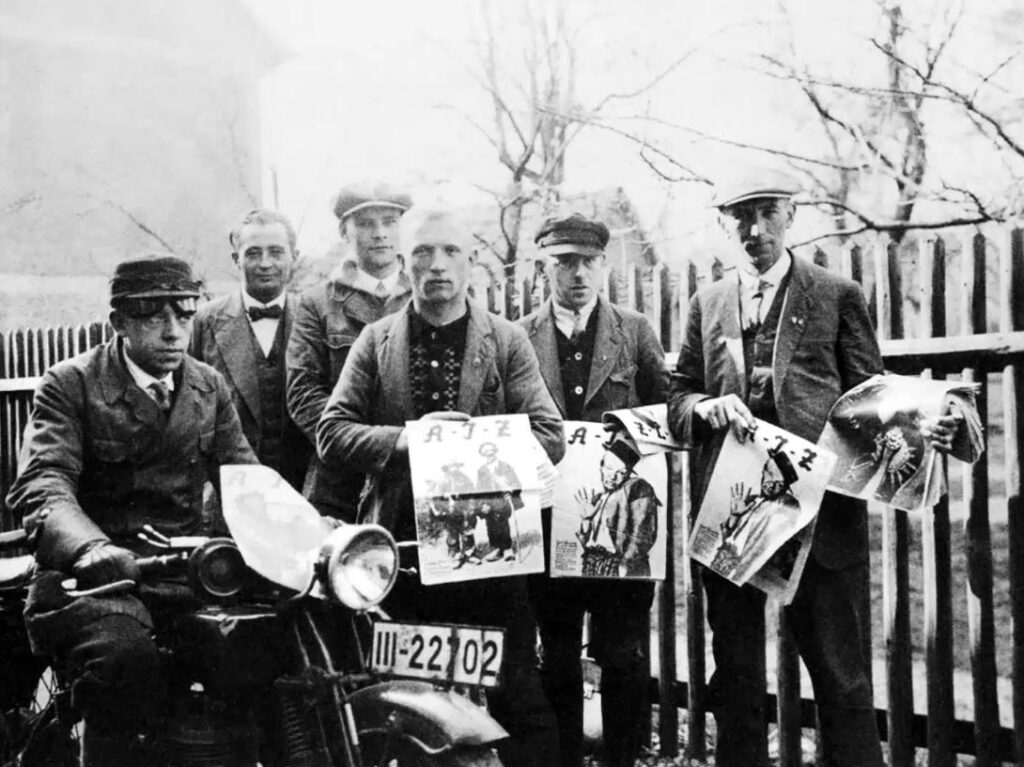
Review of: Christian Joschke, La Révolution suspendue: photographie et presse communiste dans l’Allemagne de Weimar (1918-1933) (Paris: Macula, 2025).
Reviewed by Tobias Ertl
“On Alexanderplatz the demonstrators were massing. I found myself in their midst, armed with 24 plates and assisted by a comrade who was responsible for taking the plates with him once they had been exposed, in order to prevent them from being confiscated. Somewhere a choir could be heard singing: ‘Down with police terror!’ Run—workers in front and the police behind. I wanted to release the shutter. Impossible. ‘Run,’ people were shouting. The police charged into the crowd and struck. A worker collapsed. A cop chased a demonstrator. I run, turn around, run—release. Did I capture the scene? Was I at the right distance? What do I know! What is certain is that the police had thrown themselves at a worker…”
On the pages of Der-Arbeiter-Fotograf (The Workers’ Photographer, 1926–33) this vivid account of the May Day demonstrations in Berlin in 1929 is accompanied by some of the images its anonymous author describes having captured and secured in the turmoil of the unrest: a unit of riot police in movement taken from an elevated vantage point, a dispersed crowd of protestors, a worker stumbling forward as he is about to be hit by a baton-wielding officer.[1] Some of the photographs are blurred due to the rapid motion of their subject, the viewpoint changes between being immersed in the action and a slightly more detached perspective, but, overall, the arrangement of the images suggests a dynamic, mobile and partisan gaze.
At the time of the events of Berlin Blutmai, when dozens of protesters were killed and hundreds injured by the city’s police forces commanded by the Social Democrat Karl Zörgiebel, the German communist Left disposed of a vast (and transnational) network of militant worker photographers who saw as one of their main tasks to “police this police”[2] and to “conquer” the apparatus of “observing machines”[3] – the new media technologies of film, photography, radio and the press – for the purpose of communist (counter)-propaganda. Christian Joschke’s book La Révolution suspendue: Photographie et presse communiste dans l’Allemagne de Weimar (1918–1933) presents a substantial and comprehensive account of the history of these networks. Highlighting, respectively, the media infrastructures and systems of image circulation on which communist Agitprop photography in the Weimar Republic was technologically and economically dependent, the political debates in which it was ideologically embedded, and the aesthetic models which were processed or produced through its visual practices, the book presents a timely intervention into an ongoing scholarly debate on the intricate relationship between art and the labour movement in the interwar period.
Joschke’s study connects several threads of research: the social and political history of the labour movement; the media history of the illustrated press and new visual technologies; and the art history of social documentary and amateur photography. It is within the latter field that the author has acquired scholarly expertise, having previously published a study on amateur photography in Wilhelmine Germany (in some sense the precursor to the book under review)[4] and having co-curated an exhibition on communist and antifascist social documentary photography in the 1930s in France.[5] The twelve chapters of La Revolution suspendue are centred around the activities of the communist politician, publisher and propagandist Willi Münzenberg (1889–1940) who was at the head of one of the largest media conglomerates of the Weimar Republic with branches in journalism and the illustrated press as well as the publishing industry, film, and radio. Münzenberg’s various and partly Moscow-backed ventures – from the Workers International Relief (1921–35) to Neuer Deutscher Verlag (1923–33), from the Arbeiter-Illustrierte-Zeitung (A-I-Z) (1924–38) to the workers’ photography magazine, Der Arbeiter-Fotograf (1926–33) – run as red threads through the book. Joschke is careful, however, to pay attention to the material, social and economic, infrastructures supporting these transnationally operative networks of communist propaganda rather than making it a narrative about a single media strategist. Along the way, the reader encounters a whole series of important but often forgotten figures mostly absent from the standard accounts of Weimar communist culture, let alone from those of modernist art history: the Émigré Hungarian graphic artist Jolán Szilágyi, the Comintern functionary, conspirator, and publisher Jakov Rejch (“Comrade Thomas”), the journalists and editors of A-I-Z Franz Höllering and Lilly Korpus, the Soviet photojournalists Max Alpert and Arkadi Chaïkhet, or the amateur photographer Erich Rinka, to name but a few; complemented, notably, by the multitude of nameless photographers, workers’ correspondents, agitators and newspaper hawkers whose dispersed archival traces the book carefully reconstructs.
Spanning roughly 400 pages, the reader is provided with a rich and complex picture of communist visual politics during the Weimar years. By training, Joschke is a historian of photography with a background in German Bildwissenschaft (he studied with Hans Belting and translated works by Horst Bredekamp) and a strong leaning towards social history. At times meticulously researched background information on the protagonists’ biographies, institutions and networks, alternate with close readings of images and theoretical reflections on the relation between aesthetics and politics, which make for a varied read. An overall strength of the book is the way it holds together distinct contexts – the milieu of amateur photographers, Münzenberg’s publishing and film enterprises, the political networks of both the KPD and the Komintern, as well as different artists and intellectual scenes and organizations, from Malik Verlag to Assoziation Revolutionärer Bildender Künstler Deutschlands (ARBKD) –, mapping out their intersections while carefully bringing into relief their discursive divergences and independent modes of operation.
The main sections of the text focus on two distinct objects of research: the Arbeiter-Illustrierte-Zeitung (chapters 4–6) and the communist networks of workers’ photography (chapters 7–10). While the reader is presented with abundant source material, it should be noted that the book draws heavily upon existing research in these fields, which it makes available for the first time to a French-speaking audience. In particular, the groundbreaking scholarship of Wolfgang Hesse is essential for any account of Weimar Arbeiterfotografie,[6] as is the work of Andrés Zervigón[7] when it comes to the intersection of post-Dada photomontage and political Agitprop. Despite its many original insights, La Révolution suspendue might at times come across more as an effort to synthesize and extend these accounts than as an entirely novel thesis on leftist visual production in interwar Germany.
Three main theses can be extracted from the book’s extensive presentation of its material: First, the surge of communist agitprop and its revolutionary usage of new media coincide with the sequence starting from the defeat of the revolutionary movements in Germany between 1919–23. It is this thesis that lends the book its title. While the time of political action is a time of visual “poverty” (p. 32), the KPD’s turn towards visual propaganda is read as an effect of the revolution’s “suspension”, prompting the “necessity to continue efforts in the realm of public opinion in order to discipline militants and rally the masses” (p. 28).
Second, the increasing use of visual techniques of mass media by the KPD’s strategists from the second half of the 1920s onwards was the effect of a hard-won struggle against “German Communism’s iconophobia”, to use Zervigón’s formulation.[8] In fact, the methods of visual Agitprop which were to become hallmarks of Weimar communist culture were first tested in avantgarde contexts – famously, John Heartfield’s book covers for Der Malik-Verlag – and were decried by the Party’s cultural critics as petty-bourgeois radicalism. A scepticism towards the lure of appearance (both in the sense of documentary evidence and of spectacular entertainment) remained intact as Münzenberg’s A-I-Z’s highjacked the media strategies of the capitalist press to the end of politically educating consciousness. Communist propaganda then comes across simultaneously as “critique of media”, as it confronts the realm of visual representation with the “world of labour” which had been excluded from it (p. 17).
Third, the space occupied by communist Agitprop is marked by a tension between vertical “diffusion” and horizontal “dissemination” (p. 74) as operational modes of educating class consciousness. While, in the wake of the ‘Bolshevisation’ of the KPD, the tactics and strategies of both short-term agitation and long-term propaganda are linked to a hierarchal model of transmission from cadres to masses, Joschke’s book achieves to convincingly demonstrate that the practices in question often contradict this logic, operating, instead, on the level of collective agency of workers and artists. This reversal is explained by the “relative autonomy” communist cultural producers enjoyed – not least through the relative independence of Münzenberg’s ventures from the national CP, depending to a larger degree on the Comintern – and by the fact that the Leninist model of propaganda itself hinged upon the “delegation of creative agency” to existing cultural mass organisations of the working class, providing “horizontal militancy” (p. 74) with room for manoeuvre.
The book’s first chapter is dedicated to an ephemera of communist visual politics of the 1920s: the illustrated Roter Abreiß-Kalender (Red Calendar), published between 1923 and 1933 by the Hamburg and Berlin based radical publishing house Carl Hoym and destined for working class households.[9] For Joschke, this peripheral artefact of everyday use counts as “first attempt to organise a visual and historical culture of the Left after the Spartakist movement” (p. 26). The commemoration of historical events of the labour movement by associating their dates to images from past and present (drawings, caricatures, reproductions of historical artworks, and, increasingly in the late 1920s, photography) partakes in the construction of a proletarian “counterhistory” (p. 13). By juxtaposing image and caption as well as past and present, the Arbeiterkalender exemplifies an operationalisation of the photographic image that Joschke traces throughout the book, namely the “transformation of immediate signification” through “dialectical montage” (p. 55). Thus positioned, images “claim truth only insofar as they open up, for the historical subject, a path toward a critical interpretation of the past, and insofar as they resist the illusion of a univocal meaning of the events represented” (p. 54).
Before the concept of the “critical image” (p. 150) is explored further in an extensive chapter on the visual techniques of A-I-Z (chapter 6), the following sections prepare the ground with detailed analyses of its socio-historical and ideological contexts. Chapter 2 discusses the first Conference of Agitprop held in Berlin at the margins of the 11th Party Congress in July 1925, chapter 3 narrates the ascent of Münzenberg’s media empire with the help of the Comintern and particularly through the Internationale Arbeiterhilfe (IAH) (International Workers’ Relief) initially founded as charity for the famines during the Russian Civil War and subsequently developing into an apparatus for Soviet propaganda. Chapters 4 and 5 situate the A-I-Z within the transnational context of both Soviet and European media landscapes, particularly the rapidly growing industry of illustrated magazines and photo agencies.
The history of the communist illustrated magazine Arbeiter-Illustrierte-Zeitung is relatively well known, albeit often reduced to John Heartfield’s photomontages which it featured from 1929 onwards and for which it is most famous today. Joschke shows how the magazine was modelled on the visual style of the bourgeois illustrated press (like the Berliner Illustrirte Zeitung) with the aim of “laying bare the truth of class relations” (p. 115). The author pays close attention to the small graphic ruses employed by the editors when they were copying the cover design of capitalist magazines: “The font sizes were confusing; since the word ‘Arbeiter’ was printed in small type, readers could easily, in a moment of inattention, mistakenly buy the workers’ magazine instead of the Berliner” (p. 115).
What makes Joschke’s contribution most valuable is that aside from an extensive discussion of on the visual strategies of the “critical image” (chapter 6) – since long a well-established discourse, especially when it comes to the emblematic figure of Heartfield – he dedicates numerous pages to explaining how the magazine was produced and distributed, where did the visual material come from, who were the audiences it reached and how did it effectively contribute to the formation of a militant proletarian culture. It is argued that the “economic and editorial model of A-I-Z was constitutive for its ‘proletarian’ identity” (p. 118). To make that point, the author homes in on how distribution networks were enmeshed in workers organisations and how readers were addressed on the magazine’s pages as producers as much as consumers. It was in fact on these pages that the communist worker photography movement found its catalyst when in March 1926 a prize competition was launched to send in photographs documenting labour, proletarian everyday life or street protests. If A-I-Z was a counter-model to the bourgeois culture industry, then it was so not only on the level of the image but already on the participatory economy of its production and distribution, both in which workers were actively involved.
A second point concerning the material economy of images is highly illuminating. Chapter 5 discusses the circulation infrastructures for the photographic material reproduced in the magazine. Here, the A-I-Z is situated both within the broader tendency of the acceleratory dynamics of the press image (the “dictatorship of the event”, p. 137) and within the politically and geographically specific history of news agencies operating in the contexts of the Soviet Union and the Comintern. Because Münzenberg and his partner Babette Gross did not have their own photo agency, the editorial teams worked closely with Russ-Foto, an agency linked to VOKS (the All-Union Society for Cultural Relations with Foreign Countries) under the leadership of Olga Kameneva. For Münzenberg, the establishment of a vast network of amateur photographers who regularly supplied photographic material was also an economically attractive way of offsetting dependency on the Soviet agency for image supply, without the costs of maintaining his own agency.
Chapters 7–10 deal with the communist worker photographer movement properly speaking, constituting the core of Joschke’s study. Just like the existence of a picture magazine with a print run up to 500.000 copies that dealt in Communist propaganda, the phenomenon of more than two thousand amateur photographers organised in over hundred local branches under communist leadership is unparalleled in history. But it is not the sheer magnitude of the movement, which explains the specificity of the German context in the second half of the 1920s. Rather, it is the fact that in contrast to the Soviet Union, “photographic Agitprop in Germany was produced by the workers” (p. 225). Joschke gives a detailed account of how the movement of amateur photography, which had existed in Germany since the late nineteenth century (and was dominated by Social-Democratic tendencies), was completely transformed by the impact of the communist workers’ movement. Here, the dialectic of party and class – of the vertically directed propaganda and horizontally structured proletarian identity – plays out in a particularly interesting fashion. For instance, Joschke shows how it took a Marxist theory of photography (distributed by writers such as Franz Höllering or Edwin Hoernle on the pages of Der Arbeiter-Fotograf alongside technical instructions) to alienate amateur photographers from their originally petty-bourgeois tastes and to “ignite in them the flame of militancy” (p. 225). In the beginning, amateur photographers with working-class backgrounds were much more inclined to produce landscapes, portraits or genre scenes in the pictorialist tradition – many aspired to artistic expression – than to the politically engaged social documentary and photojournalism (Photoreportage) soon to be their trademarks. To invent a proletarian style of photography, the aesthetic taste of workers had to be dismantled.
What characterised the workers’ photography of the Weimar years in aesthetic terms? The author evokes a range of artistic lineages and aesthetic-political models, concerned to situate his object not only in socio-historical, but also art-historical perspective. On the one hand, he invokes modernist photography which was at the height of its success (with exhibitions such as Film und Foto in 1929) during the same years the Arbeiterfotografie flourished (its ‘left’ version being Moholy-Nagy’s New Vision, its ‘right’ version Renger-Patzsch’s New Objectivity). On the other hand, naturalism and critical realism, represented by visual artists of communist conviction by the likes of Otto Nagel or Käthe Kollwitz served as models for representing the everyday life of the working class, as the author exemplifies in his analysis of Walter Ballhause and Ernst Thormann.
Joschke shows how the discourse of workers’ photography navigated between these heterogeneous tendencies, but here a more thorough analysis of the visual style of the plethora of amateur photographs printed in Der Arbeiter-Photograph (which, in fact, display a wide range of formal choices) would have been desirable. Printing four full-page reproductions of canonical modernist book and poster designs by László Moholy-Nagy and the likes (pp. 300–3) and a good dozen of well-known photomontages by John Heartfield throughout the book almost amounts to a waste of paper, given the available mass of material of the communist illustrated press unbeknownst to many. One does wonder if the relatively inconclusive summary of the style of documentary workers’ photography as an “engaged humanism” (p. 296) with attributes of a somewhat vague “visual vocabulary of modernity” (p. 308) is awarded art-historical legitimacy by association with canonical modernist works. At the very least, the characterisation would have benefited from a more rigorous formal analysis of the material.
Concerning the overarching framework of the book, a similar ambiguity remains. Bridging Heartfield’s realism of critical montage (chapter 6) with the documentary ethos of photojournalism (chapters 10–11) poses questions that the book only tentatively answers. Franz Höllering, for example, incited proletarian amateur photographers to resist the “dreadful epidemic known as photomontage”,[10] an aesthetic gimmick for bourgeois tastes, insisting instead on the “objective reports” of “an observing machine that cannot be deceived”.[11] Heartfield, on the other hand, proclaimed that “you can lie to people with photos, really lie to them”,[12] which is why montage was seen as the paradigmatic form of a partisan communist realism. Both camera and scissors were seen as weapons of class struggle – but it seems that they operated on conflicting grounds: here, the authenticity of lived experience and the technologically mediated evidential truth of the document, there the “transformation of immediate signification” through “dialectical montage” (p. 55). These are fundamental contradictions within the aesthetic programmes of communist Agitprop that deserve to be articulated more incisively.
The most compelling claim for the aesthetic and political specificity of communist worker photography can be found on page 292 of La Révolution suspendue. The static and pessimist view of naturalist social documentary, Joschke argues, was overcome not mainly by modifying subject matter or formal design but by transforming the mechanism of identification on the part of the viewers. The viewer identifies no longer with the proletarians represented in the image; rather, they identify with the subjectivity of the photographer, seen as an active, mobile, polyfocal and multiple (collective) “class eye” (p. 295). Here, the hypothesis of a “disseminated agency” comes full circle. The revolutionary aesthetic operation of workers photography is conceptualised as a collective subjectivation of the photographic gaze. This thesis is beautifully illustrated in a short section on the streets and protests (chapter 9). To the Agitprop activists, the streets are a “theatre of struggle” (p. 258) in which the agile photographers with their “observing machines” are positioned alongside the producers of banners, placards and posters. The velocity of the press image coincides here with the dynamism of the collective – “the very opposite of the static, singular image of the mass” (p. 261) characteristic of fascism [13] –, a dynamism encapsulated in the juxtaposition of viewpoints in the layout of A-I-Z or Der Arbeiter-Fotograf, where the images are printed in series.
The closing chapters of the book present two simultaneous ‘endings’ of the workers’ photography movement in the 1930s, one induced by the centralisation of photo agencies under Stalinism (chapter 11), the other by the exile imposed on many of its practitioners (including Münzenberg’s A-I-Z) by Nazism’s rise to power (chapter 12). While the latter chapter reiterates the well-known appraisal of Heartfield’s antifascist photomontages, the former chapter introduces a much appreciated, if inconclusive, comparison of German workers’ photography with the writer and journalist Sergej Tretyakov’s notions of “factography” and “operativism”. This line of inquiry deserves further scholarly attention, especially regarding the call for the deprofessionalisation of the artists and intellectuals which constitutes (at least from a Tretyakovian perspective) the necessary correlate to the “collective and anonymous” (p. 344) participation of workers in the communist press.
These last two chapters set the stage for a brief conclusion, the only moment in the book where the author attempts to bridge the gap to the present. Here, the notion of “counter-public” as established by Alexander Kluge and Oskar Negt in the 1970s serves as a reference point to extend the experiences of the aesthetic activity of workers in the 1920s and 1930s to “our modern democracies” (p. 392). But, with such a move, it seems, not only the historical dialectics of party and class, shown by the author himself to be constitutive of the “horizontal” practices of communist Agitprop demonstrated in this book, is all too hastily resolved in a one-sided way. What remains of the dialectic and the historical experience of the workers’ movement it encapsulates, is the “rebellious subjectivity” (Eigensinn) which “allows us to describe what, in our experience, resists systems” (p. 393). With such a general, depoliticised notion of resistance, the revolution no longer seems to be suspended, but sublated: aufgehoben instead of aufgeschoben. This is not to suggest that the book should offer a critical political theory of the present; that is, after all, not its concern. Yet such a conclusion also raises questions about how we construe the history of failed revolutions.
For anyone interested in the study of left-wing culture in the Weimar Republic – and indeed the communist workers’ movement of the interwar years more generally – La Révolution suspendue offers a rich, thoroughly researched, and exceptionally well-written study.
[1] See Anonymous, ‘Mit der Kamera zwischen Gummiknüppel und Karabiner’, Der Arbeiter-Fotograf 3, no. 6 (1929): pp. 107–8 and ‘Dokumente zum 1. Mai in Berlin’, Der Arbeiter-Fotograf 3, no. 7 (1929): p. 133.
[2] Walter Nettelbeck, ‘Polizei dieser Polizei’, Der Arbeiter-Fotograf 3, no. 8 (1929): pp. 147–48.
[3] Franz Höllering, ‘Die Eroberung der beobachtenden Maschinen’, Der Arbeiter-Fotograf 2, no. 10 (1928): pp. 3–5.
[4] Christian Joschke, Les Yeux de la Nation: Photographie amateur et société dans l’Allemagne de Guillaume II (1888-1914) (Dijon: Presses du Réel Editions, 2013).
[5] Amarice Damao, Christian Joschke, and Florian Ebner, eds, Photographie, arme de classe: La photographie sociale et documentaire en France : 1928-1936 (Paris: Éditions du Centre Pompidou, 2018).
[6] Wolfgang Hesse, Die Eroberung der beobachtenden Maschinen: zur Arbeiterfotografie der Weimarer Republik (Leipzig: Leipziger Universitätsverlag, 2012); Wolfgang Hesse, ed., Das Auge des Arbeiters: Arbeiterfotografie und Kunst um 1930 (Leipzig: Spector Books, 2014).
[7] Andrés Mario Zervigón, John Heartfield and the Agitated Image: Photography, Persuasion, and the Rise of Avant-Garde Photomontage (Chicago: University of Chicago Press, 2012).
[8] Andrés Mario Zervigón, ‘Persuading with the Unseen? Die Arbeiter‐Illustrierte‐Zeitung, Photography, and German Communism’s Iconophobia’, Visual Resources 26, no. 2 (2010): pp. 147–64.
[9] The calendar was only recently (re)disovered by Wolfgang Hesse, Der rote Abreißkalender. Revolutionsgeschichte als Wandschmuck (Lübeck, 2019). The chapter mostly draws on Hesse’s previous account.
[10] Höllering, ‘Die Eroberung der beobachtenden Maschinen’: p. 3.
[11] Höllering, ‘Fotomontage’, Der Arbeiter-Fotograf 2, no. 8 (1928): p. 4.
[12] Heartfield, quoted in: Zervigón, ‘Persuading with the Unseen?’: p. 159.
[13] A note from Benjamin’s drafts for the Artwork essay resonates with this hypothesis of a mobile “class eye” of workers’ photography. Benjamin describes the “loosening” of the masses as an effect of the passage from mass image to class consciousness: “Proletarian class consciousness, which is the most enlightened form of consciousness, incidentally transforms the structure of the proletarian mass in a fundamental way. The class-conscious proletariat forms a compact mass only from the outside, in the imagination of its oppressors. The moment it takes up its struggle for liberation, its apparently compact mass has in fact already begun to loosen. It ceases to be governed by mere reactions; it moves into action. The loosening of the proletarian masses is the work of solidarity.” (Walter Benjamin, Das Kunstwerk im Zeitalter seiner technischen Reproduzierbarkeit (= Werke und Nachlaß, Bd. 16), ed. Burkhardt Lindner (Berlin: Suhrkamp, 2012), p. 159.)