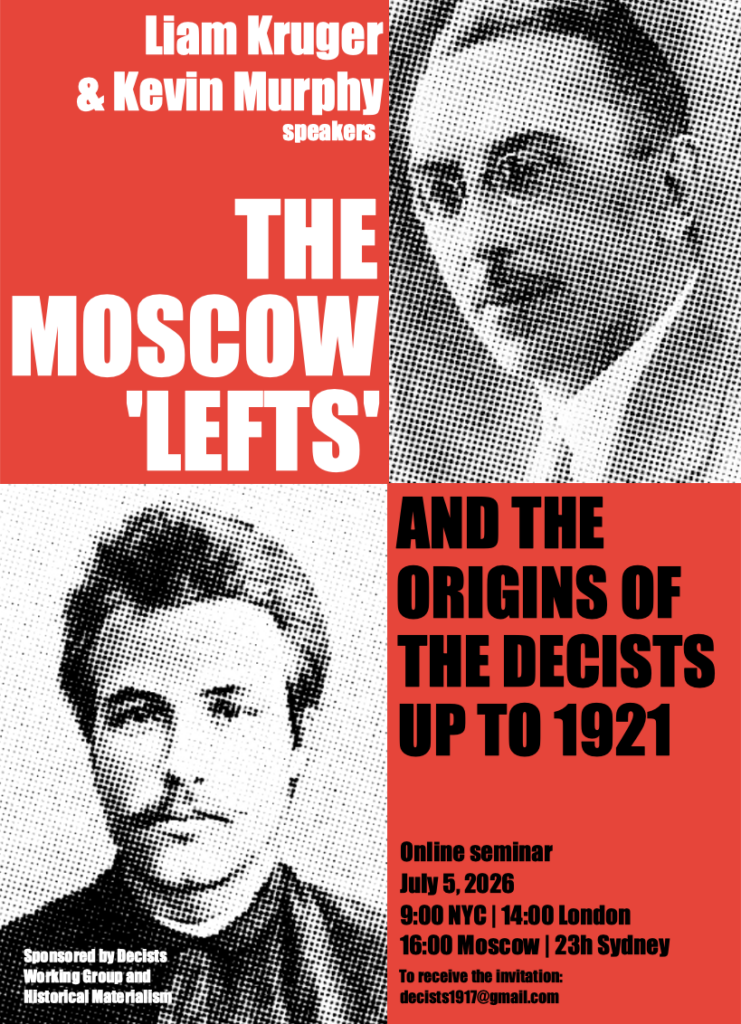
Liam Kruger
In all that has been written about the Russian Revolution and the internal dynamics of the Bolshevik Party, there has yet to be an attempt to detail the origins of the Party’s longest active internal left-wing opposition group; the Democratic Centralists (Decists). What accounts exist in various ways mischaracterize the Decists and fail to capture their political project and answer key historical questions on their origins.
To remedy this gap, I hope to build on the research Kevin Murphy has presented on the Moscow Lefts and Left Communist opposition as precursors to the Decists and construct as clear an outline as possible for how the Decists came to be organized. Through outlining the early history of the Decists, I will also contend with the common mischaracterization of the Decists as merely a group of intellectuals and some poor criticisms of their arguments.
I will begin this essay with a discussion of the purported origin of the Decists as a grouping in early 1919 around the Eighth Party Congress (18-22 March). However, I contend that they were nothing like a cohered faction until the lead up to the Ninth Party Congress which ran from 29th of March to 4th of April 1920. I will then move on to the Tenth Party Congress (8-16 March 1921) as the final struggle of the Decists as a legally recognized faction. In discussing each of these, the arguments the Decists made will be scrutinized, but this is not the place for a full analysis of their diagnoses and proposals. I will then conclude by summarizing and offering a counter-characterization to this period of Decist activity and evaluate their role in the Bolshevik Party from 1919-1921.
1919: Origins of the Decists?
It is often suggested that the Decists began early in 1919. But though figures like Timofey Sapronov, Valerian Osinsky and Vladimir Smirnov were active and had been for some time as Kevin argued, the question of whether the Decists existed at this point is one primarily of political and organizational coherence. If there was a set of ideas which united left-oppositionists into a faction it certainly did not exist by the Eighth Party Congress in March 1919.
The idea that would unite the oppositionists into the Group of Democratic Centralism was that very concept. Going back to 1906, Lenin had stated that “the principle of democratic centralism in the Party is … universally recognized [in the RSDLP]”. The basic principle that Lenin was pointing towards was that the Party needed to have open democratic discussions within it and carry out decisions as one united body. But it was always an inconsistently used term with an interchangeably robust or simple understanding, applying sometimes strictly to a social democratic party or sometimes to indicate a socialist policy towards national minorities or the economy.
The earliest one can reasonably date the origins of the Decists is from a resolution passed by the Moscow Party Conference and supported by the Saratov Party Committee in support of the principle of democratic centralism in early March 1919. These localities were both strongholds of the left as outlined by Kevin on the Moscow lefts, but Sapronov was also active in the Saratov underground and followers of him controlled the local Party organization and Soviet through mid-1919.
But the lack of any organizational or theoretical coherence was shown in the interventions of various oppositionists at the Eighth Congress from the 18th to 22nd of March. Largely, the opposition at the Congress was carried out by Osinsky himself, he spoke far more than the others and was clearly harsher on the state of the Party and Soviets. One historian called Osinsky “Lenin’s most implacable and extremist opponent.” Osinsky argued that Lenin and Sverdlov had substituted themselves for the Central Committee (CC) and so the body had degenerated and the whole party with it. On the relationship of the Party to the masses, he argued that: “The solution of affairs is concentrated in narrow collegia, which, we have to state directly, are largely cut off from the masses. All questions are now decided in the executive bodies, from the very top to the very bottom.” Osinsky opposed the creation of the Politburo, a subgroup within the CC, which he saw as codifying the undemocratic substitutionism that had characterized the way that Lenin and Sverdlov had made decisions in the place of the Soviet Government. Trotsky later remarked that Osinsky was absolutely correct in this assessment – that the Politburo shortly became “the actual governing body of the Party and ipso facto of the Soviet government and the Communist International.”
While Sapronov mostly expressed his agreement with Osinsky, he did show clear disagreement on the proposal of bringing workers onto the CC, and on whether members of the CC should also be officials in the state apparatus. David Priestland went as far as to argue that the “thrust of the institutional reforms proposed by Sapronov and Osinsky contradicted each other”. Smirnov, on the other hand, spoke exclusively on military questions, which his role as leader of the Military Opposition had garnered him enough support to present as a co-rapporteur.
On democratic centralism, it was invoked a few times by oppositionists, but never in a theoretically clarified way. Efim Ignatov, who was politically close to the future Decists, argued that “the centralization of power is necessary, and democratic centralism is necessary, as is proclaimed everywhere and by all. But, comrades, this centralism must be based on the Soviets.” Mark Minkov, a later Decist, argued similarly that: “strict centralization is necessary. But the fact is that there are two kinds of centralism: we stand for democratic centralism, not bureaucratic centralism.” Osinsky developed on democratic centralism quite a bit more, stating that: “We all stand for democratic centralism, but when our comrades begin to put it into practice, they do so in a misguided way: they understand centralism to mean that all issues must be decided at the center, that everything must be dragged to the center.” Rather, Osinsky contended that democratic centralism required a strong degree of autonomy at the local level in carrying out general directives from the center and sought in his theses on soviet construction to specify the limits of the center’s authority and power.
Though the Congress voted against Osinsky’s theses, the oppositionists were given a hearing and had their proposals debated and rejected fairly. Additionally, Osinsky succeeded in defeating Zinoviev’s procedural proposal on the structure of the Congress and was himself elected to a five-person commission to write a proposal based on Zinoviev theses of party question. That’s not to say that there was no hostility – Zinoviev called out five oppositionists (and noted Sapronov as the most serious) who had been active behind the scenes. But these oppositionists were not yet cohered as the Democratic Centralists.
Between the Congresses
Though the Decists had not come into existence by the Eighth Party Congress, there is no definitive point in which they did throughout the rest of 1919 either. Donald Raleigh argued that Saratov’s Democratic Centralists controlled the local Party branch and Soviet by September 1919, but it is unclear whether this is an organized group or merely followers of Sapronov’s approach to the Soviet-Party relationship. There was certainly no public proclamation of a faction, but Sapronov was hard at work amassing supporters in the lead-up to the Eighth Party Conference from 2-4 December 1919.
It is important to note for the significance of the oppositionist’s interventions that the Party conferences and congresses were not equivalent bodies in authority or importance. The Congresses were the yearly meetings which were the highest decision-making body of the Party. Delegates were selected proportionately from all local organizations, determined Party policy and elected the CC. Conferences were more ad-hoc, were called to respond to specific questions or prepare the Party for a particular intervention. They were also smaller and had looser rules on delegation.
The Eighth Party Conference was called to prepare the Bolshevik intervention into the Seventh Congress of Soviets which opened immediately after the Conference closed. It was at this Conference that Sapronov gained the most serious victory for left oppositionists since the stalling of Brest-Litovsk. Thanks to his position as the chairman of the Moscow City Executive Committee, the fact that the Conference was held in Moscow, and surely much dogged argumentation, Sapronov went into the meeting with the support of at least 40 of the 45 delegates. With this, Sapronov was able to defeat the proposal given by a representative of the CC and pass his own resolution which highlighted the “significant structural and operational shortcomings of the Soviet-controlled nationwide governmental system embodied in the first (1918) Soviet constitution.” As well as his resolution which aimed to make the Soviet Central Executive Committee more representative and enshrine greater powers in the local soviets, Sapronov won 5 of the 7 persons on a draft commission which would mandate the Party’s stance at the upcoming Seventh Congress of Soviets.
The Seventh Congress opened on the 5th of December 1919 and ended officially on the 9th. What exactly came of the Congress hasn’t been well understood until recently, with the classic history from Leonard Schapiro being that the Decists resolution won the day on the question of Soviet construction and committed to Soviets to democratic centralism, but that it simply became a dead letter as the Bolshevik leadership never put it into practice. Alexander Rabinowitch’s The Bolsheviks Survive has been essential for demystifying the Congress. He showed how the Bolshevik CC’s Politburo was caught on the backfoot from their defeat at the Eighth Conference and only decided to make Sapronov’s commission non-mandating after the Soviet Congress had already begun. Lenin and Trotsky both intervened to defeat Sapronov’s proposal but failed to sway the delegates. Rabinowitch judged: “As nearly as one can tell, however, Lenin’s speech did not win over his audience. His passionate arguments against constitutional reform were not followed by the explosion of spontaneous applause that his public speeches and comments now regularly commanded.” His proposal was withdrawn and Sapronov’s was adopted by the Congress. However, the Politburo met again on the 9th (final day of the Congress) and was joined by Sapronov and some allies, with the decision made to pass Lenin’s resolution. In the text for the final resolution, which was not available for old historians of the Congress, the signatures for the chair and secretary of the Congress were dated 12th December.
This is certainly bizarre, but the more conspiratorial conclusion that Rabinowitch pointed towards in which a secret session was held to undermine the democratic decision of the Congress seems unlikely to me. Why would they go to the trouble of passing their unpopular resolution only to keep it hidden and effectively ignore what was passed by the Congress in practice? Additionally, the position of Sapronov is curious. It is out of character for him to not fight back, and certainly if he was threatened with some kind of disciplinary measure, it is improbable that it never comes up in his future writings. Rather, Sapronov at the Ninth Party Congress clearly believed that Lenin was forced to retreat at the Soviet Congress. He would continue claiming for the next few months that the Seventh Soviet Congress passed a resolution “entirely opposed by comrades working in the Central Committee” but was unanimously adopted by “our faction”. It’s clear that by the time of the Fourth Ukrainian Party Conference in March 1920 Sapronov wanted to position himself as part of a faction which had existed from at least December of the previous year and in which democratic centralism figured as a major theoretical staple.
The Ukraine Conference
The existence of the Decists as an organized faction is seen concretely in the debates at the Ukraine Conference which ran from March 17-23, 1920. This Conference was given the importance of a Congress and represented the whole Bolshevik Party in Ukraine. Democratic centralism was invoked repeatedly in the discussions, and whether or not they went by the name there was clearly a faction cohered around a set of ideas on economic construction and party democracy who stood in opposition to the party leadership. This Conference, just like the previous Soviet Congress, is rife with historical controversy. It was marred by divisive factional fighting – on many votes the delegates were literally split in two halves – and following the victory of the Decists in elections to the CC of the Ukrainian Party, the All-Russian CC decided to abolish it and appoint a CC themselves. The center of the controversy is the Decists, as they effectively took over and expanded rapidly the Kharkiv Party Organization following Sapronov’s appointment there as chairman of the Kharkiv Provincial Revolutionary Committee in late 1919.
The Kharkiv organization held a ‘party week’ where their membership rapidly grew just a few weeks before the Conference, and so were able to send 64 delegates out of the 240 total. This was combined with Sapronov being sent to Ukraine with a good number of his followers, and finding likeminded comrades in a number of influential Ukrainian Bolsheviks such as Yakov Drobnis, a member of the Ukrainian CC since its founding and chairman of the Poltava Provincial Committee, and Rafail Farbman, who was for all of the preceding year the effective organizational head of the whole Ukraine Party. Just like at the Eighth Party Conference, Sapronov didn’t just have his ideas but a section of the organization behind him.
But the Russian CC had good reason to disband the Decist Ukrainian CC. Along with running the Kharkiv party week so shortly before the Conference – which was explicitly directed against to prevent factional delegate stacking – the Decists won the Conference Presidium and failed to control the meeting. This was a product of the factional atmosphere and numerous interjections, interruptions and name-calling from both sides. The rules of procedure were bent and the Decist dominated Presidium lost the confidence of the delegates and had a vote of no confidence expressed against them by a vote of 100-84. From this point, Stalin was made to chair most of the proceedings. But most significantly, in the elections to the Ukrainian CC, the Decists list won only 112 votes out of 240, with 116 of the remaining delegates actively protesting and refusing to vote, including a few who were included on the Decists’ own list.
Considering the acrimonious nature of the Conference and reasonable questions of legitimacy, it was a fair decision to overwrite the election of the Decists to the CC and appoint a new one. Although Lenin and the Bolshevik CC would not have done so if it were their supporters who won out at the Conference, and despite being indicated to the contrary, no Decist leader was appointed to the new CC. The Decists were also spread out by the CC following the Conference. As for the actual political debates, they overlap considerably with those at the Ninth Party Congress, so I’ll discuss them jointly in the following section, but the Decists’ most significant debate of the Ukraine Congress was on economic policy. On this, Sapronov went head-to-head with Stalin, who represented the Party leadership, and won out, 117-86. The Ukrainian Party was committed to the Decists position that the “guiding principle in the organization of the governing bodies of a socialist republic is collegiality.”
1920: Collegiality vs One Man Management at the Ninth Party Congress
The Ninth Party Congress of the Bolshevik Party was held just a week after the Ukraine Conference, from the 29th of March to the 5th of April 1920. The major question the Congress sought to resolve was on the nature of economic reconstruction following the end of the major period of the Civil War. The CC’s solution to the dire economic situation was embodied in their theses on the militarization of industry. This involved increasing discipline in the factories, making use of bourgeois specialists such as engineers and economists, compulsory direction of labor, and the general replacement of collegial with one-man management. Collegiality was the administration of the state, economy, and military through collegial boards of at least three persons, at minimum they typically involved one bourgeois specialist, one worker, and one political commissar or representative of the Bolshevik Party. Although the boards could be much larger. The CC saw collegiality as too cumbersome with debates getting in the way of the efficient carrying out of business. The Decists led the defense of the collegial principle against the CC.
Though they were not known as the Decists or Group of Democratic Centralism – a factional title which would only come at the Tenth Party Congress – the intervention of Sapronov, Osinsky, and Vladimir Maximovsky marked a significant increase in the coherence and factional identity of the grouping. Robert Service was right to state that “The Democratic Centralist group was not a highly organized faction. It published only a few special pamphlets and held only a few separate meetings before the opening of the Congress“, but the key leaders had jointly signed onto their central “Theses on Collegiality and Unity” which they proposed to amend the CC’s resolution.
The Theses on Collegiality put forth the argument that collegiality was essential for all sorts of issues. It stressed that neither collegiality nor individual management were the sole basis for organizational development. Both had technical benefits, but collegiality had certain socio-political “advantages that make it the fundamental principle of Soviet organizational structure and require its preservation and strengthening”. Through active participation on a collegial board in a state institution, trade union, factory management or whatever else, workers would develop a high level of administrative training and be taught to resolve issues in the interest of the whole. Additionally, collegial boards were claimed to be the best way to make use of the technical skills of bourgeois specialists while keeping them under control. They argued that:
Collegiality, in one form or another, on one scale or another, is the necessary foundation of the system of democratic centralism and the strongest weapon against the revival of departmentalism and the bureaucratic stagnation of the Soviet apparatus. Preserving and strengthening collegiality is the key to success in our economic struggle, which can only be built on a combination of combat techniques and the creative initiative of conscious workers.
The reference to combat techniques was part of the Decists indicating their support for the militarization of industry in theory. Going back to the Ukraine Conference, Sapronov argued that the “militarization of labor is necessary at present, but [they were] opposed to the forms that [were] being applied in practice in the introduction of militarization.” Their approach to specialists was similar:
Collegiality is the very form that prevents people from turning into bureaucrats. Comrades, whether there is a collegium or a single leader, the outcome is determined by consciousness, as our gospel says. Comrades, if a single person is surrounded by specialists—elements far from being proletarian—he will soon turn into a bureaucrat, even if he was and remains a good communist. But if this official is surrounded by a workers’ collegial body, any bureaucratism on his part is reined in as much as possible.
As should be clear, the Decists saw bureaucracy, the use of specialists and militarization as interconnected, and made the case for collegiality as a tool against these dangers throughout the Congress. They argued most significantly in the discussions on the report and activity of the CC, the debate on economic construction, and on party organization.
On the CC, Maximovsky led the charge by directly attacking the leadership for contributing to the bureaucratic degeneration of the Party:
We defend the democratic centralism that is written about in the party charter adopted at the December conference. We defend democratic centralism in the construction of Soviet power organs. … What the Central Committee is guilty of is bureaucratic centralism. That is the essence of the matter; this centralism flourishes here with all its charms. They say that fish stinks from the head down.
The form this bureaucratic degeneration took was a disconnect of the center from the localities, and ‘departmentalism’ – the issue of branches of administration not being connected and rather concerning themselves with their own affairs.
Sapronov targeted Lenin directly, arguing that through over-reliance on appointments, specialists, and centralization, he was laying the basis for a “dictatorship of party officials.” Sapronov and the Decists constantly reiterate that they were not opposed to these on principle, but that their application was stifling democracy within the Party, both because of their form and quantity. Sapronov opined that even Party members were not able to think for themselves:
Then why talk about the dictatorship of the proletariat, about the self-activity of workers—there is no self-activity! You turn even party members into obedient gramophones, who have bosses who order them to go and agitate, but they have no right to elect their own committee, their own body.
In the debate on economic reconstruction, Osinsky began by positioning the Decists as representatives of a “civilian sphere” within the party, while Trotsky came from the military culture. In doing so Osinsky attempted an ecumenical approach where he brought together positive insights from different areas of Party activity and made the specific case that military approaches aren’t always appropriate for the civilian sphere. Though they supported such positive aspects of militarization such as accountability, discipline, and a business-like approach, they were against the “blind imitation of military models.”
In response to the criticism that the arguments for collegiality rested too much on principle and didn’t deal with the problems they were immediately facing, Osinsky pointed out how their theses were explicit about the nature of the period being a transitional one of proletarian dictatorship – they weren’t developing ideas for socialism but for how to protect workers’ democracy from bureaucratization. Osinsky invoked democratic centralism not just as a principle for a socialist organization, but also as state policy. Lenin and Kamenev argued for a particularly strict definition of democratic centralism in which it simply meant that the congress elected a CC which was to govern with absolute authority until the next congress. In contrast, Osinsky developed an understanding in which democratic centralism:
consists in the implementation of the Central Committee’s directives through local organizations, in the independence of the latter, and in their responsibility for specific areas of work. If party work is divided into several branches with special departments, and if these departments are under the general leadership of the local organization, just as Soviet departments are under the authority and leadership of the provincial executive committee, then this is democratic centralism, i.e., the implementation of central decisions through local bodies that are responsible for all specific areas of work at the local level.
In the debate on party organization, Maximovsky presented a resolution which defended democratic centralism further and gave an outline of where the Decists saw the bureaucratization of the Party as stemming from the degenerated Soviets which they were forced to manage. He proposed implementing democratic centralism in order to revitalize the Soviets. This would be accomplished by creating plenums where workers in the provincial areas can meet, enforcing that local issues are dealt with through local committees and avoiding “petty supervision” from higher bodies. Kamenev argued effectively how Maximovsky’s theses were overblown and too prescriptive, and Kamenev’s resolution was adopted by the Congress. Sapronov’s proposal on the report of the CC was also defeated, but Osinsky was successfully voted to join the Congress Presidium (which already included Sapronov) to fully discuss his proposed amendments to the theses on economic reconstruction. He was however unable to prevent the rapid replacement of collegial boards with one-man management within industry which had already been developing rapidly from roughly 11% in 1919 to 69% by March 1920.
Between the Congresses, Again – The Decists in the Trade Union Debate
The period between the Ninth and Tenth Party Congresses has been characterised by Robert Daniels as when “the democratic opposition was at its peak.” That was due to a mood of open discussion and debate in the transition to peacetime development and because the Party centre was confident they could maintain control. At the Ninth Party Conference of 22-25 September 1920, the leadership was able to pass motions in support of the work of the CC despite Decist opposition. Sapronov was also unable to pass a motion at the Moscow Provincial Committee despite having the support of the newly formed Workers’ Opposition. This was another left-wing opposition faction within the Party, but they found their leadership amongst trade-union Bolsheviks and focused their attacks on the overreliance on specialists in the economy.
The situation changed as the trade union debate broke out and schisms in the Party’s top leadership led to a tightening of unity and diminishing the space for other opposition groups. Though initially positioning themselves closely to the Workers’ Opposition in the debate, as they had been making similar arguments for some time, the Decists also sided with Trotsky and Bukharin at one meeting at least, according to the testimony of Alfred Rosmer.
Later in the debate, the Decists put forward their own platform, “About Trade Unions”, published on January 16, 1921. But this didn’t do much more than portend their formal withdrawal from the debate with the publication of “The Immediate Tasks of the Party” on January 22, which laid out their arguments for the Tenth Party Congress.
1921: Tenth Party Congress
The acrimonious nature of the trade union debate combined with the overlapping crises facing the Party and state (the Tambov revolt, strikes in Petrograd, and uprising in Kronstadt) resulted in the Tenth Party Congress being far more tense and hostile than the previous congresses discussed. The Congress ran from March 8-16, 1921, and is often regarded as a turning point in the development of the Bolshevik Party as it passed the ban on factions and introduced the first steps of the NEP. It was also in the lead-up that the Decists presented themselves to the Party as the ‘Group of Democratic Centralism’ for the first time.
Right from the start of the Congress, the Decists were shown less consideration than they were previously afforded, with Sapronov being refused entry into the Congress Presidium despite Drobnis’ pleading that “one of the largest and most influential currents in our party — the ‘Democratic Centralism’ group” must be included in the spirit of party unity. Even a further push from Yevgeni Preobrazhensky that “the unity of the party” depended on the inclusion of a Decist was unsuccessful. Later, Osinsky commented regretfully that the Party had “no camaraderie” and they treated “each other almost as enemies.” The hostility to the Decists peaked in a motion signed by 43 delegates which called for them to be expelled, and that they represented petit-bourgeois elements.
On the debate on party building, the theses declared that building the party was the most important task, but that the Civil War had given rise to bureaucratism in the apparatus and in the leadership. The Decists argued this tendency was intensified rather than combatted by the decisions at the Ninth Congress. Practically, the theses called for depowering the politburos and orgburos, for more Party conferences, and for the CC to make more regular reports and contact with the provincial meetings. It also argued that the CC should only give directives, rather than write full drafts to be adopted by subsidiary bodies, and it defended factional rights and including workers on Party committees.
Maximovsky defended the Decists’ approach which saw a source and solution to bureaucratization in the central leadership of the Party. Largely, their proposals were about the structure and form of the Party apparatus. Maximovsky argued that the unrestricted power of the politburos and orgburos – especially at the top Party leadership – had created a dangerous overlap between the Party and state which infected the highest levels of the Party with the bureaucratic degeneration of the state. He called for their abolition and replacement with executive commissions organized around clearly defined issues. Rafail similarly targeted his proposals to the structure of the party, declaring that workers’ democracy “cannot be implemented among the non-party working masses.” They distinguished themselves from the Workers’ Opposition on these points, and in seeing the source of the crisis in the Party itself rather than its use of specialists.
Though the Party leadership agreed that bureaucratism from the state apparatus was a threat, there was no response to Maximovsky’s argument that this stemmed right from the top of the CC. Bukharin defended the CC on many practical grounds and asserted that it was against democratic centralism to blame them for a general crisis in society. His resolution passed with 369 votes, with 23 going to the Workers’ Opposition and just 9 for the Decists – though Maximovsky was included on the commission to work out a final proposal.
The Decists supported the ban on factions on the basis that there really was a threat to party unity from the petit-bourgeois politics represented by the Workers’ Opposition. They did argue to remove point 4, which was about limiting criticism within Party internal channels, and point 7, which allowed a 2/3 majority of the CC to expel members from the Party, including other members of the CC. They argued that this later point would allow the majority to effectively override the will of the congress which elected the minority and contravene democratic centralism, but they were defeated. However, Kamensky did convince Lenin to remove a paragraph which specifically targeted factionalism in pre-Congress discussions.
Summarizing the Early Decists
Following the Congress and the passing of the ban on factions, the Group of Democratic Centralism ceased to exist. Although many of the individuals rejoin in opposition by 1923, the immediate aftermath diminished any hopes of continuing the faction even if the group had any wish to do so. It was nothing like the repression faced under Stalin and none of the rank-and-file Decists were expelled, but Maximovsky and Sapronov were demoted to minor posts and they lost any control over local committees or papers. And though Osinsky was on the CC, his position was weak and by the 12th Congress he was not even elected as a delegate. A similar situation was imposed on many oppositionists, as Stalin’s emissaries prevented dissidents from being elected as local officials throughout the country.
As for what they accomplished in these three years of activity, they clearly scored some victories but were wholly unable to seriously challenge the direction of the Party or the rise of the bureaucracy within it. Historians have often found recourse in characterizing the Decists as intellectuals in order to explain their failure to seriously challenge the Party leadership. The basic idea that they were intellectuals is so widespread that at the time of writing it figures prominently in their descriptions on Wikipedia and Britannica. Schapiro uses the characterization most stridently, claiming that their intellectual proclivities led them to be appeased by promises in resolutions, and to have no stomach for struggle!
A full refutation of this description is not possible here, but it must suffice to say that the leadership of the Decists can in no way be so simply characterized. Smirnov and Osinsky surely came from intellectual, student backgrounds, but as Schapiro himself stated, the Decists “voiced the views of the restive local party and soviet organizations.” They found their origins in the Moscow Provincial Committee and were most supported by local leaders in Ukraine and Saratov. Their views were not informed by an intellectual background or perspective, but as members of the old guard of the Bolshevik Party who were won to the Party on lofty Marxist ideals. Sapronov and Smirnov were “heroes of the Moscow insurrection”, and an analysis of where each Decist was elected from, their class position before joining the Party and their role within it would confirm this characterization.
Yet unlike the top central leadership who were forced to mediate their politics through the challenges of holding onto state power, the Decists represented a more consistently left-wing and radical arm of the Party. This is part of what can be understood in Osinsky’s argument that the Decists represented the ‘civilian’ sphere compared to Trotsky and the CC representing the ‘military’. The provincial level Bolshevik leaders were not as enmeshed in the state apparatus as those at the center.
This also addresses another misunderstanding of the Decists which is used to explain their ineffectiveness; that they weren’t willing to go against the Party. Schapiro pointed out that the Decists were not “an opposition in any real sense of the term. They had no separate organization, no fixed membership, no press or publications of their own, and no platform or policy as an alternative to the official communist programme.” They have been criticized for not challenging the rule of the Party, being a mere “disparate group”, and only offering surface level structural reforms. To understand the early Decists one must understand that they were Marxists and Bolsheviks concerned with holding on to the dictatorship of the working class until international revolutions saved Russia from its isolation and the basis for socialism could be built. Their political project was not about democracy for the sake of it, but about arguing a different orientation to the only organization which was interested in holding on to the gains of the revolution. They were never going to organize against the Party in this period, and it would have been wrong to do so.
To conclude, the early Decists developed out of the previous left-wing currents and opposition groups of the Bolshevik Party. They represented, not an intellectual current, but one of the middle-rank leadership of Party old-guard and cadre who remained principally committed to Marxist politics. That is not to say that the Decists didn’t show flexibility in their proposals, but that they consistently fought to shift the emphasis of the Party and Soviet state towards democracy and local autonomy and to provide a left-wing counterbalance to what they saw as the self-undermining policies pursued by the Party leadership.
Their assessment of the period as one of proletarian dictatorship where the major question was of holding on to power and not of socialist construction was sober-minded and orthodoxly Marxist. Additionally, their diagnosis of the source of the degeneration of the Party and the corresponding rise in bureaucratic tendencies was fundamentally correct. They recognized the deep hollowing out of the working class following the Civil War and the subsequent necessity for bureaucratic control of the Soviet state. I think it is fair to find some fault in their emphasis that this bureaucratization infected the Party from the top-down. Though, the argument that therefore the top of the Party needed to be structurally reformed and its relationship with the state scrutinized was useful in that it recognized that the Party itself was the only subjective force in this period that could maintain a consistently revolutionary perspective, and that the top of the Party as the most theoretically developed and committed Marxists were the best hope.
Democratic centralism clearly played a key role in theoretically cohering the Decists and their proposals and interventions imbued the concept with much more depth than it is usually afforded. In their conception, there was an important dynamic in the relationship between a strong, unified, and democratically elected center and localities which have defined and important areas of responsibility, sufficient autonomy and are places to develop the self-activity of the working masses. Their constant emphasis that the Party and Soviet state were not living up to the accepted principle of democratic centralism was an important intervention, but it’s unclear how their concrete proposals could have fundamentally altered this situation.
Collegiality was surely a formal structure more conducive to granting workers a greater degree of control over their workplaces than one-man management. Additionally, the practical arguments that the form would better allow the disciplining of bourgeois specialists and allowing various kinds of expertise to come to the fore are compelling. But in a situation of generalized de-politicization and industrial decline it seems that collegiality would do little more than develop a small layer of ex-worker managers rather than empower the whole class to take control of society. It is surely true that one-man management helped lay the basis for the defeat of workers self-management, the bureaucratic degeneration of the state and eventually the rise of state capitalism. But it was exactly the kind of retreat almost necessitated by the devastation the working class suffered through the Civil War.
The Decists theses on party building for the Tenth Congress could have played some role in holding back the rise of the bureaucracy and Stalin, but without the revolution spreading internationally the workers’ state in Russia was doomed. The early Decists therefore do not show a potential alternative path for the development of the revolution, instead they represented a tendency within the Bolshevik Party less encumbered by the responsibility of running an increasingly degenerated workers’ state than the central leadership, but just as committed to the leading role of the Party in holding on to the dictatorship of the proletariat.