Kevin Murphy
Text available in English and in Chinese
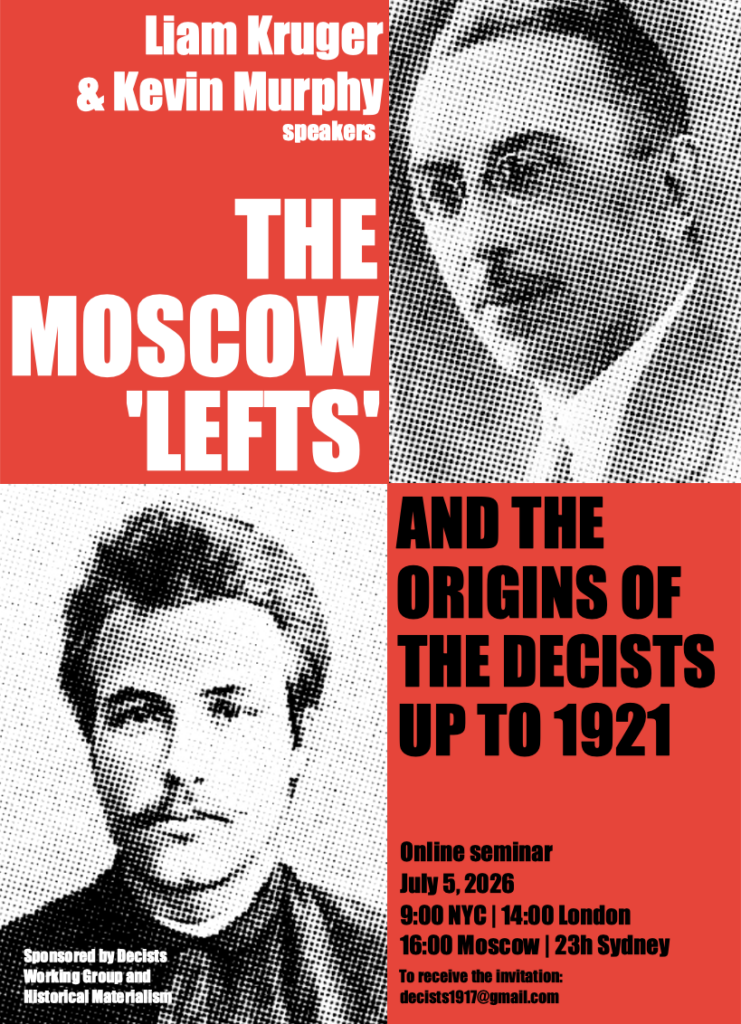
Over some twenty minutes, I will attempt to explain the origins of the Moscow Left Bolsheviks among both young workers and students before 1917 and their extreme radical positions and collaboration with Lenin during the 1917 revolution when they fought for Soviet power. I will also examine their activity as part of the Left Communist opposition of 1918, by far the largest opposition movement in the history of the Soviet Union.
To be clear, I am not suggesting some sort of linear progression of these ‘precursors’ to the Decist opposition. While some of the Left activists from 1905 to 1917 did support the Left Communist communists in 1918, and later went on to support the Decists in 1919, many did not. Moreover the issues involved changed significantly under very different circumstances. Nevertheless, I believe that we can discern certain radical themes that persisted over time. So hopefully we can take up these issues in the discussion.
Additionally, this brief overview of the Decists precursors is somewhat superficial, almost by definition. Several texts for this essay are available in the links below and I would encourage everyone to think about the many fascinating issues. Two of these topics, the later Decists participation during the 1917 revolution and the Left Communists of 1918 both warrant more detailed seminars on their own.
The first chapter in Stephen Cohen’s biography of Nikolai Bukharin is very useful for understanding the formation of Moscow leftists who were centered at Moscow State University. During the 1905 Revolution, Buknarin’s comrades viewed him as the most talented of the Moscow group that including later Decists Valerian Osinsky and Vladimir Smirnov and other future prominent Bolsheviks such as Georgii Lomov, Varvara Yakovleva and Dmitry Bogolepov. All played significant roles in the student movement during the first revolution, were ardent advocates for Soviet power in 1917 and supported the Left Communist opposition in 1918. Bukharin and Osinsky organized the first student rally in 1906 at Moscow State University and then helped build the first city-wide student organization. In 1907, the group also organized the first congress of Russian social democratic student groups, later recognized as the forerunner of the Komsomol.
According to Cohen, Bukharin’s friendship with Osinsky and Smirnov proved to be “particularly important.” All three teenagers studied economics and became well-known as leaders of “raids” against liberal professors at Moscow State University, challenging their arguments and encouraging others to use lecture halls to agitate for wider social causes.
Working class militants were also part of this extreme left in Moscow. The Bolshevik organization in Moscow had to circumvent the notorious Okhrana (secret police) who were particularly strong in the city. Timofei Sapronov was among the talented organizers and a future Decist leader, who worked for the construction workers union and as a Bolshevik revolutionary. Sapronov’s From the History of the Workers’ Movement (1925) described how provocateurs repeatedly thwarted Moscow Bolshevik efforts to organize in Moscow. One especially talented police agent, commented Sapronov, meant that “the entire Moscow organization was in his hands and through him, in the hands of the Okhrana.” In the aftermath of the defeat of the 1905
revolution, workers’ militancy waned until the ghastly Tsarist massacre of over two hundred striking workers in the Lena Goldfields reignited the movement in April 1912. Sapronov vividly described the profound shift in construction workers attitudes after the massacre:
On the morning of that memorable spring day, when news of the Lena execution arrived, everything was calm. But then lunchtime came, and the workers gathered in a dingy tavern…Suddenly, a powerful cry burst through the window: “We’ll load the cartridges ourselves, screw bayonets onto our rifles…”A moment of bewilderment… Shouts of “Strike!”—and everyone rushes to the windows. Demonstrators are marching down the street, singing a revolutionary battle song. A flustered policeman tries, not quite to stop them, not quite to disperse the demonstrators, but they seem not to notice him, continuing on their way, and their battle song grows louder and more confident. The policeman blows his whistle, but it is drowned out by the song. The workers’ demonstration has disappeared around the corner; it’s no longer visible, but the sounds of a battle song drift through the tavern’s open windows. Inside the tavern, there are shouts, noise, and arguments again…the mood is combative, and the workers disperse with the feeling that something is in the air—that just as spring arrives in nature, so too is spring arriving in the labor movement.
And indeed, from this day on, something new begins. From this day on, the working class’s struggle against capital intensifies. On this very day and for a whole series of days thereafter, a broad wave of political protest strikes by Russian workers sweeps through the country. The bourgeois newspapers do not write about this, but you can’t hide a needle in a haystack. Workers pass the news from mouth to mouth: daily updates. Today one factory went on strike, tomorrow another, the day after tomorrow a third. Workers in Moscow, St. Petersburg, Riga, and other cities are striking.
Some 70,000 Moscow workers struck in support of the Lena workers and would repeatedly do so thirty times over the next four years during the most sustained political strike movement in world history. What is remarkable about this movement, as detailed Okhrana reports indicate, was that the Bolshevik activists not only were the primary catalysts of this movement but that the Okhrana knew exactly who the main organizers were in their repeated arrest sweeps after each strike. From the Lena massacre in 1912 till July 1914, almost all socialists cooperated in this movement. But with the war in August 1914, Moscow Bolsheviks had to go it alone as both the Mensheviks and Socialist Revolutionaries largely refrained from political strikes, submitting to nationalist sentiments as they would again in 1917.
In addition to mass arrests and exile, the Okhrana employed another strategy against the Bolshevik activists. The attempt to form a Moscow committee failed “due to various mobilizations, the group’s activities slowed down and eventually ceased altogether” wrote Sapronov. During the first year of the war, “it was difficult to carry out any kind of extensive work, not only because the reaction was raging, but mainly because no sooner had a new group been organized than a new mobilization was announced, and most of the group—and sometimes the entire group—had to go to the front.”
Two issues about 1917 Bolshevik policies need clarification for us to make sense of the political alliance between Lenin’s advocates for Soviet power in Petrograd and the Moscow Lefts.
The first is well-known to those who have read Lenin–he changed his analysis of the revolution. As he wrote in 1918, “Yes, our revolution is a bourgeois revolution…we have said it hundreds and thousands of times since 1905…Beginning with April 1917… we publicly declared and explained to the people: the revolution cannot now stop at this stage.” The capitalist economic catastrophe had reached “fantastic dimensions, which… will demand steps forward, to socialism.” Lenin’s 1917 position was largely consistent with Trotsky’s Permanent Revolution that also argued there was no half-way house during the revolution and that Russia was part of the European crisis of capitalism.
The second important factor was Lenin’s newfound agreement with Bukharin’s maximalist position on the “destruction of the bourgeois state.” Lenin had started his study of Marx and Engels on the Paris Commune in Zurich, telling Kamenev on July 5th, “if they do me in, I ask you to publish my notebooks” and then finished when he went underground. The state, as an instrument of class rule, used violence and its institutions to suppress other classes and could not simply be taken over by a workers’ government. His arguments in State and Revolution guided his actions in 1917 and helped revive the anti-statist method of Marx and Engels. Upon returning to Russia, Lenin acknowledged that his reversal was directly influenced by Bukharin and it would shape his reliance on the Moscow Lefts aligned around him.
Cohen contends that Lenin looked to the Moscow Lefts as a counterbalance to the older Moscow right Bolsheviks, much in the same way that his collaboration and eventual unity with Trotsky’s Interdistrict Organization had helped overcome the Bolshevik Petrograd rightists who also had repeatedly sought compromise with the Mensheviks. The younger generation, wrote Osinsky, had led the Moscow struggle for Soviet power “against significant resistance by a large part of the older generation of Moscow officials.” Bukharin was the most prominent of these Moscow revolutionaries, though future Decists leaders, including Sapronov, Osinsky, Smirnov and Central Committee member Andrei Bubnov played significant roles.
Timofei Sapronov, the thirty year-old Bolshevik leader, is featured prominently in Eduard Dune’s Notes of a Red Guard chapter on the revolutionary year as a young Leninist, as was Dune, a worker in the Providnik factory in the Moscow suburb of Tushino. In May, Sapronov spoke to a general meeting of Provodnik workers about Lenin’s April Thesis for Soviet power, According to Dune, Sapronov “spoke in words all those attending could understand.” Quoting Lenin, Sapronov asked if workers needed a government “composed of representatives of the bourgeoisie and former tsarist officials or should transfer power to representatives of the working class, the Soviet?” Sapronov argued that workers’ control within Provonik proved the legitimacy of socialism. Workers earned as much as much in an eight-hour day as they had previously under the twelve-hour day, even without the Tsar and police order had improved during the Revolution, as there was no theft, drunkenness or hooliganism. ”If we could organize a revolutionary government in one factory, then why could we not create a similar order across all of Russia?”
A talented organizer and prolific recruiter, Sapronov supplied Dune with banned Marxist literature and anti-war pamphlets, gradually integrating him into the illegal factory committee that he then joined as a seventeen year-old in March 1917. According to Dune, the Mensheviks in Povodnik stagnated, with “the same hundred members that had in earlier months” while the Bolshevik flourished, ballooning to “about a thousand members in our factory, i.e. one-fifth of the total work force.” Moscow Bolsheviks put forward other resolutions of workers control from below to deal with the worsening economic catastrophe. For example, to end the three-month strike of leather workers in October, Victor Serge wrote, the Bolshevik-dominated Soviet (since September
5) told the workers to start running the factories themselves.
The generational and political divisions weakened the Moscow party organization. The leftists controlled the Moscow region organization (encompassing 37% of the country’s population according to Cohen) but continuously spared with the rightest Moscow City party leadership. In early summer, the Lefts managed to dislodge four rightist editors from the Moscow the party daily newspaper Sotsial Democrat and then the Moscow theoretical journal Spartak, replacing them with an editorial board troika of Bukharin, Osinsky and Smirnov. The left control of these publications helped radicalize Bolshevik policy during Moscow’s October days.
After Kornilov’s attempted military coup, the Moscow Lefts supported the call for Soviet power. Dune wrote that he then viewed Lenin’s April Thesis argument for Soviet power in a new light. Quoting from Lenin’s September Impending Catastrophe and How to Combat it”, Dune wrote that workers grasped Lenin’s contrasting choice “the dictatorship of the Kornilovists or the dictatorship of the proletariat” which “spoke to us more than high flown phrases.” A resolution by Osinsky, Smirnov and Smeshko in support of the Soviet seizure of power passed unanimously in a city-wide Bolshevik meeting. Although the Bolshevik Moscow Committee supported the October insurrection, the rightists leaders only did so half-heartedly because of overwhelming rank-and-file pressure rather than ideological agreement for the Soviets to take power.
Apparently unaware of the continued Bolshevik rightist strength in Moscow, Lenin on October 1 (14) proposed to the Moscow and Petrograd party committees and Soviet representatives that “It is not necessary to “begin” with Petrograd. If Moscow “begins” without any blood being shed, it will certainly be supported…” Dune wrote that Sapronov gave a detailed report that encouraged Moscow members to discuss whether they should take the initiative for Soviet power, but also mentioned that there were differences in the Central Committee. “Our resolution expressed our readiness to act on behalf of Soviet power and also the urgent necessity of arming the Red Guards…” Cohen points out that the Lefts pushed for Moscow regional (Oblast) party control over the right dominated Moscow city organization. Dune remarked that, “It was necessary to bind together all branches in the Moscow oblast’, particularly those that were close to the city and that could offer it genuine help.” When the battle of Moscow began, Sapronov and Dune went to the reserve regiment in Pavlov who were reluctant to hand over rifles without orders for fear of being court-martialed. Sapronov replied that the officers who were shooting at unarmed workers were not stopping to ask whether their action was lawful, then stated, “I order you in the name of the Military Revolutionary Committee to arm all those who volunteer to fight for the revolution. If you need a piece of paper, I’ll sign it!”
Yet the indecisiveness of Moscow Committee rightists Viktor Nogin and Alexei Rykov would prove costly in the week-long battle that killed over a thousand. Although far outnumbering the forces of the counterrevolutionary Committee of Public Safety (50,000 to 10,000 according to Nikolai Muralov of the Military Revolutionary Committee) Serge comments that, “the faulty organization and the hesitations of the Red side kept the outcome of the struggle uncertain.” While the Right SRs helped ensure that the Committee for Public Safety was well-armed and prepared, the MRC was only formed on October 25. The Bolsheviks allowed the thoroughly discredited Mensheviks (only 2.44 percent in Moscow elections a few weeks later) onto the MRC where they openly undermined efforts for Soviet power. Rykov of the Moscow Committee even advocated negotiations with Right SR Colonel Ryabtsev, whose forces executed unarmed workers in the Kremlin. Ultimately, the Moscow Lefts were able to overcome the machinations of the Bolshevik
rightists. Dune recounts Smirnov’s crucial role in defeating the counter-revolutionary forces entrenched in the Kremlin. Smirnov “persuaded and organized artillery soldiers” to fire on them, liberating the “Moscow Soviet from blockade.”
Victor Serge’s description on The Start of the White Terror quotes one of survivors of the grisly White massacre in the Kremlin: “The men still cannot believe that they are going to be shot like this, without trial…At a signal, the din of the three machine-guns blends with cries of terror, sobs and death-rattles.” The massacre was “not an isolated act” , wrote Serge. “Practically everywhere the Whites conducted arrests followed by executions.” As Serge wrote, the truce agreement allowed the “Kremlin butchers” to be freed. These tragic events are invariably deleted from liberal academic accounts of Moscow’s October Revolution (see the Koenker and Smith commentary in Notes of a Red Guard).
The Chairman of the Moscow Soviet and right Bolshevik leader Nogin travelled to Petrograd to try to convince Lenin to soften his stance against the Mensheviks and Right SRs, then, along with Rykov, resigned in protest from the Council of People’s Commissars. In his Ten Days That Shook The World, John Reed described Moscow workers’ attitude toward Nogin afterward in a city-wide Bolshevik meeting:
At first the place was filled with the intellectuals—those who lived near the center of the town. Nogin spoke, and most of his listeners were plainly with him. It was very late before the workers arrived; the working-class quarters were on the outskirts of the town, and no street-cars were running. But about midnight they began to clump up the stairs, in groups of ten or twenty—big, rough men, in coarse clothes, fresh from the battle-line, where they had fought like devils for a week, seeing their comrades fall all about them. Scarcely had the meeting formally opened before Nogin was assailed with a tempest of jeers and angry shouts. In vain he tried to argue, to explain; they would not listen. He had left the Council of People’s Commissars; he had deserted his post while the battle was raging. As for the bourgeois press, here in Moscow there was no more bourgeois press; even the City Duma had been dissolved. Bukharin stood up, savage, logical, with a voice which plunged and struck, plunged and struck… Him they listened to with shining eyes. Resolution, to support the action of the Council of People’s Commissars, passed by overwhelming majority. So spoke Moscow…
The Left Communism opposition of early 1918 was undoubtedly the largest and most powerful opposition in the history of the Soviet Union. At first, the contested issues centered around peace with Germany and the Central Powers. On October 26, 1917 the new Soviet government issued a decree on peace “without the seizure of foreign territory or foreign nationalities, and without reparations” that called upon all belligerent peoples and their governments to start immediate negotiations for a just, democratic peace.” Of course this declaration could only have validity if both sides agreed. On December 2, 1917, negotiations began in Brest-Litovsky, Belarus with Germany, Austria-Hungary, and the Ottoman Empire.
During the course of negotiations, three different Soviet positions emerged and each would briefly dominate: Lenin’s position which was for peace at any price, because the collapsing and exhausted Russian army was incapable of fighting. The Russian people demanded peace, bread, and land; failing to deliver peace would trigger the immediate collapse of Bolshevik power. The Left
Communists called for a revolutionary war and no negotiations with imperialism that partisan war was needed a revolution would spread. Trotsky’s third position was for neither peace/nor war, stalling in negotiations in the hope that Central powers soldiers would refused to fight and even mutiny. In January, the Bolshevik Central Committee decided to allow Trotsky ‘do everything to drag out the signing of a peace’.
While nine signatories of the 1927 Decist Platform of 15 were active supporters of the Left CommunistsI (V. Emelyanov, T. Sapronov, M.N. Mino, V.M. Smirnov, V.P. Oborin, S. Shreiber, F.I. Pilipenko, E. Dune and A.L. Slidovker), Valerian Osinsky was one of its central leaders. On December 28th, Osinsky and two other comrades (A. Lomov and I. Stukov) put forward a resolution in the Moscow Regional Bureau demanding an end to negotiations and a complete break with imperialist ‘robber’ states, arguing for “revolutionary war.” This meeting marked the formation of the Left Communists as a faction with Osinsky arguing that he was defending “Lenin’s old position.” Support for the Left spread so rapidly, especially among urban working class members, that when the Central Committee and local party leaders convened before of the Third Congress of Soviets (January 8th) Osinsky’s and Yevgeni Preobrazhensky’s resolution for revolutionary war gained a majority with 33 votes. Combined with Left Socialist Revolutionaries support, the revolutionary war position briefly dominated local soviets. Lenin conceded that in response to a Central Executive Committee circular to weigh popular support for the different positions, a small majority, 105 to 95, supported the revolutionary war position. Left support was so strong that the Petersburg Committee briefly published a daily newspaper ‘Kommunist’ to mobilise popular support and, according to one account, blocked ‘Leninists’ from appealing to the rank-and-file members. Even after support for the left’s waned in April and May, the Moscow party region continued to publish a journal, also called Kommunist, edited by Bukharin, Kar Radek, Osinsky, and another future Decist leader, Smirnov.
The demise of Left Communism, as Ronald Kowalski describes, was directly related to the German offensive from February 18 to March 3. To put it simply, there was an enormous discrepancy between the revolutionary war resolutions of the left passed overwhelmingly in many factories and the willingness of Russian forces to fight. One German soldier described the absence of even combat in his diary. “It is the most commercial war I have ever known. We put a handful of infantrymen with a machine gun and a gun onto a train and rush them off to the next station; they take it; make prisoners of the Bolsheviks, and then pick up a few more troops and so on.” Lenin’s assessment of war weariness to stop the German war machine was clearly more accurate than the Left Communists.
If the early 1918 party dispute was just about the willingness of Russians to fight, there wouldn’t be much to discuss. In fact, the party discussion extended far beyond the immediate military capability of the fledgling Soviet regime. These included sharp discussions on imperialism and workers’ control. On both of these issues, Lenin backtracked from his earlier more radical positions.
Lenin’s more extreme earlier positions applied to his analysis of imperialism and the revolutionary process. Whereas in early 1916 he had argued that, “Revolution is not a single act, it is not one battle on one front, but a whole epoch of acute class conflicts, a long series of battles on all fronts.” By the summer of 1917, he came to assert more categorically that state capitalism, the most advanced form of finance capitalism, did exist in Russia and argued, in a manner similar to Rudolph Hilferding and the Left, that despite
the continuing widespread existence of a small-scale economy ‘finance capital ruled the country, primarily through banks and syndicates’. Mass arrests of party leaders in Italy, and mutinies in the German army led Lenin to argue “that a great turning-point is at hand, that we are on the eve of a world-wide revolution.” By September, when he argued much more forcefully for Soviet power, he argued that the imperialist war and “state monopoly capitalism” had prepared the material conditions for socialism. No longer did Lenin talk of an entire epoch, but of socialism on the immediate agenda, as the last “rung on the ladder of history”.
With the worsening economic catastrophe in Russia in early 1918 and the obvious weakness of the Soviets forces against the German military juggernaut, Lenin’s position became more pessimistic on the immediate prospects of European revolution. Shortly after the Brest-Litovsk Treaty in March 1918, Lenin began to question just how far state capitalism had developed in Russia. It was the Germans, he now argued, “who possessed discipline, organisation, and harmonious cooperation on the basis of modern machine industry, and strict accounting and control…And that is just what we are lacking.” By May, he conceded that revolution might come “immeasurably slower pace than we expect…It may begin with a brilliant success in one country and then go through agonising periods…”
So why did Lenin temporarily flip his assessment of imperialism and the possibility of a rapid advance of the socialist movement in 1917? Kowalsky contends that Lenin had earlier exaggerated the extent to which finance capital had advanced in Russia itself. Caught up by the euphoria surrounding the collapse of the autocracy, Lenin overstated the feasibility of the Russian revolution propelling the revolutionary movement rapidly throughout Europe.
The most fascinating position of the Left Communists was on the issue of workers’ control of the factories. Unlike the other issues in which Bukharin was the clear spokesperson, Osinsky was the most outspoken advocate for workers’ control. The epicenter of the workers’ control movement was Petrograd and I would encourage everyone to read the worker’s control chapters in Stephen Smith’s Red Petrograd and also Kowalki’s Organization of Industry chapter in The Bolshevik Party in Conflict.
The workers’ control movement was rooted in the workers’ revolutionary actions against their employers. While no simple definition of worker’s control is satisfactory, the variety of issues illustrates that movement went far beyond the confines of wages and normal industrial relations. These included efforts by workers taking over administrative tasks to keep factories running, appealing to other factories or the Soviet for raw materials and fuel, combatting employer sabotage, auditing corporate finances, control over hiring and firing, setting work norms and more.
Although the Bolsheviks supported this movement, prior to October, both sides of the early 1918 dispute agreed that the party had no clear position. As Osinsky put it, “But if we ask ourselves how, in the period before 25 October, we as a party envisaged the system of workers’ control… then we shall find no clear answer anywhere.” Lenin also stated that prior to Soviet power, there could not have been “a definite plan for the organisation of economic life.”
The November 14 (27) Decree on Workers’ Control, largely written by Lenin, legitimized what many workers in the city of Petrograd city had already accomplished during the revolution. The Decree introduced workers’ control in “all industrial, commercial, agricultural enterprises” and through their elected representatives would have “the right to supervise production, fix the
minimum of output, and determine the cost of production.” The decree also surely encouraged the movement. Outside of the city, in Petrograd province factory committees set up control commissions in 212 factories to oversee and intervene in the running of factories, 76% of these commissions were set up after October. Smith contends that Lenin’s decree “reflected his faith in the creativity of the masses” that would persist for the first three months of Soviet power.
By early 1918, however, the economic crisis that started in 1916 had deteriorated into a catastrophe, with workers fleeing Petrograd, factories laying off workers or closing and the real threat of famine, plus ensuing fear and panic of German occupation. Almost half of Petrograd’s workforce was unemployed due to critical shortages of fuel and raw materials. Smith describes that in late January the bread ration was reduced to 150 grams per day in late January and to just 50 grams (2 ounces) a month later. Hunger and unemployment led to mass de-urbanization as Petrograd’s population dropped from approximately 2.4 million in 1917 to about 1.5 million by mid-1918, and eventually fell to around half a million in 1919. Obviously, these were not the optimal conditions for building socialism.
Despite the economic calamity, it would be incorrect to situate the discussions in the context of the Civil War. In fact both sides, Lenin and the Communist Opposition, framed the context of the Civil War in the past tense, that the immediate danger had passed. In February and March 1918 Lenin had repeatedly referenced “the triumphal march” of Soviet power to refer to the many overwhelming victories over counter-revolutionary forces in Russia. When Lenin spoke to the Moscow Soviet on April 23, he once again warned of the external threat from Western imperialism, which “we do not have sufficient forces for an active, armed struggle against…” Yet the immediate internal threat had passed with the death of Kornilov on April 13, as he asserted that “We can say with confidence that in the main the civil war is at an end.” This was also the position of the Left Communists. As Osinsky wrote in his On the Construction of Socialism, “the hard times when the armed forces of the bourgeoisie (the White Guards, the supporters of Kaledin and others) were crushed, has come to an end.” As we now know, the imperialist stage of the Civil War–including massive U.S., British and French (December 1917) and German (February 1918) funding for the Whites had already begun and military intervention (Murmansk, March 1918) was just beginning.
The dire economic calamity surely influenced Lenin’s reversal on workers’ control that he discussed in military metaphors as “a temporary and partial retreat” to the class enemy in his The Soviets at Work. The stark measures included one-man management, piece rate production, the use of the Taylor-system time and motion studies and bonus wage rates to bourgeois managers and specialists. Lenin also proposed a system of “State Capitalism,” where major industries, banks, and transport remained in private hands but under strict state oversight. Underpinning his analysis was the belief that state capitalism was necessary because it was “immeasurably superior to our present economic system” and justified the measures because “the Soviet state is a state in which the power of the workers and the poor is assured.”
The Left Communists were not opposed to employing the existing technical personnel (spetsy) but rather focused on who would oversee them. They argued that specialists’ previous and often tacit supervisory powers should be delegated to local rather than centralized organizations: factory workers’ control, factory committees and trade unions. The Lefts were much more intransigent in their opposition to the “captains of industry” to help run the shattered economy. Kowalski states that the Left’s position echoed the fears of many rank-and-file workers. Osinsky argued that the “captains of industry” were so imbued with values of capitalism that, “the
danger exists that our ‘teachers’ will not help us to build socialism, but, on the sly, they will create a real capitalist trust, they will conduct their own class policy.”
The Left Communists challenged this and other other aspects of Lenin’s new policy against workers’ control which also gained considerable rank-and-file support. For example, at the First Regional Congress of metal workers, held in Moscow on 19 to 22 April, a clear majority rejected any compromise with the “captains of industry” and opposed both piece rates and the Taylor system. Instead, it demanded the rapid nationalisation of industry which would lay the foundations for the construction of socialism. Two months later, Lenin dropped his conception of private capitalist ownership under strict Soviet control. The nationalization of large-scale industry was issued by the Council of People’s Commissars (Sovnarkom) and signed by Vladimir Lenin. This decree formally transferred all major industrial, mining, and transport enterprises into state ownership to establish a centralized planned economy.
Kowaliski posits that the Left Communists sought an industrial system of a “genuine democratic centralist system”, which would combine workers’ management at the factory level with central planning of the economy at the national-level. Osinski’s articles in Kommunist and speeches at the Congress of Economic Council formed the basis for his essay On the Construction of Socialism. While almost all Bolsheviks agreed that central planning was necessary for the socialist economy, the self-activity of workers at the grass roots was not considered an optional extra. Large enterprises were to be run by boards (kollegii), two thirds of which was to be elected by the workers themselves though, to avoid parochialism, not composed of a majority of workers employed in the factory. Osinsky 1918 essay was arguably the most enduring contribution of the Left Communists and would influence future Decists thinking on workers’ self-emancipation. For Osinsky and the Left Communists, workers’ participatory actions were not an optional extra that were safeguarded by Soviet power, but central to their vision of socialism and the self-emancipation of the working class:
We stand for the construction of proletarian society by the class creativity
[samodeiatel’nost) of the workers themselves, not by orders from on high issued by the ‘captains of industry’ … We proceed from faith in the class conscious-ness, in the active class initiative, of the proletariat. It cannot be otherwise. If the proletariat does not know how to create the necessary preconditions for the socialist organisation of production, then no one can do this for it nor compel it to do this … Socialism, and the socialist organisation of production, must be constructed by the proletariat itself, or not at all, and something else will be constructed – state capitalism.
Osinsky is not arguing here about state capitalism in Lenin’s sense, under the control of the Soviet state. Rather, he was arguing that this form of state capitalism–without the active participation of workers–had nothing to do with socialism. Years later, this would be the conclusion that the Decists themselves would draw.
Three quick general comments on the experience of the Moscow Lefts influence on the Decists:
First, the Moscow Lefts were repeatedly on the extreme left of the Bolsheviks on almost every issue. Their positions often placed them in alliance with Lenin against the right Bolsheviks who pandered to anti-Soviet, pro-capitalist ‘socialists’. Moreover, these positions were not
momentary leftist tub thumping but rooted in principle–as their 1918 confrontation with Lenin over workers’ control proved. Indeed, this radicalism would endure for two decades until Stalin’s executions in 1937.
Second, the workers’ control movement of the Russian Revolution undoubtedly contributed to the policies of the Decists. Even the fairly modest form of workers’ control by Provodnik factory workers that Dune and Sapronov described, linked the self-activity of workers in one factory to their conception of socialism. These ideas were rooted in Marx and Engels: ‘the emancipation of the working class must be the act of the working class itself.” Similarly, the absence of such self-activity, as Osinsky’s formulation argued–addressed the larger substitution problem of the Russian Revolution. If a social force other than the working class is in charge and is the prime mover of social change, such a regime has nothing to do with socialism. We can see this repeatedly in the later documents of the Decists.
Third, the question on the origins of the Decists 1929 state capitalist analysis came up recently at one of our seminars. This question can be somewhat answered by looking at the arguments of prominent Left Communists, particularly Bukharin and Osinsky on state capitalism. The nine signers of the Decists June 1927 Platform of Fifteen who were also supporters of the Left Communists were surely aware of their analysis. The transition from their earlier theoretical analysis of state capitalism, influenced by Friedrich Engels (Anti-Duhring), Rudolph Hilferding (Finance Capital) and Nikolai Bukharin (Imperialism and World Economy) as applied to an exploitative class analysis of the Stalinism within the world capitalist system was a quite logical transition.
Further Reading
Bukharin and the Bolshevik Revolution Stephen Cohen
Chapter 1.The Making of an Old Bolshevik and
Chapter 2.The Triumph of Radicalism in 1917
Bukharin and the Bolshevik Revolution : a political biography, 1888-1938 : Cohen, Stephen F : Free Download, Borrow, and Streaming : Internet Archive
Year One of the Russian Revolution Victor Serge
On Moscow’s October:
https://www.marxists.org/archive/serge/1930/year-one/ch02.htm
Notes of a Red Guard Eduard Dune (Decist)
1917 in Moscow, chapters 2 and 3:
https://files.libcom.org/files/notes_of_a_red_guard.pdf
The Bolshevik Party in Conflict: The Left Communist Opposition of 1918 Ronald Kowalski The Organisation of Industry (Chapter 5)
Ronald Kowalski – The Bolshevik Party in Conflict The Left Communist Opposition of 1918
The Moscow Lefts–Precursors to the Decists
莫斯科左翼:民主集中派的前身
﹝美国﹞凯文·墨菲(Kevin Murphy)
2026年7月
柏林炮兵团志愿兵 译
凯文·墨菲是美国马萨诸塞大学波士顿分校的历史学家,也是著名的《革命与反革命: 莫斯科一家金属厂的阶级斗争》(Revolution and Counterrevolution: Class Struggle in a Moscow Metal Factor)一书的作者,该书获得了2005年多伊彻纪念奖(Deutscher Memorial Prize)。
在大约二十分钟以内,我将试图解释1917年之前莫斯科的布尔什维克左翼在青年工人和学生中的起源,以及他们在1917年革命中为争取苏维埃政权而战时所持的激进立场和他们与列宁的合作。我还将考察他们作为1918年的‘左派共产主义者’反对派的活动,这是苏联历史上规模最大的反对派运动。
需要明确的是,我并不是要宣称在这些先驱(precursors)与民主集中派之间存在某种线性的发展(linear progression)。虽然1905年至1917年间的许多左派活动家确实支持了1918年的左派共产主义运动,并在后来继续支持1919年的民主集中派,但还有许多人并未如此。此外,涉及的议题在截然不同的环境下也发生了重大变化。尽管如此,我相信我们还是可以识别出一些持续存在的激进主题(certain radical themes that persisted over time),并希望在讨论中我们能探讨这些问题。
这篇关于民主集中派前身的简要概述,从定义上看难免有些肤浅。本文的几篇参考文献可以在下方的链接中找到,我也鼓励大家思考其中许多引人入胜的问题。其中的两个主题——后来的民主集中派在1917年革命中的作用以及1918年的左派共产主义者运动——都值得作为单独的主题加以研究。
斯蒂芬·科恩(Stephen Cohen)所著的《尼古拉·布哈林传》的第一章,对于理解以莫斯科国立大学为中心的莫斯科左派圈子的形成非常有帮助。在1905年革命期间,布哈林的同志们视他为莫斯科小组中最有才华的人——该小组成员包括后来的民主集中派成员如瓦列里安·奥辛斯基和弗拉基米尔·斯米尔诺夫(Valerian Osinsky and Vladimir Smirnov),以及其他未来的著名布尔什维克,如格奥尔基·洛莫夫、瓦尔瓦拉·雅科夫列娃和德米特里·博戈列波夫(Georgii Lomov, Varvara Yakovleva and Dmitry Bogolepov)。这些人在第一次革命期间的学生运动中都发挥了重要作用,也是1917年苏维埃政权的热忱拥护者,并支持了1918年的左派共产主义反对派的成立。布哈林和奥辛斯基于1906年左右在莫斯科国立大学组织了第一次学生集会,随后帮助建立了第一个全市性的学生组织。1907年,该小组还组织了俄罗斯社会民主主义学生团体的第一次代表大会,该大会后来被认为是共青团的先驱。
据科恩所述,布哈林与奥辛斯基和斯米尔诺夫的友谊被证明‘尤为重要’。这三名青少年都学习经济学,并以领导对莫斯科国立大学自由派教授的‘突袭’而闻名,他们公开挑战教授的论点,并鼓励他人利用讲堂来进行鼓动工作。
工人阶级的激进分子也是莫斯科左翼的一部分。莫斯科的布尔什维克组织不得不转入地下以规避在该市势力尤为庞大的秘密警察(Okhrana)势力。季莫费·萨普罗诺夫(Timofei Sapronov)就是其中一位颇具才华的组织者,也是未来的民主集中派领袖。他在建筑工人工会工作,同时也是一名布尔什维克革命者。萨普罗诺夫的《工人运动史》(1925年)一书描述了密探如何一再挫败莫斯科布尔什维克组织活动的努力。萨普罗诺夫评论说,一个特别有才干的警探意味着‘整个莫斯科组织都逃不出他手中,并通过他落入秘密警察之手’。在1905年革命失败后,工人阶级的战斗性也减弱了,直到1912年4月沙皇政府在勒拿金矿屠杀了两百多名罢工工人——这场可怕的屠杀重新点燃了运动。萨普罗诺夫生动地描述了屠杀后建筑工人态度的深刻转变:
‘在那个值得纪念的春日早晨,当勒拿的大规模处决的消息传来时,一切都很平静。但到了午餐时间,工人们聚集在了一个昏暗的小酒馆里…突然,一声强有力的呼喊从窗户外爆发出来:‘装好子弹,装上刺刀…’在一瞬间的困惑后,‘罢工!’的喊声响了起来——所有人都冲向窗户。示威者正在街上行进,唱着革命的战斗歌曲。…他们的声音越来越响亮,越来越自信。警察吹响了哨子,但哨声被歌声淹没了。工人的示威队伍已经消失在拐角,看不见了,但战斗歌曲的声音仍从小酒馆敞开的窗户里飘进来。小酒馆里又是一阵阵的喊叫、嘈杂和争论…情绪变得越来越好斗,人们带着一种感觉,即有重要的事要发生了——就像春天突然降临自然一样,春天也正在降临到劳工运动中。’
‘确实,从这一天起,一些新的事情开始了。从这一天起,工人阶级反对资本的斗争加剧了。在随后的日子里,一波广泛的俄国工人政治抗议和罢工浪潮席卷全国。资产阶级报纸不会记录这些,但你无法把针藏在干草堆里。在工人们里,消息口耳相传,每日更新。今天这家工厂罢工,明天那家,后天又一家。莫斯科、圣彼得堡、里加和其他城市的工人都在陆续罢工。’
大约七万名莫斯科工人举行罢工声援勒拿工人,并在接下来的四年里成为了世界历史上最持久的政治罢工运动——他们反复进行了三十多次罢工。正如详细的秘密警察报告所示,这场运动的显著之处在于,布尔什维克活动家不仅是这场运动的主要催化剂(the primary catalysts),而且秘密警察所知道的主要组织者——他们在历次罢工后被反复逮捕。从1912年的勒拿大屠杀到1914年7月,几乎所有的社会主义者都参与了这场运动。但随着1914年8月战争的爆发,莫斯科的布尔什维克不得不独自行动,因为孟什维克和社会革命党人都选择不再进行政治罢工,而屈从于民族主义的情绪,正如他们在1917年再次做的那样。
除了大规模的逮捕和流放,秘密警察还对布尔什维克活动家采用了别的打击策略。萨普罗诺夫写道,组建莫斯科委员会(a Moscow committee)的努力失败了,‘由于各种军事动员,工人的活动放缓并最终完全停止’。在战争的第一年,‘很难开展任何广泛的工作,不仅因为反动势力十分猖獗,而且主要因为每当一个新的团体刚刚组织起来,新的动员令就宣布了,团体的大部分人——有时甚至是整个团体——不得不被送上前线。’
关于1917年布尔什维克的政策,有两个问题需要澄清,以便我们理解在彼得格勒列宁支持苏维埃的倡导者与莫斯科左翼之间的政治联盟。第一个因素对于读过列宁著作的人来说是众所周知的——他改变了对革命的分析。正如列宁在1918年所写:‘是的,我们的革命是资产阶级革命…自1905年以来,我们已经说过成百上千次这样的话…但是从1917年4月开始…我们必须公开宣布并向人民解释:革命不能再停留在这一阶段。’因为资本主义的经济灾难已经达到了‘惊人的规模,这…要求我们向前迈进,走向社会主义。’列宁在1917年的立场大体上与托洛茨基的不断革命论一致,后者也认为革命期间没有中间道路可走,也不能半路停下,并且俄国的危机本质上是欧洲资本主义的世界性危机的一部分。
第二个重要因素是列宁与布哈林关于‘摧毁资产阶级国家’的立场达成了新的共识。列宁在苏黎世开始研究马克思和恩格斯关于巴黎公社的著作,他在7月5日告诉加米涅夫:‘如果他们把我干掉,请你出版我的笔记’,然后在他转入地下时完成了他的国家研究。列宁强调国家作为阶级统治的工具,使用暴力及其机关来实行镇压,因而不能简单地被工人阶级接管。他在《国家与革命》中的论点指导了他在1917年的行动,并复兴了马克思和恩格斯的反国家主义方法(the anti-statist method)。回到俄国后,列宁承认他的转变也是受到了布哈林的影响,这影响了他对围绕后者的莫斯科左派的看法。
科恩认为,列宁将莫斯科左派视为对抗莫斯科的右翼布尔什维克的一种平衡力量。奥辛斯基写道,年轻一代领导了莫斯科争取苏维埃政权的斗争,‘抵抗了莫斯科党内年长的成员中的一大部分人的阻力’。布哈林是这些年轻的莫斯科革命者中最杰出的,尽管未来的民主集中派领导人,包括萨普罗诺夫、奥辛斯基、斯米尔诺夫和中央委员安德烈·布勃诺夫(Andrei Bubnov)也发挥了重要作用。
季莫费·萨普罗诺夫,这位三十岁的布尔什维克领袖,在爱德华·杜恩(Eduard Dune)的《赤卫队笔记》关于革命一年的章节中被着重描述。杜恩是莫斯科郊区图希诺普罗维德尼克工厂的一名年轻的列宁主义工人。五月,萨普罗诺夫向普罗沃德尼克工人的全体会议发表了关于列宁四月提纲中关于苏维埃政权的讲话。据杜恩回忆,萨普罗诺夫‘用所有与会者都能听懂的语言讲话’。萨普罗诺夫引用列宁的话,问工人们是否需要‘由资产阶级代表和前沙皇官员组成的政府’,还是应该‘将权力移交给工人阶级的代表,即苏维埃’?萨普罗诺夫认为,普罗沃德尼克工厂内部的工人占场运动证明了社会主义的合法性。工人在八小时工作制下的收入与之前在十二小时工作制下一样多,并且即使在沙皇倒台且警察秩序崩溃的情况下,也没有发生盗窃、酗酒和流氓行为。‘如果我们能在一个工厂里组织一个革命政府,那么我们为什么不能在整個俄罗斯建立类似的秩序呢?’
作为一名有才华的组织者,萨普罗诺夫向杜恩提供被禁的马克思主义文献和反战宣传册,逐步将他纳入地下的工厂委员会——杜恩于1917年3月在他十七岁时加入了该委员会。据杜恩说,普罗沃德尼克的孟什维克则停滞不前,‘与之前几个月一样,还是同样的几百名成员’,而布尔什维克则蓬勃发展,激增至‘在我们工厂大约有一千名成员,即总劳动力的五分之一。’莫斯科的布尔什维克提出了由工人自下而上控制生产的决议,以应对日益恶化的经济灾难。例如,维克托·塞尔日(Victor Serge)写道,为了结束皮革工人长达三个月的罢工,布尔什维克主导的苏维埃(自9月5日起)号召工人自己开始管理工厂。
然而,代际和政治分歧削弱了莫斯科的党组织。左派控制了莫斯科地区的党组织(根据科恩的说法,涵盖了全国37%的人口),但持续与右翼的莫斯科市委领导层发生冲突。夏初,左派成功地将四位右翼编辑从莫斯科的党报《社会民主党人报》和莫斯科的理论杂志《斯巴达克》(Spartak)中撤换,取而代之的是由布哈林、奥辛斯基和斯米尔诺夫组成的三人编辑委员会。左派对这两份出版物的控制有助于在莫斯科的十月革命里激进化布尔什维克政策。
在科尔尼洛夫未遂的军事政变之后,莫斯科左派响应了苏维埃政权的号召。杜恩写道,他当时开始以新的视角看待列宁四月提纲中关于苏维埃政权的论点。杜恩引用列宁九月的《大难临头,出路何在》中的话写道,工人们领会了列宁所提出的对比选择——‘科尔尼洛夫分子的专政或无产阶级专政’,这‘对我们来说比华丽的辞藻更有说服力’。由奥辛斯基、斯米尔诺夫和斯梅什科(Smeshko)起草的支持苏维埃夺取政权的决议,在莫斯科全市布尔什维克会议上得到一致通过。尽管布尔什维克莫斯科委员会支持十月革命,但右翼领导人只是半心半意地这样做,这是由于压倒性的基层压力,而非在观念上的认同。
显然没有意识到莫斯科布尔什维克党内右翼的持续力量,列宁于10月1日(14日)向莫斯科和彼得格勒党委及苏维埃代表提议:‘革命不一定非要在彼得格勒开始。如果能莫斯科开始而不流血,它肯定会得到支持…’杜恩写道,萨普罗诺夫为此提交了一份详细的报告,鼓励莫斯科的党员讨论他们是否应该主动争取苏维埃政权夺权,但也提到中央委员会存在分歧。‘我们的决议表达了我们代表苏维埃政权采取行动的意愿,以及武装赤卫队的紧迫必要性…’科恩指出,左派提议由莫斯科地区党委来制约右翼主导的莫斯科市委。杜恩评论说,‘有必要将莫斯科州的所有支部联合起来’,特别是那些靠近城市并能提供真正帮助的支部。当莫斯科的战斗开始时,萨普罗诺夫和杜恩前往帕夫洛夫的预备团,该团因担心被军事法庭审判而不愿在没有上级命令的情况下交出步枪。萨普罗诺夫回答说,那些向手无寸铁的工人开枪的军官并不会停下来询问他们的行为是否合法,然后声明:‘我以军事革命委员会的名义命令你,武装所有为革命而战的人。如果你需要一份文件,我会签字!’
然而,莫斯科委员会里的右翼分子维克托·诺金和阿列克谢·李可夫(Viktor Nogin and Alexei Rykov)的优柔寡断,造成了千余人在长达一周的战斗中的死亡。尽管远远超过反革命的‘公共安全委员会’(Committee of Public Safety)的兵力,塞尔日评论说,‘红军方面组织上的缺陷和犹豫不决,使得斗争的结果一直悬而未决。’当右翼社会革命党人确保‘公共安全委员会’装备精良、准备充分时,军事革命委员会却直到10月25日才成立。布尔什维克市委还允许那些已彻底声名狼藉的孟什维克(几周后的莫斯科选举中仅获2.44%的选票)进入军事革命委员会。莫斯科市委员会的李可夫甚至主张与右翼社会革命党人里亚布采夫上校谈判,而后者的部队刚刚在克里姆林宫处决了手无寸铁的工人。最终,莫斯科左派才战胜了布尔什维克右翼发动革命。杜恩还讲述了斯米尔诺夫在击败盘踞在克里姆林宫的反革命势力方面的关键作用。斯米尔诺夫‘说服并组织了炮兵’向他们开火,从而“解除了对莫斯科苏维埃的封锁’。
维克托·塞尔日在《白色恐怖的开端》中的描述引用了一位克里姆林宫白色大屠杀幸存者的话:‘这些人仍然不敢相信他们会就这样被枪决,不经过任何审判…只有一个信号,三挺机枪的轰鸣声与恐惧的呼喊、啜泣和垂死的喘息声混合在一起。’塞尔日写道,这场大屠杀‘并非孤立事件’。‘几乎在所有地方,白军都进行了逮捕,随后是处决。’正如塞尔日所写,停战协议允许‘克里姆林宫的刽子手’被释放。这些悲惨事件却总是从自由派学者在关于莫斯科十月革命的叙述中删除(见科恩克和史密斯在《赤卫队笔记》中的评论)。
莫斯科苏维埃主席和右翼布尔什维克领导人诺金前往彼得格勒,试图说服列宁软化他对孟什维克和右翼社会革命党人的立场,然后与李可夫一同辞去人民委员会职务以示抗议。约翰·里德在《震撼世界的十天》中描述了事后莫斯科工人在一次全市布尔什维克会议上对诺金的态度:
‘起初,会场挤满了知识分子——那些住在市中心附近的人。诺金发言了,他的大多数听众显然都支持他。工人到达时已经很晚了,因为工人区在城郊,而电车已经停运。但大约午夜时分,他们开始成群结队地走上楼梯,十人或二十人一组——这些高大、粗犷的男人,穿着粗糙的衣服,刚从战线赶来,在那里他们像魔鬼一样战斗了一周,眼看着战友们在他们周围倒下。会议正式开始没多久,诺金就遭到了他们的嘲弄和愤怒喊叫的冲击。他徒劳地试图争辩、解释,但那些愤怒的工人就是不听——他已经离开了人民委员会,他在战斗激烈时擅离职守。至于资产阶级报刊,在莫斯科这里已经不再有资产阶级报刊,甚至连市杜马也被解散了。布哈林站了起来,粗犷但又逻辑清晰,他的声音时而低沉,时而尖锐,时而低沉,时而尖锐…工人用闪亮的眼睛听他讲话。决议是支持人民委员会行动的决议,并且以压倒性多数通过。在莫斯科,人们就是这样发言的…’
1918年初的左派共产主义反对派无疑是苏联历史上规模最大、最强大的反对派。起初,争论的焦点围绕与德国和同盟国的和平问题。1917年10月26日,新苏维埃政府颁布了和平法令,‘不谋求并吞外国领土和外国民族,但是也不赔款’,呼吁所有交战国人民及其政府立即开始谈判,以达成公正、民主的和平。当然,这一声明只有双方都同意才有效。1917年12月2日,在白俄罗斯布列斯特-立托夫斯克,与德国、奥匈帝国和奥斯曼帝国的谈判正式开始。
在谈判过程中,出现了三种不同的立场,每种立场都曾短暂占据主导地位:列宁的立场是无论如何都要和平,因为崩溃且精疲力竭的俄国军队已经无力作战。俄国人民要求和平、面包和土地;若不能实现和平,就将立即导致布尔什维克政权的崩溃。左派共产主义者呼吁进行革命战争,不与帝国主义谈判,他们认为通过游击战争,革命将会蔓延。托洛茨基的第三种立场是‘不战不和’,在谈判中拖延,直到同盟国士兵拒绝作战并发起兵变。一月,布尔什维克中央委员会投票赞同托洛茨基‘尽一切可能拖延和平协议的签署’的方针。
虽然1927年《十五人纲领》的9位签署者是左派共产主义者的积极支持者(V. 叶梅利亚诺夫、T. 萨普罗诺夫、M. N. 米诺、V. M. 斯米尔诺夫、V. P. 奥博林、S. 施赖伯、F. I. 皮利片科、E. 杜恩和A. L. 斯利多夫克尔(V. Emelyanov, T. Sapronov, M. N. Mino, V. M. Smirnov, V. P. Oborin, S. Shreiber, F. I. Pilipenko, E. Dune and A. L. Slidovker)),但奥辛斯基是其核心领导人。12月28日,奥辛斯基和另外两名同志(A. 洛莫夫和I. 斯图科夫)在莫斯科地区局提出一项决议,要求结束谈判并与帝国主义‘强盗’国家彻底决裂,主张进行‘革命战争’。这次会议标志着左派共产主义者作为一个派系的形成,奥辛斯基辩称他是在捍卫列宁的立场。不过,对左派的支持起初迅速蔓延,尤其是在城市的工人阶级成员中,以至于当中央委员会和地方党委领导人在苏维埃第三次代表大会(1月8日)前夕召开会议时,奥辛斯基和普列奥布拉任斯基关于继续革命战争的决议以33票获得多数。在左派社会革命党人的支持下,革命战争的立场短暂主导了地方苏维埃。列宁承认,作为对中央执行委员会不同立场的回应,存在一个微弱多数,以105票对95票的优势支持革命战争立场。左派的支持力量占据了上风,以至于彼得格勒委员会短暂出版了一份日报,《共产主义者》,来动员民众支持,并且根据一份记载,试图阻止‘列宁主义者’向普通党员发出呼吁。即使在4月和5月对左派共产主义者的支持减弱之后,莫斯科地区党委仍继续出版一份名为《共产主义者》的期刊,由布哈林、卡尔·拉狄克、奥辛斯基和另一位未来的民主集中派领袖斯米尔诺夫担任编辑。
正如罗纳德·科瓦尔斯基(Ronald Kowalski)所描述,左派共产主义的衰落与2月18日至3月3日的德国发动的大规模攻势直接相关。简而言之,在许多工厂以压倒性多数通过的革命战争决议与军队实际的作战意愿之间存在着巨大的差距。一名德国士兵在日记中描述了前线的情况。‘这是我见过的最轻松的战争。我们只需要为一小队步兵配上一挺机枪和一门火炮,装上火车,把他们送到下一站,他们就会占领车站并俘虏那里的布尔什维克,然后我们再重复这一过程,坐着火车去下一站。’列宁关于厌战情绪的判断显然比左派共产主义者更准确。
但是如果1918年初的党内争论仅仅关乎俄国人是否愿意作战,那么左派共产主义者就没什么好讨论的了。事实上,党的讨论远远超出了新生的政权的军事能力问题。这些讨论还包括了关于帝国主义和工人控制的激烈辩论。在这两个问题上,列宁都从他更早期更激进的立场上后退了。
列宁的早期立场适用于他对帝国主义和革命进程的分析。在1916年初,他曾论证说:‘革命不是一次行动,不是一条战线上的战斗,而是在一整个阶级冲突尖锐化的时代,在所有战线上的一系列长期战斗。’到了1917年夏天,他开始更明确地断言,国家资本主义,即金融资本主义的最先进形式,确实存在于俄国,并以类似于鲁道夫·希法亭的方式论证,尽管小资本仍广泛存在,但金融垄断资本已经在通过银行和辛迪加统治着这个国家。意大利国内的起义,以及德国军队中的兵变,使列宁断言‘一个伟大的转折点即将到来,我们正处于世界革命的前夜。’到了九月,当他主张一切权力归苏维埃时,他认为帝国主义战争和‘国家垄断资本主义’已经为社会主义准备好了物质条件。列宁不再谈论长期斗争,而是将社会主义提上当前的议程,作为‘历史阶梯上的最后一跃’。
随着1918年初俄国经济灾难的恶化,以及苏维埃政权相对于德国军事的明显弱势的显露,列宁对欧洲的革命前景变得悲观。在1918年3月布列斯特-立托夫斯克条约签署后不久,列宁开始质疑俄国的物质条件问题。他现在论证说,是德国人‘拥有纪律、组织,以及基于现代机器大工业、经济核算和控制的社会…而这正是我们所缺乏的。’到了五月,他承认革命可能‘以比我们的预期还有缓慢得无法估量的速度到来…它可能在一个国家以辉煌的成功开始,然后经历痛苦的时期…’
那么,为什么列宁在1917年暂时改变了他对帝国主义和社会主义运动的评估呢?科瓦尔斯基认为,列宁早先夸大了金融资本在俄国本身的发展程度。由于被沙皇专制崩溃后的兴奋情绪所感染,列宁高估了俄国革命推动革命运动迅速席卷整个欧洲的可能性。
但左派共产主义者最引人入胜的立场是关于工厂的工人控制的问题。与布哈林的立场不同,奥辛斯基是工人控制最直言不讳的倡导者。工人控制运动的中心是彼得格勒,在此我鼓励大家阅读斯蒂芬·史密斯的《红色彼得格勒》一书中的有关章节,以及科瓦尔斯基的《冲突中的布尔什维克党》(The Bolshevik Party in Conflict)中有关工业组织的章节。
工人控制运动植根于工人反对雇主的革命行动。虽然不存在一个令人满意的定义,但历史表明这场运动远远超出了经济斗争的范畴。工人控制运动不仅仅是合作化,它包括了工人接管行政的任务,以维持工厂运转、向其他工厂和苏维埃获取原料和燃料,打击雇主破坏、审计公司财务、制定人事规划和工作定额等等。
尽管布尔什维克总体上支持这场运动,但在十月之前,1918年初争论的双方都同意党对此没有一个明确的立场。正如奥辛斯基所说:‘但如果我们问自己,在10月25日之前,我们作为一个党,是如何设想工人控制的…那么我们在任何地方都找不到明确的答案。’列宁也表示,在苏维埃政权之前,不可能有‘组织经济生活的明确计划’。
11月14日(27日)的《工人控制法令》主要由列宁起草,意在使彼得格勒市的工人在革命期间已经取得的成就合法化。该法令规定‘在所有工业、商业、农业企业’实行工人控制,并通过其当选代表‘监督生产,规定最低产量,并确定生产成本。’该法令无疑也鼓励了这场运动。在城外,彼得格勒省的工厂委员会在212家工厂设立了监督工厂运营的工人委员会,其中76%是在十月之后设立的。史密斯认为,列宁的法令‘反映了他对群众创造力的信念’,这种信念在苏维埃政权的初期持续存在。
然而,到1918年初,始于1916年的经济危机已恶化为灾难,工人纷纷逃离彼得格勒,工厂大部分被关闭,饥荒不断肆虐,还伴随着对德国占领的恐惧。由于燃料和原材料的严重短缺,彼得格勒近一半的劳动力都陷入了失业。史密斯描述说,一月下旬的面包配给量减少到每天150克,一个月后又减少到仅50克(2盎司)。饥饿和失业导致大规模的人口流失,彼得格勒的人口从1917年的约240万下降到1918年中期的不足150万,并最终在1919年降至约50万。显然,这不是建设社会主义的条件。
尽管经济灾难深重,但将这些问题简单地归于内战是不正确的。事实上,双方,列宁和左派共产主义反对派,都将内战的背景视为过去,认为即时的危险(the immediate danger)已经过去。在1918年的2月和3月,列宁多次提及‘苏维埃政权的凯旋进军’,指的正是对反革命力量取得的压倒性军事胜利。当列宁在4月23日向莫斯科苏维埃发表讲话时,他再次警告来自西方帝国主义的外部威胁,‘我们没有足够的力量进行积极的武装斗争来对抗他们…’然而,随着科尔尼洛夫于4月13日去世,直接的军事内部威胁已经过去,列宁断言:‘我们可以有信心地说,内战基本上已经结束了。’这也是左派共产主义者的立场。正如奥辛斯基在他的《论社会主义建设》中所写,‘资产阶级武装力量(白卫军、卡列金支持者等)的艰难时期已经结束。’
严峻的经济灾难不能简单地归于外部力量和反革命武装,这无疑影响了列宁在工人控制问题上的转变。他在《苏维埃政权当前的任务》中将其态度的转变描述为‘对阶级敌人的一次暂时和局部的退却’。新的经济管理措施包括一长制、计件工资制、泰勒制,以及对资产阶级经理和专家的奖金工资。列宁还提出了‘国家资本主义’制度,即主要工业、银行和交通仍掌握在私人手中,但受到严格的国家监督。支撑他分析的信念是,国家资本主义在当前是必要的,因为它‘比我们所有的经济制度优越得多’。列宁试图证明这些措施是合理的,因为‘苏维埃国家是一个工人和贫苦农民的权力得到保障的国家’。
左派共产主义者并不反对雇用现有的资产阶级分子和技术专家,而是关注谁将监督他们。他们认为,对专家的监督权力应该委托给工人而非中央的集权组织:专家受到工厂的工人、工厂委员会和工会的控制。左派在反对由‘行业领袖’(captains of industry)帮助管理已经破碎的经济方面要固执得多。科瓦尔斯基指出,左派的立场呼应了许多普通工人的担忧。奥辛斯基认为,这些人的管理完全服从于资本主义价值观,以至于‘他们不会帮助我们建设社会主义,而是会偷偷地创建一个真正的资本主义托拉斯(real capitalist trust),执行他们自己的阶级政策。’
左派共产主义者对列宁新政策的挑战也获得了相当大的基层支持。例如,在4月19日至22日于莫斯科举行的第一次金属工人地区代表大会上,多数代表明确拒绝与行业巨头妥协,并反对计件工资制和泰勒制。相反,他们要求迅速国有化工业,以为建设社会主义奠定基础。两个月后,列宁放弃了他关于在苏维埃严格控制下的私人资本主义的构想。大型工业的国有化由人民委员会(Sovnarkom)颁布。这项法令正式将所有重要工业,以及采矿和运输业转为国家所有,以建立集中的计划经济。
科瓦尔斯基认为,左派共产主义者寻求一种基于民主集中制的工业体系,该体系将工厂层面的工人管理与国家层面的中央计划结合起来。奥辛斯基在《共产主义者》杂志上的文章和经济委员会代表大会上的演讲构成了他《论社会主义建设》的基础。虽然几乎所有布尔什维克都同意中央计划对于社会主义经济是必要的,但工人群众的民主管理却被一部分人视为可有可无的附加物。根据左派共产主义者的设想,大型企业将由委员会管理,其中三分之二由工人自己选举产生,但为了避免地方主义,这个委员会的选举在地区的尺度上进行,而不是由工厂自己的工人占据多数。奥辛斯基1918年的文章可以说是左派共产主义者最持久的贡献,并将影响未来的民主集中派关于工人自我解放的思想。对于奥辛斯基和左派共产主义者来说,工人的参与行动不是苏维埃政权的附加物,而是社会主义和工人阶级自我解放的核心:
‘我们主张由工人自身的阶级创造力(samodeiatel’nost)来建设无产阶级社会,而不是由行业领袖自上而下地发号施令…我们立足于对无产阶级的阶级意识和阶级主动性的信念。如果无产阶级不知道如何为社会主义创造必要的先决条件,那么也没有人能为他们做到这一点,更不能强迫他们这样做…社会主义和社会主义的生产组织,必须由无产阶级自己来建设,否则就根本不是社会主义建设,而是在建设别的东西——国家资本主义。’
奥辛斯基在这里说的不完全是列宁意义上的、处于苏维埃国家控制下的国家资本主义。不过他也认为这种没有工人积极参与的国家资本主义与社会主义毫无关系。多年后,这也是民主集中派自己得出的结论。
关于莫斯科的左翼力量对民主集中派的影响,由此可以有三个简短的一般性评论:
首先,莫斯科左派在几乎所有问题上都处于布尔什维克党内的左翼。他们的立场常常使他们与列宁结盟,反对那些反苏维埃的、亲资本主义的‘社会主义者’即右翼布尔什维克。但是这些立场并非源于煽动和个人忠诚,而是植根于原则——正如他们在1918年与列宁在工人控制问题上的对抗所证明的那样。事实上,这种激进主义一直持续了二十年,直到斯大林的大清洗将他们肉体消灭。
其次,俄国革命的工人控制运动实践无疑对民主集中派的理论有所贡献。即使是杜恩和萨普罗诺夫描述的普罗沃德尼克工厂工人那种相当温和的工人控制形式,也将一个工厂中工人的自我运动与社会主义的愿景联系起来。这些思想根植于马克思和恩格斯:‘工人阶级的解放必须是工人阶级自己的事情。’同样,正如奥辛斯基的表述所指出的,这种自我运动的缺失——即俄国革命中更大的‘替代主义’问题(the larger substitution problem)——导致了社会主义过渡最终的失败。如果工人阶级以外的社会力量掌权并代替工人成为社会变革的主要推动者,这样的政权就与社会主义无关。我们可以在后来民主集中派的文件中反复看到这样一点。
第三,关于民主集中派1929年对国家资本主义分析的起源问题。最近我们的一次研讨会上也提出了这个问题。这个问题可以从最著名的左派共产主义者,特别是布哈林和奥辛斯基关于国家资本主义的讨论中寻找答案。那些同时也是左派共产主义者支持者的民主集中派,例如1927年6月《十五人纲领》里的九位签署者,肯定熟悉他们的分析。从他们早期受恩格斯(《反杜林论》)、希法亭(《金融资本》)和布哈林(《帝国主义和世界经济》)影响的国家资本主义理论分析,过渡到对世界资本主义体系内斯大林主义政权的性质的分析,是一个相当合乎逻辑的过程。
参考书目
Bukharin and the Bolshevik Revolution Stephen Cohen
Chapter 1.The Making of an Old Bolshevik and
Chapter 2.The Triumph of Radicalism in 1917
Bukharin and the Bolshevik Revolution : a political biography, 1888-1938 : Cohen, Stephen
F : Free Download, Borrow, and Streaming : Internet Archive
Year One of the Russian Revolution Victor Serge
On Moscow’s October:
https://www.marxists.org/archive/serge/1930/year-one/ch02.htm
Notes of a Red Guard Eduard Dune (Decist)
1917 in Moscow, chapters 2 and 3:
https://files.libcom.org/files/notes_of_a_red_guard.pdf
The Bolshevik Party in Conflict: The Left Communist Opposition of 1918 Ronald Kowalski
The Organisation of Industry (Chapter 5)
Ronald Kowalski – The Bolshevik Party in Conflict The Left Communist Opposition of 1918