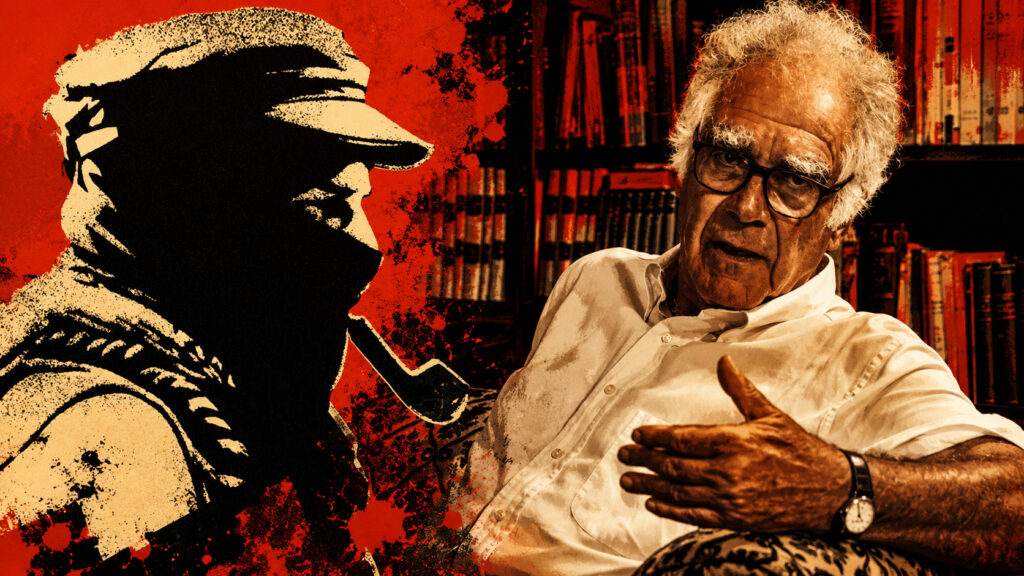
(You can download the three pieces as a single PDF here. You can also find the Introduction by Juan Grigera and the Letter to Marcos by Adolfo Gilly)
22nd October 1994
Adolfo Gilly
Mexico City
From Subcomandante Marcos
Zapatista Army of National Liberation (EZLN)
General Headquarters
Mountains of the Mexican Southeast, Chiapas
Mexico
To Güilly
SupMarcos
I received the photocopies of Carlo Ginzburg’s article, “Clues: Roots of an Evidential Paradigm” (apparently undated, though one senses it was written around 1978), together with an illegible dedication from you about something concerning the thinking of Old Antonio (and Heriberto as well),1 likewise undated. Apologies for my repeated insistence on dates (and even times, if possible). The fact is that, upon coming down from the mountains, I encountered several surprises. One of them was discovering that the “theoreticians”, revolutionaries of ten years ago, have now become melancholy apologists for neoliberalism. Well then, after my scolding (don’t laugh; I know perfectly well that my reputation for being grumpy and rude continues to grow like foamby the day), I shall turn to what occurred to me while reading the aforementioned article by this Ginzburg boy.
I remember reading T.S. Kuhn’s book The Structure of Scientific Revolutions, I think in an edition from Fondo de Cultura Económica (the ‘Breviarios’ series?). Back then, there was that whole discussion about differences or similarities between the natural and social sciences, the whole ‘epistemological break’ business, the ‘paradigms’ and their ‘rupture’, and all the usual etceteras that, as always, had nothing to do with reality. Now I read that this fellow Carlo Ginzburg traces, through symptoms, in psychoanalysis, detective fiction, and late-19th-century aesthetics, the coincidences of a new paradigm: the evidential one. All of that puts me to sleep. What would happen, for example, if ears, fingers, or fingernails (which so terrified late-19th-century aesthetic theorists, Giovanni Morelli dixit)2 don’t correspond to anyone—that is, they could belong to anyone?
I mean to say that this analysis, or “tracking” (“following the animal’s trail”, as Old Antonio used to say), requires a frame of reference, something against which to compare or contrast the clue that has been gathered. But, what if there is nothing within that frame of reference against which the symptom can be contrasted? I mean, Old Antonio could tell the time and route of the tepezcuintle, the white-tailed deer, even the puma, because there existed a point of reference: a tepezcuintle, a deer, a lion. But what if not? What would Old Antonio have inferred had he come across the tyre tracks of one of those vehicles used by archbishops and drug traffickers?
In short, this so-called paradigm is tautological. Its underlying assumption is accepted as true (the frame of reference against which the “clues” are measured) and, therefore, the conclusion necessarily follows as true: the very method by which those “clues” are “gathered”.
The author seeks to ecape “the fruitess opposition between ‘rationalism’ an ‘irrationalism’”. But for whose benefit? I mean, the supposed struggle between “rationalism” and “irrationalism” is merely a variant of an idealist position: the subject, the individual, as the foundation of knowledge. The dispute concerns only whether the subject is rational orrrational in the process of knowing. In reality, the problem in the sciences lies in the struggle between materialism and idealism. (Ah, the now-reviled Lenin! Ah, the forgotten Materialism and Empirio-Criticism! Ah, Mach and Avenarius reborn! Ah, stubborn Vladimir Ilyich!) Just look at how the historical referent of this scientific “paradigm” is pushed into a corner in the final part of the text, merely to “complete” the analysis of the discovery of fingerprints and their use for police control. If I remember correctly, by the end of the nineteenth century the dominant social sciences found themselves rather disconcerted by a new theory laying claim to scientific status: the science of history. It had emerged through a critique of idealism (and through a political practice), as well as of the system of domination that sustained and provided the “foundations” for bourgeois science. A counteroffensive was necessary. The social classes had to be stripped of the historical agency that the irreverent theory of that equally irreverent German Jew had bestowed upon them, and that agency had to be returned to the guarantor of the system: the individual and the idea that moved him (whether rationally or irrationally). Is this not Morelli’s objective in seeking a method that would allow a work of art to be attributed to its individual creator? The search for details serves, ultimately, to reconstruct the individual who produced them. Pure science, isn’t it?
The resemblance to detective methods (find the criminal, single him out, detach m from the social context that makes him possible, and, above all, conceal behind his brilliant crime the “other” crime, that of exploitation) leads to the same outcome: the hunt for, and eventual discovery of, the “special” individual, the one who produces either a work of art or a criminal act. (By the way, why don’t you use this method to identify the “special” individual who engineered that criminal “work of art” known as the 21 August electoral process?)3
Well, Ginzburg is difficult to follow. I imagine the intellectual fashion these days is this sort of everythingology: mixing all kinds of social “sciences” so as to make reality explicable within an incomplete theoretical framework which, in order to complete itself, must resort to other theoretical frameworks, even contradictory ones. This continual leap from “common-sense” knowledge to scientific knowledge to aesthetic products is one of the ways in which the dominant ideology exercises its domination within the sciences. Since “common sense” is allowed to leap into scientific knowledge, one might ask: what is the frame of reference of “common sense”? Is it not that of the dominant ideology? At times, the author reaches the sublime: he refers to law and medicine as two “sciences”. Armed with such forceful arguments, he conveniently “forgets” the central problem: how are the clues read, and from what class position? If one can leap from hunters’ anecdotes to the science of history, then what are the “historical readings” of the clues that have been gathered? Should we not also question the method by which those clues are collected? Is there not a class position involved in selecting certain clues and not others? Is there not a relation between the reading of those clues and a political position? Is not this criterion for selecting and interpreting clues, ultimately, a class criterion?
For example, the author states that “relations between doctor and patient […] have not changed mh since the time of Hippocrates”.4 The relationship between doctor and patient? No! What is involved is something far more complex: the relationship between the medical institution and the body, together with all those “scientific” concepts such as “normality”. Examples? AIDS. Was it not regarded as little more than a curiosity so long as it affected only homosexuals? Did not the real “scientific” concern with AIDS begin when it started affecting heterosexuals? And did not interest increase further when it began to “strike” prominent and distinguished figures?
But one cannot sit down and argue with this Ginzburg fellow: he keeps jumping from science to aesthetics, to history, to medicine, to literature, to psychoanalysis. It is amusing, mind you. In the early years of the guerrilla, we had the three laws of dialectics. The first was: “everything has to do with everything”. The second was: “one thing is one thing, and another thing is don’t fuck with me”. The third was: “there is no problem big enough that it cannot be turned on its head”. And the fourth (yes, I know I said there were three, but, since they are dialectical laws, one should not expect too much formality from them) was: “fuck the world and matter.” (You have no idea how much it amuses me to imagine how ‘conflicted’ you will be when deciding whether to publish this part of the letter.) In short, this Ginzburg fellow is perfectly traceable to an individual… by his obscurantism.
Since we are speaking of “scientific” paradigms, consider the current one. Within what paradigm does the theory that underpins and justifies the dominant system fit? (For a long time now, the role of dominant social theories has been to “justify”– that is, to render just – the dominant system, i.e. the brutal process of dispossession of wealth, consciousness, and history that is beginning anew as the century draws to a close). For that is what neoliberalism is: the novissima theory of a new partition of the world … and of its corners as well. You need not go as far as Italy and the neo-rise of the Right. Just look around here. Take the pearls that Salinas, Aspe, and Serra Puche hand out to us free of charge.5 Here, the paradigm consists in this: if reality does not correspond to whathe theory dictates and prescribes, then a new “reality” must be invented, the reality of mass media. Consider, for example, the myth of the country’s “industrialisation” through NAFTA, and contrast it with the actual growth of micro-enterprises and Mexico’s real place within the international division of labour: countries that produce raw materials—and cheap labour—and countries that are industrialised. The nineteenth century? Not at all, brother. The eve of the twenty-first!
There are at least two Mexicos (I say there are four, but let’s not quarrel over one or two more; let’s call it three, to split theifference). One is the Mexico of presidential reports, official speeches, major news broadcasts, commercial advertisements, and tourist promotions. The other is the Mexico that actually exists, the one that makes possble the unfortunate “confusion” of vehicles in Jalisco in May, the January uprising in Chiapas, the March of Colosio, the September of Ruiz Massieu, the October of … whonext? The Mexico of 4 per cent, of 50%–26%–16%…6 Did you already kn did? Fine. But then why is it that the more celebratory the official discourse becomes, the more violent reality grows? No, I am not going to answer that. That is work for theorists, not for warriors. And the third Mexico? Well, it is the one that struggles … I think.
One more thing. Here we encounter a serious problem for Morelli–Doyle7–Freud–Ginz-burg–Güilly. Let us try to apply the “evidential” paradigm to Neo-Zapatism. To remain consistent with this “science,” we must search for the individual who is the “author” of the plans, the leadership, the conception, and so foh. Let us suppose it is that long-nosed fellow beneath the ski mask (“and rather fu of himself,” say the macho types) who calls himself “Marcos”. Let us gather clues fm him: the obvious nose, the debatable eye colour, the crow’s feet, his clumsy way of walking and writing (believe me, they are one and the same), the lies or truths he tells, or that are told, about his past, and, of course, his fingernails (it is harder to draw conclusions from his ears).
—
P.S. This is out of place and does not belong here, but it is relevant, since it has to do with fingernails and so on:
INSTRUCTIONS FOR CARRYING ON
Standing before any mirror, become aware that you are the best of yourself.
Even so, something can always be saved:
a fingernail, for example…
—
Let us suppose that one succeeds in assembling a more or less complete image of the man behind the long-nosed ski mask (“and full of himself,” the macho types insist). Then comes the moment of comparing him against a frame of reference. Let me hazard a guess, on the basis of the clues, as to what happens in each case: In the Ministry of the Interior, they comb through the files of sympathisers of liberation theology, the yearbooks of the Ibero, ITAM, and UNAM, and, naturally, the reserve squad of the Monterrey football team. In the PRI, they sift through the address books of resentful, sidelined, or politically resurrected party members. In the CIA and FBI, they consult their lists of Cubans, Nicaraguans, Libyans, fedayeen, ETA members, and so on. On the Left, they search their memories. In intellectual circles, their grudges. In Mexican households, they look in the mirror. The result? “Marcos” can be anyone, or no one at all. He can be everybody and nobody. He does not exist; he is an unfinished invention, a model kit that each person assembles to his or her own taste. A man without a face is not necessarily a man whose face is covered. Above all, he is a man with an ordinary face, a face that tells us nothing, that leads nowhere. A useless face, merely the skeleton upon which to give shape to the long-nosed ski mask (“and full of himself,” the macho types reaffirm).
The same goes for the ski mask. I no longer know how many different—and contradictory—arguments I have offered for wearing it. Let me see: the cold, security, anti-caudillismo (paradoxically enough), a tribute to Old Antonio’s black god, aesthetic distinction, embarrassment at being ugly. Probably none of those arguments is true. The fact is that, now, the ski mask has become a symbol of rebellion. Only yesterday it was a symbol of criminality or terrorism. Why? Certainly not because we intended it to be.
(It is now 14:00 hours [according to your clocks]. I have just been informed of yet another incursion by a federal army patrol, this time on the side of the ruins of Toniná, in Ocosingo. We are no longer going to issue a denunciation. We are tired of it and, besides, we are going to end up like the shepherd crying, “Wolf! Wolf!” and eventually no one will believe us anymore…)
Now let us turn to a paradigm that has fallen out of use. We shall have to go to the wastepaper basket, retrieve that old and crumpled sheet called “The Science of History”, Historical Materialism, and smooth it out once again. Why was it thrown away? Was it the moral hangover that followed the collapse of the socialist camp? A “tactical” retreat in the face of the overwhelming advance of the Marine boys and neoliof history”? Did it go out of fashion along with the desire to struggle? Why is a revolution today so quickly relegated to the realm of utopias? What happened to them Güilly? Did they get tired? Bored? Did they sell out? Did they surrender? Was it not worth it? Is it no longer worth it? Or was it that this theory led them into a blind alley (at least for theorists) where you had to be consistent in practice? What happened to them, Güilly? It seems to me that cynicism is now the banner of the Left. “Realism,” a columnist will correct me. “Realpolitik,” another will add. Perhaps it turns out that the most elaborate theories were never more than convoluted reworkings of the old manuals. In the end, why am I telling you all this? All I meant to do was write that damned article I rashly promised you one wrong afternoon for the irregular Vientos del Sur,8 and then you go and put this article by this Ginzburg fellow (whose surname already carries its own penance) in my way. Then again, perhaps it was not you who sent it, but some other “Güilly.” In any case, the aforementioned article is going to take a while, so don’t wait up for it. In exchange, and in the meantime, I am sending you this charming letter, which you may use as filler for the absent section “Readers Erupt”, a regrettable omission in the irreverent pages of Vientos del Sur.
All right, Güilly. Stay well find yourself an easier name to write, because at our checkpoints I have heard six different versions of it.
From the mountains of the Mexican Southeast,
Subcomandante Insurgente Marcos
Mexico, October 1994.
P.S. YES AFTER ALL. Very well, I shall begin to explain. We did not set out to do it. In reality, the only thing we have set out to do is change the world; everything else we have been improvising as we went along. Our square-headed conception of the world and of revolution was left badly dented by its confrontation with the reality of Indigenous Chiapas. Out of those blows came something new — which does not mean “good” — what is now known as “Neo-Zapatism”.
P.S. NO AFTER ALL. Better wait e is coming again. Smile. It is 20:46, “south-eastern time”, as Tacho says.
Notes
1 Old Antonio (El Viejo Antonio) is a legendary, wise Indigenous Mayan elder and a fictional character since the first communiqués of the Ejército Zapatista de Liberación Nacional, EZLN, or the Zapatista Army of National Liberation. These fragments were later reunited and published in 1998 in Subcomandante Marcos Relatos del Viejo Antonio, CIACH, Chiapas, Mexico. Heriberto, on the other hand, is a fictional child character also featured in Marcos tales from the Lacandon jungle. (All notes are from the translator.)
2 Giovanni Morelli (1816–1891) was an Italian art historian whose method of attributing paintings through minute, often overlooked details (such as ears, hands, or fingernails) is extensively referenced in Ginzburg’s “evidential paradigm” piece. He argues that Morelli influenced thinkers such as Sigmund Freud.
3 21 August 1994 is a reference to Mexican general elections in which Ernesto Zedillo (PRI) was elected president, despite opposition groups, including the EZLN, questioned their legitimacy, showing that the broader political conditions under which they were conducted, including media bias, state patronage, and unequal access to political resources, precluded genuinely democratic competition.
4 Ginzburg 1986, p. 106
5 Salinas, Aspe, and Serra Puche refer respectively to President Carlos Salinas de Gortari, Finance Minister Pedro Aspe Armella, and Trade Minister Jaime Serra Puche, the principal architects of Mexico’s neoliberal reforms and the implementation of NAFTA in the early 1990s.
6 The March of Colosio and the September of Ruiz Massieu refer to the assassinations of PRI politician Luis Donaldo Colosio (March 1994) and PRI secretary-general José Francisco Ruiz Massieu (September 1994).
7 This is short for Arthur Conan Doyle, referenced in Ginzburg 1986.
8 The journal Marcos refers to is Viento del Sur, published in Mexico between 1991 and 1997.