Translated and Introduced by Juan Grigera
The three pieces of this correspondence can be downloaded a single PDF here. You can also find the Letter from Subcomandante Marcos and the Letter to Marcos from Adolfo Gilly and the References.
In memory of Carlo Ginzburg, Historical Materialism returns to this remarkable reception of his work and, in particular, his ‘evidential paradigm’. These letters exchanged between Subcomandante Marcos and Adolfo Gilly, originally published in the Mexican journal Viento del Sur1 and translated here into English for the first time, show how Ginzburg’s work resonated well beyond microhistory and historiography, inspiring wider debates on Marxism, knowledge ‘from below’, revolution, class struggle, and armed struggle.
Carlo Ginzburg (1939–2026) was born in Turin into a family marked by anti-fascist commitment and literary brilliance. He is widely known for his contributions to the craft of history, showing how small traces, marginal lives, and fragmentary archives could open onto vast questions of power, belief, persecution, and popular culture. His best-known works, including The Night Battles, The Cheese and the Worms, Ecstasies, and “Clues: Roots of an Evidential Paradigm”, were often read under the (postmodern) umbrella of ‘subaltern histories’ and microhistory. For Ginzburg, the historian was not only a scholar of documents but a reader of clues: someone who could reconstruct hidden worlds from the smallest signs. His work remains a model of intellectual rigour, moral imagination, and fidelity to the oppressed.
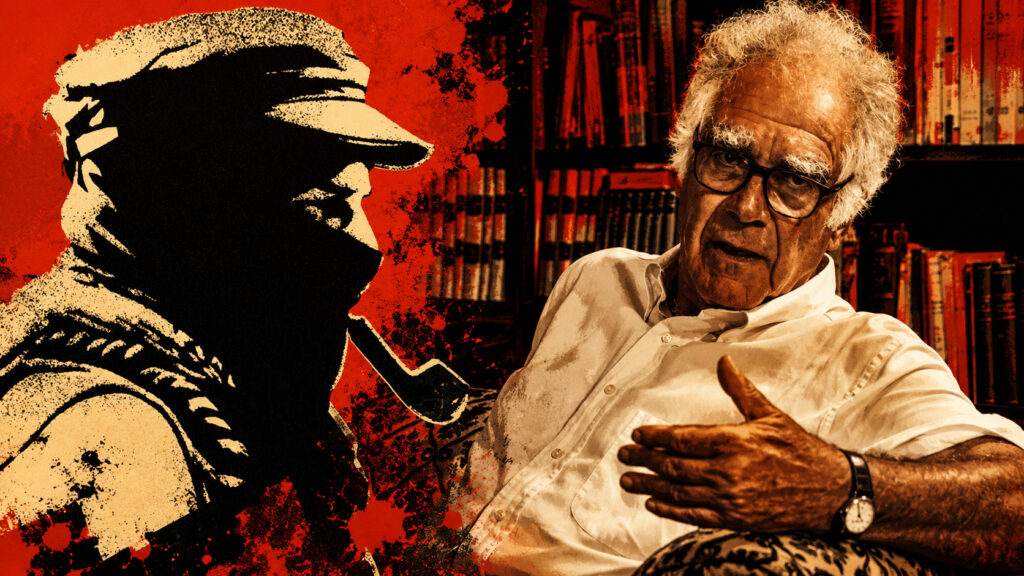
The exchange between Subcomandante Marcos and Adolfo Gilly that follows is unusual in several respects. First, Gilly’s reading is not a postmodern subalternist appropriation of Ginzburg. Rather, he sees in the evidential method a way of thinking about the knowledge, experience, and political agency of the oppressed, while recognising that these enter class struggle, armed struggle, and revolutionary practice in uneven and complex ways. Second, Marcos’s reply is marked by a more classical revolutionary Marxism than the one which neo-Zapatismo would later become associated with.
The correspondence that follows drew on Gilly’s longstanding relationship with the Zapatistas. In May 1994, during the electoral campaign, he was part of the delegation accompanying Cuauhtémoc Cárdenas to Chiapas and, in June, returned with a smaller group. One participant later recalled the latter encounter between Gilly and Marcos as one “between people who understood the practices and forms of armed struggle”.2 Gilly said that:
On 29 October 1994, in Aguascalientes, Chiapas, three visitors had a long conversation with Marcos, Tacho, and Moisés […] In those hours we spoke of the political situation, of the elections, of revolutions, of democracy, of armed and unarmed men and women, of life itself, amid much laughter which, in their case, masked as they were, could be seen in their eyes, and in ours, I suppose, across our whole faces.3
Following this encounter, Adolfo Gilly sent Marcos Ginzburg’s essay “Clues: Roots of an Evidential Paradigm”,4 as a way of continuing a conversation they had begun in person. He wanted to speak with Marcos about the art of making revolution and about the need revolutionaries have to know human beings. As Ávila notes,5 for Gilly, such knowledge could not be reduced to doctrine, programme, or abstract theory. It was formed through experience, attention to concrete human beings, and the ability to read indirect or concealed signs. Ginzburg’s evidential method mattered because it offered a way to think the traces left by subaltern classes: traces of experience, reason, culture, and struggle that dominant knowledges often ignore, devalue, or appropriate.
Marcos’s reply was a scathing critique, not exempt from sarcasm. Here lies a second peculiarity of the exchange: his reading of Ginzburg is marked by the language and references of a more classical, explicitly Leninist, or Third International Marxism. He dismisses the “evidential” paradigm as a form of bourgeois idealism — whether rationalist or irrationalist — because, in his view, it overlooks the centrality of class position to all knowledge. At the same time, he speaks from practice, against theoreticism, and against those who had renounced struggle. For many enthusiasts of neo-Zapatismo, the letter came as a surprise. It appeared as a rigid, even dogmatic, Marxist intervention, revealing an intellectual and political formation quite different from the Marcos they expected: the writer who had become famous for his poetic prose, statements of horizontalism and heterodox style.
Gilly carefully crafted “because it was delayed, a long response”. This is both a defence of Ginzburg, a selective introduction to his œuvre, and a defence of a specifically humanist Marxism. What is at stake is not simply a methodological quarrel. The debate asks how revolutionaries know what they know; what they learn from theory, from experience, from defeat, and from those from below; and how Marxism might remain open to the unexpected without surrendering its critical force. What Gilly sees in Ginzburg are the rudiments of a method for thinking about the knowledge of the oppressed and about the difficult art of making revolution.
This is perhaps why, beyond Ginzburg, Gilly — “formed in the school of ‘Marxism-as-critique’ […] and not in that of ‘Marxism-as-science’” — places James C. Scott, Michel Foucault, Marc Bloch, and E.P. Thompson in the same constellation. His aim is the opposite of allowing them to be absorbed into a postmodern subalternism. Rather, he seeks to recover what their work offers to revolutionary practice: to the Zapatistas, above all, but also to any politics concerned with recovering the voices, knowledges, desires, and forms of rationality of those who rarely have a public voice, and who appear in official archives only through the marks left by domination.
For Gilly, Ginzburg’s text touched a sensitive fibre in Marcos. It pressed on the point where Marcos’s previous intellectual formation met — and was dented by — the lived reality of Indigenous Chiapas. That was the point at which the old “square-headed conception” of revolution was transformed by experience, giving rise to something new: neo-Zapatismo.
Gilly’s closeness to Zapatismo continued over the following years. He visited the communities, took part in their encounters, accompanied LaCampaña in 2005, 2006, and 2007, and wrote a powerful book on the roots and reasons of the movement: Chiapas: la razón ardiente.6 That relationship can be traced at least as far as the rather unfortunate “Digna Rabia” campaign in 2009.
We hope that, in publishing this exchange, we can bring back into view a fresh, even if thirty-years old, reception of Ginzburg’s work: one that reads the evidential paradigm not only as a contributon to historical method, but as a provocation to Marxism, revoce, and the recovery of suppressed knowledge. In returning to this exchange after Ginzburg’s death, we also return to a question that remains alive: how to forge a method for understanding revolutionary practice that can rescue the traces, actions, and knowledges of those from below — “even the dead” — from the enemy who, as Benjamin warned, continues to win.
Notes
1 Subcomandante Insurgente Marcos, ‘Carta a Adolfo Gilly’, Viento del Sur, no.4 (summer 1995) pp. 21-25 and Adolfo Gilly “Huellas, Presagios, Historias, Carta al Subcomandante”, Viento del Sur, no 4 (summer 1995), pp. 26-49.
2 Hernández Navarro 2025, p. 52.
3 Gilly 1995, Introduction.
4 Ginzburg 1986.
5 Ávila 2025.
6 Gilly 2002
References
Ávila, Felipe 2025, “Discusión sobre la historia entre Adolfo Gilly y el subcomandante Marcos”, in Felipe Ávila Espinosa et.al. (eds) Historia a contarpelo, Adolfo Gilly y el arte de historiar, INEHRM, México.
Gilly, Adolfo 1995 “Huellas, Presagios, Historias, Carta al Subcomandante”, Viento del Sur, no 4 (summer 1995), pp. 26-49.
Gilly, Adolfo, 2002, Chiapas: la razón ardiente, México: Ediciones Era
Ginzburg, Carlo 1986. “Clues: Roots of an Evidential Paradigm”, in Clues, Myths and the Historical Method, Johns Hopkins University Press