Articles
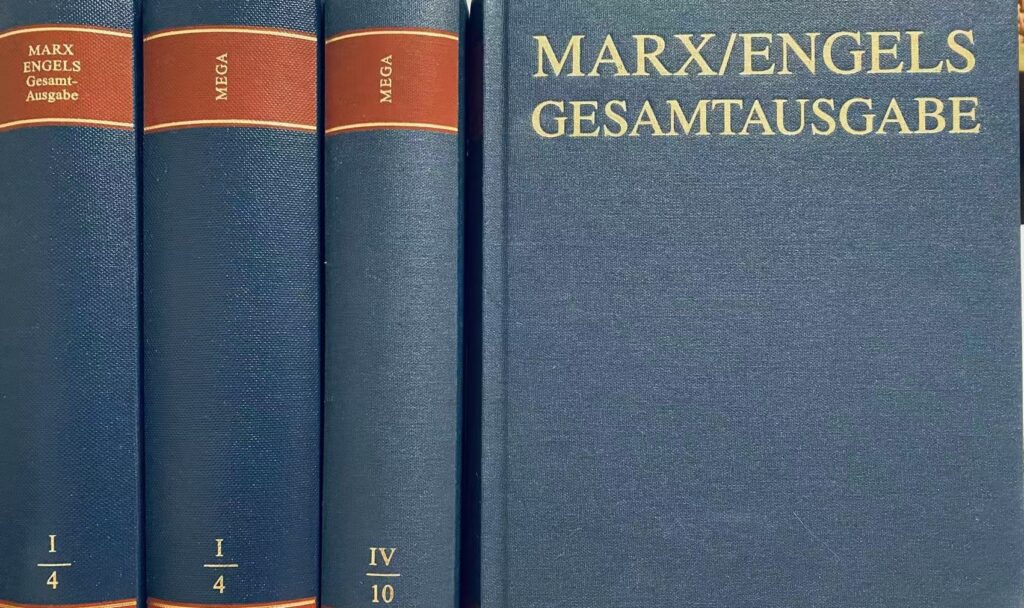
Introduction to Dossier ‘Marx, MEGA and MEGA-Marx’
Lenin once said: if you ditch Hegel, you derail Marx. This comes with a reminder: read your Marx or crash hard! But what to read in Marx, which Marx, when, and how? Reading Marx doubles, triples, quadruples as misreading, overreading, underreading, un-reading, Ur-reading Marx; as reading into Marx; as reading Marx into others; as reading Marx reading others. ‘Marx’ usually designates Marx and Engels as an intellectual unit and a political party; at other times, ‘Marx’ refers to a lone wolf apart from Engels. Engels, the ‘General’, for his part, inhabits several lives: Engels before Marx, alongside Marx shoulder-to-shoulder, and after Marx. Engels may have called himself a ‘second fiddle’ next to Marx, but he was more than a reader, editor and sponsor of Marx. He was a theoretician, tactician and adventurer in his own right. The two comrades in arms authored what fills their archives, and, by silence, what never made it in. Yet the fate of that legacy is scarcely theirs to decide alone.
MEGA in Greece: Reflections on Translating and Editing Marx’s Writings
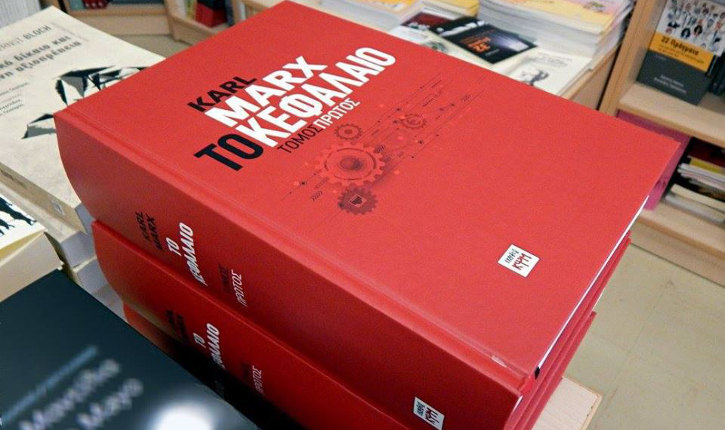
The reception and dissemination of Karl Marx’s opus in Greece, in its first steps during the interwar period, is combined with the development of the nascent labour movement. Already before WWII, there were more several attempts to translate Das Kapital, whereas many of the minor ‘canonical’ works (Manifesto of the Communist Party, On the Jewish Question, etc.) had been translated and published in the form of brochures (or newspaper articles) for the benefit of the militant classes. The militant aspect of the translations, i.e., their instrumental incorporation into the realm of political praxis in the form of an exemplary discursive reference,[1] was a feature that would accompany the translations of the majority of Marxian works in the following decades.

Reading Capital in Light of “New MEGA”: Teinosuke Ōtani’s Research on Marx’s Original Manuscripts and the Theory of Interest-Bearing Capital
In April 2019, the Japanese Marxist economist Teinosuke Ōtani[1] died at the age of 84. Outside of Japan, Ōtani is probably best known for his involvement in the Marx Engels Gesamtausgabe (MEGA) project. From 1992 until his death, Ōtani was a member of the editorial board of the Internationale Marx-Engels-Stiftung (IMES), which is tasked with editing new MEGA volumes; and, from 1998 to 2001, he headed the Tokyo-based MEGA editing team.[2]

A French edition of the works of Marx and Engels based on MEGA-2: the GEME project
The aim of this article is to present the main features of the Grande édition Marx et Engels (GEME)[1] project from a specific angle: that of the dissemination, in France and more generally in the French-speaking world, of the philological advances made possible by the second Marx-Engels-Gesamtausgabe (MEGA-2).[2] The aim here is not to revisit the general theoretical issues[3] of the GEME project, but, rather, to situate it within the history of Marx and Engels editions in France in order to show the contribution made by the various volumes published since its launch in 2008 and to indicate how future volumes are likely to extend it.
Notes on the Translation of Some Specialist Marxist Terms into Italian and English
Everyone knows the wordplay “traduttore-traditore (translator-traitor)”: valid in general, it is particularly relevant in the case of Marx and even more so in that of Capital. Marx’s style is that of a scientist and person of learning, but, at the same time, that of one who revels in the brilliance of a seasoned publicist. His language reflects this background, juxtaposing the rigour of systematic argument with polemical sarcasm, a strictly dialectical lexicon with salacious banter, and the linguistic geometries of philosophical German with polyglot slang. It is difficult to render all this in translation. We have done everything possible to reflect the liveliness of his style. As for the more strictly scientific issues, we thought it necessary to devote a few pages to explaining the translation of certain key terms. The choices made in this new edition are in fact linked to the problems that emerged from a comparison of existing translations and the methodological problems that developed in parallel with the publication of the new historical-critical edition. Translating a certain term often implies interpretative choices; if that is inevitable, it seems only fair to make that clear. Below, the reader will encounter a list of fundamental categories, for each of which an Italian translation and theoretical justification is provided. In this way one has the possibility, at least in the case of the concepts listed, to go back to the German and, even where one might disagree with the translator, to know what the category in question is.[1]
The Marx-Engels-Gesamtausgabe in Italy
The second Marx-Engels-Gesamtausgabe has enjoyed a degree of popularity in Italy since the late 1970s.
Trump 2.0, Fascism, and the Problem of Order under Capitalism
Let’s start from the premise that capitalist rule confronts an endemic problem of order. That problem of order is traceable ultimately to the primary social division that characterises capitalist society, the one separating capitalists (the owners of the means of production) from workers (those dispossessed of direct access to the means of life).
Every Song’s a War Song: Spotify and the Military Music Industrial Complex
In the 1890s, the idea of a “record industry” was a novel concept. The phonograph had only been invented in 1877, its close cousin the gramophone patented and made available for purchase little more than a decade later. The notion that you could hear a sound at a time other than when it was being created? Until recently, this had been beyond the pale of possibility, akin to the first decades of the photograph, just starting to shift the sonic and cultural contours of daily life.
The Council System in Germany (1921)
Richard Müller (1880–1943) was a German lathe operator, union organiser, and revolutionary who led the Revolutionary Shop Stewards during World War I. In November 1918, he became Chairman of the Executive Council of Workers’ and Soldiers’ Councils, effectively serving as head of state of the short-lived Socialist Republic of Germany. After losing influence in the Communist Party by 1921, he turned to writing, producing the classic three-volume history Vom Kaiserreich zur Republik (1924–25). Withdrawing from politics after 1925, he became a businessman and died in relative obscurity. For further discussion of Müller’s life and work, see the book by Ralf Hoffrogge, Working-Class Politics in the German Revolution: Richard Müller, the Revolutionary Shop Stewards and the Origins of the Council Movement.
Who Was Larisa Reisner? An Interview with Cathy Porter
Cathy Porter, author and translator, educated at London’s School of Slavonic and East European Studies and Cambridge University, has published over twenty books on Russian history, culture and politics, most recently Larisa Reisner. A Biography (2nd ed., Brill/Historical Materialism/Haymarket, 2022), shortlisted for the Isaac Deutscher Memorial Prize, and its accompanying volume Writings of Larisa Reisner, her six books, translated with Richard Chappell, again for the Historical Materialism Book Series. Author of Alexandra Kollontai. A Biography, first published in 1978, she is also a translator of Kollontai’s fictional trilogies Love of Worker Bees and A Great Love. This interview was originally published in About Narration (1975): Materials, Comments, Interventions, Edited and introduced by Sezgin Boynik and Tom Holert, Rab-Rab Press, 2025
From the Nation to the People: Rethinking the “We” of Emancipation
The following text is based on an intervention at the conference Historical Materialism Paris: Conjuring the Catastrophe / Combating the Catastrophe, held from 26 to 28 June 2025.