Introduction
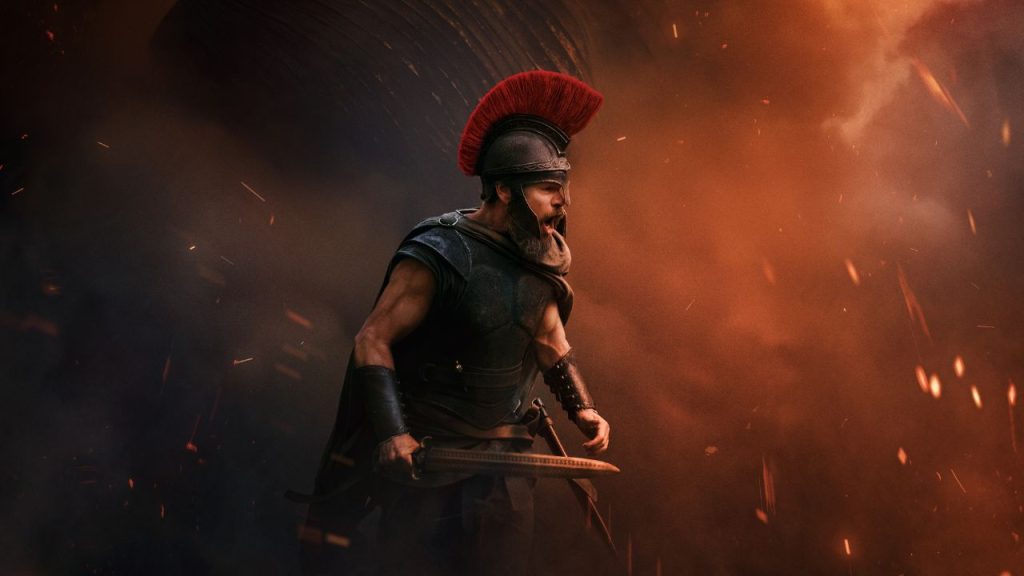
In The Odyssey, Christopher Nolan returns to one of the foundational narratives of Western civilisation, following the journey of a warrior attempting to return home after years of invasion, destruction, and displacement. Yet what gives this adaptation particular significance at the present historical moment is not simply its visual reimagining of Homer’s world, but the way a contemporary blockbuster reorganises the contradictions surrounding war, victory, violence, alienation, political order, and homecoming that remain embedded within the ancient narrative. The film approaches war not through the exhilaration of victory, but through its lingering effects on the individual and on the very possibility of recovering a life after violence. In this sense, The Odyssey extends a shift that began to emerge more clearly in Nolan’s cinema with Oppenheimer, as questions of history, war, and moral responsibility moved more directly towards the centre of his cinematic project.
Within this cinematic trajectory, The Odyssey represents a significant development in Nolan’s cinema from Memento through Tenet. Fragmented temporality, epistemological uncertainty, narrative puzzles, and increasingly elaborate technological spectacle have occupied a central place in his films, often allowing causality, historical or otherwise, to recede behind the spectator’s effort to decipher ambiguity and reconstruct what is unfolding on screen. The phase that began to emerge after Tenet, however, and became unmistakable with Oppenheimer, brought these formal strategies into confrontation with something considerably more resistant to abstraction: history itself. The Odyssey extends this shift through a radically different register, returning to an ancient narrative whose extraordinary persistence derives from contradictions that have never found definitive resolution: between victory and loss, civilisation and barbarism, homecoming and alienation, and between political order and the violence upon which that order is founded and through which it is maintained.
This shift, however, cannot be explained simply as an autonomous development in the work of an individual filmmaker. Nolan’s most recent films emerge within a historical conjuncture in which the world itself is undergoing profound changes. Escalating wars, intensifying nuclear anxieties, increasingly aggressive forms of imperial power, and the expanding resistance to them – including resistance emerging from within the imperial system itself – have returned questions of war and peace to the forefront of public consciousness. Under these conditions, it becomes increasingly difficult for mainstream culture to continue indulging in the more nihilistic forms of historical agnosticism that characterised significant aspects of the post-Cold War period. Wars, in particular, invariably demand explanation; their victims, their psychological aftermath, their moral contradictions, and their capacity to threaten humanity itself become increasingly urgent realities that cannot easily be ignored or displaced from cultural consciousness.
It is precisely from this contradiction that what this study describes as the hegemonic reconfiguration of anti-war consciousness emerges. The contradictions of war do not disappear; they are preserved and, at times, even brought to the forefront of the cinematic experience. Yet they are simultaneously transformed into spectacle, increasingly refracted through cinematic narratives centred on the individual and on personal and psychological experience, recast within a universalising humanist discourse, and, ultimately, articulated through the logic of the cultural commodity. What is constrained in this process is not anti-war consciousness itself, but its potential movement from the moral and human condemnation of war towards a sustained interrogation of the historical structures that produce it: empire, relations of power, and the political and economic class interests through which wars are reproduced. Anti-war consciousness can thus be reconfigured within hegemonic structures without being extinguished or rendered politically meaningless. Its critical energies remain present, but their dominant explanatory horizon is redirected in ways that can reproduce ideological consensus even as the contradictions capable of unsettling that consensus persist. This process, therefore, cannot be adequately understood through models in which dominant culture simply absorbs oppositional consciousness and deprives it of its critical force. The problem posed here is more dialectical: it concerns how hegemony reorganises genuinely oppositional meanings while preserving contradictions whose critical possibilities can never be completely exhausted by their dominant articulation.
The theoretical intervention of this study is therefore twofold. First, it develops the concept of hegemonic humanism to explain how contemporary mainstream cinema can reconfigure the historical and structural terms through which genuine anti-war consciousness becomes intelligible without extinguishing its critical force; second, it argues that this process cannot be separated from the political economy of blockbuster form, through which spectacle, technological magnitude, global circulation, and commodity value participate materially in organising the cinematic experience of historical contradiction.
A reading of The Odyssey, therefore, reveals more than a new phase in Christopher Nolan’s cinematic style or career. The film illuminates a broader transformation within contemporary hegemonic cinema: a movement from forms organised around the historical uncertainty characteristic of the postmodern conjuncture towards the hegemonic reconfiguration of an expanding anti-war historical consciousness now forcefully re-entering the public sphere. Within this framework, the central question is no longer how the blockbuster transforms war into consumable pleasure, but how a film such as The Odyssey can condemn war, make us experience its trauma, and mourn its victims and consequences, while simultaneously displacing from the centre of historical explanation the structures through which war is continually reproduced and sustained.
- From postmodern fragmentation to the return of history
To understand the place The Odyssey occupies in the recent trajectory of Christopher Nolan’s cinema, it is necessary to return briefly to the narrative and aesthetic tendencies that characterised his work before 2023. In an earlier study, I traced the development of these tendencies as manifestations of a postmodern sensibility in Nolan’s cinema,¹ and there is no need to rehearse that argument here. What matters for the present discussion is the historical point at which that trajectory eventually arrived. Across more than two decades, Nolan’s fascination with fragmented temporality, unstable and dispersed perception, incomplete knowledge, and narrative reconstruction remained remarkably persistent, even as the function of these devices gradually changed. What began in Memento as a highly productive tension between formal fragmentation and the spectator’s desire to reconstruct meaning developed progressively towards a cinema in which complexity, uncertainty, and technological virtuosity increasingly became constitutive attractions of the cinematic experience in their own right.
The trajectory from Memento to Tenet, therefore, can be understood as something more consequential than an escalation in budgets or technological ambition. It marks a gradual transformation in the relationship between fragmentation and indeterminacy, on the one hand, and historical consciousness, on the other. In Memento, uncertainty functions as an impetus to confront the problem of meaning: What happened? Why did it happen? What has Leonard forgotten? How does the absence of memory leave him vulnerable to manipulation by others and to his own disorientation? Tenet, by contrast, marks a point at which the separation of causal relations from any sustained historical or material explanation becomes increasingly integral to the logic of the cinematic experience itself. Complexity thus shifts from being a means through which events are reconstructed towards becoming progressively a principle of spectatorship in its own right.
Historically, this trajectory in Nolan’s cinema corresponded to a broader cultural conjuncture that followed the end of the Cold War, in which uncertainty, instability, and scepticism towards comprehensive historical explanations acquired considerable intellectual and aesthetic authority. This cultural shift did not emerge autonomously, but developed alongside major political transformations associated with the weakening of socialist alternatives and the consolidation of neoliberal capitalist hegemony, under which historical-materialist understandings of social and economic reality themselves sustained powerful ideological blows at the level of hegemonic ‘common sense’. History, however, did not disappear from Nolan’s cinema before 2023, and Dunkirk provides perhaps the clearest example. Yet, even here, historical events are transformed into experiential spaces through which the spectator encounters history with extraordinary sensory intensity without necessarily being compelled to reconstruct the broader political and historical relations that produced those events. In this sense, immediate sensory experience increasingly acquires an epistemological authority of its own, while the impulse to move from experiencing history to explaining its dynamics and conditions recedes.
The changing nature of this relationship became more apparent with Oppenheimer. Although temporal fragmentation, subjective uncertainty, and the manipulation of narrative structure remain central to the film, these strategies no longer separate the cinematic experience from a historical trajectory that can be reconstructed. War, political institutions, ideological conflict, and individual responsibility remain anchored in identifiable historical coordinates. Oppenheimer, thus, assumes a transitional significance within Nolan’s trajectory: fragmentation does not disappear, but it can no longer as readily displace history from the centre of the cinematic field.
This transformation provides the necessary point of departure for understanding the place The Odyssey occupies in Nolan’s most recent phase. Epistemological fragmentation remains, as do the fascination with technological spectacle, subjective uncertainty, and the auteur-director’s persistent postmodernist ‘play’ with time. Yet these elements now operate within a cultural conjuncture in which history – and, in this particular case, historical contradictions surrounding war and violence – can no longer be displaced as readily into the realm of abstraction. The problem, therefore, shifts from whether coherent historical meaning can be recovered to a different question: what happens when historical realities once again impose themselves upon cultural consciousness, while dominant industrial and ideological structures continue to shape the forms through which history becomes visible and intelligible?
Therefore, if we are to understand why history returns with such force in Nolan’s recent cinema, and why war and its consequences become so central to that return in The Odyssey, we must first move beyond the filmmaker himself towards the historical conjuncture that made such a transformation possible. The question, then, is no longer simply: what changed in Nolan’s cinema after Tenet? It becomes instead: What changed in the world that made such a transformation in his cinema historically possible?
- War as an inescapable historical reality
Questions of violence, war, and political order have hardly been absent from Nolan’s cinema: terrorism and political authority frame central concerns of The Dark Knight trilogy; war constitutes the historical world of Dunkirk; and geopolitical conflict provides an essential dimension of Tenet’s narrative background. What has changed in the present conjuncture, then, is not the appearance of war for the first time in Nolan’s cinema, but the position war itself has come to occupy within contemporary historical consciousness.
This transformation has occurred with remarkable speed. Russia’s full-scale invasion of Ukraine in 2022 returned the prospect of major interstate warfare within Europe – and, with it, the possibility of direct confrontation between nuclear powers – to the centre of political debate. The destruction of Gaza and the widening scope of US military confrontations in the ‘Middle East’ further destabilised assumptions underpinning the discourse of the post-Cold War ‘international order’. The subsequent expansion of confrontation to include Iran, together with attacks on nuclear facilities, brought the possibility of direct military conflict even more sharply into an increasingly volatile and dangerous regional landscape. At the same time, data from the Stockholm International Peace Research Institute indicate that global military expenditure reached an unprecedented $2.72 trillion, following the largest annual increase recorded since the end of the Cold War. These developments have coincided with the weakening of arms-control mechanisms and the continued modernisation of the arsenals of all nine nuclear-armed states.² As a result, political discourse across a number of major states has increasingly emphasised military preparedness not as an exceptional response to a temporary crisis, but as an enduring condition of state security and political existence.
What distinguishes the post-2022 historical conjuncture, therefore, is not the outbreak of war as such. Wars, occupations, military interventions, and imperial violence never disappeared during the decades that followed the end of the Cold War. Iraq, Afghanistan, Palestine, Libya, Syria, and Yemen, alongside numerous conflicts across the Global South, make any such historical claim impossible to sustain. What has changed is that the political and discursive arrangements that previously made it possible to represent these wars as localised crises, ‘humanitarian’ interventions, ‘counterterrorism’ operations, or temporary disruptions within an international order presumed to be fundamentally stable have become increasingly difficult to maintain. The exception has begun to reveal itself as structure.
This transformation has been accompanied by another development no less important to the present historical conjuncture: the widening resistance to attempts to normalise permanent war as an acceptable condition of contemporary life. Among younger generations in particular, the state-organised mass destruction of Gaza became a catalyst for expanding demonstrations and mass anti-war mobilisations, the cultural boycott of Israel, and growing educational and solidarity movements across Western university campuses. In the United States alone, the Crowd Counting Consortium recorded approximately 12,400 pro-Palestinian protest events between October 2023 and June 2024.³ This mobilisation intersects with a pronounced generational divide documented in public-opinion surveys, with those under thirty expressing substantially lower levels of support for US military aid to Israel and greater criticism of Israel’s military operations in Gaza than older age groups.⁴ The significance of these movements lies not simply in their scale, but in what they reveal: the meanings attached to war, military intervention, national security, and Western geopolitical power have themselves become increasingly contested, producing a field of cultural contradiction to which hegemonic institutions must continually respond.
It is precisely here that the historical conjuncture acquires particular significance for understanding The Odyssey. Cultural production does not mechanically reflect political events, and the film should therefore not be reduced to a cinematic allegory of particular contemporary conflicts. Films acquire their meanings and historical dynamics within conditions over which neither filmmakers nor studios exercise complete control. The historical environment conditions which contradictions become culturally legible, which anxieties acquire a sense of urgency, and which questions audiences carry with them into the cinema. A return to an ancient narrative about a warrior coming home after a prolonged war cannot, therefore, acquire the same meaning within a historical conjuncture in which the effects of war upon individuals and societies, the persistence of violence after combat has ended, and the impossibility of simply returning to a prewar condition have become increasingly urgent concerns within contemporary consciousness.
The Odyssey’s return across nearly three millennia to the world of myth might appear to constitute a radical retreat from contemporary history. Yet this apparent distancing may itself represent another form of encounter with history. In fact, what has sustained the cultural vitality of Homer’s epic across centuries is precisely its articulation of military victory and its human consequences. Odysseus returns from war victorious, but victory does not restore what the war has taken from him. War returns home with him: through memory, violence, alienation, displacement, and through the increasingly unstable boundary between civilisation and barbarism.
Under different historical conditions, these contradictions might have been subordinated to adventure, myth, and heroism, or to the cinematic imagination’s attempt to recover the ancient world and its enchantments. In the present conjuncture, however, they become open to a different reading: as questions about what prolonged wars do to human beings, and what they do to societies that reorganise themselves around violence. The ancient warrior returning from Troy can thus be encountered through a contemporary cultural vocabulary of trauma, moral injury, displacement, and the impossibility of simply returning to a ‘normal’ life after war.
In this sense, Nolan’s return to myth gives his more recent historical engagement a different form. The Odyssey places at its centre a surviving warrior deeply marked by war, attempting to return to a homeland that is no longer what it was, just as he is no longer the person who left it. The ancient epic thus becomes available for rereading within a historical conjuncture in which war has reasserted itself as an immediate and haunting reality whose consequences do not end with the cessation of battle or the declaration of victory.
Yet this represents only one side of the contradiction. If changing historical conditions increasingly press hegemonic cinema to acknowledge the catastrophe of war, they do not determine the form that such acknowledgement must take. The Hollywood system through which these anxieties are mediated remains structured by an extraordinary concentration of capital, transnational distribution networks, technological spectacle, the transformation of the auteur-director’s name into a brand, and political assumptions deeply embedded within the cultural formations from which this cinema emerges. At this point, the central question shifts. It is no longer primarily why anti-war consciousness has acquired an increasingly visible presence in this phase of Nolan’s cinema, but what happens to that consciousness as hegemonic culture itself begins to engage with and reconfigure it.
It is precisely at this point that the concept of ‘hegemonic humanism’ becomes theoretically necessary for understanding how The Odyssey reorganises its anti-war contradictions within the structures of the contemporary blockbuster.
III. ‘Hegemonic humanism’ and the reconfiguration of anti-war contradictions
The historical conjuncture discussed in the previous section poses a fundamental problem for hegemonic cultural production. As war and militarisation become increasingly present within public consciousness, accompanied by mounting anxieties over the possibility of large-scale destruction and its human consequences, mainstream cinema can no longer readily disregard the contradictions these conditions generate. At the same time, it is equally inadequate to conceive of contemporary Hollywood as operating exclusively through the crude and direct glorification of military power, since such a conception underestimates hegemony’s capacity to adapt and reproduce itself under changing historical conditions. The more complex ideological operation of the contemporary blockbuster lies precisely in its capacity to acknowledge contradiction, engage with criticism, and even articulate powerful moral objections, while reconfiguring these responses within forms that tend to preserve prevailing conceptions of history, power, and social reality.
Within this framework, The Odyssey provides a particularly revealing instance of this process, precisely because its concern with the devastating consequences of war should not be dismissed as false or insincere. In fact, the film confronts the inability of military victory to erase trauma, the persistence of violence beyond the battlefield, and the difficulty of recovering home, identity, and humanity after prolonged immersion in war. Its ideological efficacy, therefore, does not derive from denying or suppressing these contradictions, but from the particular ways in which it reorganises them.
These ideas possess a genuine humanist force in their own right. War destroys those who wage it as well as those against whom it is waged; victory cannot restore what violence has destroyed; and returning home cannot simply undo the transformations produced by war. It would be theoretically reductive to treat such propositions as merely an ideological screen or form of mystification. Their capacity to resonate with contemporary audiences derives precisely from the fact that they articulate experiences and anxieties that have become increasingly present and culturally legible within the historical conjuncture in which we live.
The ideological problem begins when the human consequences of war become increasingly detached from the historical structures that produce them. This distinction lies at the heart of what I describe here as ‘hegemonic humanism’. In this regard, it is critical to stress that my use of this term designates a mode of meaning-production in which moral values are articulated as human and universal, while their meanings are reconfigured through hegemonic forms in ways that tend to constrain their capacity to interrogate the social relations and class dynamics of power that produced the crisis itself. By this I do not mean a false humanism cynically imposed upon audiences, or a manipulative discourse designed to conceal an explicitly militaristic worldview; in fact, the effective operation of hegemonic humanism is precisely related to the genuine nature of its ethical concerns.
Hegemonic humanism, therefore, acknowledges suffering, condemns brutality, mourns destruction, questions authority, and invites the spectator to empathise with human beings shattered by war. At the same time, however, it increasingly reorganises these experiences through narratives that render their historical conditions more abstract and less historically specific, or that personalise them by relocating their primary explanatory force within the psychological interior of the individual. The human costs of war thus remain fully visible, while the social relations and historical structures through which those costs are produced become progressively less determinate as objects of historical explanation.
This distinction is fundamental. When war comes to appear primarily as an expression of an inherent human propensity towards violence, ambition, revenge, fear, or self-destruction, the search for its causes gradually shifts away from historically specific social relations and structures: empire, class, struggles over resources, geopolitical power, and institutional interests. War remains morally condemned, yet it simultaneously begins to appear as an inevitable consequence of the very ‘nature of human civilisation’. The spectator can therefore reject its brutality while the conceptual resources through which the historical structures that continually reproduce war might be understood – and imagined as capable of transformation – become progressively weakened.
To demarcate hegemonic humanism more precisely, it must be distinguished from adjacent concepts. Unlike classical liberal humanism, which takes the autonomous individual as the foundation of rights and agency, or humanitarian discourse, which frequently approaches suffering as an immediate condition demanding ethical response, hegemonic humanism operates through the reconfiguration of the historical terms by which structural violence becomes intelligible. Nor is it simply a form of abstract universalism. Rather than erasing historical specificity from the outset, it begins within concrete historical crises – war, invasion, colonial and neocolonial aggression – but progressively rearticulates their meanings through universalising categories of human tragedy, existential dread, and an ostensibly transhistorical human propensity towards violence, vanity, and hubris.
Hegemonic humanism must also be distinguished from traditional models of ideological containment or incorporation that understand dominant culture primarily through the absorption and neutralisation of oppositional meanings. Such models often posit a predominantly top-down process through which oppositional ideas are stripped of their critical force and ultimately absorbed into dominant ideology as commodities emptied of their oppositional content. Hegemonic humanism operates more dynamically. It does not require the anti-war position or the critique of imperialism to become false, nor does it depend upon transforming them into empty commodity discourse or entirely depriving them of their critical energies. On the contrary, genuine moral outrage, affective revulsion, and the fear generated by militarisation can remain powerfully present; indeed, their presence can become integral to the cultural authority and aesthetic seriousness acquired by a film such as The Odyssey. Hegemonic relations here operate not primarily through the suppression of anti-war consciousness, but through the reconfiguration of the explanatory frameworks through which the social and historical causes of war become intelligible.
Hegemonic humanism, then, is not a philosophy inherently complicit with power, but a historically specific ideological process through which genuine humanist responses to suffering – empathy, grief, and the moral condemnation of violence – are progressively rearticulated within hegemonic common sense. Its political significance lies not in rendering these responses false, but in shifting their explanatory horizon: violence produced through historically specific conditions can increasingly appear as a permanent tragic condition rooted in ‘human nature’, while the structures sustaining its reproduction recede from the horizon of historical transformation.
As Gramsci suggests, hegemony is sustained not primarily by compelling people to accept ideas they already recognise as false, but by organising historically produced assumptions that have sedimented into ‘common sense’ and consequently come to appear natural, reasonable, and largely removed from political contestation. The ideological efficacy of an anti-war blockbuster, therefore, does not require the spectator to endorse military violence; indeed, the opposite may be true. The spectator may experience the film through events that condemn war and expose its brutality as a profound moral tragedy, while simultaneously reproducing a hegemonic common sense in which that tragedy comes to appear as a permanent and natural condition of human existence.
The operation of hegemonic humanism can therefore be understood as a movement through several interconnected processes: preservation, spectacularisation, personalisation, psychologisation, universalisation, and naturalisation. Historical contradiction is first preserved rather than suppressed; its violence and suffering are then intensified as cinematic spectacle; structural conflict becomes increasingly organised around individual experience; historical causation is progressively refracted through psychological injury and trauma; these experiences acquire the status of universal human dilemmas; and the conditions that produce them can consequently begin to appear as expressions of an enduring human propensity towards violence rather than as historically transformable social relations. These processes need not occur mechanically or with equal force in every film. They designate a hegemonic tendency whose effectiveness depends precisely upon the continued presence of contradictions capable of exceeding the forms through which they are organised.
This movement from understanding the material and social conditions that produce war and violence towards interpreting them through the terms of hegemonic common sense constitutes one of the central operations of hegemonic humanism. Its efficacy lies precisely in the fact that opposition need not be extinguished for hegemonic relations to persist. The spectator can temporarily withdraw from violence, empathise with the traumatised warrior, mourn the victims, distrust political leaders, criticise unrestrained ambition and heroism, and recognise the moral bankruptcy of power when it is severed from accountability. None of these responses necessarily falls outside the field of hegemony. They can remain genuinely critical while simultaneously being articulated within forms that reconfigure the historical frameworks through which violence, power, and their social causes become intelligible. Hegemony, in this sense, does not require the disappearance of contradiction; it operates through the continuing struggle over the terms within which contradiction itself acquires meaning.
The Odyssey derives much of its power precisely from its refusal to reduce war to uncomplicated heroism and from its sustained exposure of the troubled relationship between conquest and suffering, civilisation and barbarism, political order and violence. To obscure these contradictions would therefore diminish the film both thematically and aesthetically. Hegemony operates differently here: the moral contradictions are not eliminated but preserved, while their meanings and explanatory relations are reorganised through a series of interrelated processes of reconfiguration.
The presence of anti-war consciousness within spectatorship is therefore integral to the film’s affective and aesthetic efficacy. What remains open is the political trajectory of that consciousness: the forms of historical understanding towards which hostility to war may ultimately develop.
In Homer’s Odyssey, the destructive contradictions of war remain fully present: victory produces alienation; political order emerges through violence; and the warrior who survives the external conflict cannot simply recover the human world he left behind. In the end, peace is achieved only through Zeus’s divine intervention, which compels a settlement with the families of the dead suitors and restores Odysseus as king of Ithaca under a renewed condition of peaceful rule. Yet the cinematic adaptation increasingly reorganises these contradictions through the contemporary language of psychological injury, trauma, and, eventually, personal recovery. Homer’s Odysseus, whose distinctive intelligence manifests itself through speech, negotiation, storytelling, and the strategic navigation of different social worlds, increasingly gives way to a more inward and psychologically wounded figure. This transformation concerns more than character construction and development. It points towards a broader process in which the explanatory weight of collective history progressively shifts towards the psychology of the individual.
Hegemonic humanism, then, does not suppress or marginalise the anti-war impulse embedded in The Odyssey; rather, it depends upon it. The film’s moral seriousness, its cultural authority, and much of its capacity to speak to the present conjuncture derive precisely from its openness, however indirect, to confronting the anxieties and contradictions that have acquired increasing urgency within our historical moment. Its ideological significance emerges, rather, through the ways these contradictions are reconfigured as they pass through the industrial, aesthetic, and narrative structures of contemporary Hollywood.
For this reason, the concepts of the commodity and commodification cannot be separated from the analysis of ideology. Within the contemporary blockbuster system, human contradictions and dilemmas are not merely represented; they are also transformed into forms of commodifiable cultural value. Moral seriousness becomes a marker of artistic prestige, ambiguity a sign of sophistication and complexity, trauma a source of affective intensity, and historical catastrophe a cinematic event. At the same time, technological magnitude intensifies the spectator’s encounter with fear, awe, violence, and monumental natural environments, so that the experience of such contradictions itself becomes a direct component of the film’s commercial value within the global marketplace.
Contradiction thus becomes productive on two levels simultaneously: it generates moral engagement, and it generates exchange-value.
This helps explain the distinctive position Nolan occupies within contemporary Hollywood. His films can be marketed simultaneously as extraordinary technological spectacles, on the one hand, and as serious meditations on the contradictions of civilisation, time, morality, violence, and human survival, on the other. The immense scale of their production does not require their political contradictions to disappear; on the contrary, those contradictions contribute to reproducing the cultural authority that distinguishes the Nolan blockbuster from more conventional franchise products. The commodity itself acquires cultural distinction through its capacity to appear to transcend commodity culture, even while remaining one of its most powerful expressions.
Hegemonic humanism, therefore, cannot be separated from the political economy through which it operates. Its universalising moral language allows historically and politically specific contradictions to circulate across markets, national contexts, and heterogeneous audiences without requiring equally specific historical explanations to travel with them. The trauma of war can thus acquire the form of an experience that appears to transcend historical divisions, while violence can increasingly be articulated as an enduring contradiction rooted in the very nature of human civilisation. Such formulations possess genuine moral force, while also facilitating the global circulation of narratives whose greater historical specificity might generate qualitatively different political contradictions and interpretations across the contexts through which they travel.
The result is not an ideological closure within which every possibility of critical meaning disappears. Hegemony rarely operates with such completeness, and the contradictions that remain present within cinematic works retain the capacity to generate readings that exceed their hegemonic organisation and, at times, even come into conflict with it. Odysseus’s trauma, for example, can lead us back towards questions of conquest, empire, and the violence that produced the very conditions of his homecoming in the first place. Cultural texts remain contradictory precisely because hegemony, however powerfully it may reconfigure their meanings, can never fully exhaust the range of significations they remain capable of producing.
Yet this residual openness should not obscure the dominant tendency. In The Odyssey, the renewed presence of history and war is accompanied by a humanist language that acknowledges suffering while reconfiguring the terms through which its causes are understood within the realm of individual recovery. The political is increasingly translated into the moral, the historical into the psychological, and what has been produced through specific historical and social structures into what comes to appear as an expression of a universal human condition. Here lies the film’s central contradiction: it becomes more deeply engaged with the historical meaning and human consequences of war at the very moment when those contradictions are increasingly reorganised through the hegemonic forms by which the contemporary blockbuster acquires its cultural and commodity value.
The result, then, is not a retreat from politics but a reconfiguration of the political itself: a hegemonic humanism through which the contemporary blockbuster can condemn the catastrophe of war while simultaneously displacing the structures that continually reproduce war from the centre of its historical and explanatory horizon.
- The Odyssey: From human history to individual trauma
The Odyssey presents us with a dual object of interpretation. On the one hand, we encounter an ancient and foundational epic whose historical meanings have accumulated across nearly three millennia, as successive and continually changing societies have reinterpreted its contradictions surrounding violence, homecoming, political order, memory, hospitality, and identity. On the other, we encounter a feature film produced in 2026 whose narrative compressions, visual strategies, and thematic transformations can be analysed as elements of a fully realised contemporary blockbuster text.
The question of adaptation therefore becomes considerably more complex than whether Nolan is ‘faithful’ to Homer. The issue is not that a contemporary filmmaker necessarily alters, condenses, or eliminates elements of an ancient text, since adaptation by its very nature entails processes of transformation; rather, it concerns what forms of historical consciousness become less available when particular narrative spaces are compressed or displaced, and what forms of contemporary understanding emerge in their place.
The Phaeacian episode acquires particular significance in this context. In Homer’s epic, Odysseus does not simply arrive among another community encountered along the route of his homecoming; he enters a social world within which his fractured relationship to identity, memory, and human community begins to be reconstructed. His encounter with Nausicaa, the court of Alcinous and Arete, the rituals of hospitality, the songs and stories of Demodocus, the recognition of the stranger, and the gradual invitation for Odysseus to narrate his own experience all participate in a process through which an anonymous and displaced survivor becomes someone who can once again be recognised by and within a human community.
The importance of these narrative structures in Homer’s Odyssey lies precisely in their refusal to treat recovery from war as a purely internal psychological process. Odysseus does not recover himself through isolated introspection; his identity is reconstructed through social relations and interactions. He is received, questioned, fed, protected, listened to, and ultimately given the space to speak about himself and his experience. Hospitality thus becomes more than an ethical value embellishing the narrative: it provides the cultural and political framework through which the stranger can re-enter the human community.
It is in this context that xenia – the conventions of hospitality and the rights of the stranger – acquires its central importance. The stranger does not recover his humanity simply because his suffering becomes intelligible to him internally; he becomes socially recognised when the community acknowledges that it bears obligations towards him. The encounter thus establishes a direct relationship between identity and social practice. Recognition does not remain an abstract principle but is materialised through food, shelter, ritual, dialogue, the exchange of gifts, collective memory, and the right to narrate one’s own history. The Phaeacian world offers Odysseus what the battlefield cannot: the social conditions through which experience can be transformed into memory, and memory into identity.
Nausicaa occupies a crucial position within this transition. She encounters Odysseus at the moment when he appears stripped of the attributes that had previously defined him as warrior, king, and conqueror. He comes before her displaced and vulnerable, deprived of the social markers through which others might recognise his status and identity. Nausicaa’s response initiates the process that supports his return to the human world because she encounters the stranger not as an enemy or a threat but as someone entitled to assistance and dignity – in the most fundamental sense, as a human being whose claim to recognition does not depend upon the credentials of power, social function, or class position.
The significance of compressing this material therefore extends beyond the mythical or emotional dimensions of what is selected for narration. This material stages an encounter – or, more precisely, a confrontation – between vulnerability and social recognition, in which civilisation acquires meaning not through military superiority but through its capacity to receive the displaced other and recognise that person’s humanity.
The same applies to Alcinous and Arete in Homer’s Odyssey. Their significance extends beyond providing shelter for the hero before he resumes his journey. Their court creates the social environment within which Odysseus can move from being a survivor burdened by the consequences of war to becoming a narrator of history. The pace of Homer’s epic slows markedly at this point because the act of narration itself becomes a historical practice. Odysseus retrospectively reconstructs his journey, transforming dispersed experiences of violence, temptation, loss, displacement, and survival into a narrative that can be communicated to others.
This is one of the most significant features of Homeric construction. Memory is not simply the psychological recovery of what has passed; it becomes an integrated social practice. By narrating his experience to others, Odysseus begins to reconstruct a coherent relationship between past and present, and therefore between experience and identity. Speech here performs a historical function: through narration, the violence of war and wandering can be recovered, ordered, interpreted, given form, and ultimately shared with others.
In Nolan’s film, close attention to cinematic form suggests that the compression or marginalisation of these reflective spaces has consequences extending far beyond narrative economy. What becomes less available is precisely the temporal and social space within which memory can become history – human history in all its complexity. Dialogue, hospitality, ritual, storytelling, and reflection all require narrative time. They interrupt movement and suspend the continuous momentum of adventure in order to pose a different set of questions: how is experience remembered? And how can the individual return to society after being transformed by violence? Nolan’s formal organisation relies upon aggressive flashbacks and sequence intercuts, together with a highly rhythmic sound design reinforced by Ludwig Göransson’s score, producing a temporal structure that privileges momentum over pause. In Homer, the Phaeacian court provides an extended narrative haven in which Odysseus assumes the role of storyteller and his experience acquires meaning through the act of recounting it before a community.
With Nolan, instead of washing ashore in Phaeacia to tell his story in flashback, Odysseus (Matt Damon) washes directly ashore in Ithaca after Calypso releases him from Ogygia. Before that, Hoyte van Hoytema’s extreme shallow-focus, subjective cinematography is used heavily during the Ogygia sequences with Calypso. Here, the camera repeatedly privileges the warrior through close framings of his face and a shallow depth of field that renders the surrounding space empty or indistinct. The exhausted features of Odysseus consequently assume an enormous visual presence, further magnified by the scale of the 70mm IMAX image, while other figures recede into an out-of-focus background. By entirely eliminating the architectural and social organisation of Scheria from the narrative, Nolan restricts the spectator’s access to any broader social world, anchoring the experience firmly within Odysseus’s own perceptual field. The visual organisation thus fundamentally reinterprets Homer’s theme of homecoming: rather than framing the hero through a lens of social reintegration, Nolan presents an image of complete subjective isolation. What the spectator is invited to experience most intensely is the psychological distance separating the traumatised individual from the world around him.
The difficulty posed by the Phaeacian world, then, is not that it lacks dramatic significance, but that its significance depends precisely upon forms of duration that can come under pressure within particular configurations of blockbuster temporality: dialogue, listening, ritual, memory, and the gradual reconstruction of social identity. The issue is, therefore, not slowness in itself, but the distribution of cinematic time – what forms of experience are allowed to accumulate duration, and which are comparatively compressed.
From this perspective, the transformation of Homeric structure becomes historically revealing. The issue is no longer simply that Nolan has eliminated or condensed scenes cherished by readers of the epic. More significantly, the adaptation shifts the centre of gravity from the social reconstruction of identity towards the internal experience of the damage produced by war. The social world through which Odysseus can recover his humanity recedes, while the psychologically burdened individual moves increasingly towards the narrative centre.
This shift becomes most apparent in the construction of Odysseus himself. Homer’s hero is defined not only by endurance or military courage but also by polymetis: a complex capacity encompassing intelligence, strategic calculation, persuasion, improvisation, deception, and mastery of speech. He survives because he knows how to read changing social situations and how to act within them. Language is frequently his most important weapon. Through speech, he negotiates with power, manipulates appearances, conceals and reveals his identity, persuades strangers, constructs alliances, and transforms positions of vulnerability into forms of agency.
The political implications of this attribute should not be underestimated. In Homer’s Odysseus, intelligence is fundamentally relational: he cannot act effectively without understanding the social world around him. His survival depends upon his capacity to read hierarchy, convention, hospitality, authority, danger, and the shifting interests of those he encounters. Political intelligence thus takes shape through interaction with others rather than through withdrawal into the self.
In Nolan’s reconfiguration of the character, however, this attribute increasingly yields narrative and affective ground to another mode of characterisation: the returning warrior burdened by psychological wounds. Odysseus becomes more inward, less centrally defined by rhetoric and speech, and more visibly marked by guilt, memory, alienation, and the accumulated effects of prolonged violence. This shift resonates powerfully with a contemporary cultural discourse equipped with an extensive vocabulary for articulating trauma, post-traumatic stress, moral injury, and the difficulty of returning to civilian life after war.
Nolan’s treatment of Athena makes this reconfiguration of metis particularly visible. By casting Zendaya as both the young Trojan woman killed during the sack of Troy and the goddess Athena herself, the film establishes repeated patterns of thematic montage connecting Odysseus’s observation of that initial violence with his subsequent divine encounters, in which Athena’s appearances reproduce strikingly similar framings, lighting, and spatial arrangements. The goddess is consequently denied any uncomplicated visual transcendence: stark side-lighting recalls the burning city, while the formal correspondence between Athena and the victim makes divine counsel increasingly inseparable from Odysseus’s memory of violence. Homeric metis, traditionally associated with the hero’s strategic intelligence and Athena’s patronage, is thereby psychologically destabilised. Athena remains present within the narrative as a divine figure, but cinematic form simultaneously permits her to be experienced through the registers of memory, guilt, and moral injury. Divine intervention and traumatic recollection become deliberately difficult to separate.
The movement towards psychological interiority is not confined to characterisation but extends into the film’s visual and sonic architecture. Whereas Homer’s Odysseus relies upon rhetoric and language to reconstruct his story, Nolan’s Odysseus increasingly encounters the past through visual flashbacks accompanied by a dense and unsettling soundscape. Memories of Troy and images of battlefield bloodshed intrude through rapid intercutting that disrupts the flow of present-tense dialogue, accompanied by mounting musical intensity and the physical vibrations of sub-bass frequencies. This audiovisual design increasingly displaces oral narration as the privileged form through which memory becomes accessible. Memory is no longer primarily a story narrated to others through which a social bond can be reconstructed; it becomes a sensory intrusion, an audiovisual shock that repeatedly assails the protagonist’s consciousness. The formal organisation of memory thus shifts its centre of gravity towards the symptomatic experience of a wounded psyche rather than the socially mediated production of a collective history.
The psychologisation of Homeric experience becomes still more explicit in Nolan’s reimagining of the lotus motif on Ogygia. Where Homer presents the lotus as an external, seductive threat encountered on a distant shore, Nolan transplants the flower into Calypso’s sanctuary, reorganising the experience through the visual and acoustic language of traumatic dissociation. Extreme close framings and radically shallow focus strip the space of continuity, leaving Odysseus suspended against an indistinct backdrop, while Göransson’s score recedes into a low-frequency pulse and muffled acoustic field. Damon’s performance reinforces this transformation: rather than registering sensual release, Odysseus withdraws into a fixed, nearly catatonic stare. Forgetting consequently ceases to function as an external temptation offered by a strange tribe and becomes an inability of the traumatised warrior to inhabit and process sensory experience. Homeric danger has migrated inward.
The ideological significance of this transformation becomes clearer, however, when situated within the framework developed in the preceding sections. The question is not whether trauma is real, nor whether interpreting Odysseus through its terms constitutes an illegitimate modernisation of Homer. The question is rather: what happens to historical contradiction when trauma becomes the primary framework through which the consequences of war are represented and explained? The transformation can therefore be understood as a shift in explanatory emphasis from the social and historical narration of experience towards the psychological interiority of the individual.
This movement preserves the anti-war contradiction even as it reorganises its terms. The film can acknowledge that war destroys something within the warrior; it can reveal that victory offers no guarantee of psychological restoration, that violence follows the soldier home, and that the identity of the hero itself may become unstable once the structures that produced and sustained that identity begin to disappear. These are significant insights, particularly within the historical conjuncture discussed earlier, in which the psychological consequences of war have acquired increasing visibility within cultural consciousness.
Trauma, however, can also universalise the political by loosening its connection to historical specificity. When war is understood primarily through the wounds it leaves within individual consciousness, the structures that produced that war can become increasingly displaced from the centre of historical explanation. Empire, class, conquest, political hierarchy, social obligations, and the institutions through which violence is organised recede towards the background, while the wounded individual increasingly becomes the principal bearer of historical meaning. Yet the result should not be understood as a falsification of history, but as a reconfiguration of the terms through which history becomes intelligible. The social practices through which memory can become collective history are compressed, while psychological suffering acquires greater narrative and affective space; the political intelligence articulated through language yields ground to the emotional interiority of the character; and the reintegration of the stranger into community becomes less central than the warrior’s struggle with himself.
This transformation becomes historically intelligible precisely because contemporary hegemonic culture possesses a highly developed and widely circulating language for articulating individual trauma, while forms of explanation centred upon collective historical causation remain considerably less privileged within dominant cultural discourse. The psychologically wounded warrior is an immediately recognisable cultural figure. Trauma can also travel relatively easily across national, political, and ideological boundaries because suffering can be apprehended as universal. The historical forces that produce such suffering are less easily universalised without opening the narrative onto sharper political antagonisms and more historically specific forms of conflict.
This transformation, therefore, participates directly in the reproduction of hegemonic humanism at the level of spectatorship. The spectator can oppose war through witnessing what it does to Odysseus without necessarily being invited, with equal force, to interrogate the historical relations through which war becomes a continually reproducible social phenomenon. The moral proposition remains powerful: violence dehumanises not only those against whom it is directed but also those who enact it. Yet social explanation recedes behind the universal tragedy of a shattered human being struggling to return home.
The structure of the large-scale event film can reinforce this movement. In The Odyssey, spectacle as a central framework of both spectatorship and marketing privileges the material manifestations of violence and the sensory experience of danger, while the psychological interiority of the protagonist provides an immediate affective means of connecting that spectacle to a human figure with whom audiences can identify and empathise. What receive comparatively less narrative duration and emphasis are the slower social processes through which Homer connects identity to hospitality, narration, collective obligation, and political intelligence.
The relationship between form and historical consciousness therefore becomes a central question. The disappearance or compression of reflective narrative spaces does more than reduce the film’s duration; it redistributes the narrative weight among the relations through which the meaning of war can be articulated. As storytelling loses some of its narrative centrality, memory becomes less socially mediated. As hospitality recedes, recognition becomes less political. And, as rhetorical intelligence yields ground to interior suffering, the hero becomes increasingly intelligible as a psychologically isolated subject and less centrally defined as an individual continually negotiating historically specific social worlds.
The distinction can be formulated differently: Homer’s Odysseus survives, in part, by transforming experience into narrative. Nolan’s Odysseus increasingly survives by enduring experience as trauma. In the first case, suffering becomes memory that is socially communicated; in the second, suffering becomes increasingly concentrated within individual consciousness. Both forms can be profoundly and genuinely humanist, but they produce different ways of understanding history.
This visual framing is reinforced through the film’s chromatic motifs and its contrasts between the ancient world and the world marked by war. The bright Mediterranean light conventionally associated with the Homeric imaginary increasingly gives way, particularly in the postwar sequences, to cold, near-monochromatic palettes and sharply directional chiaroscuro that accentuates the shadows across Odysseus’s face and the physical traces of violence upon his body. Colour and lighting therefore operate as more than aesthetic devices; they become visual correlatives of an internal ‘moral injury’. Nature, the sea, and the cities remain geographical and social spaces, but they are increasingly refracted through the damaged subjectivity of the returning warrior, acquiring the spectral quality of an external world experienced through internal devastation. The historical dimensions of conquest are not eliminated, but their perceptual centrality yields ground to a cinematic poetics of individual trauma capable of rendering the horror of war with extraordinary sensory force while making its structural determinations comparatively less central to the experience.
This tendency becomes still clearer when the elimination of Homer’s Phaeacian haven is placed in direct relation to the climactic confrontation with the suitors in Ithaca. In Homer’s epic, the massacre in the palace does not function as a purely military resolution in which conflict is definitively settled through armed force. Its violence immediately generates further social and political consequences, culminating in divine and communal intervention to halt the cycle of vengeance and re-establish the political and social order of Ithaca.
In Nolan’s cinematic reconfiguration, by contrast, the confrontation becomes one of the film’s most concentrated moments of visual and sonic spectacle, in which the political and social dimensions of the restoration of power increasingly share – and, at moments, yield – narrative and perceptual emphasis to escalating physical suspense and technological display. Nolan intensifies this transformation through extreme temporal compression and fragmented editing: the violence unfolds through rapidly abbreviated shots whose accumulation resists the measured choreography of heroic combat, while arrows, blades, bodily impacts, and other sounds of physical violence are amplified into an oppressively dense acoustic field. The palace consequently ceases to function simply as the destination of homecoming and becomes perceptually continuous with the battlefield. Odysseus has returned geographically, but cinematic form suggests that the warrior has not escaped the temporality of war.
In Homer’s epic, the Phaeacian episode provides a crucial counterweight to the climactic violence: an extended space for listening, social ritual, and reflection upon the consequences of war. In Nolan’s film, this reflective dimension is entirely eliminated in favour of moving directly towards the technological and sensory escalation of the palace massacre. The contrast is especially revealing at the level of cinematic form: where the epic poem allocates substantial narrative duration to dialogue, hospitality, and reciprocal recognition in Scheria, Nolan’s film compresses these social processes entirely, allowing the soundtrack to assume an increasingly physical presence through low-frequency and sub-bass intensity as violence erupts in Ithaca. Revenge is thereby experienced through the convergence of personal catastrophe, psychological disturbance, and the spectacular eruption of the hero’s accumulated trauma, while the political and social processes through which order is reconstructed receive no screen time. This narrative omission reveals a distinct allocation of cinematic resources: reflective social processes are excised, while spectacular violence receives privileged temporal, sensory, and technological elaboration. Rather than demonstrating an inherent preference of blockbuster form for acceleration, this structural choice shows how the film’s political economy of spectacle privileges the cinematic representation of individual trauma over collective memory and social reconstruction.
Homeric structure continually situates the individual within institutions, conventions, communities, obligations, and systems of recognition. Nolan’s psychological emphasis moves more decisively inward, producing a hero whose wounded interiority becomes the primary site upon and through which the consequences of war are registered. Historical contradiction therefore remains visible, but its explanatory centre shifts from the relations through which societies organise violence and negotiate recovery from it towards the subjective scars that violence leaves within the individual.
The political significance of this transformation lies precisely in its capacity to produce powerful moral intensity while weakening historical specificity. The spectator may leave The Odyssey more acutely aware of what war does to human beings without necessarily becoming more aware, to the same degree, of the political structures through which war is organised and continually reproduced. Violence is condemned through its human consequences, while the historical processes that produce it remain comparatively less prominent. Yet this hegemonic reconfiguration remains incomplete, because the contradictions preserved within Homeric narrative cannot be fully dissolved into psychology. The violence Odysseus carries home with him, the instability of the boundary between civilisation and barbarism, the relationship between political order and killing, and the difficulty of reconstructing social life after war all exceed what the language of individual trauma can fully contain. Indeed, the very attempt to understand the warrior psychologically can reopen questions about the historical world that produced his wounds.
This residual contradiction is, therefore, not incidental but necessary, because it prevents hegemonic humanism from becoming a closed ideological system. The film may reconfigure history through trauma, but trauma itself continues to point outward, towards historical causes that psychological explanation alone cannot resolve. The anti-war impulse remains genuine, even as its historical meaning is increasingly reorganised through the cultural authority that individual suffering has acquired in our time. What in Homer is embedded within social structures and practices – hospitality, political intelligence, storytelling, collective recognition, and the reconstruction of identity – becomes increasingly concentrated within the psychologically wounded subject. The result is therefore a recovery of history at the very moment when history is being reconfigured through the language of individual trauma.
This prepares the ground for the final stage of the argument, because the shift from collective history towards individual suffering cannot be separated from the industrial form through which the adaptation itself is produced. The compression of reflective spaces, the elevation of spectacle to a privileged position within the cinematic experience, the psychological centrality of the protagonist, and the particular distribution of narrative duration are not merely interpretive choices; they are also formal choices that exist in a material relationship with the economic and technological logic of the contemporary global blockbuster.
The question, then, is no longer simply what Nolan has done to Homer, but a more fundamental one: how has capital structured the conditions through which Homer could become Nolan?
- The political economy of anti-war spectacle
The transformations examined in The Odyssey cannot be understood solely at the levels of narrative and ideology. The movement from historical contradiction towards trauma remains materially connected to the industrial conditions through which the film is produced, distributed, marketed, promoted, and consumed. The contemporary blockbuster does not merely represent contradictions or articulate a perspective upon them; its industrial apparatus participates in shaping the forms through which those contradictions become cinematic experience. Questions of budget, exhibition formats, technological innovation, scale of production, marketing, publicity, and the branding of the auteur-director are therefore indispensable critical and theoretical concerns rather than supplementary production information surrounding a cinematic work presumed to exist independently of them. The contemporary blockbuster is simultaneously a technological system, an investment structure, a promotional event, a distribution network, and a globally circulating commodity. Its cultural, social, and political meanings consequently emerge in interaction with these material dimensions of its existence.
The extraordinary financial and production scale of Nolan’s recent work makes this relationship particularly consequential. Expanded access to immense financial and technological resources undoubtedly enlarges the range of aesthetic possibilities available to the filmmaker, but such expansion never occurs without corresponding forms of pressure and constraint. Each increase in productive capacity opens new creative possibilities while also exerting pressure upon alternative cinematic directions. A film requiring exceptional levels of investment must operate within conditions capable of justifying that investment economically and culturally: it must distinguish itself from ordinary cinematic consumption, offer forms of spectatorship and audience engagement that competing media cannot easily reproduce, establish a global presence, transform technological achievement into cultural and commodity value, reinforce Nolan’s authority as an exceptional auteur, and ultimately turn the consumption of the film into an event in itself rather than simply another encounter with a cinematic work. Under such conditions, budget can no longer be treated as background information, because the scale of production itself becomes part of the creative process and of the film’s aesthetic and cultural power.
Capital, of course, does not by itself determine decisions concerning a film’s cinematic form, nor do filmmakers working with enormous budgets cease to possess meaningful capacities for aesthetic choice and invention. The relationship between capital and aesthetic form is considerably more dialectical than that. While extensive resources enable exceptional possibilities in cinematography, sound, production design, practical effects, location shooting, performance, scale, and casting, the magnitude of investment simultaneously generates pressures for those resources to become perceptible within the finished commodity. Technological innovation acquires value by becoming visible or experientially tangible; production value must be felt; and the forms of spectatorship offered by the film are increasingly called upon to demonstrate what distinguishes a work requiring such extraordinary financial and industrial mobilisation. Spectacular experience therefore becomes more than simply Nolan’s personal preference for a particular cinematic style. At this level of production, it becomes materially embedded within the economic logic of the film itself.
In The Odyssey, these economic pressures towards spectacular realisation become part of the process through which an ancient text is transformed into a large-scale global film marketed as an event. Seas, storms, battles, monsters, landscapes, ships, armies, and bodies all provide forms of visual and sensory intensity through which a canonical literary work can be reconstituted as a globally marketable blockbuster, making the ancient world itself available for technological realisation. Sequences organised around movement, danger, physical confrontation, extraordinary environments, and visual transformation possess a particular affinity with the capacities of large-scale spectacular cinema because they allow the resources invested in the production to become powerfully perceptible on screen: through monumental locations, richly detailed environments, epic battles, visual effects, and the sensory density of the image.
The relationship between the narrative spaces discussed in the previous section and the scale of production is, however, more complex. Hospitality, dialogue, storytelling, listening, memory, social recognition, and ritual depend, above all, upon the allocation of sufficient narrative duration within the film. Their cinematic value does not necessarily depend upon technological escalation or spectacular magnitude, nor does it require production resources to become immediately perceptible as spectacle. An extended exchange between Odysseus and his hosts, for example, may possess extraordinary historical, political, and philosophical significance without visually displaying the financial resources mobilised to produce it. Slower cinematic rhythms can derive their force from sustained reflection, acts of listening and narration, exchanges of ideas, hospitality, and the sharing of individual and collective memory. Yet this does not make such rhythms inherently incompatible with blockbuster form. Rather, within a particular industrial configuration organised around the marketable distinction of scale, technological innovation, and sensory experience, extended narrative spaces whose value is not immediately dependent upon spectacular display may enter into tension with other ways through which the film renders the magnitude of its investment perceptible.
This does not mean that large-scale spectacular cinema is incapable of accommodating dialogue, contemplation, or narrative stillness; indeed, under particular circumstances, slowness itself can become a source of spectacle, prestige, immersion, and commodity distinction. An industrial system organised around production values of this magnitude nevertheless generates pressures to translate investment into forms of cinematic differentiation that audiences can see, feel, recognise, and circulate through cultural discourse. In the logic of capital, what is privileged is therefore not acceleration as such, but the capacity to convert extraordinary resources into perceptible and communicable aesthetic value.
The Odyssey was produced on a reported budget of approximately $250 million, accompanied by a global marketing campaign estimated at roughly $125 million.⁵ Its theatrical performance was correspondingly exceptional: by September 2026, the film had surpassed $1.67 billion at the worldwide box office and had become Universal Pictures’ highest-grossing film worldwide.⁶ Such figures do not in themselves explain the film’s aesthetic choices. They do, however, establish the extraordinary material scale within which those choices were made. The budget greatly expanded Nolan’s capacity to realise Homer’s world cinematically while simultaneously generating material incentives for the production to make that investment perceptible as distinctive cinematic experience.
Monsters, battles, voyages, storms, landscapes, physical danger, and monumental environments become particularly productive within this configuration because they allow technological and financial resources to acquire immediately perceptible aesthetic form. Homer’s Phaeacian world, by contrast, relies on a different economy. Its significance depends upon hospitality, storytelling, social ritual, sustained listening, and recognition – forms of experience whose cinematic value cannot be measured through technological magnitude alone. The elimination of these reflective spaces in Nolan’s script can therefore be understood not simply as an economy of screenwriting, but as part of the political economy through which this particular blockbuster distributes its cinematic resources. What emerges is not a necessary industrial preference for acceleration over slowness, but a configuration in which spectacular danger, sensory intensity, and psychologically immediate experience possess a particularly strong capacity to transform extraordinary investment into recognisable and globally marketable cinematic distinction.
This argument is not intended to reduce Nolan’s cinematic treatment to a set of studio calculations, nor to suggest that the inclusion or exclusion of particular scenes follows from some crude marketing formula. Rather, the claim is that the capitalist industrial structure within which the artwork is produced as a commodity creates a historically specific field of possibilities within which certain aesthetic decisions become materially more compatible with the imperatives of production, differentiation, and circulation than others. The relationship between capital and artistic form is therefore neither automatic nor mechanical, but historical and dialectical. Investment on this scale makes particular creative choices especially productive: visual spectacle can render the magnitude of production perceptible and culturally meaningful; technological innovation can distinguish the commodity within an increasingly competitive media environment; psychological intensity can facilitate affective engagement across heterogeneous global markets; and universalised moral dilemmas can circulate without necessarily activating, to the same degree, the political antagonisms generated by historically specific explanations.
It is precisely at this point that the relationship between the global blockbuster and hegemonic humanism becomes especially significant. The universal moral language through which The Odyssey approaches trauma, survival, and homecoming possesses a particular affinity with global commodity circulation: historically specific contradictions become affectively intelligible to widely divergent audiences without requiring an equivalent degree of specificity in explaining their causes. Universalised psychological and moral experience can therefore enhance the cultural portability of the commodity across markets, while spectacle gives that universality enormous sensory and experiential force.
This relationship also helps explain Nolan’s growing significance within the contemporary Hollywood system. A Nolan film is no longer marketed primarily through genre distinction, stars, narrative style, or even pre-existing intellectual property alone. Increasingly, the Nolan name itself functions as a commodity brand, promising a particular combination of technological ambition, intellectual seriousness, narrative complexity, spectacular scale, and cultural prestige. Audiences are invited not simply to see The Odyssey, but to experience ‘a new Christopher Nolan film’, a designation that carries expectations extending from the architecture of narrative organisation to the technologies of exhibition. IMAX, technical innovation, large-scale production, narrative complexity, immersive sound, and the insistence upon theatrical viewing consequently converge within a single cultural and commodity identity.
It is precisely here that cinematic authorship acquires an explicit economic function. Nolan appears simultaneously as a filmmaker possessing an exceptional degree of creative control and as the public face of an immense industrial apparatus mobilising capital, technology, labour, distribution, and publicity. His reputation as a filmmaker with an independent creative vision becomes one of the principal mechanisms through which some of the largest commercial productions can be presented as uncompromising expressions of cinematic authorship. Large-scale production is thereby culturally rearticulated: extraordinary industrial expenditure can be understood as evidence of artistic commitment; technological escalation as an expression of aesthetic principle; intensive global marketing as widespread cultural anticipation; and the transformation of a film into a massive commercial event as, paradoxically, a defence of cinema itself.
In this sense, the auteur-director does not stand outside the commodity system but provides one of the most effective cultural forms through which concentrated capital can acquire a recognisable human authorship and an apparently coherent artistic legitimacy. The artistic prestige and moral seriousness associated with Nolan’s name allow visual spectacle to be understood not as empty production extravagance but as an appropriate means of confronting large questions of history, civilisation, violence, and human destiny on a scale commensurate with their perceived significance. The distinction between artwork and commodity consequently becomes increasingly difficult to sustain in any simple form. Nolan’s cultural prestige enhances the symbolic and commercial value of the commodity, while the extraordinary resources concentrated within that commodity continue to expand the technological and aesthetic possibilities through which his prestige can be sustained and reproduced.
Marketing and publicity extend this process by transforming Nolan’s films into ‘events’ before audiences encounter them as cinematic narratives. The circulation of behind-the-scenes production material, repeated discussion of technological innovations, emphasis on exhibition formats and screen scale, publicity surrounding budgets and stars, and the persistent foregrounding of Nolan’s directorial ambition all participate in shaping audience expectations in advance. The spectator consequently enters the cinema already equipped with a cultural framework connecting technological magnitude to artistic achievement. In this sense, spectacle begins to organise the experience of the film even before its images appear on the screen.
The political economy of the anti-war cinematic experience therefore cannot be separated from the question of reception. Audiences do not encounter images of battle or trauma as isolated representations, but as elements within a highly coordinated cultural event whose immense technological and financial resources have already been translated into expectations of seriousness and significance. Economic investment consequently produces more than images; it also participates in producing interpretive authority. A film that mobilises specialised technologies, occupies premium exhibition spaces, reaches audiences through a massive promotional campaign, and circulates globally as an event establishes part of its cultural authority through the very magnitude of its material presence. This authority does not determine how audiences will interpret the film, but it helps structure the horizon of expectations within which interpretation begins.
The relation between political meaning and commercial form should therefore not be conceived as one in which an otherwise autonomous political message is subsequently corrupted by commodification. In the contemporary blockbuster, political meaning and commodity form are produced relationally within the same cultural and industrial process.
If visual spectacle did no more than obscure the anti-war argument, the ideological process would be considerably simpler. Its effectiveness lies precisely in the fact that spectacle can intensify that argument affectively. The overwhelming scale of the violent world through which Odysseus moves may heighten the spectator’s sense of exhaustion, vulnerability, and the human damage produced by war. Hegemonic meaning does not emerge because this affect disappears, but because affect can become increasingly detached from a structural and dialectical understanding of historical causation while retaining – and potentially intensifying – its moral force. Capital amplifies the experience of contradiction while simultaneously participating in the organisation of the forms through which that contradiction becomes intelligible.
The changed historical conjuncture has, once again, made war a cultural problem that cannot easily be displaced from view. The Odyssey re-engages this problem through trauma, moral responsibility, and human suffering, while large-scale cinematic production reorganises these contradictions as spectacular experiences capable of generating aesthetic, cultural, and commodity value. Historical contradiction thus passes through a material system that reorganises the conditions of its intelligibility as it becomes culturally consumable experience.
For this reason, the question of cinematic budget here extends well beyond debates over excessive expenditure. Speculating about what The Odyssey might have become had it been produced under radically different financial conditions can be analytically useful – not because smaller budgets necessarily produce more liberated or politically audacious cinema, nor because technological magnitude is inherently conservative in intellectual or political terms, but because the thought experiment clarifies how different material conditions generate different fields of aesthetic possibility. A less monumental production structure would not simply have meant fewer spectacular images; it might have reorganised the relationships between action and contemplation, scale and intimacy, acceleration and extended duration, visual spectacle and social interaction. The fundamental question, then, is not how much Nolan spent, but how expenditure itself becomes a historical force participating in the formation of cinematic form within the hegemonic structures of contemporary capitalism.
From this perspective, The Odyssey reveals one of the deepest contradictions of contemporary blockbuster cinema. At the very moment when historical conditions make anti-war consciousness increasingly difficult to exclude from cultural representation, Hollywood possesses unprecedented technological capacities for rendering the horrors of war with extraordinary sensory force. Yet these same capacities operate within an economic system in which the global circulation of such critique is materially bound to the transformation of that horror into a spectacular cinematic event capable of generating and accumulating commodity value.
The blockbuster can condemn destruction while deriving part of its competitive distinction as a commodity from transforming that destruction into spectacular visual experience; it can mourn the devastating human consequences of war while simultaneously converting those consequences into consumable sensory experience. It can question power and authority while itself embodying an extraordinary concentration of economic and technological resources. Contradiction, therefore, does not exist outside the film as something merely surrounding it; it is embedded within the material conditions of the film’s own existence.
The significance of this development consequently extends beyond Christopher Nolan himself. If the post-Cold War conjuncture created particularly favourable conditions for historical uncertainty, fragmentation, and political indeterminacy to acquire cultural authority, the contemporary conjuncture presents dominant culture with a different problem: how to engage moral and human objections to war that renewed militarisation, imperial conflict, and resistance have made increasingly difficult to exclude from cultural consciousness.
Within this context, anti-war consciousness does not enter Hollywood as an autonomous political message subsequently wrapped in commercial form. Rather, it enters as an immanent contradiction, shaped through the industrial processes by which the work becomes possible as an affectively powerful cinematic experience, an object of cultural prestige, and a globally circulating commodity. The relationship between political meaning and commodity form is, therefore, neither incidental nor external but structurally constitutive. The material capacities that enable contemporary cinema to render the horrors and suffering of war with extraordinary sensory force also participate in reorganising the historical and conceptual frameworks through which war and its consequences become intelligible.
Within this theoretical horizon, capital no longer merely finances cinematic form; capital itself becomes cinematic form.
Notes
- Malek Khouri, ‘From Memento to Tenet: Christopher Nolan Between Postmodern Absurdity and the Fatigue of the Overindulgent Director’, E-CineIndia, 27 (July–September 2025).
- Stockholm International Peace Research Institute (SIPRI), SIPRI Yearbook 2025: Armaments, Disarmament and International Security (Oxford: Oxford University Press, 2025).
- Crowd Counting Consortium, ‘Protests in the United States on Palestine and Israel, 2023–2024’ (Cambridge, MA: Ash Center for Democratic Governance and Innovation, Harvard Kennedy School, 2024).
- Pew Research Center, ‘Younger Americans Stand Out in Their Views of the Israel-Hamas War’, 2 April 2024; Gallup, ‘Disapproval of Israeli Action in Gaza Eases Slightly in U.S.’, Gallup News, 10 July 2024.
- Jake Coyle, “Nolan’s ‘The Odyssey’ Storms the Box Office with a $264.1 Million Global Debut,” Associated Press, July 19, 2026.
- NBCUniversal, ‘Christopher Nolan’s The Odyssey Reaches $1.677 Billion at the Global Box Office to Become Universal Pictures’ Biggest Film’, 12 September 2026.
References
CCC (Crowd Counting Consortium) 2024, ‘Protests in the United States on Palestine and Israel, 2023–2024’, Ash Center for Democratic Governance and Innovation, Harvard Kennedy School, available at: https://www.hks.harvard.edu/publications/protests-united-states-palestine-and-israel-2023-2024.
Coyle, Jake. “Nolan’s ‘The Odyssey’ Storms the Box Office with a $264.1 Million Global Debut.” Associated Press, July 19, 2026.
Gallup 2024, ‘Disapproval of Israeli Action in Gaza Eases Slightly in U.S.’, Gallup News, 10 July, available at: https://news.gallup.com/poll/646955/disapproval-israeli-action-gaza-eases-slightly.aspx.
Khouri, Malek 2025, ‘From Memento to Tenet: Christopher Nolan Between Postmodern Absurdity and the Fatigue of the Overindulgent Director’, E-CineIndia, 27, July–September, available at: https://fipresci-india.org/e-cineindia/.
Liang, Xiao, Nan Tian, Diego Lopes da Silva, Lorenzo Scarazzato, Zubaida A. Karim and Jade Guiberteau Ricard 2025, Trends in World Military Expenditure, 2024, SIPRI Fact Sheet, Stockholm: Stockholm International Peace Research Institute.
NBCUniversal 2026, ‘Christopher Nolan’s The Odyssey Reaches $1.677 Billion at the Global Box Office to Become Universal Pictures’ Biggest Film of All Time’, 12 September, available at: https://www.nbcuniversal.com/article/christopher-nolans-odyssey-reaches-1677-billion-global-box-office-become-universal-pictures-biggest.
Pew Research Center 2024, ‘Younger Americans Stand Out in Their Views of the Israel-Hamas War’, 2 April, available at: https://www.pewresearch.org/short-reads/2024/04/02/younger-americans-stand-out-in-their-views-of-the-israel-hamas-war/.
SIPRI (Stockholm International Peace Research Institute) 2025, SIPRI Yearbook 2025: Armaments, Disarmament and International Security, Oxford: Oxford University Press.