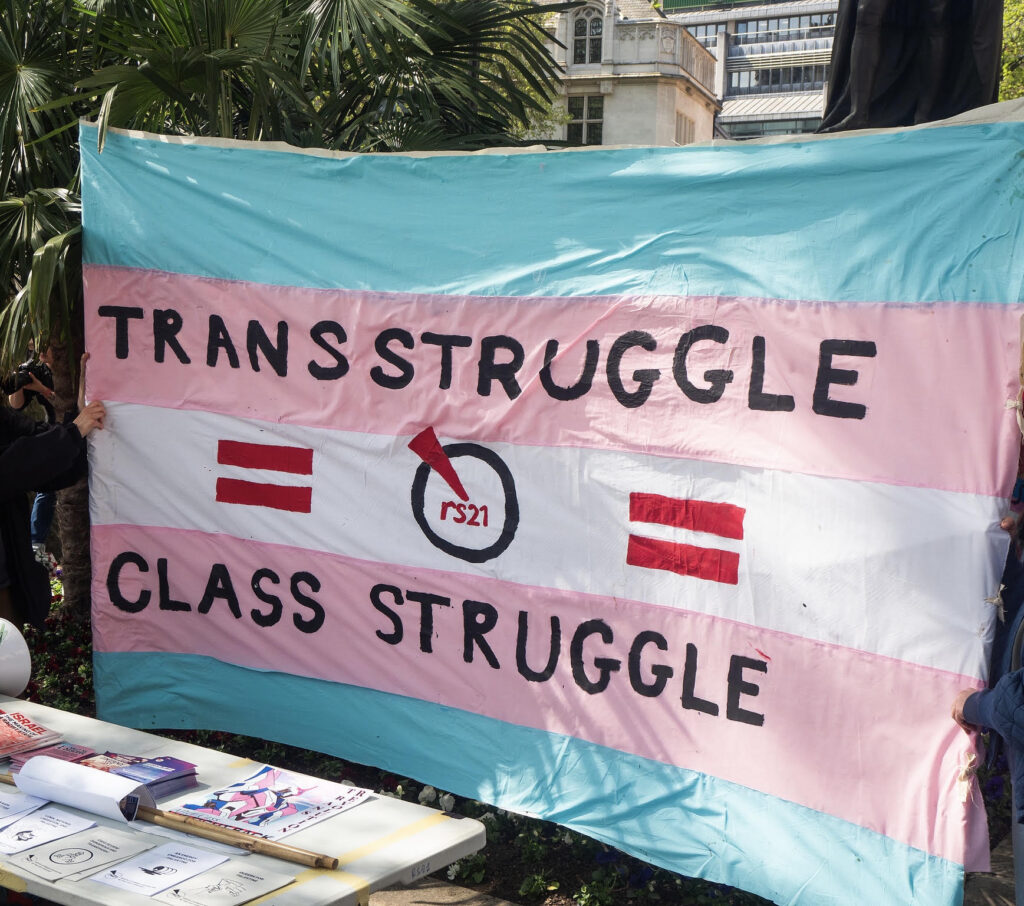
As state transphobia in Britain escalates, Fraser Amos argues that to escape the dead ends of trans liberalism and class reductionism we need to organise a class politics of trans liberation.
In a landmark ruling in April 2025, the British Supreme Court reinterpreted provisions of the Equality Act conceived as anti-discrimination protections into a mandate for transphobic exclusion. Britain’s Equality and Human Rights Commission (EHRC) has now issued guidance for services in implementing the ruling which threatens to segregate and exclude trans people from public space[1]. While the Good Law Project pursues important legal challenges to the guidance, what this means in practice won’t ultimately be decided in the courts or by equalities bureaucrats. How and to what extent organisations and the public comply will be decided through struggle. Coordinated action in workplaces, on the streets and in national politics has the power to render the guidance unviable.
Within three days’ notice of the Supreme Court ruling, a broad coalition of trade unions and queer and feminist movements, organised a demonstration in Parliament Square against the decision which to the surprise of organisers and the police drew around 30,000 people. Three months later, in July 2025, London Trans Pride saw an unprecedented 100,000 people turn out for a march which largely ‘broke with the neoliberal politics which have dominated queer organising for the last two decades’[2]. In the year since, activist groups like Trans Kids Deserve Better and The Dyke Project have sustained a campaign of direct action; while hundreds have joined the Trade Unionists for Trans Rights network to coordinate resistance to the implementation of transphobic guidance in workplaces.
The chants, demands and speeches heard at these mobilisations increasingly connect the dots between escalating attacks on trans people’s presence in public space, the campaign of everyday gender policing they sanction and the wider assault by the state on the bodily autonomy of the working-class, queers, women and racialised people. While these developments mark a hardening of state transphobia, they also reflect a growing understanding of trans liberation as a class struggle for the bodily freedom of everyone. A mass politics organised on this basis holds out real hope for building the coalition needed to confront the rising tide of reaction. Such a politics however faces twin obstacles.
Neither class reductionism nor trans liberalism
From our trade unions to political parties and social movements, a residual ‘trans liberalism’ constrains political imagination, stifles solidarity and deflects anger away from the ruling class. As Nat Raha wrote a decade ago, trans liberalism names the idea that ‘transgender rights are the solution to the problems facing trans people, and will enable our participation in (Western) capitalist society’[3]. It conceives liberation as winning legal equality, promising state protection through the criminalisation of interpersonal transphobia and specialist trans-specific service provision. This is a political common sense in which transphobia is an inherited individual prejudice, rather than a material part of the patriarchal reproduction of capital and the state. Its strength reflects decades of depoliticisation in which queer struggles have been overtaken by NGOisation, leadership assumed by influencers and activist networks devoured by identitarian navel-gazing.
At its best on the left, we find a trans liberalism supplemented by demands for economic equality, a politics of trans rights combined with redistribution well exemplified by Zack Polanski’s Green Party. At its worst, trans liberalism preoccupies us in litigating ordinary people’s personal beliefs and feelings about gender over building broad coalitions for bodily autonomy and the forms of organisation that expand people’s horizons in practice. Get lost in this moralistic quagmire, and we find ourselves locked into a ‘culture war’ on the terms of our enemies serving to divide and rule the working class.
Others on the left seize on this dead-end to argue that ‘trans issues’ are fundamentally minoritarian and threaten to derail coalition-building around majoritarian bread-and-butter demands. This is often described as ‘class reductionism’. Yet while it masquerades as hard-nosed class strategy, this orientation remains closer to bourgeois political science than meaningful class politics. Its one-dimensional conception of ‘class’ as a set of rational economic interests shorn of the gendered, sexual, and cultural texture of everyday life can hardly build a mass politics which speaks to the working class.
Any left coalition premised on the avoidance of the question of trans liberation will fracture on impact with the centrality of transphobia and transmisogyny to the rising tide of reaction it aspires to confront. This connection is not hard for our opponents to understand. The same far-right forces which want to make trans life impossible want to deport migrant and Muslim communities en masse, repress trade unions and extinguish socialist politics. The same state which deports migrants, criminalises Muslim political expression, subjects black and brown people to racist policing and restricts the right to organise and protest, now moves to force trans people out of public space.
Bodily autonomy and freedom from state violence are no less material class concerns than bread and butter ‘economic’ ones; they are an integral part of how class is lived. Meaningful bodily autonomy also means access to a warm home, good food, welcoming public space, relationships of care, creative labour and the means to secure them – things trans people are denied more than most. Demands for equal rights without material transformation ring hollow for the overwhelming majority of trans people exploited at work, reliant on social security or forced into bad housing situations.
At the same time, transphobic legal discrimination reinforces this economic and social exclusion. Class-blind laws function as a means of class oppression, with working-class trans people who struggle to buy themselves out of dependence on public services and spaces facing the full force of state transphobia. The fight for trans rights cannot be trusted to liberals; it is an inextricable part of class struggle, and this struggle is the route to trans liberation.
The cisness of capital
Trans oppression doesn’t persist simply due to interpersonal or even legal discrimination. Such discrimination reflects that under capitalism, labour and space are organised on a patriarchal basis. While capitalism promises abstract equality, it emerged from patriarchal class societies and relies on patriarchal forms of domination to reproduce itself. In the workplace, capital relies on paternalistic management control, infantilising and often feminising workers. In the state, the political rule of capital is underpinned by organised male violence of the military and police, and masculinist bureaucratic control. In the home, capital relies on patriarchal family relations to depoliticise and absorb the cost of the care work which reproduces the labour it directly exploits.
Wherever capital is accumulated, it organises life into these ‘separate’ spheres. Work that produces commodities is masculinised as ‘the economy’; work that reproduces labour is feminised as ‘private life’. Even where women have entered the formal economy, capital pays less for the commodified care work they have historically undertaken within the household for free. At times of crisis, women find themselves the first pushed out of the formal economy into the ‘home’ to care for the family.
The division between masculine ‘productive’ and feminine ‘reproductive’ labour is the material basis of the gender binary; the reason it can appear as natural and universal. What is implicit in this separation of spheres is its cisness. Trans people, and trans women in particular, often find themselves expelled from this division of labour – excluded from the formal economy, policed out of public space, and deprived of care within the family. Outside the formal economy, respectable public space and the bourgeois family, trans women are disproportionately likely to make a living through sex work, alongside poor, migrant and racialised women. Transfeminine sex workers of colour and street queens in particular have been at the militant edge of queer politics.
Capital’s cisness does more than just name ‘a pure binary of men and women’, but as Emma Heaney puts it ‘produces myriad racialised and classed categories of people whose communal indifference to the bourgeois mores of sex is deemed aberrant’[4]. Trans people, racialised workers and the global poor often share a common failure to embody this split between a masculine economy and a feminised private life. Capital holds this binary up as a universal ideal — a mark of civilisation and sexual respectability. But it was always a fiction for most: bourgeois ideals of masculinity and femininity originated in a separation of domestic and economic life only the wealthy could actually live. By the 19th century, strict conformity to the gender binary had come to signify whiteness, hardening into a category of race science. In this way, trans oppression and racialisation are not separate processes but conjoined aspects of patriarchal oppression under capitalism.
From a bourgeois perspective, the lives of impoverished, racialised and trans people are deviant and marked out for corrective state violence. This template for this violence was forged through colonial statecraft. Jules Gill Peterson has shown how the British Raj conducted intensive repression of Hijra in 19th-century India, criminalising their livelihoods and subjecting them to violent public defeminisation — a template for transmisogynistic state violence that followed[5]. Such violence is both an invitation and a warning: deputising some men to enact patriarchal violence with impunity, while threatening everyone with the same treatment if they fail to conform.
In the twentieth century this corrective violence extended into medicine, where cisness, like capital, confronts the human body as a limit to be overcome. From the 1910s in the United States, particularly white intersex people whose bodies were deemed sexually ambiguous were subjected to experimental ‘corrective’ procedures to shore up a racial ideal of binary sexual differentiation[6]. Ironically, these interventions demonstrated the variability and plasticity of sex, pushing medical cisness to seek refuge in a new distinction: between polymorphous bodily sex and binary psychosocial ‘gender’.
Feminist and queer struggles in the post-war period seized on the concept of gender to politicise sexual oppression as socially constructed. Some, particularly wealthy white trans people, were able to access therapies and surgeries originally developed as ‘corrective’ procedures on intersex people by asserting a mismatch between their gender and sex in need of correction. Over time more trans people have been able to use medical recognition of this mismatch as ‘gender dysphoria’ to secure access to gender affirming care.
However, even today, in the NHS as across much of the world, trans people face long, arduous and invasive processes to access hormone therapies and surgeries. Much of medicine simply ignores trans people’s own experience of their bodies, insisting on a binary model of transition. Medical cisness homogenises, pathologises and exceptionalises trans experiences of gender and their healthcare needs as radically alien from everyone else. In reality, trans people are at the sharp end of a healthcare crisis which denies timely, attentive and individualised care to the whole working-class and to women, racialised and disabled people in particular.
Medical cisness shores up a punishing ideal of ‘health’ shorn of real recognition of the needs and desires to which we are all subject. Capital determines our value by our productivity and our ease navigating a world built for its circulation and cisness first and foremost. Our ability to embody this ideal however is continuously undermined by capital’s exploitation of our bodies and minds, exhausting them and the relationships that sustain us. The whole working class is caught in this bind to one extent or another, with many disabled by it, and all but some of the wealthiest facing disability by old age.
Most trans people experience disability and transness simultaneously: the pathologisation of their transness simultaneously to the pathologisation of other aspects of their bodies devalued by capital. The battery of tests and hoop-jumping required to gain access to gender affirming care mirrors that needed to secure workplace adjustments for disability and access social security entitlements. Politically, we see that ableism and transphobia feed one other as reactionaries insists that autism and neurodivergence among trans kids demonstrate that transness is simply social confusion.
Trans kids and parents are the target of such moral panics. Where parents respect their kids’ desire to transition, reactionaries attack it as child abuse, demanding state intervention. Where parents obstruct transition, reactionaries invoke the sacrosanct rights of parents against any agency which might otherwise support the child. Beyond this political pressure, parents face enormous structural pressure to socialise children into cisness, often driven by a desire to protect them from social rejection, destitution and violence.
The state looks to the family to discipline children into conformity with the demands of capital and its cisgendered division of labour. As trans kids assert their gender for themselves, they throw into question their status as the property of parents, and the demands the state and capital make of parenting. Little wonder that trans comrades are disproportionately represented on the socialist and abolitionist left. Being trans in itself isn’t to resist capital, but it can threaten to disturb ‘private’ aspects of its reproduction within the family and in schooling, some of the earliest and most intimate ways we learn to submit to domination. Trans liberation threatens to expose the ubiquity of what Kay Gabriel calls ‘transsexual desires’, the desire ‘to have a certain embodied relationship to the signification of sexual difference, and to assert autonomy over that relationship’[7].
Trans liberation as class politics
This is what reactionaries sense when they condemn pronouns, gender-neutral toilets and inclusive sex education as gender communism. As absurd as such attacks might sound, they have a material basis and a mass resonance. Much of the world is organised as if cisness were natural and inevitable. Most people are raised with traditional ideals of gender which seem to offer certainty and a stable identity in a world that feels in freefall. This is what reactionaries are playing on by staging a ‘trans debate’ in the media centred on personal beliefs about gender. When they ask, ‘Do you really believe a woman can have a penis?’ they seek to evoke discomfort and disgust at the subversion of traditional gender and grant permission to cast off the guilt imposed by ‘woke elites’ for harbouring such feelings.
Reactionaries want nothing more than for us to play the part scripted for us and tie ourselves in knots over people’s personal feelings about gender. The venom of these debates is that they play on feelings of shame and disgust all too familiar to many trans and queer people. Making windows into souls shows us nothing we don’t already know. To accept that the ‘socially conservative’ are the enemy of trans liberation is to obscure the class character of trans oppression and foreclose possibilities for coalition building against the prime agent of transphobia: the ruling class. Chauvinists and racists are eager to seize upon apparent ‘social conservatism’ in migrant and Muslim communities as evidence of backwardness, justifying political exclusion and criminalisation.
Thinking about people as ‘socially conservative’ or ‘socially liberal’ is to do the work of bourgeois political science for it. Popular consciousness is as fluid and contradictory as social experience itself. Many cishet people hold what we might call ‘socially conservative’ views while recognising in trans and queer experience something of their own oppression; of how their own bodies, affects and desires are disciplined and denigrated by dominant gender norms. A class politics of trans liberation weaves together the different experiences of the working class into a tapestry that tells a story of shared struggle, showing that the liberation of trans people, Muslims, women and the working class as a whole are inextricably bound together.
The same state which attacks the bodily autonomy of trans people and pushes them out of public space systematically criminalises migrants through the hostile environment and Muslims through ‘Prevent’. While the far-right in Britain sees trans people as weakening the nation by corroding the traditional family from within, they see Muslim and migrant communities as undermining it from without. ‘Trans exclusionary radical feminism’ is a gateway drug to such far-right politics, with a terf group following the Supreme Court ruling turning its attention to tackling ‘the dangers of mass immigration for women’[8]. All the while, the border, police and prisons commit violence against women on an industrial scale, most of all against racialised and migrant working-class women.
Every one of the state’s incursions against the bodily autonomy of trans people strengthens its capacity to criminalise racialised and oppressed people and represents an attack on the class as a whole. Empowering male officers of the British Transport Police to strip-search trans women disproportionately affects trans women of colour and emboldens racist policing. Policing trans people’s access to toilets and gendered spaces means policing everyone’s conformity to patriarchal gender norms, especially butch women. Attempts to exclude trans women from women’s sport have been, at the same time, a racist policing of women’s physiology and hormone levels. The denial of puberty blockers to trans children when they have Gillick competence is a sharp curtailment of the freedom of children to shape major decisions about their lives.
We have every reason to expect increasing attacks on bodily autonomy in the coming years as the state seeks to tighten its control over working-class bodies. Periods of militarisation and imperial conflict such as the one we are now living through have historically been the greatest impetus for the extension of such control. We are already seeing increased military spending in Britain funded by cuts to disability benefits, public services and social provision on which trans, disabled, women, and racialised working-class people disproportionately rely. Reactionaries attack trans healthcare as an excess the nation can hardly afford in times of war, stirring a moral panic about the war-readiness of the population – of men and boys in particular – and the need for national service. In the reactionary vibe shift we see that militarisation is a social process demanding patriarchal gendered subjectivities, frustrated masculinities out of which to make body bags.
All across the world today, the drums of war are beaten by the forward march of sexual reaction. The imbrication between the imperial and patriarchal reproduction of capital in the domination of people the world over is increasingly a mass intuition. The ubiquity of the chant ‘one struggle, one fight: Palestine, trans rights’ speaks to the mass politicisation of trans and queer people through the Palestine solidarity movement and the inspiration of the Palestinian struggle since the start of the genocide.
Here we find the starting point for building a coalition for bodily autonomy which can outlive the Supreme Court ruling by connecting resistance to transphobic, patriarchal, racist and imperial state violence. As we organise for this in workplaces, communities and politics we must expose how the policing of trans life is central to the oppression of the bodies, expression and relationships of the class as a whole. Only a class politics of trans liberation can free us from the domination of capital, patriarchy and transphobia, and lead us to a world where the free development of each is the condition for the free development of all.
Photo credit: https://glass.photo/yung_beaujolais/5HcT0ekwgBMsReFoMHMjJ3
[1] https://goodlawproject.org/discriminatory-and-unworkable-trans-guidance-to-come-into-force
[2] https://revsoc21.uk/2025/07/28/london-trans-pride-a-historic-and-radical-protest/
[3] https://www.versobooks.com/en-gb/blogs/news/2245-the-limits-of-trans-liberalism-by-nat-raha
[4] https://www.jstor.org/stable/jj.14443783
[5] https://www.versobooks.com/en-gb/products/3054-a-short-history-of-trans-misogyny
[6] https://www.jstor.org/stable/10.5749/j.ctv75d87g
[7] https://www.are.na/block/7106265
[8] https://metro.co.uk/2025/04/23/terfs-anti-trans-victory-now-migrants-22951420/