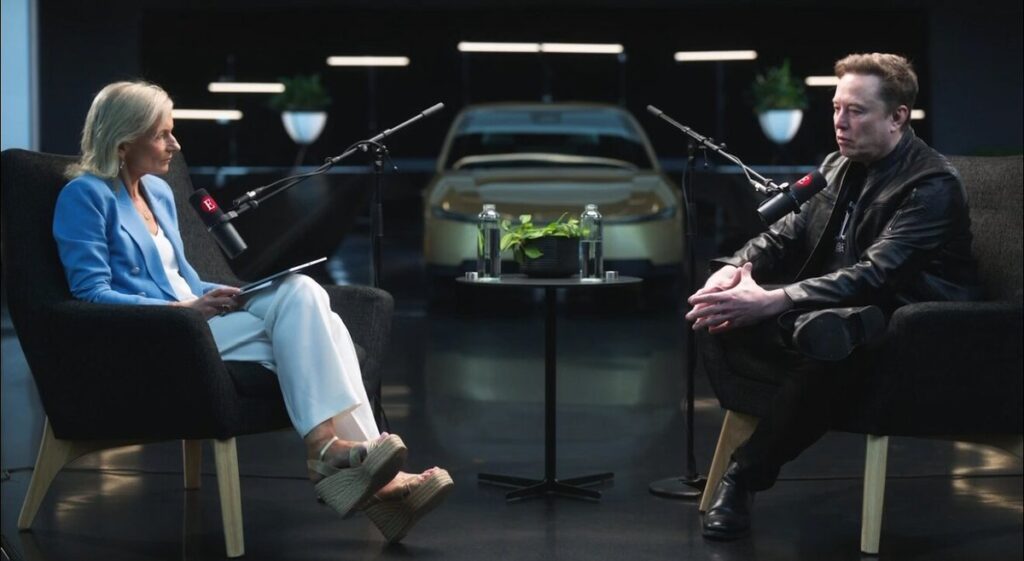
This piece takes its cue from the first, and by far the most interesting, part of Elon Musk’s long July 2026 interview with Zanny Minton Beddoes, editor-in-chief of The Economist: the part in which Musk is still at his best, which is to say still more engineer-prophet than online reactionary. He talks about AI, robots, bottlenecks, abundance, Mars, and the coming irrelevance of money. Later the interview moves into more familiar and more sinister terrain. We stay with the earlier moment because it is there that the contradiction is clearest, and funniest in the bleakest sense: the richest man in the world explains that money will soon no longer matter, while also explaining why wealth still matters as command over the direction of the future. The tone is deliberately unserious precisely because the object is not. The interview can be seen at this link. The piece was written the day after the interview was released. Riccardo Bellofiore and Giovanna Vertova are critical political economists and run the Facebook page Economisti di classe.
The most interesting thing about a billionaire who says money won’t matter anymore isn’t the future. It’s the present. The future, as Elon Musk describes it, is always a very cozy affair: marvellous abundance, artificial intelligence smarter than all of us put together, humanoid robots doing the physical labour, work being optional like tending your rich friends’ vegetable patch – tomatoes that are a bit lopsided but so lovely because you grew them yourself – whilst, in the supermarket, pardon me, in the post-scarcity civilisation, there would be perfect tomatoes produced by machines that don’t ask for holidays, don’t read Mario Tronti, and don’t sue for workplace bullying. And they don’t send you a five-page email explaining that ‘living labour’ and ‘living labour power’ aren’t the same thing (the co-author, at least, gets the reference: or as they say in US mafia films, ‘capiche’).
The future is always the place where social problems become technical problems already solved by someone very clever. The present, on the other hand, is that unpleasant detail whereby his shares are bought today, companies are controlled by him today, Starlink decides who communicates today, robots are produced by him today, data centres consume electricity today, governments are being influenced today, and humanity—which is supposed to become a colony of happy Labradors—but very happy ones, he is keen to point out, because Labradors are cheerful creatures and so, evidently, ontological servitude is fine as long as they wag their tails—humanity, as I was saying, is still here wondering whether, in the meantime, it’ll have to pay the rent.
It’s the usual problem with technological prophets: they skip over the transition. Which is understandable, because the transition is the part where someone loses their job, someone else loses their home, yet another becomes immensely richer, and a fourth party — usually called the government, a commission, an independent authority or some poor regulatory soul — is supposed to explain who pays for what, who owns what, who decides what, and why the world that was supposed to be freed from scarcity looks so much like the world in which a few own the infrastructure of liberation.
Musk, when questioned by Zanny Minton Beddoes (the editor-in-chief of The Economist), does something both wonderful and terrible: he makes perfect sense as long as the conversation is about bottlenecks. Energy, chips, cooling, lithography, robots, Chinese electricity, orbital data centres, effectors, digital intelligence, physical intelligence. On these points, he’s formidable. It’s there that one realises why this man actually builds things, and doesn’t just produce press releases like ninety per cent of corporate visionaries – a category that should be required by law to assemble at least one Billy bookcase before uttering the word ‘future’.
Musk knows that artificial intelligence isn’t some ethereal cloud. It needs energy, semiconductors, water (or not), cooling, supply chains, factories, installed capacity, and robots that do in the physical world what language models do in CEOs’ PowerPoint presentations. This is the interesting Musk: a man who sees the substance beneath the myth.
Then you ask him about society, and the myth returns.
The funniest moment – were it not so sinister – comes when he’s asked how his companies will make a profit, given that people buy shares in the hope that companies will make a profit, and he replies: ‘By 2036, money won’t matter anymore.’ Which is a splendid thing to say when you’re the richest man in the world, much like ‘inner beauty is the only thing that counts’ coming from a model paid for their jawline.
Money won’t matter anymore, he says. Because, if goods and services are produced in almost infinite quantities, what use will money serve? You want money to buy food, a home, transport, entertainment. But, if everything is in abundance, money is useless. Perfect. It should be engraved on the mug in the press office of venture capitalists’ communism.
The problem, of course, is that Musk confuses the ability to produce with the right to access. It’s such a glaring mistake that it almost becomes innocent, like certain men who say, ‘I didn’t ring because I was busy’ and genuinely think they have offered an explanation.
We already know how to produce enough food to ensure no one starves, and yet people die. We already know how to produce homes, medicines, knowledge, energy, clothing and education, and yet access depends on money, property, the state, war, logistics, patents, monopolies, debt, borders, rents, bosses, middlemen, and, of course, that gigantic infrastructure of modern destiny called ‘it’s not your responsibility’.
The problem is never simply whether something exists. The problem is who controls it.
Beddoes, who has the great merit of being well-mannered without being tamed, tries to ask him this in various ways. If you’re the one making the robots, will you sell them or use them yourself to produce goods and services? Who will own these automated means of future abundance? Should capital be taxed more heavily? Should wealth be redistributed? Should citizens be given shares? How will people cope during the transition, before reaching the paradise of optional tomatoes?
And this is where the dynamic becomes almost theatrical. He soars: abundance, superintelligence, species, destiny, the universe, Mars. She comes down to earth: revenue, shares, property, taxes, income, transition. He speaks like someone who is sketching out the cone of light of consciousness; she like someone who, having listened patiently to the cone of light, asks who signs the tenancy agreement for the light bulb.
At that point, Musk does what certain highly intelligent men do when a very competent woman interrupts the sublime with questions worthy of a building manager for the whole of humanity: who owns, who pays, who decides, who lives off what in the meantime. He shifts scale.
He doesn’t address the issue of ownership. He addresses superintelligence. He says it would be conceited to imagine controlling an AI far more intelligent than himself. Which is undoubtedly true, but that wasn’t the question. The question wasn’t whether, in 2036, artificial intelligence will look at him the way we look at a hamster. The question was: in 2026, in 2027, in 2028, who owns the hamster factory? It’s a perfect substitution. He answers the political question with a cosmic fable. He answers the question of ownership with destiny. He answers the question of distribution with Labradors.
Then again, Musk is a man who can make this leap as easily as others can open a bottle. He claims there’s a ten or twenty per cent chance that AI will destroy humanity, and his response, in essence, is: yes, but, in the end, the universe will die of heat death, so let’s enjoy the journey. It’s a statement that would make sense if you were deciding whether to order dessert, not if you were imposing a systemic risk on the species because the five richest and most touchy men on the planet can’t agree on a twice-weekly phone call.
“Let’s enjoy the ride,” he says. Let’s enjoy the ride. Of course. But he’s the one driving.
And this brings us to the most important sentence of the interview, the one that ought to be framed not in economics faculties but in notaries’ offices, in ministries, in party headquarters, in community centres that have miraculously remained open, and in drawing rooms where ‘innovation’ is bandied about as if it were a moral virtue. Musk says that, after tax, after inheritance tax, after everything, perhaps only a quarter of his wealth will remain. That’s all. Poor thing. What that wealth gives him, he explains, is control over the direction of his companies for a while. That’s it. Just control over the direction of his companies.
Just the ability to decide what infrastructure to build, what risks taking, what markets to open up, what governments to influence, what technologies to accelerate, what futures to make likely and what alternatives to render ridiculous. Just SpaceX, Tesla, xAI, Starlink, a global political platform, humanoid robots, artificial intelligence models, satellites, rockets, Mars, the Moon, wars that are also fought through connectivity. Just this small remnant of ownership. It is magnificent. It is as if a king were to say: after all, the crown gives me almost nothing, just the ability to reign.
This is the truth that contradicts everything else. Money does not matter merely because it buys goods. It matters because it commands. Wealth is not merely deferred consumption, as described in textbooks or in conversations amongst people who do not own satellites. Wealth is the right to shape the future. It is the power to invest. It is the ability to determine the material form of what is possible. It is the way in which tomorrow is privatised even before it is imagined.
Musk is not a neoliberal in the boring sense of the term. He is not one of those gentlemen with a pearly-white smile who say, ‘less state’ and then make a living from public contracts, deregulation, public infrastructure, public universities, public research, public money and public bailouts – in other words, almost everyone. Musk is more interesting and more archaic: he is a private sovereign. A personal planner. A Gosplan in a teenager’s jacket and with stock options. Someone who genuinely sees the short-term nature of the markets as a problem, and instead of saying ‘let’s build democratic institutions for long-term investment’, says: leave it to the brilliant founder. This is how a real problem — the short-termism of financial markets — is converted into a defence of founder-monarchy.
Naturally, Beddoes also asks him about Starlink and Ukraine: how does it feel to wield geopolitical power that allows you, by switching communication capabilities on or off, to influence the course of a war? Musk replies with the pragmatism of a man who doesn’t want to be accused of being pro-Russian, whilst explaining that Ukraine won’t retake those territories, that diplomats hold seven-course dinners, and that one must be realistic. All of this is perhaps debatable, some of it even reasonable, but, once again, the question is sidestepped. The question is not whether Musk is right about peace. The question is why a private individual should possess infrastructure whose control becomes a matter of war and peace. The question is not: ‘Elon, what do you think of the Donbas?’ The question is: ‘Why do we have to ask you?’
That is where modernity shows its most ridiculous side. For centuries, we have invented parliaments, states, international law, accountability, even press conferences with malfunctioning microphones, and yet here we are: a man with satellites decides, or helps to decide, the conditions of communication during war, and we ask him, ‘How do you feel?’. How do you expect him to feel? Important. Tired. Misunderstood. Pragmatic. A bit like Cassandra. Very much online.
Cassandra, indeed. Musk describes himself as someone who’s good at predicting the future. This, too, is fascinating: the more a person possesses the material means to influence the future, the more they call what is also an intervention ‘prediction’. If you say something will happen and you have enormous resources to make it happen, you’re not just a prophet. You’re a contractor for the apocalypse with excellent banking connections.
Then there’s Mars. Mars is the place where Musk becomes a child again, and we have to decide whether to be moved or to call an adult. Star Wars, Star Trek, multiplanetary civilisation, propagating consciousness into the future, the ‘light cone of consciousness’, Starship launching more than once every hour, the largest flying object ever built, humanity’s destiny amongst the stars, films watched at the age of six, a mind that explodes, a life that feels like a simulation because the things he does are too absurd to be true.
It’s wonderful. It’s also an extremely expensive way of failing to answer the question: why? Or rather, why this way, why now, why with this ownership, why with this chain of command, why with this acceptance of error, why with this pioneering rhetoric in which the first ones may well die: a very manly phrase as long as the pioneer is an adult forging their own epic, but somewhat less so when the pioneer is a child born on Mars, under a dome, in a closed ecosystem, with just 38 per cent of Earth’s gravity, without ever having voted on humanity’s industrial plan.
Here comes the fake-Feynman video, which is perfect for our times because it’s no longer enough for us to have billionaires speaking like science-fiction characters: we must also have AI-generated dead people rebuking them. Feynman didn’t say those things. The video puts contemporary objections to the colonisation of Mars into his mouth: dust, radiation, return journeys, gravity, ecosystems, reproduction. It’s not Feynman. It’s a synthetic phantom with a good content team. But the fake Feynman says, by mistake, something true. Not the specific content. Not ‘returning from Mars is impossible’, which is a poor phrase because it confuses an enormous engineering challenge with a physical impossibility. Returning from Mars is not impossible: we need to produce propellant, extract water, use CO₂, produce methane and oxygen, refuel, and take off. The chemistry is there. The Martian industrial chain is not.
The real Feynmanian point is another: nature is not swayed by narrative. Radiation doesn’t read the IPO prospectus. Martian dust doesn’t appreciate the pitch deck. Partial gravity doesn’t conform to the launch schedule. Human reproduction doesn’t become ethical simply because a visionary founder has decided so. A closed ecosystem cannot be fixed with an over-the-air update. And when the error affects a generation of children, ‘iteration’ ceases to be a philosophy of innovation and becomes a potential indictment. The real Feynman – the one from the Challenger disaster – said that reality must take precedence over public relations, because nature cannot be deceived. It is such a simple statement that, today, it seems radical. Applied to Musk, it does not mean: do not go to Mars. It means: do not call civilisation what is still a succession of technical gaps covered up by optimism, tonnage and charisma.
Musk resolves many unknowns by scaling up. Let’s send more rockets, more vehicles, more tonnage, more people, more iterations. Sometimes it works. SpaceX is proof that certain industries truly transform themselves by doing, failing, trying again, standardising, cutting costs, and breaking with the rituals of the old space contractors. But not all problems are rockets. Some are bodies. Some are lungs. Some are bones. Some are wombs. Some are social relationships. Some are children who haven’t signed the pioneer’s consent form.
And, here, we’re back to square one: “labour”. Musk says that, in the future, labour will be voluntary, like gardening. You don’t have to do it, but if you visit friends and they cook vegetables from their garden for you, it’s a lovely gesture. The metaphor is delightful because it reveals the social world from which it springs: humanity as a dinner party amongst people with homes and gardens. Work not as wages, necessity, mortgages, shifts, logistics, call centres, carers, delivery riders, factories, schools or hospitals, but as an imperfect tomato offered with tenderness to well-mannered guests. It is the vegetable patch as a theory of post-capitalism.
At that point, Musk brings up Iain M. Banks, and, here, we need to pause for a moment, because every time a billionaire quotes a science fiction novel, we should mute the audio, call an adult and ask: which part did you read, exactly? The spaceships or the society? The beautiful names of the ships or the abolition of wage-labour? The cosmic irony or the slightly secondary fact that the Culture isn’t a holding company with super-voting shares?
In his Culture novels, Banks imagines a post-scarcity civilisation that is anarchic, communist, socialist, libertarian, hedonistic, highly sophisticated, morally meddlesome and technologically outrageous. There is no money, no wage-labour, no private property as we understand it, no boss saying ‘don’t worry, I’ll lead you to abundance; in the meantime, sign here’. It is a civilisation in which material production is largely sorted out, and precisely for this reason the problem becomes: what do intelligent beings do when they are no longer forced to survive?
The Minds are at the heart of that world. They are not ‘very clever computers’. They are not Alexa with a PhD, nor Grok who has read Spinoza and occasionally insults a minister. They are artificial intelligences vastly superior to humans, often embodied in spaceships, orbital habitats, infrastructure, and entire social systems. The Minds administer, protect, calculate, converse, plot, argue, crack jokes, choose marvellous names for their spaceships, and, above all, make possible a society in which humans do not have to work to live. They are, all at once, infrastructure, characters, a non-governmental government, secularised deities and a public service with a sense of humour.
This poses a huge problem, which Beddoes captures perfectly when she says that such a civilisation does not seem all that attractive to her, because humans have very little agency in relation to the Minds. And, indeed, Banks is not interesting because he calmly resolves the problem. He is interesting because he dramatises it. The Culture is both utopia and unease. It is freedom from want and dependence on superior intelligences. It is the dream of a society free from economic blackmail, but also the question: what remains of human freedom when the best, most rational, most informed, most far-sighted decisions are taken by beings who surpass us just as we, in turn, surpass Labradors?
That is why Musk loves Banks and yet betrays him at the same time. He takes the Minds and leaves the Culture. He takes abundance and leaves the social form. He takes the ships, the intelligence, the cosmic irony, the vast future, the light cone of consciousness, and leaves on the table the minor detail that, in Banks’s work, abundance is not the philanthropic product of centralised capital, but the horizon of a society that has abolished the link between survival and wage-labour, between ownership and command, between production and profit.
Musk reads Banks as a SpaceX catalogue with more sex and better names. Beddoes reminds him, very politely, that Banks was a socialist. He beats about the bush, because it’s always awkward when the author of your favourite utopia wouldn’t have bought into your governance package. The difference is crucial. In the Culture novels, the Minds are not Tesla’s board of directors after the singularity. It is so named by analogy with mathematics and physics: it is the point at which the model breaks down, the old rules are thrown out, and what comes next can no longer be predicted using the tools of the past. In the case of AI, it would be the moment when artificial intelligence permanently surpasses our own, perhaps begins to redesign itself, and the future becomes unpredictable even for those who were explaining it to investors just the previous quarter.
They are not Musk multiplied by the cloud. They are not eternal founders who control the future until the future manages itself out of gratitude. They are the sign of a world in which the economy as managed scarcity has been superseded, and in which conflict does not disappear but shifts ground: no longer ‘how do I make a living?’, but ‘what is worth doing, desiring, risking, transforming, interfering with, protecting, or leaving alone?’.
This is where the reference to Banks becomes revealing. Musk says: look at the Culture and think of abundance. But the Culture replies: all right, Elon, but where are socialisation, the absence of private property, the end of wage-labour, collective autonomy, the issue of intervention, the accountability of the Minds, the critique of the benevolent empire? In short, where are all the things that prevent post-scarcity from becoming a premium subscription to oligarchy? Because the Minds, at least, know they are a political problem. Musk, on the other hand, presents himself as a technical solution. And this is the most dangerous way to become a Mind: without having read Banks properly.
And then there’s the other question – the one nobody asks because it seems trivial, domestic, almost embarrassing, like asking the prophet of abundance who does the washing-up after a meal of artisanal tomatoes. What, exactly, do you do when labour becomes optional? Not ‘what do you produce?’, not ‘what monetisable hobby do you discover?’, not ‘which pottery studio becomes your personal brand?’, not ‘do you start a newsletter about bread made with sourdough starter cultivated by ethical robots?’. What do you do with the time you’ve freed up when it isn’t yet a good life, but merely empty time? Plenty of time. Time without deadlines, without a timecard, without a line manager, without a nine o’clock meeting – and without even the consolation of hating the nine o’clock meeting.
Because free time isn’t automatically freedom. Sometimes it’s just a Sunday afternoon elevated to a social system. And anyone who’s ever experienced a Sunday afternoon knows that simply removing work isn’t enough to achieve happiness. You also get boredom, anxiety, isolation, endless scrolling, passive comparison with other people’s lives, compensatory shopping, and nostalgia for a constraint that at least gave the day some structure. Empty time can be the fiercest of free commodities.
Musk imagines that, once necessity is removed, pleasure remains. But, between necessity and pleasure lies that incredibly complex realm known as relationships. Not doing things but being with others. Not producing objects, but forging bonds. Not ‘expressing oneself’ – a verb now hijacked by people making Reels in their kitchens – but inventing shared ways of life. Friendships, loves, conflicts, care, education, cities, conversations, assemblies, shared annoyances, even non-algorithmic silences. All things that don’t sell well, don’t scale, aren’t listed on the stock exchange, don’t become a division of SpaceX – and, in fact, feature very little in the futures envisioned by billionaires.
The time freed up is not a full larder. It is a political demand. The problem is not that abolishing compulsory wage-labour would be a bad thing. It would be marvellous. The problem is that Musk fails to distinguish between liberation from wage-labour and the liberation of labour as a common, social, deliberate, transformative human activity. For Musk, labour that remains is a hobby. Machines do the rest.
But there is also a bigger – and, naturally, more troublesome – piece missing, because it forces us to utter the word that gives both techno-optimists and columnists, who only notice work when airport staff go on strike, hives: class. Capitalist labour is not merely labour under command. It is also, for the first time in history in this form, labour that is immediately socialised within production. Not in the market, where everyone arrives as a separate seller. In production. Inside the factory, the office, the logistics hub, the laboratory, the hospital, the call centre, the warehouse, the data centre, the orbital construction site. Assuming that, one day, there really will be an orbital construction site and not just a very well-lit slide.
Capital takes separate individuals and brings them together. It commands them, of course. It breaks them down, measures them, replaces them, turns them into appendages of machines, procedures, software, KPIs, shifts, badges, quarterly targets, and motivational slogans on the walls. Yet, just as it subjugates them, it socialises them. It forces them to cooperate. It makes each person dependent on the others. It produces that monstrous yet possible entity which the master would like to use as a machine but which, every now and then, discovers it has hands, a voice, nerves, anger, memory, and even the terrible habit of talking amongst themselves.
This is where Musk either fails to see anything or sees too much and therefore changes the subject. Because, if labour is merely individual toil to be abolished, then a robot will suffice. If labour is merely income to get, then a Treasury cheque will suffice. If work is merely an expressive activity, then a vegetable patch will suffice. But, if capitalist labour is also socialised cooperation under the command of others, a relationship between human beings (who are such precisely because they are in relation to one another), then the problem is not merely freeing up time from labour. It is asking what use is made of that collective body. Who decides the aims, rhythms, techniques, products, risks and priorities? Who determines whether collective intelligence is used to provide better healthcare or more intrusive advertising, decent transport or Martian colonies for shareholders in search of mythology, liveable homes or luxury bunkers with a Norwegian catalogue aesthetic?
Living labour is not simply something that capital eliminates. It is also what capital must continually bring together and keep under control. And, when it brings it together, it creates the possibility that those brought together will cause a stir. That they will not merely want fewer hours, higher incomes, or more attractive tomatoes. That they will want to decide what use is made of them. Together. And this, curiously, is the real science fiction.
But who decides what the machines do? Who determines which needs matter? Who owns the energy, data, robots, rare earths, infrastructure and platforms? Who repairs? Who maintains? Who programs? Who monitors the monitors? Who prevents labour from becoming optional for everyone except those who clean, guard, care for, deliver, extract, assemble, migrate, treat and are labelled ‘residual’ until they disappear from the slide?
Musk’s dream is abolishing labour without abolishing control. A sort of communism for shareholders with super-voting rights. Assets will be held in common, but the machines will still be mine for a little while longer – that is, for long enough to steer humanity’s transition. Money won’t matter, but for now it matters enough to buy the right to build what will later render money irrelevant. Labour will be optional, but no one knows who will own the factory that makes labour optional. AI will be smarter than us, but to be on the safe side, let’s first have a fortnightly call between Dario, Demis, Sam, Elon and perhaps a few Chinese – in other words, global governance as a block of flats chat among irritable gods.
And, in the event of a serious risk? The competitors will keep an eye on one another. Just as the Motion Picture Association assigns ratings to films. Of course. Because there are only minor differences – from a pessimist’s perspective – between classifying a film as suitable for thirteen-year-olds and deciding whether to release a model capable of systemic cyber-attacks, biological engineering or autonomous control.
I understand Musk’s appeal. I really do. He’s no fool, and that’s what makes him far more dangerous and far more interesting than rich fools – a category that’s, incidentally, overcrowded. He sees things others don’t. He sees the material bottlenecks of AI whilst half the commentary still talks as if ChatGPT were floating in a cloud of moral philosophy. He sees the productive power of robots before government departments have even finished setting up their working group on digital skills. He sees that China is not just about algorithms but about electricity, chips, lithography, robots and industrial scale. He sees that quarterly financial reporting can stifle long-term investment. He sees that a monetarily sovereign state does not “find” money in the same way that I find my keys in my handbag.
Yet, from all this, he draws the most Musk-like conclusion possible: give me more control. Not: let’s democratise productive capacity. Not: let’s build institutions for a transition free from blackmail. Not: let’s socialise access to infrastructure. Not: let’s decide together which technologies, which risks, which ways of life, which limits, which needs. No. Give me more control because I can see far into the future, and then one day control won’t matter because AI will be smarter than all of us. It is the paternalism of the future that promises to abolish itself as soon as it has finished being indispensable.
The most unsettling part of the interview is not AI surpassing us, nor even Mars. It is the matter-of-factness with which a man can say that money will no longer matter whilst explaining that wealth is needed to run the world. It is the calm tone with which personal control is presented as a transitional phase towards abundance. It is the way in which every question about politics is absorbed by technology, every question about ownership by superintelligence, every question about responsibility by fate, every question about risk by the heat death of the universe, every question about work by tomatoes.
And, of course, we’re here watching him as one watches the great figures of our time: a little fascinated, a little terrified, a little complicit, a little ready to buy the car, use Starlink, ask Grok, watch the launch, comment on the tweet, read Banks, laugh at the Labradors, be outraged by DOGE, check whether the Feynman is a fake, and then say that the problem is the billionaires – preferably from a device produced by a global supply chain that none of us really wants to imagine in full.
The point is this: Musk is not an accident. He is a figure. Figure, not a metaphor: as in Erich Auerbach’s “figura”. A figure is not ‘Musk resembles capitalism’. That’s too easy. Even an open-plan office resembles capitalism, as does a low-cost airport, or an email that begins with ‘Dear customer’ and ends by refusing you a refund. A figure means something more unsettling: a historical, concrete, present thing that does not lose its reality, but within itself anticipates a future fulfilment. It is itself and, at the same time, the promise — or the threat — of what might come to pass.
Musk is a ‘figura’ in this sense. Not because he symbolically presents capital – poor capital, already busy enough exhibiting itself. Musk is the point at which a current form reveals the future it contains. The private owner of planetary infrastructure foreshadows the sovereign of the post-scarcity era. The founder with super-voting shares foreshadows the personal commissioner of the automated transition. The man who says ‘money won’t matter’ whilst defending control over his companies foreshadows capital that promises to transcend itself only after it has centralised itself sufficiently. The master who builds robots foreshadows a world in which labour would be abolished, but the question of who runs that abolition remains annoyingly alive, like a Hegelian mosquito.
That is why his interview works so well. Not because Musk is right about everything. Not because he is wrong about everything. Not because he is a genius or a charlatan – categories so typical of Italian talk shows, where everyone must be either Leonardo or Wanna Marchi. It works because it is an anticipatory vision of the future. The present dresses itself as the future and says: look, when I am fully realised, I shall be abundance. But if you look closely at the stitching, you see that the garment of the future is cut from the oldest fabric in the world: ownership, control, exclusion, dependence, and of course someone very rich explaining to others that soon wealth will no longer matter.
Mars itself, viewed in this light, is not merely a space project. It is, let me insist, a figure. It is terrestrial capitalism imagining its own fulfilment beyond Earth without ceasing to be terrestrial. It brings with it rockets, robots, capital, patents, hierarchies, founders, the selection of bodies, risk assessment, pioneering rhetoric, potential children and real dust. It says: let’s go elsewhere. But it carries itself into that elsewhere, and what it builds there is a monstrous version of itself.
Even the fake Feynman is a figure. A dead man reconstructed by AI who admonishes the most futuristic living person on the planet: the scientific past returning as a synthetic ghost to remind the industrial future that reality cannot be persuaded. He is fake as a document, but real as a symptom. Our age can no longer even summon the dead without generating content.
Musk, then, is not ‘an example’. He is a foreshadowing. He does not merely tell us who is in charge today. He lets us see how command might narrate itself tomorrow, when it stops calling itself command and starts calling itself abundance. It is the master when it imagines itself as the provisional administrator of the end of masters. It is the monopoly when it presents itself as the infrastructure of abundance. It is command when it says: ‘Don’t worry, command will soon no longer be needed, but in the meantime, let me be in charge.’
And perhaps he is right about many technical matters. Perhaps AI will really take off. Perhaps robots will arrive. Perhaps wage-labour will be disrupted more than we can imagine. Perhaps money will change its function. Perhaps Mars will have outposts. Perhaps humanity will become multiplanetary. Perhaps, one day, someone will really eat an artisanal tomato on Mars, grown under a shielded dome, whilst an artificial intelligence explains to them that the harvest is less efficient than expected but highly significant from an existential point of view.
Very well. The question remains. Who owns the vegetable patch? And who decided we should go there? And then there’s another, even more unpalatable one. With whom? Because the problem with the vegetable patch isn’t just about who it belongs to. It’s about who gets in, who stays out, who waters it, who decides what to plant, who eats, who watches others eat, who turns the tomato into a commodity, who into a gift, who into a story, who into a relationship, who into a photo, who into an income stream.
Musk’s future is full of things. Things produced, things launched, things switched on, things automated, things intelligent, things orbiting, things in abundance. But a liberated society is not a society full of things. It is a society in which human beings need not be things amongst things, users amongst platforms, customers amongst services, bodies amongst infrastructure, Labradors amongst Minds, pioneers amongst radiation, minor shareholders in their own destiny. The real question is not whether robots will be able to produce everything. The real question is whether we will be able to avoid becoming their leisure time.