PART TWO
Read here: PART ONE, PART THREE, PART FOUR
You can download entire dossier as single pdf file here
The Critical Balance Sheet on Actually Existing Stalinism
If we wish to thoroughly criticise Rockhill’s approach, we must confront the historical legacy of Stalinism. Throughout Rockhill’s work, there is an uncritical adulation of “AES”, past and present alike. He presents the Soviet Union, China, and similar states as principled opponents of imperialism and steadfast champions of world revolution. For Rockhill, criticism of AES is not merely mistaken but practically verboten – tantamount to treason against the revolution, and, at times, indistinguishable from a CIA psyop. But this rose-coloured view of the Soviet Union, China, and related regimes obscures the repeated double-crossing of anti-imperialist and workers’ struggles by Stalinism itself. These historical facts cast serious doubt on the revolutionary credentials of “Marxism-Leninism”.
Part of the tragedy of Stalinism is that it often drew into its orbit some of the most devoted, idealistic, and committed militants of the working class and oppressed. These cadres joined Communist Parties to organise workers, combat oppression, and fight fascism. But their loyalty to the Comintern and the USSR did not necessarily translate into loyalty to communism. In countless instances, militants became unwitting agents of reaction despite their revolutionary intentions. The catastrophe of Stalinism lies here: that so many of the best and brightest saw their ideals weaponised against the very causes for which they struggled. Nearly a century of betrayals followed, and we address several of the most consequential below.
A) China
Considering that Rockhill is a vociferous defender of the PRC, he should be aware of how the Soviet Union undermined the Communist movement there during the 1920s. While China was in the middle of a great upheaval against imperialism, feudal landlords, and capitalists, the Comintern under Stalin directed the Communist Party of China (CPC) to subordinate itself to the Kuomintang (KMT). The KMT was dominated by landlords and “progressive” capitalists who were said to represent a necessary stage in the unification of China. The Comintern justified this policy, since the KMT was seen as a reliable ally to the Soviet Union. Yet this meant that, in the great struggles of the 1920s, the revolutionary activities of Chinese communists were constrained by its need to not antagonise the KMT. The Comintern advisor Mikhail Borodin described the policy in racist terms as follows: “The present period is a period in which the Communists should do the coolie service for the Kuo Min Tang [sic]”.[1]
Despite the efforts of the Chinese communists to hold back popular struggles, these erupted nonetheless. Alarmed by such upheavals, the KMT leadership planned an annihilation campaign against the Communists. But, even as Trotsky and CPC members pushed to break with the KMT, Stalin insisted that the alliance be preserved at all costs. The outcome – long foreseen – was the 1927 massacres of urban communist cadres and trade unionists. The CPC was subjected to a devastating White Terror, and many of its most brilliant and dedicated militants were slaughtered. As Isaac Deutscher wrote, the Chinese Revolution was sacrificed to the interests of the Soviet bureaucracy and “socialism in one country: “Thus the Chinese communists were made to pay their tribute to the sacred egoism of the first workers’ state, the egoism that the doctrine of socialism in one country had elevated to a principle. The hidden implications of the doctrine were brought out and written in blood on the pavements of Shanghai”.[2]
B) Germany
Perhaps the greatest tragedy world communism suffered due to Stalinism occurred in Germany. After the Great Depression began in 1929, mass unemployment and political instability created significant revolutionary opportunities throughout the world. Nowhere was this more apparent than in Weimar Germany. The Communist Party of Germany (KPD) was the largest Communist party outside the USSR and was poised to make major political advances. However, the Depression also enabled Hitler and National Socialism to gain mass support. It was not long before Hitler was a serious contender for political power – along with being an existential threat to the KPD and the German workers’ movement.
Unfortunately, the KPD was largely blind to the Nazi menace and refused to form a united front with the German Social-Democratic Party (SPD) to stop them. The KPD’s strategy was shaped by the Comintern’s Third Period line adopted in 1928. Stalin argued that the SPD was the greater threat and condemned them as “social fascists”:
There is just as little ground for thinking that Social-Democracy can achieve decisive successes in battles, or in governing the country, without the active support of the fighting organisation of the bourgeoisie. These organisations do not negate, but supplement each other. They are not antipodes, they are twins. Fascism is an informal political bloc of these two chief organisations; a bloc, which arose in the circumstances of the post-war crisis of imperialism, and which is intended for combating the proletarian revolution.[3]
This line meant that the KPD would direct its main fire against the SPD, not Hitler and the Nazis.
As the political situation in Germany reached a boiling point, Trotsky warned that, without a united front between the workers’ parties they would be completely decimated. He stated in December 1931: “Worker-Communists, you are hundreds of thousands, millions; you cannot leave for anyplace; there are not enough passports for you. Should fascism come to power, it will ride over your skulls and spines like a terrific tank. Your salvation lies in merciless struggle. And only a fighting unity with the Social Democratic workers can bring victory. Make haste, worker-Communists, you have very little time left!”[4]
Nonetheless, the KPD remained largely aloof in recognising the danger. As party leader Ernst Thälmann said: “Nothing could be more fatal for us than to opportunistically overestimate the danger posed by Hitler-fascism”.[5] In effect, the KPD treated the Nazis’ rise as a symptom of German capitalism’s imminent demise. Hitler’s ascension, they believed, would only be short-lived before the inevitable proletarian revolution. Or, as the attitude went: “After Hitler, us!”
Upon Hitler becoming Chancellor in January 1933, the KPD, SPD, and the entire German left was simply crushed. A Nazi dictatorship was swiftly established, and the largest workers’ movement in the world was defeated without firing a shot. In the face of this world-historic catastrophe, the Comintern offered no critical summation. On the contrary: it proclaimed that the KPD had followed the correct line from beginning to end. The Comintern declared on 1 April 1933: “Having heard Comrade Heckert’s report on the situation in Germany, the presidium of the ECCI states that the political line and the organisational policy followed by the CC of the Communist Party of Germany, with Comrade Thaelmann [sic] at its head, up to the Hitlerite coup, and at the moment when it occurred, was completely correct”.[6]
For Trotsky, the Comintern’s debacle in Germany was equivalent to the betrayal of the Second International in August 1914. Essentially, the Stalinist leadership of the USSR and the Comintern had not only failed a world-historic test; they proved completely incapable of drawing any critical balance sheet. This convinced Trotsky that the Soviet bureaucracy could not be reformed and led him to call for independent Marxist parties and a Fourth International to replace the Third. Losurdo and Rockhill portray the USSR and Stalin as an anti-fascist force, but they largely ignore how the Comintern helped Hitler rise to power in the first place.
C) Spain
In some ways, the Comintern’s shift to the popular front after 1935 marked an even more epochal change than the Third Period. In the name of defending the Soviet Union and combating fascism, communist parties advocated “popular fronts” that included social democrats, liberals, and even conservatives. So long as they were “anti-fascist”, communist parties were willing to form an alliance. This new line privileged the defence of “democracy” (while downplaying its class character) at the expense of socialist revolution. In addition, it also encouraged Communists to champion nationalism and retreat from the anti-imperialist struggle. As seen below, the popular front often meant that communists acted less as revolutionary vanguards than as brakes on mass struggle.
One of the supposed successes of the popular front occurred in Spain, which elected a left-leaning government in early 1936. By this point Spain was entering a pre-revolutionary situation, with strikes, land seizures, and clashes with the far right. The Spanish ruling class and military believed a communist revolution was imminent. To forestall it, General Francisco Franco led a military coup on 17 July 1936. The army seized large swaths of Spain but did not destroy the Republic. In fact, armed workers defeated the coup in key cities such as Madrid and Barcelona. Moreover, Franco’s coup triggered the very revolution that he had hoped to stop.
The Spanish Civil War immediately assumed international dimensions. Both Hitler and Mussolini provided critical aid and supplies to Franco’s Nationalists, while the Republic was blocked from buying the arms it needed abroad. The British and French formed a “Non-Intervention Committee” that hoped to contain the war to Spain but in practice hampered the Republic’s fighting capacities. Germany and Italy ignored the committee and continued to support Franco. The Soviet Union emerged as one of the only major backers of the Republic, sending in crucial supplies of arms and advisors. In addition, the Comintern organised the famed International Brigades: tens of thousands of Communists and anti-fascists who travelled to Spain and gave their lives fighting the Nationalists.
The Civil War helped the Communist Party of Spain (PCE) gain mass support. For one, they were identified closely with the Soviet Union – the Republic’s most substantial backer – and the PCE was second to none in its commitment to defeating Franco. Yet the PCE was not a driver of the revolution in the Republican Zone. In this, they followed the dictates of Soviet foreign policy and the popular front. The Soviet Union was determined to gain a military alliance with Britain and France to contain the fascist powers; to make an alliance viable, Stalin encouraged the PCE to hold back the revolution in Spain. Britain and France would be unlikely to aid Spain or align with the USSR if the latter appeared as a sponsor for proletarian revolution there. In December 1936, Stalin told the Socialist Spanish Prime Minister Largo Caballero to pursue a moderate path to win over the bourgeoisie and peasantry: “This is necessary in order to prevent the enemies of Spain from regarding her as a Communist Republic, and, in this way, to avoid their open intervention, which constitutes the greatest danger to Republican Spain”.[7]
In other words, the prestige of Stalin and the Comintern was deployed to buttress the reestablishment of bourgeois “order” and private property in Spain. Following this strategy meant that the PCE refused to support Moroccan independence, even though Morocco was a major base of support for Franco. But open anti-imperialism would only serve to antagonise Britain and France, who had vast holdings of colonial subjects in Africa. PCE leader José Díaz openly opposed Moroccan independence, proposing instead that Spain “extend its democratic regime to the colonial peoples who, like Morocco, are today victims of the deceptions and betrayals of Franco and his satellites, who force them to fight against us out of fear”.[8]
Even as he absolves the PCE, International Brigade member and Stalinist historian Arthur Landis admitted that the failure of the Republic and the Spanish left to call for Moroccan independence was a grave mistake: “The treatment of the just demands of the Moroccan Nationalists was one of the gravest errors committed by the Spanish Republic throughout the length of the war. It was unworthy of the Socialist leadership; in no way corresponded to the thinking of the masses of the people who had voted for the Popular Front, and was an affront to all those who at the time were shedding their blood in an anti-fascist, anti-colonialist cause”.[9] It should be noted that neither Losurdo nor Rockhill – who present themselves as champions of anti-colonial struggles – are willing to make any admission about the PCE’s betrayal of Morocco during the Civil War.
Rockhill is correct that George Orwell ultimately threw in his lot with British intelligence. But if we want a non-reductive and dialectical approach to intellectuals, we should take Orwell’s journalism seriously – especially when he was committed to some version of independent socialism. Perhaps Orwell’s most important contribution was exposing Stalinist perfidy in Spain, and how verbal commitments to socialism and national self-determination were turned inside-out. Since Orwell was a member of the POUM, and they were labelled “fascists” by the Stalinists, perhaps Rockhill would have no qualms accepting Orwell as fascist in Spain. But against the PCE, Orwell was for Moroccan independence:
Why was there no rising in Morocco? Franco was trying to set up an infamous dictatorship, and the Moors actually preferred him to the Popular Front Government! The palpable truth is that no attempt was made to foment a rising in Morocco, because to do so would have meant putting a revolutionary construction on the war.[10]
By 1937, the PCE’s drive to restore “order” and roll back the revolution had placed it on a collision course with more radical groups, such as the anarchists and the semi-Trotskyist Partido Obrero de Unificación Marxista (POUM). Though the POUM was dwarfed by the Communists and anarchists in terms of membership, it was anti-Stalinist, condemned the Moscow Trials, and advocated social revolution. The POUM even sought to offer Trotsky asylum in Catalonia. To Stalin, the possibilities of Trotskyists gaining power in parts of Spain seemed very real. At the end of 1936, the Comintern issued a directive to the PCE to eliminate the POUM:
Whatever happens the final destruction of the Trotskyists must be achieved, exposing them to the masses as a Fascist secret service carrying out provocations in the interests of Hitler and General Franco, attempting to split the Popular Front, conducting a slanderous campaign against the Soviet Union, a secret service actively aiding Fascism in Spain.[11]
The conflict between the PCE and the anarchists/POUM came to a head in May 1937. In the radical hub of Barcelona, PCE police attempted to retake the telephone exchange controlled by the anarchists. This led to several days of fighting in the city before the radicals laid down their arms. In the aftermath, the POUM was condemned by the PCE for leading a “fascist putsch”. Leading Communists such as José Díaz demanded its suppression:
In Spain itself, who but the Trotskyists inspired the criminal putsch in Catalonia? La Batalla [POUM paper] in its 1 May edition was full of brazen incitements to revolt … Well, this paper is still coming out in Catalonia … Why? Because the government cannot make up its mind to seize it as every antifascist demands.
If, after ten months of war, a strong policy is not instituted to make the rear worthy of some of the fronts, I shall be forced to conclude, and I am sure every antifascist will be too, that unless this government imposes order in the rear another Popular Front government will have to do so.[12]
In the following months, the POUM was banned, its members arrested, and its leader Andrés Nin murdered in police custody.
The Barcelona May Days marked the nadir of the Spanish Revolution. While the Republic fought on for two more years, the struggle had lost much of its radical character. In the end, all the compromises, betrayals, and “realism” of the Comintern did not save Spain. Instead, the country endured decades of fascist repression. Given the war’s ignominious end, it is reasonable to ask if a more revolutionary and anti-colonialist line would have prevailed. In his critical study of the Comintern, former PCE member Fernando Claudín reaches this conclusion:
The spirit that made possible the defence of Madrid was that of the proletarian revolution, and if there was any possibility of victory it could be found only in the spreading and deepening of this spirit. But that necessitated the setting-up of a revolutionary proletarian government that would leave no room for doubt as to the aims of the struggle and would undertake with inflexible firmness the solution of the tasks imposed by the war – the organisation of the army and the production of armaments, the supplies needed, and so on, together with something that the government, concerned to restore the Republican state order, increasingly dominated by Azaña, Prieto and Co., who were exclusively preoccupied with resembling the ‘Western democracies’, did not contemplate and could never have contemplated, namely, the organising of large-scale revolutionary guerrilla activity in the areas dominated by the rebel generals.[13]
The irony of such a judgment from a former Stalinist is that it aligns on the whole with Trotsky’s own position during the Spanish Civil War, which called for revolutionary methods and the liberation of “colonial slaves”.[14] How Rockhill can fit all this into his preestablished “AES” schema, where AES is always aligned with the interests of the masses and the colonised, is beyond us.
D) France and Its Empire
In France, a Popular Front government was also elected in May 1936. The working class welcomed the new government with a general strike and factory occupations. Workers’ demands went beyond mere bread-and-butter issues and assumed a potentially revolutionary character. But the French Communist Party (PCF), which had grown immensely, rejected any revolutionary offensive. Its General Secretary Maurice Thorez said on 11 June: “To seize power now is out of the question … the strike movement must be limited to the satisfaction of demands of an economic character”.[15] Three days later, the PCF’s paper L’Humanité ran the headline: “The Communist Party Is Order!”[16] Thorez declared on September 8: “The Communist Party had the courage to proclaim: it is necessary to know how to end a strike.”[17] From a Marxist perspective, are these the words of communists – or of strike-breakers?
As part of its new parliamentary “respectability”, the PCF also dialled back its internationalism and draped itself in the French tricolour. As Thorez stated in January 1936: “The united front, the people’s front, the feeling of attachment to our country, the true unification of France—all these questions, already old or still quite new, had to be explained and interpreted by the central committee… We boldly deprived our enemies of the things they had stolen from us and trampled underfoot. We took back the Marseillaise and the tricolour”.[18] Moreover, the PCF voted for the Franco-Soviet military alliance in 1934 and for conscription, in line with the interests of Soviet foreign policy. But again, from a Marxist perspective, should workers’ parties support imperialist militaries? Isn’t this a replay of the Second International’s August 1914 catastrophe?
Predictably, the PCF’s newfound patriotism pushed it toward opposing national liberation struggles in France’s colonial empire. Thorez even condemned anti-colonialism as a fascist plot! Instead of independence for the toiling subjects of the French Empire, the PCF promised a “fraternal union” that preserved colonial rule.[19]
Unsurprisingly, colonial populations were less enthused about “fraternal union” with French imperialism than Thorez was. Many anti-colonial activists who had previously supported the Comintern due to its anti-imperialist pledges felt utterly betrayed. The Syrian communist and future Ba’ath founder Michel Aflaq, then studying in France, broke with the PCF and with the Syrian-Lebanese Communist Parties over their support for continued French rule. Aflaq said in 1966: “During this period I admired the hardness of the Communists’ struggle against the French. I used to admire the toughness of the young men in the Communist Party. After 1936 and the assumption of power in France by the Léon Blum Front government, I became disenchanted and felt betrayed”.[20] This volte-face on the colonial question was a key moment of the Popular Front’s duplicity – one that Rockhill and Losurdo’s writing totally avoids. But the much maligned “Eurocentric” Trotsky was clear-eyed about what it meant:
The French Popular Front has signified, since its debut, that the Socialists and Communists placed their political activity under the control of the Radicals. The French Radicals represent the left flank of the imperialist bourgeoisie. On the banner of the Radical party are inscribed “patriotism” and “democracy”. Patriotism signifies defense of the colonial empire of France; “democracy” signifies nothing real…Everything will remain in place: property, democracy, colonies, and with them misery, high cost of living, reaction and the danger of war.[21]
E) United States of America
The Communist Party USA (CPUSA) was smaller than its European counterparts but also embraced the popular-front strategy. Before 1935, it had been at the forefront of many anti-racist, union, and unemployed struggles across the country. Yet the popular front marked a sea change in the CPUSA’s focus. The new line required the CPUSA to seek out “anti-fascist” allies, who would be friendly to the Soviet Union. The Communists supposedly found them in Franklin Roosevelt and the Democratic Party.
FDR – previously condemned by the party as an agent of Wall Street – was embraced as a champion of the common man.[22] The CPUSA now found itself supporting the “liberal” wing of imperialism, i.e., the Democratic Party. During the 1936 elections, CP General Secretary Earl Browder was technically running, but in practice he was campaigning for Roosevelt. Later Browder explained his convoluted logic of supporting Roosevelt without endorsing him:
If we really wished to assure Roosevelt’s reelection we could not endorse him because that would cause him to be labeled “the Communist candidate”… This would lose him many times as many votes from the “Right” as it would bring him from the “Left”… On the other hand we could put up our own candidate but conduct such a campaign that would assure Roosevelt all votes under our influence except the diehard opponents of all “capitalist” candidates… Thus I became the logical Communist presidential candidate and made my ambiguous campaign in favor of “my rival”, Roosevelt.[23]
Browder’s support for Roosevelt meant that the CPUSA abandoned its political independence from bourgeois parties. The popular front inaugurated nearly a century in which the CPUSA functioned as loyal Democrats with Soviet allegiance. We would ask how Marxist-Leninists such as Rockhill square anti-imperialism with official Communist support for one of the foremost imperialist organisations in history.
Before the popular front, the CPUSA often led militant anti-racist struggles. For example, they led the fight to save the Scottsboro Boys and organised sharecroppers in Alabama who fought the Ku Klux Klan. This latter episode is admirably described in Robin D.G. Kelly’s Hammer and Hoe: Alabama Communists during the Great Depression. However, the popular front pushed the party to retreat from its anti-racist commitments in order to ally with Southern Democrats. The Southern Democratic Party was a white supremacist organisation that upheld Jim Crow and refused to condemn lynching. But the CPUSA sought to ally with this reactionary apparatus. The Black communist member Harry Haywood recalled how the party dissolved its militant organisations to become more appealing to liberals:
The Party’s work in the Black liberation movement felt the first effects of this retreat. Scarcely a year after the Seventh Congress called on communists to strengthen their own ranks and maintain the initiative within the united front, the US Party moved to liquidate a main revolutionary strongpoint of its work in the South, the militant and communist-led Sharecroppers Union… I believe that those responsible for liquidating the Sharecroppers Union were motivated by a sort of crude trade union economism, a desire to restrict the struggle of Black soil tillers to economic issues (as if this were possible) and a feeling that the existence of an independent and mainly Black union with the explosive potential of the Sharecroppers Union would frighten off our new democratic front allies: the Roosevelt New Dealers, the Southern moderates and the CIO leadership… One could almost hear the opportunists sighing with relief upon the union’s dissolution.[24]
Despite these overtures to reaction, the CPUSA remained pariahs throughout the South, and the alliance with the liberals never amounted to much. Valuable work was destroyed for no gain.[25]
During the Depression, the US labour movement grew more militant. Major strikes in 1934 in Minneapolis, Toledo, and San Francisco were all led by radicals. In the case of Minneapolis, this included Trotskyist leadership.[26] By 1936, the Congress of Industrial Organisations (CIO) emerged, determined to organise major industries. The CPUSA had real influence within the CIO and was poised to become a leading force in the labour movement. In fact, it would have been entirely conceivable for a labour party to materialise and challenge both the Democrats and the Republicans.[27] While the labour bureaucrats resisted such a break, the CP potentially could have pushed for it. Instead, the CPUSA used its immense authority to discipline the labour movement and prevent any rupture with either the labour bureaucracy or the Democratic Party.[28] As labour historian Art Preis concluded, the alliance with the Democrats shackled the labour movement from realising its true potential:
The history of the CIO was to constantly appear as an admixture of two elements. On the one hand, mass organisation of the industrial workers was to lead to titanic strike battles, most often initiated by the militant ranks despite the leadership. On the other, the workers were to be cheated of many gains they might have won because of the intervention of the government which had the backing of the CIO leaders themselves. Unwilling to “embarrass” the Democratic administrations, forced by the very fact of their political alliance to cover up the anti-labor acts of the New Deal and Fair Deal regimes, the CIO leaders kept one arm of the CIO-its political arm-tied behind its back. Reliance on the capitalist government and on one of its major political wings crippled the CIO.[29]
The “crowning achievement” of the popular front was the drive to “Americanise” the Communist Party. In 1936, Browder coined the slogan “Communism is the Americanism of the Twentieth Century” where the party covered itself in the stars and stripes. At demonstrations, the party marched behind the flag, while its mass meetings had banners displaying Washington and Lincoln. The desire to “Americanise” the party and respectability politics went hand-in-hand with indifference to racism, alliance with bourgeois liberals, and a practical abandonment of revolution. In other words, “Communism is Twentieth Century Americanism” amounted to no communism at all.[30]
F) Nazi-Soviet Pact
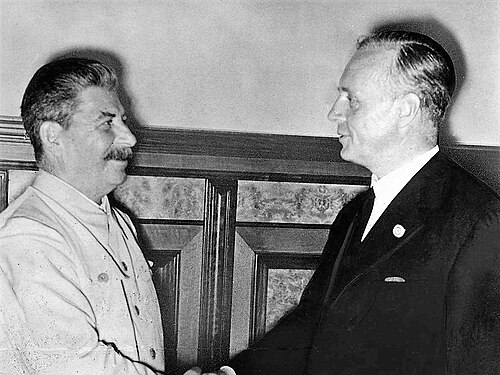
In the summer of 1939, Browder dismissed any rumours of a rapprochement between Germany and Russia by saying categorically: “There is as much chance of Russo-German agreement as of Earl Browder being elected President of the Chamber of Commerce”.[31] While Browder was not appointed to the Chamber of Commerce, Nazi Germany and the Soviet Union did sign a Non-Aggression Pact on 23 August 1939. One of its provisions was the division of Eastern Europe, including Poland, between the two countries. Against Stalinist narratives (e.g., Losurdo’s), the Pact was a move of cynical Realpolitik by the USSR that stunned and disoriented the communist parties of the world.
These organisations suddenly were forced to justify and rationalise the Soviet betrayal of the antifascist cause. The official line now held that the Pact was a brilliant move by Stalin to forestall war and defend peace. In December 1939, CPUSA leader William Z. Foster defended Soviet expansion into Poland in a pamphlet devoted to Stalin:
Undeterred by this defeat of the international peace front and the outbreak of the war, the Soviet Union, guided by the brilliant strategy of Stalin and the Communist Party, has developed a new policy in the struggle for world peace and democracy. As it has rapidly unfolded, this policy has amazed the world with its boldness, some of its major aspects being the Soviet-German Non-Aggression Pact, the smashing of the fascist Axis, the liberation of the White Russian and Ukrainian minorities in Poland, the armistice with Japan, and the mutual assistance pacts with the Baltic nations.[32]
Jewish Communists were especially tormented by the Pact with antisemitic Nazis. Louis Gronowski, a French Jewish Communist, described his agony:
…this pact was repugnant to me, it went against my sentiments, against everything I had maintained until then in my statements and writings. For all those years, we had presented Hitlerite Germany as the enemy of humanity and progress, and above all, the enemy of the Jewish people and the Soviet Union. And now the Soviet Union signed a pact with its sworn enemy, permitting the invasion of Poland and even taking part in its partition. It was the collapse of the whole argument forged over these long years. But I was a responsible Communist cadre, and my duty was to overcome my disgust.[33]
In other words, party discipline overrode all principles, and loyalty to the USSR and Stalin counted above all.
The Pact also caused immense damage to resistance forces in fascist countries. For example, the KPD, which had been viciously persecuted by the Nazis, now found themselves upholding the Pact. In February 1940, KPD leader (and future head of East Germany) Walter Ulbricht wrote an article naming not Hitler, but opponents of the Pact as the main enemy, implying the need for German workers and communists to defend the Third Reich against the Allies:
When the middle-class papers declare in one article that England is fighting for freedom, and report in another article in the same paper the arrest of fighters for freedom, the muzzling of the workers’ press, the establishment of concentration camps and special laws against the workers, then the German workers have the proof before their eyes that the ruling class in England is carrying on the war against the working class, and that, if Germany were conquered, the German working class would be treated in the same way.[34]
In the same article, Ulbricht called upon German workers to defend the Pact and condemned any resistance to Hitler as playing into the Allies’ hands. No wonder that dedicated anti-fascists were bewildered and demoralised by this turn.
In France, the PCF in line with the Pact refused to support the war effort; when France was occupied by the Germans in June 1940, the party largely laid low and did not engage in active resistance. In fact, the PCF hoped that by playing nice, the Germans would allow them to be a legal force. Towards this end, the PCF dispatched emissaries to meet with Otto Abetz, the German ambassador in Paris, for permission to resume publication of L’Humanité. The Germans refused – ironically sparing the PCF from writing apologetic drivel in defence of an alliance with fascism.[35]
The Pact and its ramifications led to mass political disorientation and worldwide despair. For Communists who prided themselves on anti-fascism, it was an unconscionable slap in the face. On a dime, they abandoned their fighting anti-Nazi commitments because Stalin had signed a deal with Hitler. While the Nazi-Soviet Pact had parallels in earlier Anglo-French agreements with the Third Reich, what made it worse was that this Realpolitik was done under the banner of proletarian internationalism and the red flag.[36]
Marxist-Leninists such as Losurdo claim that the Nazi-Soviet Pact was a strategically necessary move to afford the Soviet Union breathing space. Losurdo cites Mao’s opinion that the Pact allowed the USSR to shift some focus away from the European theatre of war to better support China against Japan.[37] In reality, it freed up the Axis powers to conquer Europe and Asia. As part of its deal, the USSR supplied the Nazi war machine with vital raw materials and supplies. And, only two years later, in April 1941, the Soviets made a separate deal with Imperial Japan. But, contrary to Losurdo’s rationalisations, to portray these Pacts as serving Chinese interests is utterly farcical. In making this pact with Japan, Stalin essentially recognised the puppet state of Manchukuo; indeed, all of these machinations were Stalin’s gifts to Axis imperialism. Trotsky stated a year before his assassination how Stalin sought to maintain the status quo and protect his bureaucracy at all costs, becoming Hitler’s ally: “If Stalin notwithstanding becomes Hitler’s quartermaster, it signifies that the ruling caste is no longer capable of thinking about tomorrow. Its formula is that of all doomed regimes: “after us the deluge”“.[38] Thus, the alliance with fascism became one of the rotten fruits of “socialism in one country”.
G) World War II
In another embarrassing about-face, the Communist Parties ended their support for the Pact with the Nazis on 22 June 1941, when Germany invaded the Soviet Union. Suddenly Hitler and Nazism became the main enemies across the board. Further, the character of the war was redefined from an inter-imperialist conflict to an anti-fascist people’s war. As the CPUSA declared: “With the fullest support of all its people, the Soviet Government is now waging a struggle not only in defense of its socialist land but also in defense of the most vital interests of the peoples in all countries. It is waging a just struggle for the cause of the freedom of all nations and peoples”.[39]
For the Soviet Union, the overriding priority was victory at any cost, and Communists everywhere were obliged to support that effort. That meant the goal was not world revolution but defeating fascism. As a goodwill gesture to the Allies, Stalin dissolved the Comintern in May 1943. When the war turned in the USSR’s favour, Stalin agreed with the Allies to the division of Europe: the East would be dominated by the USSR, while the West would remain capitalist. Since Stalin was determined to keep his agreements with his bourgeois partners, Communists were expected to do the same. Deutscher observed how Stalin repeatedly urged Communists to ally with reactionaries:
He [Stalin] urged the French communists to take their cue from General de Gaulle at a time when they were the chief driving force behind the French Resistance. He urged the Italian communists to make peace with the House of Savoy and with the government of Marshal Badoglio, and to vote for the re-enactment of Mussolini’s Lateran pacts with the Vatican. He did his best to induce Mao Zedong to come to terms with Chiang Kai-shek, because he believed, as he said at Potsdam, that the Kuomintang was the only force capable of ruling China. He angrily remonstrated with Tito because of the latter’s revolutionary aspirations, and demanded his consent to the restoration of the monarchy in Yugoslavia… He stared with incredulity and fear at the rising tides of revolution which threatened to wash away the rock of ‘socialism in one country’, on which he had built his temple. This so-called prophet of Marxism and Leninism appears at this moment as the most conservative statesman in the world.[40]
In Axis-occupied countries, Communists played leading roles in the armed resistance. Party discipline and cadre structures made them uniquely suited to underground and illegal work, and many partisans were drawn by the revolutionary vision of a liberated society. One Italian partisan, Aligi Barducci, was described as motivated by the need to fight both fascism and the capitalist world that engendered it: “Sure, he was fighting against the Nazi-Fascist enemy, but in his blazing red shirt he was considered, and rightly so, the combatant of a “greater war”, that of all the oppressed against the oppressors, of poverty against wealth, of justice against injustice”.[41] By the war’s end, Communists globally had hundreds of thousands of partisans under arms and were serious contenders for power.
However, even though many partisans desired socialism, the Communist Parties were not fighting for it. Almost everywhere, they formed broad “national fronts” stressing national liberation rather than socialist revolution. For instance, the Greek Communist Party (KKE) declared its intention to unite all patriots against the invader: “The KKE supports by all possible means the struggle for national liberation, and will do all in its power to help gather all the patriotic forces into one unbreakable national front, which will unite the whole people to shake off the foreign yoke and to win national liberation at the side of our great Allies”.[42] In a telegram, Thorez instructed PCF cadres not to frame the war as a revolutionary overturn of capitalism: “Insist yet again on absolute necessity in all your agitation to avoid presenting German war against Soviet Union as a war between capitalist system and socialist system. For Soviet Union it’s a national war of defense against fascist barbarism. Chatter about world revolution serves Hitler and harms international rallying of all anti-Hitlerite forces”.[43]
As a result, when the Axis powers were defeated, Communist Parties laid down their arms and surrendered any opportunity for revolution, compromising with bourgeois forces to restore “order”. In Italy, Communist Party leader Palmiro Togliatti supported the Lateran Accords with the Vatican and amnestied fascists. In France, the PCF accepted ministerial positions in De Gaulle’s Provisional Government, refused to support colonial independence, and disarmed its partisans.[44]
In Greece, the KKE had effectively liberated the country from the Axis in 1944. Nevertheless, Greece fell under British influence, and the KKE was ordered to stand down. In January 1945, it signed a treaty with the British-backed government, agreeing to demobilise their armed units in exchange for amnesty and a referendum on the monarchy. Upon hearing about the treaty, partisan leader Aris Velouhiotis wrote a letter to the Central Committee of the KKE denouncing the sell-out:
Why did you do this? Where are we going? Why did we shed so much blood? Why did they burn our houses for three years? Why are you handing us over without a battle? What are we going to do now? Where is our popular justice, our self-government?… Reaction has raised its head… You don’t see any of this. You have been isolated from the popular masses and you have lost their pulse. Wake up. Even at this late stage it’s not too late, but soon it will be and we will then need massive sacrifices in blood and toil. Don’t let reaction permanently gain a foothold.[45]
Only a year later, repression of the KKE would lead to civil war in Greece. Yet Stalin refused to intervene. As he told Georgi Dimitrov: “I advised not starting this fighting in Greece… They’ve taken on more than they can handle. They were evidently counting on the Red Army’s coming down to the Aegean. We cannot do that. We cannot send our troops into Greece, either. The Greeks have acted foolishly”.[46]
Only in Yugoslavia and Albania did partisans take power – largely because they liberated themselves and ignored “fraternal” Soviet advice to refrain. But, elsewhere, Moscow subordinated revolutionary initiatives to prosecuting the war, condemning colonial uprisings against the “democratic” Allies in the name of unity. The Communist Party of India (CPI) declared that the Soviet Union was “the only Fatherland of the proletariat” and backed the British war effort.[47] When nationalists led by Nehru and Gandhi launched the Quit India movement in 1942, demanding an immediate end to British rule, the CPI not only opposed the campaign but actively collaborated with the British authorities to suppress it. In March 1943, CPI General Secretary Puran Chand Joshi sent a letter to the colonial administrator Reginald Maxwell, detailing their actions to disrupt the Quit India movement: “We have fought the fifth column politically and practically and our policy has been so effective that the main theme of the Congress Socialists and Forward Bloc illegal hand bills and journals is ‘The struggle failed because of Communists’ treachery…’”[48] The Communist Party of India’s abandonment of the independence struggle ensured that the bourgeois nationalists became the hegemonic force in the movement and thus the principal rulers of India after 1947.
What happened in India was not an aberration in the colonial and semi-colonial world. Similar patterns appeared elsewhere: in Mandatory Palestine, the Communist Party of Palestine (PCP) encouraged its members to enlist in the British armed forces and toned down its criticisms of Zionism. The PCP also called upon Jewish workers “to fulfil their sacred duty … in the great antifascist front of the Anglo-Soviet alliance”.[49] The British government did not legalise the PCP, but noted that “the general attitude of the PCP and its members is irreproachably pro-British”.[50] Iraqi communists issued a statement of support for the British colonial government and war effort in May 1942: “[O]ur party regards the British army, which is now fighting Nazism, as an army of liberation…we must, therefore, help the British army in Iraq in every possible way”.[51] In Latin America, the Cuban Communists (renamed the Popular Socialist Party in 1944) also participated in the government of Fulgencio Batista from 1943-1944.[52]
In the Philippines, the Communist Party (PKP) formed Hukbalahap, or the Huk guerrilla movement, to fight the Japanese occupiers. The Huks built up a strong base of support on the island of Luzon. During the war, the Huks fought alongside the American military against their common enemy. As American forces retook the Philippines, they proceeded to disarm the Huks and arrest their leaders. Many Huks and their sympathisers were subjected to a reign of terror by US forces. Huk leader Luis Taruc later admitted that the guerrillas had been politically disoriented, having been told that the Americans would arrive as liberators:
We had left our people unprepared for what to expect from the return of the Americans. That is why our soldiers, gladly greeting the GIs and fighting beside them, were stunned when the same GIs turned around and disarmed them, arrested them, and permitted them to be massacred… Most tragic of all were the people who supported our struggle against the Japanese but who welcomed the Americans and the regime which they later dictated. It would take bitter years before they would see the vulture disguised as an eagle. For the benefit of the CIC [Counter-Intelligence Corps], which arrested and investigated us: our crime was not that we were anti-imperialist, but that we were not anti-imperialist enough.[53]
In the Allied countries, Communists were hyper-focused on winning the war at all costs to the detriment of any other struggles. In Britain, the Communist Party (CPGB) went from condemning Winston Churchill as a warmonger to enthusiastically championing him. In Britain’s Chance Has Come, CPGB leader Harry Pollitt urged unity behind Churchill: “There can be only one consideration, whether the people mean to defeat Hitler or openly or covertly endeavour to sabotage the common victory of the British and Soviet people. This is why a fight for a united national front means support for Churchill’s government and all measures of a common victory…”[54] Pollitt’s nationalist position dovetails to a great degree with Orwell’s “patriotic socialism” in the latter’s The Lion and the Unicorn (1941). Orwell’s wife, Eileen Blair, described the intent of the essay as “how to be a socialist while Tory”.[55] This is close to Pollitt’s attempt at being a Communist while supporting imperialist Tories, like Churchill.
Trotskyists – and anyone who supported strikes in war industries or advocated expanded trade union rights – were denounced by Stalinists as little better than fascists. Another CP pamphlet, Clear Out Hitler’s Agents by William H. Wainwright went so far as to call for physically removing Trotskyists from the labour movement: “Be on the alert for the Trotskyist disrupters. These people have not the slightest right to be regarded as workers with an honest point of view. They should be treated as you would a Nazi. Clear them out of every working class organisation”.[56]
In the United States, the CPUSA wrapped itself in the banner of “American democracy” while simultaneously condemning struggles for racial equality. The “Double V for Victory” campaign, launched by Black activists, linked victory against fascism abroad with victory against racism at home. Nevertheless, the party regarded this effort as potentially pro-fascist. In the October 1941 issue of The Communist, James Ford wrote that “it would be equally wrong to press these demands without regard to the main task of the destruction of Hitler, without which no serious fight for Negro rights is possible. Both would play into the hands of the appeasers, the Trotskyites and traitors”.[57]
While the CPUSA deplored Axis colonialism, it opposed demands for Puerto Rican independence. Instead, the party argued that Puerto Ricans should back the US government as part of a common struggle against fascism. The Communist Party highlighted its support for the US and urged Puerto Ricans to join the US military. According to the Puerto Rican communist Juan Santos Rivera, “[o]ur soldiers march to the battle fields of Europe and the Pacific along with the US armed forces … because Puerto Ricans understand we need to join with [those fighting] the war[s] of national liberation because that is the only way to obtain and guarantee freedom for all peoples, including our own”.[58] Naturally, Puerto Rican party members dutifully enlisted. In addition, communists backed the Popular Democratic Party (PPD) and its leader Luis Muñoz Marín. The PPD was the Puerto Rican bourgeois party closest to the United States. As Rivera put it: “[The PPD stood for] the interests of the Puerto Rican national bourgeoisie … [that] in this historical moment, coincide with the immediate interests of the working and peasant class”.[59]
Nor did the CPUSA protest against Japanese internment; it actually expelled its Japanese-American members. The party also routinely published racist caricatures of the Japanese in The Daily Worker. The culmination of this chauvinism was a cartoon celebrating the 1945 Soviet declaration of war on Japan and the atomic bombings of Hiroshima and Nagasaki as “the old one-two”. The incineration of hundreds of thousands of people by atomic weapons was described by The Daily Worker as “The Super-Duper Week”.[60]
During the war, organised labour agreed to a “no strike pledge” in key industries. But this did not stop workers from launching unauthorised strikes in defence of their economic interests. The CPUSA used its immense power in the labour movement to enforce the no-strike pledge. When the 500,000 members of the United Mine Workers struck in April 1943 over lagging wages and unsafe conditions, the Roosevelt Administration placed the mines under federal jurisdiction. The miners refused demands to return to work. In May, Browder declared the striking miners to be in league with fascism:
It is clear by now that we are not dealing with misguided or short-sighted men who are just swept away by the pressure of a mass resentment of the labor movement because of an accumulation of grievances. We are dealing with a well-developed, organised conspiracy against the war, to prevent the solution of the grievances of labor and then to manipulate those grievances in order to whip up strike sentiment and a strike movement among the workers of this country, all directed toward one specific purpose-to create a crisis in the United States that will prevent the opening of the second front in Europe which will crack Hitler in 1943.[61]
Communist Party members also enlisted in the American armed forces in large numbers. According to Foster in his official history of the CPUSA: “No organisation in the country made a better record in the people’s war than did the Communist Party and the Young Communist League. They gave 15,000 of their men and women members to the armed services. On the battle fronts the fighters conducted themselves with characteristic Communist courage and devotion”.[62] However, the American military was not a red army, but an imperialist force. As enlisted soldiers, these party members helped to reconquer American colonies in the Pacific (e.g., the Philippines and Guam) and ensure US dominance in Western Europe.[63]
Earl Browder championed class collaborationism between workers and capitalists, stating in 1943: “If J.P. Morgan supports this coalition and goes down the line for it, I as a Communist am prepared to clasp his hand”.[64] After the Tehran Conference in 1943, cooperation between the Western Allies and the Soviet Union was at its zenith. Browder believed that this would usher in a post-war era of peace and class harmony: “Capitalism and Communism have begun to march together towards the peaceful society of tomorrow”.[65] In May 1944, the CPUSA dissolved and reconstituted itself as the Communist Political Association, intended to function as a pressure group supporting progressive candidates and US-Soviet cooperation.
Later party histories would blame Browder alone for liquidating the CPUSA as an independent vanguard organisation and its abandonment of Marxism. But these policies were not his invention. They flowed from the popular-front line articulated at the Comintern’s Seventh Congress in 1935 and were expanded under wartime conditions. Browder’s approach faithfully represented the Soviet line during the war, specifically for the US but also for the Allied “democracies”. In April 1945, the Soviets criticised him as a revisionist through the PCF leader Jacques Duclos.[66] In short order, the CPUSA was restored and Browder expelled.
In reality, Browder was not removed for revisionism but because the Soviet line changed quickly as the wartime alliance with the United States began to fracture. The Soviets judged that he could not execute the necessary turn for the looming Cold War. But it did not matter if he was willing to make the needed about-face or politically readjust in the nick of time. His name was too closely associated with these liquidationist policies, and thus he had to take the fall for them, as just another CP patsy. Yet even after his expulsion, Browder remained a stalwart Stalinist, forever loyal to the USSR.[67]
Unlike World War I, which was fundamentally an inter-capitalist dogfight, World War II had multiple dimensions. In his study of the war, Ernest Mandel identified five major aspects. The first was an inter-imperialist struggle between the Allied and Axis powers; the second, a struggle between the USSR and Nazi Germany; the third, the Chinese fight against Imperial Japan; the fourth involved Asian colonies fighting for liberation, and the fifth and final aspect was armed resistance by various partisan forces, often possessing a revolutionary character.[68]
With Mandel’s framework in mind, the Soviet Union’s fight against Nazi barbarism was absolutely justified and necessary. But serving in imperialist armed forces for the redivision of the world was not. Anti-imperialist struggles were justified against both the fascist and “democratic” imperialists. When judging imperialism for Mandel, location matters: Hitler is a menace in Belgium, but so is Churchill in Bengal. Stalinist parties did not navigate these contradictions well and often prioritised old-fashioned European chauvinism over anticolonialism and proletarian internationalism. What was tragic about the Second International was downright farcical with the Third, but no less devastating for the prospects of socialism in Europe and across the globe. What Losurdo and Rockhill condemn Kautsky and Bernstein for in 1914 should equally apply to Stalin and Thorez in 1941.
H) Israel-Palestine
The Communist Party of Palestine (PCP) was formed in 1923 to promote Jewish and Arab unity against British colonialism and separatist Zionism. Like other Communist Parties, the PCP was subject to the shifting lines of the Comintern.[69] It moved from denouncing Arab nationalists in the 1920s to tailing them in the 1930s. But, with the outbreak of the Second World War, the PCP underwent severe political convulsions. The party confused its Arab members by encouraging them to join the British armed forces and also began softening its opposition to Zionism. This led to a split in 1943 with the formation of the National Liberation League (NLL), composed largely of Arab Communists. While the NLL was more oriented toward the Arab population, it shared the same Stalinist outlook as the PCP.
After the war, the British presence in Mandatory Palestine became increasingly untenable, and Zionist militias were determined to seize control of the region. In this environment, the PCP and the NLL initially supported Arab and Jewish unity. However, they were thrown for a major loop in November 1947 when Andrei Gromyko, the Soviet Permanent Representative to the United Nations, supported the partition of the region into separate Zionist and Arab states. This went against decades of official Soviet foreign policy against Zionism. The Soviet shift was motivated by the hope of expelling the British Empire from the Middle East and securing a potential pro-Soviet ally in a newly independent Israel.
The full impact of this shift did not register immediately, but both the NLL and the PCP eventually fell into line. The PCP renamed itself the Communist Party of the Land of Israel (MAKEI), adopting for the first time the Hebrew name for the country – Eretz Israel – used by the Zionist movement. They also encouraged their members to join the Haganah, one of the main armed Zionist groups.[70]
When Israel was created on 14 May 1948, both the Soviet Union and the United States were the first two countries to recognise it in the UN. The newly formed country owed much of its existence to both the USSR and the Eastern Bloc. The MAKEI, with the full support of the Israeli leadership, worked to ensure the flow of weapons to Israel. Through Czechoslovakia, the Eastern Bloc supplied the Israel Defense Forces (IDF) with $12 million worth of weaponry, including 24,500 rifles, 5,200 machine guns, and 54 million rounds of ammunition.[71] Without this crucial support of arms, the IDF would not have triumphed so easily in 1948. Finally, MAKEI General Secretary Meir Vilner was one of the 37 signatories of the Israeli Declaration of Independence.[72]
The NLL also supported partition, claiming that it would only be a “temporary measure”. In October 1948, the NLL, along with the Communist Parties of Iraq, Syria and Lebanon issued a joint statement condemning the Arab invasion of Palestine and supporting the creation of Israel. The communiqué declared:
The Palestine war was a direct result of the fierce struggle between England and the United States, who caused the war in order to exploit it to settle accounts between them …The Palestine war revealed finally and completely the betrayal of the reactionary rulers in the Arab states and their complete submission to foreign imperialism.[73]
The Arab parties defended the Soviet line on partition, and their statement made no mention of Israel or criticised Zionism. With the exception of Iraqi CP General Secretary Yusuf Salman Yusuf, all the Arab Communist Parties supported Soviet recognition of Israel.[74]
For all of Losurdo and Rockhill’s anti-Zionist rhetoric, neither seriously confronts the Stalinist record in the Middle East. If Losurdo criticises the Frankfurt School’s pro-Israeli politics – and even likens Adorno and Horkheimer’s support for the 1967 war to an “August 4th 1914” level of betrayal – then what of Stalin’s policy?[75] What of the role of “Actually Existing Socialism” in cementing the division between Arab and Jewish workers? Squaring the circle on this issue would be quite the Orwellian feat of doublethink.
I) Algeria
At its founding in 1920, the PCF inherited the pro-colonial outlook of the Second International and refused to support Algerian independence. At the Fourth Congress of the Communist International, Trotsky condemned the pro-colonial outlook of the PCF:
The Fourth Congress once again calls attention to the exceptional importance of correct and systematic work by the Communist party in the colonies. The congress sharply condemns the position of the Communist section in Sidi-Bel Abbès [of the PCF section in Algiers], which employs pseudo-Marxist phraseology to cover up a purely slaveholder’s point of view, fundamentally supporting the imperial rule of French capitalism over its colonial slaves. The Congress considers that our work in the colonies should be based not on forces that are so imbued with capitalist and nationalist prejudices, but, rather, on the best forces among the indigenous people themselves, and above all, among the indigenous proletarian youth.[76]
Despite early Comintern pressure, the PCF never fully shook off its pro-colonialist attitude. As noted earlier, it embraced the French Empire during the Popular Front. And on 8 May 1945 – the day the war ended in Europe – an uprising in Sétif against the French colonial administration was met with a police massacre that killed tens of thousands of Algerians. The PCF called the demonstrators fascist provocateurs: ‘the Hitlerite killers who took part in the events of May 8th and the pseudo-nationalist leaders … have tried to deceive the Moslem masses … in their attempt to create a rupture between the Algerian and the French peoples”.[77]
Nor was Algeria the only example of the PCF’s support for the French Empire. In the aftermath of the war, the party became a central component of the French government, with Maurice Thorez serving as deputy prime minister from 1946 to 1947. In their ministerial capacity, the PCF backed the French war effort against their own sister party in Indochina. When the French bombarded Haiphong in November 1946, PCF deputies voted against war credits, while the party’s government ministers approved them.[78] Only after the PCF was kicked out of the government in 1947 did they oppose the French war effort in Southeast Asia.
On 1 November 1954, the Front de libération nationale (FLN) launched an armed insurrection in Algeria. The PCF condemned the FLN’s actions as adventurist. In March 1956, as the war in Algiers intensified, Socialist prime minister Guy Mollet called for emergency powers to crush the rebels. The PCF delegates voted unanimously in favour of the government’s measure. Their statement declared: “We are for the existence and permanence of political, economic, and cultural bonds between France and Algeria…Peace must be re-established in Algeria… ”[79]
The Socialist and future French President François Mitterrand praised the PCF’s “realism” and sense of responsibility regarding French interests in Algeria: “When I saw the communists vote in favor of the special powers [to fight the Algerian FLN], knowing how they really felt, I understood just how responsible and serious this party was”.[80]
Only later did the PCF belatedly and half-heartedly support Algerian independence. The FLN militant and intellectual Frantz Fanon sharply criticised the PCF’s chauvinist attitude in ways that echo Trotsky’s earlier arguments. Given how often Trotsky is painted as a “Eurocentrist” as opposed to Fanon, Fanon’s position against Actually Existing Stalinist practice is worth quoting at length:
The Communist Left, for its part, while proclaiming the necessity for colonial countries to evolve toward independence, requires the maintenance of special links with France. Such positions clearly manifest that even the so-called extremist parties consider that France has rights in Algeria and that the lightening of domination does not necessarily imply the disappearance of every link. This mental attitude assumes the guise of a technocratic paternalism, of a disingenuous warning against the danger of regression… The demand for special links with France is a response to the desire to maintain colonial structures intact. What is involved here is a kind of terrorism of necessity on the basis of which it is decided that nothing valid can be conceived or achieved in Algeria independently of France. In fact, the demand for special links with France comes down to a determination to maintain Algeria eternally in a stage of a minor and protected State. But also to a determination to guarantee certain forms of exploitation of the Algerian people. It is unquestionably proof of a grave failure to understand the revolutionary implications of the national struggle.[81]
In the meantime, intellectuals such as Jean-Paul Sartre were risking a great deal by publicly supporting the FLN. If Losurdo dismisses Sartre’s stance as “idealist”, then what of the PCF’s pro-colonialist position?[82] Who was closer to French conservatism, Sartre or the Stalinists, when the PCF voted for special powers to keep Algeria French – L’Algérie est française et le restera? In contrast to the PCF, French Trotskyists were not only agitating for the FLN, but manufacturing weapons for them.[83] Again, when it comes to Algeria, who are the real chauvinists: the PCF, with Thorez as deputy prime-minister, or the Trotskyists? Losurdo and Rockhill’s efforts to paint Trotskyism as inherently Eurocentric are constantly refuted by these concrete historical examples.
J) 1968
The 1960s were an era of student rebellion, upheaval, and radical possibility. No place experienced a greater revolutionary opportunity than France in May 1968. While the French events shared the same kind of student radicalism found in the United States, West Germany, Italy, Czechoslovakia, Japan, Mexico, and Brazil, they also expanded into a massive general strike by the working class. In that sense, the French May uniquely challenged the bourgeois order in one of the major industrial heartlands of capitalism.
By the late 1960s, the PCF was one of the largest political forces in France, routinely winning more than a fifth of the electorate, controlling the major trade unions, and – at least on paper – committed to socialist revolution. Yet, when the students clashed with the police, the PCF condemned them as ultraleftists who were objectively serving the interests of President Charles De Gaulle. On May 3 1968, PCF leader – and true spiritual heir to Thorez – Georges Marchais wrote in L’Humanité:
[These students] are also trying to give lessons to the working class. More and more they are to be found at factory gates or in areas inhabited by immigrant workers distributing leaflets and other propaganda… These false revolutionaries must be energetically unmasked; for, objectively, they serve the interests of the Gaullist government and the big capitalist monopolies… The views and activity of these “revolutionists” are laughable; in as much as they are generally the children of big bourgeois, contemptuous of students from working-class origins, who will soon dampen their “revolutionary flame” to go and run papa’s business and exploit the workers in the best traditions of capitalism.[84]
Over the course of May and June, the working class joined the fray, with more than 10 million on strike and occupying their factories. While workers considered anti-capitalist alternatives, the PCF did its utmost to keep the demands strictly “reasonable”. It also used its influence in the trade unions to keep workers separated from student radicals. As the historian David Caute noted, the PCF consistently acted in defence of French capitalism: “The [French] Communist Party was profoundly Gaullist, devoted to ‘order,’ to authority, to transmitting commands from above, to the cult of personality, to channeling popular aspirations into tidy ‘agreements.’”[85]
While Rockhill, in his article for the Los Angeles Review of Books, points out that Michel Foucault was politically Gaullist prior to May ‘68, he does not pass an equally vehement judgment against the PCF’s own Gaullism. Regarding Rockhill’s criticisms of the “gauchiste” and “culturalist” tendencies within the student movement, what was the actual roadblock towards socialist revolution in May ‘68: the “ultraleft” students (whom Rockhill amalgamates with Trotskyists) or the Stalinists?[86]
While the far left – Trotskyists, Maoists, and anarchists – attempted to provide leadership to the May events, they were too small to lead a revolution. By contrast, the PCF had the social weight to challenge the bourgeoisie, but they never posed the question of overthrowing capitalism. Instead, they acted as the main obstacle to revolution. Daniel Singer, who wrote the seminal history of May 1968, concluded with the following judgment of the PCF:
Between the promise of a new French revolution and its fulfillment stands the French Communist party. The PCF has appeared from the beginning of this story as the villain, as the main obstacle to a revolutionary conclusion, or, depending on your stand point, as the hero, the unexpected pillar of the regime, the surprising darling of the traditional upholders of capitalist society… The negative hero was not a clumsy and inefficient participant in the May Movement. It was a conscious opponent, throwing from the start the might of its machine across the path that might have led in a revolutionary direction.[87]
Despite Sartre’s theoretical and political weaknesses, he was right to point out the counterrevolutionary character of the PCF in May ‘68: “In particular, as long as the French Communist Party is the largest conservative party in France, and as long as it has the confidence of the workers, it will be impossible to make the free revolution that was missed in May”.[88]
K) China – Nixon
In February 1972, US President Richard Nixon visited Mao Zedong in Beijing. This historic meeting ended decades of American hostility towards China. The United States sought rapprochement with China in order to isolate the Soviet Union and facilitate its exit from the Vietnam War. For his part, Mao’s meeting with Nixon was hypocritical, since he had just previously condemned the Soviets for softening their opposition to American imperialism.
However, the theoretical rationale for China’s opening to the Americans can be found in their polemics against the post-Stalin USSR. Although allied after the founding of the PRC in 1949, relations declined sharply after Khrushchev’s denunciation of Stalin in 1956. By the early 1960s, the Sino-Soviet alliance had broken down, and by decade’s end the two powers were engaged in open-border clashes.
In their anti-Soviet polemics, the Chinese had originally warned that Khrushchev’s leadership was revisionist. As these polemics intensified, Mao warned that the restoration of capitalism in the USSR was imminent. After the Warsaw Pact invasion of Czechoslovakia in 1968, Premier Zhou Enlai declared the Soviet Union was now a “social-imperialist power”.[89] Two years later, in 1970, China went further, announcing that the Soviet Union had become fully fascist: “The Soviet Union today is under the dictatorship of the bourgeoisie, a dictatorship of the big bourgeoisie, a dictatorship of the German fascist type, a dictatorship of the Hitler type”.[90]
But China continued to describe both the USSR and the USA as equally dangerous imperialist powers. At the Ninth Congress of the CPC in April 1969, Lin Biao outlined the “four major contradictions” in the world system:
… there are four major contradictions in the world today: the contradiction between the oppressed nations on the one hand and imperialism and social-imperialism on the other; the contradiction between the proletariat and the bourgeoisie in the capitalist and revisionist countries; the contradiction between imperialist and social-imperialist countries and among the imperialist countries; and the contradiction between socialist countries on the one hand and imperialism and social-imperialism on the other.[91]
Despite initially placing the US and the USSR on the same footing, this shifted within two years. The United States came to be described as a “waning” superpower and a secondary enemy. According to Mao’s distinction between primary and secondary contradictions, this made the USSR the principal strategic enemy, and the main blow should be directed against it. This provided a theoretical justification for the Sino-American alliance following Nixon’s visit.[92]
The outgrowth of this foreign policy shift became known as the “Three Worlds Theory”. But the origins of this idea can be traced to Mao’s 1963 discussion of “intermediate zones” between the USA and USSR:
In my view there are two intermediate zones: the first, Asia, Africa and Latin America and the second, Europe. Japan and Canada are not happy with the United States. The six-nation Common Market, represented by De Gaulle, is made up of powerful capitalist countries. Japan in the East is a powerful capitalist country. They are unhappy with the US and the Soviet Union. Are the Eastern European countries that satisfied with Khrushchev of the Soviet Union? I don’t believe so. Things are evolving and contradictions are revealing themselves.[93]
The Three Worlds Theory reached full maturation in Deng Xiaoping’s 1974 speech to the United Nations:
Judging from the changes in international relations, the world today actually consists of three parts, or three worlds, that are both interconnected and in contradiction to one another. The United States and the Soviet Union make up the First World. The developing countries in Asia, Africa, Latin America and other regions make up the Third World. The developed countries between the two make up the Second World.[94]
The Mao-Deng formula held that the USA and USSR were superpowers that constituted the First World and were the main enemies of humanity; developed countries in Western Europe, Japan, Canada and Oceania represented the Second World, while the Third World represented the majority of the world’s peoples. Therefore, Mao and Deng argued it was possible for the Second and Third Worlds to unite in a common front against the two superpowers.[95] Significantly, the Three Worlds Theory meant that China no longer considered itself part of the “socialist camp”, but located itself in the Third World. While the US and USSR were both accused of “hegemonism”, the latter was deemed the more proximate danger, making “tactical” unity with the United States possible.
The results of the Chinese pivot to the Americans had a disorienting effect on many Maoist sympathisers. China now supported strengthening NATO in order to deter the Soviets. In the “Third World”, it quickly found itself backing various reactionary bourgeois forces. For example, China materially supported the Sri Lankan government’s 1971 crackdown against “Trotskyite” protesters. In Iran, it backed the American-supported Shah. When the Socialist Salvador Allende was overthrown by the CIA on 11 September 1973, China was not only among the first governments to recognise Pinochet, but its embassy – along with the American one – was closed to refugees. It also cut off aid to revolutionaries in Oman who were fighting the Iranian-backed government.
During the Portuguese Revolution of 1974, China backed the pro-NATO, CIA-aligned Socialist Party against the forces of Soviet “social-imperialism”. When the Cuban and Soviet-backed MPLA took power in Angola in 1975, China found itself allied with Apartheid South Africa in support of the anti-communist UNITA. China also abandoned its support for Palestinian rights and endorsed restrictions imposed by certain Arab governments. They also cultivated friendly relations with Filipino dictator Ferdinand Marcos as he fought local Maoists. Finally, Chinese support for the United States meant the de facto abandonment of Vietnam.[96]
The Three Worlds Theory was socialism in one country with Chinese characteristics. For one, it grew out of the same nationalist outlook that informed Stalin’s original iteration. Like the USSR, China treated its own national interests as paramount over those of world revolution. But unlike the Soviet version, the Three Worlds Theory employed Mao’s understanding of contradiction to provide a philosophical veneer for its rapid strategic zigzags. But the practical result was largely the same: political disorientation, retreat, and betrayal.
Mao’s understanding of foreign affairs also emphasised the supposed “revolutionary” credentials of various Third World national leaders. In effect, class differences between exploited and exploiters were blurred or erased in the Third World. Rather than presenting workers and other oppressed groups as the primary revolutionary agents, this role was increasingly assigned to the “national bourgeoisie”. In other words, the effacement of class produced a false unity between proletarian and bourgeois interests. In the language of Maoist “dialectics”, as long as the proletariat and the bourgeoisie inhabited the same Third World nation, the contradiction between them could be redefined as “non-antagonistic”. China elevated to a categorical principle the need for workers to back their national bourgeoisie in order to advance the global revolutionary struggle. In practice, crass realpolitik displaced class struggle, internationalism, and anti-imperialism.
For a genuinely Marxist standpoint, left-nationalist governments in the Third World remain integrated into the structures of global imperialism. They are not, in principle, opposed to capitalism or imperialism. Internationalism requires opposing all imperialist attacks on these countries. But when Marxists extend solidarity, it is not toward ruling classes – which can include anticommunist mullahs – but to the working masses themselves. Uncritical defence of ostensibly “anti-imperialist” national leaders, by contrast, is not only short-sighted but creates political confusion. Instead of advocating the creation and support of independent Marxist parties, Stalinist tendencies lapse into tailism and liquidationism: salvation is sought in existing counterrevolutionary bureaucracies, national bourgeois regimes of any stripe, or – as we learned with late Maoism – even in US imperialism. For the Stalinist, the self-emancipation of the working class only exists in a red heaven. Down here on earth, we are told to be “realistic”, and to emphasise “the primacy of practice”.
The Prophet Smeared
What Rockhill calls “Imperial Western Marxism” also includes Really Existing Trotskyism. To avoid any misunderstanding regarding his views on Trotskyism and Trotsky himself, we will quote Rockhill verbatim. First comes the claim that the politics of Trotskyism led directly to a pro-imperialist outlook:
Non-communist Marxists were particularly useful because their expertise in Marxism could be mobilised to understand and fight the enemy, while their anticommunism helped guarantee their ultimate fealty to the bourgeois state (although there are some exceptions). This was not only true in the case of the Frankfurt School but more generally, so much so that some scholars talk—with plenty of evidence to support this claim—of a Trotskyism-to-CIA pipeline. One of the objectives of the US national security state was to wage a highly sophisticated intellectual world war on Marxism, driving a wedge between its supposedly authentic and respectable Western forms, on the one hand, and its purported perversions in the East, where it became a material reality instead of a pristine system of ideas. The Frankfurt School, like the dominant forms of Trotskyism in the imperial core, played an important role in this war.[97]
Despite asserting that there is “plenty of evidence”, Rockhill provides no substantiation whatsoever for the claim of a “Trotskyism-to-CIA pipeline” or for the alleged anticommunist role of Trotskyists in imperialism. There are no quotes, no footnotes, no evidence of any kind. It is a dogmatic assertion that echoes 1930s-style Stalinist demonisation.
The clearest refutation of these claims can be found in the final struggle of Leon Trotsky himself. From 1939-40, Trotsky argued with his dissenting followers such as Max Shachtman and James Burnham over the class nature of the Soviet Union. In the wake of the Nazi-Soviet Pact, Trotsky maintained that the USSR remained a degenerated workers’ state and must be defended against imperialism, which he regarded as the paramount enemy. By contrast, both Shachtman and Burnham contended that the USSR had become a new class society – indeed, an imperialist power – which did not merit any socialist support.[98] Ultimately, Shachtman and Burnham lost the struggle and departed the Trotskyist movement, while Trotsky spent his last year defending the USSR against his own fellow party members. As for the subsequent evolution of Shachtman and Burnham toward the political right, that coincided with their rejection of virtually everything Trotsky stood for.
Rockhill’s allegation of a Trotskyism-to-CIA pipeline resembles Bush-era claims of a Trotskyist-to-neoconservative pipeline. This charge is also baseless, if not itself a right-wing talking point.[99] The overwhelming majority of the neoconservatives were never Trotskyists of any sort. The few who were former Trotskyists such as Irving Kristol, Maurice Seymour Lipset, and Gertrude Himmelfarb were only briefly in the movement and quickly aligned with the “Shermanites” (oriented toward Shachtman). They very soon developed an anti-Leninist and pragmatist outlook influenced by Robert Michels and eventually rejected Trotsky altogether.[100] Their trajectory paralleled James Burnham’s own embrace of Michels’ elitism in his anti-Marxist book The Machiavellians: Defenders of Freedom (1943).
For Trotskyists, or any leftist, to become a neoconservative meant completely abandoning any trace of revolutionary Marxism. The neocon-Trotskyism stereotype originates in paleoconservative rhetoric – often tinged with antisemitism – that sees both as globalist, internationalist, and rootlessly cosmopolitan. As Richard Seymour pointed out: “The entire schema of neoconservatism as the heir of Trotskyism is chimerical, in fact: it operates through a metonymic substitution of imagery…”[101] This substitution creates a false analogy, if not identity, between Dick Cheney’s Project for a New American Century and the theory of permanent revolution. Because Neoconservatism is (falsely) alleged to be globalist, it is depicted as a right-wing version of Trotskyism.
When Stalinists commit this fallacy, they echo palaeocons like Patrick Buchanan or conspiracy theorists like Alex Jones. Buchanan once claimed: “As Leon Trotsky believed in advancing world communist revolution, neocons and democratists believe we have some inherent right to intervene in nations that fail to share our views and values”.[102] Jones went further on his InfoWars program. After claiming that the American deep state has been thoroughly infiltrated by “Trotskyites”, he lamented that Stalin had failed to finish the job of murdering them all.[103]
While some former Trotskyists have embraced reactionary positions, they are by no means the only left current to have produced notorious renegades. Former Maoists, for instance, include many Democratic Party activists in the United States, the pro-imperialist nouveaux philosophes in France, and Stéphane Courtois, editor of The Black Book of Communism. Official Marxism-Leninism has also generated its fair share of defectors, such as Whittaker Chambers (author of Witness and a founder of National Review), Jacques Doriot (a Nazi collaborator), and Jay Lovestone (who put the CIA in AFL-CIO). If, according to Rockhill’s logic, there is a direct pipeline to imperialism via Trotskyism, then there are equally well-travelled routes from AES to reaction. To quote Pilgrim’s Progress: “I saw there was a way to Hell even from the gates of Heaven”.[104]
The second major accusation made by Rockhill concerns Trotsky’s alleged willingness to collaborate with the US government by donating his archives and offering to testify before the Dies Committee in 1939:
It is interesting to note that [William] Langer met with Leon Trotsky in Mexico and was responsible for arranging for his papers from his exile period in Mexico to be archived at Harvard. See Winks, Cloak and Gown, 73. On Trotsky’s willingness to collaborate with the US government (such as with the anticommunist Dies Committee), his dependance {sic} on US funds and personnel, and his interest in going to the United States, see William Chase, “Trotsky in Mexico: Toward a History of His Informal Contacts with the US Government, 1937 – 1940”, published (in Slovak) in Otechestvennaia istoriia, Vol. 4 (July/August 1995): 76 – 102 (English version obtained directly from the author).[105]
To begin with, there was nothing underhanded about the donation of Trotsky’s archives to Harvard. As a political exile perpetually short of funds, he arranged the transfer in order to secure financial support. At the same time, he ensured that any potentially sensitive materials regarding his political comrades would be sealed until at least 1980. William Langer was an intelligence agent during and after the war, but those agencies did not exist in the 1930s. At the time, Langer was a prominent Harvard historian, and Trotsky spoke with him in that academic capacity. There is no credible basis for imputing a conspiracy between Trotsky and the American government based on these facts. Thus, this charge amounts to absolutely nothing and is hypocritical – particularly given that numerous Stalinist organisations have donated their archives to “bourgeois” universities without such actions being construed as CIA plots. Needless to say, there is nothing nefarious about the CPUSA donating its archive to NYU’s Tamiment Library.
The accusation regarding Trotsky’s supposed willingness to work with the Dies Committee is more serious. The Dies Committee (more popularly known as the House Un-American Activities Committee – HUAC) was formed in 1938 to investigate radical “subversion” in the USA, particularly from the political left. Shortly after the Nazi-Soviet Pact, the Committee conducted hearings that involved leading CPUSA members such as Earl Browder and William Z. Foster. During these hearings, both men used the occasion to condemn Trotsky as a counterrevolutionary.[106]
Following these hearings, Martin Dies – the chair of HUAC – extended an invitation on 12 October 1939 for Trotsky to testify. Trotsky was fully aware of HUAC’s reactionary nature yet agreed to do so. His aim was to rebut slanderous charges and planned to use HUAC as a public platform to expose the Stalinist persecutions before a wider public. But Trotsky did not intend to become a state witness and imposed explicit conditions before he appeared. For one, he would not call for repression against the CPUSA, and two, he wanted his testimony to be seen before the whole world.
The Dies Committee backtracked on their invitation and wanted Trotsky to give written testimony from Mexico. Trotsky refused this, stating:
Mr. Dies says that he may send an investigator to Mexico to “take Trotsky’s statement”. But I never invited his representative to Mexico, irrespective as to whether or not he presented me with an assurance that he would be permitted to return to the United States. I agreed only to make a public deposition before a committee of the House of Representatives with the full possibility of elucidating all obscure questions through cross-examination. If Mr. Dies wishes my opinions in written form only, he can read my books.[107]
Dies and the US government refused Trotsky’s conditions. The historian Pierre Broué maintains that the invitation was finally withdrawn because Dies did not want a revolutionary to be given a platform in Washington DC: “The State Department considered Dies’s initiative imprudent, deemed it dangerous to give Trotsky such a prominent platform, and asked Dies to back down. Dies cancelled everything through United Press dispatches, then announced that he would send his investigators to Trotsky, to which the latter retorted that he would not receive them: the matter was settled”.[108] James Burnham in 1939 and some Trotskyists objected to the Old Man appearing before the Dies Committee, as it would open the movement to Stalinist attack. But Trotsky was a master polemicist and accomplished public speaker, who understood how to turn a hostile forum to his advantage.
While Rockhill reproaches Trotsky for an appearance that never took place, he ignores the fact that prominent Marxist-Leninists such as Earl Browder and William Z. Foster willingly testified before the same committee and denounced Trotsky as a fascist. The obvious question for Rockhill is why is Trotsky singled out for condemnation while others receive a free pass? Is this not a striking instance of double standards?
The article by William Chase, on which Rockhill relies, indulges in a great deal of speculation without facts about Trotsky’s motives. One conjecture is that Trotsky might have compromised the USSR or the Comintern’s operations with his prospective Dies testimony. But opposed to Chase, Trotsky’s political activity and public statements indicate no intention of doing so. Indeed, the accusation that Trotsky would sabotage the Soviet Union comes straight out of Vyshinsky and the Moscow Trials. There is not a shred of proof to back this up.
Chase further speculates that Trotsky wanted an American visa. Certainly, his own safety was a major concern. Hounded from country to country by both bourgeois governments and Stalinist parties, America was an enticing prospect for political asylum. And, given the strength of the Trotskyist movement there, he could reasonably expect stronger protection. But, if Trotsky was absolutely single-minded on obtaining a visa, he would not have stipulated so many political conditions on testifying. When those conditions were not met by the Dies Committee, he refused to go. Thus, the claims by Chase and Rockhill that Trotsky was engaged in some sort of covert manoeuvring are baseless.
While Rockhill makes unsubstantiated claims of Trotsky’s complicity with the state, he forgets that the CPUSA actually did support bourgeois repression of the Trotskyists. In June 1941, leaders of the Socialist Workers’ Party (SWP) were arrested for violating the Smith Act. They were charged with advocating the overthrow of the American government – or, in other words – socialist revolution. By this point, the Soviet Union was at war with Germany and the CPUSA saw any opposition to the war effort as treasonous. To that end, the CPUSA supported Federal prosecution, with CP leader Milton Howard describing the SWP as “a fascist fifth column” who “deserve no more support from labor and friends of national security than do the Nazis”.[109] Eight years later, when CPUSA leaders themselves were convicted under the same law, the SWP unequivocally defended their civil liberties, and called for solidarity against state repression. The SWP’s magazine The Militant declared without hesitation: “The conviction on that day of 11 Communist Party leaders in the political trial at Foley Square struck a hammer-blow against the democratic liberties of the whole working-class”. Or, as the headline put it even more bluntly: “CP Trial Verdict Hits Rights of All”.[110]
Rockhill starts his book with an extended discussion of Che Guevara, his assassination, and the publication of his diary. In this, he contrasts Trotskyism as politically abstract, Eurocentric, and (objectively) pro-imperialist. This includes, without citation, the allegation that Ernest Mandel celebrated the demise of the USSR in 1991.[111] Rockhill ignores that one of Che’s main economic advisers in the “Great Debate” (1962-1965) concerning socialism in Cuba was Mandel himself. Meanwhile, in Bolivia, the Communist Party under Mario Monje refused to support Che’s guerilla campaign. In fact, most of the Latin American Communist Parties were committed to a two-stage theory of development and refused to support armed revolution backed by Cuba.[112]
Mandel was not without flaws, and his illusions about Gorbachev’s Perestroika merit criticism. Nevertheless, considering Mandel’s agreement with Trotsky that the USSR was still a workers’ state – however degenerated – it would be out of character for him to celebrate and gloat over its demise. As he warned in 1991 at a Moscow news conference in front of Soviet media, “it is certain that if the Soviet economy becomes privatised, the USSR will become a Third World country, not a Sweden or a Finland”.[113] This was not the voice of someone applauding neoliberal reforms, American-style shock therapy, or the presidency of Vladimir Putin. When it comes to Putin, one cannot say the same of Rockhill, who depicts the Russian president as playing a progressive role on the world stage in opposition to imperialism.[114]
Last – but not least – is the charge that Trotskyism is inherently Eurocentric. Echoing Losurdo, Rockhill often casts Trotskyism as a pseudo-Marxism of the imperial core opposed to the colonised periphery.[115] But Trotsky’s anti-colonialist and anti-chauvinist positions are abundantly clear throughout his life. At the Fourth Congress of the Comintern in 1922, he condemned pro-colonial socialists in the harshest terms and wanted them cast out of the movement.[116] As we have seen elsewhere, he castigated the PCF for their chauvinism and “slaveholder’s mentality”. In the ranks of the international communist movement, Trotsky was unequivocal in supporting national liberation struggles.
In his 1933 letter to South African revolutionaries, Trotsky explicitly linked the class struggle with national liberation from imperialism:
The historical weapon of national liberation can be only the class struggle. The Comintern, beginning in 1924, transformed the program of national liberation of colonial people into an empty democratic abstraction which is elevated above the reality of class relations. In the struggle against national oppression different classes liberate themselves (temporarily) from material interests and become simple “anti-imperialist” forces.[117]
In the colonial world, where Stalinist parties often assumed a prolonged “democratic stage” in alliance with the national bourgeoisie, Trotsky’s theory of permanent revolution rejected such Menshevik-like stageism. Far from being Eurocentric, it insisted that socialist revolution could emerge in the periphery prior to the imperial core – a perspective borne out, in important respects, by revolutions in China, Cuba, and Vietnam.[118]
Contrary to the claim that Trotskyism is confined to the imperial centres, it has been a genuine international current from its inception. Alongside strong movements in the United States and France, there have also been vibrant Trotskyist parties in Vietnam, Sri Lanka, Bolivia, Argentina, China, Peru, Nigeria, Zimbabwe, and South Africa. These movements have faced repression not only from bourgeois and imperialist forces, but also from Stalinism. Vietnamese Trotskyist leaders Phan Văn Hùm and Tạ Thu Thâu built a major working-class base in Saigon, but, following the August Revolution of 1945, they were both executed by Ho Chi Minh’s Viet Minh. Chinese Trotskyists endured long-term prison sentences under both Chiang Kai-shek and Mao Zedong. Not too long after the 1949 revolution, Mao jailed the Trotskyists en masse, all of whom were dedicated revolutionaries. Zheng Chaolin spent at least 34 years in Chinese prison, rivalling the record of the nineteenth century French revolutionary Louis-Auguste Blanqui.[119]
Even the early Comintern struggled with entrenched racism in the Communist Parties. One notorious example occurred during the Rand Rebellion of 1922, when the South African party displayed the slogan “Workers of the World, Fight and Unite for a White South Africa!”[120] In response to this kind of racism, Trotsky’s letter to the South African revolutionaries offered a clear and unambiguous statement: “In any case, the worst crime on the part of the revolutionaries would be to give the smallest concessions to the privileges and prejudices of the whites. Whoever gives his little finger to the devil of chauvinism is lost”.[121]
Granted the above, it should be clear that “Eastern Marxism” is not homogeneously Stalinist, let alone Dengist. Not only were there Trotskyist and other revolutionary currents in the East, but even among Marxist-Leninists there were major differences. For example, Che Guevara was fiercely opposed to markets and would likely have denounced Deng Xiaoping’s “socialism with Chinese characteristics,” along with its apologists such as Losurdo and Rockhill. In 1929, the Peruvian Marxist thinker José Carlos Mariátegui not only rejected Menshevik-like stageism for Peru, but also rejected any bogus “anti-imperialism” that was not based in class struggle and revolution. Any compromise with the national bourgeoisie and other class enemies was anathema to him:
For us, anti-imperialism does not and cannot constitute by itself a political program for a mass movement capable of conquering state power. Anti-imperialism, even if it could mobilize the nationalist bourgeoisie and petty bourgeoisie on the side of the worker and peasant masses (and we have already definitively denied this possibility), does not annul class antagonisms nor suppress different class interests.[122]
Che and Mariátegui may fall under the banner of “Eastern Marxism,” but their views are distant from the nationalist and developmentalist apologetics found in latter-day neo-Stalinism. These examples show that “Eastern Marxism” is not the kind of caricature portrayed in Rockhill’s narrative.
The Rockhill-Furr Bloc
Before turning to Rockhill’s broader neo-Stalinist methodology, it is worth noting how readily he has endorsed some of the most lurid strands of conspiratorial thinking about Trotsky. This includes the tired, unproven, and wholly fraudulent claim of “collaboration” between Trotsky and the Nazis. While Rockhill is more sophisticated and polished than the average online Marxist-Leninist troll, it is very unfortunate (but predictable) that he accepts the unscrupulous allegations made against Trotsky by what might be called the Grand Inquisitor of contemporary Stalinism: the notorious medieval literature professor from Montclair – and recipient of the Stalin Society’s “Man of the Year” award – Dr. Grover Furr.[123]
At a Peking University conference in October 2025, it was reported that “Rockhill appreciated Furr’s archival work and encouraged a more direct connection between historical analysis and contemporary political struggles”.[124] But whatever “archival work” Furr does in Soviet history serves a clear apologetic function: exonerating Stalin, lionising him as a historical “giant”, and whitewashing the political record of his crimes.
We are not in a position to question Furr’s authority about matters of English Medieval literature. He has a doctorate in this field, and we give him the benefit of the doubt when it comes to judging Geoffery Chaucer’s Canterbury Tales or Arthurian romances. But Furr’s Medievalism does not end in the fourteenth century, and he brings the worst aspects of Dark Age superstition to his treatment of Soviet history. In more than a dozen repetitive books on 1930s-era Stalinism, he has defended the Moscow Trial verdicts and incredulously claimed that Stalin committed absolutely “no crimes”. Furr told an audience back in 2012: “I have yet to find one crime — yet to find one crime — that Stalin committed… I know they all say he killed 20, 30, 40 million people — it is bullshit”.[125] One does not need the inflated figures of Robert Conquest or Jordan Peterson to admit that Stalin’s dictatorship was responsible for an immense loss of life.[126]
Furr is the go-to source, if not supreme historical authority, for Marxist-Leninists across the world who want to defend Stalin’s legacy. He has also attracted the notice of fascists who are curious about Stalin, such as the white supremacist and Stalin-admirer, Nick Fuentes. But Furr is, to put it as fairly as possible, a completely unreliable guide on Soviet history. His work is saturated with conspiratorial reasoning and a catalogue of fallacies that would embarrass even a first-year student in an introductory logic course. He sincerely – and absurdly – believes that a vast “Trotskyite-Fascist” plot operated against the Soviet state. He accepts, virtually without qualification, all the coerced confessions of the Moscow Trial defendants, despite there being not a single shred of corroborating evidence. Indeed, he perversely argues that the lack of physical evidence is the best proof that this conspiracy existed! In Furr’s twisted logic, Trotsky and his co-conspirators were so clever and devious that they eliminated any real paper trail to connect them to their crimes.
Ironically, for a self-proclaimed Marxist, this is the same kind of reasoning Furr shares with the neoconservative Donald Rumsfeld. The former US Secretary of Defense justified the March 2003 invasion of Iraq with a similar sophism regarding Weapons of Mass Destruction (WMDs). As he infamously put it, “the absence of evidence [for WMDs] is not the evidence of absence”.[127] In one of the more egregious examples of pseudo-dialectics in recent memory, Rumsfeld tried to derive a positive conclusion from a wholly negative premise. Likewise, Furr’s “materialist” method attempts to do the impossible: to prove the guilt of Trotsky not only with bloodstained confessions, rumours, and gossip, but with absolutely no evidence at all.[128]
Rockhill concurs with Furr when he doubts the validity of the 1937 Dewey Commission, which reviewed the claims of the Moscow Trials and found Trotsky not guilty. As a red herring, Rockhill notes that the head of the commission, John Dewey, was an anti-communist and later a Cold Warrior. While one can certainly disagree with Dewey’s politics and philosophy, there is no serious reason to doubt he performed his role conscientiously as chairman of the Commission. Trotsky was aware of Dewey’s anti-communism but still wanted a neutral intellectual authority to preside over the event. During the proceedings, Dewey sharply pressed Trotsky about whether Bolshevism logically culminated in Stalinism.[129] While the Commission exonerated Trotsky, Dewey remained a political and philosophical opponent of both Trotsky and Bolshevism. In the following year, the two engaged in a fierce polemical exchange over Marxism and morality.[130] Thus, any claim that the Dewey Commission was set-up to merely “whitewash” Trotsky is untenable. Had Trotsky merely sought a form of celebrity justice he would not have invited Dewey to chair the Commission. Instead, he could have simply held a press conference to deny Stalin and Vyshinsky’s charges.
Rockhill has also recommended a 2018 Italian-language volume titled Pyatakov’s Flight: The Tactical Collaboration between Trotsky and the Nazis. Its cover, which features a swastika draped over Trotsky’s face, clearly signals its intent. The book claims that the former Left Oppositionist Georgy Pyatakov in December 1935 flew to Norway to conspire with Trotsky, allegedly to plan terrorist actions against the Soviet Union. Furr repeats these charges in his book Trotsky’s ‘Amalgams’ from 2015. There is, however, no evidence that such a meeting ever took place. No foreign flights landed in Norway during the period in question, and Trotsky was under close surveillance by Norwegian authorities, effectively confined to house arrest for much of his exile there. He was not even permitted to publicly defend himself against the Moscow Trial charges or to publish his writings. As Trotsky wryly observed, the only productive activity left to him was to read Hegel: “Had I at least known that all literary work was forbidden me, including all work of self-defense, I would have, for the moment, laid down my arms and read Hegel – there he sat, right on the shelf”.[131]
The falsehood of Trotsky’s clandestine meeting to foment fascist terrorism was exposed almost immediately after the Soviet prosecutors spread it. That Rockhill recommends works recycling the worst Stalinist slanders from Grover Furr and company is quite telling. It is equivalent to citing fundamentalist creationists like Ken Ham in a debate on Darwinian evolution and the age of the earth. At this point, we are no longer dealing with political criticisms of Trotskyism anymore. To criminalise Trotsky as a Nazi agent – the gravest accusation imaginable – is to dispense altogether with the political obligation to refute his positions. One need only denounce him as a twentieth-century Judas Iscariot, a monstrous Svengali, fit only for eradication. If Trotsky is cast as an absolute evil, then the struggle against him and his supporters ceases to be a matter of reasoned debate and devolves into witch-hunting—a Manichaean politics of Stalinist angels versus “Trotskyite” demons.
You can download entire dossier as single pdf file here
[1] Quoted in Chen Duxiu, “How Stalin-Bucharin Destroyed the Chinese Revolution”, Marxists Internet Archive. https://www.marxists.org/archive/chen-duxiu/1929/12/destroy.htm ; For background on the Chinese Revolution of 1925-1927, see Harold R. Isaacs, The Tragedy of the Chinese Revolution (Chicago: Haymarket Books, 2010).
[2] Isaac Deutscher, The Prophet Unarmed: Trotsky 1921 – 1929 (New York: Verso, 2003), 273. The defeats of 1927 had long-term implications for the Chinese Revolution. The survivors retreated to the countryside, where they waged guerrilla warfare under the leadership of Mao Zedong. The Chinese Revolution would succeed more than two decades later in 1949. However, this victory was won largely by ignoring the “fraternal” advice of Joseph Stalin. The newborn People’s Republic copied the Soviet model and was never a healthy workers’ state.
[3] Joseph V. Stalin, “Concerning the International Situation”, Marxists Internet Archive. https://www.marxists.org/reference/archive/stalin/works/1924/09/20.htm ; For background surrounding the term “social fascism” see Lea Haro, “Entering a Theoretical Void: The Theory of Social Fascism and Stalinism in the German Communist Party”, Critique: Journal of Socialist Theory Vol. 39, No. 4 (December 2011): 563-582.
[4] Leon Trotsky, “For a Workers’ United Front Against Fascism”, Marxists Internet Archive. https://www.marxists.org/archive/trotsky/germany/1931/311208.htm
Trotsky compared the situation facing the German Left to bulls before the slaughter in the following Aesopian fable he wrote:
“A cattle dealer once drove some bulls to the slaughterhouse. And the butcher came nigh with his sharp knife. “Let us close ranks and jack up this executioner on our horns”, suggested one of the bulls. “If you please, in what way is the butcher any worse than the dealer who drove us hither with his cudgel?” replied the bulls, who had received their political education in Manuilsky’s institute. [The Comintern.] “But we shall be able to attend to the dealer as well afterwards!” “Nothing doing”, replied the bulls firm in their principles, to the counselor. “You are trying, from the left, to shield our enemies – you are a social-butcher yourself”. And they refused to close ranks”.
See Leon Trotsky, “What Next? Vital Question for the German Proletariat”, Marxists Internet Archive. https://www.marxists.org/archive/trotsky/germany/1932-ger/next03.htm
[5] Quoted in Rosa Meyer-Leviné, Inside German Communism Memoirs of Party Life in the Weimar Republic (London: Pluto Press, 1977), 177.
[6] “Resolution of the ECCI Presidium on the Situation in Germany—1 April 1933”, in The Communist International 1919 – 1943—Volume III: 1929 – 1943, ed. Jane Degras (Oxford: Oxford University Press, 1965), 257.
[7] Quoted in Burnett Bolloten, The Spanish Civil War: Revolution and Counterrevolution (Chapel Hill: The University of North Carolina Press, 1991), 251. Bolloten’s work provides critical background on the factors that allowed for the PCE to gain hegemony in the Loyalist zone.
[8] Quoted in Miguel Martín, El colonialismo español en Marruecos (1860-1956) (Ruedo Ibérico, 1973), 180. [Our translation] In addition, the PCE wanted to give Morocco to Britain and France in exchange for support. See Bolloten 1991, 181-82. As the French historian Pierre Broué notes, efforts by the revolutionary left to support a revolt in Morocco were rejected by the PCE and the Republican government for fear of offending the Western powers. See Pierre Broué and Émile Témime, Revolution and Civil War in Spain (Chicago: Haymarket Books, 2008), 267.
[9] Arthur H. Landis, Spain: The Unfinished Revolution (New York: International Publishers, 1975), 192.
[10] George Orwell, Homage to Catalonia (New York: Harcourt, Brace & World, Inc., 1952), 69-70. For more on Orwell’s ideological evolution in relation to Stalinism and the USSR, see Greene 2023, 11-22. For POUM’s advocacy of Moroccan independence, see POUM, “Morocco and Our Revolution”, Marxists Internet Archive. https://www.marxists.org/history/spain/poum/spanishrevolution/v1n9-dec-23-1936-Spanish%20Revolution.pdf
[11] Quoted in Jonathan Haslam, The Soviet Union and the Struggle for Collective Security in Europe 1933 – 39 (London: Palgrave, 1984), 116.
[12] Quoted in Bolloten 1991, 463.
[13] Fernando Claudín, The Communist Movement: From Comintern to Cominform – Part One: The Crisis of the Communist International (New York: Monthly Review Press, 1975a), 238.
[14] Leon Trotsky, “The Lessons of Spain: The Last Warning”, Marxists Internet Archive. https://www.marxists.org/archive/trotsky/1937/xx/spain01.htm
[15] Quoted in Daniel R. Brower, The New Jacobins: The French Communist Party and the Popular Front (Ithaca: Cornell University Press, 1968), 152.
[16] Quoted in ibid. 153.
[17] Quoted in Claudín 1975a, 210.
[18] Executive Committee of the Communist International, “Extracts from an ECCI Message to the Eighth Congress of the French Communist Party”, Degras 1965, 384.
[19] See Brower 1968, 105. In 1937, Thorez told the PCF that France had a special mission in the world and condemned anticolonial revolts as fascist plots: “Recalling the formulation of Lenin’s, we have already told the comrades from Tunis, who approve, that the right to separation does not signify the obligation to separate. If the decisive question of the moment is the victorious struggle against fascism, the interest of the colonial peoples lies in their unity with the French people and not in an attitude which could favor the projects of fascism and, for instance, place Algeria, Tunis and Morocco under the heel of Mussolini or Hitler, or make Indo-China a base for militaristic Japan.
“To create the conditions for this free, confident and fraternal union of the colonial peoples with our people, is that not also to work toward the fulfillment of France’s mission in the world?” Maurice Thorez, France of the People’s Front and Its Mission in the World (New York: Workers Library Publishers Inc., 1938), 99.
[20] Quoted in Tariq Ali, Clash of Fundamentalisms: Crusades, Jihads and Modernity (New York: Verso, 2003), 111.
[21] Leon Trotsky, “The Decisive Hour in France”, Marxists Internet Archive. https://www.marxists.org/archive/trotsky/1938/12/france.htm
[22] See the following example of the Daily Worker’s attitude condemning Roosevelt before the popular front: Daily Worker, “White House is Still a Wall Street Annex”, Marxists Internet Archive. https://www.marxists.org/history/usa/pubs/dailyworker/1933/v010-n065-NY-mar-17-1933-DW-LOC.pdf
[23] Earl Browder, “The American Communist Party in the Thirties”, in Rita James Simon, ed., As We Saw the Thirties: Essays on Social and Political Movements of a Decade (Urbana: University of Illinois Press, 1969), 234.
[24] Harry Haywood, Black Bolshevik: Autobiography of an Afro-American Communist (Chicago: Liberator Press, 1978), 533.
[25] Robin D.G. Kelley, Hammer and Hoe: Alabama Communists During the Great Depression (Chapel Hill: University of North Carolina Press, 1990), 176-77.
[26] For Trotskyists and the 1934 strike in Minneapolis, in particular see Farrell Dobbs, Teamster Rebellion (New York: Pathfinder Press, 2004).
[27] On the role of a labour party in revolutionary politics, see Trotsky’s discussion with SWP leaders in Leon Trotsky, The Transitional Program for Socialist Revolution (New York: Pathfinder Press 1973), 113-124, 130-36, and 150-58.
[28] On the labour struggles of the 1930s and the role of the Communist Party, see Mike Davis, Prisoners of the American Dream: Politics and Economy in the History of the US Working Class (New York: Verso, 2018), 56-100; David Milton, The Politics of US Labor: From the Great Depression to the New Deal (New York: Monthly Review Press, 182), 95, 107, 136-44; Charlie Post, “The Popular Front: Rethinking CPUSA History”, Against the Current, No. 63, July/August 1996. https://againstthecurrent.org/atc063/p2363/
[29] Art Preis, Labor’s Giant Step: The First Twenty Years of the CIO: 1936-55 (New York: Pathfinder Press, 1974), 49.
[30] Davis 2018, 74-75. One joke from the 1930s and 40s went: how do you know a person is a CP member? Answer: They know all the lyrics to the Star-Spangled Banner.
[31] Quoted in Harvey Klehr, The Heyday of American Communism: the Depression Decade (New York: Basic Books, 1984), 387.
[32] William Z. Foster, “Lenin and Stalin as Mass Leaders”, Marxists Internet Archive. https://www.marxists.org/archive/foster/1939/12/stalin.htm
[33] Quoted in Alain Brossat and Sylvia Klingberg, Revolutionary Yiddishland: A History of Jewish Radicalism (New York: Verso, 2016), 139-40.
[34] Walter Ulbricht, “Article in Die Welt (2 February 1940)”, Marxists Internet Archive. https://www.marxists.org/archive/ulbricht/1940/die-welt.htm
[35] Olivier Wieviorka, The French Resistance (Cambridge: The Belknap Press of Harvard University Press, 2016), 35.
[36] For the disastrous results of the Pact on the USSR, see Greene 2023, 300-04.
[37] Domenico Losurdo, Stalin: History and Critique of a Black Legend (Iskra Books, 2023), 183. See also Mao Zedong, “Interview with a New China Daily correspondent on the new international situation”, Marxists Internet Archive. https://www.marxists.org/reference/archive/mao/selected-works/volume-2/mswv2_17.htm
[38] Leon Trotsky, “On the War and the Soviet-Nazi Pact”, Marxists Internet Archive. https://www.marxists.org/archive/trotsky/1939/09/aboveall.htm
[39] Communist Party USA, “Support the USSR in its Fight Against Nazi War”, The Communist (July 1941): 579. https://www.marxists.org/history/usa/pubs/communist/v20n07-jul-1941-The-Communist-OCR.pdf. In the flipflopping of the Soviet line on Nazi Germany, it is hard not to see where Orwell’s parodies of the Ministry of Truth in his novel 1984 come from. One day, Oceania has always been at peace with Eastasia, and the next, it has always been war with them. Rockhill might call this “dialectics”, but it more closely resembles what Orwell called “Doublethink”, or the pseudodialectics of Stalinist pragmatism. While Deutscher was highly critical of Orwell, he acknowledged that Orwell’s despair in socialism and turn to the right stemmed from his experiences with Stalinism during the Spanish Civil War and his horror at the purges. See Isaac Deutscher, “1984 – The Mysticism of Cruelty”, Marxists Internet Archive. https://www.marxists.org/archive/deutscher/1955/1984.htm
[40] Isaac Deutscher, “Russia After Stalin”, Marxists Internet Archive. https://www.marxists.org/archive/deutscher/1953/russiaafterstalin.htm; On the later anti-Tito campaign carried out by Stalin, see Isaac Deutscher, Stalin: A Political Biography (New York: Oxford University Press, 1967), 593-96. Tito was aware of Stalin’s attempts to assassinate him and sent a telegram to Moscow in 1950: “Stalin. Stop sending assassins to murder me. We have already caught five, one with a bomb, another with a rifle … If this doesn’t stop, I will send one man to Moscow and there will be no need to send another”. Zhores A. Medvedev and Roy A. Medvedev, The Unknown Stalin (London: I. B. Tarius, 2003), 62.
[41] Claudio Pavone, A Civil War: A History of the Italian Resistance (New York: Verso, 2013), 430.
[42] Quoted in Pierre Broué, “How Trotsky and the Trotskyists Confronted the Second World War”, Marxists Internet Archive. https://www.marxists.org/history/etol/revhist/backiss/vol3/no4/brouww2.html
[43] Maurice Thorez, “Liberation France is Linked Victory Soviet Union”, Marxists Internet Archive. https://www.marxists.org/reference/archive/thorez/1941/victory-soviet.htm
[44] For the PCF and PCI’s postwar sellouts, see Fernando Claudín, The Communist Movement: From Comintern to Cominform – Part Two: The Zenith of Stalinism (New York: Monthly Review Press, 1975b), 316-70.
[45] Aris Velouhiotis, “Last Letter of Aris Velouhiotis to the Central Committee of the KKE”, Marxists Internet Archive. https://www.marxists.org/archive/velouchiotis/1945/03/24.htm
[46] Georgi Dimitrov, The Diary of Georgi Dimitrov 1933 – 1949, ed., Ivo Banac (New Haven: Yale University Press, 2003), 352-53. For more background on the Greek Civil War, see Doug Enaa Greene, “Struggle and suffering: The 1946-49 Greek Civil War”, LINKS International Journal of Socialist Renewal, July 17, 2015. https://links.org.au/struggle-and-suffering-1946-49-greek-civil-war
[47] Communist Party of India, “The People’s War against Hitler Fascism”, Class Struggle. https://classstruggle.in/wp-content/uploads/2022/02/cs-fed-2022-article-Hitler.pdf
[48] Quoted in Arun Shourie, ‘The Only Fatherland’: Communists, ‘Quit India’ and the Soviet Union (Noida: Harpercollins Publishers India, 2014), 69.
The CPI went on and said that they were the only party in India fighting the “fifth column”: “From the ranks of the people we are the only political party that FIGHTS [caps in original] the fifth column. Government repression feeds the fifth column, our propaganda and work isolate the fifth column from the honest patriots… The National War Front line does not touch the fifth column while our policy makes it squeal…” Ibid.
[49] Musa Budeiri, The Palestine Communist Party 1919-1948: Arab and Jew in the Struggle for Internationalism (Chicago: Haymarket Books, 2010), 88.
[50] Quoted in ibid.
[51] Ilario Salucci, A People’s History of Iraq: The Iraqi Communist Party, Workers’ Movement, and the Left 1923-2004 (Chicago: Haymarket Books, 2005), 23.
[52] Steve Cushion, The Hidden History of the Cuban Revolution: How the Working Class Shaped the Guerrilla Victory (New York: Monthly Review Press, 2016), 21.
[53] Luis Taruc, Born of the People (Westport: Greenwood Press, 1973), 207. For background on US intervention in the Philippines, see William Blum, Killing Hope: US Military and CIA Interventions Since World War II (London: Zed Books, 2004), 38-43.
[54] Quoted in Robert Black, Stalinism in Britain: A Trotskyist Analysis (London: New Park, 1970), 151. For more on Churchill during World War II, see Tariq Ali, Winston Churchill: His Times, His Crimes (New York: Verso, 2022), 228-333.
[55] DJ Taylor, Orwell: The New Life (London: Constable, 2023), 13.
[56] Quoted in Black 1970, 190-91.
[57] James W. Ford, “Some Problems of the Negro People in the National Front to Destroy Hitler and Hitlerism”, The Communist Vol. 20, No. 10 (October 1941): 889.
[58] Quoted in Margaret Power, “The Challenges and Complexities of Anti-fascist Politics in Colonial Puerto Rico, 1935 – 1945”, Canadian Journal of Latin American and Caribbean Studies Vol. 48, No. 3 (2023): 404.
[59] Quoted in ibid. See also Rafael Bernabe, Obstinate Star: A History of the Puerto Rico Independence Movement (Chicago: Haymarket Books, 2026), 294-95.
[60] See Tony Pecinovsky, “On 4th of July, remember CPUSA’s commitment to patriotism”, People’s Weekly World, July 2, 2015. https://peoplesworld.org/article/on-4th-of-july-remember-cpusa-s-commitment-to-patriotism/ ; See the account of Japanese-American and CPUSA member Karl Yoneda who was interned during the war along with his wife Elaine. Vivian McGuckin Rainieri, The Red Angel: The Life and Times of Elaine Black Yoneda (New York: International Publishers, 1991); For the CPUSA’s racist caricatures and celebration of the destruction of Hiroshima and Nagasaki, see “The Old One-Two” The Daily Worker, August 10, 1945, 5. https://archive.org/details/per_daily-worker_daily-worker_1945-08-10_22_191/page/n4/mode/1up and “The Super-Duper Week”, The Daily Worker, August 11, 1945, 6. https://dn721907.ca.archive.org/0/items/per_daily-worker_daily-worker_1945-08-11_22_192/per_daily-worker_daily-worker_1945-08-11_22_192.pdf
Nor was the US CP alone in supporting the bomb. A year later, CPGB member William Paul claimed: “All intelligent people know that the atomic bomb helped to shorten the war and thus saved millions of lives”. William Paul, “Atomic Energy and Social Progress”, Marxists Internet Archive. https://www.marxists.org/archive/paul-william/pamphlets/1946/atomic.htm
[61] Earl Browder, “The Strike Wave Conspiracy”, The Communist Vol. 22, No. 6 (June 1943): 493.
[62] William Z. Foster, History of the Communist Party of the United States (New York: International Publishers, 1952), 409.
[63] For American imperialist ambitions in Europe and Asia during and after World War II, see David Horowitz, Free World Colossus: A Critique of American Foreign Policy in the Cold War (New York: Hill and Wang, 1965) and Gabriel Kolko, The Politics of War: the World and United States Foreign Policy, 1943-1945 (New York: Pantheon Books, 1990). In contrast to the pro-imperialism of the Moscow-line Communist Parties, the Fourth International adopted the “proletarian military policy” in response to World War II. This was a series of transitional demands that included trade union control of military training and the election of officers. This policy recognised many workers sincerely wanted to fight fascism, but that bourgeois-imperialist states would be incapable of doing so in a revolutionary manner. For details, see Leon Trotsky, “On Conscription”, Marxists Internet Archive. https://www.marxists.org/archive/trotsky/1940/07/letter04.htm ; Prometheus Research Library, “Documents on the “Proletarian Military Policy”, Marxists Internet Archive. https://www.marxists.org/history/etol/document/icl-spartacists/prs2-pmp/index.htm ; Socialist Workers Party, “‘Proletarian Military Policy of the Socialist Workers Party,’ Adopted at the S.W.P. National Conference from Socialist Appeal. 4 No. 40. October 5, 1940”, Revolution’s Newsstand. https://revolutionsnewsstand.com/2023/05/21/proletarianmilitarypolicyofthesocialistworkers-party-adoptedat-the-s-w-p-national-conference-from-socialist-appeal-4-no-40-october-5-1940/
[64] Earl Browder, “Tehran: History’s Greatest Turning Point”, The Communist Vol. 23, No. 1 (January 1944): 8.
[65] Quoted in Claudín 1975b, 395.
[66] For the Duclos letter, see Jacques Duclos, “On the Dissolution of the Communist Party of the United States”, Marxists Internet Archive. https://www.marxists.org/history/usa/parties/cpusa/1945/04/0400-duclos-ondissolution.pdf ; For background see James G. Ryan, Earl Browder: The Failure of American Communism (Tuscaloosa: The University of Alabama Press, 1997), 246-53, 255, 256, 260-65.
[67] In 1946, Molotov, Stalin’s righthand man, rewarded Browder by appointing him as “American Representative of the State Publishing House” for publication of Soviet books in the United States. See Philip J. Jaffe, The Rise and Fall of American Communism (New York: Horizon Press, 1975), 141-42.
In Browder’s debate with Max Shachtman at Webster Hall in March 1950, the sad irony of Browder’s loyalty was highlighted by Shachtman: “When I saw [Browder] standing there at the podium, I said to myself: Rajk was the general secretary of the Hungarian Communist Party, and was shot, or hanged, or garrotted. Kostov was the general secretary of the Bulgarian Communist Party. And when I thought of what happened to them, I thought of the former secretary of the American Communist Party, and I said to myself: There-there but for an accident of geography, stands a corpse!” See Earl Browder, C. Wright Mills & Max Shachtman, “Is Russia a Socialist Community?” Marxists Internet Archive. https://www.marxists.org/archive/shachtma/1950/03/russia.htm
[68] Ernest Mandel, The Meaning of the Second World War (New York: Verso, 1986), 45.
[69] Members of the PCP who lived in the USSR were swept up in the purges of the 1930s. These included Joseph Berger, a founder of the PCP who spent 20 years in a gulag. See Joseph Berger, Shipwreck of a Generation: The Memoirs of Joseph Berger (London: Harvill Press, 1971). In addition, Leopold Trepper, who was the main leader of the Red Orchestra spy ring that helped the USSR win World War II was arrested upon returning to Moscow in 1945. He spent the next ten years in Soviet prisons. See Leopold Trepper, The Great Game: Memoirs of the Spy Hitler Couldn’t Silence (New York: McGraw-Hill, 1977).
[70] Joel Beinin, Was the Red Flag Flying There? Marxist Politics and the Arab-Israeli Conflict in Egypt and Israel 1948-1965 (Berkeley: University of California Press, 1990), 47.
[71] Ilan Pappé, The Ethnic Cleansing of Palestine (London: Oneworld, 2006), 44 and 268.
[72] See “The Signatories of the Declaration of the Establishment of the State of Israel”, Israeli Ministry of Foreign Affairs. https://www.gov.il/en/pages/signatories-of-the-declaration-of-the-establishment-of-the-state
[73] Quoted in Beinin 1990, 53.
[74] Tariq Ali, Bush in Babylon: The Recolonisation of Iraq (New York: Verso, 2003), 64.
[75] Losurdo 2024a, 126-30.
[76] John Riddell, ed., Towards the United Front Proceedings of the Fourth Congress of the Communist International, 1922 (Boston: Brill, 2012), 1131.
At the same congress, Trotsky urged the PCF to reassess its approach to supporting Algerian independence:
“Only an irreconcilable struggle against colonial slavery by the Communist Party in the motherland and a systematic struggle in the colonies themselves can weaken the influence of ultra-nationalist forces among the oppressed colonial peoples among the working masses, win these masses’ sympathy for the cause of the French proletariat, and thus make it impossible for French capitalism to utilise the indigenous proletariat in the colonies as a final reserve of counter-revolution. The Fourth World Congress calls on the French Party and its Central Committee to devote incomparably more attention, resources, and means than before to the colonial question and to propaganda in the colonies.
“It calls especially for the Central Committee itself to establish a permanent bureau for work in the colonies, drawing into this representatives of indigenous Communist organisations”. ibid.
[77] Quoted in David Caute, Communism and the French Intellectuals 1914-1960 (New York: The Macmillan Company, 1964), 208.
[78] Ibid. 210 and Black 1970, 221.
[79] Quoted in Alistair Horne, A Savage War of Peace: Algeria 1954-1962 (New York: New York Review of Books, 2006), 137.
[80] Ian Birchall, Bailing Out the System: Reformist Socialism in Western Europe, 1944-85 (London: Bookmarks, 1986), 97.
[81] Frantz Fanon, Toward the African Revolution (New York: Grove Press, 1967), 87-88.
[82] Losurdo 2024, 134-37.
[83] In particular, see Ian Birchall, ed., European Revolutionaries and Algerian Independence: 1954 – 1962 (London: Merlin Press, 2012).
[84] Quoted in Ian Birchall, “FRANCE 1968: ‘All power to the imagination!’“ in Colin Barker, ed., Revolutionary Rehearsals (Chicago: Haymarket Books, 2002), 29-30.
[85] David Caute, The Year of the Barricades: A Journey Through 1968 (New York: Harper and Row, 1988), 250.
[86] See Gabriel Rockhill, “Foucault: The Faux Radical”, The Philosophical Salon, October 12, 2020. https://thephilosophicalsalon.com/foucault-the-faux-radical/?fbclid=IwAR3RA_8YDdIAHl77HUQf5YPz-6Tlfja2MH9KJc1Vut_026GzA2oroxel3BA and Gabriel Rockhill, “The Myth of 1968 Thought and the French Intelligentsia: Historical Commodity Fetishism and Ideological Rollback”, Monthly Review Vol. 75, No. 02 (June 2023). https://monthlyreview.org/articles/the-myth-of-1968-thought-and-the-french-intelligentsia-historical-commodity-fetishism-and-ideological-rollback/
[87] Daniel Singer, Prelude to Revolution: France in May 1968 (Chicago: Haymarket Books, 2013), 276 and 280.
[88] Jean-Paul Sartre, Between Existentialism and Marxism (New York: Verso, 2008), 60. For Sartre during May 1968 and its aftermath, see Ian Birchall, Sartre Against Stalinism (New York: Berghahn Books, 2004), 211-18.
[89] Total Bankruptcy of Soviet Modern Revisionism (Peking: Foreign Languages Press, 1968), 4.
[90] Renmin Ribao, Hongqi, and Jiefangjun Bao, Leninism or Social-Imperialism? — In Commemoration of the Centenary of the Birth of the Great Lenin (Peking: Foreign Languages Press, 1970), 14. Mao is alleged to have made that remark in May 1964. See ibid. 60.
[91] Lin Biao, Report to the Ninth National Congress of the Communist Party of China (Peking: Foreign Languages Press, 1969), 81-82. For the Byzantine circumstances surrounding Lin Biao’s death, see Jaap van Ginneken, The Rise and Fall of Lin Piao (New York: Penguin, 1977).
[92] On the sophistical nature of Mao’s dialectics, see the following: Raya Dunayevskaya, “50 years after the revolution – Mao, Hegel, and dialectics in China”, Marxists Internet Archive. https://www.marxists.org/archive/dunayevskaya/works/1957/maos-dialectics.htm; Raya Dunayevskaya, Philosophy and Revolution: From Hegel to Sartre, and from Marx to Mao (New Jersey: Humanities Press, 1982), 151-87.
[93] Mao Zedong, “There Are Two Intermediate Zones”, in Mao Zedong on Diplomacy (Beijing: Foreign Languages Press, 1998), 387.
[94] Deng Xiaoping, “Speech at Special Session of UN General Assembly”, in And Mao Makes Five: Mao Tse-tung’s Last Great Battle, ed. Raymond Lotta (Chicago: Banner Press, 1978), 491.
[95] For an example of this thinking, see Communist Committee, “The Soviet Union: Is it the Nazi Germany of Today?” Marxists Internet Archive. https://www.marxists.org/history/erol/ncm-5/ussr-nazi.htm; In line with this approach, French Maoists condemned Trotskyist attempts to undermine the French army since this weakened France against Soviet social-imperialism. See Livio Maitan, Party, Army and Masses in China: A Marxist Interpretation of the Cultural Revolution and its Aftermath (London: New Left Books, 1976), 346.
[96] For a fuller listing of the twists and turns of Chinese foreign policy during the late 1960s and early 1970s, see Maitan 1976, 309-48; Max Elbaum, Revolution in the Air: Sixties Radicals Turn to Lenin, Mao, and Che (New York: Verso, 2002), 213-14, 223, 230, and 256; Nigel Harris, Mandate of Heaven: Marx and Mao in Modern China (Chicago: Haymarket Books, 2015), 265-82.
[97] Rockhill 2025, 261.
[98] On Shachtman’s ideological evolution from Trotskyism to the social-democratic right, see Doug Greene, A Failure of Vision: Michael Harrington and the Limits of Democratic Socialism (Washington: Zer0 Books, 2022), 25-35. For Burnham’s right-wing evolution see Daniel Kelly, James Burnham and the Struggle for the World: A Life (Wilmington, Delaware: ISI Books, 2002).
[99] In particular, see the image at the top of the following article. Grover Furr, “Anatomy of an Incompetent and Dishonest Trotskyite”, Attack Neodemocracy, January 12, 2025. https://neodemocracy.blogspot.com/2025/01/anatomy-of-incompetent-and-dishonest.html
[100] Martin Krygier, Philip Selznick: Ideals in the World (Stanford: Stanford University Press, 2012), 20.
[101] Richard Seymour, The Liberal Defence of Murder (New York: Verso Books, 2008), 153.
[102] Pat Buchanan, “Our innocents in the Middle East”, New Hampshire Union Leader, January 3, 2012. https://www.unionleader.com/opinion/columnists/our-innocents-in-the-middle-east/article_448ee8f7-feb3-53b5-8dca-cff42c76ce27.html
[103] YoureAllLosers0x0, “In which Alex Jones discovers post-Trotskyism (neoconservatism) and becomes a Stalinist”, Reddit, September 30, 2021. www.reddit.com/r/redscarepod/ comments/pyt0af/in_which_alex_jones_ discovers_posttrotskyism
[104] For Courtois, see Greene 2023, 76-79. On Chambers, John V. Fleming, The Anti-Communist Manifestos: Four Books that Shaped the Cold War (New York: W. W. Norton, 2009), 267 – 346; On Doriot see Julian Jackson, France: The Dark Years 1940-1944 (Oxford: Oxford University Press, 2001), 78 – 9, 94, and 568; On Lovestone, see Ted Morgan, A Covert Life: Jay Lovestone: Communist, Anti-Communist, and Spymaster (New York: Random House, 1999).
[105] Rockhill 2025, 289. See also William J. Chase, “Trotsky as an Informer in Pursuit of US Visa”, Neodemocracy, March 22, 2021. https://neodemocracy.blogspot.com/2021/03/trotsky-as-informer-in-pursuit-of-us.html
[106] As Browder told HUAC: “The Chairman: You believe that the Trotskyites are all bad? Mr. Browder: They are all bad. The Chairman: In other words, nothing anybody can say for them. Mr. Browder: You can list all the cuss words together in describing them”.
See House of Un-American Activities, “Investigation of un-American propaganda activities in the United States. Hearings before a Special Committee on Un-American Activities, House of Representatives, Seventy-fifth Congress, third session-Seventy-eighth Congress, second session, on H. Res. 282, to investigate (l) the extent, character, and objects of un-American propaganda activities in the United States, (2) the diffusion within the United States of subversive and un-American propaganda that is instigated from foreign countries or of a domestic origin and attacks the principle of the form of government as guaranteed by our Constitution, and (3) all other questions in relation thereto that would aid Congress in any necessary remedial legislation”, Archive.org (p. 4411). https://archive.org/details/investigationofu194007unit/page/n5/mode/1up See also Pierre Broué, Trotsky (Paris: Fayard, 1988), 724.
[107] Leon Trotsky, “Statement on Dies Backing Down”, Marxists Internet Archive. https://www.marxists.org/archive/trotsky/1939/12/dies3.html
[108] Broué 1988, 724. [Our translation]
[109] Quoted in Donna T Haverty Stacke, Trotskyists on Trial: Free Speech and Political Persecution Since the Age of FDR (New York: New York University Press, 2015), 79.
[110] The Socialist Workers Party, “CP Trial Verdict Hits the Rights of All”, The Militant, October 24, 1949, 1. www.themilitant.com/1949/1343/MIL1343.pdf
[111] Rockhill 2025, 323.
[112] As Che himself said about Monje and the Bolivian CP in January 1967: “As I expected, Monje’s position was at first evasive and then treacherous. The party has taken up arms against us and I do not know where this will lead, but it will not stop us and maybe, in the end, it will be to our advantage (I am almost certain of this). The most honest and militant people will be with us, although they are going through a more or less severe crisis of conscience”. Ernesto Che Guevara, The Bolivian Diary (New York: Harper Perennial, 2006), 78. For more background on the Latin American CPs and the pro-Cuban guerrillas see Richard Gott, Guerrilla Movements in Latin America (London: Thomas Nelson and Sons, Ltd., 1970).
[113] Ernest Mandel, “Ernest Mandel in Moscow”, Marxists Internet Archive. https://www.marxists.org/archive/mandel/1991/01/moscow.html
[114] Critical Theory Workshop. “Multipolarity and the Role of the Left–Gabriel Rockhill Compilation”. YouTube. July 14, 2024. https://www.youtube.com/watch?v=C9Od4H0WkHs.
[115] Rockhill 2025, 261.
[116] Riddell 2012, 828.
[117] Leon Trotsky, “Letter to South African Revolutionaries”, Marxists Internet Archive. https://www.marxists.org/archive/trotsky/1933/04/safrica.html
[118] See Leon Trotsky, The Permanent Revolution & Results and Prospects (New York: Pathfinder Press, 1970); Michael Löwy, The Politics of Combined and Uneven Development: The Theory of Permanent Revolution (London: Verso, 1981); Greene 2022, 185-92.
[119] Gregor Benton, Prophets Unarmed: Chinese Trotskyists in Revolution, War, Jail, and the Return from Limbo (Chicago: Haymarket Books, 2017), 1067.
[120] Baruch Hirson, “The General Strike of 1922”, Marxists Internet Archive. https://www.marxists.org/history/etol/revhist/supplem/hirson/1922.html
[121] It is worth noting that Albert Nzula, the Communist Party of South Africa’s first Black secretary general, was a sympathiser with Trotsky who was living in the USSR during the early 1930s. In 1934, he died under mysterious circumstances. For background on Nzula, see Paul Trewhela, “The Death of Albert Nzula and the Silence of George Padmore,” Searchlight South Africa Vol. 1, No. 1 (September 1988): 64-69. https://www.marxists.org/archive/padmore/nzula-padmore.pdf
[122] José Carlos Mariátegui, “Anti-Imperialist Viewpoint,” Marxists Internet Archive. https://www.marxists.org/archive/mariateg/works/1929-ai.htm
[123] “Peking University Held Professor Grover Furr’s Lecture”, Peking University, October 19, 2025. https://mp.weixin.qq.com/s/6VtkADKBHi6RQVZy5kp63Q
[124] Ibid.
[125] Grover Furr, ““Communist Denier” Teaches Students”, Young Americans for Liberty, November 7, 2012. YouTube video, 2:01. www.youtube.com/watch?v=PdajUraK0LM
[126] On the problems with Robert Conquest’s numbers and methodology, see Greene 2023, 68-72.
[127] Roger Cohen, “Rumsfeld Is Correct – the Truth Will Get Out”, The New York Times, June 7, 2006. https://archive.nytimes.com/www.nytimes.com/iht/2006/06/07/world/IHT-07globalist.html
[128] For those interested in the deeper problems with Furr’s Stalinist conspiracism, see the two chapters in Greene 2025.
[129] Leon Trotsky, The Case of Leon Trotsky: Trotsky’s Testimony before the 1937 Dewey Commission investigating charges made against him in the Moscow Trials (New York: Pathfinder Press, 2007), 432-33 and 516-17.
[130] Leon Trotsky, “Their Morals and Ours”, Marxists Internet Archive. https://www.marxists.org/archive/trotsky/1938/morals/morals.htm and John Dewey, “On Their Morals and Ours”, Marxists Internet Archive. https://www.marxists.org/history/etol/document/comments/dewey01.htm; See also Isaac Deutscher, The Prophet Outcast: Trotsky 1929 – 1940 (New York: Verso, 2003), 352-58.
[131] Leon Trotsky, “Leon Trotsky in Norway”, Marxists Internet Archive.
https://www.marxists.org/archive/trotsky/1936/12/nor.htm
The Dewey Commission concluded the following about Pyatakov’s alleged meeting with Trotsky: “We hold that the evidence concerning Pyatakov’s alleged flight in the record of the trial is open to the gravest doubt; that the Prosecutor’s silence, and that of the Court, in the face of published testimony impugning that evidence during the trial, warrants a suspicion of frame-up; that the doubt which the record inspires is converted by the evidence offered in rebuttal into certainty that no such flight took place. We therefore find that Pyatakov did not see Trotsky in December, 1935, and did not receive from him instructions of any kind; and that the disproof of Pyatakov’s testimony on this crucial point renders his whole confession worthless”. Leon Trotsky, Not Guilty: Findings of the 1937 Dewey Commission Chaired by John Dewey Investigating the Charges Against Leon Trotsky in the Moscow Trials (New York: Pathfinder, 2008), 247.
See also Grover Furr, Trotsky’s Amalgams. Trotsky’s Lies, The Moscow Trials as Evidence, The Dewey Commission. Trotsky’s Conspiracies of the 1930s, Volume One (Kettering, Ohio: Erythros Press and Media, LLC, 2015), 432-34 and 469-75.