PART ONE
Read here: PART TWO, PART THREE, PART FOUR
You can download entire dossier as single pdf file here
Introduction: Frankfurt, Moscow, Beijing
Since Maurice Merleau-Ponty popularised the phrase “Western Marxism” in the aftermath of the Korean War, it has remained a contentious and slippery term. Perry Anderson attempted to define Western Marxism more narrowly, characterising it by philosophical pessimism, isolation from the workers’ movement, and above all, a sense of political defeat.[1] Yet such a definition excludes many Marxists living in the West from qualifying as “Western Marxists”. For those who do fit the designation, rather than joining a militant party, the doyens of Western Marxism checked into what Georg Lukács once called “The Grand Hotel Abyss”.[2] This metaphor captures the comfortable, non-threatening, and largely “petty-bourgeois” existence of many left-wing intellectuals who had separated themselves from the gritty realities of class struggle. Instead of meeting the fate of revolutionary thinkers like James Connolly, Che Guevara, Karl Liebknecht or Rosa Luxemburg, they led respectable lives that did not fundamentally disturb the status quo.
With Perry Anderson’s definition in mind, the archetypal Western Marxists of the twentieth century are best exemplified by the first generation of the Frankfurt School, including – though not limited to – Theodor Adorno, Max Horkheimer, and Herbert Marcuse. Despite their ostensible revolutionary beginnings, these theorists often kept their distance from the working class and mass politics. Over time, this political distance came to be justified by an increasingly conservative theoretical orientation. A young Horkheimer, writing under the alias Heinrich Regius, observed that “a revolutionary career does not lead to banquets and honorary titles, interesting research and professorial wages. It leads to misery, disgrace, ingratitude, prison and a voyage into the unknown, illuminated by only an almost superhuman belief”.[3] This statement reads as particularly eerie in light of what Horkheimer later became: fully ensconced in the warm bosom of elite academia. In the case of the first generation of the Frankfurt School, history seems not to be without its sense of irony.
Such criticisms of the Frankfurt School are not new. Nor are they misplaced. Yet a new species of critique has emerged from circles that style themselves “Marxist-Leninist”, though the more accurate label would be neo-Stalinist. Among these critics is Domenico Losurdo, the late Italian scholar and historian of philosophy, who delivered his own verdict on the Frankfurt School in Western Marxism: How It Was Born, How It Died, How It Can Be Reborn, published in 2024.[4] The book reprises many of the criticisms of Western Marxism found in Anderson, but shorn of the latter’s original sympathy for Trotsky’s alternative to both Stalinism and Adorno. Unlike Anderson, moreover, Losurdo underscores what he sees as Western Marxism’s blind spot regarding colonialism, drawing strong attention to what he identifies as its chauvinistic tendencies. Losurdo also casts a much wider net in identifying who is a Western Marxist, extending the category to include even explicit critics of Marx such as Hannah Arendt and Michel Foucault. Further, Losurdo’s formulation risks losing all conceptual-historical precision when it is expanded to fit revolutionary figures like Leon Trotsky, whom he criticises for harbouring “Eurocentric” tendencies.
Another self-described Marxist-Leninist, Gabriel Rockhill, has advanced his own concept of the “global theory industry”, intended in part to supplement Losurdo’s criticisms. For Rockhill, it is not enough to criticise contemporary theory at the level of ideas – what he calls an “immanent critique”.[5] Instead, he argues, we must move beyond Adornian Ideologiekritik and expose these theorists as pseudo-Marxist agents of imperialism, whether they are on the CIA payroll or explicit Cold Warriors. This, for Rockhill, constitutes a properly “materialist” analysis: an account of how dark money determines consciousness. If Balzac quipped that behind every great fortune is a crime, then for Rockhill, behind every Critical Theorist (with capital letters) stands the bourgeoisie.
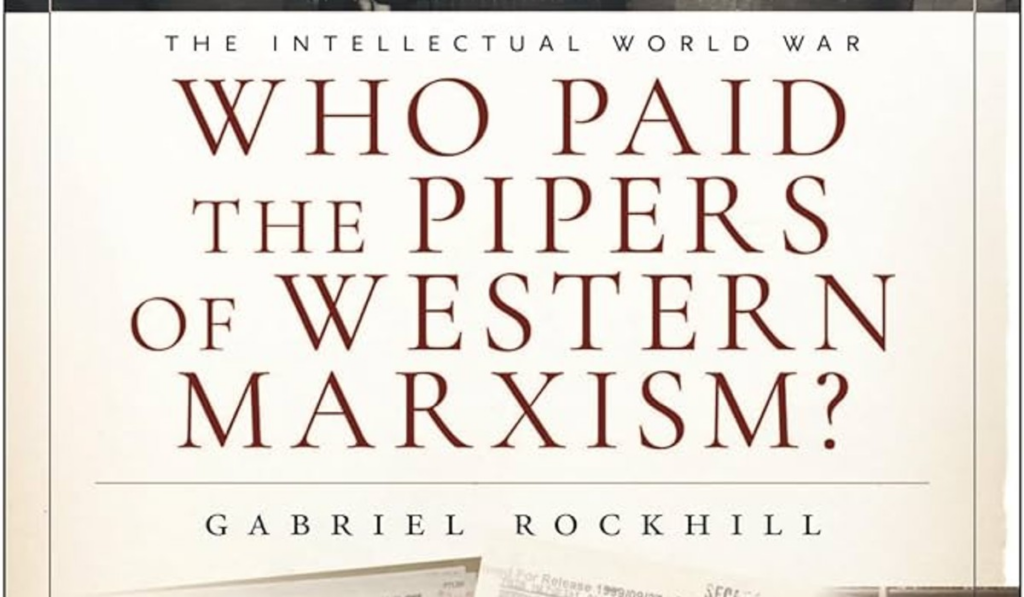
Rockhill has gained notoriety with his latest book from Monthly Review Press called Who Paid the Pipers of Western Marxism? The Intellectual World War; Marxism Versus the Imperial Theory Industry (Volume 1) (2025).[6] The title is a mouthful, and the book ranges widely – from Rockhill’s intellectual autobiography in French Critical Theory (under the auspices of Jacques Derrida himself) to the claim that Western Marxism functioned as an ideological front in the Cold War. It also contains extended passages outlining his methodological approach, which he calls “Dialectical and Historical Materialism” (DHM).[7] Politically, Rockhill in this book does not explicitly call himself a Marxist-Leninist, or a Stalinist, but, instead, embraces the label “anti-imperialist Marxism”.[8] What he calls “Global Marxism,” or non-Western Marxism, is theoretically and politically superior to anything coming out of the “imperial theory industry”.
Monthly Review Press has announced two additional volumes from Rockhill, which will supposedly demonstrate how the rest of contemporary Left theory serves as a Trojan horse for imperialist interests. Despite the apparent Marxist, socialist, and left-wing credentials of the Frankfurt School – and of French academic luminaries like Foucault and Derrida – they are all, to cite the Maoist formulation, “left in form, but right in essence”. For Rockhill, this is not merely a problem of ideology, but of the “imperial superstructure”.[9] Social being has penetrated academic consciousness to such an extent that Critical Theory, whether in its German or French variants, is rendered either useless for activists or, worse, it transforms them into complicit agents of the bourgeois state. From Theodor Adorno to Slavoj Žižek, the rock stars of academic Marxism are, in Rockhill’s view, not your friends. They are, as he puts it, the pied pipers of imperialism.
It is true that much of contemporary theory is hostile to classical Marxism and rejects its central premises. Whether the issue is the dialectics of nature, the labour theory of value, or even the need for an independent Marxist party, relatively few academics working in “theory” today defend these positions. It is no surprise to anyone that the reigning ideas of academia still reflect late capitalism. However, Rockhill goes much further in his claims. His specific accusations about the Frankfurt School’s connections to state agencies should be reviewed and scrutinised carefully. It would be valuable to see how other scholars of the Frankfurt School assess the allegations.
Unfortunately, in his polemical fervour, Rockhill tips his hand as a Stalinist ideologue by manufacturing conspiratorial amalgams. Not only is the Frankfurt School depicted as populated by ex-Nazis, CIA stooges, and the like; Trotsky himself and Trotskyists are cast as collaborators with American imperialism. Anything that appears remotely critical of Stalinism is automatically “fed-jacketed”, and Rockhill asserts a direct Trotskyism-to-CIA pipeline without so much as a footnote to substantiate the claim. Even the Grand Inquisitor of contemporary Stalinism, Professor Grover Furr, would at least provide a citation – however dubious the source – when making such a sweeping allegation.
Even if one were to concede much of Rockhill’s lurid narrative of intrigue, espionage, and betrayal, it fails to explain how the Frankfurt School actually emerged. The Institute of Social Research was in existence before the CIA or OSS were formed, but Rockhill omits one of the most decisive forces shaping Western Marxism: Stalinism itself. Against today’s historical amnesia, Stalinism was not a bulwark against Western imperialism, which even some members of the Frankfurt School believed. On the contrary, to quote Trotsky, it functioned as “an agency of imperialism”.[10] By privileging international stability and domestic peace over revolutionary upheavals, the Stalinist bureaucracy helped stabilise the imperialist system and severely distorted Marxist theory and practice as a consequence.
The Soviet Union was widely regarded as the homeland of socialism and a beacon of hope for the workers across the globe. Nonetheless, the outlook of Stalinist states did not genuinely reflect internationalism, but rather the parochial policy of “socialism in one country”. What passed for pragmatic realism produced betrayal after betrayal of workers’ movements and national liberation struggles for over a century. Movements were sacrificed to the needs of the ruling clique. Even after the fall of the USSR, similar patterns persist in various parties, organisations, and remaining Stalinist states, such as the People’s Republic of China (PRC).
While Rockhill details Adorno, Horkheimer, and Marcuse’s connections to Western institutions and intelligence agencies – highlighting their accommodation to imperialism, with Horkheimer perhaps as the most glaring case – he neglects to examine how the Frankfurt School accommodated Stalinism in the 1930s. As much as he condemns their compromises, he remains silent about the betrayals of the workers’ movement carried out by Soviet Moscow. The resulting narrative is thus incomplete and one-dimensional, drawing heavily on a truncated historical framework reminiscent of Stalin’s Short Course.
Rockhill’s book also obscures how much he shares with his ideological targets. The Critical Theorist who declares that the proletariat has been integrated into bourgeois society by the culture industry is not qualitatively much different than the Stalinist (or Maoist) who dismisses the Western working class as irredeemably bourgeoisified and incapable of revolution. In both cases, the core is condemned in favour of privileging a supposedly revolutionary periphery, even if that periphery is bourgeois, capitalist, and governed by reactionary nationalists. The Critical Theorist who rejects practice as corrupt can converge, paradoxically, with the commissar who reduces theory to the immediate needs of the state bureaucracy. When the self-emancipation of the working class is abandoned, liberation is outsourced – either to Western “progressive” imperialism or to “Actually Existing Socialism”. If Adorno said, “nothing but despair can save us”,[11] Rockhill shares in that despair when he aligns himself with the Communist Party of China, which now counts billionaires among its members.[12]
Since the collapse of the USSR in 1991, China has become the principal reference point for many Marxist-Leninists. It is hailed as an emerging superpower and harbinger of socialism. Nonetheless the PRC’s embrace of market mechanisms, entrenched inequality, and strategic alliances with imperialist states contradicts that image. This uncritical enthusiasm has led theorists such as Losurdo to revise fundamental Marxist categories. Communism is no longer about the abolition of markets or the withering away of the state. Instead, the conservative features of Stalinism – products of poverty, isolation, and civil war – are reified as emancipatory. Elements of Marx’s own project, including the main thrust of Lenin’s The State and Revolution, are criticised as utopian, anarchistic, or even “Bakuninist”.[13]
Drawing on the French Revolutionary analogy, Trotsky described the emerging Soviet bureaucracy as not merely counterrevolutionary but Thermidorian. After the fall of Robespierre, the Thermidorians of the 1790s merely wore the mask of revolution. They maintained the superficial trappings of Jacobinism, such as the Republican calendar, while rolling back the substance of the Republic of Virtue in favour of a conservative dictatorship of privilege and wealth. Like the Thermidorians after Robespierre, the Stalinist leadership also expropriated popular power, while retaining the symbols of Bolshevism. As Trotsky observed, Soviet officialdom paid formal lip service to international revolution but embraced conservative nationalism in practice.[14]
Contrary to Rockhill’s presentation, most Western Marxists ultimately accepted this Thermidorian consolidation as a historical fact. None of them agreed with Trotsky’s alternative. Even when figures such as Walter Benjamin or Bertolt Brecht expressed sympathy for Trotsky, the dominant view – echoing Lukács – was that “socialism in one country” represented political reality. Trotsky appeared romantic or messianic, incompatible with the “realistic” needs of state building. In this respect, Losurdo and Rockhill are at one with the Western Marxists they criticise. Adorno, Horkheimer, Bloch, Merleau-Ponty, Sartre, and Žižek all rejected permanent revolution. And, in the 1930s, Adorno and Horkheimer themselves adopted accommodationism, offering tacit support to the Soviet Union during the height of the purges.
Finally, when Rockhill criticises the irrationalist features of Western Marxism as inherently imperialist, he neglects to confront irrationalist defences of Stalinism. Bloch’s romantic utopianism, for example, lent itself to apologetics for Stalinist orthodoxy. In the 1930s, he did not merely theorise and wax poetic; exhibiting his loyalty in practice, Bloch wrote affidavits for the Moscow Show Trials, trying to prove how the defendants were indeed agents and foreign spies.[15] Irrationalism in late modernity did not flow solely from Schopenhauer, Nietzsche, and Heidegger. Stalinism was also a major source of irrationalism. Lukács himself conceded after 1956 that the methods of Stalinism led to a destruction of Marxist thinking.[16]
Any critique of irrationalism that omits what Isaac Deutscher called the medieval mentality of Stalinism is woefully incomplete, and continues to launder irrationalism in another pseudo-socialist guise.[17] Today, online subcultures celebrate what Benjamin Noys calls “phantasmagoric Stalinism”, which fetishises the power and cruelty of the General Secretary.[18] There is even something distinctly Nietzschean in this aestheticisation of power under the banner of “Marxism-Leninism”. Neither Losurdo nor Rockhill address this dimension of authoritarian nostalgia. Nor do they confront the far right’s own fascination with Stalin, a disturbing historical phenomenon we will examine below.
To properly address Rockhill’s claims requires not only a direct engagement with his book, but also the development of independent criticism of both Stalinism and the Frankfurt School from a standpoint distinct from these currents. This means analysing how the pessimism of the Frankfurt School emerged in relation to Stalinism, rather than in isolation from it. It also requires drawing up a critical balance sheet of “Actually Existing Socialism”, coming to grips with the tragedy of Stalinism. This means accounting for how Stalinism functioned as a roadblock to socialist and anticolonial struggles, while also undermining the anti-fascist cause. From there, the essay proceeds to evaluate key elements of Rockhill’s neo-Stalinist methodology, while providing a critical overview of the major figures of the Frankfurt School’s first generation. We conclude by advancing an alternative framework for Marxist theory that decisively departs from Rockhill’s approach while avoiding the major pitfalls of the Frankfurt School.
The Kremlin Ball at the Grand Hotel Abyss
Emerging in the aftermath of World War I and the isolation of the Russian Revolution, most Western Marxists – at least those typically labelled as such – occupied a middle ground between Stalinism and social democracy. Western Marxists were never a unified group with a coherent political programme. By the 1930s, Adorno, Horkheimer, and Marcuse preferred the relative solitude of academia to active political engagement. However, there were also Communist Party militants like Lukács and Antonio Gramsci who remained politically active. As the standard narrative goes since Anderson’s Considerations on Western Marxism (1976), what these intellectuals shared was a greater emphasis on culture, philosophy, and aesthetics than was found in “Classical Marxism”, with its traditional focus on political economy.[19]
Contrary to Rockhill’s impression of Western Marxism as uniformly hostile to the Soviet Union, the reality before World War II was far more complex. Anderson noted the following: “It [Western Marxism] never completely accepted Stalinism; it never actively combated it either”.[20] During the 1920s, the Institute of Social Research was founded independently of both the Comintern and social democracy. But independence did not mean overt hostility toward the USSR. In fact, there was no official position on the Soviet Union, whether positive or negative. When Friedrich Pollock wrote Experiments in Economic Planning in the Soviet Union 1917 – 1927, he delicately refrained from declaring explicit support. At the same time, the Institute regretted the division of the working-class movement in Germany between Communists and Social Democrats.[21]
When Horkheimer became director of the Frankfurt School in 1930, its distance from Marxist orthodoxy increased. In “The Impotence of the German Working Class”, (written in 1927 but only published in 1934), Horkheimer expressed scepticism about the ability of Germany’s working-class parties to carry out a proletarian revolution. He remarked that the Social Democrats were unwilling to act, and the Communists unwilling to think.[22] The catastrophic defeat of the German left in 1933, with the rise of Hitler, only reinforced the Frankfurt School’s political pessimism.
After Hitler’s triumph, the Frankfurt School was forced into exile. In 1935, Adorno and Horkheimer reestablished the Institute at Columbia University in New York. Despite their relocation to the United States, both remained fixated on European affairs, Marxism, and the USSR. In certain respects, they shared Rockhill’s view that the Soviet Union was the only effective anti-fascist force. Adorno wrote in 1936: “In two years at the most, Germany will attack Russia, while France and England stand back on the basis of the treaties which will have been signed by then”.[23]
During the Moscow Trials, Adorno was aghast when leading Bolsheviks confessed to fantastic crimes. Writing to Horkheimer after the first trial in August 1936: “Has the planet really and truly gone to Hell?”[24] But this was a private judgment he did not think should be said publicly. Adorno believed that the Frankfurt School should not openly criticise either Stalin or the Soviet Union lest it damage the antifascist cause. As he told Horkheimer: “The most loyal attitude to Russia at the moment is probably shown by keeping quiet”.[25] But, unlike many fellow-travellers, Adorno’s conscience seemed troubled by this silence: “[i]n the current situation, which is truly desperate, one should really maintain discipline at any cost (and no one knows the cost better than I!) and not publish anything which might damage Russia”.[26]
Although he agreed with Adorno’s need for silence, Horkheimer maintained his own ambiguity toward Stalinism. Despite its crimes, he believed the USSR represented something better than Western capitalism. Even as late as 1956, he stated: “We have nothing in common with Russian bureaucrats. But they stand for a greater right as opposed to Western culture. It is the fault of the West that the Russian Revolution went the way it did”.[27] His 1939 essay “The Jews and Europe” published shortly after the Nazi-Soviet Pact, removed references to the USSR and directed its main thrust against Hitler. In this article, Horkheimer famously argued that fascism was an outgrowth of capitalism: “…whoever is not willing to talk about capitalism should also keep quiet about fascism”.[28]
We see here that Adorno and Horkheimer occupied a position similar to many fellow travellers and left-leaning intellectuals. During the 1930s – what Victor Serge lamented as “The Midnight of the Century” – they witnessed triumphant counterrevolutions in both Russia and Germany. Yet they also viewed Stalin and the USSR as the only bulwark against the Nazi threat. To that end, the Frankfurt School was willing to mute any criticisms of the Soviet Union. It is an attitude for which Rockhill might have shown greater sympathy.
One of the earliest criticisms of the Frankfurt School comes not from the ranks of Stalinism, but from Trotskyism. The German member of the Fourth International Heinz Epe – writing under the alias Walter Held – published a 1939 assessment of Horkheimer’s version of Marxism. Held acknowledged the high theoretical level of Horkheimer’s journal and praised its critiques of reactionary philosophical currents such as neo-empiricism and irrationalism. For all of Rockhill’s insistence that his critique of the Frankfurt School is not reductive, he does not display the same appreciation of Horkheimer’s early work in philosophy one sees in Held.
However, Held pointed to a debilitating dualism between theory and practice in Horkheimer’s Marxism, particularly in the latter’s rejection of the need to build a new party against Stalinism. This retreat from organisational struggle in favour of abstract theorising turned Horkheimer, in Held’s view, into a petty bourgeois liberal. As Held wrote:
Horkheimer fails to shed the skin of a bourgeois professor. Despite his recognition and mastery of the materialist dialectic he remains among the clouds of philosophy where he elegantly dispenses with the aesthetic epigones, but without daring the jump towards earth. While, in theory, he recognises the necessity of the unity of theory and practice, he rejects it in practice.[29]
Despite Horkheimer’s explicit criticisms of the Popular Front, Held argued that the Frankfurt School remained downright ambiguous on the Russian question.[30] In the pages of the Frankfurt School’s Zeitschrift für Sozialforschung, there is no substantive push back against Vyshinsky and the Moscow Trials. Meanwhile, pro-Stalinist literature such as the Webbs’ Soviet Communism: A New Civilisation (1936) was praised “to high heavens” in the journal. Held asked, “[s]hould one really value a vague friendship with Stalin more than the upholding of certain ideas?”[31] He concluded his essay with one of the clearest and sharpest criticisms of Horkheimer’s brand of Critical Theory: “Marxism as a refuge from the present – that must be the most grotesque variation so far. But exactly this grotesqueness seems to have found a home in the Institute for Social Research. Publisher and collaborators of the journal obviously put more value on agreement on abstract method than on concrete questions of today”.[32]
One might infer from Held’s review that there was nothing inherently anti-Stalinist about Critical Theory. In its withdrawal from the present, there was a room – metaphorically speaking – for a Stalinist suite at the Grand Hotel Abyss, where Horkheimer and Adorno could bump shoulders with Vyshinsky and the Webbs. By rejecting mass struggle and ignoring Trotsky’s call for an independent Marxist movement, the Frankfurt School drifted towards accommodation with the Stalinist bureaucracy. While supporting Trotsky was difficult and dangerous, Held believed it remained the principled course. He himself died tragically and was likely murdered by the GPU after his arrest in Russia at the age of 31.[33]
Rockhill cannot explain how the same logic that permitted the Frankfurt School to tolerate Stalinism also facilitated its later accommodation to the West. The Thermidorian phase of the Russian Revolution brought its own perks for what Trotsky called “radical tourists”, including Lion Feuchtwanger, Henri Barbusse, George Bernard Shaw, Romain Rolland, and (of course), Sidney and Beatrice Webb. One could be a “friend of the Soviet Union” without being a revolutionary, and as Trotsky observed, Lord Passfield (Sidney Webb) could hobnob with Soviets officials and still defend his Majesty’s Empire. Many of these fair-weather leftists were initially horrified by Bolshevism but later saw in Stalin a conservative and “realist” force that brought stability. “Friendship for the Soviet bureaucracy is not friendship for the proletarian revolution, but, on the contrary, insurance against it”.[34]
Thus, rather than criticising the bureaucracy as betraying the revolution, these tourists were rewarded with all the privileges and fanfare the Soviet Union had to offer. Trotsky observed in Revolution Betrayed:
For many of the petty bourgeoisie who master neither pen nor brush, an officially registered “friendship” for the Soviet Union is a kind of certificate of higher spiritual interests. Membership in Freemason lodges or pacifist clubs has much in common with membership in the society of “Friends of the Soviet Union”, for it makes it possible to live two lives at once: an everyday life in a circle of commonplace interests, and a holiday life elevating to the soul. From time to time the “friends” visit Moscow. They note down in their memory tractors, creches, Pioneers, parades, parachute girls – in a word, everything except the new aristocracy. The best of them close their eyes to this out of a feeling of hostility toward capitalist reaction.[35]
The fate of “radical tourists” in the Soviet Union was not always so pleasant; while being wined and dined and feted at one moment, the tables could turn, and they could find themselves blindfolded against a wall. Parallel to Lukács’ metaphor of the Grand Hotel Abyss for Western Marxism is also Russell Jacoby’s example of the Hotel Lux, a very real and often frightening place to be during the purges. Russell points out that if “the Hotel Abyss can symbolise Western Marxism in the 1930s and 1940s, the Hotel Lux can symbolise Soviet Marxism. Unlike the Hotel Abyss, the Lux was not a metaphor but a hotel housing foreign Communists who resided in Moscow. A detailed guide book might mention that the Lux offered a special service: Visitors were often spared the annoyance of checking out. Many foreign Communists were arrested in their rooms in the Lux”.[36]
Stalinism – or “Actually Existing Socialism” – was not the heroic tableau depicted in Socialist Realist paintings or in Rockhill’s writing. It was a despotic and decadent regime that reproduced many of the corrupt features earlier witnessed by Gracchus Babeuf under the French Directory. The Left Oppositionist Christian Rakovsky warned his fellow Bolsheviks of what happens when a revolution degenerates – when popular power is usurped by a narrow clique. History does not exactly repeat, but it rhymes: like their French predecessors, the Soviet Thermidorians chased after wealth, luxury, and debauchery, while the masses remained passive, and authentic Bolshevism was suppressed and ultimately exterminated. Babeuf met his fate on the scaffold; Rakovsky after years of persecution, was among the last Left Oppositionists to capitulate to the Russian Thermidorians. Following the Third Moscow Show Trial, he was sentenced to twenty years of hard labour – only to be shot under Stalin’s orders in 1941.
Like many fair-weather friends of Stalinism, Horkheimer and Adorno did not take the self-emancipation of the proletariat seriously. This anxiety and lack of faith in the revolution appears even in Adorno’s unconscious. In one dream from 1944, Adorno reported he “was [at] a large party at which Trotsky was present. He was the centre of a group of disciples to whom he was lecturing in an animated and somewhat authoritarian fashion. The question arose of whether one should speak to him. I voted in favour, adding that one should not talk politics, but simply that it would be inelegant to cut such a renowned guest”.[37] Even in sleep, revolutionary Marxism appeared as a social impropriety, and the dream’s latent meaning dovetailed well with the statements Adorno made wide-awake. At the end of World War II, he declared that the proletariat had no revolutionary potential left: “The decay of the workers’ movement is corroborated by the official optimism of its adherents”.[38]
Revolutionary optimism, by contrast, survived in Trotsky’s Fourth International, which did not ground itself in prevailing moods, but in a longer historical arc. At the height of the Moscow Trials – while Stalin’s agents hunted his family – Trotsky quoted Spinoza: “not to laugh, not to weep, but to understand”.[39] This commitment to reason and revolution stood in sharp contrast to the increasingly pessimistic turn of Adorno and Horkheimer in the 1940s, best exemplified in their most famous co-authored text, The Dialectic of Enlightenment (1944). There, Schopenhauer and Nietzsche began to displace Hegel and Marx, where Reason itself is implicated as responsible for the horrors of the 20th century.
The Frankfurt School: Rockhill’s Critique and Ours
A) Cultural Marxism Conspiracy Theory
Rockhill’s Pipers does not discuss in any depth the pre-war origins of the Frankfurt School; its focus is chiefly on its post-war evolution. But in his criticisms of its legacy, Rockhill does nothing to address the right-wing, and even fascist, demonisation of the Frankfurt School that circulates so widely in contemporary political discourse. In these screeds from William Lind, Jordan Peterson, Christopher F. Rufo, Kevin MacDonald, and James Lindsday, Adorno and Horkheimer are the poster boys for intellectual evil. To make an analogy, Adorno in philosophy is to reactionaries what George Soros is to politics. In many conservative spaces, the Frankfurt School are literally doctors of the Church of Satan. If classical Marxism failed in its ungodly attempt to overthrow the West, these insidious academics were hellbent on seizing the cultural superstructure first before transforming the material base. While Rockhill describes the Frankfurt School as theorists of the “imperial superstructure”, the right-wing version of this claim casts them as the godfathers of Cultural Marxism.[40]
Although Rockhill himself is not on the Right, aspects of his critique of the Frankfurt School draw from the same well that these conspiracy theorists often do. This is especially evident in his reliance on writings from Progressive Labor, the magazine of the Progressive Labor Party (PLP). Those articles informed not just the Stalinist Left, but Lyndon LaRouche’s longwinded diatribes against Adorno, Horkheimer, and Marcuse as CIA agents.[41]
What occulted mysteries did Progressive Labor claim to reveal to its readers? It was already public knowledge that Marcuse worked for the Office of Strategic Services (OSS), as had a number of other Marxian intellectuals, including Paul Sweezy, Paul Baran, Otto Kirchheimer, and Franz Neumann. John Herz even quipped that “the left Hegelian weltgeist had found its temporary abode there in the Central European section of OSS”.[42] The extent of Marcuse’s connections to intelligence agencies after World War II – and into the 1950s – is a matter that will be discussed below.
However, the PLP went much further than acknowledging these facts. It alleged that Marcuse was still a CIA agent in the 60s; that his ideas about Eros (or “free love”) were a psyop, meant to encourage promiscuity as a distraction from revolutionary politics. And around the time the PLP was circulating these unsubstantiated allegations, the German radical Daniel Cohn-Bendit interrupted Marcuse’s 1969 lecture in Rome to ask why “this “father of the New Left” accepted payments from the CIA”.[43]
Rockhill does nothing to refute the more lurid claims of the PLP but merely cites those articles without further ado. But these PLP stories about Marcuse in the pay of the CIA helped spawn a whole cottage industry of far-right conspiracy theories. Lyndon LaRouche, for instance, built on the PLP rumours to further portray Adorno, Horkheimer, and Marcuse as the masters of brainwashing. Even Angela Davis was recast as a “Marchunian” Rockefeller-funded radical, who was first brainwashed by Adorno in Frankfurt before Marcuse got his cultural Marxist hands on her.
Of course, in LaRouche’s grandiosity, the Frankfurt School was amalgamated with a whole gallery of evil – Kissinger, Lukács, Gramsci, Hegel, the Rockefellers, the Masons, the British Empire, the Mossad, and the ancient Greek philosopher Aristotle constituted one big Legion of Doom against Western Civilisation. Only the neo-Platonic Promethean, Leibnizian, Hamiltonian, and, for some reason, Luxemburgian genius of Lyndon H. Larouche Jr. could save the human race from thermonuclear annihilation and cultural degeneracy.[44]
After LaRouche, sectors of the far right globally saw the Frankfurt School as the main enemy of civilisation. Adorno himself, through his connections to Paul Lazarsfeld, the Princeton Radio Project – and other secretive intelligence organisations – assumed mythic proportions in these accounts. He was variously credited with inventing the lyrics to The Beatles, promoting soap-opera melodramas, and even helping to cultivate the obsession with American football. It is patently absurd that the man who famously criticised the culture industry is simultaneously the one who created it.[45]
But not so for the far right, or even leading figures of what Rockhill calls “Actually Existing Socialism,” (AES) like Cuban leader Fidel Castro. Why is Castro’s critique of the Frankfurt School missing in Rockhill’s account, if he is such an important and exemplary advocate of “Global Marxism”? He even quotes Castro at the very beginning of his Pipers, a book written as a polemic against the Frankfurt School. So why not include these pertinent observations from El Commandante? Right after Castro endorses Bilderberg conspiracy theories, and claims that Walter Lippmann was “the man in charge of making Americans like The Beatles”, he has this to say about Adorno:
The responsibility of drawing up a social theory of rock-and-roll fell to the German sociologist, musicologist and composer Theodor Adorno, ‘one of the most important philosophers of Frankfurt’s Social Research School…’ Adorno was brought to the United States in 1939 to head the Princeton Radio Research Project whose aim was to control the masses. This project was financed by the Rockefeller Foundation and founded by one of the men who David Rockefeller trusted: Hadley Cantril…”
In fact, the Nazis had made an intensive use of radiophone propaganda as an instrument for brainwashing and had turned it into an integral part of the fascist regime. This was observed and studied by the Tavistock networks and it was widely used in all of their experiments. The aim of this project, as stated in Adorno’s ‘Introduction to the Sociology of Music’, was to program a mass “musical” culture as a way to achieve mass social control…[46]
If Rockhill regards the theorising of AES as superior to that of Adorno, Horkheimer, Marcuse – and the rest – it is surprising that he does not cite Castro’s judgment on the matter. What a missed opportunity! But, seriously, and without sarcasm this time, how different are Castro’s conspiracy-mongering claims from the far-right bogeyman image of Adorno as a diabolical mastermind behind American pop culture? The Stalinist school of falsification, which once demonised Trotsky as a fascist spy, seems just as capable of peddling tall tales about Adorno and company.
B) Adorno and Horkheimer
Some of Rockhill’s claims rest on FOIA documents that connect the Frankfurt School to intelligence services and even anti-communist plots. We need to be careful in evaluating this, since, while Rockhill reproduces a sample of these documents, he does not provide all of them. It would take a serious historian of the Frankfurt School to wade through these materials and assess them properly. For our part, we can at least distinguish what we know to be true, what remains uncertain, and what is just plain wrong.
When it comes to Adorno and Horkheimer, Rockhill shows remarkably little appreciation of their situation as refugees escaping Nazi Germany. He says virtually nothing about the harassment the early Frankfurt School suffered at the hands of the Nazis: their books were burned (alongside Trotsky’s) and they were chased out of their own country for being Jewish and for being leftists. True, Rockhill highlights the fate of Walter Benjamin, and he is right to criticise Horkheimer’s callousness towards him, as well as the later censorship of Benjamin’s writings. But Benjamin is not the main subject of Rockhill’s criticisms. More oddly, Rockhill laments Benjamin’s fate while ignoring his influence on Adorno’s Negative Dialectics, or critical theory more broadly. Where is the engagement with Benjamin’s own Messianic, theological, and Nietzschean interpretations of historical materialism? And what has had a bigger impact on academic culture: Benjamin’s relationship to Brecht – who was hostile to the Frankfurt School – or his relationship to critical theory?[47] One can make the case for Brecht’s positive influence on Benjamin, but Rockhill leaves an entire dimension of Benjamin’s legacy out of the picture.
Nor were these thinkers only hounded by the Nazis. The early Frankfurt School also suffered harassment in the United States, at the hands of the FBI and the overall anti-communist climate. Rather than an active desire to become government stooges or CIA plants, their self-censorship and conformity to American norms stemmed more from fear of their survival than from a nefarious plot. We noted above how they were willing to accommodate to Stalinism in the 1930s, and there is nothing inherent to “critical theory” that makes it automatically pro-American. Still, we agree that such conformism inflicted a substantial amount of damage on Adorno and Horkheimer’s politics. When Adorno attacked Lukács in the pages of Der Monat for being a “Wilhelmite schoolmaster” and Stalinist apparatchik, Lukács was under house arrest by the Soviets, while Adorno was publishing articles in a magazine funded by the CIA. Der Monat was a CIA-backed publication, and it was only too happy to print such an uncharitable article at Lukács’ political nadir in 1956.
There are other troubling facts about the Frankfurt School – long known to historians – that Rockhill presents as if they were new revelations. The fact that Der Monat was a CIA-funded magazine was common knowledge, and István Mészáros had already criticised Adorno’s scurrilous behaviour (and CIA connections) in his book The Power of Ideology (1989). Unlike Rockhill, however, Mészáros was a staunch critic of Stalinism, and he defended Lukács – his former teacher – against the persecution he suffered under the Soviets. Considering Rockhill’s pro-Soviet stance and his positive attitude toward the later Lukács, one would think this puts him in a conundrum. As a proponent of AES, does he support the crushing of the 1956 Hungarian Revolution with Soviet tanks? If so, what does that imply for “counterrevolutionaries” like Imre Nagy and Lukács – the former being hanged, the latter placed under house arrest? Can Rockhill really maintain his unreconstructed Stalinism while ignoring how shamefully Lukács himself was treated by the Stalinist system?[48]
Mészáros also confronts Adorno’s Negative Dialectics on a much deeper theoretical level than Rockhill’s Pipers. It is not enough to provide a sordid paper trail for an idea; one must also refute the idea itself. Mészáros does exactly this in his critique of Adorno’s anti-Hegelianism. As he points out:
Adorno’s celebrated aphorism ‘the whole is the false’ sounded most impressive in its scathing rejection of Hegel. However, as soon as one started to ask the question, what exactly was the meaning of such a statement, the aphorism totally deflated itself. For, apart from its facile overturning of Hegel’s profound (even if in his own use rather problematical) formula: ‘the truth is the whole’, it amounted to no more than a piece of rhetorical meaninglessness.[49]
Regarding their political rap sheet, the pro-Western politics of Adorno and Horkheimer are clear. They sided with Western imperialism and Israel against Nasser in the 1956 Suez crisis; they supported Israel during the 1967 war (which Losurdo calls their “August 4th” moment); they expressed disdain and contempt for the student movement, and Horkheimer most egregiously supported the American military effort in Vietnam.[50] Rockhill also brings attention to their flippant attitude towards ex-Nazis working in the Institute, as well as Adorno and Horkheimer’s broader loyalty to the Federal Republic of West Germany. As we know, Adorno and Horkheimer were deeply pessimistic about the prospects for socialism, eventually settling into what Lukács called the “Grand Hotel Abyss” of academia and the establishment. Those rooms in the Grand Hotel do not pay for themselves, and there is an unmistakably “petty-bourgeois” dimension to Adorno and Horkheimer’s critical theory that rejects mass politics.
But even conceding all this, Rockhill does not actually refute the main ideas of Adorno and Horkheimer. There is no attempt to seriously grapple with negative dialectics, Horkheimer’s critique of traditional theory, or their understanding of political economy or sociology. It is true Adorno’s thinking contains irrationalist elements, a point made clearer in the recent scholarship of Mikko Immanen, who highlights Adorno’s debt to Oswald Spengler and Ludwig Klages. In another study, Immanen details the affinities between Adorno’s criticism of Enlightenment reason and Heidegger, showing how the Frankfurt School on certain issues was closer to Heidegger than to the later Lukács. Adorno put it in a 1948 letter to Thomas Mann that he preferred Heidegger’s book on Hegel’s Phenomenology to Lukács’ The Young Hegel. And, in another letter to Horkheimer, asking him to write a review of Heidegger’s Holzwege, he admitted that “in a way … [Heidegger here] is not all that different to us”.[51] In their criticisms of Engels’ materialism, Hegelian dialectics, and Enlightenment rationality, the Frankfurt School becomes the final episode in German Romanticism. On this point we agree with Lukács: Adorno remains ostensibly “left” in his normative commitments, but drifts right in his epistemological ones.
Rockhill prides himself on how “non-reductive” and “dialectical” his method is. Nonetheless, there is no appreciation for those elements of Hegelian dialectics and Marxist critique in Adorno’s work. Adorno was not exactly a postmodernist and did not completely jettison all aspects of Marxism entirely from his oeuvre. We see them emerge in scattered insights into sociology, phenomenology, positivism, Hegel, Heidegger, fascism, and antisemitism, as well as in his reflections on culture – music, opera, his critique of superstition and the occult, and his prolific essays on literature. There are positive things to learn from Adorno, but one must possess the right method to extract and assimilate what is rational in his thought. In drawing up a critical balance sheet of Adorno, we cannot simply declare him to be theoretically bankrupt. If Adorno is nothing more than a theorist of the “imperial superstructure”, should we even bother taking him seriously as a philosopher? Such vulgar Marxism gives one licence to ignore the Frankfurt School as merely reactionary rather than to “non-reductively” engage with it.[52]
The same applies for Horkheimer: not everything he wrote is of equal value, and we need to contextualise the stage at which a particular book, essay, or collection of aphorisms was written. When he composed the Dawn aphorisms in the 1920s, in political sympathy with Rosa Luxemburg (and under the pen name Heinrich Regius), there are many passages that an orthodox Marxist could still find illuminating and true. In Dawn, Horkheimer is absolutely scathing about the academicisation of Marxism, the hypocrisy of the rich, and he even offers sharp criticisms of Nietzsche as a Dionysian reactionary and philosopher who justified slavery. There are other essays that Horkheimer wrote on the history of philosophy that we can still read with profit. His writings on bourgeois scepticism, Vico, German Idealism, positivism, pragmatism, Bergson, and neo-Thomism are first-rate, and written with dialectics and Marxist criticism in mind.
You would not know this from reading Rockhill’s account, who does not seem particularly interested in Horkheimer’s actual theorising. It is true that Horkheimer’s critical theory eventually degenerated into a species of Burkean conservatism and even theism: the notion, as he puts it in the (aptly titled) Decline aphorisms, that progressive politics is ultimately faith-based. One can argue that certain weaknesses were present in Horkheimer’s critical theory from the beginning – weaknesses later exploited and intensified to shift him from a neo-Kantian “critical” Marxism – which rejected the rationalism of Spinoza and Hegel, and the ontological materialism of Marx and Engels – toward a full-blown Nietzschean and Schopenhauerian pessimism. But the horrible politics of Horkheimer and the reactionary role he increasingly played in later years do not negate his past theoretical insights.[53]
If we want to see philosophy as a scientific field, then we cannot just moralise about the politically corrupt nature of thinkers. Either the ideas they argue for are true or they are not. One idea for which Adorno and Horkheimer became notorious for was the “culture industry”. In their polemics against consumerism, they waged a Nietzschean attack against mass society rather than attacking class society. The problem, in their account, was not so much the exploitation of the proletariat as the entertainment of the proletariat. Radio, film, magazines, television, and other consumer habits were said to be turning the entire planet into a disenchanted and anaesthetised dystopia worthy of Aldous Huxley. Despite Adorno’s insightful review of Huxley’s Brave New World, written from a Marxian perspective, the position on mass society in the Dialectic of Enlightenment is not far removed from Huxley’s own elitism.[54]
Behind Adorno and Horkheimer’s disdain for consumerism lies a deeper critique of materialism and of the Marxist conception of human needs. For classical Marxism, the problem with bourgeois society was not an over-abundance of wealth, but its restriction for the masses, and the imposition of asceticism on the proletariat. When it came to Rousseau’s rejection of modern civilisation as inherently corrupt in favour of a more Spartan-style republic, Hegel rejected such beautiful-soul primitivism. The proliferation of needs in civil society and the creation of new needs is precisely what separates the modern world from the austerity of feudalism. But Hegel did not see a way of disentangling the production of modern needs from capitalist social relations. Such wealth would inevitably generate poverty, or the immiseration of the worker. Hegel acknowledged that the workers’ status in bourgeois society was alienated, yet he did not see a way out of these contradictions. At most, he recommended proto-Keynesian measures aimed at taming the market and even went so far as to advocate shared control between workers and owners within corporations. But Hegel never called for the abolition of private property, and he regarded contemporary egalitarian movements as too abstract.[55]
When Marx and Engels criticised the contradictions of capitalism, they did not do so from the position of Rousseauan asceticism or Luddite machine-wrecking. The machine enslaves the worker under capitalism, but it also provides the key to liberation. The same holds for consumerism. At least from the perspective of Marx and Engels, consumption is not a mark of decay or decadence. They had little or nothing in common with such romantic contempt for modernity or the yearning to return to simpler (and poorer) times. This romantic critique of consumerism reappears in Adorno, Horkheimer, and Marcuse, and – as Ishay Landa demonstrates in his work – this has nothing to do with Marx and Engels’ position. The realm of freedom for Marx is grounded in necessity; the more impoverished the economic basis of society, the less space there is for freedom to develop.[56]
One cannot separate Adorno and Horkheimer’s criticisms of consumer and mass society from their more conservative moments. For instance, later in his career, Horkheimer expressed worry that contraception would destroy romance and intimate relationships, while Adorno feared that popular culture would degrade people’s attention spans. Radio, the cinema, cartoons, popular protest songs, were all said to be brainwashing the masses into mindless drones incapable of independent thinking or revolt. As much as academics today wince at Adorno’s ignorant (and racist) criticisms of jazz, they rarely connect them to his broader Nietzschean critique of mass society and consumerism. As Landa has pointed out as well, Adorno’s criticisms of jazz have unfortunate affinities with certain far-right attacks. What the fascist thinker Julius Evola writes about jazz is at times practically indistinguishable from Adorno’s attacks on the culture industry:
…America has realised on a large scale and spread all over the world through a very significant phenomenon: jazz. In the ballrooms of American cities where hundreds of couples shake like epileptic and automatic puppets to the sounds of black music, what is awakened is truly a “mass state” and the life of a mechanised collective entity. Very few phenomena are so indicative of the general structure of the modern world in its last phase as this, since what characterises it is the coexistence of a mechanical, inanimate element consisting in movement of a primitivist and subpersonal type that transports man into a climate of turbid sensations (“a petrified forest wrecked by chaos”, said H. Miller).[57]
Evola goes on to attack modern sports as a primitivist cult of action that dissolves the individual into the collectivist whole. In Revolt Against the Modern World (1934), he extends this critique to modern civilisation itself, in language that sounds eerily similar to Dialectic of Enlightenment:
After […] the frantic circulation of capital […] was set in motion, mankind has finally arrived at a point where the relationship between need and machine (or work) have been totally reversed; it is no longer need that requires mechanical work, but mechanical work […] that generates new needs. In a regime of superproduction, in order for all the products to be sold it is necessary that the needs of single individuals […] be maintained and even multiplied so that consumption may increase […]. Modern civilisation has pushed man onward; it has generated in him the need for an increasingly greater number of things; it has made him more and more insufficient to himself and powerless. Thus, every new invention and technological discovery, rather than a conquest, really represents a defeat and a new whiplash in an ever faster race blindly taking place within a system of conditionings that are increasingly serious and irreversible and that for the most part go unnoticed.[58]
What Adorno, Horkheimer, and Evola share is a vision of modernity as ushering in not freedom and plenty, but the Nietzschean “last man”. If there is one central tendency to reject in the Frankfurt School, it is their elitist critique of consumption and mass society – both of which are prerequisites for an international socialism worthy of the name. The realm of freedom presupposes a modern industrial infrastructure. Of course, socialists must advocate a sustainable model of growth that does not accelerate climate change or environmental catastrophe. Growth for its own sake is absurd (and bears the connotations of cancer). Nevertheless, we should not seek to impose unnecessary or conservative limits on the habits of the masses.
But why are we spending so much time discussing consumerism and mass society in Frankfurt School theory? For the simple reason that if there is one thing about Adorno and Horkheimer that Rockhill appreciates, it is their criticisms of the culture industry. In fact, Rockhill’s entire critique of the “theory industry” reads like a Marxist-Leninist parody of Adorno’s concept. However, for Rockhill, Adorno and Horkheimer do not go far enough in criticising themselves as promoters of the “culture industry” at the academic level. He puts it that “Theodor Adorno and Max Horkheimer provided some insightful criticisms of the culture industry, excoriating the system operative behind mainstream capitalist culture, without subjecting the industry within which they worked—the theory industry—to the same blistering critique”.[59] Rockhill’s description of the commodification of theory (and “commodity fetishism”) is extrapolated from a Frankfurt School-style critique of consumerism more generally: “Moreover, the theory industry abides by a temporal logic similar to other culture industries, where tried and true values anchor consumerist traditions while an endless stream of new products vie for that status in the future”.[60]
There is even a surprising overlap between the Frankfurt School’s criticisms of consumerism, mass society, and modern life and the way the Soviets reacted to American popular culture. For instance, it would not be difficult to mistake tirades from Pravda about American rock music and Adorno’s denunciations of pop-music as soulless. But the Soviets went much further in actually banning American music from their citizens. Here is a small sample of popular music that the Russians banned in 1985: Black Sabbath, Alice Cooper, Pink Floyd, Kenet Hit, Talking Heads, Sex Pistols, B52s, Madness, Styx, Iron Maiden, Judas Priest, ACDC, Donna Summer, The Ramones, and – last, but not least – Tina Turner.
Besides being American, what does Tina Turner have to do with this list? Apparently – at least according to the official reasoning – “sex”. These bands, singers, and many others were banned not simply because the Soviets detected “fascistic” or capitalistic messaging. They were also prohibited for “sex” and “eroticism”. Kenet Hit, in particular, was banned for “homosexualism”.[61] If Adorno and Horkheimer decried the baleful effects of the cultural industry on the masses, then the Soviets took a step further, and tried to stamp out the culture industry altogether. Even when it comes to homosexuality, Adorno shared Stalinist conservatism about it. He was not shy about writing in print that homosexuality was regressive, totalitarian and promotes “identity thinking”. Adorno’s homophobia (which is not alien to the Stalinist tradition) is on full display with this sentence: “Totalitarianism and homosexuality belong together”.[62]
Did Adorno ever support censorship of popular culture along the lines of the Soviets? Unfortunately, he came uncomfortably close in another context. In the 1930s, Adorno wrote under the rather “Aryan”-sounding pen name “Hektor Rottweiler” about the Nazi suppression of jazz. While “Rottweiler” did not explicitly endorse the new Nazi law, neither did he clearly oppose it. Instead, he attacked jazz as culturally degenerate and worthy of disappearance. In these early essays on jazz, one can already discern the lineaments of Adorno’s later critique of the culture industry. It is therefore striking that Rockhill does not address Adorno’s infamous criticisms of jazz. The very word “jazz” does not appear at all in Pipers, and nowhere in its more than 400 pages does Rockhill mention this episode of Adorno writing as “Hektor Rottweiler” under the Nazis. As noted above, Rockhill endorses Adorno’s critique of the “culture industry”, but he neglects to trace this style of criticism back to its earlier expression in the 1930s jazz essays.[63]
Against Adorno, even in recent popular television series such as Star Trek, Star Wars Andor, and The Boys, we can see open pushback against fascism, imperialism, racism, and capitalist exploitation. There are even depictions of workers’ strikes, mass uprisings, and similar forms of resistance shown and celebrated. This is not limited to television or films, but can be found across popular music, novels, comic books, and newer forms of social media. If capitalist culture were simply a smooth and homogenous system of totalitarian control, it would be difficult to account for the appearance of such themes at all, and Adorno would be right that the social whole is irremediably false. Yet these phenomena within the superstructure are not simply imperial in character, but also sites of popular and class struggle. As C.L.R. James put it: “To believe that the great masses of the people are merely passive recipients of what the purveyors of popular art give to them is in reality to see people as dumb slaves”.[64]
Often these progressive themes in popular culture become the targets of reactionary criticism. Such attacks typically come from far-right voices who condemn bourgeois culture as “woke” or as manipulated in the interests of political minorities allegedly seeking to “destroy the West”. Unfortunately, it is therefore not a mere coincidence that the Frankfurt School’s criticism of mass culture as totalitarian has found a sympathetic ear among reactionary figures such as the late Johathan Bowden, Richard Spencer, and Paul Gottfried. Gotffried writes the following in his memoirs:
…there were Frankfurt School texts I found instructive, particularly Dialectic of Enlightenment (1972) by Adorno and Horkheimer and Adorno’s Negative Dialectics (1973), both of which analyze social and cultural phenomena in a manner that I as a nonleftist could appreciate. Adorno’s attacks on bureaucratic structures and on Enlightenment rationalism, a theme that runs through Dialectic of Enlightenment, have profoundly conservative implications, providing that one can separate such perceptions from the muddled syntax in which they are encased. I thought that one should be free to take from Adorno, Horkheimer, and Marcuse what seems relevant, while being permitted to dump the rest.[65]
Likewise, Richard Spencer, in conversation with Johathan Bowden, expressed interest in reappropriating Adorno and Horkheimer’s criticisms of Enlightenment reason and consumer culture from a far-right perspective.[66] But, as we have seen, not only the far right but even Stalinists can accept the rejection of mass culture found in the Dialectic of Enlightenment. In Rockhill’s case, this critique of the culture industry becomes an essential component of his own framework. Given his vociferous polemics against the Frankfurt School, it might be surprising to learn how his Stalinism comes with its own Adornian characteristics.
C) Marcuse, US Intelligence, and the “Compatible Left”
Throughout Pipers, Rockhill repeatedly emphasises the need for an “anti-reductionist” approach. This rhetoric appears designed to soften his more shocking claims and to reassure readers that his judgments are fair and balanced. Considering his constant refrain about the need for “dialectics” and to carefully situate all phenomena and individuals in their specific material and political context (or, in Rockhill’s DHM jargon, in their “totality”), we should provide his core argument for historical nuance below:
In assessing the Frankfurt School’s collaboration with the US government, it is of the utmost importance to highlight different levels of complicity. The Frankfurt scholars needed employment. Like many intellectuals, their employers had questionable reputations, to put it mildly, but this must be contextualised and situated within an overall calculus of scholarly survival. The simple fact of working for a particular organisation does not automatically disqualify someone intellectually or politically. Within the OSS, for instance, there was a wide spectrum of political orientations, and some researchers were open to or even supportive of certain aspects of socialism. The agency itself was highly compartmentalised, with a clear distinction between the analytic and action arms (although the former fed into, and provided cover for, the latter). Moreover, some intellectuals made a significant portion of their career out of their government service, while others only served for a rather brief wartime stint. Several of them went on to produce important scholarship that was not simply an expression of the dominant ideology. Paul Baran, Arno Mayer, and Paul Sweezy are three such examples. A dialectical approach, which examines the social totality and all of the nuances of individual orientations within it—as well as how they changed over time—is necessary in order to avoid reductivist accounts.[67]
Admirable sentiments indeed. But, as we will see in the case of Herbert Marcuse, Rockhill often fails to heed his own advice, and he engages in ad hominem attacks on Marcuse’s work without addressing many of its central claims. We have already discussed Rockhill’s (non)-“reductivist” approach to Adorno and Horkheimer, but, when it comes to Marcuse, reductionism is on full display. Instead of critically evaluating Marcuse’s ideas and politics, Rockhill appears more concerned with the bottom line – namely, who is writing Marcuse’s checks. Rockhill’s strong emphasis on Marcuse’s sources of funding is not applied equally to the work of Paul Sweezy or Paul Baran, both of whom worked for US intelligence and later went on to become the chief editors of the socialist magazine Monthly Review.
As part of his own “popular front”, Marcuse was employed by the Office of Strategic Services (OSS) during World War II. This fact was widely known and something that Marcuse himself readily acknowledged. Later, when asked about his involvement with the OSS by student radicals, Marcuse expressed no regrets, maintaining that it was anti-fascist work: “If critics reproach me for that, it only shows the ignorance of these people who seem to have forgotten that the war then was a war against fascism and that, consequently, I haven’t the slightest reason for being ashamed of having assisted in it”.[68]
Rockhill is correct that working for the OSS is troubling. The OSS was set up in 1942 as an intelligence agency to combat the Axis powers. Its director, William Donovan, was eager to enlist talent from across the political spectrum for the war effort. As he later remarked: “I’d put Stalin on the OSS payroll if I thought it would help us defeat Hitler”.[69] To that end, Donovan went out of his way to recruit known members of the Communist Party and various left-wing fellow travellers, including Marcuse, Neumann, Sweezy, and Baran. All of these leftist recruits saw their involvement in the OSS as contributing to the war effort and, just as importantly, the destruction of fascism.
In their zeal to join the OSS, these leftists neglected the class nature of American imperialism; that the US state and its various agencies were advancing imperialist interests. The CP member and International Brigade veteran Milton Wolff joined the OSS and later noted that the agency was interested in restoring bourgeois rule in Italy, not popular power. Even though the OSS assisted Italian partisans, it worked to ensure that the Communist Party would not take power: “If the United States Army had not intervened, if the OSS hadn’t intervened with large sums of money, Italy would have been a socialist country”.[70] The fight against the Germans and Italians was conducted because they were rival imperialist powers. The US ruling class had no fundamental opposition to fascism as such. We also know that the US government helped fund various fascists after World War II in order to contain the Soviets.[71]
Another Abraham Lincoln Brigade veteran, Irving Goff, likewise observed that Donovan and the OSS were willing to make use of various leftists for this purpose since it was clear that the American government was the one calling the shots:
He [Donovan] says, “We’re collaborating with the Communist Party, boy. Isn’t that interesting?” He always called me “boy”, affectionately. He says, “But in your connection, make sure the Communist Party doesn’t come out ahead”. I said, “That’s valid. They’re out to win the war, we’re out to win the war. I’ll do the best I can to win this war”. He said fine, and left.[72]
Donovan’s remark about using the Communists recalls a similar statement made by CIO leader John L. Lewis, who also employed party members as union organisers. When Lewis was confronted about this, he answered: “who gets the bird? The hunter or the dog?”[73]
The involvement of Marcuse, along with Sweezy, Baran, and countless other leftists in the OSS cannot be merely justified under the banner of antifascism. Whatever their noble intentions in fighting fascism, they were still collaborating with US imperialism. However, if Rockhill is correct to call out Marcuse here, this applies just as much to the founders of Monthly Review. And, furthermore, it applies doubly to the author of the first 1949 article written for Monthly Review, entitled “Why Socialism?”
Who is this mysterious agent of imperialism who graced the opening pages of Monthly Review, you might ask? None other than Albert Einstein. But it would be risible to think that the contents of Einstein’s article could be adequately addressed merely by citing his involvement with the US government and its nuclear weapons programme. Nor could we even hope to understand the theories of Special and General Relativity by just condemning him as an imperialist stooge.[74]
Marcuse’s involvement with the US government continued after the war when he was employed by the State Department. As a political analyst, he undertook studies of the USSR and the Eastern Bloc. Rockhill notes that Marcuse’s position undoubtedly involved associating with the CIA: “According to his job description, there can be no doubt: Marcuse collaborated with the CIA and other government agencies in producing intelligence reports that guided US foreign policy”.[75] Granted the Cold War conditions, any governmental study of the Soviet Union and the Eastern Bloc could not escape collaboration with US intelligence. Thus, there is little reason to believe that Marcuse could ever escape that network.
One source Rockhill relies on heavily is the German historian of the Frankfurt School, Tim Müller. In his 2011 book, Krieger und Gelehrte: Herbert Marcuse und die Denksysteme im Kalten, Müller investigated not only Marcuse’s involvement with the OSS and State Department, but how it shaped his worldview. He claims that by 1951 Marcuse was considered a “leading authority” on communism for the State Department.[76] It should also be noted that Marcuse represented the “left” view in the Department, advocating engagement with dissident and reformist wings in the Soviet bloc. Nevertheless, even if he was not an avowed Cold War “hawk”, Marcuse was still a researcher for the anti-communist campaign conducted by the United States.
In his role as a “left-wing” State Department functionary, Rockhill argues how Marcuse was part of a broader effort to infiltrate and cultivate a pseudo-left. Rockhill describes this project as the construction of “the compatible Left” – that is, a Left ultimately aligned with Western imperialism and opposed to AES. He cites, in particular, a CIA document from May 1952 outlining a strategy for mounting an ideological offensive against the Soviet Union.[77] Such an attack, the document suggests, would be comprehensive, targeting Soviet society both philosophically and politically. In “Marxian language”, it proposed dismantling dialectics, materialism, and the theory of surplus-value. Politically, it would promote attacks on Stalin as a dictator, arguing that Bolshevism leads inexorably to totalitarianism, and even cites Boris Souvarine’s biography of Stalin as a useful example.
We do not know whether Marcuse ever had access to this document. But Rockhill makes great hay out of it, strongly implying that any criticism of Stalinism is – whether the critics know it or not – doing the dirty work of imperialist psychological warfare. It does not matter if Stalinism was ultimately responsible for destroying authentic Marxism in the Soviet Union, or how Stalin’s narrowminded pragmatism made a mockery of “dialectical materialism”. Nor does it matter that between Lenin’s Bolshevik Party and Stalin’s CP lay a “river of blood” (as Trotsky called it). If any intellectual or scholar writes a book criticising Stalin’s dictatorship, even if they never saw this CIA document, then it is guilt by association.[78]
In the realm of theory, various leftist intellectuals, including Marcuse, advanced longstanding criticisms of philosophical materialism and the dialectics of nature. But the rejection of the dialectics of nature has a longer prehistory than the phantasmagoria of Cold War intrigue. It can be traced back to Neo-Kantian rejections of Hegelian rationalism and materialism within European social democracy. Marcuse himself developed such criticisms in his doctoral work as a philosophy student. In his early writings on phenomenology and Marxism, as well as in his two books on Hegel, he rejects Soviet-style diamat and Engels’ expositions of Marx. Horkheimer, too, in his late-1920s review of Materialism and Empiriocriticism, rejected Lenin’s approach. Nor were they alone within the broader workers’ movement in criticising classical Marxist philosophy: similar critiques can be found in Austro-Marxism (e.g., the Adlers), council communism (Anton Pannekoek), and other left-wing critics of the Soviets (Karl Korsch). Even within the Soviet Union, the Mechanists argued that Marxism should be freed from dialectics and Hegel altogether.
We agree that materialism and the dialectics of nature are foundational for Marxism, and that it is no coincidence that CIA operatives sought to target them. But these criticisms of dialectics and materialism must be addressed on the theoretical plane, rather than being superficially dismissed in the manner of vulgar Marxism. Not every criticism of dialectical materialism amounts to a psychological operation, and many of these predated the CIA’s existence.
D) Marcuse, Soviet Marxism, and The New Left
Marcuse left government service in the early 1950s, returning to university teaching and research at Brandeis University (1954-65). But Rockhill insists that Marcuse’s involvement with these intelligence services continued during this period: “[Marcuse] was simply pursuing his intelligence work under academic cover. When he began his academic career, he was actually still officially a member of the State Department (his temporary leave from it only became permanent in September 1953)”.[79]
Even later in the decade, Rockhill argues that these connections persisted. He claims how Marcuse’s book Soviet Marxism (1958) was effectively vetted by the intelligence community and funded through grants from the Rockefeller Foundation. Rockhill points out that Marcuse’s acknowledgements thanked several figures (old friends and fellow-travellers) who had longstanding ties to US intelligence: “In sum, of the six principal individuals thanked by Marcuse in his ostensibly academic publication, at least three were major CIA collaborators (and the others circulated in similar networks)”.[80] Müller himself concurs, observing that the book was a continuation of previous government research:
The critical theorist and Marxist Marcuse was interested in the same developments as the intelligence analyst Marcuse. There was an identity of cognitive approaches that extended to the point where enlightenment transformed into concrete measures of psychological warfare. “Soviet Marxism” was a sophisticated reworking and continuation of the research program that Marcuse had pursued as a communism expert in the State Department.[81]
Nevertheless, even if we concede that Marcuse’s book largely continues the research he conducted for the State Department, that does not by itself debunk any of the claims advanced in Soviet Marxism. This book is not a simple anti-communist harangue – à la Robert Conquest or Richard Pipes. Marcuse notes that the USSR was not socialist in the sense envisioned by Marx and Engels. At the same time, he claims that the Soviet Union was ruled by a non-capitalist bureaucracy that oppressed the workers and peasants. But, in contrast to many Cold Warriors, he did not think that the Soviet bureaucracy was a new exploiting class. More like Isaac Deutscher, Marcuse was optimistic about the reform prospects for Khrushchev’s de-Stalinisation campaign. Finally, he rejected the idea that the USSR was an inherently expansionist state bent on global domination. Instead, he argued that the regime’s conservative commitment to “socialism in one country” tended towards coexistence and accommodation rather than aggressive expansion.[82]
Aside from the issue of government funding, what Rockhill objects to most in Marcuse’s Soviet Marxism is its lack of deference to Marxist-Leninist orthodoxy. He argues that Marcuse also failed to grasp the material and political situation of the USSR, and instead indulged in what he calls a “puerile celebration of a utopian version of socialism in order to juxtapose it to the horrors of socialism in the real world”.[83] Moreover, he contends that Marcuse lacks the historical-materialist “rigor” he attributes to other preferred writers of Soviet history, such as Annie Lacroix-Riz, Domenico Losurdo, Ludo Martens, and Michael Parenti.[84]
Let us consider these pious doctors of the church of Stalinism, whom Rockhill cites as ultimate authorities. He cites them less for their expertise on the Soviet Union, and for their ideological bonafides. Lacroix-Riz has written on Soviet foreign policy as it relates to France during the 1930s and is a longtime Marxist-Leninist activist. Ludo Martens is best known for his book Another View of Stalin (1994), a work that does not rise much above the scholarly level found in the writings of Grover Furr, an arch-Stalinist conspiracy theorist.[85] The late Michael Parenti never claimed to be a specialist on the USSR, although, unlike Martens and Furr, he did condemn Stalin’s purges in his book Blackshirts and Reds (1997).[86]
Finally, Losurdo’s greatest strengths as a Marxist lay in the history of philosophy rather than in Soviet historiography. When we read the historian Albert Soboul, it is for his insights on the French Revolution, not his justifications for a lifetime membership in the PCF. Or when we read W.E.B. Du Bois on the Civil War and Reconstruction, we do not need to treat his paeans to Stalin with the same level of seriousness. The same could be said about Losurdo. There are, of course, many revisionist scholars of the USSR whom Rockhill might have consulted, such as Sheila Fitzpatrick and J. Arch Getty. But none of them defend Stalinist dogma.
Strangely, Rockhill chides Marcuse for failing to take account of an obscure 1955 CIA document that purportedly argued that Stalin was not a dictator.[87] But a closer reading of that same document suggests something quite different: the CIA still regarded Stalin as the all-powerful leader of the USSR, surrounded by many willing lieutenants. While the report notes that Soviet leadership formally operated on a collective basis, it also acknowledges that “there was no organised opposition” to Stalin. Indeed, how could there have been? Stalin accumulated an immense amount of power as General Secretary, and established a system of bureaucratic patronage, privilege, and terror. Open opposition to Stalin was invariably met with imprisonment, if not execution. It is truly sad that the CIA analysts who produced the document Rockhill cites did not avail themselves of Marcuse’s Soviet Marxism. Even that book – funded with Rockefeller money – explains the reality of the Soviet system better than most “Marxist-Leninist” scholars can.
In the following decade, Marcuse became a central figure of the New Left. Yet, again, Rockhill maintains that Marcuse was still likely functioning as a government asset during the 1960s. For one thing, he holds the view that the New Left was simultaneously against the system and compatible with it. Even while the FBI was working to disrupt the New Left through COINTELPRO, Rockhill argues that the state also sought to hijack the movement in order to defeat the Marxist “Old Left”:
The US national security state thereby often took a two-pronged approach, using what it could of the New Left as a weapon of war against the purported Old Left, while seeking over all to beat back any form of left politics. In other words, the New Left was an enemy, which is clear from the long and detailed history of the FBI’s COINTELPRO (COunterIntelligence [sic] PROgram), which was officially run from the mid-1950s through the early 1970s and was designed to “disrupt and destabilise”, “cripple”, “destroy” or otherwise “neutralise” dissident political movements and organisations. However, the New Left was also sometimes recognised, particularly by agencies like the CIA, as a useful enemy”.[88]
In that regard, Rockhill claims that Marcuse served as a conduit to create a compatible Left. He insinuates that Marcuse’s promotion by major media outlets as a guru for the New Left was managed by the intelligence agencies: “…the bourgeois media is largely controlled and overseen by the US national security state. This begs the question: was the promotion of Marcuse as the godfather of the New Left due, at least in some degree, to the bourgeois state’s mobilisation of its media assets?”[89]
Without descending into conspiracy-mongering, the simpler explanation is that students and radicals found Marcuse’s work often compelling and insightful. He was a charismatic and outspoken figure who publicly condemned the Vietnam War and expressed solidarity with new social movements – most notably, environmentalism, Black Power, feminism, and the antiwar movement. But Rockhill remains adamant about Marcuse’s anti-communism: “His radicalisation did not … call into question the fundamental orientation that allowed him to dutifully serve the US national security state and the capitalist ruling class in their intellectual world war: he remained an anticommunist until the end”.[90]
Given Rockhill’s strident criticism of Marcuse as “an anticommunist until the end”, it is worth quoting Marcuse’s actual positions here. It is true Marcuse was sharply critical of Stalinism; nevertheless, he also defended his student – and prominent Communist Party member – Angela Davis, who lost her academic position and was viciously repressed by the state. In 1972, Marcuse linked the struggle to free Angela Davis to the Black Power movement and to the victory of the NLF in Vietnam:
Angela has always emphasised during her defense that she is a communist. What this means in this regard is this: understand that the liberation struggle of blacks is a part of, or aspect of, the general struggle for liberation from capitalism. And this general struggle (of course with minority impacts) has an extremely concrete and horrifying target: the war against the Vietnamese people. The complete terrorism of late monopoly capitalism is concentrated against them…The counterrevolution must be stopped. If it’s not, the alternative will be fascism. It is not we here, here in the USA. who stand in the forefront of the fight—it is rather the people of Vietnam. Let us work for their liberation!”[91]
If Marcuse was truly acting as an agent of imperialism to destroy the Old Left, why would he go out of his way to defend a member of the Communist Party, and call for the victory of the Vietnamese communists over US imperialism? Perhaps Rockhill thinks that Marcuse needed to maintain his cover somehow, and that is why he publicly defended Davis? To even ask such a question seems patently absurd.
As is clear, Rockhill denounces Marcuse as one of the godfathers of Western Marxism and the “compatible left”. But he largely ignores the fact that Marcuse expressed solidarity with various Third World figures and movements. For example, beyond Vietnam, Marcuse praised Che Guevara as “very far from the Stalinist bureaucrats, very near to socialist man”.[92] It is not only Cuba that he was hopeful about, but Marcuse was even inspired by the early phases of the Chinese Cultural Revolution. He states his support for all these movements in his Essay on Liberation (1969), arguing how the cracks in the Stalinist monolith opened up new radical alternatives within socialism:
Last but not least, the opposition within the advanced capitalist countries has been seriously weakened by the repressive Stalinist development of socialism, which made socialism not exactly an attractive alternative to capitalism. More recently, the break in the unity of the communist orbit, the triumph of the Cuban revolution, Vietnam, and the “cultural revolution” in China have changed this picture. The possibility of constructing socialism on a truly popular base, without the Stalinist bureaucratisation and the danger of a nuclear war as the imperialist answer to the emergence of this kind of socialist power, has led to some sort of common interest between the Soviet Union on the one side and the United States on the other.[93]
Finally, if Marcuse were still an intelligence asset toward the end of his career, why was the FBI keeping him under strict surveillance? None other than FBI Director J. Edgar Hoover considered Marcuse to be a dangerous radical. In a 1966 report Hoover wrote:
Although subject [Marcuse] is not a member of a basic revolutionary organisation, he is a self-admitted Marxist who travels extensively making frequent speeches in which he espouses Marxism. He is also currently participating actively in protest demonstrations against the United States intervention in Vietnam [and] is an author and a philosophy professor [and therefore] in a position to influence others against the national interest in a time of national emergency.[94]
In other words, Hoover considered Marcuse a threat to national security. While state agencies can certainly be clumsy, it strains credulity to imagine the CIA would keep the FBI completely in the dark about a supposed asset. Rockhill ultimately refuses to face the reality that Marcuse was not in any respect a pro-imperialist stooge by the 1960s. This was something that even Hoover and the FBI recognised.
Rockhill condemns Marcuse’s analysis of Western capitalism in One-Dimensional Man (1964) (ODM) as a continuation of his earlier intelligence work. Marcuse’s text argues that traditional class struggle is outmoded in the West and instead champions various outside groups as potential agents of revolutionary change. Rockhill claims this enabled Marcuse to play the role of a radical recuperator, channelling the New Left movements into harmless utopianism: “Marcuse’s capitalist and state backers were clearly pleased with the central thesis of the book, namely that class struggle had been overcome by economic and technological development, and the possibility of an alternative society was thereby foreclosed, or at least banished to the realm of the imagination”.[95]
Certainly, one can disagree with the conclusions of ODM. Philosophically, one can be critical of Marcuse’s philosophical reliance on his old professor (and unrepentant Nazi) Martin Heidegger. Marcuse’s criticisms of “technological” or “instrumental” rationality are too closely aligned with Heidegger’s own observations about modern technology. Thus, despite the sharp criticisms of Heidegger that appear in Marcuse’s interviews and other writings, he never fully broke with him in the realm of theory. Marcuse’s arguments about “repressive desublimination” and his dichotomisation of “true” and “false” needs also echo the romantic rejection of consumerism and mass society already present in Adorno and Horkheimer’s Dialectic of Enlightenment. Lastly, regarding the assumptions Marcuse made about political economy in ODM, Paul Mattick wrote one of the strongest reviews from a more orthodox Marxian standpoint. Marcuse himself reportedly described Mattick’s response as “the only solid and real criticism” of his book.[96]
There is also a certain irony in the fact that Marcuse’s analysis parallels the central thesis of Monopoly Capital by Paul Sweezy and Paul Baran, published by Monthly Review Press – Rockhill’s own publisher – in 1966. In that book, Sweezy and Baran employ a Keynesian-Marxian framework to argue that the rate of profit does not tend to fall but actually rises under monopoly capitalism. This creates a problem for the system as to where to invest the growing surplus, which in turn leads not to universal human flourishing but to various forms of parasitic waste. The affinities between these conclusions and Adorno and Horkheimer’s critique of mass society seem unmistakable. And, like the first generation of the Frankfurt School, Sweezy and Baran claim that the working class is no longer the primary revolutionary agent:
The answer of traditional Marxian orthodoxy-that the industrial proletariat must eventually rise in revolution against its capitalist oppressors-no longer carries conviction. Industrial workers are a diminishing minority of the American working class, and their organised cores in the basic industries have to a large extent been integrated into the system as consumers and ideologically conditioned members of the society. They are not, as the industrial workers were in Marx’s day, the system’s special victims, though they suffer from its elementality and irrationality along with all other classes and strata-more than some, less than others.[97]
Sweezy and Baran concede that imperialist wars abroad generate new crises at home; such radical upsurges are likely to emerge from students, racial minorities, and other marginal groups. And yet Monopoly Capital argues that there is no real internal opposition – i.e., no working-class movement – strong enough to overthrow Western capitalism. Again echoing the critique of the “culture industry” found in Dialectic of Enlightenment (though without directly drawing from the well of Nietzschean pessimism), Sweezy and Baran maintain that the ruling class can effectively “buy off” the workers. The task of political struggle is thus relegated to small groups, since most of the population has been pacified and integrated into bourgeois society.
Mandel observed in his review of Monopoly Capital how this line of argument led Sweezy and Baran to virtually deny the possibility for socialism in the United States:
But there still remains the inescapable conclusion that all these forces are today minority forces in American society; that even the conscious option in favor of socialism, as a result of the example of the more efficient and more democratic functioning of the countries calling themselves socialist, – some time in the future predicted by Sweezy and Baran, – could only be a minority action as are all purely ideological options in history. This much is certain – in the absence of powerful socio-economic motives growing from the basic instability of American society, the hope for a revolutionary overthrow of monopoly capitalism by these forces remains largely utopian.[98]
As one can observe, while Monopoly Capital is more firmly grounded in political economy than ODM, their conclusions strongly overlap. Both works argue that the industrial proletariat had been integrated into Western capitalism, and that the revolutionary subject must be sought for elsewhere. For Sweezy and Baran, just as much as Marcuse, socialism is no longer a material necessity but assumes the character of a Kantian regulative ideal. But replacing material necessity with categorical imperatives is the mark of any utopian reformism, a theoretical manoeuvre that goes all the way back to Eduard Bernstein’s own moralising alternative to classical historical materialism.
All of this discussion sets the stage for a final irony. For we find Paul Baran, in a letter to Paul Sweezy, criticising Marcuse along precisely these same lines:
I have just finished reading Marcuse’s new book (in MS) [One Dimensional Man], which in a laborious kind of a way advances this very position which is called the Great Refusal or the Absolute Negation. Everything is Dreck: monopoly capitalism and the Soviet Union, capitalism and socialism as we know it; the negative part of the Marx story has come True — its positive part remained a figment of imagination. We are back at the state of the Utopians pure and simple; a better world there should be but there ain’t no social force in sight to bring it about. Not only is Socialism no answer, but there isn’t anyone to give that answer anyway. From the Great Refusal and the Absolute Negation to the Great Withdrawal and the Absolute Betrayal is only a very short step. I have a very strong feeling that this is at the moment in the center of the intellectuals’ thought (and sentiment) — not only here but also in Latin America and elsewhere, and that it would be very much our commitment sich damit Auseinander zu setzen [to confront and come to terms with this sentiment]. There is hardly anyone else around. The official left simply yells [you have been victimised] à la Political Affairs, others are bewildered.[99]
Nevertheless, given their shared premise that the industrial working class in the West has been integrated and effectively bought off, we do not see how Baran can criticise Marcuse so harshly without falling prey to the same problems. When it comes to the “Great Refusal” leading to the “Great Withdrawal” (or worse) he doth protest too much. The truth is the political economy underlying the Frankfurt School is largely compatible with the one advanced by Sweezy and Baran.
About the overlap between Marcuse and the founders of Monthly Review in their departure from class struggle and classical Marxism, Rockhill remains silent. Marcuse’s work is castigated as a CIA psyop that helped defang the New Left’s connection to orthodoxy; but when Baran and Sweezy reach the same conclusions, Rockhill gives them a pass, raising no comparable accusations of state collaboration or of being dupes of American imperialism.
One final episode from Marcuse’s intellectual career is worth dwelling on, since Rockhill presents this as a prime example of his alleged betrayal. Towards the end of his life, Marcuse expressed solidarity with the East German dissident Rudolf Bahro. Unlike many other dissidents, Bahro was himself a Marxist and the author of The Alternative in Eastern Europe (1977), an analysis of the Eastern Bloc inspired by Marxist categories.[100] The East German authorities arrested Bahro and accused him of working with Western intelligence. Rockhill accepts the claims of the East Germans at face value that Bahro was some sort of agent. But, as far as anyone can determine, such allegations were baseless; his real crime was to write a book critical of the state. As Alexander Amberger notes in his history of dissident leftists in East Germany:
Since the actual content of The Alternative did not provide sufficient legal grounds for arrest, Bahro was detained on the basis of Paragraph 100 of the German Criminal Code, which referred to ‘subversive associations’ – a very elastic concept. The trial that followed was in the end nothing more than a farce. Bahro was accused of intelligence activities and the disclosure of secrets and was sentenced to eight years in prison.[101]
Marcuse, along with other leftists such as Ernest Mandel, Pierre Frank, and Rudi Dutschke, came out in open solidarity with Bahro. They demanded his release and hailed The Alternative for its critical analysis. Their solidarity was extended not to an agent of imperialism but to a fellow Marxist.
However, Rockhill claims that their support for Bahro did align with the interests of Western intelligence: “Whatever the case may be, the position he [Marcuse] took perfectly aligned with the agenda of his former colleagues in the State Department and his friends who managed the soft-power investments of the capitalist ruling class”.[102] While the capitalist press may have condemned Bahro’s treatment, this was undoubtedly disingenuous, since they did not approve of any socialist reformer in the East. Rather, they seized the opportunity to take cheap shots at “East German totalitarianism”, even while backing the brutal repression of leftists in the West. What Rockhill ultimately does here is create a false amalgam, bringing together Marcuse and the CIA simply because both were opposed to Soviet bloc “AES”.
On the 30th anniversary of East Germany in 1979, Bahro was granted amnesty on the condition that he leave the country. He accepted and departed for West Germany on 17 October 1979.[103] Despite any “legalese” to the contrary, this amounted in practice to a deportation. Bahro was punished by the East German state for writing a critical Marxist analysis. Rather than confront his actual ideas, they painted him as a criminal in service to the West. But this is straight out of a Moscow Trials playbook, where ideas were dismissed as just a mask for a criminal conspiracy. Rockhill seems all too willing to believe the claims of the Stasi without question.
As we can see, Rockhill’s criticisms of Marcuse are among the weakest in his book. This weakness is not an accident but flows from his own Stalinist methodology. When Marcuse was attacked in the 1960s for being a CIA agent by the Progressive Labor Party, the anarchist Murray Bookchin rightly claimed that their style of character assassination had its origins in the Moscow show trials:
A spiritual erosion developed within the [Russian Communist] party that paved the way for the politics of the secret police, for character assassination, and finally for the Moscow trials and the annihilation of the Old Bolshevik cadre. One sees the return of this odious mentality in PL articles like “Marcuse: Cop-out or Cop?”—the theme of which is to establish Marcuse as an agent of the CIA. (See Progressive Labor, February 1969.) The article has a caption under a photograph of demonstrating Parisians which reads: “Marcuse got to Paris too late to stop the May action”. Opponents of the PLP are invariably described by this rag as “redbaiters” and as “anti-worker”. If the American left does not repudiate this police approach and character assassination it will pay bitterly in the years to come.[104]
One may disagree with Bookchin’s criticisms of Leninism, but his point still stands today. Unless one believes that J. Edgar Hoover was somehow kept out of the loop, then there is no evidence that Marcuse remained a CIA or State Department asset in the 1960s. And drawing from the well of unscrupulous articles written by the PLP in its factionalist heyday is not something that inspires confidence. What is needed instead is a genuinely materialist approach to the Frankfurt School, that can develop a critique of its ideas and institutional connections without the phantasmagorical delusions of Stalinism, LaRouche, or the contemporary alt-right.
You can download entire dossier as single pdf file here
[1] See Perry Anderson, Considerations on Western Marxism (London: Verso, 1976), 42. For the origins of the term “Western Marxism,” see Nicholas Devlin, “Karl Korsch and Marxism’s interwar moment,
1917–1933,” History of European Ideas Vol. 48, No. 5 (2022): 574–593.
[2] Georg Lukács, The Theory of the Novel (Cambridge: MIT Press, 1971), 22.
[3] Max Horkheimer, Dawn and Decline: Notes 1926-1931 and 1950-1969 (New York: The Seabury Press, 1978), 41.
[4] Domenico Losurdo, Western Marxism: How It Was Born, How It Died, How It Can Be Reborn (New York: Monthly Review Press, 2024a).
[5] Gabriel Rockhill, “Critical and Revolutionary Theory: For the Reinvention of Critique in the Age of Ideological Realignment,” in Domination and Emancipation: Remaking Critique, ed. Daniel Benson (London: Rowman & Littlefield, 2021), 118.
[6] Rockhill’s title is a homage to Frances Stonor Saunders book, Who Paid the Piper? The CIA and the Cultural Cold War, which details CIA involvement with the Congress for Cultural Freedom. See Gabriel Rockhill, Who Paid the Pipers of Western Marxism? The Intellectual World War; Marxism Versus The Imperial Theory Industry (Volume 1) (New York: Monthly Review Press, 2025), 61-2.
[7] Ibid. 75-80.
[8] Ibid. 333.
[9] Ibid. 154.
[10] Leon Trotsky, In Defense of Marxism (New York: Pathfinder Press, 1973), 24.
[11] Adorno as quoted in Rockhill 2025, 223.
[12] For billionaire membership in the “Communist” Party of China, see Bloomberg, “Why Communist China Is Home to So Many Billionaires”, Fortune, November 29, 2018. https://fortune.com/2018/11/29/communist-china-billionaires-jack-ma/; Sui-Lee Wee, “China’s Parliament Is a Growing Billionaires’ Club”, New York Times, March 1, 2018. https://www.nytimes.com/2018/03/01/business/china-parliament-billionaires.html; In the following clip, Rockhill fails to distinguish between the Western proletariat and the labour aristocracy as a whole. He then extrapolates this to cover the “academic” labour aristocracy, not bothering to distinguish between elite professors and the thousands of poorly paid adjuncts in the same institutions. In many respects, Rockhill’s account of the “intellectual labor aristocracy” resembles J. Sakai’s Settlers, which argues that the entire American working class is irredeemably corrupt and bought off. “The Intellectual Labor Aristocracy W/ Gabriel Rockhill.” n.d. Youtube. Accessed April 18, 2026. https://www.youtube.com/shorts/Urw8RRepoOs.
[13] Domenico Losurdo, Democracy or Bonapartism (New York: Verso, 2024b), 320-21.
[14] For more on the Thermidorian degeneration of the USSR under Stalin, see Leon Trotsky, The Revolution Betrayed: What is the Soviet Union and Where is it Going? (New York: Pathfinder Press, 1972); Douglas Greene, Stalinism and the Dialectics of Saturn: Anti-communism, Marxism, and the Fate of the Soviet Union (New York: Lexington Books, 2023), 251-283; Sheila Fitzpatrick, The Russian Revolution (Oxford: Oxford University Press, 1994), 156-72; Michael Reiman, The Birth of Stalinism: the USSR on the Eve of the “Second Revolution” (London: I. B. Tauris & Co. Ltd., 1987); and Victor Serge, Russia Twenty Years After (Atlantic Highlands: Humanities Press, 1996).
[15] Ernst Bloch, “Discussing Expressionism”, in Aesthetics and Politics (London: New Left Books, 1977), 15. For more background on Bloch’s complicated political trajectory and eventual turn against Stalinism see Greene 2023, 121-23.
[16] Georg Lukacs, The Process of Democratisation (Albany: State University of New York Press, 1988), 117-136.
[17] See Isaac Deutscher, “Marxism and Primitive Magic”, in The Stalinist Legacy: Its Impact on Twentieth Century World Politics, ed. Tariq Ali (Chicago: Haymarket Books, 2013), 95-106.
[18] See Historical Materialism: Critical Marxist Theory. “Crisis and Criticism (with Benjamin Noys and Harrison Fluss)”. YouTube. May 22, 2025. https://www.youtube.com/watch?v=sOyhNac3coo.
[19] Rockhill stated that Anderson neglected to discuss the contributions of Third World Marxism in his analysis of Western Marxism:
“He [Anderson] praises the innovation of western Marxists for coming up with new ways of thinking and new ways of speaking. not the innovation of Ho Chi Minh, of Mao, of Che and many other examples that one could point to that are innovations – that are theoretical innovations – of the highest possible sort because they have practical implications for elevating the lives of literally millions of people subjected to the most heinous forms of abject immiseration”. Critical Theory Workshop. “Gabriel Rockhill Interviewed by the Marx Memorial Library”. YouTube. December 24, 2025. https://www.youtube.com/watch?v=skQI7h3jDUE.
[20] Anderson 1976, 96.
[21] A great deal of this section draws upon Greene 2023, 118-120.
[22] Quoted in Martin Jay, The Dialectical Imagination: A History of the Frankfurt School and the Institute of Social Research 1923 – 1950 (London: Heineman, 1973), 14.
[23] Quoted in Rolf Wiggershaus, The Frankfurt School: Its History, Theories, and Political Significance (Cambridge: MIT Press, 1995), 162.
[24] Quoted in Stefan Müller-Doohm, Adorno: A Biography (Cambridge: Polity, 2005), 226.
[25] Quoted in Wiggershaus 1995, 162.
[26] Ibid.
[27] Theodor W. Adorno and Max Horkheimer, “Towards a New Manifesto”, New Left Review 65 (Sept-Oct. 2010): 41.
[28] Max Horkheimer, “The Jews and Europe”, in Critical Theory and Society: A Reader, ed. Stephen Eric Bronner and Douglas MacKay Kellner (New York: Routledge, 1989), 78.
[29] Walter Held [Heinz Epe], “Critical Theory without Political Praxis? A Discussion with the Zeitschrift für Sozialforschung”, trans. Alex de Jong. Historical Materialism. https://www.historicalmaterialism.org/article/critical-theory-without-political-praxis-a-discussion-with-the-zeitschrift-fur-sozialforschung/
[30] See Horkheimer’s criticisms of popular frontism in Max Horkheimer, ‘Die Philosophie der Absoluten Konzentration’, Zeitschrift für Sozialforschung, VI:2 (1938), 245-294. Given Horkheimer’s later conservatism, he was reluctant to republish such an article criticising social democracy and popular-front tactics.
[31] Ibid. Elsewhere, Rockhill discusses Held’s criticism of the Frankfurt School without mentioning their softness on Stalinism. See Rockhill 2021, 123.
[32] Held, “Critical Theory without Political Praxis?”
[33] For background, see Walter Held, “Why the German Revolution Failed”, Marxists Internet Archive. https://www.marxists.org/history/etol/revhist/otherdox/whatnext/heldgerm.html
[34] Trotsky 1972, 302.
[35] Ibid. 305.
[36] Russell Jacoby, Dialectic of Defeat: Contours of Defeat (Cambridge: Cambridge University Press, 1981), 115-16.
[37] Theodor W. Adorno, Dream Notes (Cambridge: Polity, 2007), 31.
[38] Theodor W. Adorno, Minima Moralia: Reflections on a Damaged Life (New York: Verso, 2005), 113.
[39] Leon Trotsky, “I Stake My Life!” Marxists Internet Archive. https://www.marxists.org/archive/trotsky/1937/09/life.htm For more on the tragedy that befall Trotsky’s family, see Sam Miller, “The Trotskys Betrayed”, Left Voice, August 20, 2020. https://www.leftvoice.org/the-trotskys-betrayed/
[40] On the affinities between Rockhill’s critique of academia and the alt-right’s attacks on higher education, see Richard Gilman-Opalsky’s review of Pipers in Marx and Philosophy Reviews. Gilman-Opalsky points out that Rockhill seems blind to the drive to purge the academy of anything resembling Marxism: “Does Rockhill imagine university administrations making a hard distinction between Marxian critical theory and Marxist-Leninist theory?” This also echoes our earlier point that Rockhill does not properly distinguish between elite academia (the “academic” labour aristocracy) and the rest: “…Rockhill tries to substantiate his claim by reporting Judith Butler’s atypical exorbitant salary and listing common speaking fees for thinkers like Gayatri Spivak, Étienne Balibar, Catherine Malabou and others…Does Rockhill really think professors doing queer theory and teaching French critical theory and Western Marxism on campuses across the United States get such posh treatment?” Richard Gilman-Opalsky, “‘Who Paid the Pipers of Western Marxism?’ review,” Marx and Philosophy, April 2, 2026. https://marxandphilosophy.org.uk/reviews/22624_who-paid-the-pipers-of-western-marxism-by-gabriel-rockhill-reviewed-by-richard-gilman-opalsky/.
[41] It is interesting to note how Rockhill’s fellow academic Stalinist, Grover Furr, has connections to the Progressive Labor Party. Their newspaper Challenge has written positive reviews of his hatchet work. Furr likewise cites PLP publications on his website. See Progressive Labor Party, ““Blood Lies” Fighting Anticommunist Lies”, Challenge, October 30, 2014. https://plp.org/home/challenge-newspaper/9686-blood-lies-fighting-anticommunist-lies
[42] Quoted in Raffaele Laudani, ed., Secret Reports on Nazi Germany: The Frankfurt School Contribution to the War Effort (Princeton: Princeton University Press, 2013), 59.
[43] Quoted in A.J.A. Woods, The Cultural Marxism Conspiracy: Why the Right Blames the Frankfurt School for the Decline of the West (New York: Verso, 2026), 17. Regarding the PLP’s cultural conservatism, one could supposedly tell who was a member of the PLP in the 1960s by sight: unlike those with bell-bottoms and long hair, the typical PLP member appeared straight-laced and dressed in a suit and tie. This austere dress code was later imitated by Lyndon LaRouche and his National Committee of Labor Caucuses (NCLC).
[44] On LaRouche’s conspiratorial thinking, see ibid. 45-57.
[45] Ibid. 53-54, 62, and 65-66.
[46] Fidel Castro, “Reflections by Comrade Fidel: THE WORLD GOVERNMENT – Part I”, Cuba.cu, August 17, 2010. http://www.cuba.cu/gobierno/reflexiones/2010/ing/f170810i.html
[47] James Philip McFarland, Constellation: Friedrich Nietzsche and Walter Benjamin in the Now-Time of History: Friedrich Nietzsche and Walter Benjamin in the Now-Time of History (New York: Fordham University Press, 2012) and Walter Benjamin, Understanding Brecht (New York: Verso, 2024).
[48] On Nagy being shot, see Simon Hall, 1956: The World in Revolt (New York: Pegasus Books, 2015), 350. On the fate of Lukács, see Michael Löwy, Georg Lukács: From Romanticism to Bolshevism (London: New Left Books, 1979), 205-13.
[49] István Mészáros, The Power of Ideology (New York: Zed Books, 2005), 102.
[50] Losurdo 2024a, 130.
[51] Quoted in Rüdiger Safranski, Martin Heidegger: Between Good and Evil, trans. Ewald Osers (Cambridge: Harvard University Press, 1998), 413.
[52] See Rockhill’s comments beginning at 17:40 in Emancipations with Daniel Tutt. “Who Paid the Pipers of Western Marxism? Lecture and Panel Discussion”. YouTube. February 20, 2026. https://www.youtube.com/watch?v=V99paWsa8vY
[53] On this point, see Harrison Fluss, “Spinoza avec Sade: On Horkheimer’s Critique of Objective Reason”, Historical Materialism, April 26, 2013. https://wearemany.org/a/2013/04/states-of-reason.html
[54] See Theodor W. Adorno, Prisms (Cambridge: MIT Press, 1997), 95-118 and Ishay Landa, The Overman in the Marketplace: Nietzschean Heroism in Popular Culture (Lanham MD: Lexington, 2009), 80-81.
[55] For Domenico Losurdo’s discussion of Hegel’s criticism of Rousseau, see Hegel and the Freedom of Moderns (Durham: Duke University Press, 2004), 188. For Hegel’s anticipation of Keynes, see Geoff Mann, In the Long Run We Are All Dead: Keynesianism, Political Economy, and Revolution (New York: Verso, 2017), 27. On Hegel, Jacobinism, and egalitarianism see Doug Enaa Greene and Harrison Fluss, “Hegel, Enlightenment, and Revolution”, Left Voice, July 26, 2020. https://www.leftvoice.org/hegel-enlightenment-and-revolution/
[56] Ishay Landa, Fascism and the Masses: The Revolt Against the Last Humans, 1848-1945 (Routledge, 2018), 349, 401, 414-17.
[57] Julius Evola, Revolt Against the Modern World (Rochester, VT: Inner Traditions International, 2016), 355-56. See also Landa 2018, 33-34.
[58] Evola 2016, 335-36. The quote and ellipses are Landa’s. See Landa 2018, 33.
[59] Rockhill 2025, 143.
[60] Ibid. 156.
[61] The Revolver Club, “Not Recommended Music! Bands Banned in the USSR”, The Revolver Club, July 3, 2023. https://www.therevolverclub.com/blogs/the-revolver-club/not-recommended-music-bands-banned-in-the-ussr?srsltid=AfmBOoruUrbyrm8lhfoeC68jF3ru4xnGDB6lqetR3xJ3aVOTToH1gPMI ; See also Alexei Yurchak, Everything Was Forever, Until It Was No More: The Last Soviet Generation (Princeton: Princeton University Press, 2005), 212-16.
[62] Theodor W. Adorno, “Sociology and Psychology–II,” New Left Review, no. 47 (January-February 1968): 96.
[63] On Adorno’s writings on Nazism and jazz, see Theodor W. Adorno, Essays on Music (Berkeley: University of California Press, 2002), 470-99.
[64] Doug Greene, “One Way Out: The Revolutionary Hero of Andor”, Left Voice, December 2, 2022. https://www.leftvoice.org/one-way-out-the-revolutionary-hero-of-andor/; Doug Greene, “I Have Friends Everywhere: Andor and a People’s History of Star Wars”, Left Voice, June 1, 2025. https://www.leftvoice.org/i-have-friends-everywhere-andor-and-a-peoples-history-of-star-wars/; Doug Greene, “Make America Super Again! On Heroes, Comics, and The Boys”, The Blanquist, August 15, 2024. https://blanquist.blogspot.com/2024/08/make-america-super-again-on-heroes.html; Doug Greene, “The Anti-Imperialism of Star Trek: Deep Space Nine”, The Blanquist, April 24, 2017. https://blanquist.blogspot.com/2017/04/the-anti-imperialism-of-star-trek-deep.html; CLR James, American Civilisation (Cambridge: Blackwell, 1993), 122.
[65] Paul E. Gottfried, Encounters: My Life with Nixon, Marcuse, and Other Friends and Teachers (Wilmington: ISI Books, 2009), 53-4.
[66] Spencer’s master’s thesis for the University of Chicago was devoted to Adorno and Wagner. We still do not have access to the thesis, since it is under academic embargo. However, it has been reported that Spencer’s thesis justifies Wagner’s antisemitism, and that Spencer criticises Adorno for underestimating those reactionary aspects of Wagner’s artform. On Bowden and the Frankfurt School, see Jonathan Bowden, “Marxism and the Frankfurt School”, Jonathan Bowden Archive, January 12, 2008. https://jonathanbowden.org/speeches/marxism-and-the-frankfurt-school/
[67] Rockhill 2025, 259-60.
[68] Douglas Kellner, Herbert Marcuse and the Crisis of Marxism (Berkeley: University of California Press, 1984), 149.
[69] Quoted in Christopher Andrew and Vasili Mitrokhin, The Sword and the Shield: The Mitrokhin Archive and the Secret History of the KGB (New York: Basic Books, 1999), 108.
[70] Studs Terkel, “The Good War”: An Oral History of World War II (New York: Pantheon Books, 1984), 485. Marcuse notes the following about OSS collaboration with Ho Chi Minh and the Vietminh: “Yes, in one of the branches of OSS. There was a strong position to support Ho Chi Minh in Vietnam at the time. The US thought he could unite the country and keep order, and probably keep the Chinese out. They thought he was just a nationalist, much like the Castro experience”. Herbert Marcuse, “Herbert Marcuse Lead by Bill Ritter”, in The Collected Papers of Herbert Marcuse Volume VI: Marxism, Revolution and Utopia, ed. Douglas Kellner and Clayton Pierce (New York: Routledge, 2014), 430.
[71] On this, see Edward S. Herman and Noam Chomsky, The Washington Connection and Third World Fascism: The Political Economy of Human Rights: Volume I (Chicago: Haymarket Books, 2014).
[72] Terkel 1984, 494.
[73] Sharon Smith, Subterranean Fire: A History of Working-Class Radicalism in the United States (Chicago: Haymarket Books, 2006), 143.
[74] For contemporary Marxist-Leninist criticisms of Einstein, see Mike Gimbel’s condemnation of Einstein’s theory of relativity as an “idealistic attack” on materialism. While Gimbel is not a member of Sam Marcy’s Workers’ World Party, he has expressed political sympathy for them. Mike Gimbel. “Dialectical Materialism vs the New Physics”. YouTube. June 14, 2013. https://www.youtube.com/watch?v=qTYGHzZCBP8. On a related note, it is worth observing that Einstein was a fellow traveller during the 1930s, who went so far as to defend the Stalinist Show Trials:
“By the way, there are increasing signs that the Russian trials are not faked, but that there is a plot among those who look upon Stalin as a stupid reactionary who has betrayed the ideas of the revolution. Though we find it difficult to imagine this kind of internal thing, those who know Russia best are all more or less of the same opinion. I was firmly convinced to begin with that it was a case of a dictator’s despotic acts, based on lies and deception, but this was a delusion”. Quoted in Albert Einstein and Irene Born, The Born-Einstein letters correspondence between Albert Einstein and Max and Hedwig Born from 1916 to 1955 (London: Macmillan, 1971), 130.
[75] Rockhill 2025, 273.
[76] Tim Müller, Krieger und Gelehrte: Herbert Marcuse und die Denksysteme im Kalten (Hamburg: Hamburger Edition, 2011), 119. [Our translation]. According to Rockhill, this book is unsurpassed: “Tim Müller, whose 736-page book on intellectual cold warriors is based on one of the most extensive engagements with the extant archival record to date”. Rockhill 2025, 273.
Despite Rockhill’s praise for this book, it is worth noting that Müller rejects Rockhill’s claims that Marcuse was involved in the West German anti-Soviet spy agency known as the Gehlen Organisation as lacking any evidence. See 39:00 in Critical Theory Workshop. “Marcuse and the US National Security State: Cold War Discourse, with Tim Müller”. YouTube. July 13, 2024. https://www.youtube.com/watch?v=hnOCQC1TFvY and Michael Barker, “Gabriel Rockhill, The Pied Piper of Stalinism”, Under the Mask of Philosophy, March 5, 2026. https://underthemaskofphilanthropy.wordpress.com/2026/03/05/gabriel-rockhill-the-pied-piper-of-stalinism/; See also Rockhill 2025, 268-70.
[77] Rockhill 2025, 344.
[78] Ibid. 347. Regarding Souvarine’s biography of Stalin, while one can reject his conclusion that Lenin is ultimately responsible for the bureaucratic dictatorship, the book is not without merit. Merely dismissing it because it is cited in a hidden CIA document is not enough to properly evaluate it. Indeed, the English translation of the biography was made by the Trinidadian Marxist C.L.R. James. Does that make James a CIA asset? It would be exceptionally odd for the State Department to deport someone who provided such a valuable service to the fight against communism.
[79] Ibid. 288.
[80] Ibid. 290.
[81] Müller 2011, 472. [Our translation]
[82] For a concise summary of Marcuse’s views on the USSR, see Greene 2023, 140-41.
[83] Rockhill 2025, 299-300.
[84] Ibid. 300.
[85] For a thorough criticism of Martens’ work, see Douglas Greene, In Stalin’s Shadow: Leon Trotsky and the Legacy of the Moscow Trials (London: Resistance Books, 2025), 58-77.
[86] Michael Parenti, Blackshirts and Reds: Rational Fascism and the Overthrow of Communism (San Francisco: City Light Books, 1997), 57.
[87] See Rockhill 2025, 300. The full document can be found at Central Intelligence Agency, “Comments on the Change of Leadership in the USSR”, The CIA FOIA Electronic Reading Room, March 2, 1955. https://www.cia.gov/readingroom/docs/CIA-RDP80-00810A006000360009-0.pdf
[88] Rockhill 2025, 310-11.
[89] Ibid. 310-11.
[90] Ibid. 330. For a counter to this view on Marcuse, see Charles Reitz, “When Marxist Intellectuals Collaborated With the CIA”, Counterpunch, December 12, 2025. https://www.counterpunch.org/2025/12/12/when-marxist-intellectuals-collaborated-with-the-cia/
[91] Herbert Marcuse, “Charles Reitz translator: Marcuse item about Angela Davis, Frankfurt, June 1972”, in Kellner 2014, 216-17.
[92] Herbert Marcuse, “Interview with Pierre Viansson-Ponte”, in ibid. 297.
[93] Herbert Marcuse, “An Essay on Liberation”, Marxists Internet Archive. https://www.marxists.org/reference/archive/marcuse/works/1969/essay-liberation.htm
[94] Quoted in Stephen Gennaro and Douglas Kellner, “Under Surveillance: Herbert Marcuse and the FBI”, Current Perspectives in Social Theory Volume 26 (2009): 305-06. https://sgennaro.blog.yorku.ca/files/2011/01/gennaro_writing-sample_marcuse.pdf
[95] Rockhill 2025, 305.
[96] Quoted in Gary Roth, Marxism in a Lost Century: A Biography of Paul Mattick (Boston: Brill, 2015), 275.
[97] Paul A. Baran and Paul Sweezy, Monopoly Capital: An Essay on the American Economic and Social Order (New York: Monthly Review Press, 1966), 363.
[98] Ernest Mandel, “Surplus Capital and Realisation of Surplus Value”, Marxists Internet Archive. https://www.marxists.org/archive/mandel/1966/10/surplus.htm
[99] Paul A. Baran, “Paul A. Baran to Paul Sweezy – October 10, 1963”, in The Age of Monopoly Capital: Selected Correspondence of Paul A. Baran and Paul M. Sweezy, 1949 – 1964, ed. Nicholas Baran and John Bellamy Foster (New York: Monthly Review Press, 2017), 430.
[100] For more on Bahro’s The Alternative, see Ernest Mandel, From Stalinism to Eurocommunism:
The Bitter Fruits of ‘Socialism in One Country’ (London: New Left Books, 1978), 100-124 and Marcel van der Linden, Western Marxism and the Soviet Union: A Survey of Critical Theories and Debates Since 1917 (Boston: Brill, 2017), 228-239.
[101] Alexander Amberger, Dissident Marxism and Utopian Eco-socialism in the German Democratic Republic: The Intellectual Legacies of Rudolf Bahro, Wolfgang Harich, and Robert Havemann (Boston: Brill, 2024), 169.
[102] Rockhill 2025, 322.
[103] Amberger 2024, 169-70.
[104] Murray Bookchin, “Listen, Marxist!” Marxists Internet Archive. https://www.marxists.org/archive/bookchin/1969/listen-marxist.htm