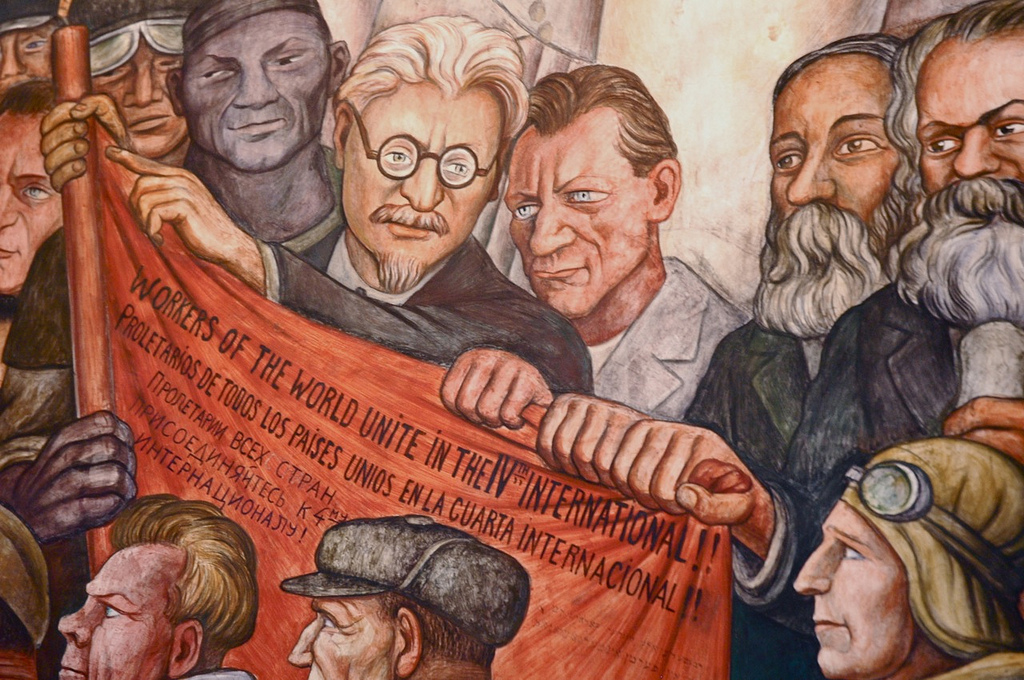
2025 has proved to be another difficult year for the Trotskyist movement. Despite reasonable election results for the Workers Left Front (Frente Izquierda de los Trabajadores, FIT) in Argentina and Die Linke in Germany, extensive involvement in the new left party in Britain (Your Party) and a merger of two International bodies, the movement, as a whole, has suffered significant political splits and has made little headway in the scores of countries where Trotskyist parties are to be found.
Fourth Internationals
For the first time in almost fifty years, two Trotskyist Internationals carried out a successful merger. In December 2025 the League for the Fifth International, led by the British Workers’ Power group, negotiated its entry into the much bigger Argentina-based International Socialist League (LIS) https://lis-isl.org/es/2025/12/un-congreso-mundial-historico-mas-de-40-paises-nos-reunimos-en-estambul/ . The LIS has proved to be relatively successful in attracting other organizations into its orbit with Socialist Horizon (USA) and the Communist Workers’ Party (Italy) both joining in 2025. As a result, LIS is now one of the larger Internationals, with 16 affiliates, and the merger will facilitate expansion into Western Europe from its predominantly Latin-American base. That said, total membership of its new European affiliates from the Fifth International – in Austria, Germany, Sweden, Switzerland and the UK – is miniscule, probably less than two hundred. In contrast, the Revolutionary Communist International (known until 2024 as the International Marxist Tendency) has now become the largest of the 34 Trotskyist Fourth Internationals with a total membership of around 7,100 and affiliates in 34 countries https://marxist.com/rci-congress-2025.htm. The mainstream (Mandelite) Fourth International continues to retain a presence in 31 countries and its 2025 congress welcomed new national affiliates from Ireland (RISE) and Scotland (Ecosocialist Scotland). Its congress also witnessed a sharp debate over the status of the Socialist Left Movement (MES), one of seven Brazilian Trotskyist organizations affiliated to the mainstream Fourth International and six of whom, including MES, operate as factions inside the leftist Socialism and Liberty Party (PSOL). Although there are few details of the debate, they most likely revolve around relations between PSOL and the Lula Presidency, an increasingly fraught topic of debate within the country.
Elsewhere however, 2025 was marked by significant organizational splits. The International Workers’ League – Fourth International (LIT-CI), another large organisation also headquartered in Argentina, suffered its most significant split in many years at the September Congress. Sharp disagreements had emerged in Brazil over the relationship between the Lula government and the United Socialist Workers’ Party (PSTU), the largest section of the LIT-CI. Factional disputes led to expulsions and walkouts from congress and when the dust had settled, the dissidents had formed two new Internationals: the International Revolutionary Workers’ Current, with affiliates in Argentina, Brazil, Chile and Costa Rica https://corici.org/ and the International Committee for the Reconstruction of the LIT, with sections in Brazil and Chile https://vozdelostrabajadores.cl/manifiesto-del-comite-por-la-reconstruccion-cir. A few weeks later, the LIT’s problems were compounded when its Peruvian affiliate also decided to quit https://pst.pe/2025/12/por-que-hemos-dejado-de-integrar-la-liga-internacional-de-los-trabajadores-lit/ .
Meantime, the problems engendered by the fragmentation of the Committee for a Workers’ International (CWI), founded in 1974 by the British-based Militant Tendency, continue to proliferate. The splits of 2019 arose from disputes over the political significance of movements based around gender and ethnic identities but soon became intertwined with arguments about bureaucratic forms of leadership and the exercise of organisational power. The major breakaway in that year constituted itself as the International Socialist Alternative (ISA), with affiliates in at least 24 countries (and there was also a smaller, mainly Spanish-speaking five country split that formed itself into the International Revolutionary Left). In 2022, ISA was wracked by an internal dispute over the handling of a sexual abuse allegation, resulting in a further split as six affiliates broke away to form Internationalist Standpoint, with its largest sections in Greece, Cyprus and Taiwan https://www.internationaliststandpoint.org/launching-internationalist-standpoint/. Two years later, another dispute over ‘identity politics’ led to yet more splits: the large US affiliate, Socialist Alternative, under the leadership of former Seattle councillor Kshama Sawant, quit and relaunched itself as Revolutionary Workers https://www.revolutionaryworker.org/; the Belgian Socialist Left Party quit in 2024 and dissolved itself in 2025 although two small breakaway groups quickly emerged in its place (Marxist Activists https://fr.marxisme.be/ and Red https://rouge-rood.be/home-2/); the Irish section along with groups from Austria, the Netherlands and Poland, broke away and formed the Project for a Revolutionary Marxist International. Throughout 2025, however, the Project has begun to disintegrate as the Austrian party quit and two other affiliates (Australia and India) appear to be defunct https://revolutionarymarxism.com/. The upshot of these developments is that the CWI, an organisation which once comprised at least 30 national affiliates, has now fragmented into five separate bodies which are all small and declining in both size and influence.
Electoral performance
Trotskyist parties have generally downplayed the significance of elections as a mechanism for the attainment and exercise of power, counterposing them to the roles of strikes, protests and demonstrations. Nonetheless, most Trotskyist parties have also followed Lenin’s dictum that revolutionary parties should treat elections as opportunities for the dissemination of revolutionary propaganda and the acquisition of recruits and as occasions on which to test their degree of popular support. In 2025 there were elections to the national legislatures of 18 countries containing Trotskyist organisations but these groups participated in only six of these contests, in Argentina, Australia, Canada, Chile, Germany and Portugal. In Argentina the four-party Trotskyist coalition, the Workers’ Left Front (FIT) secured the election of three deputies with a vote share of 4.34 per cent, up slightly on its 2023 result of 3.73 per cent. Since its formation in 2011, the Front’s electoral performance has proved remarkably stable, securing between three and five deputies with around 4-5 per cent of vote share. But, in light of the many protests and demonstrations against the Milei government throughout 2025, this modest gain is rather underwhelming. Elsewhere the Anti-Capitalist Network, a component of the Portuguese Left Bloc, saw its vote share in the May election slump to just 1.99 per cent, the worst result in its 26 year history. In Australia, two Trotskyist groups contested the May 2025 election: Victoria Socialists, a group heavily influenced by Socialist Alternative, which has observer status at the mainstream (Mandelite) Fourth International and Socialist Alliance, a non-affiliated organisation. Vote shares of 5.65 and 2.95 per cent respectively were enthusiastically celebrated by both groups as representing major advances for the far left. In reality, both groups fought only a handful of the 150 electoral districts (four and six respectively), and those few were carefully chosen; a more broadly based electoral challenge would likely yield lower vote shares. Such a challenge will certainly emerge because, in the wake of the election, Victoria Socialists voted to transform itself into a national party, provisionally called the Australian Socialist Party, with branches in all states. The German party Die Linke, an organisation that includes four Trotskyist factions, performed unexpectedly well in the February election, increasing its Bundestag representation from 39 to 64 deputes despite a 14 per cent reduction the size of the lower house. In contrast, the two small German parties that contested the election obtained their usual result, less than half of one per cent of vote share in a handful of seats, a similar result to the Canadian Communist League, whose two candidates stood as ‘Independents’. In both cases, these recent results are unchanged from many electoral outings over the past 30 years and it was a similar story in Chile, where the Workers’ Revolutionary Party (PRT) obtained a vote share of 2.30 per cent in the minority of constituencies it chose to contest, a similar result to those of previous elections over the past 10 years. Finally, in Britain the Socialist Party’s electoral front, the Trade Unionist and Socialist Coalition (TUSC), stood 103 council candidates in the annual local elections. None were elected and their median vote share, at 1.1 per cent, was the worst result since the formation of TUSC in 2010.
Political parties
In Britain, the announcement of a new left party in July 2025 generated enormous enthusiasm from most Trotskyist groups, fourteen of whom encouraged their members to join the organisation (provisionally then known as ‘Your Party’). Over the next few months, they became actively involved in the creation of local proto-branches and in preparations for the founding conference at the end of November. The acting party leadership announced in September that conference delegates would be elected by ballot from membership lists and also declared a prohibition on ‘dual membership’ (of Your Party and other parties, including Trotskyist groups) https://bbkbritpol.substack.com/p/the-trotskyist-left-and-your-party. Despite the eve of conference expulsion of a handful of Socialist Workers’ Party (SWP) members, and the ostensible bar on dual membership, Trotskyist organisations supplied around 150 delegates at the 1,500-2,000 strong gathering as well as several dozen speakers, drawn mainly from the largest groups, the SWP, the Socialist Party, Counterfire, rs21 and Socialist Alternative https://www.socialistparty.org.uk/wp-content/uploads/2025/12/1347.pdf. The new party, now officially known as Your Party following a vote amongst its 55,000 members, also voted for motions declaring it to be a socialist and working class organisation, opposed to all forms of oppression and committed to an anti-austerity programme for the 2026 local elections. Trotskyist groups active in Your Party had already begun planning for elections early in 2026 to the organisation’s Central Executive Committee (CEC) but just two days before Christmas the acting leadership declared in the election rules and procedures document that members of ‘other national political parties’ would not be allowed to stand https://www.yourparty.uk/cec-elections-rules/ . Although they ignored the previous ban on dual membership, most Trotskyist groups decided not to push their own candidates for the CEC elections but to support a list compiled by a broad coalition called Grassroots Left https://www.facebook.com/groups/731896240163150/posts/26850876964505054/.
Elsewhere in Britain, the Revolutionary Communist Party (RCP), formerly the entryist group Socialist Appeal, quickly lost interest in Your Party after an initial burst of enthusiasm, and returned to its main business of turning the RCP into a mass revolutionary party of tens of thousands. Its recruitment campaign, ‘Are You a Communist?’ was launched in March 2023 and led to an initial surge of new members, taking its total to 1,100 by November of that year. ‘Dizzy with success’, the RCP leadership talked of reaching 2,000 members by the end of 2024 before pressing on to the next milestone of 10,000 members. In fact the RCP grew to just 1,200 by December 2024 and to 1,300 by December 2025, despite vigorous recruitment efforts on university campuses, where it is easily the most visible far left grouping https://communist.red/five-takeaways-from-the-rcp-central-committee-meeting/. A similar pattern of rapid initial growth followed by a substantial slowdown also occurred amongst a number of RCP sister parties, namely in Canada, Denmark, Finland, Germany and the USA https://marxist.com/the-imt/international-marxist-tendency/the-imt.htm . The Socialist Workers’ Party announced towards the end of the year that it has a little over 2,800 dues-paying members, and, although it remains the largest Trotskyist group in the country, it does not seem to have grown significantly as a result of its involvement in numerous Palestinian and anti-fascist protests; indeed its website records a significant fall in the number of party branches in Britain, down from 60 over the past few years to 49 https://weeklyworker.co.uk/worker/1566/too-little-too-late/. In contrast, Counterfire, which has been equally active in the Palestinian protests since October 2023 has increased its membership by several hundred and its number of branches by 50 per cent over that period https://www.counterfire.org/article/counterfire-conference-resolutions-2025/.
Meanwhile, France witnessed the continued disintegration of one of its largest Trotskyist groups, the New Anticapitalist Party (NPA), launched with such high hopes in 2009. Following the expulsion of the Permanent Revolution group in 2021, the party experienced a two-way split the following year: NPA-Anticapitaliste continued under the leadership of Phillipe Poutou, whilst the ostensibly more radical breakaway adopted the name of NPA-Révolutionnaires (NPA-R). At its first congress in February 2025, the NPA-R leadership secured overwhelming support for its political resolution, yet still proceeded with the expulsion of a small minority faction, Socialism or Barbarism, which has now reformed itself into an independent organisation. Meanwhile, the Permanent Revolution group appears to have grown through in involvement in campaigns around pension reforms and has an impressive 275,000 followers on Facebook: https://www.revolutionpermanente.fr/. Although France now has nineteen Trotskyist groups, the French movement continues to be dominated by the same groups that have held sway for decades: the two New Anticapitalist Parties, Workers’ Struggle (Lutte Ouvrière), the Independent Workers’ Party (Parti Ouvrier Indépendant) and its 2015 breakaway, the Workers Party (Parti des Travailleurs – formerly the Parti Ouvrier Indépendant Démocratique).
In the United States, the other major centre of world Trotskyism, the Socialist Workers’ Party (SWP) continued its long, slow decline, with much of its activity centred on securing book and pamphlet sales and newspaper subscriptions as well as state electoral contests in which it typically obtains miniscule vote totals. Beyond the ageing ranks of the SWP, the US Trotskyist left is more fragmented than ever, with 30 organizations now engaged in building a revolutionary cadre force and many of them likely to count their membership in the hundreds. The same is probably also true of the International Committee of the Fourth International (ICFI) according to Beatty (2024: https://www.plutobooks.com/product/the-party-is-always-right/). On the other hand, its extensive and frequently updated World Socialist Web Site was said to be receiving around 70,000 page views daily, in early 2023 (https://www.wsws.org/en/articles/2023/02/14/per1-f14.html).
Further reading
Beatty, Aidan 2024, The Party is Always Right: The Untold Story of Gerry Healy and British Trotskyism, London: Pluto Press.
Kelly, John 2018, Contemporary Trotskyism: Parties, Sects and Social Movements in Britain, Abingdon: Routledge.
Kelly, John 2022, The Twilight of World Trotskyism, Abingdon: Routledge.
Maitan, Livio 2019, Memoirs of a Critical Communist: Towards a History of the Fourth International, Dagenham: Merlin Press.