In this interview with Historical Materialism, Dylan Riley offers an anatomy of his concept of ‘political capitalism’ in dialogue with theorists of technofeudalism and those who claim we are returning to a ‘normal capitalism’. He reflects on how the Left should think about the role of material interests in the struggle against a rising Far Right under political-capitalist conditions, and assesses Trump II in light of recent events.
Teddy Paikin: In your recent piece in the Ideas Letter and in several contributions to the New Left Review, you and Robert Brenner have further developed the ‘political capitalism’ thesis, the view that capitalist reproduction increasingly relies on upward redistribution via ‘politically engineered support for high asset prices’ rather than traditional forms of investment and accumulation. You describe this process as a mutation of capitalism under specific circumstances, especially during periods of stagnation. Could you speak about the inspirations behind and development of this idea alongside Robert Brenner?
Dylan Riley: If you look at the line of heterodox Keynesianism coming out of Alvin Hansen, there is a hinting toward an idea that secular stagnation goes hand in hand with the increasing importance of rent-seeking. That’s very explicit in his work on the Great Depression. You could say that some of this stuff was taken up by Baran and Sweezy in the monopoly-capitalism thesis. Although I’m not really an exponent of the monopoly-capitalism thesis – I don’t think that describes the current dynamics of capitalism – I do think it is useful in examining the changing role of political power in determining the rate of return. And, as I’ve made clear in a number of writings, I think that Max Weber is essential here to understanding what’s going on. Weber coined the term ‘political capitalism’ to refer to economic activity that is profit-oriented but relies predominantly on political means.
TP: In your piece for the Ideas Letter, you reject two alternative explanations of the contemporary transformations in capitalism. One is the idea that today’s capitalism is nothing but a return to a ‘normal capitalism’ with profit rates comparable to those at the turn of the century. The other is the technofeudalism thesis which, as you’ve mentioned elsewhere, is a renewed monopoly-capitalism thesis. Could you clarify your refutation of these two views and specify how you think the political-capitalism framework better explains mutations in contemporary capitalism?
DR: With respect to the ‘return to normal capitalism’ thesis, we could say that, since the publication of Piketty’s Capital in the Twenty-First Century, there is a notion that capitalism has been a very high-inequality, low-growth regime, except for this exceptional period, roughly from 1945 to 1973, in which it was a high-growth, relatively low-inequality regime. In support of this idea, some scholars make use of the Angus Maddison data on GDP growth to show how slow growth was in the nineteenth century, sometimes going all the way back to the Roman Empire. There is a conceptual and an empirical point I’d like to make about the use of these long-run GDP statistics over time. The conceptual point is that, if it’s true that capitalism is, for the most part, a low-growth regime, you would have to reject most of what Marxists have thought of as distinctive to capitalism since the fifteenth century, which is that this is a system that uniquely in world history was able to engender rapid economic growth and development. To deny that seems perverse to me. Among other things, it would be impossible to explain the British breakout from the Malthusian cycle, or the emergence of the First or Second industrial revolutions, and massive increases in productivity over time.
So, the question that remains is, what’s going on with these long-run data series that seem to show relatively low growth? I think that’s a very important question. My sense – and it is only a sense, because I really need to do some work on this – is that these very broad indicators, especially when you include different places across the globe, essentially blend together economies where you already had a breakthrough to modern capitalism with places where you clearly did not. Does it make any sense to even talk about national growth rates in a country like pre-unification Italy, where you’re putting the Po Valley together with the large landed estates of the South? This could also apply to the United States, if you’re thinking about aggregate growth statistics that combine the South and the North.
Now, turning to the technofeudalism thesis, first articulated by Cédric Durand and then cashed out in a somewhat different form by Yanis Varoufakis and Jodi Dean, among others, the basic idea is that in the current period you have platforms whose value expands simply by increasing the number of their users. You can think about it in comparison to the automobile, for example. If one person purchases a car, the utility of that car is individual to that person. It is either useful or it is not useful. It doesn’t matter if other people have the same car or have a different car; the utility of that individual car is still the same. But, with platforms – social media platforms being perhaps a key example of this – the value of the platform increases as the number of users that use that platform increases. And the idea of technofeudalism, as I understand it, is that this process allows for the creation of a rent that can be appropriated by the owners of platforms, regardless of how much they have (or have not) invested in improving the technical capacity of their programmes. The obvious upshot of this is that you have many platforms that can rake in a lot of profit even though they may be technically inferior to alternative platforms. Ultimately, the profits that they collect are a form of monopoly or monopsony rent. I think this describes something important about what is going on, but my general sense is that there still is a considerable amount of competition among the big tech companies, such that, as a global description of the economy, I’m dubious of the technofeudalism thesis. However, I would say that, from my perspective, one of the virtues of the technofeudal literature is that it does try to periodise capitalist development and recognise that there’s something truly new going on, and I think that’s an intellectual virtue.
TP: In your view, does political capitalism offer a more robust framework than ‘neoliberalism’ for understanding capitalism since the 1980s? Or are these two separate and complementary processes?
DR: That’s a great question. My general view is that neoliberalism is the ideological form of political capitalism. It’s the ideology of political capitalism, and, like a lot of ideologies, it is a deeply misleading guide to the actual process of what’s going on. The rise of neoliberalism corresponds almost perfectly to the slowdown in growth in the 1970s. But the reality of neoliberalism – although it’s shrouded in the praise of markets and market allocation – is primarily political. It is an ideology of markets combined paradoxically with an ever more aggressive use of political power to shape profitability. But neoliberalism as an account of the actual dynamics of capitalism offers a terrible guide. It’s the ideological envelope in which political capitalism unfolded.
TP: That’s very counterintuitive, because one wouldn’t expect an ideology which is based on market fundamentalism and a harsh separation of the political and the economic to develop a regime of accumulation in which the capitalist class becomes so dependent upon the state for its reproduction.
DR: Let’s just remember what Marx says in The German Ideology: reality appears upside down as in a camera obscura. The point about ideology is not that it reflects reality; the point is that it inverts it. What is the ideology of capitalism in its classic phase? Well, to put it very simply, it is to describe a system of social production that is characterised by a very intricate global division of labour, in which all of the parts are linked to all the other parts, as if it were the very opposite – that is to say, a society of petty commodity producers. This is not the first time in the history of capitalism that the ideological envelope would point in the opposite direction of the social reality.
TP: Your writings on politics under political capitalism emerged from a comparison with the theorisation developed by Przeworski and others of the nature of postwar capitalism. This was a period of sustained economic dynamism creating the conditions for the survival of capitalist democracy through a positive-sum form of capital accumulation in which wages and profits rose simultaneously, thereby undergirding a class compromise. But, with the advent of secular stagnation in the 1970s, this compromise disappeared as capitalists became less interested in making productivity-enhancing investments and moved toward rentier strategies of reproduction. From what I understood of the stagnation thesis, the basic political implication of your argument is an inability of traditional Keynesian methods and a repetition of the postwar welfare state to resolve capitalism’s current predicament. How do you think we should adapt our politics to political-capitalist conditions? Can you compare your view with what you believe follows politically from the technofeudal and ‘normal capitalism’ theses?
DR: Maybe the comparison would be the best way forward. If we take Piketty and his many followers’ line of argument, the idea is that, at some point in the 1970s, things went off the rails and we got increasing inequality. It’s a little mysterious exactly why that happened. I find the r > g presentation to be descriptive, not explanatory. But the idea, politically, is that what must happen is a reconstruction of the classic social-democratic model of politics. For Piketty, the problem has been the rise of a kind of Brahmin Left, along with a series of political mistakes by centre-left parties. I think this view is widely shared on a certain sector of the Left – that we should try to correct centre-left parties that have somehow forgotten they were supposed to appeal to the working class. Somehow, we are supposed to remind their leaderships to be better social democrats. It strikes me that the problem with that position is that it ascribes what has been a very widespread collapse in the social-democratic project to contingent political mistakes. But how could it be that the Democratic Party, the Labour Party, the French Socialists, whatever remains of the Italian Communist Party, and the SPD all made the same mistake at the same time? How could that be just a contingent political error?
The idea of a rerun of classic mid-century social democracy doesn’t seem to me to be a particularly workable idea for different reasons. One is that, as I have said, it really misunderstands that the contemporary working class itself is very fragmented. We need to somehow address those fragmentations, not pretend that an economic message is going to lead automatically to political unity. I don’t think that’s the right way forward. The other thing is I find that the rebooted social-democratic arguments tend to be very nation-state-oriented in their outlook. The people who argue for this kind of politics are willing to make a lot of concessions to xenophobia, which I find to be antithetical to a genuine left project. I think we need to think about a project that is both sensitive to the different articulations within the working class and is consistently internationalist. Those are both necessities for me.
On the technofeudalism front, the politics of technofeudalism relies on the idea that there’s a real basis for a cross-class compromise between those segments of capital that are being exploited by the technofeudalists and the working class, and I’m a little sceptical of that argument as well. Politically, the upshot is not that different from the idea of rebooting social democracy – even though the analysis on which it is based is very different.
TP: It seems to want to reboot the idea of a failed bourgeois revolution.
DR: That’s a good way of putting it. You could say that in some ways it reflects historical reality because we’ve now fallen behind the French Revolution (laughs). But thinking beyond capitalism is more where I would like to end up.
TP: Given that capitalists today depend increasingly on the state for their income, do you think that it follows from the political-capitalism thesis that capturing the state and using it to impede this kind of upward redistribution should be a central aspect of socialist politics and strategy? What kind of new relationship to the state do you think political capitalism implies?
DR: I think there’s an enormous opening for the Left in what’s going on, because you could say that the political power of capitalism has always been the relative separation of the economic from the political, thereby allowing the economy to be treated as a realm of technocratic and non-political decision-making. Obviously, that is being completely overturned at this point. You see it even in the US, in just the regular conversations among the mainstream press that Trump is a communist because he’s handing out money to his friends. So, I think we have an opportunity here. We need to be thinking about the use of political power in new ways that have to do with breaking our dependence and reliance on enormous and unaccountable private actors for determining the growth path of all of our societies. I also think we need to think about technological development as a political choice as well.
TP: One might have expected the zero-sum dynamics of political capitalism to have reignited class struggle, but, given the decline of the organised labour movement since the neoliberal period, what we’ve seen instead are renewed forms of populism on the Left and Right – or sometimes ‘neo-Bonapartisms’, as you put it – and the rise of nativism. So how can you explain the failure of an organised socialist Left and labour movement to re-emerge within the present context? And how do you think that is connected to the rise of nativism among workers?
DR: I think the turn to the right among a segment of the working class is the most difficult problem that the Left faces today. You see this in the recent elections and the AfD. But the idea that class struggle would heat up as capitalism became less dynamic, or less able to deliver material goods, has turned out not to be true at all. As you can see by the whole history of West-European social democracy, the power of workers has been greater in those periods when there have been gains to share, at least within the context of established electoral systems. The reason for that is obvious: it’s really under those conditions that working-class parties can deliver material gains for their constituents. So, there was a virtuous and self-reinforcing cycle during the boom years after the Second World War, by which workers’ parties won gains that then increased their legitimacy at the polls, which allowed them to win further gains. All of that, however, was dependent on the long economic boom of the postwar period.
The problem is that as that boom receded, it was not the case that workers were going to jettison reformism and go over to revolution. The reason that’s not the case is because there are lots of other strategies available to specific segments of the working class that allow them to defend their material interests, but that are not class strategies. There’s organising along lines of nationalist exclusivity: xenophobia is one form; in some countries, racial identity is an avenue, or in some cases various forms of credentialling. There are many ways in which this can happen, some of which are more reactionary and anti-democratic than others. But there’s a wide suite of available strategies that are open to workers in moments of slower growth or economic downturn. And it’s very difficult to get to a class strategy in the context of economic slowdown. This was most fully laid out by Przeworski in Capitalism and Social Democracy. I think it’s important for the Left to think about the material reasons that workers turn to the right, over and above – or entwined with – whatever ideological reasons might also exist.
TP: This point is connected to your argument in a recent piece in Sidecar on the question of material interests in which you argue – against what you call a ‘simplified rational choice or “analytical” Marxism’ – that it is insufficient simply to invoke working-class material interests. In fact, it could be counterproductive when no concrete horizon of socialist politics exists.
DR: The politics of the contemporary period needs to be a politics that makes tangible, in whatever ways possible, forms of life that are non-capitalist and collective, that make the possibility of an alternative real to people so that they can orient their interests in that direction. This may sound like a purely social-theoretical question, but it’s absolutely crucial. We need to think about futures as real in a way that sometimes some on the Left have been reluctant to do. If you think about the way people live their lives: you live your life toward what’s coming. You need to have an image of what that might be, and that is a decisively important political matter. What we really shouldn’t be doing is saying we need to reconstruct the mid-century class compromise. That is a way of envisioning the future that is utterly nostalgic, and it seems to me we don’t want to be in that position.
TP: In creating that kind of horizon, what role do you think Marxist concepts have to play in the renewal of class struggle? Perry Anderson ended a recent article in the New Left Review with the line: ‘Ideas incapable of shocking the world are incapable of shaking it’. Why do you think that Marxist and socialist vocabulary no longer has the same power it had in the nineteenth and twentieth centuries in creating that concrete alternative? How could it be adapted to participate in a contemporary making-concrete?
DR: I wish I had a concrete answer. I only have a methodological answer. I think what Perry was saying – and this derives from Gramsci and others in the Marxist tradition – is that we need to think about politics as the articulation of a concrete fantasy. It is something which is tangible and almost aesthetic in a way and that people can think about and orient themselves toward. One of the ideas that has to be abandoned is that to be a materialist, or to be a historical materialist in particular, means that one doesn’t take ideas seriously. That’s completely untrue. It’s never been true. If it were true, why did Marx spend most of his energy and his greatest book essentially unfolding a critique of ideology?
The readers of Historical Materialism know this, but I guess it is just worth emphasising: the problem is that if we don’t do that work, it’s not that the future or imaginaries cease to exist; it’s that they’re simply occupied by the Right. When we take a big step back and think about the position of the Left in the current period, there are many things that are very encouraging, especially compared to where it was in the 1990s. But we certainly do not have a vision of the future which is as total or as vivid as what the Silicon Valley tech guys are promoting with artificial intelligence, among other things. But the Marxist tradition is completely irreplaceable. Even its basic model of what it means to be a human being is about as good as anything out there, especially for these questions about orientation to the future. I just think it’s completely irreplaceable, and we have to continue to work to develop it and to update it for the circumstances that we’re currently facing.
TP: It hasn’t lost any of its analytical power, but it does seem to have lost a degree of political force when considered in historical perspective.
DR: This is not the first time, I suppose, in the history of Marxism or the history of the working-class movement, that there’s been this gap between analytical power and political relevance. But I think that the current moment, as dark as it is, does create opportunities because it’s so revelatory of what could be done, for example, with the modern state, were it to be reconfigured in ways that might make for a better future.
TP: I’d like to get your current assessment of Trump II, and how you relate it to your thesis on political capitalism. Is Trump a kind of expression of political capitalism or a shift to something else? How does the change from Trump I to Trump II modify your view of the political nature of Trumpism?
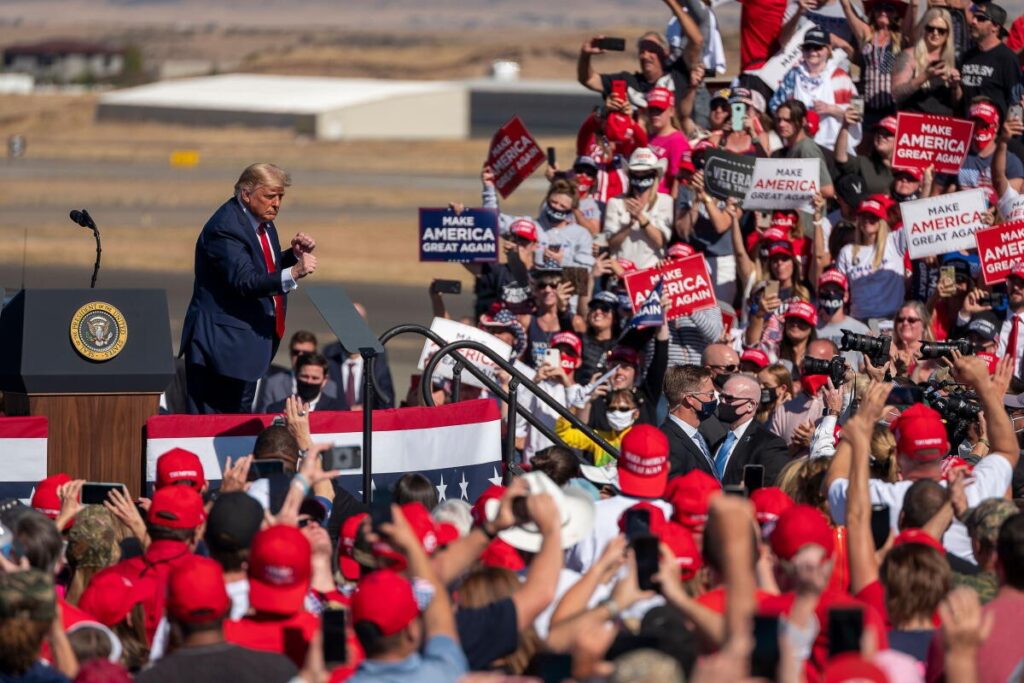
DR: I definitely interpret Trump as the apotheosis of political capitalism. It’s the whole thing taken to this unbelievable extreme. It’s almost too easy; I’m almost reluctant to say this, but how do you theorise this? The thing about Trump II is that you can’t theorise it just as a political phenomenon because it’s also a giant system of plunder. It’s quite different in that respect from Trump I. Many of his actions are essentially undertaken just to squeeze, extort, and extract. In terms of the relation between Trump I and Trump II, historians will have to approach this. Presumably, someone will write a three-part analysis of the age of Trump in which the Biden years are going to play a crucial role. Trump I was this quite shambolic, incoherent affair. He didn’t even think he was going to win. He came in; he didn’t really have a cadre, and they didn’t really have a programme for governing. With Trump II, they came into office with a very well-articulated strategy, with Russell Vought and Stephen Miller as the primary driving forces and ideologues behind this, and they’ve carried it through to some effect.
The problem of Trumpism is Trump. He constantly gets in the way of what they should be doing, and so it never can quite gel as a coherent thing because he does crazy and erratic stuff. I’m sure, for example, that there are theories about how Trump’s war with Iran somehow reflects the geopolitical interests of the US, but I’m sceptical about this. I think a lot of this behaviour is just erratic and irrational, alongside the self-enrichment of his own personal familial group. I think this behaviour gets in the way of the project that they would like to be pursuing, which is much more well-articulated by a figure like J.D. Vance or even Stephen Miller than it is by Trump and his super-immediate entourage itself.
He’s a peculiar figure because you could say his very particular attraction is bound up with his weaknesses. The only person with that kind of politics who could actually win an American election is Trump as a personality. But, precisely because of what he is as a personality, the project also can’t entirely be carried through, because he’s so utterly venal in everything. We’ll see what happens at the election. The unpopularity of this project is just astonishing; it’s basically just very hardcore supporters who are still with him at this point. Unless something dramatic happens, it looks like they’re in for a beating in the immediate term at the midterm elections. The problem is, though, none of the big structural problems of American politics are going to be resolved in any way, and structural problem number one is what to do with the working class.
Dylan Riley is Professor of Sociology at the University of California, Berkeley and the author or co-author of six books. He studies capitalism, socialism, democracy, authoritarianism, and knowledge regimes in broad comparative and historical perspective. His most recent work focuses on the relationship between democracy and capitalism, particularly in its current phase. He is also at work on two larger book projects: a collection of essays provisionally entitled Science, Ideology, and Method, and a comparative historical analysis of democratisation in Germany, Italy, Japan, France, the UK and the US from c1200 to c1950 provisionally entitled Special Paths.