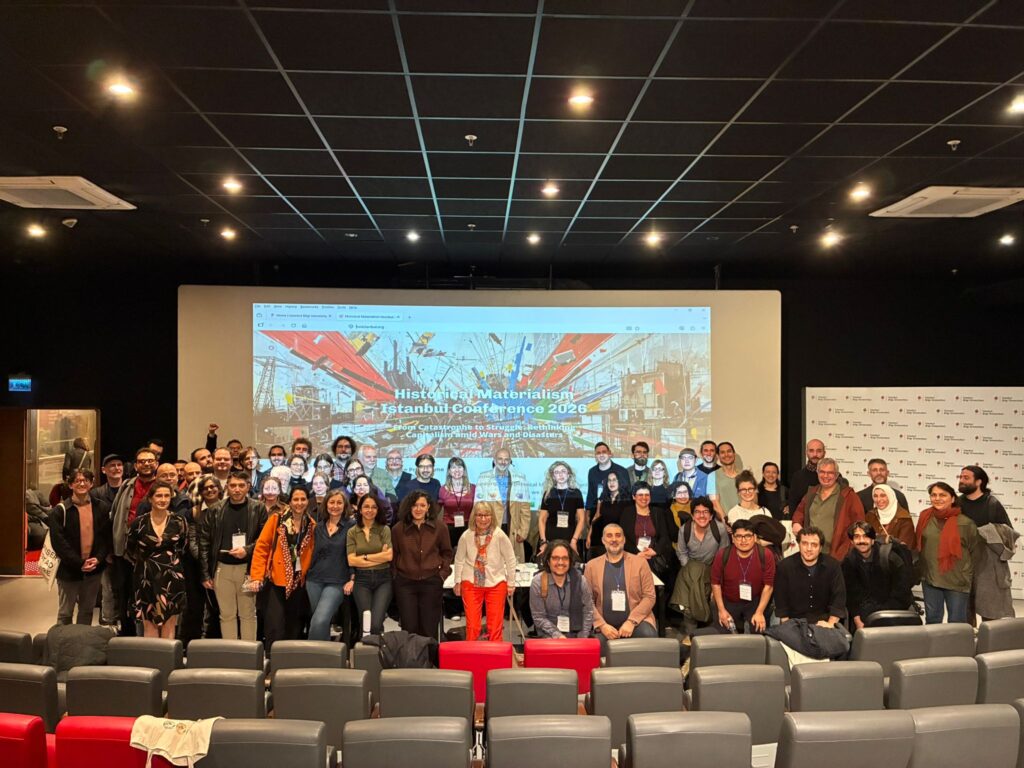
From 3 to 5 April 2026, hundreds of people from every continent came together at the HM Istanbul 2026 Conference. Convened at Istanbul Bilgi University, Santral Campus, the conference took place under the theme “From Catastrophe to Struggle: Rethinking Capitalism amid Wars and Disasters”. Across 127 panels and with 456 speakers, the conference brought into dialogue a wide range of struggles, experiences, and critical perspectives on war, ecology, authoritarianism, class, gender, race, social reproduction, and resistance.
This gathering was significant not only because of its scale, but because it created a space to reconnect questions too often treated in isolation: war and ecological destruction, the rise of far right, authoritarianism and dispossession, food and energy regimes, feminist struggle and class politics, social reproduction and imperial violence. In a period when catastrophe is no longer an exception but increasingly a mode of rule, HM Istanbul 2026 insisted on the need for a shared analytical and political horizon. Our conference itself emerged from within these very dynamics. It was made possible under precarious conditions, through collective labour, commitment, and solidarity.
For many of us, “wars of capitalism and resistance” are not abstract theoretical questions, nor are they matters belonging to distant geographies or past times. They are a living reality, both past and present, unfolding in the here and now. Across different places and in different forms, wars and resistances shape bodies, labour, everyday life, memory, and the horizon of the future.
When we speak of the wars of capitalism, we speak of imperialism. We speak of uneven and internally interconnected social relations of class and power that cut across national borders and cannot be reduced to methodological nationalism. In this sense, war is not limited to military confrontation between states. It is also class war; it is an assault on social reproduction; it is ecological destruction; it is the devastation of the infrastructures of life, the commons, and the relations of solidarity that make collective existence possible.
Today, it is no longer possible to treat war, ecological destruction, authoritarianism, deepening inequality, migration regimes, the care crisis, and the different forms of social disintegration as separate processes. Each appears as a distinct expression of capitalism’s crisis-ridden mode of reproduction. Catastrophe is no longer an external disruption to the system. It is increasingly becoming one of the system’s governing logics. In this sense, destruction is not merely an outcome. It also becomes a terrain for new rounds of accumulation: war feeds reconstruction contracts, disaster feeds urban transformation, food crisis feeds concentration in agriculture, and energy crisis feeds new forms of extractivism.
This is why it is no longer sufficient to explain catastrophe through mismanagement, poor policy choices, corruption, or authoritarian excess alone. These are important, but they do not exhaust the problem. What lies beneath them is a deeper structural dynamic: capital expands by fragmenting, exhausting, and reorganising life. It works through the commodification of nature, the precarisation of labour, the dismantling of the public, and the invisibilisation of social reproduction. War, ecological crisis, the intensification of women’s care burdens, and the transformation of borders into death zones are therefore not separate tragedies, but interconnected moments of the same historical system.
For this reason, we must also question the meaning of peace. Peace is often presented as the opposite of war, yet under capitalism it can become the continuation of violence by other means. It can appear as postwar reconstruction business, as pacification, as counterinsurgency, as a new terrain of accumulation, or as a mechanism for disciplining class struggle and other struggles for liberation and equality. So-called peace processes may obscure the crucial political question: whose peace, which peace, and at whose expense? We therefore insist that peace cannot be treated as an abstract or neutral category, but must be understood in relation to its material, political, and class content.
One of the most important openings of this year’s conference was the renewed discussion of ecology, food, and agriculture. The ecological crisis must not be reduced to environmental degradation in the narrow sense. The transformation of soil, water, forests, pastures, coasts, and agricultural production is inseparable from the crisis of social reproduction. It means the disintegration of rural labour, the liquidation of small producers, the conversion of food into a speculative commodity, the intensification of forced migration, the erosion of local forms of life, and the further intensification of care burdens. The destruction of nature and the destruction of the social fabric are directly linked.
We see this clearly in Turkey and across the world. Mining projects, energy investments, tourism concessions, mega-infrastructure projects, and urban and rural land regimes do not merely consume nature. They reorganise social life itself. When a forest is destroyed, what is lost is not only trees. Water regimes are altered, agricultural production contracts, local economies collapse, migration begins, women’s unpaid labour intensifies, and local cultures are weakened. When coastlines are opened to capital, what disappears is not only a landscape, but access to the commons. Ecological struggle is therefore not simply a defence of nature in the abstract. It is a struggle to defend the material foundations of life.
A feminist perspective is indispensable both for understanding the present catastrophe and for building a struggle against it. Wars, disasters, economic crises, and ecological destruction never affect everyone equally. They deepen gendered inequalities. Women take on more unpaid labour, are pushed further into precarious sectors, are more harshly affected by displacement and poverty, and face heightened risks of violence. As public services shrink, the burden of care is shifted back into households, and in most cases onto women. The crises of our time must therefore be understood as crises of social reproduction as much as crises of production, accumulation, and rule.
One of the central questions that emerged throughout this conference is the question of political strategy. What forms of resistance, solidarity, and internationalism can we build today? The answer cannot lie in the flat and reactionary formula that “the enemy of my enemy is my friend”, nor in political identification with one or another authoritarian regime, fascist force, or capitalist state. Nor can it lie in a politics confined to reacting to isolated events and immediate incidents. What we need instead is a political horizon capable of tracing the connections between different wars, between regional conflicts, between interlocking forms of oppression and domination, and between the struggles that arise against them.
This is precisely why a new synthesis is needed. For too long, fields of struggle have often been fragmented into separate languages and separate political compartments: ecology in one place, labour in another, feminist struggle elsewhere, urban struggle elsewhere still. Yet capital attacks all these terrains at once. It comes as a mining license, a starvation wage, a trustee regime, a deportation system, misogynist family policy, war budgets, or a post-disaster economy of plunder. If the attack is combined, the response must also be combined. The political value of this conference lay precisely here: in trying to read catastrophe not through isolated symptoms, but through the interconnected logics of capital accumulation, state violence, class relations, gender regimes, and imperialist competition.
We also insist that the deepening catastrophe cannot be answered by green capitalism, technocratic transition agendas, or imperial strategies of decarbonisation built on new forms of plunder. What is now packaged as energy transition, critical minerals, carbon markets, and technological modernisation is too often a reorganisation of the geography and techniques of exploitation rather than a break from them.
Against this, we affirm the need for public planning, the prioritisation of social need, the defence of the commons, the decommodification of energy and food, the socialisation of care, and the strengthening of democratic participation. The question is not only what kind of technology is used, but what kind of social order is being built. The issue is not only what is produced, but for whom, for what purpose, at what scale, and under whose control.
Such a horizon refuses to separate anti-war struggle from anti-fascist struggle, or class struggle from struggles shaped by gender, race, ecology, and social reproduction. It calls for forms of resistance that are not only oppositional but also affirmative, regenerative, and durable. It calls for struggles that do not simply denounce destruction, but work to create new forms of collective life, new relations of solidarity, and new possibilities for liberation and equality. In an interconnected world marked by radically uneven conditions of living and dying, only such a political imagination can begin to confront the material foundations of war, fascism, dispossession, and destruction.
HM Istanbul 2026 should therefore be understood not as a closure, but as a moment in an ongoing process of political dialogue, collective reflection, and shared struggle. The discussions opened here must continue across geographies, movements, and experiences. They can help us explain more powerfully why anti-war struggle is also ecological struggle; why feminist struggle is also labour struggle; why food sovereignty is inseparable from democratisation; why disasters are not natural but political; and why fighting against the catastrophe is a class question.
As a first step in carrying these discussions forward, an Book of Abstracts will be prepared in order to bring together and preserve the contributions, debates, and intellectual and political encounters that emerged throughout the conference.
We extend our sincere thanks to all speakers, participants, chairs, and volunteers whose labour, care, and commitment made HM Istanbul 2026 possible. We also thank Istanbul Bilgi University for its support and hospitality, and all those institutions – Praksis, TSBD, SAV, Eğitim Sen Istanbul Branch 6, Mülkiyeliler Birliği – who worked with us throughout this collective process.
Historical Materialism Istanbul 2026