
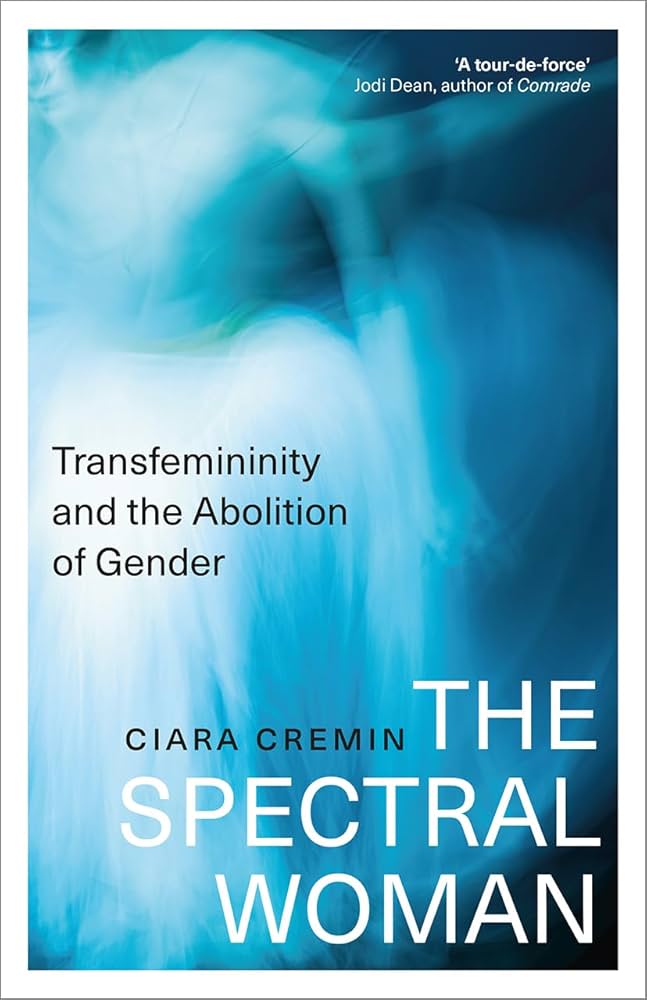
Ciara Cremin, The Spectral Woman: Transfemininity and the Abolition of Gender, Pluto Press, 2025
Reviewed by Cat Moir Wolfe
Introduction: the mask of manhood
One of the memes on the popular satirical social media profile #manwhohasitall shows a picture of a man (young, white, able-bodied) running along a tarmacked road wearing a grey sports t-shirt and black running shorts. Beneath the picture, the caption reads: “A man deliberately exposing his thighs. What do you think?” It made me chuckle when I saw it, though I admit I did not spend much time analysing how or why the joke worked, beyond grasping it as another example of the handle’s trademark style, skewering sexist and misogynistic stereotypes by applying the tropes they rely on to men instead of women.
Then, reading Ciara Cremin’s latest book The Spectral Woman: Transfemininity and the Abolition of Gender (Pluto Press, 2025) this summer, I came across the following passage: “As with putting your face on, only women go bare. Laying them bare, men’s legs are, by comparison, always sheathed hence why the phrase ‘bare legged’ is not in their vocabulary. They may not know it, and no doubt would be horrified by the thought, but they are already wearing the pantyhose” (pp. 133-134). Underlying Cremin’s argument here is one of the central claims of her latest book: that what we call the feminine—which Cremin associates with essential human vulnerability to our dependence on others, fragility to the contingencies of life and, crucially, an awareness of and ability to accept these truths—is the universal condition, and that masculinity, and, with it, the very idea of essential gender divisions, is a defence against this condition. As such, it is “the masculine that … performs and makes gender a thing” (p. 24). Man is “primarily a mask”, concealing the truth of our fundamental human need for mutual connection and solidarity, painting himself with the colours of self-sufficiency and the desire to dominate (p. 35). Meanwhile, woman “does not disavow that they wear [a mask]”, a persona that is always necessarily constructed around the fundamental lack at the heart of human subjectivity (ibid.).
Suddenly I saw the meme in a new light. Clearly, the joke is supposed to be funny because, in our androcentric society, only women are judged for baring—or not baring—their legs. But Cremin goes further, audaciously answering the rhetorical question “What do you think?” about a man deliberately exposing his thighs by offering an interpretation of why women are so judged and not men.
They say explaining a joke kills it, but killjoyism of all kinds, including occasionally Cremin’s own, comes under literal and implicit fire in The Spectral Woman, which, refreshingly for a work of theory, is replete with humour in a performance of the book’s argument that laughter, joy, and the ability for self-deprecation are essential to any “serious” communist project.
However, another of the book’s targets is exactly the kind of cisheteronormative, largely white, GirlBoss feminism that undergirds #manwhohasitall’s satirical perspective in the first place, with its relentless spotlight on female CEOs and conspicuous absence of trans-identified figures. Following on from her earlier work on (trans)gender-related questions (notably Man-Made Woman: The Dialectics of Cross-Dressing (Pluto Press, 2017), and The Future is Feminine: Capitalism and the Masculine Disorder (Pluto Press, 2021), the first two parts of a trilogy of which The Spectral Woman is the third and final instalment), here Cremin explores how the figure of the eponymous spectral, transgender woman can help us to think and build a communist society. Deftly weaving together Marxist, feminist, and queer theories, critical theory and psychoanalysis, and personal experience, the book intervenes in and advances contemporary debates about how reflection on transgender issues can underpin an emancipatory, and unashamedly utopian, class politics.
 The feminine unconscious
Cremin’s main argument in the book is, in some ways, a version of an argument made elsewhere by Andrea Long Chu: everyone is feminine, and everyone hates it.[1] Cremin draws here on a psychoanalytic argument, advanced primarily by Kleinian and post-Kleinian theorists and analysts (Cremin cites Hanna Segal in this respect) that goes as follows: the first and most fundamental identifications of all subjects are with what have come to be coded as the “feminine” traits of the psyche, because whatever their sex or gender, our primary caregivers—the first “objects” with whom we identify as infants—essentially occupy a maternal (feminine) function or role, caring for us in the extreme vulnerability and dependency of our early lives, meeting our needs, and acting in our service. These identifications are the earliest source of love of the infant towards the primary objects, but this love is, from the outset, mixed with hate, because the tiny subject is also unconsciously aware of their vulnerability and dependency: for example, because it sometimes takes longer for the carer to arrive than the infant can tolerate, or because the infant can feel themselves in their body to be small and weak compared to the bigger, stronger beings that feed them and hold them and move them around. Because it is scary to feel vulnerable and dependent on others, the metaphorically speaking maternal, feminine object—the literal caregiver(s) with whom we identify, but also our internal object, that part of the caregiver(s) that we have introjected and has become part of us, with all the vulnerability and dependency that this internal object represents—is, from the get-go, the target of our hatred. Herein lie the very deep roots of misogyny, Cremin argues, which, psychoanalytically speaking, is the projection of the hatred one feels towards the feminine parts of oneself onto those others outside us that we consider, or are socially considered, to be feminine.
So, Cremin argues, everyone is feminine and everyone hates it, and the traits we customarily associate with masculinity—things like self-sufficiency, power, control, dominance over others, competition to be the best—are developed as defences against this basic, universal, feminine condition. As a result of this split, femininity comes to be associated with weakness, dependency and vulnerability—the most basic and universal human traits—and thus socially devalued, while masculinity is (falsely) associated with strength and independence, a delusion clothing the lack that inhabits us all.
For Cremin, these binaries are symbolically real and unavoidable as such, even if they are not real in any essentialist sense of the word. Overcoming them means “reconciliation with the feminine”, which, in turn, means “dismantling the apparatuses that perpetuate masculine domination and an ego competitively invested in and reliant on status and power” (p. 91, p. 2). Restating an argument already rehearsed in The Future is Feminine, Cremin argues that “Masculinity is to capitalism what femininity is to communism” (p. 2). But, she reassures us, “we do not have to wait for the latter to address problems associated with the former” (ibid.).
Thus, if Cremin’s basic argument echoes that of Chu, she marshals it for quite different purposes. In Cremin’s view, Chu holds back from drawing practical conclusions from her insight into the force of the feminine, conclusions that, for Cremin, are unavoidably communist in scope. For, if the basic condition of the human subject is that we are dependent on others, in need of the love and care of others, and, equally, of the possibility to offer our love and care to others, clearly such flourishing cannot be achieved within the capitalist framework of androcentric liberal individualism. To paraphrase Patricia Gherovici on this point, whose work on transgender psychoanalysis influences Cremin here, communism needs a sex change.[2] The Spectral Woman sets out to give it one.
According to Cremin, the fact that “the human personality is stunted by a socialised fear of the feminine … is brought into sharp relief through the unique angle on gender afforded to transgender women” (p. 1). To be sure, the author is, as she puts it, “anti-trans”, in the sense that she argues there is “no positive means through which the gender of a trans person [or indeed any person] can be defended”, since gender is not something we “are” or “have” but something that is symbolically imposed on us whether we like it or not, and which we create in and through the way we inhabit it (p. 15). We might usefully refer to Cremin’s position here as a non-gender-critical critique of gender, demonstrating that one can interrogate the concept of gender without retreating to the reactionary stronghold of biological reductionism. She herself refers to this position as a “trans negativity”, in opposition to the kind of identity thinking that she sees as unfortunately dominating much of the discourse around transgender politics.
For Cremin, it is only on the basis of such a negative position that “the idea of being woman can be defended as a signifier registering a process of self-overcoming that purges the psyche of its deleterious phallogocentric effects” (ibid.). In other words, it is not in “being” trans, or feminine, or woman, in any specific way that we can achieve our emancipation, but in pushing back collectively against the androcentrist ideology that erects and perpetuates such categories in the first place. In this, her perspective is very much aligned with the guiding claim made by the editors of Transgender Marxism that “‘transgender’ is not a staid ontology, or an abstract, regulative identity imposed from without, but a practical truth. Our every identification is realised by the conscious, patient, and collective action of intentional communities which ground and give meaning to it”.[3]
Nevertheless, the perspective of the transgender or, in Cremin’s terms, spectral woman offers a unique vantage point from which to explore the salient questions of how androcentrism and capitalism come to be in cahoots and how the force of the feminine can help us to undo their unholy union.
The spectral woman is spectral, Cremin argues, because in her “uncanny” appearance—the uncanny referring to the “disturbing manifestation of repressed images, those seemingly dead and buried in the unconscious that return uncomfortable truths”—she reminds us of the fundamentally constructed nature of gender, of the (unconscious) choices that have to be made in order for the subject—any subject, masculine, feminine, cis, trans, non-binary…—to situate themselves in the field of sexual difference (p. 11). Of course, we all do this in many diverse and singular ways, but one of the main mechanisms for all subjects, though particularly those socialised as masculine, is to repress and become intolerant of our vulnerability, and to hitch the cart of our personality to the phallus (whatever form it might take for us) as the symbol of power and strength.
By reminding us more or less consciously of these uncanny truths, the spectral woman thus calls into question the fundamental premise of what Cremin, with a nod to Mark Fisher, calls “androrealism”, the ideology according to which “there is no conceivable arrangement in which a competitively invested ego plagued by envy and in need of adulation does not in degrees predominate”, (TINA mark 2 to the TINA mark 1 that it is easier to imagine the end of the world than to imagine the end of capitalism (p. 11, p. 222). Yet, if it is because she reminds us of the uncomfortable, repressed truth about gender that the spectre is often the target of a specific kind of misogynistic hatred, she also reveals the possibilities that lie latent within each of us to challenge and transform the phallic libidinal economy of capitalism. With echoes of Marcuse, Cremin imagines a non-phallic, communist libidinal economy in which the highly genitalised, free-market regime of enjoyment is replaced by the collectivised benefits of a recovered polymorphous perversity. If, as Cremin freely admits, such a “utopian prospectus” is difficult for us to imagine, that should not stop us from indulging the labour of imagination as a powerful force for critical praxis (p. 2).
In my view, one of Cremin’s most powerful claims in the book is that “gender dysphoria” is not something unique to transgender people, but is “the universal condition of being gendered” (p. 19). Cisgender people, she argues, are alienated in their gender, in the sense that they, too, never correspond in the register of the real to any concept of whatever it might mean symbolically to “be” a woman, man, etc., whereas trans people, performatively aware of this fact, if not always explicitly cognisant of it, are alienated by gender tout court in the sense that they “[tarry] with the knowledge that they are never fully it, never were it and never will be it but nevertheless must at some level maintain a semblance of gender as if it is what they declare it to be and practice” (ibid.). Specifying further, Cremin argues that cis women are alienated in their femininity to the extent that their bodies are falsely conflated with the latter, while cis men are alienated by femininity to the extent that they repudiate femininity to maintain the idea of being a man (p. 20).
This insight into the universality of gender dysphoria resonates strongly with the experiences I have had in my clinical training as a psychoanalytically oriented psychologist and therapist, working with both cis and trans people: what really comes across in the clinic is that everyone, irrespective of sex or gender, is, in some respect, deeply, existentially anxious about their psychosexuality. What does it mean to “be” a woman or a man? Am I “enough” of a woman now that I only have one breast, or now that I have gone through the menopause, or now that I have had vaginoplasty? Am I a “real” man if I am infertile, or if I choose not to have a penis? Am I, in fact, bisexual if I only ever have same-sex relationships? These are the kinds of questions I have heard time and time again during my training: they are questions we are all (not only the “hysteric”, who, for Lacan, is supremely concerned with the question of whether they are a man or a woman) asking ourselves all the time, and the fact that they take up so much space in clinical work attests, I would argue, to the profound truth of Cremin’s point.
Communism’s sex change
The first two thirds of Cremin’s book primarily elaborate on various aspects of (trans)gender politics. Chapter 2 describes how gender is instantiated via the gaze and dynamics of interpellation, and deals with intersections between the politics of gender and race (about more which in a moment). Chapter 3 defines coming out as trans in Lacanian terms as an ethical act, which requires what Badiou would call the subject’s fidelity. Here, Cremin sensitively supports her arguments with expositions of some of her own anxieties about her transition and its profound, often unforeseen, consequences.
As far as transgender politics is concerned, Chapter 4 is, arguably, the most important in the book, drawing on Lacan’s concept of the sinthome to distinguish between (cross-)dressing as a woman, and living as a woman embraced as the subject’s sinthome, the unique way in which the subject deals with her lack. As Cremin freely acknowledges, orthodox Lacanians may take issue with some of her interpretations here, though I think it is worth pointing out that the attitude of the gatekeeper, psychoanalytic or otherwise, who fears the discursive field of their power being contaminated by creative reinterpretation through dialogue with other perspectives, smacks of exactly the kind of penetration anxiety that Cremin seeks to highlight as an effect of the masculine disorder. It is possible, if we let go of our need to control and police the boundaries of our fields qua extensions of our egos, to allow ourselves to be fruitfully influenced by what it outside without sacrificing the core of who we are and what we do. This, it seems to me, is precisely the spirit of the kind of “feminine” critical practice that Cremin advocates, and with which I wholeheartedly agree.
Moreover, as far as Cremin’s recourse to Lacanian psychoanalysis goes, her work is very much of a piece with recent developments in the field that seek to correct earlier, pathologising visions of transgender experience by situating the latter as a creative solution the universal problem of subjectivity. On this account, gender identity, whether cis or trans, is neither something one is “born as”[4] nor something one consciously chooses, but is, rather, the result of a whole sequence of unconscious identifications and renouncements within the symbolic field of sexual difference.
However, as the book’s central premise recalls, the starting—and for Cremin, end—point of this process is that of primary femininity, understood as the primacy of feminine identification in all subjects. This claim leads Cremin in Chapter 4 to argue that femininity—over against, for instance, non-binary identification—is “the only mode of negating the gender binary” such that “‘she’ functions as the universal pronoun for refusal” (p. 43). Cremin argues here, again along Lacanian lines, that, because language is inherently androcentric, there is no signifier for being non-binary, no “means to communicate whether through dress or gestures that it is appropriate to be addressed as ‘they’”. It is impossible, she continues “to even convey ‘they’ by appearing ambiguous in one’s gender. People will simply be curious as to which of the genders you are” (p. 166). Though the binary “can be contested in words”, Cremin claims, “in everyday life, it is the many other signs through which intentionality is conveyed that is of material importance” (ibid.) Indeed, in moments when nonbinary identification is “presumed to escape gender inscriptions and not therefore subject to translation through them, it risks reinforcing them”, confirming “in its opposition to a binary that there is such a thing as a binary” to be opposed (p. 148).
Cremin is careful to assure her readers that her theoretical position here, which involves a steadfast commitment to the uniquely transformative force of the feminine for overcoming the binary, does not come at the expense of respect for and sensitivity to the right of nonbinary people to identify themselves as such (addressing them with their preferred pronoun(s), for example) and to pursue alternatives to androhegemony. Nevertheless, I imagine Cremin’s argument here will animate the ongoing discussion about the contours of the gender binary within trans studies and queer theory circles.
Though the critique of capitalism is woven throughout the book, it is in Chapter 5 that we pivot to the Marxier parts of the argument. After all, why should the question of (trans)gender identity be important for a class politics or a communist politics? As Cremin argues, primarily because of the way in which androcentrism/realism with its attendant depreciation of all things feminine—especially when they are highlighted as such in the figure of the spectral woman—has become one of the mechanisms by which capitalism maintains its domination. As Cremin states already in the first chapter, “trans politics is predicated on class insofar that it is a praxis towards overcoming the gendering effects that, in class society, render the category of trans meaningful and of material importance” (p. 29). In other words, to the extent that the values attributed to phallic masculinity—competitiveness, activity, strength, dominance, individualism…—effectively align with capitalism’s core values, the reproduction of the one implies and necessitates the reproduction of the other. In other words, there’s no two ways about it: collective emasculation is the only road to communism.
The softer side of the argument, advanced in Chapter 5, draws on Benjamin’s concept of phantasmagoria, explores how commodities such as lipstick hold the archaic promise of something both before and beyond exchange value. Like his contemporary Bloch and rather unlike Adorno, Benjamin saw commodities as harbouring the image, indeed the feeling, of something more than merely their worth as exchangeable things. To be sure, under culture industry conditions, handbags, lipsticks, movies, books have worth only insofar as they produce capital in the act of being exchanged. What is more, as Cremin grapples with in this chapter, these objects are often produced in the most appalling labour conditions, their production wreaking havoc on our fragile ecosystems. Yet these objects are not entirely reducible either to their market worth nor to their conditions of production (about which, Cremin reminds us, we can in any case do nothing as individuals, which is why consumer activism is a mirage). People covet and keep a beautiful handbag not only because this or that brand is supposed to say something about us, or because owning something expensive (or fake expensive) is supposed to give us phallic status. We do so because the handbag is beautiful, because it feels good to hold it, because it was given to us by a loved one and thus invested with memories and feelings… In other words, because it connects us to something in ourselves and in others that is beyond its value as a mere object of exchange. These myths or signifiers speak for Cremin, as they did for Benjamin, to the promise of what a feminine communism might have in store for us, in a relation to objects (which in psychoanalytic terms includes other subjects) beyond the purely phallic.
If the question of how, concretely, a feminine communism, with its implied overcoming of phallic sexuality, indeed of masculinity tout court, can be achieved must remain necessarily somewhat speculative in the detail, the final Chapter 6 offers some hints towards the kind of praxis that Cremin sees capable of bringing it about. While I prefer not to indulge in spoilers at this point, let us just say Cremin offers a series of Theses in the Marxian spirit, as well as subverting the “twelve rules” format of a certain adversary in a playful expression of a possible strategy.
Ultimately, though, it is in Lenin’s concept of dual power that she sees the most potential for developing a feminine communist praxis. Minding Nancy Fraser’s insight that political appeals to what we imagine to be capitalism’s outside usually end up recycling capitalist stereotypes, Cremin argues:
If there is a candidate for dual power and a subjective formation appropriate to a post-capitalist arrangement, it is obviously the invisible labour – a feminine labour – that in the present falls mostly on women as defined by their organs. It lies in the caregiving and community building essential for holding society together and, while invisible and uncounted under relations of exchange, also essential to capitalism (pp. 226-227).
Reflecting on the prospect of older age that many people face outside the confines of bourgeois cishetero relationship norms, Cremin also invites us to imagine a kind of socialised polyamory that extends beyond the structure of the traditional romantic or sexual relationship, in Richard Gilman-Opalsky’s words, a “polyamory of a communist affection for others”.[5]
The ruthless criticism of everything existing
I am sure readers are by now under no illusions about the fact that I thoroughly enjoyed reading The Spectral Woman, and have found much in it, from both a Marxist and a psychoanalytic perspective, to appreciate. But no good book review would be complete without some critical reflections, questions, and further elaborations, so here goes, in no particular order of importance…
1. The question of which comes first, misogyny and transphobia or the stereotypes that enforce them, is always going to be something of a chicken and egg problem, and there is no definitive answer. In The Spectral Woman, a certain logical priority is implicitly given to the genesis of misogyny in the individual psyche as it relates to and identifies with its primary, feminine (internal) object. But, just as Benedict Anderson pointed out that the de facto existence of nationalism preceded the emergence of the nation, there is also a sense in which relations of gendered domination precede the attribution and acquisition of gendered stereotypes.[6] Thus, when Cremin argues that traits such as weakness, dependency etc. are “arbitrarily” associated with the feminine and their opposites with the masculine, in fact we might say that this is not arbitrary at all, but explicitly serves the perpetuation of an already existing androcentrism and masculine hegemony.
With regard to homosexuality, Freud maintained in 1915 that “all human beings are capable of making a homosexual object-choice, and have in fact made one in their unconscious”.[7] This is why Tim Dean and Christopher Lane argue that it is homophobia, not homosexuality, that makes people ill: the existence of homophobia creates the idea of homosexuality as something negative, just as the existence of misogyny creates the idea of femininity as something negative, a reasoning that somewhat runs against Cremin’s claim that the masculine is derived from the feminine and only retrospectively represses it.[8] The same might well be said of trans identity, given the polymorphous nature of an infantile sexuality in which we are more or less free, at least for a while, to play dress-up as the “other” gender without much consequence, as Cremin describes herself as having done in her own childhood—a harmless pleasure that had to be relinquished in adolescence when things suddenly get all genital and serious.
But where do such misogyny and transphobia come from? As I have already said, for Cremin, the roots of misogyny are to be found at least initially in the universal repression and devaluation of the feminine aspects of the psyche, which are projected onto others as negative. The object then becomes the object not only of hatred, but also of envy, because we unconsciously envy the other the embodiment of those elements we have repressed. Let us call this the projection argument. While I do not disagree with this argument, it is only one of at least two kinds of psychoanalytic argument that can be used to explain discriminatory hatred. Another, which I will call the group psychology argument, draws on contemporary group psychoanalytic theorists such as René Kaës,[9] who emphasise the fact that the group and its psychodynamics always precede the individual subject in some sense.
Underpinning this argument is the idea that one of the most powerful unconscious forces motivating human behaviour is the desire for the group—the family, the culture to which we belong and which, in the first instance, secures our survival—to be symbolically and physically reproduced. Anything perceived to threaten the group’s reproduction, for instance “contamination” by elements considered to be group-external, must be violently rejected. This is, of course, one of the dynamics powerfully at play when racism and misogyny collide, for instance when racist men protest in bad faith about perceived attacks on/theft of “their” women by “foreigners”.
But it is also, I would argue, eminently at work in the dynamics of homo and transphobia. After all, until very recent advances in reproductive medicine (IVF…) and laws (for instance the extension of adoption rights to LGBT+ people), the physical reproduction of any given group depended on heterosexual sex taking place whether by choice or by force. Needless to say, from a group psychoanalytic perspective, the existence of non-cisheterosexualities is capable of provoking deep unconscious anxiety about the physical reproduction of the group, and thus the security of the individual subject, who fundamentally depends on it. This anxiety thus gives rise to constructs such as gender stereotypes, homophobia and transphobia, and androrealist ideologies that are intended to ensure the group’s symbolic reproduction over time.
Seen from this perspective, cisgender women do not threaten the reproduction of the group in quite the same way (though their potential reproductive failure does, which is why cis women who have not wanted or not been able to have children for whatever reason have always been demonised), and as such misogyny and transphobia can be seen to differ in certain respects. The feminine is hated because it reminds us of our dependency (on the group, on the relation); anyone who is not cisgender or heterosexual is hated because they risk not contributing to the group’s reproduction. Thus if we can say that trans women are at once victims of misogyny as women and of transphobia as trans women, we can also say that they are victims of both these things based on two kinds of unconscious argument: projection (the trans woman did not renounce her femininity as I did, she transgresses the gender binary that I conformed to long ago), and group psychology (as a woman the trans woman reminds me of my inherent femininity qua dependence on the group, and she threatens the physical and symbolic reproduction of the group on which I depend).
2. One of the questions frequently levelled by critics of “identity politics”, and which played out notably in the scandal around the former NAACP activist Rachel Dolezal, goes, very crudely, as follows: if all identity is socially constructed, why are trans women women, but “blacking up” is racist? Cremin tackles this rather blunt question head on in Chapter 3, where she argues as follows:
When people, as happened at an online symposium with Slavoj Žižek, ask the difference between putting on makeup and calling yourself a woman and blacking up your face and calling yourself black, the histories of transness and blackness are flattened; persecution, oppression, exploitation and appropriation are swept aside in one trite remark that omits how these terms are by necessity mobilised in struggles for liberation (p. 73).
While Cremin draws on certain points of intersection and analogy between blackness and transness in her argument, she thus resists any simplistic claim to equivalence with regard to experiences and histories of oppression.
I am neither a trans studies scholar nor a scholar of race, and, moreover, I am a white, cisgender, working-class woman, so please allow me to preface this remark with a little “fwiw”. But fwiw, I would like to flesh out Cremin’s response to this question with a psychoanalytic Marxist reflection that I think builds more or less on what she is saying here. There is a key difference, it seems to me, between the lived experience of gender and race with respect to the subject’s individual and collective histories. Each and every one of us, as we navigate the field of sexual difference, has to (unconsciously) make a choice about where to situate ourselves in this field. We each have the masculine and the feminine as identificatory models, as psychic schema or functions, available to us in our early environment, no matter what kind of household or family we grow up in, so any one of us can, psychically speaking, become a woman or a man, whatever our anatomy.
The situation is not, it seems to me, quite the same with racial or cultural identifications. We do not all grow up with any and all cultural identifications available to us in our family environment or even in our family history (to be sure, if one wanted to be facetious, one could argue that we are all descended from a common ancestor and, as such, in some specious sense, contain the entirety of human culture within ourselves, but from a psychoanalytic perspective at least, what matters is the culture of living memory: the parents, grandparents, and perhaps great-grandparents’ generations, though of course each person’s relationship to their family history differs with regard to their available knowledge, memory, and records). Thus what some today call cultural appropriation—identifying with a culture in which we were not raised—can legitimately be considered violent, especially when that culture has a history of oppression that is not that of our own family or group, or indeed was primarily caused by representatives of our family or group (as is the case when white people black up, for instance). The transgenerational trauma of enslaved Afro-Caribbean people, for instance, is not mine to bear, and any attempt to identify myself with Afro-Caribbean culture would therefore be violent, whether it would involve my not acknowledging this trauma or, conversely, fallaciously claiming to bear it.
Of course, sexual difference, like racial and cultural difference, also has a history, and here the TERF might object, well, what about the transgenerational trauma of women, who have been violently oppressed by men? Is not a man who then claims to be a woman either papering over this trauma or falsely claiming it to be his? Cremin’s book offers an implicit answer to this question, since she argues that gender identification is universal in a way that cultural identification is not. While we all more or less identify with (aspects of) a culture, our inherent psychic polymorphism and bisexuality offer us affordances with regard to gender that are not present in the same way in the cultural or racial fields. In other words, we have all had a mother (whatever her sex or gender), and her trauma, whatever injustices she suffered for her femininity, is therefore legitimately also ours to bear.
3. One of the main pillars of Cremin’s argument in The Spectral Woman is that masculinity and capitalism are in league with one another. At points, she puts the point in stark terms: masculinity is capitalist, femininity is communist. Masculinity bad, femininity good. To become truly communist, we must overcome, nay, abolish masculinity and bask in the fully liberated glory of the feminine. We must emasculate ourselves, and embrace a non-phallic sexuality.
Two possible points can be raised here. First, while we might agree that there is an elective affinity between masculinity and capitalism, is the masculinity as channelled by capitalism “worse” than the forms of masculinity that have existed in times and places where capitalism did not reign supreme? When Cremin admits, for instance, that so far, historically, “communism has only been imagined in a masculine register”, are we to conclude from this that capitalist masculinity is worse than its really existing communist variant? (p. 2) At times, in Cremin’s book, it sounds as if masculinity and capitalism are reducible to one another, an implication that ought at least to be interrogated given the ambitions of the book. Is it naïve, for instance, to expect that all the more nefarious aspects of what we associate with masculinity should disappear in a post-capitalist society, just because the wage-relation and the drive to endless accumulation no longer hold sway? What would it mean if we could overcome capitalism without the concomitant disappearance of masculinity, or if we could overcome masculinity but without managing to make capitalism disappear?
Second, is it really true, for instance, that what is habitually coded masculine in androcentric culture is always, necessarily, exclusively bad? Let us think in this respect of anger and aggression. Typically “masculine” traits, which are clearly mobilised in the service of misogyny, transphobia and the like, they are nevertheless also universal human traits, as Freud—and, with him, Cremin—acknowledge (p. 222). What is more, have we not seen how damaging it can be when people—though it is usually feminine-identifying subjects, i.e. cis and trans girls and women, trans boys and men, and otherwise gender non-conforming kids and adults—learn that they should repress their anger and aggression rather than feeling and expressing it, as masculine identifying subjects are permitted to do (albeit often in a rather limited palette of ways)? To be fair to Cremin, she does explore the more nuanced associations of masculinity in places (pp. 174-178). But the question remains, is not the careful and self-critical embrace of the so-called masculine what is needed here, more than its abolition (which often simply means repression, and the concomitant return of the repressed in a more violent form)?
Maybe it is because I am a woman who for a long time invested the more “masculine” aspects of my psyche (intellectual work, defence against dependency, a certain difficulty with passivity…) to my great detriment, but now feel comfortable with inhabiting certain masculine aspects of myself (access to aggression and anger, self-deprecating acknowledgement of my incorrigible tendency to mansplain…); or maybe it is because I am currently pregnant with a child bound to be assigned male at birth, and riddled with anxieties about what it means to “raise a boy” (or whoever he will be, only time will tell) in this androcentric culture; or maybe it is just because I have swallowed the androrealist pill and cannot take the blinkers off, but throughout the book I kept questioning what sometimes felt to me to be the one-sidedness of this premise. Does the abolition of gender have to mean the overcoming of the masculine-feminine dialectic through the triumph of one side over another rather than in the sublation of both? AITHA (Am I The Hegelian Asshole?) here, or is there something to recover in masculinity and phallic sexuality after all? This was the enduring question with which I was left after reading The Spectral Woman, though, in Cremin’s (and, if I may say, my own) defence, the question is equal to the utopian ambitions of the book, a version of the question we ask of every speculative construction of a liberated world that we cannot do without.
Conclusion: lipstick is a comrade
Now that I have aired my criticisms, such as they are, I would like to conclude with one last thought that nagged me throughout the book, but on which Cremin finally completely won me over. Cremin wants to enlist lipstick as a comrade in the fight against androrealist capitalism with its no-alternative-to-phallic-sexuality, but, as I kept thinking every time this argument came up, from a psychoanalytic perspective, is not lipstick, well, irredeemably phallic? Not (only) in the crude and obvious sense of its form, but in the way in which it represents a symbolic attribute of the phallus. After all, lipstick is a tool of seduction par excellence, a kind of weapon by means of which the wearer wields her (or his, or their, though in Cremin’s scheme, the wearer of lipstick is always feminine no matter their gender) sexual power, over themselves, over another.
Cremin takes the opposite stance, arguing that the “enduring appeal of lipstick is in what about it is ephemeral”: the way it wears off as soon as we apply it, sticking to cups and leaving a stain; the way we trace it repeatedly, lovingly around the gaping hole of the mouth; its feel and appearance that bring pleasure to us and to others (p. 211). In aligning the twisting up and down of the lipstick in its enclosure with Freud’s analysis of his nephew’s game of fort-da, Cremin makes lipstick “emblematic of loss and hence of desire to recover it”, a means not only of coming to terms with the reality of absence and loss, but of creating something pleasurable and beautiful out of it (ibid.). “They say lipsticks are phallic”, she writes. “They would be wrong”, and I admit that I am convinced (ibid.).
I’ve always liked to wear red lipstick and have always understood it as a vaguely sex-political-aesthetic gesture, but I have never, until now, seen lipstick as a comrade. I would like to end with the words of Ciara Cremin herself in The Spectral Woman on this point:
Red lipstick is for dreamers and revolutionaries. Communism imagined without lipstick is a communism of the failed intellect. The fully automated luxury communisms of theory bros are notable for their absence of feminine flourishes, their dreamworlds dour and forgettable, like their masculine style. Hence why the spectres of the world ought to publish their views, their aims, their tendencies and join all of those whatever the sex or gender to pronounce on the joys of femininity. The future is imagined by those who have only tasted Coke warm (it tastes like shit, as Žižek indelicately puts it). We need those who have tasted femininity ice-cold in the hot desert of the real to wrestle the future from its masculinist branding. Lipstick is our totem, a mere metaphor for feminine communism, just as the hammer was for a masculine one (p. 213).
In my manuscript, this whole paragraph is highlighted, and the attached note simply reads: YES!!!
References
Anderson, Benedict 1983, Imagined Communities: Reflections on the Origin and Spread of Nationalism. Verso.
Chu, Andrea Long 2025, Females. Verso Books.
Cremin, Ciara 2017, Man-Made Woman: The Dialectics of Cross-Dressing. Pluto Press.
— 2021, The Future is Feminine: Capitalism and the Masculine Disorder. Pluto Press.
— 2025, The Spectral Woman: Transfemininity and the Abolition of Gender. Pluto Press.
Dean, Tim, and Christopher Lane, eds. 2001, Homosexuality and Psychoanalysis. University of Chicago Press.
Freud, Sigmund 1905/1953, Three Essays on the Theory of Sexuality. Standard Edition, 7:123-246. Hogarth Press.
Gherovici, Patricia 2017, Transgender psychoanalysis: A Lacanian Perspective on Sexual Difference. Routledge.
— 2018, “Psychoanalysis Needs a Sex Change”. In Current Critical Debates in the Field of Transsexual Studies, pp. 75-88. Routledge.
Gilman-Opalsky, Richard 2020, The Communism of Love: An Inquiry into the Poverty of Exchange Value. AK Press.
Gleeson, Jules Joanne and Elle O’Rourke 2021, Transgender Marxism. Pluto Press.
Kaës, René 2013, Un singulier pluriel: La psychanalyse à l’épreuve du groupe. Dunod.
Kirshner, Lewis A. 2006, “The Work of René Kaes: Intersubjective Transmission in Families, Groups, and Culture”. Journal of the American Psychoanalytic Association 54, no. 3.
Saketopoulou, Avgi, and Ann Pellegrini 2024, Gender Without Identity. New York University Press.
[1] Chu 2025.
[2] Gherovici 2017, 2018.
[3] Gleeson & O’Rourke 2021, p. 40.
[4] Saketopolou & Pellegrini 2024.
[5] Gilman-Opalsky 2020, p. 6
[6] Anderson, 1983.
[7] Freud 1953, pp. 145–146.
[8] Dean and Lane 2001, p. 4.
[9] Kaës 2013, cf. Kirschner 2006.