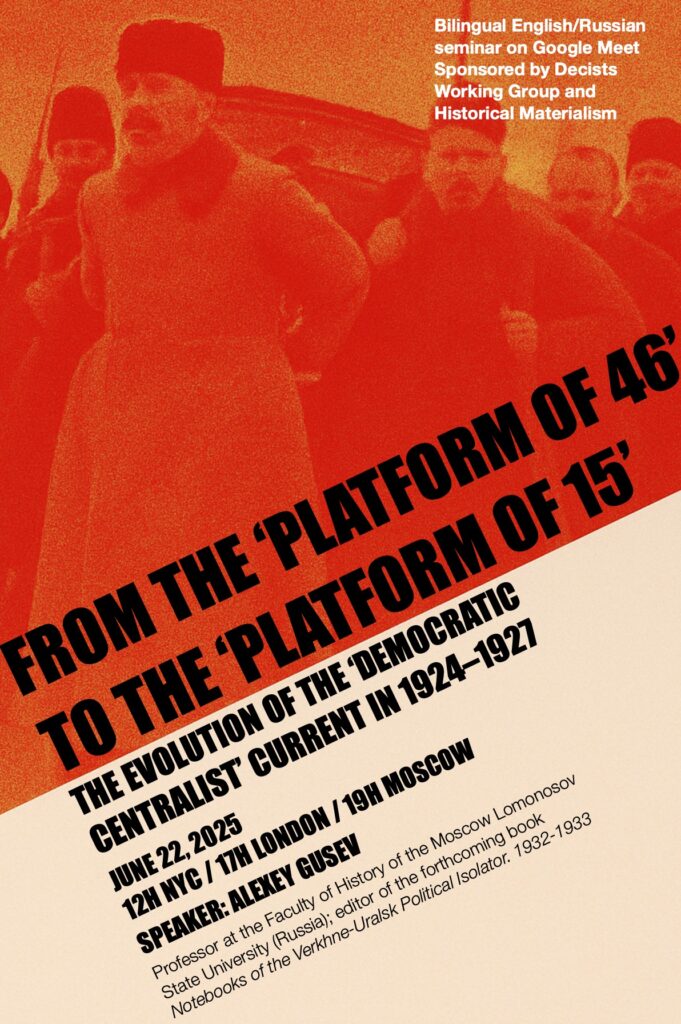
By Alexei Gusev, Text in English & Russian.
In 1921, after a heated party “Debate on the Trade Unions”, the Tenth Congress of the Russian Communist Party (Bolsheviks) decided to dissolve all intra-party factions and groups and prohibited their creation in the future. Among others, the “Democratic Centralism” group, which had been active since 1919 and had presented its platform on issues of party building at the Tenth Congress, had to cease to exist. However, the adoption of the resolution “On Party Unity” did not lead to the establishment of real unity in the RCP(b). The “Group of the Ten” (Lenin, Zinoviev, Stalin, and others), which won at the congress, established control over the party apparatus and began to pursue a policy where representatives of the losing groups were characterised as factional: supporters of the Workers’ Opposition, Trotsky and the Decists began to be gradually removed from leadership positions at the centre and in the regions, replaced by protégés of the “Ten”. After Lenin’s departure from direct leadership of the Party due to illness in 1922, real power was concentrated in the hands of the “Troika” of Politburo members: Zinoviev, Kamenev and Stalin. The latter, having taken the post of General Secretary of the Central Committee of the RCP(b), began to reorganise the party apparatus – to form a rigid administrative vertical, consisting of party secretaries loyal to him from top to bottom.
The effective liquidation of elections to party positions and the suppression of criticism under the slogans of “fighting factionalism” led to the spread of discontent in the party ranks and a new outbreak of intra-party struggle in 1923. The opposition that formed at that time and came out with the Platform of 46, included, on the one hand, Trotsky’s supporters led by Yevgeny Preobrazhensky, and, on the other, the Decists led by Timofey Sapronov. This opposition was not “Trotskyist”: this word had not yet been put into circulation, and Trotsky himself, although he defended in his articles the need for a “New Course” for democratisation of the RCP(b), did not personally participate in open discussions at party meetings – partly due to illness, partly due to his reluctance to make a public break with the majority of the Politburo members. In the press and documents of that period, the oppositionists were called not Trotskyists, but “supporters of Sapronov and Preobrazhensky”. Sapronov and a number of other Decist leaders did indeed play a key role in the creation and activities of the “1923 Opposition”. Although there were no more than ten Decists among the 46 prominent Bolsheviks who signed the Platform (Sapronov, V.M. Smirnov, Ya.N. Drobnis , T.I. Kharechko, and others), it was they who were considered by the party leadership to be “pioneers of the struggle against the main line of the Party” and the “core” of the opposition. Indeed, the content of the platform as a whole corresponded to the views that the Decists had been defending for several years, fighting against the bureaucratisation of the party and the development of authoritarian tendencies within it. Trotsky and his supporters had only later, by 1923, realised the need to counter the dominance of the “secretary hierarchy” and the “regime of factional dictatorship”. Therefore, representatives of the majority of the Politburo could claim that Trotsky had joined the Decists and even headed them, and that the entire opposition was nothing more than a revived group of “Democratic Centralism” in a new guise. It is instructive that the Moscow headquarters of the opposition was located in the apartment of one of the Decists – Deputy People’s Commissar of Education Vladimir Maksimovsky – in the 1st House of Soviets (the National Hotel).
In the intra-party debate of 1923-4, the opposition suffered a defeat, which the Stalinist apparatus managed to achieve by using a wide range of “dirty political techniques”. The 13th Conference of the RCP(b) in January 1924 declared the oppositionists to be bearers of a “petty-bourgeois deviation”, giving rise to a new wave of party sanctions against them. After this, the activists of the Decists stopped public appearances for some time. However, connections between them were maintained, correspondence was conducted, and meetings of the oppositionists periodically took place in private apartments, where political issues were discussed.
In the summer of 1925, the Decists again found themselves at the centre of attention of the Central Control Commission of the RCP(b) in connection with the so-called “Pilipenko affair”. This affair is interesting not only for its information about the internal processes in the Decist circles after 1923, but also because it reflected a new stage in the evolution of the intra-party regime and the Party’s “political culture”.
The circumstances of this case are as follows. In June 1925, the Central Control Commission came into possession of a private letter sent at the end of the previous year, 1924, by Boris Pilipenko, who worked in the Agitation and Propaganda Department of the MOPR in Kharkov, to Yakov Drobnis, a member of the Small Council of People’s Commissars of the Russian Federation in Moscow. Both were Decists, active participants in the discussion of 1923 (Drobnis’s signature is under the Platform of the 46). After the discussion, Pilipenko was expelled from the Party “for failure to eradicate oppositional deviations”, but was later reinstated with a reprimand. Another prominent Decist, Yuri Kotsyubinsky, a former member of the Soviet government of Ukraine, who was then transferred to diplomatic work, brought the letter from Pilipenko to Drobnis to Moscow. Drobnis passed the letter to one of the leaders of the Decists and the opposition of 1923, member of the Presidium of the USSR State Planning Committee Vladimir Smirnov, from whom the letter, together with the wallet in which it was located, was stolen several months later. Then, according to the Central Control Commission, this letter ended up in the Moscow Lost and Found Office, from where some vigilant employee, having familiarised himself with its contents, passed it on to the party control organs. It should be noted that this whole story looks rather suspicious: it cannot be ruled out that the theft of the letter from Smirnov was the result of a planned operation against the opposition.
Based on Pilipenko’s letter, the Central Control Commission opened a case against him, Drobnis, Smirnov, Kotsiubynsky, as well as Taras Kharechko and his wife Vera Bukhartseva, who were mentioned in the letter, on charges of “factional activity”.
What did this letter say?
Pilipenko wrote that the opposition had been inactive for a year after the discussion of intra-party democracy, and that had weakened it: “Such long periods of silence lead to the waverers and even some of those who were with us turning away from us”. It was necessary to prepare for a new round of struggle and strive to spread its influence among new party members and non-party workers. “The fundamental questions of the revolution” would inevitably lead the masses of workers and peasants to a clash with “today’s usurping bosses”, “the mad dogs of falsified Leninism”, and the opposition must be ready to lead this movement. If a split in the party was imminent, it was necessary to act “in the direction of organising a faction” that would oppose the group that had seized power in the party. Pilipenko also suggested that the Decists intervene in the “Literary Discussion” that took place at the end of 1924, caused by the publication of Leon Trotsky’s article “Lessons of October”. Although Pilipenko considered Trotsky’s attempt to use the pointing to the past political mistakes of Grigory Zinoviev and Lev Kamenev, committed in 1917, against the ruling “Troika” to be “stupid” (indeed, the “historical” accusations immediately turned against Trotsky himself), he believed that it was impossible to remain silent in the situation of the increasing persecution of Trotsky: it was necessary to “resist the charlatan writings”. In other words, the author of the letter, addressing Drobnis (and, through him, to other leaders of the Decists ), advocated for the activation of the opposition movement.
However, Pilipenko’s letter had no direct consequences in terms of activating the opposition. Apparently, he did not receive a response. At that stage, the leaders of the Decists preferred to wait and not react to the campaign to expose “Trotskyism”. And this is not surprising, considering that Trotsky himself and his supporters avoided defending the “Lessons of October”. Pilipenko’s letter lay in Smirnov’s wallet for a long time – until it fell into the hands of the Central Control Commission.
The leadership of the control bodies of the RCP(b) immediately saw in this letter evidence of an anti-party conspiracy. All those involved were summoned to the Presidium of the Central Control Commission in June 1925 and subjected to lengthy interrogations. They were accused of creating an anti-party factional organisation, which allegedly existed in Moscow and Kharkov, conducted correspondence, held meetings and was preparing to “blow up the party from within” by leading a counterrevolutionary movement against the Soviet government. The accused tried to prove that they had no organised faction, that it was a simple exchange of opinions in a private letter. But the chairman of the Central Control Commission, Valerian Kuibyshev, and secretaries Yemelyan Yaroslavsky and Matvey Shkiryatov, who conducted the interrogations, responded to this by saying that “the letter asks questions that the Party does not forgive”, and every honest Communist who learned of the existence of such an “outrageous” document was to immediately report it to the party organs. Thus, the requirement for party members to report any manifestations of “factionalism”, first formulated by the head of the OGPU Felix Dzerzhinsky in 1923, was already perceived by the party leadership as the norm two years later. It is also significant that no concept of the secrecy of personal correspondence existed for the Central Control Commission: all aspects of the private life of a party member were now subject to the control of party authorities.
Following the consideration of the case, the Presidium of the Central Control Commission issued in November 1925 a resolution on the punishment of those involved, which was approved by the Politburo of the Central Committee and then published in Pravda. (This, by the way, is an interesting illustration of how the mechanism of the control bodies of the RCP(b) actually functioned. According to the Party Charter, the Central Control Commission was a completely independent, autonomous body, equal in rights with the Central Committee. However, in reality, the decisions of the Presidium of the Central Control Commission were sent to Stalin for approval by the Politburo – i.e. to the very body whose legality the Central Control Commission was called upon to control). The resolution ordered Pilipenko to be expelled from the party, and Drobnis, Smirnov, Kotsyubinsky, Kharechko and Bukhartseva to be given severe reprimands. This decision was made by the Politburo, although not all of its members were convinced of the advisability of such a severe punishment for Pilipenko. The archives contain a private letter from Nikolai Bukharin to the Secretary of the Central Control Commission, Nikolai Yanson, in which the “favourite of the party” spoke in favour of limiting themselves to a severe reprimand and not “embittering” the Decists, but trying to “attract them a bit to us”. Bukharin believed that, in the conditions of the developing conflict between the Central Committee’s leadership group and Zinoviev’s faction, it was desirable to pursue a policy aimed at ensuring the neutrality of Vladimir Smirnov and others. However, this opinion had no effect, and the hard line prevailed with regard to the Decists.
Thus, from one private letter, which, as already noted, had no practical results, arose, on the initiative of the party leadership, a large “case” that was directly supervised by the Politburo. From this we can conclude that the leaders of the RCP(b) were seriously afraid of any attempts to revive an organised intra-party opposition, especially with the participation of important party and government figures in the past, such as Drobnis, Smirnov, Kotsiubinsky and Kharechko (the latter was previously the secretary of the Central Committee of the Communist Party of Ukraine). They were especially afraid, apparently, of a possible fusion of the opposition with the workers’ strike movement that had revived in early 1925, taking place under conditions of “compaction of the working day”, i.e. an increase in the intensity of labour in factories without a corresponding increase in real wages. At this time, in particular, there was a transition in textile factories to weavers servicing three looms, and spinners three sides of water-machines. When considering the “Pilipenko case” at the Presidium of the Central Control Commission, Yaroslavsky directly linked workers’ protests with the activities of some unnamed oppositionists who participate in strikes and “incite workers to critical speeches”.
At the same time, the OGPU organs arrested members of the opposition group in the city of Orekhovo-Zuyevo, one of the centres of the Russian textile industry and the labour movement, where, in 1885, the famous “Morozov strike” had taken place, the first major strike action by workers in Russia. The Orekhovo-Zuyevo opposition group consisted mainly of workers from the Spinning Factory – old Bolsheviks with pre-revolutionary experience, veterans of the revolutionary movement (Ivan Akilov and others). During the campaign to “increase labour productivity”, they began to organise meetings where they expressed outrage at the increased pressure on workers, as well as the persecution of Trotsky, the dominance of bureaucracy, the growth of inequality, and the “pollution of the party” by careerist elements. They discussed the creation of an organisation with cells in the form of “fives” and the establishment of connections with opposition elements in Ivanovo, Leningrad, and Bogorodsk. This group, whose case was examined at the plenum of the Central Control Commission in September 1925 simultaneously with the “Pilipenko case”, had no connections with the leaders of the opposition and arose exclusively from below, reflecting the growing discontent in working-class circles. The emergence of such groups was, from the point of view of the party leadership, a very alarming symptom.
As Decist Eduard Dune, later, already in exile in the 1940s, recalled, it was in 1925 that an “extensive unsigned typewritten document” entitled “The Labour Question” was distributed in opposition circles. It stated that, on the one hand, the party was making concessions to the well-to-do peasantry (such decisions on allowing hired labour and land lease were adopted by the 14th Party Conference in April 1925), and, on the other hand, increasing pressure on industrial workers. Under the guise of scholastic reasoning about the construction of socialism, an intensification of labour was taking place, which was accompanied by a curtailment of workers’ rights; at enterprises, “complete autocracy of the administration was established”. From this, the conclusion was drawn about the need for workers to have instruments of protection from “their” state, including real guarantees of the right to strike. According to Dune, both Trotsky and Zinoviev reacted negatively to this document, evaluating it as “Menshevik”, but it was read and actively discussed in Decist circles. Thus, the preconditions were created for the Decist movement to switch its attention from purely intra-party and macroeconomic issues to problems related to the situation of the working class, which largely determined the further evolution of the Decist movement.
However, the leaders of the Decists did not forget about general economic issues, analysing the processes and trends in the national economy of the USSR, which in the mid-1920s was experiencing increasing difficulties. They were associated with the end of recovery after wars and devastation and the need to allocate funds for investment in the creation of new production capacities. In April 1926, Vladimir Smirnov gave a report on the state of the Soviet economy at a meeting of the Economic Section of the Communist Academy, and then used this report as the basis for the article “On the Question of Our Economic Difficulties”, published in the May issue of the Krasnaya Nov’ magazine. As one of the leading Soviet economists and head of the Financial Section of Gosplan, Smirnov had extensive information about the real state of affairs in the economy, and this situation alarmed him. He drew attention to the development of inflationary tendencies associated with the decline in the purchasing power of the chervonets. This, in turn, was due to the financing of industry primarily through money emission, and not through its own internal savings: “Industry needs constant irrigation with chervonets’ rain”. This situation arose because, since 1923, after the “sales crisis” of industrial goods, the government had been consistently pursuing a policy of reducing wholesale prices for industrial products, and this deprived industry of the necessary sources of accumulation. Moreover, as Smirnov emphasised, the reduction in wholesale prices had only a small effect on retail prices for industrial goods, the index of which remained stably high. Thus, it was not consumers who benefited from the reduction in wholesale prices but mainly trade intermediaries – both cooperative trade bodies with their bloated bureaucratic apparatus and private capital. Smirnov clearly demonstrated the gap between wholesale and retail prices, which deprived industry of the funds it needed, in graphs, one of which is shown in the slide. From this he concluded that it was necessary to bring wholesale prices closer to the level of retail prices, as well as to devalue the chervonets in order to then maintain its rate at a stable level.
These and subsequent speeches by Smirnov on economic issues contained criticism not only of the economic policy of the party and state leadership, but also of its theoretical foundations. He believed that the ideologists of the ruling group were inclined to ignore the objective laws of the functioning of the market economy, trying to crudely manipulate prices administratively, which only had a negative effect. Until the market withered away in a socialist society, Smirnov emphasised, it was necessary to rely on market principles, and not destroy them – only in this way, combining planned regulation with the natural relationship between supply and demand, could the economy, and, above all, the industrial sector, be developed. Thus, the Decist theorist – contrary to the stereotypical perception of the oppositionists as “ultra-leftists” – actually criticised the Stalin-Bukharin policy from a “market” standpoint, for which he received another accusation of Menshevik deviation.
Meanwhile, in the spring of 1926, in the Communist Party began to develop process of formation of the bloc of the main opposition groups: Zinoviev’s “New Opposition”, which suffered a defeat at the 14th Party Congress and lost its main stronghold in Leningrad, and the Trotskyists and Decists. The latter played an important role in this process. According to Trotsky, the initiative to form an opposition alliance belonged to them, and the first meetings of representatives of the uniting groups were chaired by Timofey Sapronov. In the summer of 1926, the rapprochement of the Trotskyists, Zinovievists, and Sapronovites culminated in the creation of the United Opposition, which began to mobilise its forces. The intensification of the opposition’s activities was manifested in their holding meetings of their supporters. The party leadership, for its part, viewed the organisation of such unsanctioned meetings as illegal factional activity and reacted harshly to them. In June 1926, a meeting with about 70 people took place in the forest near the Dolgoprudnaya railway station near Moscow, at which a prominent party figure, deputy chairman of the Revolutionary Military Council, Mikhail Lashevich, one of the leaders of the Zinovievites, spoke. For this, he was excluded from the candidates for membership in the Central Committee, other participants in the meeting were also subject to sanctions, and Zinoviev, as someone involved in the “Lashevich affair”, was removed from the Politburo.
Vladimir Smirnov was also charged with holding an unauthorised opposition event. In August 1926, he spoke at a meeting held in the apartment of the railroad worker and communist Babashin with a report devoted to criticism of the domestic and foreign policies of the party and state leadership. Having learned about the preparation of this meeting, the Central Control Commission sent there its agent Yevgeny Skolznev, who immediately filed a denunciation of Smirnov’s “anti-party activities” with the party organs. According to Skolznev, in his speech, Smirnov not only denounced the “dictatorship of Stalin”, but also warned that in a conflict with the opposition, the authorities would resort to direct state repression – they would arrest and imprison dissenters. In this case, the speaker called on workers to actively protest, including strikes and demonstrations.
On the basis of Skolznev’s denunciation, the Moscow Control Commission decided in September 1926 to expel Smirnov from the Party. They also demanded that members of the party cell of the USSR State Planning Committee, of which he was a member of the presidium, condemn his “factional work”. But, instead of unanimously condemning Smirnov’s actions, a heated discussion broke out at the meeting of the cell, which included leading Soviet economists. Smirnov’s speech, according to his opponents, was in the nature of a “declaration of opposition”. He declared that, by suppressing any dissent as “factionalism”, the leading group of the Central Committee was itself a real faction that had destroyed intra-party democracy. As a result of its policy, the situation of the working class and the peasant poor in the country was worsening, while capitalist elements, associated in particular with merchant capital, were, on the contrary, becoming stronger. The intensity of labour at enterprises had recently increased by 30%, while wages had increased by only 5%. Trade unions, called upon to protect the interests of workers, are losing their independence, turning into appendages of the administration. The theory of “socialism in one country” was leading to a dangerous loss of the prospect of an international revolution. In general, the Party was turning from Leninist to Stalinist, which the General Secretary’s supporters were already beginning to talk about openly. “I have fought, am fighting and will fight Stalin’s faction”, concluded Smirnov.
Smirnov was supported at the meeting by other oppositionists from among the tops of Gosplan – the former People’s Commissar of Finance of the USSR Grigory Sokolnikov, Yuri Gaven and Ivar Smilga. The latter, having stipulated that he was not advocating for factionalism, directly stated that Smirnov was right: power in the party had been seized by the “National-Bolsheviks” led by Stalin, and, in order to return to the Leninist path, it was necessary to restore party democracy. And although Stanislav Strumilin and other leaders of the cell, as well as representatives of the city party committee who had arrived at the meeting, insisted on supporting the decision to expel Smirnov from the Party, the corresponding resolution they proposed passed with a majority of only 4 votes: 18 against 14. Thus, in 1926, oppositionists still made up about half of the Gosplan leadership.
While Smirnov defended the views of the opposition in the Gosplan party cell, another leader of the Decists, Timofey Sapronov, took part in a stormy meeting at the Ryazan-Urals Railway. In September 1926, the United Opposition decided to move from organising private meetings of its supporters to open speeches at party meetings at enterprises. One of these enterprises was the railway traction service of the Ryazan-Urals Railway, which included the Paveletsky Station in Moscow. Here, the bureau of the party cell was headed by the oppositionist Tkachev, against whom the Moscow Control Commission had initiated the procedure of expulsion from the Party. However, he did not surrender his party card and organised a party meeting, at which Sapronov was invited to speak. By this time, the railway workers were gripped by discontent due to the reduction of rates, the increase of norms, and the fall in real wages by 40%. Such an atmosphere contributed to the growth of the popularity of the party opposition.
At a meeting of railway workers, which lasted two days, Sapronov was confronted by representatives of the enterprise administration, the Moscow Control Commission, and local district committees of the Party and the Komsomol. The situation at this event was later vividly described by the leader of the Decists in a statement to the Central Control Commission: the district committee members did not allow him to speak, and then “this entire company surrounded me, jabbing their fists in my face, cursing in the streets, and, as the workers put it, using three-story obscenities. I was saved from physical violence by the energetic protest of all the workers”. The next day, Trotsky came to the meeting with Sapronov, and was greeted with an ovation from the workers present. In response, the district committee representatives declared the meeting illegal and called on all who did not want to put themselves outside the ranks of the Party to leave it. But, according to Sapronov, “despite the disorganising behaviour of the district committee members, the meeting continued and ended with the unanimous adoption of the resolution and the singing of the Internationale”.
However, not everywhere were the public appearances of the opposition as successful as on the Ryazan-Ural railway: in other places the party apparatus was better prepared to resist. As Trotsky recalled, all means of “administrative mechanics” were put into action with “telephone calls to party bureaucracy for meetings of workers’ cells, a frantic accumulation of cars, the roar of horns, well-organised whistling and roaring when oppositionists appeared on the platform. The ruling faction put pressure by mechanically concentrating its forces, threatening repression”. When Sapronov arrived at a meeting of the party cell of the Podmoskovnaya railway depot on 1 October (which voted for the opposition in 1923), he was simply not allowed in. That same evening, together with Trotsky, Zinoviev, Smilga, Radek and Pyatakov, he went to a party meeting at one of the large Moscow factories, Aviapribor on Krasnaya Presnya. Here, in 1923, the opposition had also received the support of the majority, and the trade union committee had previously been headed by the oppositionist Kosenko. The meeting lasted all night, and the leaders of the Moscow and Krasnopresnensk party organisations, Nikolai Uglanov and Martemyan Ryutin, as well as high ranking party propagandists Aleksandr Slepkov and Jan Sten spoke out against the opposition, denouncing their “factional forays” (the irony of history: all of them, in turn, later joined the “right” opposition and were shot). As a result, the resolution in support of the “general line” received the majority of votes (78), with 27 people voting for the opposition. The opposition also failed to pass its resolutions at meetings in early October at other enterprises: the Leningrad plant “Krasny Putilovets”, where Zinoviev spoke, the Moscow plants “Dynamo”, “Serp i Molot”, and others.
After this, an anti-opposition propaganda campaign was launched in the party press, which relished the defeat of the “bankrupt leaders” who were trying to “impose another discussion on the Party”. The tone of this campaign is vividly illustrated by the poem by the Stalinist poet-propagandist Demyan Bedny “Platoon. Discussion Ballad”, published in Pravda on October 8:
…Radek is as cheerful as a monkey,
He curls up like a belly-worm.
– “One!
Two!
Pla-a-a-atoon …
Stop! […]
At the command of the boss
Having rammed the fence,
With a machine gun attack
We approached Aviapribor. […]
But the cell did not tremble:
It received the guests with hostility,
Factional family bit their tongues”.
Particular emphasis was placed on the participation in opposition actions of the leaders of the Decists, who were known for their dissent even during the Lenin period. Their struggle against Stalin’s policies was portrayed as a direct continuation of the struggle against Lenin. “In fact, who would want to listen to Sapronov?” Pravda asked rhetorically. “Only those who do not know him. ‘Glory to you, Lord’, – in 1918 he fought against Lenin, in 1919 he fought against Lenin, in 1920 the same, in 1921 the same. In 1923 he received ‘orders’ from Trotsky for the struggle against Lenin’s Central Committee, and now, in 1926, he has ‘moored’ in the opposition bloc and is walking around the cells with a firm decision to open a discussion again”.
In these circumstances, having received an ultimatum from the majority of the Politburo demanding that they cease public speeches and repent of their “factionalism”, Trotsky, Zinoviev, and their supporters decided to give in. On 16 October 1926, representatives of the opposition in the Central Committee issued a statement in which they acknowledged their own and their supporters’ responsibility for “factional steps” and “violations of party discipline” – in particular, for the fact that with their actions in Moscow and Leningrad they had attempted to start a party discussion without the sanction of the leadership of the Party. Repenting of their “mistakes”, Trotsky, Zinoviev, Kamenev, Sokolnikov, Pyatakov, and Evdokimov promised, on behalf of the opposition, to “cease the factional struggle”.
This statement, the text of which was twice rewritten under the dictation of Molotov and Bukharin, but was not discussed with the opposition activists, came as a surprise to the oppositionists and left a painful impression on many of them. Some rank and file at local level directly assessed it as a capitulation and betrayal on the part of the leaders. A direct consequence of this statement was the exit of the Decists, who categorically rejected it, from the opposition bloc. They considered the Zinovievites, inclined to compromise with the Stalin-Bukharin group, to be the main culprits of the “capitulation”, and they denounced the Trotskyists for conniving with Zinoviev’s opportunism. But the Decists saw the main reason for the “political fall of the opposition generals” in their failure to understand the depth of the degeneration of the party-state system of the USSR and their attempts to return to power with the help of top-level manoeuvres. In a circular letter sent out in 1927, Sapronov noted that, by relying on “correcting the line of the Stalinist party” with the help of “liberal methods” and ambiguous phraseology, the Trotskyist-Zinoviev group was effectively turning into a “tame, court opposition”. The leader of the Decists even compared this “non-proletarian opposition of former leaders” to the Zubatov agency of the tsarist regime in the labour movement. The answer to this should have been, in his opinion, the ideological and organisational consolidation of a genuine proletarian opposition, not seeking an agreement with the apparatchiks, but relying on the working class and fighting to establish its power in the country. Such conclusions formed the basis for the development in 1927 of “Platform 15” – the new programme document of Decists, who adopted the name “Proletarian Opposition”.
Thus, in the period between the defeat of the opposition in 1923 and the formation of the alliance of opposition groups in 1926, the Decists took a wait-and-see position: they did not speak out openly either during the “Literary Discussion” of 1924 or during the clash between the Stalin-Bukharin and Zinoviev groups in 1925. Although individual supporters of “Democratic Centralism” – such as Boris Pilipenko – already then proposed moving to decisive action, the leaders of the current believed that favourable conditions for activating the struggle had not yet developed. However, connections within the Decists group were maintained at this stage, exchanging opinions on political and theoretical issues in correspondence continued. The party leadership monitored the situation in the Decist environment, tracking down and suppressing the slightest manifestations of “factionalism”, as evidenced by the “Pilipenko Drobnis affair” in 1925. At the same time, attempts were made to neutralise the Decists by attracting some of them to their side. At this time, such prominent figures as Nikolai Osinsky, Vladimir Maksimovsky, and Andrei Bubnov left the opposition. According to Sapronov, Stalin suggested that he join the “general line”, using a rather specific method. Sapronov recalled that Stalin told him: “There are too many Jews in the Politburo, they must be thrown out. A Russian man like you should be represented in the Politburo”. However, the anti-Semitic arguments, which, as the General Secretary apparently assumed would find a response among the workers (and which were later used in the fight against the opposition), did not affect Sapronov.
The processes that took place in the USSR in the mid-1920s – the growth of socio-economic problems, the intensification of exploitation of the working class and the spread of discontent in the proletarian environment – could not help but influence the Decists. They began to pay increasing attention to the “labour question”, i.e. the problems of the deteriorating material and legal situation of workers, and at the same time analysed the socio-economic policy of the party and state leadership, coming to the conclusion that it contradicted the interests of socialist construction and was leading the country to a crisis.
The formation of the United Opposition with participation of the Decists in the summer of 1926 marked the beginning of a new upsurge in their activity. However, the period of their close cooperation with the Trotskyists and Zinovievists was short-lived: already in October of the same year, the “Sapronovites” left the bloc in protest against the unprincipled and shameful, as they considered it, concessions of Trotsky and Zinoviev to the Stalinist clique and the undemocratic internal structure of the united opposition itself. The views of the Decists gradually became radicalised: noting the deep bureaucratic-petty-bourgeois degeneration of the entire Soviet system, they were losing hope of reforming the “Stalinist party” and sought ways out of the current situation through the construction of their own organisation to fight for the restoration of the dictatorship of the proletariat. The result of the evolution of the “Democratic Centralism” current was the formation of the “Proletarian Opposition” – an association of communists who launched a struggle against the party-state leadership while simultaneously distancing themselves from the “liberalism” and “compromise” of the Trotskyists and Zinovievites.
От Платформы 46-ти к Платформе 15-ти: эволюция течения «демократического централизма» в 1924-1927 гг.
В 1921 г., после ожесточенной внутрипартийной «дискуссии о профсоюзах» Десятый съезд Российской Коммунистической партии (большевиков) постановил распустить все внутрипартийные фракции и группы и запретил их создание в дальнейшем. Среди прочих должна была прекратить свое существование и группа «Демократического централизма», которая действовала с 1919 г. и выступала на Х съезде со своей платформой по вопросам партийного строительства. Однако принятие резолюции «О единстве партии» не привело к утверждению в РКП(б) реального единства. Победившая на съезде группа «Десяти» (В.И. Ленин, Г.Е. Зиновьев, И.В. Сталин и др.), установив контроль над партийным аппаратом, стала проводить политику, которую представители проигравших групп характеризовали как фракционную: сторонников Рабочей оппозиции, Л.Д. Троцкого и децистов начали постепенно смещать с руководящих должностей в центре и на местах, заменяя ставленниками «Десятки». После отхода Ленина от непосредственного руководства партией из-за болезни в 1922 г. реальная власть сосредоточилась в руках «тройки» членов Политбюро: Г.Е. Зиновьева, Л.Б. Каменева и И.В. Сталина. Последний, заняв пост генерального секретаря ЦК РКП(б), приступил к реорганизации партаппарата – формированию жесткой административной вертикали, состоявшей из лояльных ему партийных секретарей сверху донизу.
Фактическая ликвидация выборности на партийные должности и подавление критики под лозунгами «борьбы с фракционностью» привели к распространению в партийных рядах недовольства и новой вспышке внутрипартийной борьбы в 1923 г. Образовавшаяся в это время оппозиция, выступившая с Платформой 46-ти, включила в себя, с одной стороны, сторонников Троцкого во главе с Евгением Преображенским, и, с другой, децистов во главе с Тимофеем Сапроновым. Оппозиция эта не была «троцкистской»: данное слово еще не было пущено в оборот, и сам Троцкий, хотя и отстаивал в своих статьях необходимость – «нового курса» демократизации РКП(б), в открытой дискуссии на партсобраниях лично не участвовал – отчасти из-за болезни, отчасти из-за нежелания идти на публичный разрыв с большинством членов Политбюро. В прессе и документах того периода оппозиционеры именовались не троцкистами, а «сторонниками Сапронова и Преображенского». Сапронов и целый ряд других децистских лидеров действительно сыграли ключевую роль в создании и деятельности «оппозиции 1923 года». Хотя среди подписавших Платформу 46-ти видных большевиков децистов было не более десяти человек (Сапронов, В.М. Смирнов, Я.Н. Дробнис, Т.И. Харечко и др.), именно их партийное руководство считало «застрельщиками борьбы против основной линии партии» и «ядром» оппозиции. Действительно, содержание платформы в целом соответствовало тем взглядам, которые децисты отстаивали уже в течение нескольких лет, борясь против бюрократизации партии и развития в ней авторитарных тенденций. Троцкий же и его сторонники только теперь, к 1923 году осознали необходимость противодействия господству «секретарской иерархии» и «режиму фракционной диктатуры». Поэтому представители большинства Политбюро могли заявлять, что Троцкий присоединился к децистам и даже возглавил их, а вся оппозиция – это не что иное, как возродившаяся группа «Демократического централизма» в новом обличье. Показательно, что московский штаб оппозиции размещался в квартире одного из децистов – заместителя наркома просвещения Владимира Максимовского – в 1-м Доме Советов (гостинице «Националь»).
Во внутрипартийной дискуссии 1923-1924 гг. оппозиция потерпела поражение, которого сталинскому аппарату удалось добиться, пустив в ход широкий набор «грязных политтехнологий». XIII конференция РКП(б) в январе 1924 г. объявила оппозиционеров носителями «мелкобуржуазного уклона», дав старт новой волне партийных санкций против них. После этого актив децистов на какое-то время прекратил публичные выступления. Однако связи между ними сохранялись, велась переписка, периодически происходили встречи оппозиционеров на частных квартирах, где обсуждались политические вопросы.
Летом 1925 г. децисты вновь оказались в центре внимания Центральной контрольной комиссии РКП(б) в связи с т.н. «делом Пилипенко». Это дело интересно не только сведениями о внутренних процессах в децистской среде после 1923 года, но и тем, что оно отразило новый этап эволюции внутрипартийного режима и партийной «политической культуры».
Обстоятельства этого дела таковы. В июне 1925 г. в распоряжении ЦКК оказалось частное письмо, отправленное в конце предшествующего, 1924 года Борисом Пилипенко, который работал в Агитпропотделе МОПРа в Харькове, Якову Дробнису, члену Малого Совнаркома РСФСР в Москве. Оба были децистами, активными участниками дискуссии 1923 года (подпись Дробниса стоит под Платформой 46-ти). После дискуссии Пилипенко исключили из партии «за неизжитие оппозиционных уклонов», но затем восстановили с объявлением выговора. Письмо от Пилипенко Дробнису привез в Москву еще один видный децист Юрий Коцюбинский, бывший член советского правительства Украины, переведенный затем на дипломатическую работу. Дробнис передал письмо одному из лидеров децистов и оппозиции 1923 года, члену Президиума Госплана СССР Владимиру Смирнову, у которого это письмо вместе с бумажником, где оно находилось, было спустя несколько месяцев украдено. Затем это письмо, по версии ЦКК, оказалось в московском бюро находок, откуда какой-то бдительный сотрудник, ознакомившись с его содержанием, передал его в органы партийного контроля. Отметим, что вся эта история выглядит довольно подозрительно: нельзя исключить, что похищение письма у Смирнова было результатом спланированной операции против оппозиционеров.
На основании письма Пилипенко ЦКК возбудила против него, Дробниса, Смирнова, Коцюбинского, а также упоминавшихся в письме Тараса Харечко и его жены Веры Бухарцевой дело по обвинению во «фракционной деятельности».
О чем же говорилось в этом письме?
Пилипенко писал, что в течение года после дискуссии о внутрипартийной демократии оппозиция бездействовала, что привело к ее ослаблению: «Такие большие периоды молчания приводят к тому, что от нас отворачиваются колеблющиеся и даже часть из тех, кто был с нами». Нужно готовиться к новому раунду борьбы и стремиться распространить свое влияние среди новых членов партии и беспартийных рабочих. «Коренные вопросы революции» неизбежно приведут массы рабочих и крестьян к столкновению с «сегодняшними заправилами-узурпаторами», «бешеными собаками фальсифицированного ленинизма», и оппозиция должна быть готова возглавить это движение. Если предстоит раскол партии, то нужно действовать «в направлении организационного оформления фракции», противостоящей захватившей власть в партии группировке. Пилипенко также предлагал децистам вмешаться в шедшую в конце 1924 года «Литературную дискуссию», вызванную публикацией статьи Льва Троцкого «Уроки Октября». Хотя попытку Троцкого использовать против правящей «тройки» обращение к прошлым политическим ошибкам Григория Зиновьева и Льва Каменева, совершенным ими в 1917 году, Пилипенко считал «глупостью» (действительно, «исторические» обвинения сразу же обернулись против самого Троцкого), он полагал, что молчать в ситуации нарастающей травли Троцкого нельзя: надо «дать отпор шарлатанским писаниям». Одним словом, автор письма, обращаясь к Дробнису (и через него к другим лидерам децистов), выступал за активизацию оппозиционного движения.
Однако никаких прямых последствий в плане активизации оппозиции письмо Пилипенко не имело. Ответа он, по-видимому, не получил. Лидеры децистов на том этапе предпочитали выжидать и не реагировать на кампанию по разоблачению «троцкизма». И это не удивительно, учитывая, что от защиты «Уроков Октября» уклонился и сам Троцкий со своими сторонниками. Письмо Пилипенко долго пролежало в бумажнике Смирнова – до того момента, как попало в руки ЦКК.
Руководство контрольных органов РКП(б) сразу же усмотрело в этом письме свидетельство антипартийного заговора. На разбирательство в Президиум ЦКК в июне 1925 года вызвали и подвергли длительным допросам всех причастных к нему. Им инкриминировали создание антипартийной фракционной организации, которая якобы существовала в Москве и Харькове, вела переписку, проводила собрания и готовилась «взорвать партию изнутри», возглавив контрреволюционное движение против советского правительства. Обвиняемые пытались доказать, что никакой организованной фракции у них не было, что речь идет о простом обмене мнениями в частном письме. Но проводившие допросы председатель ЦКК Валериан Куйбышев и секретари Емельян Ярославский и Матвей Шкирятов отвечали на это, что «в письме задаются такие вопросы, которые не прощает партия», и каждый честный коммунист, узнавший о существовании такого «возмутительного» документа, должен был незамедлительно донести о нем в партийные органы. Таким образом, требование к членам партии доносить о любых проявлениях «фракционности», сформулированное впервые главой ОГПУ Феликсом Дзержинским в 1923 г., спустя два года уже воспринималось партийным руководством как норма. Показательно также, что никакого понятия тайны личной переписки для ЦКК не существовало: все аспекты частной жизни члена партии должны были теперь подлежать контролю партийных инстанций.
По итогам рассмотрения дела Президиум ЦКК вынес в ноябре 1925 г. постановление о наказании его фигурантов, утвержденное Политбюро ЦК и затем опубликованное в «Правде». (Это, кстати, является интересной иллюстрацией того, как в реальности функционировал механизм контрольных органов РКП(б). Согласно Уставу партии, ЦКК являлась полностью самостоятельным, независимым органом, равноправным с ЦК. Однако на самом деле решения Президиума ЦКК отправлялись Сталину для утверждения в Политбюро – т.е. в тот самый орган, законность действий которого ЦКК была призвана контролировать). Постановление предписывало исключить из партии Пилипенко, а Дробнису, Смирнову, Коцюбинскому, Харечко и Бухарцевой вынести строгие выговоры. Это решение было принято Политбюро, хотя не все его члены были уверены в целесообразности такого строго наказания для Пилипенко. В архиве сохранилось частное письмо Николая Бухарина секретарю ЦКК Николаю Янсону, в котором «любимец партии» высказывался за то, чтобы ограничиться строгим выговором и не «озлоблять» тем самым децистов, а попытаться «немножко привлечь их к себе». Бухарин полагал, что в условиях развивавшегося конфликта руководящей группы ЦК с фракцией Зиновьева желательно проводить политику, направленную на обеспечение нейтралитета Владимира Смирнова и др. Однако это мнение не возымело действия, и в отношении децистов победила жесткая линия.
Таким образом, из одного частного письма, не имевшего, как уже отмечалось, каких-либо практических результатов, возникло по инициативе партийного руководства большое «дело», которое курировало непосредственно Политбюро. Из этого можно заключить, что вожди РКП(б) серьезно опасались любых попыток возрождения организованной внутрипартийной оппозиции, тем более с участием крупных в прошлом партийных и государственных деятелей, таких как Дробнис, Смирнов, Коцюбинский и Харечко (последний был ранее секретарем ЦК Компартии Украины). Особенно опасались, по-видимому, возможного смыкания оппозиции с оживившемся в начале 1925 года забастовочным движением рабочих, которое происходило в условиях «уплотнения рабочего дня», т.е. увеличения интенсивности труда на заводах без соответствующего повышения реальной зарплаты. В это время происходил, в частности, переход на текстильных фабриках к обслуживанию ткачами трех станков, а прядильщицами трех сторонок ватер-машин. При рассмотрении «дела Пилипенко» на президиуме ЦКК Ярославский прямо связал рабочие протесты с деятельностью некоторых неназванных оппозиционеров, которые участвуют в стачках и «подбивают рабочих к критическим выступлениям».
Тогда же органы ОГПУ произвели аресты участников оппозиционной группы в городе Орехово-Зуево, одном из центров российской текстильной промышленности и рабочего движения, где в 1885 г. произошла знаменитая «Морозовская стачка», первое крупное забастовочное выступление рабочих в России. В состав орехово-зуевской оппозиционной группы входили главным образом рабочие Прядильной фабрики – старые большевики с дореволюционным стажем, ветераны революционного движения (Иван Акилов и др.). Во время кампании по «поднятию производительности труда» они стали устраивать собрания, где возмущались усилением нажима на рабочих, а также травлей Троцкого, засильем бюрократии, ростом неравенства и «засорением партии» карьеристскими элементами. Обсуждалось создание организации с ячейками в виде «пятерок» и установление связей с оппозиционными элементами в Иваново, Ленинграде. Богородске. Эта группа, дело которой рассматривалось на пленуме ЦКК в сентябре 1925 г. одновременно с «делом Пилипенко», не имела никаких связей с лидерами оппозиции и возникла исключительно снизу, отразив растущее в рабочих кругах недовольство. Появление таких групп представляло, с точки зрения партийного руководства, весьма тревожный симптом.
Опасения партийных вождей относительно соединения коммунистической оппозиции со стихийным рабочим протестом были не напрасны. Как вспоминал позднее, уже будучи в эмиграции в 1940-е годы один из активных децистов Эдуард Дунэ, именно в 1925 г. в оппозиционной среде получил распространение «обширный машинописный документ без подписи» под названием «Рабочий вопрос». В нем говорилось о том, что, с одной стороны, партия идет на уступки зажиточному крестьянству (соответствующие решения о разрешении наемного труда и аренды земли были приняты XIV партийной конференцией в апреле 1925 г.), а, с другой, усиливает нажим на промышленных рабочих. Под прикрытием схоластических рассуждений о строительстве социализма происходит интенсификация труда, которая сопровождается урезанием прав рабочих, на предприятиях «устанавливается полное самодержавие администрации». Отсюда делался вывод о необходимости для рабочих иметь инструменты защиты от «своего» государства, в том числе реальные гарантии права на забастовки. По свидетельству Дунэ, и Троцкий, и Зиновьев, отнеслись к этому документу негативно, оценив его как «меньшевистский», но в децистских кругах его читали и активно обсуждали. Таким образом, создавались предпосылки для переключения внимания децистов с чисто внутрипартийных и макроэкономических вопросов на проблемы, связанные с положением рабочего класса, что во многом определило дальнейшую эволюцию децистского течения.
Однако лидеры децистов не забывали и об общих вопросах экономики, анализируя процессы и тенденции в народном хозяйстве СССР, которое в середине 1920-х гг. испытывало возрастающие затруднения. Они были связаны с окончанием восстановления после войн и разрухи и необходимостью изыскания средств для инвестиций в создание новых производственных мощностей. В апреле 1926 г. Владимир Смирнов выступил с докладом о состоянии советской экономики на заседании Экономической секции Коммунистической академии, а затем положил этот доклад в основу статьи «К вопросу о наших хозяйственных затруднениях», вышедшей в майском номере журнала «Красная новь». Будучи одним из ведущих советских экономистов и заведующим Финансовой секцией Госплана, Смирнов владел обширной информацией о реальном положении дел в экономике, и это положение вызывало у него тревогу. Он обращал внимание на развитие инфляционных тенденций, связанных с падением покупательной способности червонца. А это, в свою очередь, происходило из-за финансирования промышленности преимущественно за счет денежной эмиссии, а не ее собственных внутренних накоплений: «Промышленность нуждается в постоянном орошении червонным дождем». Такая ситуация складывалась потому, что с 1923 г., после «кризиса сбыта» промышленных товаров правительство последовательно проводило политику снижения оптовых цен на промышленную продукцию, а это лишало индустрию необходимых источников накопления. Причем, как подчеркивал Смирнов, снижение оптовых цен лишь в малой степени влияло на розничные цены промтоваров, индекс которых оставался стабильно высоким. Тем самым выгоду из снижения оптовых цен извлекали не потребители, а главным образом торговые посредники – как кооперативные торговые органы с их раздутым бюрократическим аппаратом, так и частный капитал. Разрыв между оптовыми и розничными ценами, лишавший промышленность необходимых ей средств, Смирнов наглядно демонстрировал на графиках, один из которых приведен на слайде. Из этого он делал вывод о необходимости приближения оптовых цен к уровню розничных, а также проведения девальвации червонца с тем, чтобы затем поддерживать его курс на стабильном уровне.
Эти и последующие выступления Смирнова по экономическим вопросам содержали критику не только хозяйственной политики партийно-государственного руководства, но и ее теоретических основ. Он считал, что идеологи правящей группы склонны игнорировать объективные законы функционирования рыночной экономики, пытаясь грубо манипулировать ценами в административном порядке, что дает лишь негативный эффект. Пока не произошло отмирания рынка в социалистическом обществе, подчеркивал Смирнов, на рыночные принципы надо опираться, а не разрушать их – только так, соединяя плановое регулирование с учетом естественного соотношения спроса и предложения, можно развивать экономику, и прежде всего промышленный сектор. Таким образом, децистский теоретик – вопреки стереотипному восприятию оппозиционеров как «леваков» – фактически критиковал сталинско-бухаринскую политику с «рыночных» позиций, за что получил очередное обвинение в меньшевистском уклоне.
Между тем весной 1926 г. в ВКП(б) началось формирование блока основных оппозиционных групп: «Новой оппозиции» Зиновьева, потерпевшей поражение на XIV партсъезде и лишившейся своего основного оплота в Ленинграде, троцкистов и децистов. Последние играли в этом процессе важную роль. По свидетельству Троцкого, сама инициатива образования оппозиционного альянса принадлежала именно им, и первые совещания представителей объединяющихся групп проходили под председательством Тимофея Сапронова. Летом 1926 г. сближение троцкистов, зиновьевцев и сапроновцев завершилось созданием Объединенной оппозиции, которая приступила к мобилизации своих сил. Активизация деятельности оппозиционеров проявилась в проведении ими собраний своих сторонников. Партийное руководство, со своей стороны, рассматривало организацию таких не санкционированных собраний как нелегальную фракционную деятельность и жестко реагировало на них. В июне 1926 г. в лесу у станции Долгопрудная под Москвой прошло собрание с участием около 70 человек, на котором выступил видный партийный деятель, заместитель председателя Реввоенсовета, Михаил Лашевич – один из лидеров зиновьевцев. За это его исключили из кандидатов в члены ЦК, санкциям подверглись и другие участники собрания, а Зиновьева как причастного к «делу Лашевича» вывели из Политбюро.
Обвинение в проведении несанкционированного оппозиционного мероприятия предъявили и Владимиру Смирнову. В августе 1926 г. он выступил на собрании, которое проходило на квартире железнодорожного рабочего-коммуниста Бабашина, с докладом, посвященном критике внутренней и внешней политики партийно-государственного руководства. Узнав о подготовке этого собрания, ЦКК направила туда своего агента Евгения Скользнева, который сразу же подал в партийные органы донос об «антипартийной деятельности» Смирнова. По словам Скользнева, Смирнов в своем выступлении не только обличал «диктатуру Сталина», но и предупреждал, что в конфликте с оппозицией власти прибегнут к прямым государственным репрессиям – будут арестовывать и сажать в тюрьмы несогласных. В этом случае оратор призывал рабочих к активным протестам, включая забастовки и демонстрации.
По доносу Скользнева Московская контрольная комиссия ВКП(б) в сентябре 1926 г. приняла решение об исключении Смирнова из партии. Осудить его «фракционную работу» потребовали также от членов партийной ячейки Госплана СССР, членом президиума которого он являлся. Но вместо единодушного осуждения действий Смирнова на заседании ячейки, в которую входили ведущие советские экономисты, развернулась горячая дискуссия. Выступление Смирнова, по определению его оппонентов, носило характер «декларации оппозиции». Он заявил, что, подавляя всякое инакомыслие как «фракционность», руководящая группа ЦК сама является настоящей фракцией, уничтожившей внутрипартийную демократию. В результате ее политики положение рабочего класса и крестьянской бедноты в стране ухудшается, а капиталистические элементы, связанные, в частности, с торговым капиталом, наоборот, укрепляются. Интенсивность труда на предприятиях за последнее время выросла на 30%, а зарплата всего на 5%. Профсоюзы, призванные защищать интересы рабочих, теряют свою самостоятельность, превращаясь в придатки администрации. Теория «социализма в одной стране» приводит к опасной потере перспективы международной революции. В целом партия превращается из ленинской в сталинскую, о чем сторонники генсека начинают говорить уже открыто. «Боролся, борюсь и буду бороться с фракцией Сталина», – заключил Смирнов.
Смирнова поддержали на собрании другие оппозиционеры из числа руководителей Госплана – бывший нарком финансов СССР Григорий Сокольников, Юрий Гавен и Ивар Смилга. Последний, оговорившись, что не выступает в защиту фракционности, прямо заявил, что Смирнов прав: власть в партии захватили «национал-большевики» во главе со Сталиным, для возвращения на ленинский путь необходимо восстановление внутрипартийной демократии. И хотя Станислав Струмилин и другие руководители ячейки, а также прибывшие на собрание представители горкома партии, настаивали на поддержке решения об исключении Смирнова из партии, предложенная ими соответствующая резолюция прошла большинством лишь в 4 голоса: 18 против 14. Таким образом, в руководстве Госплана оппозиционеры в 1926 г. составляли еще около половины.
В то время как Смирнов защищал взгляды оппозиции в партъячейке Госплана, другой лидер децистов Тимофей Сапронов принял участие в бурном собрании на Рязано-Уральской железной дороге. В сентябре 1926 г. объединенная оппозиция решила перейти от организации частных встреч своих сторонников к открытым выступлениям на партийных собраниях на предприятиях. В качестве одного из таких предприятий была выбрана служба тяги железной дороги, к которой относился Павелецкий вокзал в Москве. Здесь бюро партъячейки возглавлял оппозиционер Ткачев, в отношении которого Московской контрольной комиссией была инициирована процедура исключения из партии. Однако он не сдал партбилет и организовал партсобрание, для выступления на котором был приглашен Сапронов. К этому времени рабочие-железнодорожники были охвачены недовольством из-за снижения расценок, повышения норм и падения реальной зарплаты на 40%. Такая атмосфера способствовала росту популярности партийной оппозиции.
На собрании железнодорожников, которое продолжалось два дня, Сапронову противостояли представители администрации предприятия, Московской контрольной комиссии и местных райкомов ВКП(б) и ВЛКСМ. Обстановка на этом мероприятии была затем красочно описана лидером децистов в заявлении в ЦКК: «райкомщики» не давали оратору говорить, а потом «вся эта компания окружила меня, тыча в лицо кулаками, ругаясь площадной бранью, и, по выражению рабочих, трехэтажной матерщиной. От физической расправы спас меня энергичный протест всех рабочих». На следующий день вместе с Сапроновым на собрание приехал Троцкий, встреченный овацией со стороны присутствовавших рабочих. В ответ представители райкома объявили собрание незаконным и призвали всех, кто не хочет поставить себя вне партийных рядов, покинуть его. Но, по словам Сапронова, «несмотря на дезорганизующий поступок райкомщиков, собрание продолжалось и кончилось единогласным принятием резолюции и пением «Интернационала».
Однако не везде публичные выступления оппозиционеров были такими же успешными, как на Рязано-Уральской железной дороге: в других местах партаппарат сумел лучше подготовиться к отпору. Как вспоминал Троцкий, в ход были пущены все средства «административной механики» с «телефонными вызовами партийной бюрократии на собрания рабочих ячеек, бешеным скоплением автомобилей, ревом гудков, хорошо организованным свистом и ревом при появлении оппозиционеров на трибуне. Правящая фракция давила механической концентрацией своих сил, угрозой репрессий». Когда 1 октября Сапронов приехал на собрание партъячейки депо железнодорожной станции Подмосковная (которая в 1923 г. голосовала за оппозицию), его туда просто не пустили. В тот же день вечером он вместе с Троцким, Зиновьевым, Смилгой, Радеком и Пятаковым отправился на партсобрание на одном из крупных московских заводов «Авиаприбор» на Красной Пресне. Здесь в 1923 г. оппозиция также получила поддержку большинства, а профком прежде возглавлял оппозиционер Косенко. Собрание продолжалось всю ночь, на нем против оппозиционеров, обличая их «фракционные вылазки», выступали руководители московской и краснопресненской парторганизаций – Николай Угланов и Мартемьян Рютин, а также известные партийные пропагандисты Александр Слепков и Ян Стэн (ирония истории: впоследствии все они, в свою очередь, примкнули к «правой» оппозиции и были расстреляны). В итоге большинство голосов (78) собрала резолюция в поддержку «генеральной линии», за оппозицию проголосовали 27 человек. Не удалось оппозиции провести свои резолюции и на собраниях в начале октября на других предприятиях: ленинградском заводе «Красный путиловец», где выступал Зиновьев, московских заводах «Динамо», «Серп и молот» и др.
После этого в партийной печати развернулась антиоппозиционная пропагандистская кампания, в которой смаковалось поражение «обанкротившихся вождей», пытавшихся «навязать партии очередную дискуссию». Тон этой кампании ярко иллюстрирует стихотворение поэта-пропагандиста Демьяна Бедного «Взвод. Дискуссионная баллада», напечатанное в «Правде» 8 октября:
«…Радек весел как мартышка,
Вьется этакой глистой.
— «Раз!
Два!
Вз-з-звод…
Стой! […]
По начальственному знаку
Протаранивши забор,
В пулеметную атаку
Взяли «Авиаприбор». […]
Но – не дрогнула ячейка:
Приняла гостей в штыки,
фракционная семейка
Прикусила языки».
Особенно подчеркивалось участие в оппозиционных выступлениях лидеров децистов, известных своим инакомыслием еще в ленинский период. Их борьба против сталинской политики изображалась как прямое продолжение борьбы против Ленина. «В самом деле, кому захочется слушать Сапронова? – риторически вопрошала «Правда». – Только тому, кто его не знает. «Слава тебе, Господи», – в 1918 году он дрался против Ленина, в 1919 году дрался против Ленина, в 1920 году то же самое, в 1921 году то же самое. В 1923 г. получал от Троцкого «ордена» за борьбу с ленинским ЦК, а теперь, в 1926 году, «ошвартовался» в оппозиционном блоке и расхаживает по ячейкам с твердым решением опять открыть дискуссию».
В этих условиях, получив от большинства Политбюро ультиматум с требованием прекратить публичные выступления и раскаяться во «фракционности», Троцкий, Зиновьев и их сторонники решили уступить. 16 октября 1926 г. представители оппозиции в ЦК обнародовали заявление, в котором признавали собственную и своих сторонников ответственность за «фракционные шаги» и «нарушения партийной дисциплины» – в частности, за то, что своими выступлениями в Москве и Ленинграде они попытались начать партийную дискуссию без санкции руководства ВКП(б). Раскаиваясь в своих «ошибках», Троцкий, Зиновьев, Каменев, Сокольников, Пятаков и Евдокимов, обещали от имени оппозиции «прекращение фракционной борьбы».
Это заявление, текст которого дважды переделывался под диктовку Молотова и Бухарина, но не обсуждался с оппозиционным активом, стал для оппозиционеров неожиданностью и произвел на многих из них тягостное впечатление. На местах некоторые прямо оценили его как капитуляцию и предательство со стороны вождей. Прямым следствием этого заявления стал выход децистов, категорически отвергнувших его, из оппозиционного блока. Главными виновниками «капитуляции» они считали зиновьевцев, склонных к компромиссам со сталинско-бухаринской группой, а троцкистов обличали за потворство зиновьевскому оппортунизму. Но главную причину «политического падения оппозиционных генералов» децисты видели в непонимании ими глубины перерождения партийно-государственной системы СССР и попытках вернуться к власти при помощи верхушечных маневров. В циркулярном письме, разосланном в 1927 г., Сапронов отмечал, что, делая ставку на «исправление линии сталинской партии» при помощи «либеральных методов» и двусмысленной фразеологии, троцкистско-зиновьевская группа фактически превращается в «ручную, придворную оппозицию». Эту «непролетарскую оппозицию бывших вождей» лидер децистов даже сравнивал с зубатовской агентурой царского режима в рабочем движении. Ответом на это должна была стать, по его мнению, идейная и организационная консолидация настоящей пролетарской оппозиции, не ищущей соглашения с аппаратчиками, а опирающейся на рабочей класс и борющейся за установление его власти в стране. Такие выводы легли в основу разработки в 1927 г. «Платформы 15» – собственного программного документа децистов, которые приняли наименование «Пролетарская оппозиция».
Таким образом, в период между поражением оппозиции 1923 года и формированием альянса оппозиционных групп в 1926 году децисты занимали выжидательную позицию: они не выступили открыто ни в период «Литературной дискуссии» 1924 года, ни во время столкновения сталинско-бухаринской и зиновьевской групп в 1925 году. Хотя отдельные сторонники «Демократического централизма» – такие, как Борис Пилипенко, – предлагали уже тогда перейти к решительным действиям, лидеры течения считали, что благоприятные предпосылки для активизации борьбы еще не сложились. Однако связи внутри группы децистов сохранялись и на этом этапе, обмениваясь в переписке мнениями по политическим и теоретическим вопросам. Партийное руководство наблюдало за положением в децистской среде, выслеживая и пресекая малейшие проявления «фракционности», свидетельством чего стало «дело Пилипенко-Дробниса» в 1925 г. Вместе с тем предпринимались попытки нейтрализации децистов путем привлечения некоторых из них на свою сторону. В это время от оппозиции отошли такие ее видные деятели, как Николай Осинский, Владимир Максимовский, Андрей Бубнов. По свидетельству Сапронова, Сталин предлагал и ему примкнуть к «генеральной линии», используя довольно специфический способ. Сапронов вспоминал, что Сталин говорил ему: «Слишком много евреев в Политбюро, надо их выбросить. Вот такой русский человек, как ты, должен быть представлен в Политбюро». Однако антисемитские аргументы, которые, как, видимо, предполагал генсек, должны были находить отклик среди рабочих (и которые в дальнейшем использовались в борьбе против оппозиции), на Сапронова не подействовали.
Процессы, происходившие в СССР в середине 1920-х гг. – нарастание социально-экономических проблем, усиление эксплуатации рабочего класса и распространение недовольства в пролетарской среде – не могли не оказать влияния на децистов. Они стали обращать все большее внимание на «рабочий вопрос», т.е. проблемы ухудшавшегося материального и правового положения рабочих, и в то же время анализировали социально-экономическую политику партийно-государственного руководства, приходя к выводу о том, что она противоречит интересам социалистического строительства и ведет страну к кризису.
Образование летом 1926 г. оппозиционного блока с участием децистов положило начало новому подъему их активности. Однако период их тесного сотрудничества с троцкистами и зиновьевцами оказался недолгим: уже в октябре того же года «сапроновцы» вышли из состава блока в знак протеста против беспринципных и позорных, как они считали, уступок Троцкого и Зиновьева сталинской верхушке и недемократичного внутреннего устройства самой объединенной оппозиции. Взгляды децистов постепенно радикализировались: констатируя глубокое бюрократически-мелкобуржуазное перерождение всей советской системы, они теряли надежды на реформирование «сталинской партии» и искали пути выхода из сложившегося положения через строительство собственной организации для борьбы за восстановление диктатуры пролетариата. Результатом эволюции течения «Демократического централизма» стало формирование «Пролетарской оппозиции» – объединения коммунистов, развернувших борьбу против партийно-государственного руководства при одновременном отмежевании от «либерализма» и «соглашательства» троцкистов и зиновьевцев.