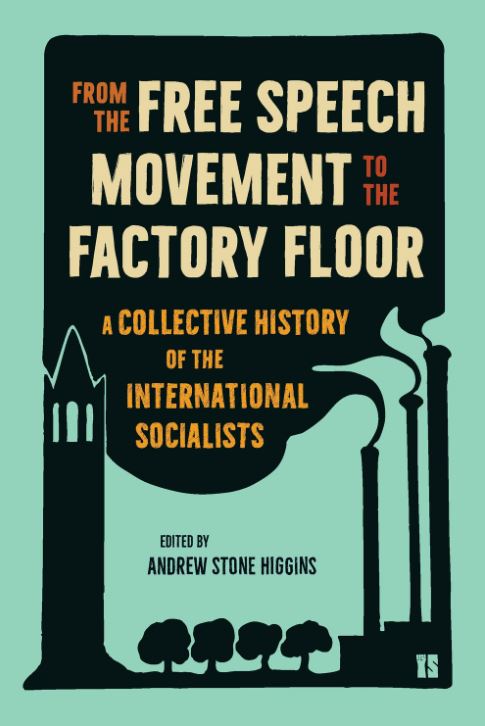
Andrew Stone Higgins, ed., From the Free Speech Movement to the Factory Floor: A Collective History of the International Socialists (Chicago: Haymarket Books, 2026)
Reviewed by David Camfield
Between the mid-1960s and the early 1970s, a new revolutionary Left emerged in the USA. Thousands of young people, radicalised mainly by the Civil Rights and later Black Power movement and the movement against the US’s war in Vietnam came to the conclusion that revolution was necessary and possible. Most of these people looked to one version or another of Marxism-Leninism as the theory needed to guide the New Communist Movement they set out to build. They often saw China as the most important socialist society, a hopeful alternative to a USSR supposedly led since the death of Stalin by counterrevolutionary “revisionists”, although some in the NCM were less critical of the USSR, Cuba, and other “actually existing socialist” societies.[1] However, a sizeable minority of the new revolutionaries rejected the politics of Stalin and Mao in favour of anti-Stalinist Marxism. This most commonly took the form of some kind of Trotskyist orthodoxy. There was also a very small but dynamic heterodox offshoot that had an impact larger than its numbers would have led anyone to expect, and it is that that is the subject of From the Free Speech to the Factory Floor. While its subtitle presents it as a “collective history”, this book of over 400 pages in length is a collection of memoirs preceded by a 23-page introduction by editor Andrew Stone Higgins.[2]
The supporters of this current initially identified as Independent Socialists, in continuity with the Independent Socialist League (ISL), the name taken in 1949 by what had previously been the Workers’ Party (formed in 1940). The ISL drifted rightwards under the pressure of the Cold War and dissolved in 1958, with most of its members joining the reformist Socialist Party (SP). In 1964, a few former ISL members, foremost among them Hal Draper, who had edited the ISL’s newspaper, like-minded members of the SP-affiliated Young People’s Socialist League (YPSL), and other Civil Rights movement organisers in Berkeley, California formed an Independent Socialist Club (ISC). The Berkeley ISC was committed to a socialism “both democratic and revolutionary, both humanist and working-class”, a “third choice for the world, as the alternative to both capitalism and Communism”.[3] Its members believed in the potential power of the working class to transform society and that a social revolution that would open the transition to socialism could only be accomplished by the self-emancipation of that class – the essence of what they soon came to call, using concepts presented in Draper’s 1966 pamphlet The Two Souls of Socialism, “socialism from below” politics, in contrast to the various forms of “socialism from above”.[4] The ISC did not pretend to be the nucleus of a future revolutionary socialist workers’ party. It saw the USSR and similar societies run by Communist parties as non-capitalist class societies (bureaucratic collectivism).
As Higgins puts it, this group that started with two dozen members was “born and baptized in the fires of the Free Speech Movement, the first major on-campus movement of the 1960s” (p. 11). Within that successful coalition at the Berkeley campus of the University of California, the ISC was arguably “the most important single political tendency” (p. 411) thanks to its constructive, non-sectarian efforts to build the broad movement in a way that was informed by an effective strategy that flowed from its particular socialist outlook. From that point on, “[t]he ISC’s combination of militant action, rigorous study, and political clarity bolstered their reputation on campus and beyond” (p. 12). It began to attract more members in and around Berkeley, while its example encouraged a sprinkling of like-minded socialists, some of them former members of the left wing of the deeply factionalised YPSL, to create similar clubs in their locales. In 1967, these would come together in a federation, the Independent Socialist Clubs of America (ISCA). That same year saw ISC members in California and New York State make herculean efforts to get the Peace and Freedom Party (PFP), whose key demands were US withdrawal from Vietnam and support for Black liberation, on the ballot. In large part due to ISC leaders within it, the PFP was able to create an alliance with the Black Panther Party. Although ISC membership was overwhelmingly white, from its inception, members were strongly committed to the struggle against racism and influenced by the Civil Rights movement. They soon came to support Black self-organisation and Black Power (pp. 112-13). In the view of one contributor to this collection, Joel Geier, “We were as much a product of the civil rights movement as of Trotskyism. … The Black liberation movement lifted us up, liberated us from sectarianism, and facilitated our leap to the New Left” (p. 155). At the same time, ISCers were adopting “a more explicit focus on the American working class – in all its diversity – and, by extension, the labor movement” (p. 17), with a perspective that identified, celebrated, and hoped to contribute to the rising level of workers’ self-organisation visible in wildcat strikes, militant rank-and-file caucuses in unions, and other initiatives. In contrast to much of the NCM, they quickly became supporters of women’s and gay liberation, though not without difficulties (pp. 103-4; pp. 304-6).
In 1969, the ISCA, growing in part from people leaving Students for a Democratic Society (SDS) as this premier organisation of the student radicalisation was torn apart by fights between rival ML tendencies, refounded as the International Socialists (IS), a name chosen in part because it was also the name of the socialism-from-below group in Britain with which the ISCA had developed links. The following year, the IS established its centre in Detroit (previously its national office had been in New York City, while its publication had been based in Berkeley). How the group was starting to change and why members decided that it should change is not discussed in Higgins’s introduction, though aspects of the shift can be gleaned from a number of chapters. “It was a sharp turn for the ISCA, which most people didn’t appreciate at the time and a lot of people still don’t appreciate” (p. 127) argues Robert “Gabe” Gabrielsky. The upheavals of 1968, above all in Vietnam, France and Czechoslovakia, provided the impetus. Many young radicals including ISCA members felt that now “Revolution was no longer confined to distant history or abstract propaganda, it was an actuality, on the world agenda, embraced by millions, possible in our lifetime” (p. 162). The IS, as Thomas Harrison recalls,
began to remodel itself on what it considered Leninist lines – a centralized revolutionary organization rather than a federation of clubs, aspiring to a working-class rather than a primarily student base. “Discipline” was introduced, meaning that after a position was debated and adopted by a vote, members were forbidden to publicly organize against it. Comrades were urged to pull up stakes, move to the Midwest, and get jobs in auto factories, telephone, trucking, steel, and the Post Office. (p. 46.)
The IS was starting to “regear” itself from activity on and around university campuses to workplace activity.[5] Between late 1970 and 1973, political disagreements arising from how the group was changing led to the departure of some former SDSers, the resignation of Draper and a handful of his closest cothinkers (Reorient), the expulsion of a small grouping, the Third Camp Tendency (TCT), including leading Berkeley member Joanne Landy, and the expulsion of a large minority, the Revolutionary Tendency (RT), that had come to support a sectarian version of Trotskyist orthodoxy.
The IS was distinguished from other far-left groups by its socialism from below politics and its view that, as David Finkel writes, “building rank-and-file movements and working-class revolutionary socialist organization were equally important tasks, interrelated, but neither one subordinated to the other” (p. 182). Although “industrialisation” – getting a unionised job in one of the sectors designated as “priorities” – was not mandatory for members, there was strong pressure to industrialise. Through the 1970s, many IS members devoted a tremendous amount of energy to workplace organising and trying to turn the group into a “workers’ combat organisation”, with six contributors to From the Free Speech Movement to the Factory Floor describing and reflecting on their experiences. ISers either joined existing caucuses of union militants or helped create new ones, which they always treated as independent democratic workers’ groups, not IS-controlled “fronts”. Unexpectedly, they had their greatest success as freight truck drivers and at UPS, where they were part of the International Brotherhood of Teamsters. IS members were leaders in forming what became Teamsters for a Democratic Union.[6] While IS unionists were able to recruit some coworkers to the IS, few stayed long. Higgins observes that “the IS culture of deep reading, broad discussions, fierce debates, and long, numerous meetings was a hard sell to prospective members with long working hours, pressing familial obligations, and a limited amount of free time” (p. 21). With hindsight, Finkel comments that union militants who joined the IS “realized sooner than many of us that the mass working-class radicalization [which IS members believed was underway – DC] wasn’t happening. Most quietly drifted away” (p. 184).
Apart from workplace organising and activity in unions, the IS had a noteworthy success with its youth group, Red Tide. The IS had attracted two groups of socialist high school students in California, one of which was publishing a newspaper, Red Tide. This became the name of the IS’s formally separate youth organisation, which presented itself as a “badass political gang” (p. 334). In 1975-6, core Red Tide members moved to Detroit. There, Red Tide initiated a campaign to free Gary Tyler, a Black teenager sentenced to death. This agitational effort turned Red Tide into a larger, majority-Black group some of whose members were also in the IS. The closing six chapters of the book are by former members of Red Tide.
In late 1976, a minority of IS members announced the formation of a Left Faction (LF). This faction, aligned with the group in Britain that had just changed its name from the IS to the Socialist Workers’ Party, was expelled in early 1977 and formed the International Socialist Organization, significantly weakening the IS.[7] The following year, the IS lowered its ambitions, relaxed its expectations of discipline, and replaced its newspaper with a less-frequent magazine. In 1979, the IS was further depleted by the resignation of another group critical of the majority’s approach, the Rank and File Caucus (RFC), which formed Workers’ Power. That year, IS members launched Labor Notes as a “project… resolutely and intentionally independent, editorially, organizationally, and financially”, of the IS (p. 188). The group’s reduced membership soldiered on in the hostile political climate of the Reagan era until the 1986 merger with a group of Fourth International supporters called Socialist Unity, Workers’ Power, and other socialists that created Solidarity.[8]
Although From the Free Speech Movement to the Factory Floor does not clearly present all of the basic history of the group that I have summarised here, a careful reader interested in the history of the socialist Left in the US can put together the pieces from its contents. The memories of former members evocatively convey personal experiences from the heady years between the mid-1960s and the mid-1970s when strikes surged, protests filled the streets, and riots shook the country – conditions in which hundreds of thousands of people radicalised and thousands came to consider themselves revolutionary socialists. As contributors look back half a century, they give readers a vivid sense of those exciting times, including some of what it was like to be a socialist organiser at a time when the level of class and social struggle in the USA was much higher than it is today and supporters of socialism from below were so much more optimistic about their political prospects than socialists with at least a reasonably accurate understanding of the current period can be today. Stories of university and high-school student activism, working with leaders of the Black Panthers, and organising as a socialist steelworker, autoworker, or truck driver will likely stay with readers. The inclusion of contributions by people who supported the TCT, the LF, and the RFC as well as supporters of the majorities that disagreed with each of these political minorities enriches the book by reflecting a diversity of IS perspectives (a contribution by a supporter of the RT would have furthered this[9]).
Yet, in spite of its subtitle’s promise of a “collective history”, this collection is mainly an assortment of individual memoirs along with some reflections (both critical and self-vindicating) on an organisation. The editor’s introduction does not signal the limits of memoir for the historical understanding of socialist organisations. As Alan Wald has written, this genre raises the issue of what he calls “the politics of memory”:
Individuals sometimes perceive or remember facets of their lives inaccurately for psychological or emotional reasons beyond their conscious control. … sometimes the past is remembered selectively, in accord with the needs of the ideological outlook one has at a given moment or had at some significant moment in the past. The contemporary cultural historian must try to recreate a whole through the use of all available evidence – documents, publications, and correspondence – as well as a wide range of personal interviews, and not be misled by an affinity or dislike for one or another political person.[10]
Not registering this does a disservice to readers who do not fully appreciate the limitations of memoir. It is not that participants’ recollections of decades ago are always unreliable, but anyone who is keen to understand the history of a political organisation needs to treat these with considerable caution. Because memoir is self-fashioned, it lacks even the element of structuring by someone else’s well-informed and thoughtful questioning that oral history interviews can introduce.
Higgins’s introduction is also wanting in a number of other significant ways. It provides a much fuller overview of the ISC and ISCA years than it does of the IS from 1969 to 1977 and it is silent on the IS from the late 1970s until its end in 1986. It does not identify how the organisation began to change as it renamed itself the IS or describe some developments in the IS between 1973 and 1978 that are crucial for understanding how the organisation fared in those pivotal years of its history. Industrialisation, which Higgins mentions and which became “de facto policy”[11] by 1973, is only one piece of the puzzle. Missing from the introduction, though not from Michael Letwin’s chapter (p. 334), is mention of how the leadership responded to the recession of 1974-75 as a historic opportunity for building a revolutionary party and so, as Milton Fisk has written, “the IS responded to the recession with a frenzied mobilization of its forces”.[12] This was accompanied with a “Bolshevisation” of the organisation that weakened internal democracy.[13] Finkel’s contribution touches on this, singling out the IS’s then National Secretary, Glenn Wolfe, for responsibility (p. 186). However, nowhere in the book is there reflection on why Wolfe’s egregious practices were accepted by most of the leadership and many members for a couple of years.[14] Also missing from the introduction is a description of how from 1978 on the IS re-evaluated what was happening in the world, acknowledged that it had failed to build a Leninist workers’ combat organisation and that a “heavy dose of voluntarism” [15] had gone along with the effort to do so, and drastically shifted its conception of members’ tasks. The split that created Workers’ Power also goes unmentioned.[16] Nor does the introduction attempt to offer even the briefest multifaceted description of the changing political culture of the ISCA/IS, something that would have been helpful for readers. Less important, there are several claims of questionable accuracy in the introduction as well as minor factual errors in a number of chapters.[17]
Higgins suggests that the ISC made “[t]wo key mistakes”: not building beyond Berkeley at the start and not entering SDS (p. 21).[18] From my perspective, what stands out as the most important mistake was the adoption by the IS – like a number of previously looser socialist organisations at the time, including the British IS[19] – of a “Leninist” micro-party form of organisation in the wake of 1968. If I may be permitted an imperfect metaphor, this introduced genes into the organism that both facilitated its growth and development and began to produce mutations that later, in response to environmental changes, became increasingly damaging to its health. Reorient sensed that this organisational form was deeply flawed. The TCT warned of “voluntarism” and what they saw as the premature adoption of “national discipline” by an inexperienced and politically unclear IS, while not “disput[ing] the need for a cadre organization or a vanguard party”.[20] That said, I do not think that anyone in the IS presented a coherent better alternative to the micro-party model (organising the IS as a “Leninist organisation”). [21] This model was adopted because most members were persuaded that it responded to the need they correctly recognised for a way of organising that was more capable of enabling them to participate effectively in workers’ struggles and build the forces of socialism from below than the loose federative model of the ISCA. With the benefit of hindsight, the adoption of the micro-party model can be seen as a mistake that socialists today should not repeat, one that ultimately did more harm than good for a group of socialists who were right about so much that mattered, some of whose extraordinary efforts and genuine accomplishments are recounted in this book.
[1] The best introduction to the NCM remains Max Elbaum, Revolution in the Air: Sixties Radicals Turn to Lenin, Mao and Che (New York: Verso, 2002). There is a useful collection of reviews of the book at revolutionintheair.org
[2] Thanks to a former member of the IS for comments on a draft of this review.
[3] Hal Draper, Independent Socialism: A Perspective for the Left (Berkeley: Independent Socialist Committee, 1964), back cover. In New York, Draper’s comrades from the WP/ISL Julius and Phyllis Jacobson had in 1961 launched the journal New Politics as a forum to present their politics in dialogue with other viewpoints. See my “Reading Third Camp Socialism in the Time of Trump and Xi, Spectre (January 16, 2026), doi.org/10.63478/4FDCOUKS
[4] Hal Draper, The Two Souls of Socialism (Berkeley: Independent Socialist Committee, 1966), https://www.marxists.org/archive/draper/1966/twosouls/The%20Two%20Souls%20of%20Socialism.pdf
[5] Joel Geier, “Perspectives and Tasks of the International Socialists”, International Socialists Bulletin 5 (1 February 1971), 2, https://www.marxists.org/history/etol/document/is-us/IS-documents/70-72/71-02-01.pdf
[6] See the discussion in Dan La Botz, “The Tumultuous Teamsters of the 1970s”, in Aaron Brenner, Robert Brenner and Cal Winslow, eds., Rebel Rank and File: Labor Militancy and Revolt from Below During the Long 1970s (New York: Verso, 2010), pp. 199-226.
[7] The history of how the LF was formed and what role the IS/SWP Central Committee played is murky and disputed. My reading of the evidence and correspondence with David McNally (email to author, 14 July 2026), who, in 1976, conversed with Barbara and Cal Winslow before they formed the LF, leads me to think that there are inaccuracies and significant omissions in the chapters of the book that touch on the issue.
[8] Today, former IS members who still consider themselves revolutionary socialists can be found in Solidarity along with a few in the Tempest Collective.
[9] This observation should not be interpreted as indicating any sympathy for the Revolutionary Tendency on my part. However, the fact that its orthodox Trotskyism attracted one-third of the membership at the time is significant for a historical understanding of the IS in the early 1970s.
[10] Alan Wald, The New York Intellectuals: The Rise and Decline of the Anti-Stalinist Left from the 1930s to the 1980s (Chapel Hill: University of North Carolina Press, 1987), pp. 13-14, 15.
[11] Milton Fisk, Socialism from Below in the United States: The Origins of the International Socialist Organization (Cleveland: Hera Press, 1977), 53. The nearly half of this 78-page pamphlet that deals with the ISC and IS remains the most substantial historical treatment of them. While useful, it must be born in mind that this pamphlet was a product of the LF’s split from the IS and its interpretation reflects this. The material archived at “Documents of the International Socialists (1969-1986),” https://www.marxists.org/history/etol/document/is-us/IS-documents/index.htm is also valuable.
[12] Fisk, Socialism from Below, p. 63. The leadership publicly presented the group and its task in this way: “The massive burden of construction a revolutionary party will fall on IS… still small and pathetically weak” but “the only possible candidate for building a revolutionary party.” Basic Education Program (Detroit: International Socialists, 1975), p. 23, https://www.marxists.org/history/etol/document/is-us/IS-documents/74-75/75.pdf.
[13] For the leadership’s thinking as argued to members, see “The IS, Revolutionary Party and Democratic Centralism” (n.d. [1975]), https://www.marxists.org/history/etol/document/is-us/IS-documents/74-75/75-(14).pdf. One of a number of responses was SF, “On Democratic Centralism”, International Socialists Convention Bulletin, 2 (18 June 1975), https://www.marxists.org/history/etol/document/is-us/IS-documents/74-75/75-06-18.pdf.
[14] In the view of one participant, “Wolfe was only the tip of the iceberg representing a desperate leadership that built the fantasy of a coming radicalization of the working class to toughen up the organization.” (Former IS member, email to author, 29 June 2026.)
[15] E.C. [Executive Committee], “A Way Forward” (n.d. [1979]), 1, https://www.marxists.org/history/etol/document/is-us/IS-documents/78-84/79-%281%29.pdf.
[16] See Rank and File Caucus of the International Socialists, “Why We Leave the International Socialists” (June 1979), https://www.marxists.org/history/etol/document/is-us/IS-documents/78-84/79-06.pdf.
[17] Higgins states that “the IS never grew beyond five hundred members” (p. 22). This seems too high, which is only further tribute to what IS members accomplished. Fisk states that the IS had “280-300” members at the close of 1976 (Socialism from Below, p. 72), and I do not recall seeing figures of more than 300 while sampling IS internal documents. At the high point, it had as many as a dozen members on staff (David Finkel, email to author, 23 June 2026). Higgins writes that Draper and his cothinkers resigned because they disagreed with industrialisation and over “concerns that the recent period of radicalization had peaked” (p. 19). This is not supported by the contents of the three bulletins issued by their Reorient group (in my possession) or by the recollections of knowledgeable former IS members with which I am familiar. Higgins also writes that veteran socialist union militant Stan Weir “remained an important member and mentor to industrializing comrades” after Draper and the Reorient group resigned, but by 1973 or 1974 Weir was no longer an IS member (David Finkel, email to author, 10 July 2026). Factual errors in contributors’ pieces that escaped editorial correction include the misdating by La Botz of the split that created Workers’ Power (p. 210), and there is a very confusing use of “should” instead of “would” in the presentation of how the RT saw the politics of the rest of the IS as supposedly not revolutionary (p. 63).
[18] I am not convinced that the original ISC could have done more than it did to build beyond Berkeley in its earliest years.
[19] See Jim Higgins, More Years for the Locust: The Origins of the SWP (London: IS Group, 1997), https://www.marxists.org/archive/higgins/1997/locust/index.htm.
[20] Lois Weiner, “Statement of the Third Camp Tendency” (n.d. [1971 or 1972]). Thanks to Thomas Harrison and Lois Weiner with providing me with a scan of this document.
[21] For a brief 21st century critique, see David Camfield et al., “A Letter from Canadian Comrades,” SocialistWorker.org, 21 March 2019, https://socialistworker.org/2019/03/21/a-letter-from-canadian-comrades.