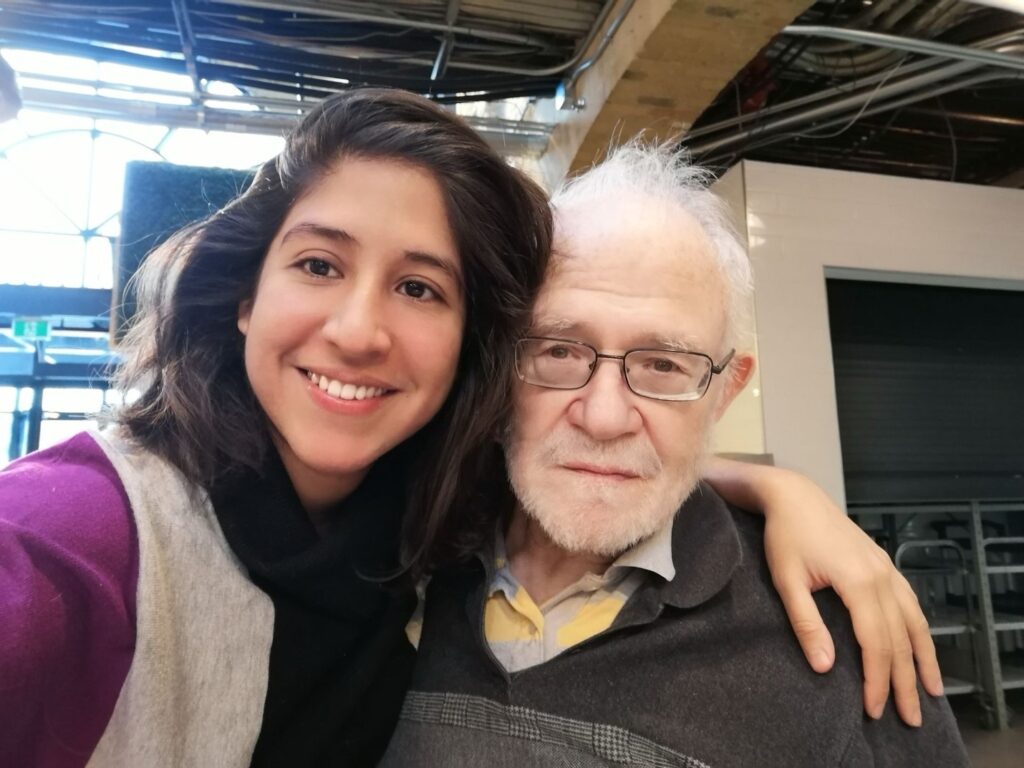
Henry Heller has passed away. A Marxist historian of early modern France and Europe with wide-ranging interests in global history, political economy, the history of ideas and revolutionary struggles, Heller published ten books with a variety of prestigious university presses as well as with small and larger leftist imprints. His passing will be felt by local activist and scholarly communities, and by an international general and scholarly readership. His friends, I among them, are left with a hollow feeling, bereft over the loss, and this miserable moment in world history has another measure of misery to carry.
The facts of a life do little to give a sense of its texture, but they do help to give that texture some context. Henry was born in New York City and educated in history at U Michigan and Cornell U. He came to the University of Manitoba in Winnipeg in 1963 as lecturer, rising to the ranks of Professor by 1979 and not retiring until 2025: in his mid-eighties! He loved his work – in spite of the decay in the quality of the University as socially congenial places that he experienced over his lifetime – and was an engaged and beloved teacher and a rigorous scholar. He became a fixture of the local left academic/activist ‘scene’ while fixing his eyes and critical acumen on broader issues and debates circulating globally within Marxist thought.
I first met him in the late 1970s as an undergraduate student looking for critical theory on the shelves of a book co-op Henry volunteered for: Liberation Books. This was among the many different social justice initiatives, groups and parties Henry helped sponsor or create through a life engaged with social change on the local and global scales. I remember a relaxed conversation with him – this was 1978 or 79 – over the counter as he was curious about why I was curious enough to buy Jean-Paul Sartre’s Critique of Dialectical Reason. Only later did I discover that he was a professor and that I should have been more respectful or even intimidated: but he never wanted to make anyone feel that way and carried himself with a charming balance of self-assurance and modesty, with a genuine interest in the people of many different class and cultural origins he encountered.
Henry was a gregarious person: the ever-present twinkle in his eyes helped soften both his imposing presence (he was a large man) and his equally imposing intellect. He had a true lust for life and was equally alive to the beauty of the northern Canadian bush, the old-world charms of France and Italy, and the beaches and people of Cuba, where he preferred to holiday. His love of and interest in people was a key stratum of his emotional structure: the layers of affect and intellect that grounded his outgoing personality.
Over his decades in Winnipeg, he married, then divorced; had a second marriage and looked after Joanne when dementia stole her from him; eventually marrying Laura Soriano as his third partner (she was with him when he passed). He had four children, all of whom are now adults.
Among his scholarly contributions, The Bourgeois Revolution in France (2006) insisted on the view of that historic event as a bourgeois-led struggle, as Marx had argued, rather than a working- or peasant-class revolution. The Birth of Capitalism (2011) was Henry’s attempt to intervene in the so called ‘transition’ or Brenner debate, arguing that capitalism developed over three centuries, “the class struggle and changes in the relations of production were historically decisive in their emergence and evolution; that home and world markets developed simultaneously; and that the territorial state was and is an integral component of capitalism”. In 2016, he published The Capitalist University, a study of how the postwar ‘corporate university’ that emerged in the post War US was deeply radicalised in the 1960s but ultimately gave way to a neoliberalism that eschewed historical analysis and took higher education through a reactionary turn.
When I came back to Manitoba in 2000 as incoming Chair of the Indigenous Studies Department, I became reacquainted with Henry as an academic colleague on the Left and therefore an ally. We participated in a critical theory reading group and developed a strong friendship. We took to having weekly breakfast meetings so we see could each other without having to rely on some meeting or event that might draw us together. As activists, we started and worked on a small informal group that sought to free the then imprisoned Chilean Mapuche leader Francisca Linconao; Henry tended to devote time to working-class, anticapitalist and international solidarity issues, while my own focus was on providing support for northern Indigenous land defenders.
Eventually, to give us an excuse to see each other, we came up with a mutual project: another book! Another book! We could foist another book on the world. This led to our study Mode of Production: The Final Horizon of Practice and Theory (2025). Apart from whatever value the text may itself have; it gave me a chance to work closely with Henry over the course of about 18 months; to bring together my own political anthropology and critical theory leanings with Henry’s historical and political economy bent. We were both surprised, I think, over how much we actually agreed with each other and were able to bring our overlapping and disparate scholarship into a single, even somewhat coherent, text.
Henry had completed or largely completed two other manuscripts, which I hope will still appear. One is a critique of the concept of wage-slavery, the other a comparison of major leftist cultural producers in the twentieth century. He finished the latter about a year ago and had just completed the former before he went on what would be his last holiday.
Among Henry’s favourite places was Cuba. He admired the spirit of the Cuban people as much as the fine quality of the beaches (and the rum!) and always felt like his tourist dollars could be best spent supporting their economy. He and Laura left for Cuba in the new year. I hadn’t been able to have our usual breakfast over the winter holiday because I was tied up with children and work. When I texted about having a breakfast just after the break, he let me know he was in Cuba and we’d do so upon his return. It was not to be. A stomach ailment resulted in him being hospitalised and, while there, his heart gave out.
Our cause, the cause of creating a world of social and economic justice where each person is respected, has dignity and has material well-being, where there are no massive hierarchies of gender or race, culture or class, where war, greed, poverty, pollution, extreme wealth of a very few and extreme poverty of the vast majority are no longer the defining features of our or any time to come; our cause has lost one of its great intellectual warriors: an elderly white male professor of extraordinary intellectual ability and capacious compassion. A bleak world has grown even bleaker.