Hans-Georg Backhaus, together with Helmut Reichelt, is regarded as a pioneer and founding figure of the so-called New Reading of Marx (Neue Marx-Lektüre), to which today a wide range of quite different interpreters of Marx are sometimes assigned. What was new at the time, in the mid-1960s, was their ‘logical-categorial’, also called ‘form-analytical’, interpretation of Marx’s analysis of the value-form, set against historicising and sociologically reductive interpretations of the opening of Capital.
Such a logical-categorial reading had precursors both in classical and ‘Western’ Marxism as well as in critical theory. But only Backhaus drew from it the radical consequence that can be described as a Copernican turn in Marx-inspired critiques of value and money: the critique of pre-monetary theories of value, that is, theories that attempt to derive value either from labour or from commodity exchange and thereby construct a positive value theory. For Backhaus, money is logically prior: no value without money.
This had far-reaching theoretical and political implications. The most important was that Backhaus took the subtitle of Capital consistently seriously: Marx’s project is a critique of political economy, not a better political economy. Marx was not simply a better Ricardo whose theory could serve as the basis for a socialist economics. Rather, he intended a critique of the totality of capitalism and of its political economy, a critique through which the dimensions of its abolition can first become comprehensible. The three volumes of Capital were the beginning of this unfinished work.
Hans-Georg Backhaus formulated the foundations for such an understanding of Capital as a critique and developed them through the inner connection between money and value. He repeatedly elaborated his central insight, the necessity of a unity of the critique of money and the critique of value, in a series of essays. However, he never wrote a standalone book, nor did he develop the consequences and implications of his approach across all three volumes of Capital. Some of his essays were translated into various languages; today, Backhaus is known not only in Europe and the Anglophone world but also, for example, in China, Japan, and South Korea. His most important texts were published in 1997 in a volume of collected texts entitled Dialectic of the Value-Form (Dialektik der Wertform), which also contains the “Materials for the Reconstruction of Marx’s Theory of Value I–IV”, written in the 1970s.
The titles of the book and the materials accurately capture the question that occupied Backhaus throughout his life. Tirelessly, he demonstrated to bourgeois economists that they fail to understand their own central object, money and value, but that this inability derives from the ‘monstrosity’ of the economic object itself. He directed this criticism of the concept of money and value not only at bourgeois economics but also at its historical antagonist, classical Marxism. And, although he always considered himself a student of Adorno, he regarded the critical-theory interpretation of Marx’s critique of political economy as truncated as well. Finally, he also identified ‘ambivalences’ in Marx himself, in the concepts of value and money and in the method of their presentation. Yet these ambivalences lie in the object itself and thus point to a problem, perhaps even a limit, of economic science as such.
Hans-Georg Backhaus died on 8 March 2026 at the age of 96 in his adopted home of Frankfurt am Main, where he lived until the end, mentally sharp, equipped with a phenomenal memory, and surrounded by his chaotic library. Those who visited him were greeted, without many polite formalities, immediately with some new insight from whatever he had recently been reading. In recent years, these were often historical works. He studied the French Revolution, particularly its left-wing factions. He was also preoccupied with the history of National Socialism in Thuringia, in which he saw parallels to contemporary developments that alarmed him.
His interest in Thuringia also had personal roots. Born in 1929, he grew up there in the small town of Remda, near Rudolstadt, and experienced Thuringian fascism firsthand. After the war, he initially remained in Thuringia and, in the GDR, had the opportunity to obtain his Abitur through a kind of evening secondary school. Even though he moved to the West in the 1950s to study law in Heidelberg, he always gave the GDR credit for having made this possible at that time and, even after 1989, never joined in the dismissive attitudes toward the GDR that became common even on the Left.
In 1961, he moved to Frankfurt because, as he repeatedly recounted, he ‘finally wanted to find out what dialectics meant’. He first attended lectures by Max Horkheimer, as well as by Karl Heinz Haag, and, from 1962, by Theodor W. Adorno. Even earlier, he had contact with figures such as Heinz Brakemeier and Leo Kofler, who were developing an anti-Stalinist interpretation of Marx, and he attended Kofler’s weekend seminars. From that time onwards, he engaged with Marx’s theory of value and, by chance, found a copy of the first edition of Capital from 1867 in the estate of the resistance fighter Hermann Brill, with whom he was then working. Comparing the value-form analysis in MEW 23 with this first edition became the initial spark for Backhaus’s new reading of Marx, since, in the later version of Capital, the ‘transition’ from value to money as well as the methodological remarks are largely missing. His reception of the then little-noticed Grundrisse also played a role.
He presented his first results in a seminar paper in Adorno’s seminar, but, much to Backhaus’s disappointment, it failed to produce the hoped-for impact. Even though Backhaus attributed to Adorno more ‘brilliant intuitions’ regarding Marx and Capital than thorough knowledge, he nevertheless held Adorno in very high esteem until the end. Backhaus’s insights were subsequently taken up by Helmut Reichelt and Hans-Jürgen Krahl, though sometimes without adequately mentioning Backhaus. Diethard Behrens and Kornelia Hafner also developed Backhaus’s theses further, and, in the 1990s, a small group of students at Frankfurt University, and soon elsewhere, continued to elaborate the Marx reading developed by Backhaus and Behrens and published on it, including in doctoral dissertations.
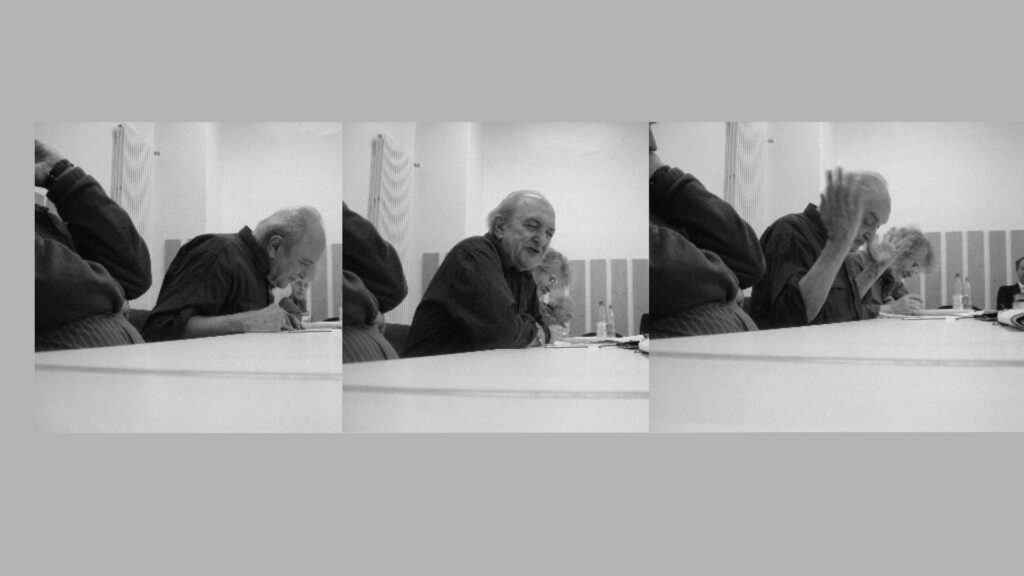
Beyond Frankfurt, these theses were discussed at the conferences of the Marx Society, founded in 1994 by Backhaus together with Diethard Behrens, Heinz Brakemeier, Hans-Joachim Blank, Michael Heinrich and others. Backhaus’s appearances in university seminars, as well as at the conferences of the Marx Society, were legendary. He was so passionate about his questions and theories that he could become wonderfully agitated, insulting his interlocutors, storming out of the room, abruptly ending events, only to return half an hour later and continue the discussion in a friendly tone.
He retained this temperament until the very end. His outrage at the stupidity and brazenness of contemporary politicians, but also of scholars, was refreshing. When he was in good form, merely mentioning names such as Saskia Esken or Jürgen Habermas could make him boil with anger. This fury stood in sharp contrast to his deep kindness toward his friends, toward the nursing staff, and toward all visitors who did not talk political nonsense. Despite all his criticism and contempt for capitalist society, Hans-Georg accepted his personal circumstances until his final years and never complained. On the contrary, he enjoyed eating game, was delighted by cake, and appreciated the soups prepared by his Polish caregiver. He laughed loudly and often, right up to the day of his death.
From him we did not only learn how to read Marx, but also how to keep one’s backbone when the wind blows from the opposite direction.
Originally published at: https://www.nd-aktuell.de/artikel/1198229.hans-georg-backhaus-verstehen-was-geld-ist.html