Nat Raha and Mijke van der Drift, Trans femme futures: Abolitionist ethics for transfeminist worlds. Pluto Press, 2024.
Sophie Lewis, Enemy Feminisms: TERFs, Policewomen, and Girlbosses against Liberation. Chicago: Haymarket Books, 2025.
Reviewed by Katharina Hunfeld
What does the consolidation of far-right power in mainstream politics demand of the Left? On the current terrain of struggle, how can feminism still be an insurgent force? Two recent books emphatically pose that it is especially now, in light of the steady erosion of political freedoms and unrelenting onslaught of capital’s violence, that we should be rethinking emancipatory strategies through comradely feminisms. In Enemy Feminism, Sophie Lewis examines anglophone, Western cisfeminisms to demonstrate that, while self-declared feminists are not all inherently on the right side of history, we should stick with the trouble of identifying and fighting enemies within our movements. In Trans Femme Futures, Nat Raha and Mijke van der Drift offer a transfeminist perspective on collective liberation by taking seriously generosity, care, complicity, abolition, love and the sensuous. These two new books are essential reading for co-conspirators wanting to take seriously the challenge of building an expansive, insurgent feminism outside of any attachment to the cisness of the bourgeoisie. Both meet the omnipresent appeal[1] to the need for new broad alliances in response to the global rise of the Far Right with resolutely antifascist sharpness. In what follows, I discuss how these books help us navigate important strategic questions: how should we manoeuvre the tension between necessary enmity and urgent coalitions? What are the limits of tolerable levels of dissonance? What does it mean to practice feminism on the side of liberation?
Enmity
Lewis’s intervention in the political present departs from emphasising the continued relevance of explicitly feminist contributions: “Feminism is necessarily central to any meaningful anti-fascism” (p. 19). Feminist praxis can, of course, take place outside of the halls of the broad church of ‘feminism’, she writes, plenty of their friends cannot find any use with the label.[2] However, enough of their enemies do: many Zionists, TERFs, SWERFs, or imperialists insist on framing their political motivations and interventions as decisively feminist. The book is concerned with the anatomy of such enemy feminisms: “I am curious what happens if we do consider the possibility that feminism can and did express itself fascistically” (p. 108). Lewis takes her readers on a turbulent ride, providing an insight into some of the reactionary forces within an uncomfortably large part of the canon of what we call feminism. Each chapter is dedicated to a specific counterrevolutionary archetype, such as the Anti-Antiracist Abolitionist, the Civiliser, the KKK Feminist, the Policewoman or the Girlboss. We encounter the 12 enemy feminisms through a range of individuals and groups who are perfectly comfortable holding the ostensible tension between identifying as feminists while simultaneously being committed nationalists, racists, slave owners, whorephobes, Klanswomen, pro-lifers, eugenicists, landlords, fascists, colonisers. Lewis revisits some fascinating figures: Mary Wollstonecraft, the “deeply frustrating ur-comrade” (p. 21) responsible for coining the slave/lady equivalence and operationalising it in defence of the British Empire. The American suffragist May French-Sheldon, who travelled through East Africa to dabble feministly in imperialism before getting paid to downplay the genocide in the Belgian Congo. The “neo-eugenicist luminary” Ayaan Hirsi Ali, known for her brand of feminist Islamophobia that happily beats “the war drum for Pentagon-led invasions and praising the sacred republic of the US for its culture of enlightenment, goodwill, and freedom” (p. 202). Or Andrea Dworkin, the pornophobe making alliance with the anti-feminist far-right (Lewis writes about her unrepentant Zionism elsewhere[3]). The evidence presented points to the fact that these feminists have not only accidentally or circumstantially colluded, but often deliberately and enthusiastically supported empire, fascism, carcerality, and white supremacy.
One key argument of the book posits that we should refuse to dismiss those anti-liberatory feminisms as ‘not real feminism’. Antifascist feminism requires accepting that there might be no true, innocent, or pure feminist position; the feminist terrain has been, and probably always will be, intensely contested. Lewis argues that we should take these enemies seriously when they position their thoughts and actions within feminism, as not doing so would relegate feminists to the indefensible position of violent ignorance. After all, “Middle- and upper-class ladies (especially) participated feministly in racial domination on a planetary scale” (p. 5). Getting to the bottom of how their oppressive-but-feminist ideologies functions is important precisely because “only by facing these truths can feminism become accountable to itself, mutate and split accordingly, and thrive” (p. 5). Pruning away the baddies won’t make them go away. For example, if we simply rebrand TERFs (Trans Exclusive Radical Feminists) as FARTs (Feminism-Appropriating Radical Transphobes), transphobia and transmisogyny will not have magically vanished. What antifascists cannot afford, especially not in the current political conjuncture, is to be defencelessly stunned when we find that some of the people fighting us are feminists. What drives the book is not primarily an existential tussle with the question of what a dedication to feminism means in light of the overwhelming evidence that so many claiming the label have been pretty awful humans and anti-emancipatory political actors. Instead, the argument works in defence of curating more explicit enmity between feminists for the purpose of asking: what is it that makes the monstrous facets of feminism so seductive, and how must our praxis change in response?
Lewis’s book has a clear strategic purpose: the act of clarifying fascist themes within our movements enables the refinement of liberatory, necessarily combative toolkits. The enemy frame foregrounds the insight that struggles within our movements are an essential part of the project of working towards the “extraordinary coalition” necessary for “denaturalizing capitalist gender, building monstrous affinities, and seeking ways to communize care” (p. 269). Only by taking seriously that feminists have participated in anti-liberatory endeavours can we more clearly see what a comradely feminism requires: “The courage to draw lines and fight people if necessary” (p. 9). By bringing into view a contested history of anglophone organised resistance against gender oppression, she demonstrates that explicit enmity—that is, fierce struggles over feminism’s purpose and remit—has always been there. In this sense, the enemy frame is not new, but their book spells out the merits of thoroughly rejecting bourgeois regimes of respectability and finding clear purpose in fractures within feminist collectives. Enmity requires the end of grace in coalitions founded on irreconcilable differences – differences with sharp contours that need to be made crystal clear. Enmity is demanding: it involves resisting any dismissive or pearl-clutching impulses so that we can take our adversaries seriously enough to struggle against.
Within our activist groups or in the classroom, an interest in the role of feminist enmity can start with a conversation around our ‘common sense’: do we share the same understanding of the edges of the label under which we come together? When teaching feminist theory to third year undergraduates in Scotland, I am each year quietly shocked anew to find that what most students associate with feminism, and what brings them to my class, is an infatuation with Sheryl Sandberg’s ‘She-E-O’ Girlboss feminism. The first few weeks of the module are spent collectively exploring some of the key tensions and fights within feminist movements. By the time we read Marxist-feminist interventions, many of my students are swept away by finally having vocabulary like ‘social reproduction’, ‘capitalist exploitation’ and ‘alienation’ for making sense of their rage, expressing that they too are aghast at their previous lack of critical interpretive horizon.[4] Still, we struggle together in taking a closer look at some feminist icons most hold dear: Adrienne Rich’s Zionism, Silvia Federici’s TERF-turn, or bell hook’s landlordism are tough contradictions to hold in a pedagogically fruitful way. Here, Lewis’s intervention meets the challenge with a refreshingly sincere rejection of cynicism. This, too, I admire in them. Comradely disappointment can have a generative effect, as it orients us towards our most essential commitments. We may understand enmity as a gesture of love towards the feminist movement: it strengthens our ability to act appropriately, to succeed in “turning feminism and anti-fascism into synonyms, via struggle, contingently” (p. 124).
Heartbreak
For the many of us united in heartbreak over the relentless Nakba still ongoing, it seems that finding community is the only way to face the unbearable. It is the overwhelming sensibility towards all that is so broken in our world that brings us together in collectives, unions, activist circles and reading groups. “Heartbreak is at the heart of all revolutionary consciousness”, argues Gargi Bhattacharyya, and it “requires a redirection towards the collective”.[5] Their reflections on revolutionary brokenheartedness remind us that grief is a deeply political phenomenon: it unites as much as it divides. Writing about the currency of grief and the question of who is allowed to mourn what loss in the wake of October 7th, Mohammed El-Kurd points out the normalisation of a particular kind of dehumanisation of Palestinian life: “We die in a lot of abandonment. Our massacres are only interrupted by commercial breaks. Judges legalise them. Correspondents kill us with passive voice. If we are lucky, diplomats say that our death concerns them, but they never mention the culprit, let alone condemn the culprit.”[6] The unbearable quotidianness of death in this live-streamed genocide is the terror shaping our nightmares and direct actions alike. As Isabella Hammad notes, “To remain human at this juncture is to remain in agony”.[7]
This moment also takes the shape of betrayal from figures we had reason to believe were fighting alongside us. Take, for instance, the monumental failure of a large part of the German climate movement to come to terms with their complicity in irredeemable genocide apologia. We know that not all feminisms are inherently liberatory; so, of course, are environmentalisms. The recent rift in the international climate activist group Fridays for Future (FfF) is a case in point: In the wake of 7 October 2023, the German chapter of FfF rushed to distance itself from figurehead Greta Thunberg’s expression of solidarity with the Palestinian people. While Greta, initiator of the “Skolstrejk för klimatet” (School Strike for the Climate), chanted “No climate justice on occupied land!”, Luisa Neubauer, a charismatic key organizer of FfF Germany, declared a separation from the statements made by FfF’s international channels due to “misinformation, hate and antisemitism”.
Neubauer’s public appearance is a case study that painfully evidences how Palestine is the litmus test[8] of our time. A week after Hamas’s Al-Aqsa Flood attack, Neubauer represented Friday for Future Germany at an Israel solidarity rally at the Brandenburger Tor, making new lines of enmity explicit. Amongst a sea of Israel flags, she begins her speech with a confession: after the climate conference in Egypt 2022, she privately visited Israel for the first time, to see “the country whom we owe so much”. She shares how, visiting the World Holocaust Remembrance Center Yad Vashem, she thought about the 1.5 million murdered children, and reflects cryptically on “what may have forgotten, before we have properly commemorated”. Speaking about her heartbreak over Hamas’ recent attacks on Israel, she foregrounds her personal guilt and Germany’s non-negotiable, eternal historical responsibility. Hers it not simply a reiteration of German Staatsraison as political calculation, but the expression of an explicitly activist morality. The speech ends on her appeal to the crowd to “open their hearts” to all of those “suffering under the terror of Hamas”, also “the civil society in Gaza” – the Palestinian people, their rights and annihilation receive no mention. After her, Ron Prosor, Israel’s ambassador to Germany, spoke about the urgent need to annihilate the “infrastructure of terror” in Gaza: this time, he emphasised, “we need to go to the end” (“Diesmal müssen wir bis zum Ende gehen”).[9] For most of the genocidal onslaught that we have been livestreaming since that October, German and Austrian FfF groups have remained largely unfazed by Israels’ indiscriminate killing. While Greta Thunberg joined the Freedom Flotilla, Luisa Neubauer toured her new book with the title: What If We Were Courageous?.
Recently, the tides seem to have been shifting slightly. We can, for instance, observe how the day on which ‘Everyone Will Have Always Been Against This’[10] has suddenly arrived for some. Neubauer, who regularly brings up patriarchy and fossil fascism as two of the only clearly labelled systems of oppression, has however still not explained why her commitment to fighting antisemitism stands in the way of acknowledging the violence of colonial occupation. In light of this deliberate omission of solidarity, what hope can there be for broad climate coalitions? What is environmental activism that refuses to address the blatant dehumanisation of the Palestinian people at the hand of a genocidal settler state? As trade-union leader and conservationist Chico Mendes, whose enmity cost him his life, said: “Environmentalism without class struggle is just gardening”. I fear it may be worse than that. If our ecological struggle is incapable of seriously grappling with the fact of settler colonialism or crude capital, it may culminate in climate barbarism: “divisions of humanity into anti-egalitarian, xenophobic, class-differentiated zones of competitive survival”.[11] Comrade Greta knows how to draw the line: “If you – in everything that is currently going on in terms of escalating imperialism, genocides, climate- and ecological-collapse, complete erosion of democracy and human rights – have a platform, but everyday continue to actively choose not to use it and take a stance, then you will not be forgiven.”[12]
Heidi Reichinnek, the co-leader of the German left-wing party Die Linke, is another complicated figure many on the Left seem to be enamoured with. Germany’s “anti-fascist rising star” went viral for her enraged response to Christian Democratic Union leader Friedrich Merz’s breaking of a historical taboo by collaborating with the far-right Alternative für Deutschland (AfD) to effectively shut down Germany’s borders and make it easier to deport asylum seekers. Her speech, celebrated all over TikTok for weeks, climaxed with the statement that “I could never have imagined that a Christian Democratic party – a Christian Democratic party! – would break ranks and make pacts with the far right”. This ahistorical lack of imagination aside, Reichinnek’s outrage ignores the fact that it is common for mainstream political parties to outflank the AfD in right-wing populism. Nonetheless, the subsequent “Heidi hype” is credited with having significantly revived the Die Linke party from its historically low pre-election polling of 4% to nearly 9% of the vote in the February 2025 elections (in which the AfD became the second strongest force, with 20.8%). Depicted as one of the last intact firewalls against a resurgent fascism, Reichinnek’s best-known political positions are support for economic redistribution in the form of inheritance tax reform, the nationalisation of housing, rent controls and doubling unemployment benefits. As a self-described socialist and feminist, she is also resolutely pro-trans, supports easier access to gender-affirming care, and advocates for the decriminalisation of abortion and sex work.
And yet, she is not a comrade we can trust to justly diagnose the material distribution of death and grief. In her only speech on a topic which she obliquely describes as the ‘situation in the Middle East’, Reichinnek issued a call for an immediate ceasefire and release of the hostages. In this address to the Bundestag on 21 March 2024, there was no mention of genocide, Palestine, the Palestinian people, or the wider context around what she describes as the “brutal massacre by Hamas on 7 October”. Vaguely pointing to a necessary critique of the military tactics of “a democracy friend of ours”, Reichinnek makes sure to stress that Israel “of course has the right to defend itself”. After all, “the Hamas” are “not freedom fighters, but terrorists”, whose “disgusting and absolutely unjustifiable” acts of alleged “brutal violence against children and sexualised violence against women”, are “almost unprecedent”. In the months between 7 October and this speech before the Bundestag, Israel had murdered well over 32,000 thousand Palestinians. What “people in Gaza” are suffering from, according to Reichinnek, is Hamas’ rule and a “humanitarian catastrophe” in which extreme hunger and many tens of thousands of deaths seem to occur without a clear cause.[13] Beyond the remit of Reichinnek’s purported “anti-fascist” grief and outrage is, of course, the fact that the German government directly supports the genocide in Gaza: from 7 October 2023 to 13 May 2025, German arms exports to Israel included, among other things, “firearms, ammunition, weapon parts, special equipment for the army and navy, electronic equipment, and special armoured vehicles”, with a total value close to half a billion Euros.[14] It is therefore not an exaggeration to say that Heidi Reichinnek’s and Louisa Neubauer’s warped expression of mourning, so typical for the so-called “anti-deutsche” German Left, facilitates the literal obliteration of a people. As Gabriel Winant so poignantly put it: “The genuine humane sentiment that it is possible to grieve equally for those on both sides is, tragically, not true. One side has an enormous grief machine, the best in the world, up and running, feeding on bodies and tears and turning them into bombs. The other is starved for grief”.[15] In the trench lines of commemoration so effectively upheld by Zionist feminism, unrelenting enmity might be the only thing that lets us sleep at night.
Complicity
So how exactly, according to the authors, should we determine the line between comrades and enemies when it comes to organised, feminist struggle? To answer this question, we need to first address one of the most prolific and irritating neoliberal poltergeists: identity politics. Lewis, Raha and van der Drift clearly position themselves in opposition to the devastatingly depoliticising and demobilising versions of feminisms that primarily centre around the politics of identity and representation. As Lewis puts it, drawing on Gloria Anzaldúa: “lines of affinity, not identity, must be drawn” (p. 17). Similarly, Raha and van der Drift state that they intend their book to shift “understandings of oppression away from identity by emphasising the importance of what we do, and how and why we do it, towards the (re)making of our lives, together” (p. 1). The widespread obsession with the fixity of positionality tends to end in an anti-emancipatory cul-de-sac full of alibis against collective action. Positionality statements and attempts at grounding political interventions based on identity categories, as they see it, are often accompanied by an individualisation of responsibility that reeks of tired, white, bourgeois fragility, “where the worst that can happen is to do bad and thus be bad, called out and be cancelled” (p. 64). If we are fighting with the goals of making genocide, fascism, and capitalism politically and affectively unviable, this is strategically unwise.
Indeed, Trans Femme Futures argues for a staunch refusal of innocence: the hard work of organizing for liberation requires dirty hands, interdependence, and desires beyond virtuousness. Raha and van der Drift dedicate large parts of their book to the politics of complicity: “Centring complicity as sociality, as conspiracy, dashes the liberal hope for a frictionless space of innocence” (p. 32). By declaring unoffending righteousness undesirable, the authors make space for meeting each other more honestly: “Each one of us is variously implicated in the wrongs of this world, with social situations that have gone astray, relationships gone bad, situations that have been taken out of our hands, and our names used for punishing people” (p. 65). As comrades, we can practise collective and total liberation in and through our movements only if we can find a way to accept the messy realities of imperfectly relating to each other. In that sense, Trans Femme Futures makes more of a reparative argument than Enemy Feminisms. There simply is no untainted ground from which any of us should claim to speak with ultimate authority – accepting this truth meaningfully complicates how we struggle alongside each other. “Thinking with complicity”, Raha and van der Drift write, “is done in part by claiming to be part of the problem, which means that we claim to be part of the conflicts against duress and domination” (p. 110). This means striving to actively make space for addressing frictions amongst comrades, to facilitate “the possibility of facing ourselves and each other to change how we make worlds together” (p. 110). What unites both books, then, is a clear purpose of redirecting the comradely attention towards navigating refusals and solidarities more effectively. For this task, the kind of abolitionist ethics Trans Femme Futures advocates offers navigational lucidity: “While morality is based on alignment with institutions and behaving correctly, ethics looks at the patterns that make us who we are and that we want to hold” (p. 65).
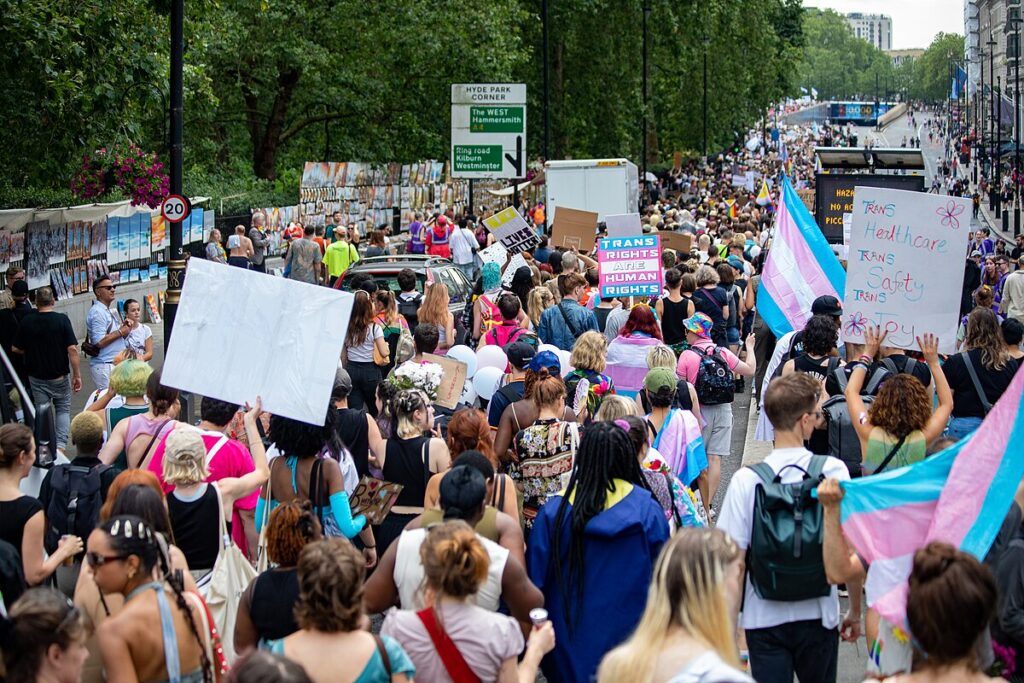
If you think transfeminism does not concern you, Raha and van der Drift gently urge you to think again: “Anyone can trans.” – anyone can cook; anyone can organise; anyone can liberate.” And, really, the can here is a should. Trans liberation involves everyone: it is the “collective movement to free all people from regimes of gender oppression through social and material transformation” (p. 1). The task of reimagining gender, pleasure, sexuality, and intimacy outside of capital and empire cannot be achieved by insisting on any certain and stable identity categories, because the exploitative structure of the global economy operates through social identities. Marxist feminist thought on social reproduction has established that gender and sexuality are crucial to the reproduction of the working class, as cis- and heteronormativity structures the division of labour, property relations and the primary reproductive unit: families established through marriage. There are no such things as eternal biological categories: capital brutalises neatly gendered bodies by appropriating our biological capacities for the pursuit of profit. Trans and intersex lives, however, “have transgressed and challenged these regimes through changing or refusing gender, which we propose is a collective effort that emerges through the practices we undertake together” (p. 1). The collective undoing of gender is necessarily entwined with the task of pushing for human emancipation. According to the authors, participation in transfeminist struggles therefore aims for the liberation of everyone, while leaving the precise direction of the necessary efforts open and avoiding being overly descriptive (p. 158). For them, destabilising capital is less a matter of a having a perfect image of what the “post” and “after” looks, feels, tastes, sounds like, and more about facilitating a liveable tomorrow through tending to a more abundant today. Flourishing, Raha & van der Drift write, “requires possibilities for conversation and political imagination, but more importantly, to highlight how we can relate to each other” (p. 5). If the book remains quite abstract and vague at times, it is because the authors reject utopian dreaming and practical planning for a sort of radical presentism that might feel too directionless to those readers coming to the book with hopes for clear strategic purpose. However, I would argue that underlying Trans Femme Futures is a distinct call for not relenting in the fight against the counterrevolutionary logic of cisness.[16]
The counterrevolutionary logic of cisness
While the anti-trans mob is mainly a phenomenon of conservative forces in the US and the UK, there is still a worryingly large number of TERFs tolerated in Marxist circles. As Holly Lewis recently wrote, it is time for us to call out those defending gender essentialism in the name of Marxism: “Do you see who stands beside you? Tories. Fascists. J.K. Rowling literally smoking a cigar on a yacht bragging about how her scheme panned out.”[17] We should commit to more, not less, explicit enmity with those who love to be in cahoots with right-wing state violence, especially if their bigotry is justified through ahistorical ontological fantasies like ‘biological women’. Sexual difference is not a biological fact, but a social hierarchy always implicated the “dehumanizing push toward classification”.[18] Sex, gender and sexuality are deeply connected to eugenicist logics of civilisation, progress, and humanity. The capitalist and colonial construction of gender relations reorganises the workforce and the reproduces class inequality by enforcing a racialised sexual dimorphism that institutionalises heteronormativity and cisnormativity and pathologises same-sex behaviours and gender-diverse identities[19]. That is why trans rights have become such a key site of political contestation for the Left: the fundamental destructiveness of this binary gender system not only functions to subjugate and exploit trans and gender nonconforming people, but also colonised, racialised, poor, working, queer, disabled and nonhuman bodies. Anti-trans violence is a systemic pressure that implicates all of us.
For Lewis, re-mobilising feminism for the task of “abolishing all organized scarcities” (p. 19) therefore requires us to formulate our feminist politics outside of the ideology of cisness. We know that the history of hetero- and cisnormativity is intricately linked to the history of the white bourgeoisie: “Whiteness and cisness are twins” (p. 265). Cisness’s racial order has been extensively discussed by especially Indigenous, Black and trans of colour scholars, spelling out how transness and race are inextricably bound up with colonial projects and global capitalism.[20] The norm of cisness is defined through race and class: bourgeois whiteness is the standard of cissexual womanhood. As Emma Heaney argues, “it is precisely the racial and class dimension of cisness that allows bourgeois women to access masculine priority without being exposed to transphobia, without being associated with the racialized history of transness and queerness”.[21] A closer look into antitrans discourse should make blatantly clear just how deeply committed cisfeminists are to eugenicist, colonial, bourgeois logics. Their righteous crusade of protecting cis women from trans ones legitimises the hunt for the infiltrator blamed for polluting womanhood. It is the same impulse at work in Zionist feminist tears, in Islamophobic discourses that invoke women’s rights, or in fascist anti-immigration positions. Cisness is not an identity, but an unattainable ideal that structures the normal, the natural, the good, always and necessarily at the expense of bodies deemed unproductive, exploitable, disposable. As Jules Gleeson reminds us, sex is indeterminant: “Whatever alignment of the several senses of sex is pursued through professional means, whatever arts or technical skills are deployed to solve this problem, indeterminacy will remain sex’s overarching feature”.[22] The reactionary mainstream can only be toppled through resolutely anti-capitalist, anti-fascist, and anti-colonial ‘feminism against cisness’.[23] A crucial aspect of successful class struggle therefore entails efforts to destabilise and defamiliarise sex, gender, and any illusion as to the dualism of the two.
Care
Under the banner of the fight against organised bourgeois cisness, Raha & van der Drift argue, there is also plenty of room for tenderness. While enmity and friction “can be generative of social movements” (p. 163), we should try and fail better to let them appear alongside a collective insistence on comradely flourishing. Care is an essential aspect of liberation, and Raha & van der Drift make a luminous contribution to its theorisation. They demonstrate how care is an important resource for pre-figuring desirable post-capitalist futures in the dystopian present: care, they write, “is a localised form of shaping futurity in trans femme worldings” (p. 67). The kind of care-communisational feminism outlined here is centrally concerned with survival and reproduction: yes, the cooking and cleaning, but also the building and maintenance of relations, the texting and sexting and hugging and fucking, the mending and mediating and tending to. Trans Femme Futures offers important reflections on trans health care by approaching it as a “body-loving practice” (p. 147), without romanticising its targeted neglect and abuse. While reproductive labour is increasingly purchasable like any other commodity (think care homes, food delivery services, private therapy, life coaches), it remains one of the key dimensions through which the state administers discipline and violence on queer, trans and intersex people. There is nothing trivial about care: the lack, refusal, or conditionality of it plays a central role in facilitating abjection and disposability. What makes gendered exploitation possible and plausible is exactly this architecture of “the counterpoint to care – that is, indifference, an attitude that separates people into an affective hierarchy” (p. 62).
Medical institutions and especially Gender Identity Clinics must therefore be central in our dismantling and rebuilding efforts: “healthcare struggles are about more than healthcare – they are about creating a world where we can trust each other with our lives” (p. 154). By taking medical care into their own hands, by self-medding and sharing knowledge, practices and resources, trans people have pre-figured communal infrastructures that foster the indispensable skills of relation needed for collective liberation. To be sure, building horizontal collective care is no replacement for also demanding more from public institutions. We can do both simultaneously: act now rather than wither in futile anticipation. Trans people’s communal survival work[24] brings into view some of the political practices that may be indispensable for countering the class war of TERFs and MAGAs alike. To care transfeministly and comradely is to enunciate “what we need to unlearn” (p. 69): hierarchies of expectations, of care giving and receiving. Trans femme ethics, then, is the navigational guide that reshapes the structure of emancipatory attentiveness. How can we simultaneously nourish each other and the worlds we would like to build collectively?
Both Enemy Feminisms and Trans Femme Futures are fantastic companions for comrades wishing to better equip themselves in the struggle against capitalism and gender domination, not just for the trenches of the ‘TERF wars’. Their contributions are vital for figuring out how to collectively determine the contours of our contestations, not by offering solutions, but by reminding us of the political use in sitting with and acting on discomfort. The tasks of un- and re-building this world from the undercommons require that we allow ourselves to be disappointed and heartbroken, to sometimes fuck up, but to nonetheless show up without reserve. This is a moment of crystal-clear antagonism: we have no time for cowards.
Bibliography
Achcar, Gilbert, 24 February 2025, ‘The Age of Neofascism and Its Distinctive Features’, available at: https://www.historicalmaterialism.org/the-age-of-neofascism-and-its-distinctive-features/.
Bhattacharyya, Gargi 2023, We, the Heartbroken, London: Hajar Press.
Blumenfeld, Jacob 2023, ‘Climate barbarism: Adapting to a wrong world’, Constellations,30, 2: 162–178.
Davis, Angela, 27 October 2023, ‘Palestine is a moral litmus test for the world’, available at: https://www.aljazeera.com/video/upfront/2023/10/27/angela-davis-palestine-is-a-moral-litmus-test-for-the-world.
Deutscher Bundestag, 26 May 2025, ‘Deutsche Waffenlieferungen an Israel und die Folgen für die Bevölkerung in Gaza’, available at: https://dserver.bundestag.de/btd/21/002/2100284.pdf
Ederer, Nora et. al., 22. October 2023, ‘Kundgebung am Brandenburger Tor: Zehntausende bekundeten Solidarität mit Israel in Berlin’, available at: https://www.tagesspiegel.de/berlin/am-brandenburger-tor-tausende-stromen-zu-solidaritatskundgebung-fur-israel-in-berlin-10666150.html.
El Akkad, Omar 2025, One Day, Everyone Will Have Always Been Against This, Edinburgh: Canongate Books.
El-Kurd, Mohammed 2025, Perfect Victims: And the Politics of Appeal, Chicago: Haymarket Books.
Farris, Sara R. 2017, In the Name of Women’s Rights: The Rise of Femonationalism, Durham: Duke University Press.
Fraser, Nancy, 14 October 2013, ‘How feminism became capitalism’s handmaiden – and how to reclaim it’, available at: https://www.theguardian.com/commentisfree/2013/oct/14/feminism-capitalist-handmaiden-neoliberal.
Gill-Peterson, Jules 2024, A Short History of Trans Misogyny, London: Verso Books.
Gleeson, Juliana 2025, Hermaphrodite Logic: A History of Intersex Liberation, London: Verso Books.
Hammad, Isabella 2024, Recognising the Stranger: On Palestine and Narrative, Fern Press.
Heaney, Emma (Ed.) 2024, Feminism against Cisness, Durham: Duke University Press.
Heaney, Emma and Sophie Lewis, 25 February 2025, ‘On the Cisness of the Bourgeoisie’, available at: https://www.pinko.online/web/on-the-cisness-of-the-bourgeoisie/.
Lewis, Holly, 6 May 2025, ‘Against Bad Arguments for Terrible Things: A Reply to John Rees’, available at: https://spectrejournal.com/against-bad-arguments-for-terrible-things/.
Lewis, Sophie, 27 May 2025, ‘“Are Women Weak Jews?” On Andrea Dworkin’s Zionism’, available at: https://spectrejournal.com/are-women-weak-jews/.
Lugones, María 2008, ‘The coloniality of gender’ Worlds & Knowledges Otherwise, 2008, 1–17.
Miller, Sam, 4 April 2017, ‘Lipstick Fascism’, available at: https://jacobin.com/2017/04/alt-right-lana-lokteff-racism-misogyny-women-feminism/.
Puar, Jasbir K. 2018, Terrorist assemblages: Homonationalism in queer times, Durham: Duke University Press.
Reichinnek, Heidi, 21 March 2024, ‘Für einen sofortigen Waffenstillstand und die Freilassung der Geiseln’, available at: https://www.dielinkebt.de/themen/reden/detail/rede-von-heidi-reichinnek-am-21032024/.
Roberts, Adrienne 2014, ‘The Political Economy of “Transnational Business Feminism”’, International Feminist Journal of Politics,17, 2: 209–231.
Snorton, C. Riley 2017, Black on both sides: A racial history of trans identity, Minneapolis: University of Minnesota Press.
Spade, Dean 2020, Mutual Aid: Building Solidarity During This Crisis (and the Next), London: Verso Books.
Stoffel, Alex 2025, Eros and Empire: The Transnational Struggle for Sexual Freedom in the United States, Stanford: Stanford University Press.
Thunberg, Greta, 22 June 2025, Post on Instagram, available on https://www.instagram.com/gretathunberg/?hl=en.
Winant, Gabriel, 13 October 2023, ‘On Mourning and Statehood: A Response to Joshua Leifer’, available at: https://www.dissentmagazine.org/online_articles/a-response-to-joshua-leifer/.
[1] Achcar 2025.
[2] See also Fraser 2013, Roberts 2014, Farris 2017, Miller 2017.
[3] Lewis 2025 for Spectre.
[4] That being said, I still take in a sharp breath when being reminded, via LinkedIn or reference requests, that many of my students end up working in the oil industry, global investment banking, or consulting.
[5] Bhattacharyya 2023, pp 115-116.
[6] El-Kurd 2025, pp. 7-8.
[7] Hammad 2024, p. 60.
[8] Davis 2023.
[9] Ederer et al. 2023.
[10] El Akkad 2025.
[11] Blumenfeld 2023.
[12] Thunberg 2025.
[13] Reichinnek 2024.
[14] Deutscher Bundestag, 26 May 2025.
[15] Winant 2023.
[16] Heaney 2024.
[17] Lewis, Holly 2025.
[18] Lewis p. 264.
[19] See Farris 2017, Stoffel 2025, Gill-Peterson 2024.
[20] See Snorton 2017, Puar 2018, Lugones 2008.
[21] Heaney and Lewis 2025.
[22] Gleeson 2025, p. 8.
[23] Heaney 2024.
[24] See Spade 2020.