The starting point for Matt Myers’s impressive three-country study is clearly signalled in its title, namely Eric Hobsbawm’s controversial 1978 Marx Memorial Lecture ‘The Forward March of Labour Halted’ (hereafter FMLH).[1] According to Hobsbawm, the size, power, unity and class consciousness of the British labour movement had peaked some thirty years earlier and was being increasingly undermined by occupational and ethnic divisions, sectional wages militancy and the erosion of traditional working-class culture and communities. Coinciding, as it did, with the high point of British trade-union membership and density, and coming from a longstanding member of the Communist Party, this bleak narrative triggered a wide-ranging and fractious debate.[2] Whilst the sharp decline of the labour movement during the Thatcher years is often taken as vindication of Hobsbawm’s analysis (not least by Hobsbawm himself!),[3] Myers’s account presents, and explores, two key objections. First, he argues that, far from being in decline throughout the 1970s, there is an abundance of evidence suggesting the workers’ movement in Europe ‘was in rude health’.[4] Both strike rates and union membership levels were on the rise, driven in part by unprecedented rates of unionisation amongst women, ethnic minorities and young workers. At the same time, the French and Italian Communist parties (the PCF and PCI respectively) obtained their highest ever absolute vote totals (in 1978 and 1976 respectively). Second, he contends that Hobsbawm’s analysis is marred by a structural determinism which omits the key role of agency, in particular, the strategic choices made by political actors, both parties and unions, as they grappled with a series of challenging economic, political and technological problems. At the heart of Myers’s analysis are the dynamics between national and local leaderships and rank-and-file members of parties and unions as they grappled with one of the key contradictions of the 1970s, the simultaneous rise of labour militancy and power and the dwindling profit rates and competitiveness of the European manufacturing industry. Within European Communist parties, rank-and-file pressures for continued militancy increasingly clashed with the ambitions of a new generation of younger, professional workers, sceptical of wages militancy and keen to promote a progressive restructuring of industry that would restore profitability whilst simultaneously protecting and advancing workers’ interests. The resulting ‘strategic impasse’ was increasingly resolved in favour of the latter ‘by disempowering those groups of workers who had invested it [the Left] with hopes of social transformation’.[5] Central to this process was the use of opinion polls, surveys and focus groups in order to circumvent the traditional machinery of branch meetings, conferences, resolutions, and voting. Equally important in facilitating the strategic redirection of workers’ movements were the ‘moral panics’ around ‘public order’ engendered by strikes of immigrant workers, notably the 1976-78 Grunwick strike in Britain, which played into reactionary and racist tropes. Finally, Myers examines the roles played by so-called ‘new social movements’, especially amongst women and ethnic minorities, and the intellectual challenges they posed for classical-Marxist narratives about social class, class power and relations of production. Once again, these debates played into factional struggles within and between parties and unions as activists grappled with the consequences and fallout of the late 1960s upsurge of labour militancy.
Before turning to the state of the workers’ movement in the 1970s, it is worth noting that Hobsbawm’s argument is not quite as straightforward as the ‘structural determinist’ label would suggest. In an essay written only three years before his Marx Memorial Lecture, Hobsbawm had voiced his growing worries about working-class divisions and economic crisis but insisted that an advance towards socialism was still possible if, in Myers’s words, ‘correct strategic choices were made’.[6] Indeed, towards the end of his 1978 lecture, Hobsbawm made a similar point about agency:
But Marxists are not economic and social determinists, and it simply will not do to say this crisis of the working class and the socialist movement was ‘inevitable’, that nothing could have been done about it. … Men, as Marx said … make their history in the circumstances that history has provided for them and within its limits – but it is they who make their history.[7] (Italics in original)
Now, it is true that much of the debate about FMLH did focus on the long-run trends discussed by Hobsbawm and devoted very little space to strategic choices, so FMLH was treated as if it were a structural determinist thesis. In that sense, Myers is entitled to take the same view and respond to the argument as understood by protagonists even if Hobsbawm’s lecture was somewhat more nuanced.
In relation to the 1970s, Myers is right to insist that the balance sheet of gains and losses for the workers’ movements in all three countries were far more positive than Hobsbawm suggests. In addition to the electoral successes of the PCF and the PCI, Myers notes there were significant increases in both money wages and the social wage (albeit for different years in the three countries); reductions in income inequality; an increase in the wage-share of national income; and a substantial raft of worker and trade-union legal rights. Hobsbawm downplayed the growth of trade-union membership in Britain, wrongly declaring that union density (the percentage of workers belonging to a union) was only slightly higher in 1978 than in 1948. In fact, British union membership grew at an unusually rapid rate after 1968, climbing by 3.3 millions and peaking in 1979 at an historic all-time high of 13.5 millions, 53.0 per cent of the workforce, with particularly impressive growth amongst women workers.[8] Moreover these gains emerged from the assertions of working-class power and militancy that constituted the world strike wave of 1968-74, the ‘sectional wages militancy’ that Hobsbawm found so troubling. Yet, notwithstanding the growth of trade unionism, Myers’s depiction of the ‘rude health’ of the workers’ movement looks far less persuasive in relation to Britain than it does in regard to France and Italy. In the political arena, the British Communist Party was always far smaller than its West-European counterparts, although, as Myers rightly notes, it continued to wield significant influence on trade-union policy until well into the 1970s. Nevertheless, from the late 1960s, its trajectory was fundamentally distinct from that of the PCF and the PCI. Membership fell dramatically, by one third (approximately 10,000) between 1969 and 1979, whilst electoral performance continued its long and relentless postwar decline from around 1,000 votes per candidate in 1966 to less than half that number in 1979.[9] It is true that the Trotskyist Left grew significantly in this period, by approximately 6,000 but, in 1979, the 9-10,000 Trotskyists were divided amongst 20 separate organisations, a factor that surely reduced their effectiveness and influence.[10] Labour Party membership also fell during this period, though only slightly, but far more alarming was the steady fall in Labour votes, from a little over 13 million in 1966 to just under 11.5 million at the 1979 election (a vote share drop of eleven percentage points) with the consequent loss of almost 100 seats.[11]
For Myers, the impasse in British leftwing politics was reflected in the controversy around Tony Lane’s 1982 article in the Communist Party journal Marxism Today.[12] Most of the text, as he notes, was an uncontentious survey of the decline of manufacturing industry and union membership and the fragmentation of collective bargaining. Lane’s critical remarks about sectional wage militancy and his support for some form of incomes policy were more controversial but largely repeated arguments that had been circulating in and around the British CP for at least ten years. What really angered many Communist trade unionists was the suggestion that some shop stewards were engaged in petty forms of corruption such as expense fiddles. Myers uses the minutes of CPGB meetings to cast doubt on Geoff Andrews’s claim that the dispute crystallised two irreconcilable political positions within the CP, between the proponents of union militancy and those who favoured a broader alliance of unions and social movements around a radical programme.[13] According to Myers, the internal debates were largely framed in terms of questions about Communist morality and procedure: was it not disloyal of Lane to criticise trade unionists in such a fashion, and in public? And why was there no consultation with the Party’s Industrial Organizer Mick Costello and other leading CP trade unionists? I am not persuaded there is much of a disagreement here, because both claims are almost certainly true: the Lane article did crystallise two opposing tendencies within British Communism; and the debate was conducted around procedural issues in order, inter alia, to avoid open confrontation and another party split (following the 1977 departure of around 700 members to form the New Communist Party). As it happens, the tactic was ineffective, because the Party did split once again just five years later.
What is less clear, however, is why this chapter focuses on the CP rather than the Labour Party. After all, Labour’s left wing had been on the rise since the 1970 election defeat and had secured the passage of a radical left-wing manifesto in 1974, drafted in part by the economist Stuart Holland with its early implementation overseen by two left-wing ministers, Secretary of State for Industry Tony Benn and Secretary of State for Employment Michael Foot. Running in parallel with this (short-lived) substantive policy shift was the rise of groups such as the Campaign for Labour Party Democracy, focused on widening the franchise for the election of party leaders and providing more rank-and-file input into the drafting of party manifestos. The culmination of these campaigns was the election of Michael Foot as Party Leader in 1980, the narrow defeat of Tony Benn for Deputy Leader in 1981, and the disastrous 1983 election, fought on a strong left-wing manifesto. In the wake of this defeat, the British Labour Party, in common with the PCF and the PCI, set out to gauge popular opinion more systematically than it had ever done in the past. Myers is right to say that the party leadership was increasingly anxious both about levels of popular support and about internal divisions within the working class. Consequently, the large-scale survey, whether of party members and/or supporters would seem to be a useful tool for collating large amounts of evidence. Myers however is deeply suspicious of survey and poll data, or what he calls ‘technologically verified knowledge’, quoting with approval the dismissive remarks of sociological authorities such as C. Wright Mills. He seems to favour traditional labour-movement mechanisms for discussion and policymaking and dismisses the idea that these fora are dominated by ‘unrepresentative grassroots activists’. Indeed, he strongly promotes the somewhat Machiavellian view that, ‘Each mass survey provided party leaders with the tools directly to counter challengers from below and to legitimate the strategic line already decided upon by the party leaders’.[14]
In the case of Britain, ‘The opinion polling of the British “Third Way” was not a neutral prism to understand the electorate but a mirror of the “values and attitudes” of the studies’ own architects’.[15] The dismissal of surveys is curious, and for several reasons. The French and Italian surveys referred to in the text provided extensive and important evidence on divisions amongst Communist party members and supporters, and attitudinal differences between them and the broader electorate. For example, whilst 71 per cent of PCF members supported more nationalisation of industry, the corresponding figure for the electorate as a whole was just 36 per cent. Data collected from a survey of Labour Party members in 1989-90 showed an equally large gap in opinions on nationalisation (and on nuclear weapons) between party members and the electorate as a whole.[16] Ten years earlier, and just a few months after the strike wave of winter 1978–9, approximately one third of trade-union members voted Conservative in the 1979 British General Election, one of the highest figures in decades. On some issues, in other words, the ‘allegedly unrepresentative grassroots activists’, were unrepresentative and the fact that survey tools were used to engineer shifts in policy does not invalidate either their use or the validity and reliability of the data they collected.[17]
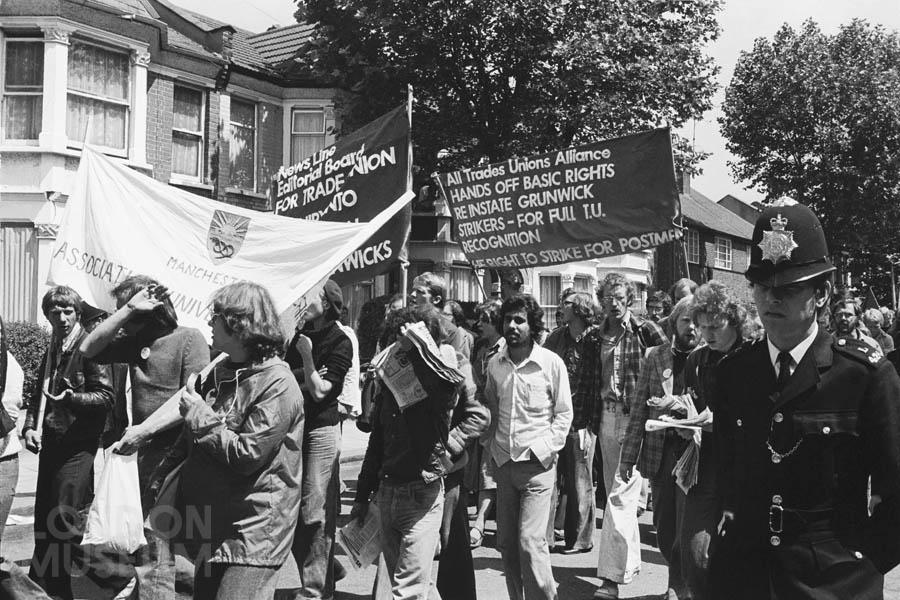
The role played by immigrant workers in the demise of the European Left is the subject of an entire chapter, focused around strikes at FIAT, Citroen and Grunwick. Whatever the merits of the argument in relation to France and Italy, the salience of immigrant workers in the Grunwick dispute is less obvious. The union recognition dispute was undoubtedly a high-profile event and became a cause célèbre not least because of confrontations in summer 1977 between mass pickets and the police. In theory, the Labour government’s new legislation should have allowed the independent Advisory, Conciliation and Arbitration Service (ACAS) to survey worker opinion and offer a recommendation for or against union recognition. In practice, the employer simply refused to meet the relevant union and refused all cooperation with ACAS, in which endeavours he was heavily backed by a new right-wing pressure group, the National Association for Freedom, discussed at length by Myers. Two years after the strike began, the unions and the TUC admitted defeat and called off the dispute. According to one of the most detailed studies of the rise of right-wing think tanks and the rise of neoliberalism, the Grunwick dispute was less to do with immigrants but was primarily about class, because, ‘it represented the first concerted resistance to the power of organized labour to appear in Britain since the 1930s’.[18] Myers also counterposes the roles of Grunwick and the late 1970s strike wave, the so-called Winter of Discontent:
Existing accounts have tended to assume the ‘Winter of Discontent’ strike wave in late 1978 and early 1979 was the most important moment in legitimating her ‘Labour isn’t working’ narrative. It was instead Labour’s handling of the Grunwick dispute which offered Thatcher’s first real political and ideological test. [19]
Yet, as one of Thatcher’s biographers makes clear, the outcome of this ‘test’ was hardly a victory for the newly elected and militantly anti-trade-union leader. Industrial relations policy until the early 1980s remained firmly under the control of James Prior, a leading member of the more moderate wing of the Conservative Party.[20] Moreover, opinion polls through 1977 and 1978 suggested Labour was actually gaining ground on the Conservatives: a Gallup poll in November 1978, for instance, found Labour enjoyed a five point lead over the Conservatives, its best result in almost four years. Yet, just weeks into the ‘Winter of Discontent’, the same polling organisation reported a complete about turn, with Labour now trailing the Conservatives by 20 points.[21] By-elections tell a similar story: Labour lost six seats between June 1975 and March 1978 but successfully defended seven seats between April and October 1978 only losing again in March 1979, shortly after the Winter of Discontent. The Grunwick dispute may well have hardened Thatcher’s already firm anti-trade-union sentiments and contributed to the erosion of trade-union power, but it is not clear that it played much of a role in boosting the popularity of the neoliberal agenda.
Finally, let us return to the core argument of the book, the idea that the late 1970s represented a huge opportunity for left advance that was squandered by conservative leaderships despite rank-and-file pressure. Central to this contention are two claims that require more detailed consideration: first, that there was a credible left strategy for socialist advance and, second, that the labour movements of the three countries in question had the power to implement such a strategy. Myers devotes considerable attention to the strategic options mapped out by party and union leaderships including the ‘Historic Compromise’ between the PCI and Christian Democracy, the Common Programme of the French Left and the Alternative Economic Strategy of the Labour Party. He also describes the debates in all three countries about various forms of industrial restructuring and worker participation in the face of falling profit rates and notes, with approval I think, the widespread worker resistance to such ideas. What are less clear are the main components of the more radical strategic alternatives to which he alludes. In the British case, debates in the mid-1970s at TUC and Labour conferences, and within the CP, turned on a return to ‘free collective bargaining’ as against the maintenance of wage restraint. After three years of state incomes policy and falling living standards, it is easy to understand why many trade-union delegates followed the wishes of their members and voted, in effect, for a wages offensive. But, in the absence of supportive industrial and economic policies from government and of other measures to enhance workers’ power at the expense of employers, the wage battles of 1978–9 did not comprise even a rudimentary strategic programme for socialist advance but, rather, contributed to a substantial right-wing electoral victory.
In relation to labour-movement power, it is certainly true that many political and union leaders of the 1970s and 1980s were increasingly alarmed about what we would now call deindustrialisation, marked by factory closures and contractions, reduced manufacturing employment, falling domestic investment and attempts to raise labour productivity through work intensification and automation. The late 1970s and 1980s also witnessed an upturn in capital mobility as manufacturers sought to relocate into cheaper and more labour quiescent locations in the global south.[22] All of these measures and initiatives are expressions of capitalist power and indicative of a new period of counter-mobilisation against organised labour and clearly posed the question: what power did industrial workers in Britain, France, Italy possess that could effectively counteract these measures? The strike weapon had certainly pushed up wages from the late 1960s, but its effectiveness was contingent on several factors: low unemployment, continuing labour demand by employers, permissive labour legislation and the belief by governments that the interests of workers and their trade unions had to be accommodated. The erosion of these conditions from the mid-1970s began to shift the balance of power against organised labour, and, consequently, the effectiveness of strike action, as the British coal miners discovered to their cost in the great strike defeat of 1984–5.
One might argue that, whilst union power alone is no match for the power of capital, a combination of union and political power, a left government built on worker mobilisation, is a different matter, or, as Myers wrote of the late 1970s, ‘The left had more options available to it than supposed’.[23] But what were these options? A recent essay by Panagiotis Sotiris explores the dilemmas and pitfalls of such an administration, starting with the Lenin-Kautsky debates, passing through the Eurocommunist moment in the 1970s and ending with the experience of Syriza.[24] Whilst rightly avoiding the crude binary axis of reform vs revolution, he is also at pains to stress the severe limitations that have bedevilled Marxist thinking about such a scenario and the absence of any creative and useful thoughts about governmental and labour movement strategy and power.
Matt Myers is surely right to emphasise the role of political debates and strategic choices in the evolution of European labour movements through the 1970s and 1980s as a corrective to accounts that have strongly emphasised structural forces and determinants. What remains less clear is the nature of the more radical options, if any, that were actually available in the economic and political conjunctures of that period and the constraints on their pursuit.
References
Andrews, Geoff 2004, Endgames and New Times: The Final Years of British Communism 1964–1991, London: Lawrence and Wishart.
Cockett, Richard 1995, Thinking the Unthinkable: Think-Tanks and the Economic Counter-Revolution, 1931–1983, London: Fontana Press.
Hobsbawm, Eric 1981a, ‘The Forward March of Labour Halted?’, in Martin Jacques and Francis Mulhern (eds.), The Forward March of Labour Halted?, London: Verso, pp. 1–19.
Hobsbawm, Eric 1981b, ‘Observations on the Debate’, in Martin Jacques and Francis Mulhern (eds.), The Forward March of Labour Halted?, London: Verso, pp. 167–82.
Jacques, Martin and Francis Mulhern (eds.) 1981, The Forward March of Labour Halted?, London: Verso.
Kelly, John 1988, Trade Unions and Socialist Politics, London: Verso.
Kelly, John 2018, Contemporary Trotskyism: Parties, Sects and Social Movements in Britain, Abingdon: Routledge.
Lane, Tony 1982, ‘The Unions: Caught on the Ebb Tide’, Marxism Today, September, pp. 6–13.
Myers, Matt 2017, Student Revolt: Voices of the Austerity Generation, London: Pluto Press.
Myers, Matt 2025, The Halted March of the European Left: The Working Class in Britain, France, and Italy, 1968–1989, Oxford: Oxford University Press.
Reid, Alastair and Henry Pelling 2005, A Short History of the Labour Party, 12th edn., Basingstoke: Palgrave Macmillan.
Seyd, Patrick and Paul Whiteley 1992, Labour’s Grass Roots: The Politics of Party Membership, Oxford: Clarendon Press.
Silver, Beverly 2003, Forces of Labor: Workers’ Movements and Globalization Since 1870, New York: Cambridge University Press.
Sotiris, Panagiotis 2025, ‘On the (Im)Possibility of a “Left Government”: Some Strategic Questions Revisited’, in Greg Albo and Stephen Maher (eds.), Socialist Register 2025, London: Merlin Press, pp. 1–28.
Taylor, Robert 1993, The Trade Union Question in British Politics: Government and Unions Since 1945, Oxford: Blackwell.
Thatcher, Margaret 1995, The Path to Power, London: Harper Collins.
Thompson, Willie 1992, The Good Old Cause: British Communism 1920–1991, London: Pluto Press.
Thorpe, Andrew 2001, A History of the British Labour Party, 2nd edn., Basingstoke: Palgrave.
Wrigley, Chris 1999, ‘Women in the Labour Market and in the Unions’, in John McIlroy, Nina Fishman and Alan Campbell (eds.), British Trade Unions and Industrial Politics, Vol. 2: The High Tide of Trade Unionism, 1964–79, Aldershot: Ashgate.
Young, Hugo 1990, One of Us: A Biography of Margaret Thatcher, London: Pan Books.
[1] Hobsbawm 1981a.
[2] Jacques and Mulhern 1981.
[3] Hobsbawm 1981b, pp. 167–8.
[4] Myers 2025, p. 2.
[5] Myers 2025, p. 3.
[6] Myers 2025, p. 39.
[7] Hobsbawm 1981a, pp. 17, 19.
[8] Taylor 1993, pp. 381–2; Wrigley 1999, p. 62.
[9] Thompson 1992, p. 218; Kelly 1988, p. 111.
[10] Kelly 2018, pp. 39–40.
[11] Reid and Pelling 2005, pp. 207–9.
[12] Lane 1982.
[13] Andrews 2004, pp. 201–7.
[14] Myers 2025, pp. 108, 110.
[15] Myers 2025, p. 117.
[16] Seyd and Whiteley 1992, p. 54.
[17] Myers 2025, p. 113. Indeed, in an earlier publication about student activism, the author quoted approvingly from a large-scale survey of students that explored their participation or otherwise in the university fee protests of 2010–11: Myers 2017, pp. 179–80.
[18] Cockett 1995, p. 222. Margaret Thatcher makes a similar point about the Grunwick dispute in the second volume of her memoirs: Thatcher 1995, pp. 397–403.
[19] Myers 2025, p. 129.
[20] Young 1990, pp. 108–11.
[21] Thorpe 2001, p. 184.
[22] Silver 2003, pp. 43–74.
[23] Myers 2025, p. 217.
[24] Sotiris 2025.