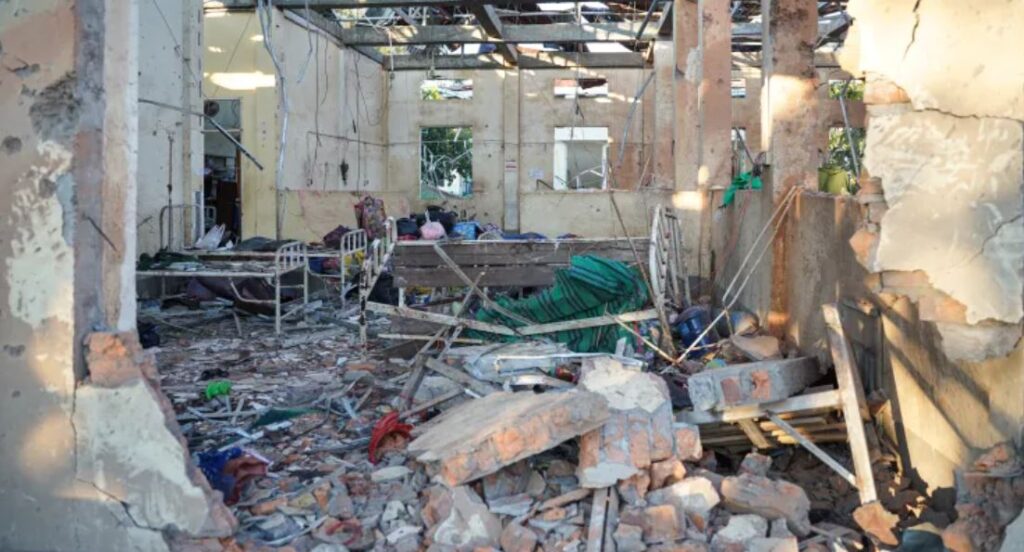
On 10 December, an airstrike by the Myanmar military destroyed a hospital in rebel-held territory.[1] Two bombs killed 34 people and injured around 80. This area in western Myanmar is controlled by the Arakan Army (AA), one of the largest and strongest armed groups currently fighting the military government. Following the military coup in 2021, major rebel groups like the AA—as well as smaller, more local People’s Defence Forces (PDFs)—managed to seize over half of Myanmar’s territory. But, since that high point in 2024, the military has reclaimed much of the territory it had lost. Renewed Chinese support for the junta, a mass conscription drive, and a relentless campaign of airstrikes have all contributed to the counter-offensive. In advance of elections that began on 28 December—widely criticised as a way for the regime to consolidate power—the military ramped up airstrikes even further, aiming for the election to happen in as many reclaimed areas as possible.
Buildings reduced to ruins, civilian infrastructure destroyed, bodies pulled from the rubble, whole families lost to the wreckage of air war—for some of us, it is hard not to see the signs, symbols, and even material traces of another place. After all, according to Haaretz, Israeli arms companies continued to sell weapons to the Myanmar military after the 2021 coup, despite a notional arms embargo. These sales included advanced weapons systems sold specifically to the Myanmar Air Force as air war was becoming central to its counterinsurgency. But, for many in Myanmar, the linkages between Palestine and Myanmar barely register at all. And, when they do, religion looms large. Myanmar Muslims have expressed solidarity with Palestinians on the basis of a shared experience of Muslim oppression. Myanmar Christians often sympathise with Israel, with a sense of and support for “biblical Israel” strongly rooted in missionary histories in Myanmar’s highlands. Myanmar Buddhists have seen Israel as a kindred state-building project threatened by insurgency. Myanmar Buddhists’ identification with an ethno-state founded on extreme violence against Muslims, including ethnic cleansing and genocide, should be no major surprise. Anti-Muslim violence has proven remarkably consistent throughout Myanmar Buddhism’s modern history—from the anti-Muslim riots of the 1930s to the ongoing Rohingya genocide, which took its most recent, most deadly, form in the 2010s.
In short, the question of Palestine in Myanmar is overdetermined by religious affiliation and communal ties. But it doesn’t have to be. There is another way of plotting the links, connections, parallels, and, indeed, solidarities that can and should bridge these two places so rarely brought together—by way of a clear set of ties that follow historical and material relations.
In fact, the arms trade and like-minded militarisms already hint at a set of relations that run even deeper. These relations, grounded in shared histories of colonisation and resource extraction—that is, in shared subjection to what Andreas Malm calls fossil empire[2]—do more than link, empirically, places often treated as separate in time and space. They also map, politically, a possible common struggle. At stake is a message for the peoples of Myanmar: the liberation of Palestine is your struggle, too. Not for religious reasons, moral reasons, or some abstract commitment to solidarity, but for historical and material reasons. Or as one group of Palestinian fighters put it in 1970, connecting Palestine to Southeast Asia at a very different moment: “Vietnam to Palestine: one struggle, many fronts.”
Empire of Steam
Malm has argued that the ongoing genocide in Gaza reflects a deeper history of colonisation and resource extraction in the eastern Mediterranean that dates to the 19th century. The destruction of Palestine, it turns out, considerably overlaps with the origins of the climate catastrophe—the destruction of the earth. Malm zeroes in on 1840, noting that the British bombardment of coastal Palestine that year was the first instance of the British empire using steamboats in a “major war”. “Steam power,” Malm writes, “was the technology through which dependence on fossil fuels came into being: steam engines ran on coal, and it was their diffusion through the industries of Britain that turned this into the first fossil economy”. But steam wouldn’t have had a major climate impact if it stayed within Britain. It was in its export to the rest of the world, “drawing humanity into the spiral of large-scale fossil fuel combustion”, that Britain “change(d) the fate of this planet: the globalization of steam was the necessary ignition”. The “key to this ignition”, then, “was the deployment of steamboats in war. It was through the projection of violence that Britain integrated other countries into the strange kind of economy it had created—by turning fossil capital, we might say, into fossil empire”. For Malm, the destruction of Palestine thus turned fossil capital into fossil empire—through the use of steamboats to wage imperial warfare.[3]
But what if the bombardment of 1840 was not the first time the British deployed steamboats to wage war? In the 1820s, in fact, the First Anglo-Burmese War provides a different vantage point on the historical geography of fossil empire. It returns us to the area of the hospital strike last month in Myanmar’s west—but almost precisely two hundred years earlier.
Shalpuri Island lies at the mouth of the Naaf River, which defines the boundary between present-day Myanmar and Bangladesh. In 1823, a border dispute there between the British colonial state and the expanding Burmese empire—both of which claimed the island—catalysed the first Anglo-Burmese war.[4] The Burmese throne sent tens of thousands of troops to its western frontier, planning to march on Chittagong. But instead of fighting on this difficult terrain, the British took the chance to strike Burma centrally. They mobilised “a large-scale sea-borne invasion of Lower Burma from an assembly point in the Andaman Islands”, surprising the Burmese monarchy as a British naval force of 10,000 men entered the Rangoon harbour.[5] The British rained rocket fire on Rangoon from their ships, capturing and holding the city before pushing up the Irrawaddy River in late 1824. At Prome, Burmese troops regrouped to attack the British forces, with one historian describing the naval clash there as follows: “The British resolutely pressed on despite Burmese attacks both on land and on the river. The Diana, a steamer recently arrived from Calcutta and the first ever used in battle, was deployed to counter the huge teak war-boats which had been the pride of (the Burmese throne’s) armed forces… It was the defeat of this river fleet … which finally led to a Burmese request for negotiations in early 1826.”[6]
It is not clear how recently the Diana had arrived from Calcutta. The steamer appears to have been part of the 1824 bombardment of Rangoon, for instance. In fact, the Diana was built in 1823 as a merchant vessel for the East India Company. It featured two 16 horsepower side-lever engines manufactured by Henry Maudslay of Lambeth.[7] But the British colonial state in Bengal purchased the steamer in 1824, with naval historians describing it as the first steam-powered ship used in war.[8] The Diana was armed with artillery known as Congreve rockets. Even a glance at the history of this artillery rocket shows its importance to British imperialism. In addition to the Royal Navy’s overpowering of the Burmese monarchy during the first Anglo-Burmese War in the 1820s, Congreve rockets were central to the British naval bombardment of Algiers in 1816; to the British bombardment of the Canton ports first in 1841, during the Opium Wars; to British naval forces’ rocket attacks on Maori fortifications in New Zealand, in the 1840s; and to subjugating insurgents during the Indian Rebellion of 1857.[9] The rockets might well have been used in what Malm calls the British “pulverization” of coastal Palestine, too, in 1840. But it was steam power that put this artillery in positions to destroy.
The power, even the prestige, that the Diana projected is worth underlining. The steamer was said to overwhelm “the enemy with equal wonder and terror”.[10] Despite the fame of the Burmese throne’s war-boats, “the power of steam enabled the Diana to manoeuvre so rapidly among them, that, notwithstanding the strength and dexterity of their rowers, they could not escape; and with irresistible force she upset, demolished, sunk, disabled and took no fewer than thirty-two”.[11] British MPs in the metropole soon praised the Diana and its new, daunting power. One MP in 1827 said that, notwithstanding “the bravery of the land forces” during the first Anglo-Burmese War, “it would have been impossible to succeed, had not their movements on the banks of the rivers been seconded by the active and valuable exertions of the flotilla. In this department, too, much assistance had been derived from the employment of a power, then for the first time introduced into war – steam. The steam vessel had been very useful, not merely in carrying on communications with despatch, but in overcoming formidable resistance.”[12] In 1841, a British lieutenant looked back on the war. Reflecting not only on the Diana’s kinetic prowess, running on coal, but also the awe, and no doubt fear, it inspired among enemy combatants, he argued that “a great portion of the success attending the Burmese campaigns was due to the prestige of the steam-vessel we had on the Iriwaddy [sic] river. The Burmese war-boats are, perhaps, the finest craft of the kind in existence; they pull many of them 100 double-banked oars, and could for a time beat the steamer: but the muscles and sinews of men could not hold out against the perseverance of the boiling kettle, and they gave up in despair, as they could not comprehend how this perpetual motion was obtained.”[13]
Such was the novel form of power—overwhelming at the level of mechanics, psychology, and movement itself—introduced by the Diana into imperial warfare. This power supercharged British expansion; it globalised Britain’s fossil economy. And this introduction of steam into war has its origins not in the British bombardment of Palestine in 1840, but with this earlier deployment of the Diana in 1820s Burma. The subsequent two Anglo-Burmese wars saw the British vanquish a highly weakened Burmese monarchy, so that Britain’s steam-based, thus coal-based, naval dominance powered British colonisation from the 1820s onwards—and then a century and more of resource extraction to feed its fossil economy. In short, the destruction of Burma turned fossil capital into fossil empire.[14]
Still, the precise historical geography of fossil empire is not necessarily the most pressing political question—the issue of what happened first and where. That historiography is important in its own right, but a different position is also worth articulating: that confronting the catastrophes of the present—from Gaza to Myanmar, from genocide to climate breakdown—means tracing these entangled geographies of destruction. Otherwise, one risks isolating a single instance, place, or territory, un-dialectically—separating struggles that are actually shared. So, this is not primarily a question of comparing the importance of the 1840 bombardment of Palestine and the 1824-26 Anglo-Burmese War. What is crucial, on the contrary, is that both are chapters in a broader history of fossil empire, which intertwines two places and two struggles that otherwise risk being lost to each other across time and space.
Meanwhile, fossil empire continued to cast a shadow over the course of British rule in Burma. In fact, petroleum extraction in precolonial Burma generated major revenue for hereditary producers already in the 18th century, making Burma the home of one of the world’s oldest petroleum industries.[15] But, after the Second Anglo-Burmese War of 1852-53—which saw Britain annex all of lower Burma—, oil became a strategic commodity for the Burmese monarchy. The Burmese ruler, King Mindon, lost royal revenue from the territories seized by Britain. This made oil revenue from areas still under his control all the more important. In 1854, as Amitav Ghosh points out, “he did what the rulers of many modern petro-states would do in the century to come: he asserted direct control over the oil fields of Yenangyaung, effectively nationalizing the industry”.[16] Producers could only sell to the throne; the king could dictate prices. He also began to export oil—through an English firm making paraffin candles—so that Burma’s first crude oil exports date to the mid-1850s. Over half of Yenangyaung’s annual production was imported by Price’s Patent Candle Company Ltd., or roughly 2,000 barrels of oil per month.
The British conquered Burma in full, however, with the Third Anglo-Burmese War of 1885. Britain annexed the entirety of Burmese territory and exiled the monarchy. Almost immediately, British interests seized upon Burmese oil production—“to safeguard the oilfields,” in their view.[17] Burmah Oil Company, first registered in Edinburgh in mid-1886, was founded only months after Britain fully incorporated Burma into British India. Over the following decades, BOC produced oil in Burma’s dry zone principally for markets in British India, which included Burma, almost exclusively for use in lighting, heating, and lubrication. This changed in 1905, when BOC signed a contract with the Royal Navy to provide the fuel as the navy shifted from coal to oil to power its warships.[18] Burma’s oilfields thus transformed from being a source of light, mainly, to a source of power. The oilfields were also the largest in the British Empire and the most productive—until the development of oilfields in the Persian Gulf. BOC even followed that move to a new carbon frontier. Four years after agreeing to supply the oil to power Britain’s warships, BOC founded the Anglo-Persian Oil Company. In 1909, BOC floated the Anglo-Persian Oil Company “as an all but fully owned subsidiary”.[19] BOC’s subsidiary, of course, was later renamed Anglo-Iranian Oil Company—and eventually British Petroleum.
Kindred Militarisms
After independence in 1948, Myanmar’s new ruling class nationalised oil production. And, with production rising in the Persian Gulf, the domestic petroleum industry in Myanmar largely faded from view. Yet the new ruling class reinforced, during the 1950s, a more proximate cause of the destruction of Palestine—not fossil empire writ large, but the Israeli state itself. U Nu, Myanmar’s dominant political figure in the early postcolonial period, saw Israel as a like-minded socialist state-building project buffeted by conflict. For, whereas Israel faced the 1948 Arab-Israeli War in the wake of its ethnic cleansing of Palestinians, U Nu’s government faced a wave of rebellions in the minoritised ethnic borderlands immediately after its own independence the same year. Myanmar became the first country in Asia to establish diplomatic ties with Israel. U Nu was also the first head of state from anywhere visit Israel, in 1955, with Ben-Gurion soon returning the favour with a 16-day tour. U Nu felt so favourably toward Israel that he pushed for Israel’s participation in nonaligned meetings, having even attempted, following Nehru, to invite Israel to the Bandung Conference.[20] Ben-Gurion went so far as to say that U Nu and his government “have more sympathy and loyalty to Israel than any other state in the world”.[21]
This “honeymoon” yielded close ties between the two countries.[22] Even before U Nu’s visit, a 1952 delegation to Israel led by Kyaw Nyein, another key leader in postcolonial Myanmar, left deeply impressed. The visit resulted in the Myanmar government exploring formal cooperation with Israel in the areas of arms production, agricultural cooperatives, and infrastructure development.[23] U Nu’s subsequent visit saw him captivated by Israel’s kibbutzim, which, for him, illustrated a socialist, collectivist spirit that resonated with his understanding of Buddhist principles. During the 1950s and into the 60s, a formal exchange programme between the two countries sent hundreds of Myanmar students, policymakers, and military officials to Israel for training. It was also during this time that the Namsang project took shape. Supported by Israeli planning experts from the Land Settlement Department of the Jewish Agency, the Myanmar government sought to create dozens of cooperative villages in the restive Namsang area of Myanmar’s northeast. The villages were modelled on Israeli settlements in occupied Palestinian territory, particularly the moshav-type settlements based on cooperative agriculture that were pioneered by Labor Zionists.[24] The Burman-dominated central government aimed to relocate demobilised soldiers to these villages, where they would establish a Burman presence, not to mention a de facto set of reserve units, in an area wracked by insurgencies.
The Namsang project was part of the Myanmar government’s broader attempt to penetrate, settle, and control minoritised peripheries where insurgencies continued to flourish—a whole translation of settler militarism to Myanmar’s own insurgent frontier. Ben-Gurion even visited the project during his tour. But the project ended in failure by 1963, with one account faulting Israeli planners for having “tried to graft cultural concepts such as pioneering onto the Burmese reality, but with no great success”.[25] More importantly, the Myanmar military had staged a coup in 1962. The coup deposed U Nu and brought General Ne Win to power, with the latter more interested in ties with Arab states than Israeli assistance. Although the Israeli planners were soon asked to leave, cooperation between Israel and the Myanmar military government continued under a lower profile.
In retrospect, the fact that relations with Israel remained quietly robust under a military that otherwise sought relations with Arab states should come as little surprise. Recently declassified Israeli documents suggest that, as Israeli lawyer and journalist Eitay Mack puts it, “the pivot of these relations was not actually socialist solidarity; it was Israeli military aid”.[26] The leaked cables reveal that Israel played a crucial role in arming, training, and generally building up and helping to maintain Myanmar’s military from the 1950s onwards. Beyond the high-level visits, cooperation on agriculture and infrastructure, and the Namsang project, direct military assistance was already prominent in the mid-1950s.
In 1955, for instance, a “rice agreement” committed Myanmar to send thousands of tons of rice to Israel each year in exchange for major Israeli weapons shipments and military training—this while Myanmar’s military was engaged in ruthless counterinsurgencies that Israel’s own Foreign Ministry estimated has having already claimed some 30,000 lives. Mack details that, in practice, the deal meant substantial military assistance, including 30 fighter jets, ammunition rounds numbering in the hundreds of thousands, 1,500 napalm bombs, 30,000 rifle barrels, thousands of mortar rounds, and a wide array of other equipment ranging from basic field supplies to parachuting gear. Moreover, Israel sent dozens of experts on training missions to Myanmar, while Myanmar military officers travelled to Israel to “learn IDF methods” on IDF bases, receiving instruction in areas such as airborne operations, weapons logistics, and training for air force pilots. Israel also cooperated with the Myanmar military to establish companies in Myanmar that operated in shipping, agriculture, tourism, and construction—all sectors in which the Myanmar military’s business activities would prove crucial in coming decades.[27]
An Israeli diplomat in Yangon put it this way to Israel’s Defence Ministry Director General Shimon Peres in 1957: “The Burmese often mentioned the great help they received from us… The equipment arrived just when they needed it, for operations against the rebels. They praise unhesitatingly the products of the military industry, finding no fault in it. All the IDF personnel who worked in Burma came in for praise.” Israel went on to establish a training institution in Myanmar focused on air and ground combat, while Myanmar relied on Israeli expertise to restructure its military along the lines of the IDF, adopting a system that separated troops into corps as well as standing and reserve units.[28]
So, after the military deposed U Nu in 1962, the groundwork was in place for military aid and security cooperation to continue—notwithstanding the Ne Win government’s outward turn away from relations with Israel. By 1966, the director of Israel’s Asia Desk would write that “A considerable portion of Israel’s exports to Burma is earmarked for the Burmese army (military gear, provisions, chemicals from Israel Military Industries and so forth).” He added that “There is a recent resumption of advanced courses for Burmese army personnel in the IDF.” Several months later, Israel’s military attaché to Myanmar wrote to the assistant head of the IDF’s Operations Division to request approval for a programme to conduct counter-insurgency training for Myanmar battalion commanders in Israel. The commanders who travelled to Israel for the programme received an “exceptional” reception in the Armoured Corps, while Chief of Staff Yitzhak Rabin visited Myanmar himself later the same year.[29]
Over the following decades, Israel continued to seek ways to support Myanmar’s generals. From the 60s through the 80s, episodes of communal violence and ethnic cleansing, for instance, appeared to the Israeli government not as grounds to moderate (much less sever) diplomatic ties but, rather, to strengthen relations in particular between the Mossad and Myanmar’s intelligence services. In the late 1960s, anti-Chinese riots in Yangon were described in Israeli cables as largely the work of Ne Win’s government, which “could have stopped the pogrom anytime it wished,” Israeli diplomat Zeev Shatil wrote. Israel understood Ne Win as targeting Chinese support for insurgencies in Myanmar—which Israel saw as an opportunity for building up intelligence cooperation. “The aid on our part will not refer to the object of Burmese concern—the Chinese—but to the methods of operation and organization that can streamline the work of the Burmese”, a cable from Israel’s Asia Desk instructed. From the 1970s onwards, some of the earliest pogroms against Myanmar’s Rohingya Muslim minority did not prevent Israel from continuing to offer security services. After meeting Myanmar’s defence minister in 1977, the Israeli ambassador to Myanmar wrote that “I raised the possibility of increasing their procurement from us”. In 1982, after meeting with a senior official from Myanmar’s Foreign Ministry, an Israeli embassy staffer reported that, from the official’s perspective, “the Muslim threat to Burma is real, and the country must do everything possible to prevent the Muslim population in Burma from growing via immigration from neighbouring countries”. Once again, Israel treated the campaign of ethnic cleansing against the Rohingya as a strategic opening. Shortly afterwards, Kalman Anner, who headed Israel’s Asia Desk, reported that “We are interested in establishing a connection between our Mossad and the Burmese Mossad”. Mossad soon provided the Israeli embassy in Yangon with an envelope to be delivered to Myanmar’s intelligence services. Its focus was information on the “Muslim underground in Southeast Asia [which operates under the] inspiration of Iran and Libya”.[30]
By the late 1980s, Israel had thus spent decades directly committed to consolidating and perpetuating military rule in Myanmar. After the Myanmar military’s massacre of unarmed protesters during the 1988 uprising, the generals reestablished a new military government, which Israel continued to support. The massacre resulted in a European arms embargo, later joined by the US, which forced Myanmar’s generals to return to Israel for weapons. In 1989, an arms deal with Israel led to a shipment that included second-hand 40mm RPG-2 grenade launchers and 57mm anti-tank guns—weapons that Israel had reportedly captured in Lebanon during the First Lebanon War following the withdrawal of Palestinian forces.[31] Myanmar’s military then used these weapons in their own counterinsurgencies.
More recently, Israel’s arms trade in Southeast Asia—which provides weapons for brutal counterinsurgencies across the region[32]—meant continuing to arm the Myanmar military during the Rohingya genocide of the 2010s and after the 2021 coup. In 2019, the United Nations singled out Israel as a key arms supplier during the genocide, noting that “Israel in particular allowed the transfer of arms … at a time when it had knowledge, or ought to have had knowledge, that they would be used in the commission of serious crimes under international law.”[33] Hence Haaretz’s reporting that, despite an arms embargo due to the genocide, Israel Aerospace Industries and Elbit Systems maintained their arms trade in Myanmar, going on to supply the generals with advanced weapons as late as 2022, after the coup. Again, these sales included weapons systems sold to the Myanmar Air Force in particular just as it was putting air war at the centre of its counter-insurgency strategy.
Still, the ties and parallels that link Israel, Palestine, the Myanmar state, and the Rohingya genocide go beyond Israel’s noteworthy provision of materiel during the genocide. In late September 2017, the Myanmar military’s “clearance operations” against supposed Rohingya militants in western Myanmar—the core of what is now widely considered the Rohingya genocide—were forcing over 15,000 refugees into Bangladesh daily. The same week, the Myanmar ambassador to Israel was one of only a few foreign diplomats to attend a ceremony at the Gush Etzion settlement in the occupied West Bank commemorating five decades of Israel’s settlement expansion. A chance coincidence yet fitting enough, the ambassador’s appearance at the ceremony calls up a striking set of symmetries between the Myanmar military’s operations in Rohingya areas and the Israeli occupation of the West Bank.
Like Palestinians displaced, dispossessed, and oppressed by the Israeli occupation, Rohingyas in western Myanmar have had to contend with a long-term project by the Myanmar military to develop settlements on their land, as well as impose apartheid-like systems of control and exclusion. The journalist Francis Wade has shown how, as Israel’s own settlement project in the West Bank expanded, the Myanmar military embarked on their attempt—less sophisticated, if equally pernicious—to claim territory and shift demography by establishing “facts on the ground” in Rohingya areas of northern Rakhine State. From the 1980s onwards, the Myanmar military built a series of model villages using Rohingya labour on expropriated Rohingya land, luring Burman Buddhists—including incarcerated people who were freed from Myanmar’s prisons through this project—to settle these villages by offering things like homes, livestock, monthly stipends, food rations, and Rohingya land itself. The sole criterion was that settlers had to be Buddhist.[34]
This “Natala” settlement project echoed the Namsang project that we saw decades before in Myanmar’s northeast.[35] That explicit Israeli-Myanmar collaboration sought to develop moshav-type settlements that would alter demography on Myanmar’s militarised frontier—an earlier translation of settler militarism that the Natala project, in some ways, brought to bear on a different frontier. But the settlement project in Rohingya areas of Myanmar’s west included stringent apartheid measures that were absent in Namsang, such as Rohingyas’ confinement to securitised villages and internment camps; limited access to healthcare, education, and employment; restrictions on movement, marriage, and the issuing of birth certificates; denial of Myanmar citizenship; and routine arbitrary arrests and extrajudicial killing by Myanmar security forces. In other words, the parallels between the conditions imposed on Palestinians and those imposed on Rohingyas were already stark by the 1990s, even before the pronounced escalation of the two genocides more recently.
It must be said, however, that all of this—close bilateral relations, a long history of security cooperation and military assistance, the Israeli arms trade in Myanmar, and similarities between genocidal settler projects—is not a question of Zionism or its lobby, conspiratorially, standing behind the ruination of Myanmar. At stake, rather, are shared, overlapping, and cooperative forces of destruction, which converge around kindred militarisms that shelter, in both places, eliminationist settler projects.
From the 1980s, meanwhile, the Myanmar state renewed its ties with fossil empire. After several decades in which fossil fuels bore little relation to class struggle, armed conflict, or political power in Myanmar, the 1980s saw the discovery of major offshore gas reserves. They were developed primarily by Korean, French, American, Thai, and Malaysian gas companies, marking a shift, certainly, in the geography of fossil empire from the 19th century. The result was three gas pipelines crossing Myanmar’s southeast, which made gas the most crucial revenue source for Myanmar’s military governments across the 1990s, 2000s, and into the post-coup present. Additionally, the Chinese government’s long-time support for the Myanmar military gained a strategic material basis in the 2010s with the construction of dual oil and gas pipelines that bisect Myanmar from the Bay of Bengal to the refineries of Yunnan.[36] The backbone of the China-Myanmar Economic Corridor, the pipelines help explain why China intervened, repeatedly, to force armed resistance groups into talks with Myanmar’s military in 2024 and 2025. These talks neutralised the armed struggle and shored up military power just as the resistance appeared ready to threaten Myanmar’s central lowlands.
In this sense, oil, gas, and the sprawling infrastructures they require came to form the enduring material basis of military rule in Myanmar over the last few decades. These capillary complexes diffuse fossil empire across Myanmar, underwriting even today the very possibility of the military’s destructive power. So, when the bombs struck that hospital in western Myanmar—when fire rained down from above, with the hospital reduced to ruins, with families pulling loved ones from the rubble—the airstrike reinscribed the bloody, excruciating force of fossil empire. It mobilised, to paraphrase Malm, the limitless capacity for destruction that is unique to fossil fuels.
Fossil empire is now almost exactly two hundred years old, and its origins lie precisely in the destruction of precolonial Burma. Yet the peoples of Myanmar’s originary subjection to the force of fossil empire does not separate, elevate, or prioritise the repression they experience, or the resistance they maintain, in and against the wreckage of the present. On the contrary, fossil empire and its descendants in modern militarism trace shared legacies of subjection that suggest, in turn, the potential contours of anti-imperial solidarity. Deeply interwoven, Palestine and Myanmar should loom large in any such anti-imperialism, the historical task of which must be, in no small part, to reclaim the liveability of this world. For we know, by now, that the destruction of Palestine is the destruction of Myanmar is the destruction, finally, of the earth.
Coda: To Destroy What Destroys
Zionist militarism’s origins in fossil empire are, in some ways, even closer than Malm suggests. It is not only that the British colonisation of Palestine, beginning with Britain’s steam-powered bombardment of its coasts, opened up a vicious historical process that produced the Israeli state in occupied Palestine. More directly, the IDF was forged out of Zionist militias whose aim was specifically pipeline defence—as recounted by Ghassan Kanafani in his reflections on the Great Revolt of 1936 (in a passage that Joshua Clover found very important as he was preparing his book on pipeline blockades, notably).
“The foundations of the Zionist military apparatus were laid under British supervision,” Kanafani writes. “The Zionist force” was first responsible for protecting the Haifa-Lydda railway, he notes. But, after that, it was “given the defence of the oil pipeline in the Bashan plain. This pipeline, which had been recently constructed to bring oil from Kirkuk to Haifa, had been blown up several times by the Palestinian rebels.” Kanafani attached major significance to the pipeline attacks. “This was of great symbolic value: the Arab rebels, who were aware of the value of the oil to the British exploiters, blew up the pipeline for the first time near Irbid on 15 July 1936. It was later blown up several times… The British were unable to defend this vital pipeline, and admitted as much, that the ‘pipe’ as the Palestinian Arab peasants called it, was enshrined in the folklore which glorified acts of popular heroism.”[37]
In Myanmar, it is a matter of historical irony that the country’s oil infrastructure was really only ever destroyed by the British—not Myanmar’s anti-colonial armed resistance, nor current resistance fighters engaged in armed struggle against the military. As the Japanese army advanced into Burma during World War II, the retreating British forces chose to destroy, in Rangoon, the port and the oil terminal—as well as, more significantly, the oil fields and refinery in Yenangyaung, that cradle of one of the world’s oldest petroleum industries.[38] The British sought to limit Japanese access to oil, with the latter’s invasion of Burma carried out mainly to obtain raw materials for their military operations, especially oil. Myanmar’s oil industry, nationalised after independence, recovered to play a modest role in the domestic market in the following decades—despite being left in ruins during the war.
But the pipelines dating to the 90s and 2010s have never been targeted, not successfully, at least. The question sometimes circulates among fighters in today’s armed struggle: why not attack the pipelines? Why not enshrine the “pipe”, as the Palestinians did, in a folklore of popular heroism? The pipelines, after all, remain the most important revenue source for the military government.
It turns out that the Myanmar-China pipelines were targeted near Mandalay in 2022, within a year after the coup, but the group (relatively small) was infiltrated and arrests were made. More importantly, the larger armed groups operating along that pipeline corridor have complex relations with China. Some depend on Chinese patronage, which is why Chinese intervention to force talks with the military have proven effective in halting resistance groups’ territorial gains.[39] Others simply refrain from angering the Chinese government, which could lead to even stronger Chinese support for the military. As for the pipelines that supply Thailand and Malaysia in the southeast, the largest armed resistance group along that corridor—the Karen National Union—has been in rebellion against the Myanmar state nearly since independence. But, to maintain their bases, their operations, and their logistical access along and across the Thai border—which they have accomplished, remarkably, over many decades—they have to carefully manage their relationship with Thailand’s government and security forces, which would not look kindly upon the destruction of one of their key energy sources. Meanwhile, smaller, more independent groups of resistance fighters still often operate, in practice, under the larger groups’ chains of command. Attacks on the pipelines are all but out of the question in the near future.
The pipelines remain intact. The hospital remains in ruins. And amid the interwoven catastrophes of this world, that slogan from another time—one struggle, many fronts—feels like a distant echo. It is only more urgent and necessary as a result.
References
Abadi, Jacob. 2004. Israel’s Quest for Recognition and Acceptance in Asia: Garrison State Diplomacy. Frank Cass.
Ashton, William. 2000. “Myanmar and Israel Develop Military Pact.” Jane’s Intelligence Review, March 1. https://www.burmalibrary.org/reg.burma/archives/200008/msg00005.html.
Aung, Geoffrey. 2024. “Logistical Turbulence: Between Valorization and Violence along the China-Myanmar Economic Corridor.” Environment and Planning D: Society and Space 42 (5–6): 583–603.
Aung, Geoffrey Rathgeb. 2025. “Unhappy Is the Land That Needs Heroes.” Endnotes, January 21. https://www.endnotes.org.uk/palabre/geoffrey-rathgeb-aung-unhappy-is-the-land-that-needs-heroes.
Belich, James. 1996. Making Peoples: A History of the New Zealanders from Polynesian Settlement to the End of the Nineteenth Century. Penguin Press.
Corley, T.A.B. 1983. A History of the Burmah Oil Company, 1886-1924. William Heinemann Ltd.
Fay, Peter Ward. 1975. The Opium War, 1840-1842: Barbarians in the Celestial Empire in the Early Part of the Nineteenth Century and the War by Which They Forced Her Gates Ajar. University of North Carolina Press.
Forbes-Mitchell, William. 1910. Reminiscences of the Great Mutiny, 1857-59. MacMillan and Co., Ltd.
Ghosh, Amitav. 2016. The Great Derangement: Climate Change and the Unthinkable. Allen Lane and Penguin Books India.
Great Britain Parliament. 1827. House of Commons Debates, 8 May 1827. “Vote of Thanks to the Army in India.” Vol. 17, cols. 668–675. Hansard 1803-2005.
Hall, D. G. E. 1960. Burma. Hutchinson University Library.
Kanafani, Ghassan. 2016. The 1936-39 Revolt in Palestine. Committee for Democratic Palestine.
Kozłowska, Magdalena, and Michał Lubina. 2021. “The Burmese Road to Israeli-Style Cooperative Settlements: The Namsang Project, 1956–63.” Journal of Southeast Asian Studies 52 (4): 701–25. https://doi.org/10.1017/S0022463421000977.
Lyon, David, and Raf Winfield. 2003. The Sail and Steam Navy List: All the Ships of the Royal Navy, 1815-1889. US Naval Institute Press.
Mack, Eitay. 2022. “Israel Saw Brutal Myanmar Regimes as a Business Opportunity, Documents Reveal.” Haaretz, October 6. https://www.haaretz.com/israel-news/2022-10-06/ty-article-magazine/.highlight/israel-saw-brutal-myanmar-regimes-as-a-business-opportunity-documents-reveal/00000183-adbd-d5eb-a3af-fdbfb0c30000?fromLogin=success.
Macleod, Christine, Jeremy Stein, Jennifer Tann, and James Andrew. 2000. “Making Waves: The Royal Navy’s Management of Invention and Innovation in Steam Shipping, 1815-1832.” History and Technology (Abington) 16 (4): 307–33. https://doi.org/10.1080/07341510008581973.
Malm, Andreas. 2024. The Destruction of Palestine Is the Destruction of the Earth. Verso.
Salman, Yaron. 2025. “Arms Diplomacy and Human Rights: The Case of Israel’s Relations with the Philippines and Myanmar.” Journal of Asian and African Studies, ahead of print, August 11. https://doi.org/10.1177/00219096251359244.
Tarling, Nicholas. 1992. “‘Ah-Ah’: Britain and the Bandung Conference of 1955.” Journal of Southeast Asian Studies 23 (1): 74–111.
Thant Myint-U. 2004. The Making of Modern Burma. Cambridge University Press.
Thant Myint-U. 2007. The River of Lost Footsteps: A Personal History of Burma. Farrar, Straus, and Giroux.
The Monthly Magazine; or, British Register. 1825. “Steam War Vessels.” The Monthly Magazine; or, British Register, December 1.
United Nations Human Rights Council. 2019. The Economic Interests of the Myanmar Military: Independent International Fact-Finding Mission to Myanmar. United Nations Human Rights Council.
Wade, Francis. 2019. Myanmar’s Enemy within: Buddhist Violence and the Making of a Muslim “Other.” Zed Books.
Wilkie, Lieutenant-Colonel. 1841. “The British Colonies Considered as Military Outposts.” United Service Journal and Naval and Military Magazine, June.
Wilson, Horace Hayman. 1852. Narrative of the Burmese War in 1824-26, as Originally Compiled from Official Documents, with a Map. Wm. H. Allen and Co.
[1] In this piece, I will use “Myanmar” when referring to the country in the present and in the postcolonial period, and “Burma” when referring to the country during the colonial and precolonial period.
[2] Malm 2024.
[3] Malm 2024, p. 13.
[4] The border dispute flared up, one notes, against the backdrop of inter-imperial rivalry between Britain and France in Southeast Asia, not least for potential export markets and raw materials, such as timber.
[5] Hall 1960, p. 41.
[6] Thant Myint-U 2004, pp. 19-20. Elsewhere, Thant Myint-U refers to the Diana as “the first steamship ever to be deployed in wartime.” Thant Myint-U 2007, p. 124.
[7] Maudslay was one of two contractors the Royal Navy had specifically asked to produce engines that would be compact and efficient enough to power ships. See Macleod et al. 2000.
[8] Lyon and Winfield 2003, p. 172.
[9] See for example Fay 1975, pp. 260-63; Belich 1996, p. 179; and Forbes-Mitchell 1910, p. 81.
[10] Wilson 1852, p. 119.
[11] The Monthly Magazine: “Steam War Vessels,” 1 December 1825.
[12] Thomas Wynn in Hansard Vol. 17, 8 May 1827, p. 668. Emphasis added.
[13] Lieutenant-Colonel Wilkie: ‘The British colonies considered as a military posts’, United Service Journal and Naval and Military Magazine, June 1841, p. 215. Emphasis in original.
[14] Although Malm 2024 argues that the 1840 bombardment of coastal Palestine marked the first use of steam power in a “major war”—thus turning fossil capital into fossil empire—he did actually write on the prior use of steam power in imperial warfare precisely in the case of the steamer Diana in Burma. He did so in an unpublished manuscript, however, which in a comradely manner he sent to me after I presented an earlier version of my argument at the 2025 Historical Materialism conference in London. I am grateful to be able to include the quotations here regarding the Diana’s power and prestige, which come from citations in Malm’s manuscript.
[15] By 1795, around 70 wells were producing an approximate total of 25,000 40-gallon barrels annually. Corley 1983, p. 6.
[16] Ghosh 2016, p. 136.
[17] Corley 1983, p. 25. It is worth noting that Corley’s history is a commissioned history, that is, a history commissioned by the company itself.
[18] Corley 1983, pp. 83-85.
[19] Corley 1983, p. 3.
[20] Cf. Tarling 1992 and Abadi 2004, p. 119.
[21] Abadi 2004, p. 123.
[22] Abadi 2004, p. 118.
[23] Abadi 2004, p. 118.
[24] Kozslowska and Lubina 2021, p. 701.
[25] Kozslowska and Lubina 2021, p. 724.
[26] Mack 2022.
[27] Mack 2022.
[28] Mack 2022.
[29] Mack 2022.
[30] Mack 2022.
[31] Ashton 2000.
[32] See Salman 2025.
[33] United Nations Human Rights Council 2019, p. 60.
[34] See also Wade 2017.
[35] “Natala” is a Burmese-language acronym for what was then called the Ministry for the Progress of Border Areas and National Races. That ministry was responsible for the settlement project. Myanmar’s “national races”, of course, do not include the Rohingya.
[36] See Aung 2024.
[37] Kanafani 2016, p. 58.
[38] Thant Myint-U 2007, p. 227.
[39] See Aung 2025 for discussion of these dynamics.