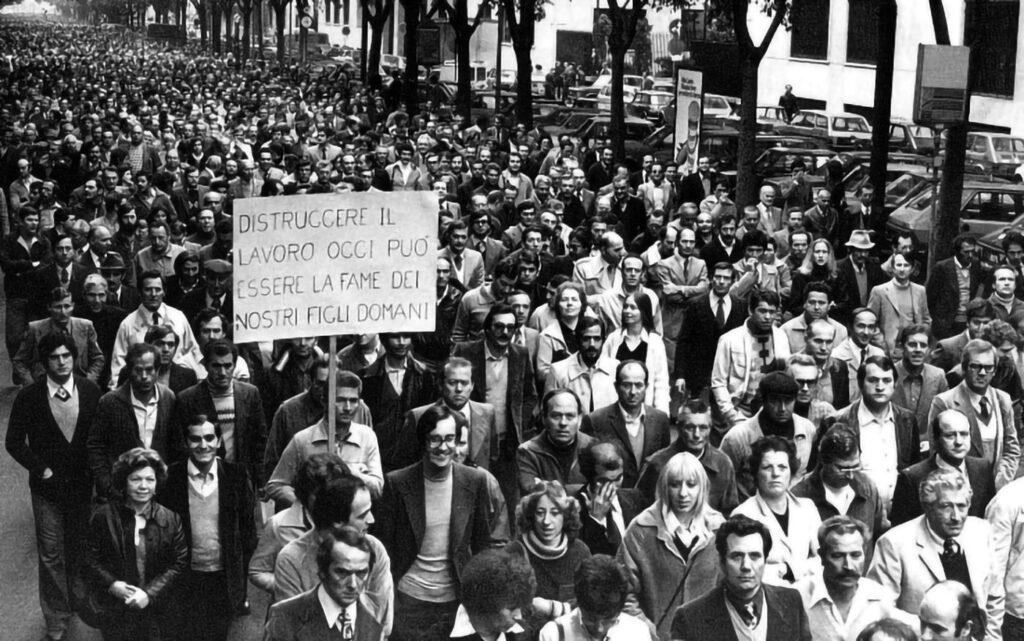
I want to warmly thank the four participants in this roundtable for taking the time to respond to my book and to Teddy Paikin for helping to bring the contributions together. It has been a great privilege to read such engaged replies. Each one drew my attention to crucial issues. While it has not been possible here to respond directly to each point raised, here are some initial reflections as part of what I hope will be a continuing conversation. My key focus has been on whether the 1970s in Britain, France, and Italy opened realistic alternative strategies for workers than the one their mainstream movements took. This question is important insofar as a rejection of determinist explanations of their late twentieth-century decline seems to have implicit within it the idea of missed opportunities.
All four respondents ask in different ways whether different strategies for socialist advance were available during the 1970s. Did the ‘Old Left’ really have a credible and deeply felt programme for socialist change? John Kelly argues that radical options in late 1970s Britain were limited, while Aurélie Andry suggests that betrayals by party and union elites say otherwise. Gerd-Rainer Horn recommends a more balanced view on white-collar workers and Nathan Crompton presses for more space for trade-union bureaucracies that leashed class struggles.
I respond to these interesting arguments in two parts. In the first section, I set out how my book is neither a counterfactual history nor a teleological account of decline. It contends that tactical decisions and strategic orientations, at certain moments, conditioned rather than determined the course of events. In the second part, I expand on the idea that working-class political institutions were both restructured by ‘modernisers’ and defeated by their times. During the 1980s, left-wing parties were recast by political entrepreneurs in an increasingly televisual age. But it took a concrete series of choices to centralise political knowledge, sideline physical spaces of political participation, and professionalise political communication. I finish by reaffirming the central thesis of my book that political history is linked to, though is not determined by, structural and cultural change.
Kelly argues that I am right to insist that the balance sheet of losses and gains for the European workers’ movement during the 1970s was far more positive than Eric Hobsabwm and the existing historiographical consensus assumed. He is less convinced by the presence in Britain of ‘even a rudimentary strategic programme for socialist advance’, let alone the availability of ‘more radical options’. For Kelly, organised labour lacked ‘supportive industrial and economic policies from government and of other measures to enhance workers’ power at the expense of employers’. This is a powerful and reasonable argument. Longer-term strategic thinking was indeed more rudimentary in Britain, though, as I show in the book, it could also be erratic and contradictory in France and Italy. The book argues, however, that the central political issue of the Left in those years was not only deficient programming or political imagination, but the inherent difficulty of realising the expectations of its new supporters whilst defending its embattled old battalions. Tactics mattered in such a context. Short-term and action-oriented choices did contribute to a sense of disarray in the workers’ movement.
To give just a few examples, why did the 1974 Labour government fail to fix the loopholes used by employers like George Ward to stymie unionisation? Even Shirley Williams and the two Labour cabinet members who attended the Grunwick picket line thought the government could have been more supportive. Did the French Communist mayor of Vitry need to use a bulldozer to evict hundreds of Malian guest workers in 1980? The French labour movement was not always as short-sighted. Did the leader of the Italian Communists have to call the student protesters of 1977 heirs to the fascist squadristi of 1919? Meeting minutes show Giovanni Berlinguer disagreeing with his brother Enrico, the party leader, on using such language. Decisions like these do seem to have undermined the coherence and credibility, because they disarticulated coalitions of the ‘old’ and the ‘new’. Tactical choices in the short term have longer-term conditions of possibility, but, in moments of transformation and conflict, they also have lasting consequences. All this goes to show that leadership matters at key junctures in history.
My approach is not to say political decisions determined everything or that changing social structures and cultures were irrelevant, but that the way the Left in Europe related to its supporters and sympathisers mattered a great deal. For example, it had several opportunities to integrate willing immigrant workers into their national coalitions. Why, then, did those in Britain and France choose at key moments to popularise ‘moral panics’ when they sought to unionise? One could say that the ‘old-left’ coalition was already unstable and incorporating marginal workers was unrealistic in the long run. But are not large coalitions always contradictory? The workers’ movement in Britain, France, and Italy had been rather successful at forging unity out of difference since 1968, as it had done previously in the great advances of the early 1910s and late 1940s. This history suggests that structural and cultural forces did not have automatic effects, no matter how powerful they were. In fact, the two forces which appeared later to have undermined the ‘Old Left’ in the 1970s had, in fact, contributed to its dynamism. Deindustrialisation and diversity came to be experienced as irresistible centrifugal forces only after a certain point. This could be because the Left in power had exhausted its available policy options by the end of the 1970s or because they had never really been tried. In any case, my concern was less the policy of states and employers alone than the strategies and tactics of social and political coalitions which internally constrained them.
Kelly writes that I am wary of ‘technologically verified knowledge’ on the basis that surveys and polls helped marginalise the ‘traditional labour movement mechanisms for discussion and policymaking’. Kelly is right in identifying a concern on my part. This is that new technocratic modes of politics contributed to the growing separation of leaders and citizens which Peter Mair termed ‘ruling the void’. There are lots of benefits of polling which I do not want to deny. However, it is historically significant that the dissemination of polling as a political technology seems to coincide with the growing importance of cultural over economic divides in society, and the growth of a more atomised body politic. In my research, I saw evidence of political professionals with few or weak links to the world of production or unions using polling to search for ‘alternative subjects’ who looked and sounded more like them. So, if there is a certain wariness, it is mainly when surveys are used in these kinds of specific circumstances.
Kelly questions the political significance of the Grunwick strike (1976–8). He notes that the dispute may have hardened Thatcher’s attitudes and undermined trade-union power but did not popularise her ‘neoliberal agenda’. He is right to say the public-sector strikes in late 1978 and early 1979 were a turning point for the Callaghan government and for Thatcher. However, it is also possible to believe that the Grunwick strike was key because the forces behind Thatcher’s anti-union drive passed their first major public test. It is also an interesting case because it shows immigrant workers striking for two years to join a supposedly ‘halted’ movement.
Kelly is also right to suggest that left-wing activists were unrepresentative of their societies on some issues. However, this was neither a problem specific to the late 1970s nor necessarily a sign of decline. Eric Hobsbawm highlighted in Age of Extremes that twentieth-century socialism was sustained by the faith of cadres whilst Stuart Macintyre noted that earnest minorities of the 1930s, ‘made up of a variety of trade union and labour activists and a sprinkling of Marxists, were at once representative of and strangers in their own society’.[1] Even though such activists could never be ‘ordinary’ people on account of their contacts outside their immediate communities with a wider world of conferences and books, they constituted a bridge between their movement and the society around them. The activists under discussion in the 1970s similarly worked through structured, hierarchical, and participatory institutions like trade unions, parties, and associations, but which were much larger and more powerful then than in the interwar years.
While Kelly is concerned with the representativeness of the activists I engage with, Horn spots that the Far Left makes ‘little more than a cameo appearance’ in my book, despite being a major player in certain social and political struggles. I studied the main parties in Britain, France, and Italy which workers joined, voted for, or were associated with, as the Far Left was rarely empowered with the same kind of responsibility. Horn is right to highlight that their activists helped to sustain spaces of grassroots and participatory democracy which he and other respondents identify as a key feature of the 1970s, and to suggest this area requires further research. Andry argues that my transnational method could have been better developed and regrets the lack of discussion of the ‘circulation of ideas and practices’ between left-wing organisations across Europe. Her work on multilateral and bilateral exchanges and French-Yugoslav connections shows how important these were. What Andry terms the ‘long-lasting cultural repercussions in delegitimising the state as a manager of the economy’ is a key development that also requires further study.
Horn also questions whether white-collar workers crowding out blue-collar leaders in the leadership of parties and trade unions made a significant difference to outcomes. Andry also suggests the benefits of a more ‘socio-historical’ and ‘prosopographical’ approach to analysing the sociological evolution of ‘activists, cadres and leaders’. They are both right to suggest that the transformation of cadres in general, and white-collar managerial and technical workers in particular, requires additional analysis and investigation.
All four respondents asked, in different ways, whether the leadership of the ‘Old Left’ had a credible and precise alternative strategy during the 1970s. Kelly draws attention to my statement that ‘the Left had more options available to it than supposed’.[2] This line refers to the numerous examples in the book where alternative strategies to the ones actually taken were advocated and promised. Though the constraints on the realisation of these proposals were real, they were plausible to many people, including antagonistic forces. The fact that millions of people did believe alternatives were possible shaped how people acted. However, the book was primarily concerned with establishing the necessary political – rather than only structural and cultural – conditions that checked the momentum of organised labour in Britain, France, and Italy during the late 1970s and early 1980s. All four respondents are right to think that its decline followed the preexisting absence of a credible alternative when conditions sharply changed. However, I also argue that certain short-term tactical decisions at key moments also helped to undermine both their existing strategic successes and the practical possibility of fully realising both minimum and maximum programmes. This is not least because they increased the plausibility of more conservative and less egalitarian solutions to the crises of the era. If I was to write the book again, I would have more precisely traced the concrete links between tactics, strategies, and programmes.
Horn, Andry, and Crompton fairly suggest that trade-union leaderships could have been given more space. Though several key passages discuss trade-union leaders who were leading members of left-wing parties, and Chapter 1 analysed the problems faced by worker activists in British, French, and Italian factories during a period of industrial restructuring, party-political leadership of organised labour remained the book’s central concern. Trade-union structures and debates are an important area for future inquiry.
I want to thank the four participants again for their very thoughtful contributions. If I was to begin again with greater freedom and space, I would spend more time on economic policy, white-collar workers, trade union leaders, international dynamics, and the radical Left. I hope my book encourages further study on the subject.
References
Macintyre, Stuart 1980, A Proletarian Science: Marxism in Britain, 1917–1933, Cambridge: Cambridge University Press.
Myers, Matt 2025, The Halted March of the European Left: The Working Class in Britain, France, and Italy, 1968–1989, Oxford: Oxford University Press.
[1] Macintyre 1980, p. 38.
[2] Myers 2025, p. 217.