The reception and dissemination of Karl Marx’s opus in Greece, in its first steps during the interwar period, is combined with the development of the nascent labour movement. Already before WWII, there were more several attempts to translate Das Kapital, whereas many of the minor ‘canonical’ works (Manifesto of the Communist Party, On the Jewish Question, etc.) had been translated and published in the form of brochures (or newspaper articles) for the benefit of the militant classes. The militant aspect of the translations, i.e., their instrumental incorporation into the realm of political praxis in the form of an exemplary discursive reference,[1] was a feature that would accompany the translations of the majority of Marxian works in the following decades.
Parallel to this characteristic reception of a body of classical theory and historical knowledge, it should be mentioned that, due to certain, mainly theological and partly philological, traditions, the concept of a ‘critical’ or ‘scholarly edition’ of a classical work would come in Greece only from the last third of the 20th century onwards.[2]
One consequence of this belated reception of a critical method concerning the interpretation and analysis of historically significant texts would be that Marx’s and Engels’ writings were in most cases studied without sufficient knowledge of their historical horizon, imposing therefore an uncritical (and often highly dogmatic) absorption of the ‘immediate’ meanings to be found on the surface of the text. It would appear that what Marx and Engels had tried to leave behind in their struggle for the formulation of a radical theoretical discourse, i.e., the abandonment of Katechismus, had regained its ground, at least in the Greek case.
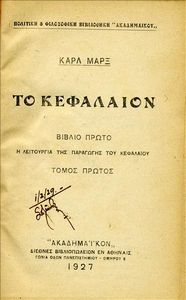
After the first unfinished attempts of translating Das Kapital in the interwar period,[3] the first complete translation of all three volumes (complemented later with the three volumes of the Theories of Surplus-Value, as the so-called fourth volume of Das Kapital) would be achieved in the first decade after the end of the Greek Civil War (1946–1949), in a twofold manner. On the one hand, the second Plenum of the Central Committee of the Communist Party of Greece decided on 12th October 1951 to commission the translation of Das Kapital, as well as the works of Lenin and Stalin. This decision was executed throughout the 1950s through a team of translators and editors, with Panagiotis Mavromatis serving as the main translator and head proof-reader for the Marxian translations.
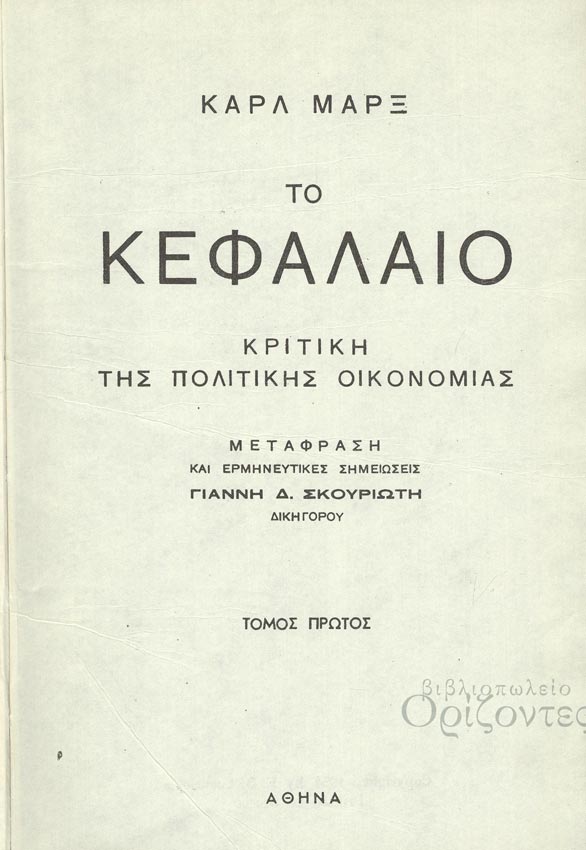
On the other hand, the lawyer Ioannis Skouriotis published, independently from the aforementioned team, in 1954, 1957, and 1960, in Athens, the three volumes of Das Kapital (‘with editorial notes’), trying to combine conceptual clarity with the so-called ‘demotic’ vernacular idiom. The result was formidable in its accomplishment but (today) as good as unreadable. Anyway, Skouriotis’ edition did not remain for long in the book market, leaving thus the so-called ‘Mavromatis translation’ (comprising also the Theories of Surplus-Value) as the sole translation of Das Kapital for the Greek public. This edition remained unchanged, even in its typesetting, for the rest of the century and into the current one.
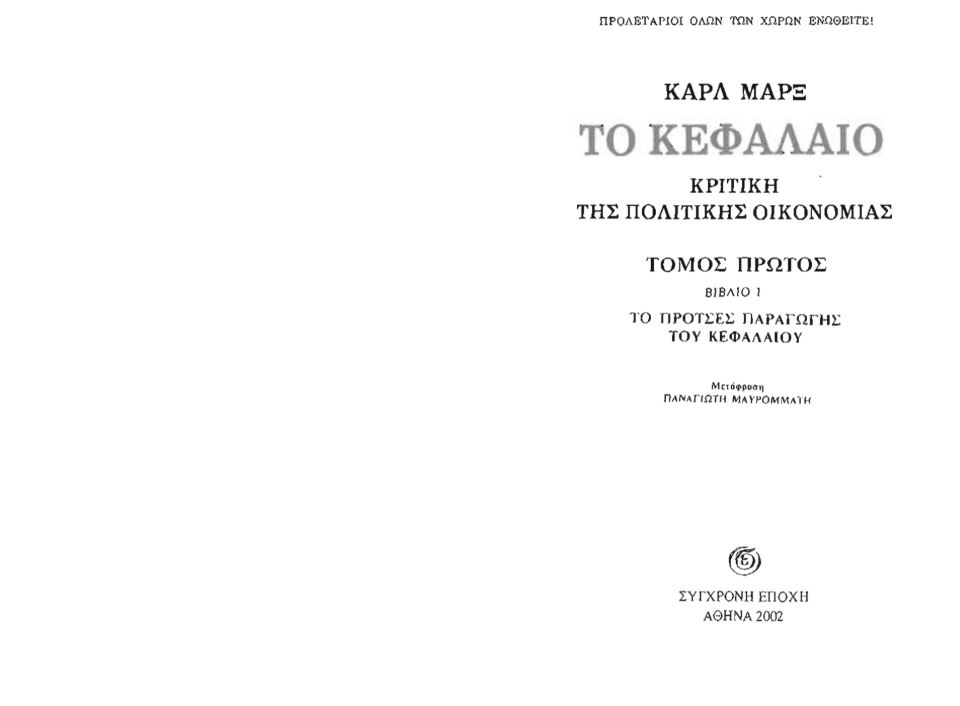
The ‘Mavromatis translation’ was, without doubt, a major achievement, considering not only the volume of the work but also, and mainly, the historical conditions of its realisation, as the Communist Party of Greece was outlawed and the entire editorial team had taken refuge in Romania and other countries of the Warsaw Pact. Yet it was inevitably, like any translation, a child of its time in its linguistic, as well as its stylistic and conceptual, aspects.
The fall of the dictatorship and the transition to a parliamentary regime in 1974 were accompanied by a boom in the book market, making it possible for many translations of several works by Marx and Engels to reach a wider readership. Expressive of the situation of the Greek Left since the split of the Communist Party in 1968, there were often two different translations of the same text published by the corresponding party publishers. However, none of these translations could be called ‘critical’ or ‘scholarly’ editions, since the main aim of these publications was, understandably after decades of persecution, the dissemination of certain ideas to the potentially or actually militant sections of the public. These translations continued to constitute the bulk of the work of Marx and Engels in Greece for the rest of the century.[4]
In the early 2000s, a significant need had emerged for scholarly translations of classical works such as the texts of Marx, at least for the purposes of university teaching (the possibility of incorporating Marx into the curriculum being one of the gradual outcomes of the regime change). Around that time, a team of university teachers in the Faculty of Political Science at the University of Crete decided to undertake an effort to translate Das Kapital anew, building on the new linguistic, conceptual, and theoretical possibilities that had matured during the last third of the 20th century, as well as the fruitful international discussions about the structure and development of Marx’s work, with the main purpose of facilitating the educational needs of university courses.
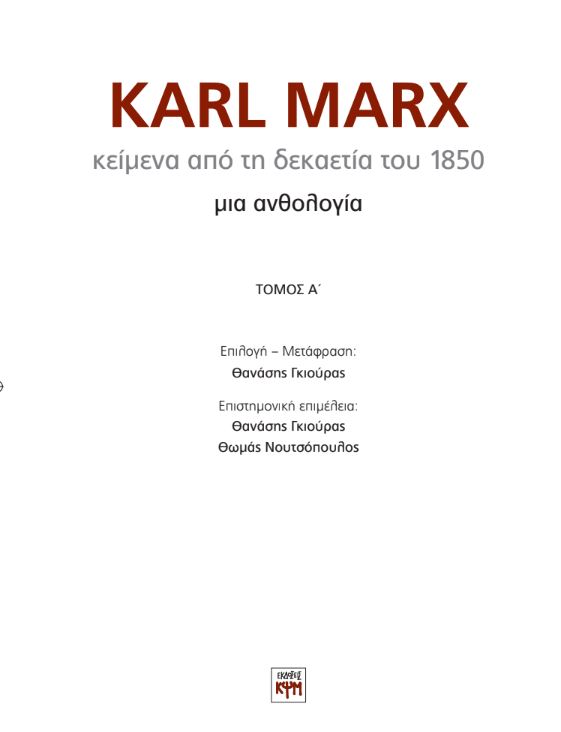
In line with that decision, a member of the team, Thanasis Giouras, translated a number of ‘canonical’ Marxian texts from the early period, such as On the Jewish Question, Critique of Hegel’s Philosophy of Right. Introduction, and others, and decided to publish an anthology of Marxian texts from the 1840s. This was the first time that a translation of Marx (and Marx alone, as no texts of Engels were incorporated in the anthology) was based on the MEGA: the 1844 Manuscripts were published in their original form, with the double and triple columns. Moreover, the chapter on Feuerbach from the so-called German Ideology (Deutsche Ideologie) was published according to its original form, as it had recently appeared as a preprint in the Marx-Engels Jahrbuch.[5] In order to facilitate this undertaking, Giouras contacted the MEGA research office at the Berlin-Brandenburg Academy of Sciences and Humanities in Berlin. This marked the beginning of a lasting collaboration, as the new head of the research office, Gerald Hubmann (who had succeeded Manfred Neuhaus), embraced the project, giving it his full support. The Marxian Anthology of the 1840s was published in Athens in 2014.[6] All the translations were made by Thanasis Giouras, and the edition was produced by him in close collaboration with Thomas Noutsopoulos, a member of the aforementioned team. The volume contained the following ‘canonical’ as well as lesser-known texts in Greece:
- Remarks on the Latest Prussian Censorship Instruction (Bemerkungen über die neueste preußische Zensurinstruktion)
- The Leading Article in No. 179 of the Kölnische Zeitung (Der leitende Artikel in Nr. 179 der Kölnischen Zeitung)
- The Philosophical Manifesto of the Historical School of Law (Das philosophische Manifest der historischen Rechtsschule)
- Debates on the Wood Theft Law (Debatten über das Holzdiebstahlsgesetz)
- Critique of Hegel’s Philosophy of Right: Introduction (Zur Kritik der Hegelschen Rechtsphilosophie. Einleitung)
- On the Jewish Question (Zur Judenfrage)
- Letters from the German-French Yearbooks (Briefe aus den Deutsch-Französischen Jahrbücher)
- Paris Manuscripts (Pariser Manuskripte)
- Notes on James Mill, Elements of Political Economy (Notes on James Mill, Éléments d’économie politique)
- Critical Marginal Notes on the Article “The King of Prussia and the Social Reform” (Kritische Randglossen zu dem Artikel “Der König von Preußen und die Sozialreform“)
- To Feuerbach (Ad Feuerbach)
- Feuerbach and History: Draft and Notes (Feuerbach und Geschichte. Entwurf und Notizen)
- Manifesto of the Communist Party (Manifest der Kommunistischen Partei)
- Demands of the Communist Party in Germany (Forderungen der Kommunistischen Partei in Deutschland)
- The Conflict between Marx and the Prussian Subject Population (Der Konflikt zwischen Marx und der preußischen Untertanenschaft)
- The Bourgeoisie and the Counter-Revolution (Die Bourgeoisie und die Kontrerevolution)
- The Trial against the Rhenish District Committee of the Democrats (Der Prozeß gegen den Rheinischen Kreisausschuß der Demokraten)
- The Billion (Die Milliarde).
The volume also included seven letters from Marx (to his father, to L. Feuerbach, to Anenkow, and to Freiligrath), as well as two appendices: Friedrich Engels’ pivotal text Outlines of a Critique of Political Economy (Umrisse zu einer Kritik der Nationalökonomie) and the lesser-known text by Moses Hess, On the Monetary System (Über das Geldwesen).
Two ‘spin-off’ publications were produced based on this anthology: The Manifesto of the Communist Party (of which there are multiple translations in Greece) was published in 2018 as a brochure, with a concise foreword by Thanasis Giouras. In 2019, two important newspaper articles by the young Marx were published as a brochure (again, with a foreword by the same translator). While Marx’s article on wood theft (Debatten über das Holzdiebstahlsgesetz) was included in the anthology, the brochure version paired this text with the article about the vine-growers of the Mosel region (Rechtfertigung des Korrespondenten von der Mosel), which had not previously been published in Greece.
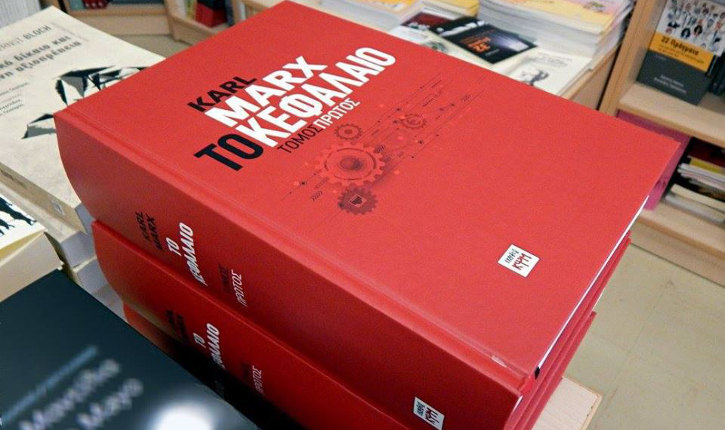
At the same time, the translation of the first volume of Das Kapital was underway, and the final structure of the volume took shape by the end of 2015. Drawing on the findings of contemporary Marx research, this edition aimed to present Marx’s work as an ongoing process rather than a fixed conceptual system.[7] The volume was conceived as a kind of ‘toolbox’ for research on Das Kapital, highlighting the fact that Marx continually refined and rewrote many parts of the first volume across the various editions published during his lifetime.
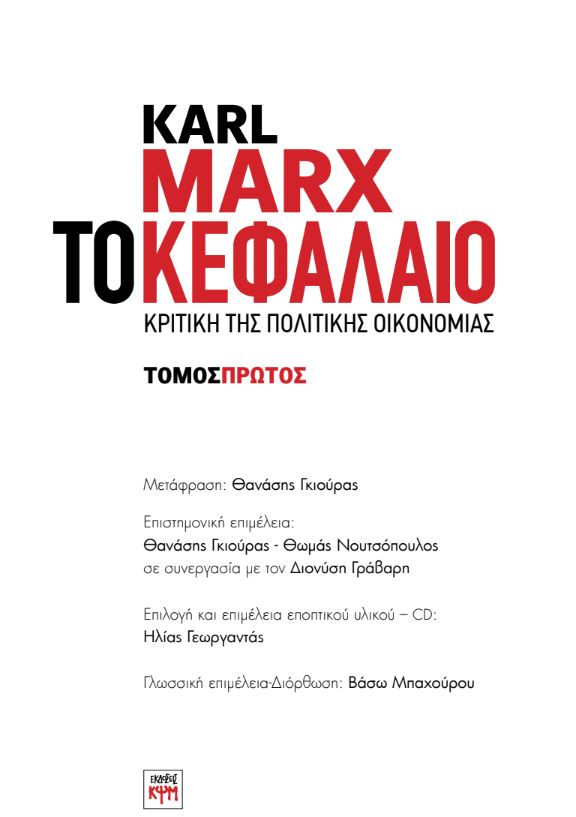
Accordingly, the volume was constructed as follows: the main basis for the translation was the text of the third German edition (1883), including Marx’s notes for that edition. To provide a broader picture, the German editions of 1867 and 1872 were also taken into account, along with the French edition of 1875. As in the Anthology of the 1840s, it was clear that it would not be appropriate, in the context of a translation, to adopt the method used in the MEGA, where all corrections and editorial notes are placed in a separate volume (Apparat). For this reason, all editorial notes were included in the footnotes. The volume contained five appendices:
- I) All citations originally written in a language other than German (i.e. English, French, Italian, Latin, and Ancient Greek) are presented in their original language.
- II) The first chapter from the first edition of Das Kapital, titled Ware und Geld (Commodities and Money), along with the appendix from the same edition titled Die Wertform (The Value-Form).
III) Marx’s corrections and revisions for the second edition, first published in MEGA II.6 under the title Ergänzungen und Veränderungen zum ersten Band des ‘Kapitals’ (Dezember 1871–Januar 1872) (Additions and Changes to the First Volume of ‘Capital’ [December 1871–January 1872]).
- IV) The majority of Marx’s modifications and additions from the French edition, especially those concerning the fetishistic character of the commodity, the elaboration of the distinction between productive and unproductive labour, the reformulation of the theory of relative surplus population, and his analysis of the cyclical nature of capitalist development.
- V) Friedrich Engels’s editorial notes and prefaces from the editions of the first volume he prepared after Marx’s death.
The volume was also accompanied by a DVD containing more than a thousand 19th-century photographs, depicting various aspects of the critique of political economy, ranging from factory work, cotton fields, and coal mines to colonial settings and the wars that shaped the formation of nation-states. The photo collection, complete with detailed editorial notes for each image, is a remarkable work in its own right.
All translations were carried out by Thanasis Giouras, and the scholarly editing was done in close collaboration with Thomas Noutsopoulos and Dionysis Gravaris. The careful curation of the photograph collection, titled Icons of Capital, was undertaken by Elias Georgantas. Corrections were made by Vaso Bachourou. The edition also included a greeting note from Gerald Hubmann.
Throughout the translation process, the members of the MEGA research office in Berlin were consistently available to offer support and guidance. The final result draws on the findings of contemporary Marx research, while also making use of the expressive potential of the Greek language in the field of social scientific inquiry. It avoids dogmatic constraints regarding the historical depth of certain concepts and expressions. In this context, the preparation process even led to moments of genuine surprise. For example, during the compilation of the volume, a seemingly minor detail came to light.
In a footnote in the chapter Division of Labour and Manufacture, there are three citations in Greek. One of them, ‘παρ’ ὧν γὰρ τὸ εὖ, παρὰ τούτων καὶ τὸ αὔταρκες’ (‘For with the latter there is well-being, but with the former there is independence’), was repeatedly attributed in various editions to Thucydides, as was the second citation found in the same phrase.[8] However, during the process of cross-checking the material for the volume, it was discovered that the phrase in fact originates from the work of Proclus Lycius, On Plato’s First Alcibiades (Εἰς τὸν Πλάτωνος Πρῶτον Ἀλκιβιάδην). Marx had come across the quotation in an appendix to James Harris’s Three Treatises, the third edition of which was published in 1772. It was in this edition alone that Harris added an appendix containing excerpts from various Greek manuscripts, ‘partly to explain, partly to give the Reader a Specimen of certain Works, valuable for their Rarity, as well as for their Merit’.[9]
After the publication of the Anthology of the 1840s and the first volume of Das Kapital, the situation unfolded much as Marx once wrote to Engels regarding his entanglement with the International Association: ‘once one says A, one must also say B’ (‘Man muß B sagen, sobald man A gesagt)’.[10] It became clear that a Marxian anthology of the 1850s was also necessary.
For this new collection, the support of the MEGA staff was invaluable, particularly in relation to the newspaper articles, with the assistance of the late Claudia Reichel, and the letters. Guidance was also offered for texts that had not yet been published in the MEGA. The Anthology of the 1850s was planned on a significantly larger scale than the volume devoted to the previous decade. It included 72 newspaper articles, mainly from the New York Daily Tribune but also from the Oder Zeitung, including all the articles on Revolutionary Spain, 25 letters from Marx, and three appendices.
The volume also featured ‘classical’ texts such as Class Struggles in France (Die Klassenkämpfe in Frankreich), The Eighteenth Brumaire of Louis Bonaparte (Der achtzehnte Brumaire des Louis Bonaparte), the Urtext of 1858, and selected excerpts from the Grundrisse. A number of works were translated into Greek for the first time, including Enthüllungen über den Kommunisten-Prozeß zu Köln (Revelations on the Communist Trial in Cologne), Lord Palmerston, Lord John Russell, and the infamous Revelations of the Diplomatic History of the 18th Century (Enthüllungen aus der diplomatischen Geschichte des achtzehnten Jahrhunderts). The anthology was published in two volumes in 2018. The translation was undertaken by Thanasis Giouras, with Thomas Noutsopoulos contributing to the editing of the Grundrisse and the Urtext.
After the publication of the Anthology of the 1850s, the next step focused once again on Das Kapital. Since the second section of the MEGA, containing all the manuscripts of Kapital, had been completed in 2012, the decision was made to introduce the Greek public to this aspect of Marx’s work, an aspect that was largely unknown in Greece. Accordingly, the so-called Manuscript 1865, the first manuscript for the second volume of Kapital, was translated and edited by Thanasis Giouras (based on MEGA vol. II/4.1) and published in 2021. This edition was one of only a few published worldwide, but it will be some time before it gains any notable recognition.
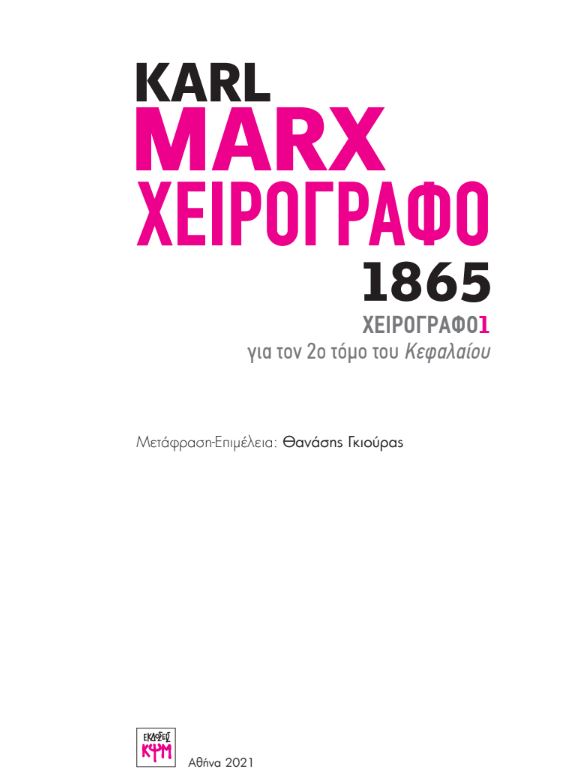
Up to 2021, all of the aforementioned translations were published by the Athens-based publishing house KAPSIMI, with invaluable assistance from Dimitris Govas, who was the production manager at the time. The next publication came from Kastaniotis Publications and was a new translation of Misère de la philosophie (Poverty of Philosophy), released in 2024. This translation was based on the French original as well as the first German translation by Karl Kautsky and Eduard Bernstein.[11]
All in all, the cooperation with the MEGA has brought about a paradigm shift in how Greek readers relate to and engage with Marx’s monumental works. It has produced translations and editorial materials of modern scholarly quality, facilitating not only the teaching of Marxian texts at the university level but also a deeper overall understanding and evaluation of his critical contributions. Yet it remains to be seen how the public, meaning in this case what Marx called ‘a reader who is willing to learn something new and therefore to think for himself,’ will engage with this material. In any case, the effort will continue.[12]
Go back to the main page: ‘Dossier: Marx, MEGA and MEGA-Marx’
Notes
[1] For a detailed analysis concerning the Greek translations of the Manifesto of the Communist Party, see C. Delistathi, ‘Translation as a Means of Ideological Struggle’, in Translation and Opposition, ed. D. Asimakopoulos and M. Rogers, Multilingual Matters, 2001.
[2] There was a project for a critical edition of ancient Greek writers at the beginning of the 19th century by Adamantios Korais; however, it remained an isolated project.
[3] The most significant of these was the undertaking by the brothers Dimitrios and Andreas Pournaras in the 1920s, who organised a ‘committee of scientists’ to translate all three volumes of Das Kapital from the French translation by Jacques Molitor. However, only the first volume and part of the second made it to the printer.
[4] Notable exceptions include the following translations: Marx’s Results of the Immediate Production Process (trans. E. Migadi, A/Synechia Publications, 1983); the first chapter of the first edition of the first volume of Das Kapital, together with the appendix Die Wertform (transl. G. Stamatis, Kritiki Publications, 1991; this was the first scholarly edition of a Marxian text in Greece); and the Grundrisse (transl. Dionysis Divaris, in the early 1990s, published by Stochastis).
[5] Karl Marx, Friedrich Engels, Joseph Weydemeyer, ‘Die deutsche Ideologie. Artikel, Druckvorlagen, Entwürfe, Reinschriftfragmente und Notizen zu I. Feuerbach und II. Sankt Bruno’, Marx-Engels-Jahrbuch, 2003, Berlin.
[6] The volume was published by the Kapsimi Publishing House.
[7] For more information on the editorial principles of MEGA, see the HKWM entry on the subject: https://www.historicalmaterialism.org/article/mega-from-the-historical-critical-dictionary-of-marxism/
[8] Cf. Marx, Capital, transl. Ben Fowkes, Middlesex: Penguin, p. 487, ft. 56; Marx, Kapital [1872 edition], MEGA, vol. II/6.1, p. 359, ft. 79; Marx, Capital, Marx-Engels Collected Works, vol. 35, Moscow: Progress Publishers, p. 370-1, fn. 3 and 3a.
[9] For a detailed analysis, see Thanasis Giouras ‘Über eine nicht nachgewiesene Zitatstelle im ersten Band des Kapital’, Marx-Engels-Jahrbuch 2012/13, pp. 286-92.
[10] Friedrich Engels, ‘Engels an Marx. 13 März 1865’ in MEGA, vol III/13, p. 327.
[11] Since only the German translation, along with Engels’ foreword, had been published in the MEGA (vol. I/30), Ulrich Pagel, the member of the research office responsible for editing the volume containing the French original, kindly shared editorial information with the Greek translator, Thanasis Giouras.
[12] Translations of various textual resources, including MEGA, and anthologies from the 1860s and 1870s (up until Marx’s death in 1883), comprising newspaper articles, political pamphlets, letters and notebook material are completed, but remain unpublished as no publisher has yet been secured.