With the passage of time, narratives about history can become vernacular truths. A historical shorthand can burrow itself deep within the political unconscious. Received assumptions about the rise of neoliberalism are today no exception. Much has been said about neoliberalism’s supposed inevitability, born out of structural factors with deep roots in the social and economic order of the early and mid-twentieth century. Frameworks of decline, as part of a historiography now several decades in the making, tell us that neoliberalism came into existence following the structural weakening of the industrial working class. Postwar capitalist society, entering a secular period of stagnation and deindustrialisation as early as the 1960s, was the chronicler of a death foretold.
A second, more cultural element combined with objective processes in order to disperse the working class and usher in an era of postindustrial society. This shift, the story goes, was rooted in habits of consumption, individualism, and identity, replacing older networks of class solidarity. These two overlapping foundations – economic and cultural-ideological – conspired to dismantle the postwar social contract. Economic forces were ostensibly bolstered through ideological shifts underwritten by a growing loyalty to racial, gendered, and cultural identities, instead of class loyalties. It is in this way that the ‘short twentieth century’, Eric Hobsbawm’s framework for the sequence initiated with the Russian Revolution, eventually ended with the collapse of the Soviet Union in 1989–91. In short, working-class upsurge brought promise in the short twentieth century but declined before truly being given a chance to blossom.[1]
It is this short twentieth century, and, in particular, its denouement of the 1970s, that undergoes significant re-evaluation in historian Matt Myers’s 2025 book, The Halted March of the European Left: The Working Class in Britain, France, and Italy, 1968–1989. By 1978, theoretical and historical figures like Hobsbawm were already beginning to speculate on the notion of a shortened twentieth century. Hobsbawm was among Britain’s most eminent historians, armed with a lifelong commitment to Communism. But he was also a pessimist with a penchant for labour sociology and a declinist temptation that became gradually more apparent in his later writings of the 1970s.
In 1981, Hobsbawm asked whether labour’s forward march had been halted.[2] Myers takes this question as his own useful starting point, carefully measuring the sociological pessimism of Hobsbawm and others against empirical foundations. He does not doubt the subjective impression of a decline in the minds of workers and intellectuals in the closing years of this period, beginning in the mid- to late 1970s, and much of the book gives attention to first-hand accounts of a crisis of faith among sections of labour and the European Left. But Myers also reveals the surprisingly belated and relatively muted nature of these sentiments at the time, which multiplied only retroactively: theories of objective decline arrived late, and only after a series of defeats following a wave of strikebreaking in Britain, France, and Italy from 1978 to roughly 1984.
Indeed, for much of the 1970s, the growing strength of the working class seemed irreversible, accompanied by an ambient and pervasive sense that history was moving in the right direction. As Jean Baudrillard asked in 1978, forgetting to knock on wood: ‘Is there an objective law (a sort of machine that is put in motion with history), a law of inertia that nevertheless works for the left, whereas it has always up to now worked only for the Right?’[3] On the part of labour, the workers’ movement was undergoing an expansion both in absolute terms and in the diversity of its composition. The traditional working class found itself enriched on both its margins: from below, the expansion of what the Italian workerists called the ‘mass worker’, comprised of youth, migrants, and working-class women who filled positions within heavy industry as well as a growing postindustrial economy and service sector; from above, the growing politicisation of wage-earning cadres, engineers, and technicians who might have once existed solely on the side of capital and the employer class, but were increasingly joining the trade unions and were viewed optimistically by radical labour sociologists like Serge Mallet, Pierre Belleville, and others. ‘Today’, Ernesto Laclau said in 1979, ‘the European working class is [still] increasing its influence’.[4]
With detail and precision, Myers explodes the myth that the 1970s were a lost decade for the European working class. By nearly every metric, the 1970s were, in fact, closer to a ‘golden decade’ for workers in France, Italy, and Britain, with the highest standard of living and the lowest levels of wealth inequality of any other decade in the twentieth century and since.[5] Through national and inter-union coordination, recurring strike waves, and everyday shop-floor militancy, workers fought for and won a higher share of GDP than ever previously obtained. ‘If any period deserves to be seen as the “golden age” of the working class’, writes Myers, ‘it was the 1970s’ (p. 14).
The decade also saw workers pushing beyond the received limits of social democracy and the narrowly redistributionist paradigm of Keynesian political reason and macroeconomic planning. Genuine workplace control and self-management, not simply a higher share of national income, were on the agenda for European workers:
Directly elected workplace delegates grew in numbers and prestige in France and West Germany. The number of Italian factory councils far outpaced the official union machinery of the Internal Commissions (Commissioni interne), especially in the engineering industry … Work-ins at the Upper Clyde Shipbuilders in Britain, self-managed cooperatives at the LIP watch factory in France, alternative workers’ production through the Lucas Plan in Britain, effective vetoes by joint shop stewards committees and factory councils of management directives in European car and engineering plants, and plans to convert business profits into stock held by wage-earner funds in Sweden testify to the creative power workers felt able to assert during the 1970s. Prominent intellectuals feared for the future of the West if an ‘excess of democracy’ was not curtailed. (pp. 17–18)
The movement for higher wages and greater job control also went hand in hand with a growing welfare state. Despite clear signs of economic slowdown and layoffs already in the early 1960s, the 1970s saw the highest rates of social spending of any decade in the twentieth century, from healthcare and housing to sports facilities and community centres. All told, the 1970s were a period of deepening gains in labour’s forward march. So, what went wrong? How do we make sense of labour’s ‘halted march’?
The identity thesis
Before considering Myers’s account of the shared balance sheet of various left governments in power across Europe, it is useful first to assess a secondary yet increasingly dominant account of neoliberalism’s rise. The latter is summed up in what might be called the identity thesis, referring to the supposedly unprecedented and all-encompassing rise of identity and identity politics in the 1970s. In Western Europe, explanatory frameworks of economic determinism were set in motion almost immediately after a wave of strikebreaking led to a series of shop-floor defeats at the turn of the 1980s. Cultural explanations, however, have, arguably, gained more traction in recent literature. Such explanations have attempted to frame working-class feminist, immigrant, anti-racist, and parallel social movements as a regrettable and diversionary turn away from class struggle and working-class organisation.
A closer look at the historical record of the 1970s shows that immigrant, anti-racist and women’s movements originated from within the postwar workers’ milieu of Western Europe in this period – not in opposition to it. Myers demonstrates the extent to which these movements significantly expanded trade-union density, swelling the ranks of Europe’s largest progressive, social-Catholic, and Communist trade unions starting in the late 1960s and early 1970s. These workers also supported and widened the workers’ movement through unofficial actions and quasi-formalised bodies ranging from wildcat strikes and shopfloor ‘counter-planning’ initiatives to the French action committees (comités d’action) and other forms of non-hierarchical self-organisation in the workplace. In short, the activity of once-marginalised workers constituted one of labour’s most dynamic and militant sectors over the course of the 1970s.
Soundbites and optics of working-class decline crash up against a rich historical context of escalating labour antagonism and political vitality in this period, enriched by Myers’s examination of original archival material and wide-ranging case studies across Britain, France, and Italy. Theories of objective decline only make sense if viewed through the lens of a narrowly defined proletariat. In France, this numerically plateaued or stagnant section of the proletariat was classically understood by the French Communist Party (PCF) as the white, male, blue-collar industrial worker. In essence, a relative decline in this portion of the class was mistaken for a decline of the class as a whole.
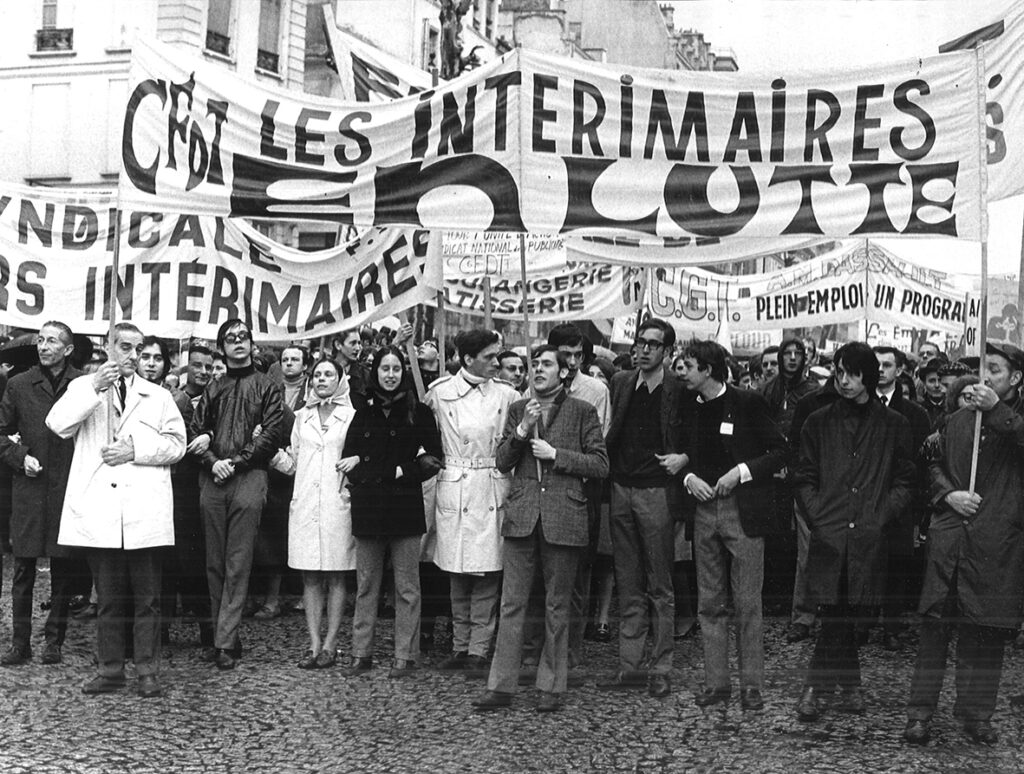
Rigorous archival and historiographic engagement with the Italian, French, and British experiences throughout The Halted March helps strengthen the picture of a deep commitment to trade unionism and workplace struggle on the part of new layers of workers across Western Europe. In the French case, this claim is perhaps even more true than Myers himself demonstrates. This is partly because The Halted March pays comparatively less attention to the role of the Confédération française démocratique du travail (CFDT) in the 1970s than the Communist-aligned Confédération Générale du Travail (CGT), France’s second-largest and largest trade unions respectively. At the time, sociologist Alain Touraine described the CFDT as a ‘political lever of the new social movements [opérateur politique des nouveaux mouvements sociaux]’.[6]
It should garner serious historical attention that these social movements emerged from within the world of labour, deeply embedded in the daily activities of union sections, strike committees, general assemblies, and the factory floor. In both practical and theoretical terms, the social movements of the 1970s contributed to an intense reflection on questions of class composition and the hierarchical stratification of the French workforce. Throughout the 1970s, capital’s social process of organisation and reorganisation was brought to new, advanced heights amidst an escalating class conflict. The latter amounted to a crisis and a problem for capital, in response to which automation and restructuring were put forward as urgent and often desperate answers.
Such processes of industrial reorganisation and crisis planning were impossible to grasp without also understanding the content of capital’s instrumental relation to hierarchies of race and gender. For this reason, race and class formed an essential component of a new class composition emergent in the 1970s. In France, the CFDT gradually registered the significance of these shifts. By 1973, the trade union endorsed ‘the deconstruction of the classic image of the union militant: skilled worker, adult, male and white’.[7] As the decade unfolded, new entrants into the working class continued to be associated with the most vital sources of class conflict and political self-organisation across France.
As mentioned, the class as a whole was supposed to be expanding from two margins simultaneously, both from above and from below. Yet, as the 1970s drew to a close, fidelity to the cause was increasingly and disproportionately carried from below. Engineers, middle managers, technicians, and foremen increasingly sided with their employers, dividing the class in a painful series of splits and betrayals. This was felt acutely during a wave of strikes launched by immigrant automobile workers in the early 1980s, deftly explored by Myers in later sections of the book (pp. 131–7, 154–62). The French state, now in the hands of a PS-dominated left majority, attempted to put an end to the strikes. ‘PS [Socialist Party] ministers’, concludes Myers, ‘in effect marginalise the most dynamic sector of the working class in France during the 1980s’ (p. 162).
On the one hand, a retrenched and increasingly managerial left elite taking the reins now prepared to govern on behalf of French capital; on the other hand, a steady combativity emerged on the part of migrant workers. Two social forces, partially aligned as recently as 1979, soon moved in opposite directions. The Socialist offensive against auto workers in the years 1982–4 was not inevitable. Among other things, it came on the heels of a years-long rent strike organised in migrant hostels across France which demonstrated internal contradictions for the Left but also points of unity.[8] The rent strike culminated in a nationally publicised fight for workers’ housing in Garges-lès-Gonesse in northern suburban Paris in 1979.[9] Workers evicted from their Garges hostel launched a high-profile encampment in front of the building. Solidarity poured in from across France, including a public pronouncement of support by the Socialist Party itself and an in-person delegation to Garges led by Mitterrand.[10]
Part of the reason for the popular outpouring of support for the evictees at Garges was the feeling that a wider social conflict had come to a head. Repression at Garges was viewed as the Giscardian government’s ‘testing’ of a possible new hardening of its strategy – a test that would pass if it were not resolutely opposed and overturned. Revolutionary communist and journalist Monique Cheran put it like this: ‘What is happening in Garges is a sort of test in the implementation of an arsenal of particularly repressive, racist laws against immigrant workers’.[11] On the ground, strikers felt that defeat at Garges would be fatal. As one striker put it in an interview with Libération: ‘We are not desperate, far from it. But we know that if we lose here, we lose everywhere’.[12] This speaks to what Myers rightly insists were epoch-defining struggles in which defeat or victory, in punctuated and pivotal moments, would have profound and lasting effects.
The Left against labour?
Myers demonstrates the relative strength, confidence, and often revolutionary optimism of the post-’68 decade. He does so not only by pointing to the objective position of the working class after several decades of concrete gains, but also by assessing the perceptions and ideas expressed by a large number of workers and their organisations. Myers gives voice to the millions of European workers who genuinely looked favourably on a set of conjunctural openings and opportunities in the 1970s. To accomplish this, he surveys an extremely large range of primary and secondary literature from seven countries, drawing on 27 separate archives in multiple languages. He also draws on oral history interviews, memoirs, and other first-person accounts.
Seen from the perspective of the parties of the Left, the story of the 1970s is one of paradoxical success. Across the decade, this Left was elected in country after country, placed in the driver’s seat of coalition governments or in positions of majority government never before witnessed since these parties were founded in the era of the Second and Third Internationals. At precisely this same moment, vocal and increasingly coordinated layers of capital found themselves in the urgent position of fighting – openly and without illusions – for their very survival. Myers draws attention to a series of high-stakes conflicts at the end of the decade and the beginning of the 1980s during which capital launched a counterattack through business-friendly newspapers, employers’ associations, and ruling-class networks.
Why did conservatives and political reactionaries, Myers asks, write so ominously and fearfully of the impending socialist threat in this period? Civilisation itself hung in the balance. If the working class could not be brought to heel, the entire system of property, family, and nation risked implosion. If the 1970s were a decade of prefigured defeat, melancholy, or withdrawal for the Left, why did the forces of capital take the threat of the left and its project so seriously? In France, the year 1971 marked the beginning of what came to be known as the ‘long and hard strikes [grèves dures]’, as part of a wider post-’68 strike wave that lasted for nearly a decade. ‘Big business [le grand patronat]’, remarked PCF member and retired miner Jean Clauzel in 1982, ‘[had] the feeling that they could forever lose their thousand-year-old privileges’ (quoted in Myers, p. 74).
Bourgeois fear-and-trembling was not alleviated with the closing of the 1970s. France witnessed the eruption of a further sequence of strikes, including a strike wave of immigrant automobile factory workers in the years 1982–4. In televised media and the wider public sphere, capital attempted to regain the upper hand through a series of moral panics and aggressive Islamophobia that exploited popular fear and resentment on a backdrop of looming unemployment, automation, and flagging rates of growth. Mitterrand’s governing Socialist Party made itself into a conduit and architect of racialised moral panic while initiating a process of labour ‘reform’. These reforms, associated with the Auroux laws passed in 1982, assisted the state in undercutting organised labour and halting the gains of the middle half of the twentieth century.[13] Fused into a powerful historic conjuncture, this was one of the great moments of betrayal that would help prepare the foundations for the resurgent Far Right.
In offices ranging from municipalities and communes to the presidency itself, parties of the electoral Left – Social-Democratic, Socialist, and Communist alike – all painted themselves into a shared corner. Each party had spun a web that was a complex creation of their own making, and not merely a structural eschatology with its own objective laws and unilateral history. Myers demonstrates that electoral opportunism and the ossification of party apparatuses were neither accidental nor inexorable, but the logical outcome of a set of choices and errors – in this case, the long-term process of PCF and PS centralisation, bureaucratisation, and professionalisation (see pp. 71–81). Strategies and technologies of internal governance within the parties, employing modern techniques of polling and communications, are the focus of Chapter 3 of the book (‘Intellectual Dissidence and the Privatisation of Politics’, pp. 90–119).
Force and actuality
Throughout the book, Myers revisits the structural melancholy of the determinists. This discourse was frequently marked by an unacknowledged retrospective character, assembled after the fact by commentators and intellectuals, excessively detached from the thoughts, words, and actions of contemporary actors on the ground. Myers sums up his project in this way: ‘The declinist narrative was primarily a retrospective projection whose plausibility grew only after a concentrated series of high-stakes conflicts’ (p. 210).
Myers reads worker testimonies, correspondences, newspapers, and internal documents of the trade-union movement to reveal a complex sense of contradictory momentum, often interspersed with an optimistic progressivism. This sentiment was, at times, prone to complacency, a danger for those who assumed themselves to be swimming with the tide of history, as Walter Benjamin reminded us in his ‘Theses on the Philosophy of History’ (1940).[14] Interestingly, and potentially more surprising for certain readers, Myers also explores a defeated and alarmist discourse of decadence on the part of economic elites. Left-declinist narratives are placed side by side with an equally adamant sentiment held by employers and governments that organised workers were on the verge of destroying liberal-democratic society tout court. ‘Communist revolution has started in France’, wrote a group of Citroën managers in 1983 in response to the country’s striking immigrant workforce (p. 135).
For at least seven straight years, from 1968 until roughly 1975, automobile employers across France responded to demands from below with recurring wage increases.[15] Yet workers at firms like Renault and Citroën were fighting for something deeper. On questions of control, working conditions, management, and ownership, workers held a set of demands and expectations that ‘[couldn’t] be bought off by the bosses [des luttes que le patronat ne pourra plus acheter]’.[16] Throughout The Halted March, this gridlock of labour and capital operates as a revelatory and provocative counterfactual: if labour really was in such a weak position, why did capital appear to be fighting for its life?
Myers forces us to rethink old assumptions about the inevitability of labour’s decline in the face of structural and conjunctural forces supposedly operating beyond its control and behind its back. These objective processes are not ignored or denied by Myers, but placed within a constellation of subjective and objective totality. He repeatedly brings our attention back to what both sides of the class relation regarded as watershed moments – namely, the epoch-defining character of the labour strikes of the period. In this way, Myers writes the history of class defeat from the perspective of class conflict.
This approach diverges markedly from much of the recent historiography on neoliberalism. Today’s dominant interpretations of neoliberal ascendancy tell the story of a working-class concealment, subjected to a kind of vanishing act: an eclipse but not a defeat. These histories paint the picture of a gradual but inevitable decline, recast in a passive register that strips history of its subjective element. In doing so, they remove the determinate content of any actual defeat (defeat or victory being the phenomenon which, by necessity, accompanies any material conflict of forces). As such, these are also not class histories, given their willingness to write the history of neoliberalism with only the rarest direct appearance of the labour-capital antagonism. As I hope I have indicated, Myers’s work can be counted as a compelling corrective to this dominant and pervasive tendency.
This does not mean that The Halted March consists in a blindly voluntarist overcorrection. The force of political economy persists in all its scale and inertia, but is now embedded in social relations that sustain, shape, and sometimes transform it. Despite Marxist inflections, workers’ actions and labour strikes feature surprisingly little in much of the historiography on the neoliberal turn. The direct conflict between labour and capital is somehow absent in those places where it matters most. The result is a kind of ambient intellectual history that focuses on figures like Thatcher, Hayek, and so on. In these works of historical research, often equipped with admirable theoretical ambitions, neoliberalism appears deeply anchored in cultural and ideological life – as it should be. But class conflict can surreptitiously disappear from view. By contrast, Myers writes a stimulating and suggestive history that prompts us to grasp subjective dynamics, collective energies, and relations of force – not merely the ideas and ideologies which adorned these forces.
The rise of neoliberal ideology, spread over a longue durée, comes through in much of the historiography published in the early 2000s. It continues to be felt in influential works by Wendy Brown, Quinn Slobodian, and many others, often with the effect of downplaying open expressions of class war on the ground (albeit occasionally compensated with an abiding theoreticism: class war on the pages of books). In his French Intellectuals Against the Left: The Antitotalitarian Moment of the 1970s, Michael Scott Christofferson is at pains to reject the notion that post-’68 liberalism emerged out of an abrupt clash of ideologies or forces, not from any sudden revelation about the Soviet Union – the publication of The Gulag Archipelago in 1974, for example.[17] Instead of any single moment or event, defeat came through a thousand paper cuts in the gradual reversion of former Communist Party members who embraced the ethics of contemplative deferral over the rupture of revolution, to use Julian Bourg’s formulation.[18]
Intellectual histories of neoliberalism in France are replete with ultra-left and millenarian figures who quickly threw in the towel when revolution did not take place. This conversion (or reconversion as the case may be) befell segments of a political intelligentsia ready to enlist with established powers when the glowing dream dissipated. This is frequently allegorised in the number of ex-gauchistes and French Maoists who quickly became nouveaux philosophes. Such conversion narratives, however, do not account for the millions of French workers who deepened their extra-parliamentary agitation from the shop floor to the quartier across the post-’68 decade, or who consistently voted for Socialist and Communist candidates well into the 1980s.[19]
The problem lay not a priori with left voters, but, instead, with the apparatuses that betrayed them. This important distinction shapes Myers’s overriding theme of a workers’ movement constrained by the accommodations of the electoral Left and its Pyrrhic victories. Mercurial ex-gauchistes mimicked a radical epistemic break that could never truly reside in the world of ideas in the first place – only in the domain of the event. Thus, in the relationship of idea and event, the reality is that the 1970s were resistant to simple sociological formulae according to which certain outcomes are encoded within deep cultural and economic structures.
Myers gives a refreshingly different sense that the long play of ideas and structures of feeling were grafted onto a material conjuncture that could undergo sudden alterations on the basis of material relations of force in struggle. Across three countries, with slight shifts in the periodisation for each case study, Myers concludes: ‘Only during a relatively concentrated moment at the end of the 1970s did confidence in labour rapidly [dissipate]’ (p. 32). In the French case, in particular: ‘Perspectives from the [PCF’s] rank-and-file suggest that long-range structural change is insufficient to explain why a sense of uncertainty within its ranks appeared so suddenly’ (p. 81).
French Marxism held to a concept of a grand soir that was simultaneously more materialist and more idealist than its structuralist analogues (structuralism’s ‘paradigm shift’, epistemic break, and so on). May ’68 taught that foretelling an event is impossible, even when certain processes of acceleration, deviation, or decline might become visible in retrospect. A militant historical sequence, which fidelity aims to prolong, can always lead to processes whose outcome is not given in advance. This does not make it impervious to subjective exhaustion – historical events can always face an internal saturation or over-extension as the sequence comes to an end.[20]
Tired, but from winning?
The core thesis of The Halted March is that the strategic decisions of socialist and Communist parties in power, and not the objective decline and deindustrialisation of the historic working class, ushered in the age of neoliberalism. These increasingly centralised and bureaucratised parties tell the story of a widening structural gulf between the labour movement and the electoral Left, with the PS, PCF, and PSU (in the French case) administering the state on behalf of capital at a time of actual and perceived economic crisis. The bureaucratisation of both the parties and the trade unions, however, is at times sidestepped and undertheorised in The Halted March, despite holding such a central place in the book.
Myers arguably places more emphasis on the bureaucratisation and professionalisation of the parties, often framing the unions as secondarily beholden to this process. It is worth considering that the dismantling of the postwar welfare state was not a straightforward shrinking or decentralisation of the state. The last half century has witnessed a reconfiguration of the state, with an expansion of its most repressive features and a newly ramified distribution of centralisation and dispersal. In tandem with this dynamic of state power, we can identify a more generalised statification, reaching beyond the confines of the formal state to include intermediary institutions, including the trade unions. Yet the expected concepts of labour bureaucracy and trade-union aristocracy do not appear in Myers’s discussion of the French experience. This is a lost opportunity because the 1970s were a period of great theoretical reflection on these questions, in the works of Daniel Bensaïd, Cornelius Castoriadis, Claude Lefort, and so many others.[21]
Like the state itself, the trade unions underwent an internal process of bureaucratisation and centralisation. This corresponded with a rising ideological centrism, discernible by the mid- to late 1970s, in a dual process of recentrage (‘re-centring’) that afflicted the CFDT in particular. The French state sought and found its chosen partner and drew the trade-union bureaucracy into a process of centralised planning. What resulted was a highly bureaucratised co-management of the class relation. With an equivalent contortion undertaken by the parties, the trade unions themselves helped propel the Left deeper into a condition of lethargy and ossification, in both subjective and bureaucratic terms.
We can speak of a singular political mode of exhaustion: tired, yes, but not always from losing (the condition with which we are so familiar today). Tired from winning. Organised labour’s institutionalisation reflected a contradictory dialectic of strength and weakness, victory and defeat. In a ruse of history, opposites collapse; winning can make you tired. This is especially true when gains arrive slowly and steadily over the course of several decades. At some point in the 1970s, by contrast, capital started fearing a tipping point and was jolted into a fight for its survival. The owners of economic production were truly propelled by a surge of fearful energy, whereas workers often looked through rose-coloured safety glasses and positivist illusions. Certain rights felt irreversible and permanent.
Many workers started to believe that the welfare state and Keynesian regulation were themselves somehow the preferred stasis of capital, rather than the dialectical result of class struggle. It is only with hindsight that we can see how profoundly false this was. In a case of wishful thinking and flattery, labour truly thought that its gains had been permanently incorporated into the functioning of capital itself. Consciously or unconsciously, capital’s worldly representatives knew otherwise.
Part of this reluctance can be explained by Myers’s effort to uncouple the mechanical and undialectical link between subjective and objective conditions. This is a book-long polemic against determinist claims that labour can only act from a place of confidence in moments of industrial growth – as if to forget the other side of Marx’s proletarian dialectic. The working class fights to defend its gains and simultaneously has nothing to lose but its chains. Those who try to give pat accounts of the defeat of the 1970s often choose one side or the other of this dialectic, instead of the difficult task of holding the two together.
By definition, verging on the tautological, deindustrialisation created demobilisation. It moved society downward in a spiralling and mutually reinforcing process of layoffs, unemployment, inflation, and a deteriorating bargaining position for workers. The impact of full employment under the postwar social contract, followed by the loss of that strong bargaining position, cannot be underestimated. Yet this undeniable and direct causal link risks obscuring the need to understand the contingency of history, leaving us to perceive and interpret the 1970s as nothing more than a precursor to the Left’s self-dissolution.
When revolutionary government did not spring forth by the end of the 1970s, the New Right saw an opening: not because of a new, objectively weakened position for the working class, but, rather, a unique and historically specific combination of subjective fatigue and flat-footed complacency. Left governments came to power at precisely this contradictory moment – and proceeded to side with capital. In case after case, left governments across Europe succumbed to the economic imperatives of austerity and workplace restructuring. Myers convincingly shows that neoliberalism was handed to the working class not by the Right, but by left parties themselves – those parties supposedly crafted to serve their interests.
Histories of neoliberalism are plagued by a retrospective fallacy that reads a known outcome in reverse, tracing it backwards into a given context and field of social relations, with both their limitations and conditions of possibility. Yet, in doing so, the historian searches for that kernel which most resembles our own present, attributing an exaggerated inevitability to what followed in its tracks. Myers shows that, in fact, the 1970s were a genuinely open decade, radically contingent in the dialectical tensions between classes, masses, and the parties that represented them.
References
Badiou, Alain 2006, Metapolitics, translated by Jason Barker, New York: Verso.
Baudrillard, Jean 2014 [1978], ‘Pavane for a Deceased Left’, in The Divine Left, translated by David L. Sweet, Los Angeles: Semiotext(e).
Bensaïd, Daniel 1976, La Révolution et le pouvoir, Paris: Penser/Éditions Stock.
Boltanski, Luc and Eve Chiapello 2005, The New Spirit of Capitalism, translated by Gregory Elliott, London: Verso.
Bourg, Julian 2007, From Revolution to Ethics: May 1968 and Contemporary French Thought, Montreal: McGill-Queen’s University Press.
Brunetti, Denis 1979, ‘Immigrés: La bataille de Garges’, Libération, 26 June.
Castoriadis, Cornelius 1973, La société bureaucratique: Vol. 2, La révolution contre la bureaucratie, Paris: 10/18–Union générale d’éditions.
Castoriadis, Cornelius and Daniel Mothé 1974, ‘Autogestion et hiérarchie’, CFDT Aujourd’hui, no. 8, July–August: 64–80.
Cheran, Monique 1979, ‘Le bataille contre les lois racistes passe par Garges’, Le Quotidien du Peuple, August: 2–4.
Christofferson, Michael Scott 2004, French Intellectuals Against the Left: The Antitotalitarian Moment of the 1970s, New York: Berghahn.
Crompton, Nathan 2025, ‘Autogestion des luttes: Immigrant rent strikes in France, 1975–1980’, in Lucas Poy and Hannes Rolf (eds.), Rent Strikes: A History of Collective Tenant Actions Across the World, London: UCL Press.
Ginesy-Galano, Mireille 1984, Les immigrés hors la cité: Le système d’encadrement dans les foyers, Paris: L’Harmattan.
Hobsbawm, Eric 1981, The Forward March of Labour Halted?, London: New Left Books/Marxism Today.
Hobsbawm, Eric 1994, Age of Extremes: The Short Twentieth Century, 1914–1991, London: Abacus.
Jyr, F. 1971, ‘Renault: Une leçon à ne pas oublier’, Tribune Socialiste, no. 498, 27 May: 10.
Laclau, Ernesto 2012 [1977], Politics and Ideology in Marxist Theory: Capitalism, Fascism, Populism, New York: Verso.
Lefort, Claude 1986, The Political Forms of Modern Society: Bureaucracy, Democracy, Totalitarianism, edited by John B. Thompson, Cambridge, MA: MIT Press.
Le Monde 1979, ‘M. François Mitterrand s’est rendu à Garges-lès-Gonesse auprès des résidents expulsés’, 30 June.
Maire, Edmond, Alfred Krumnow and Albert Detraz 1973, La CFDT et l’autogestion, Paris: Les Éditions du Cerf.
Moss, Bernard H. 1988, ‘Industrial Law Reform in an Era of Retreat: The Auroux Laws in France’, Work, Employment and Society, 2, 3: 317–34.
Myers, Matt 2025, The Halted March of the European Left: The Working Class in Britain, France, and Italy, 1968–1989, Oxford: Oxford University Press.
Tribune Socialiste 1968, ‘Pour un gouvernement de transition vers le socialisme’, no. 374, 13 June: 32.
Touraine, Alain 1984, ‘La CFDT, le mouvement ouvrier et la gauche’, in La CFDT en questions, Paris: Gallimard.
[1] Hobsbawm 1994.
[2] Hobsbawm 1981.
[3] Baudrillard 2014, p. 47.
[4] Laclau 2012, p. 141.
[5] For Hobsbawm, by contrast, the ‘Golden Years’ were those immediate postwar decades known in France as les trente glorieuses (‘thirty glorious years’). See Hobsbawm 1994, pp. 257–86.
[6] Touraine 1984, p. 226.
[7] Maire, Krumnow and Detraz 1973, p. 17.
[8] Ginesy-Galano 1984.
[9] See Crompton 2025, pp. 141–71.
[10] Le Monde 1979.
[11] Cheran 1979, pp. 2–4.
[12] Brunetti 1979, emphasis added.
[13] Moss 1988, pp. 317–34. For an extensive discussion of Auroux and the ‘flexibilisation’ of the labour market under the Socialists, see Boltanski and Chiapello 2005.
[14] Myers 2025, p. 58.
[15] Boltanski and Chiapello 2005, pp. 165–342.
[16] Jyr 1971, p. 10. This helps explain capital’s eventual shift to a strategy of qualitative instead of strictly quantitative (that is, wage-based) reforms, taking their chances on new strategies of factory reorganisation. Cf. Boltanski and Chiapello 2005, pp. 165–342.
[17] Christofferson 2004.
[18] Bourg 2007.
[19] Thousands among their ranks believed in revolution but also felt that it would be a long process. In their eyes, a Socialist government would need a transitional programme which would inaugurate, not terminate, a protracted period of class struggle. For an expression of this view towards the long haul, penned immediately after May–June 1968, see Tribune Socialiste 1968, p. 32.
[20] Badiou 2006, p. 127.
[21] For a few key and representative texts, see Bensaïd 1976; Castoriadis 1973; Castoriadis and Mothé 1974, pp. 64–80; Lefort 1986.