The following text is based on a lecture delivered in Arabic on 22 January 2016, at the symposium on “Five Years Since the Arab Revolutions: The Difficulties and Consequences of Democratic Transition”, held at the American University of Beirut and convened by the Issam Fares Institute for Public Policy and International Affairs and the Arab Center for Research and Policy Studies. The Arabic text was first published in the now-defunct Marxist journal Bidayat, n° 16, 2017.
Undoubtedly, the most famous slogan among all those chanted by millions of people in the squares and streets of Arab cities during the uprising that swept the Arab region in 2011 is also the most radical slogan of all: “The people want to overthrow the regime.” This slogan, however, contains a highly complex political riddle, one that the vast majority of those who chanted it certainly overlooked: What is it exactly that which the people want to overthrow, i.e. “the regime”?
So, what is “the regime”? And how does it differ from the “state”, which no one called for overthrowing? Indeed, some participants in the uprisings insisted on preserving the state and rescuing it from the clutches of the “regime”. This pertinent and self-evident question leads, in turn, to a crucial one: Can the regime be overthrown without also overthrowing the state? In other words, is the “regime” a distinct entity separate from the “state,” or are they organically linked, so that the overthrow of the former is impossible without the disintegration of the latter?
Let us then consider these two terms and their meaning. The clearest of them is undoubtedly the concept of the state, whose definition is basically agreed upon by Karl Marx and Max Weber. Both indicated that the primary function of the state is repression, and that its backbone is thus its armed forces—army and police—while the administrative functions in the economic and social spheres, undertaken by the bureaucratic apparatus, come second, followed by the judicial institution and ideological apparatuses. While Weber and Marx agreed on the interests served by the state in precapitalist sociopolitical systems—when the ruling group was a hereditary class headed by a ruling dynasty—they differed on the nature of the interests served by the “modern” capitalist state, in which actual power is no longer a hereditary personal possession. (The crux of the methodological disagreement between the two thinkers lies in Weber’s rejection of Marx’s class analysis.) The relationship between rulers and the state is, however, the heart of the matter when it comes to the distinction between state and regime, as we shall see shortly.
The first historical use of the term “regime” in connection with revolution became prominent with the French Revolution, when the term “ancien régime” came to refer to absolute monarchy in opposition to “democratic” electoral legitimacy (popular sovereignty). The term was then applied to all similar regimes that existed in Europe and clashed with revolutionary forces demanding electoral democracy (“the bourgeois revolution”), whether republican or constitutional monarchical. It is worth noting here that the Arabic term “النظام” encompasses a range of meanings for which English uses different terms such as “regime” and “system”. The Arabic term “النظام” (system/regime) is used to refer to the economic system (capitalist, for example) as well as to the various forms of democratic electoral systems or regimes (parliamentary or presidential)—not to mention the concept of “order” in contrast to chaos.
However, the “regime” that the people sought to overthrow refers to a different, more specific meaning, one that both English and French denote as “regime”, especially when used without a further qualifier. In this case, one speaks of “the regime” (with the definite article indicating a particular case) to denote a specific authoritarian system of government, whether it be collective tyranny (such as rule by a military junta) or autocratic/familial. The latter case is the most prevalent in the Arab region, where it is common to refer to the regime as belonging to a single individual, speaking of “so-and-so’s regime”: Ben Ali’s, Mubarak’s, Gaddafi’s, Assad’s, and so on.
Herein lies the core problem in the relationship between the regime and the state in the Arab region. The public’s concern for the state stems from its functions that benefit the public, such as maintaining order, and managing economic and social affairs, including public services (health, education, transportation, etc.). It is easier to separate these functions from the dominant interests in the general administration of the state when the latter belongs to the category of the “modern state”, as Weber distinguished it—that is, a state not owned by any one individual, but, rather, a state in which all agents, from the bottom to the top of the hierarchy, are employees, and where political decision-makers hold a temporary mandate derived primarily from elections. Marx asserted, nevertheless, that this “modern” state was, in its essence as in its form, a state of the capitalist class, and he stressed the need to replace it with a state based on direct democracy, inspired by the Paris Commune of 1871, whose achievements he praised in his book The Civil War in France.
The necessity of overthrowing the “ancien régime” state and replacing all its institutions with modern ones is something on which liberals and socialists agree in principle, as it is a state serving an oligarchy that owns it and transmits its ownership hereditarily. It is a state perfectly suited to its role in maintaining despotic rule. In the face of such a state, the bourgeois liberals themselves become revolutionaries when they have no fear that the revolution might sweep away the entire capitalist system along with the despotic regime. And therein lies the dilemma: one of the most important characteristics of the Arab region (as I tried to demonstrate in my book The People Want) is that it represents the largest contemporary concentration of “ancien régime” states based on absolute, hereditary power.
The Arab region is characterised by the predominance of the “patrimonial state”—in Weber’s typology (Patrimonialstaat), a state whose rulers consider that it is their private property and pass it down hereditarily, whether its form is monarchical or pseudo-republican (what has been aptly nicknamed jumlukiyya in Arabic, merging jumhuriyya, republic, with malakiyya, monarchy). The rulers of patrimonial states in the Arab region ensure the loyalty of their state apparatuses to themselves and their families by exploiting tribal, sectarian, and provincial allegiances. One consequence of the regional persistence of this type of state is that we still need the 14th century’s Ibn Khaldun to analyse it as much as we need Marx and Weber. This makes regime and state so intertwined that “to overthrow the regime” in patrimonial states is impossible without confronting and defeating the state machine, starting with its armed apparatuses.
This is something the inhabitants of monarchies instinctively understand, and it explains why the famous slogan “The people want to overthrow the regime” remained marginal in the movements of those countries. People recognised its gravity and realised that achieving it required a balance of power or exceptional circumstances that were not present in any of the monarchies in 2011. (This is, incidentally, the primary reason why the monarchies, except for Bahrain, did not experience a sweeping revolutionary tide like the one that engulfed Tunisia, Egypt, Libya, Yemen, and Syria, and not because those regimes possessed greater legitimacy, as some superficial Western orientalists claimed.) As for the inhabitants of the Libyan jumlukiyya, their full awareness of this led their uprising to quickly transform into an armed rebellion, and then a civil war. The inhabitants of the Syrian jumlukiyya deluded themselves into thinking they could overthrow the Assad regime, just as the Tunisians overthrew Ben Ali and the Egyptians overthrew Mubarak, without overpowering the Assad state itself (many believed or hoped that Western intervention in Libya would deter the Syrian state apparatuses from committing a massacre). They awoke from this delusion to face one of the greatest tragedies in contemporary Arab history.
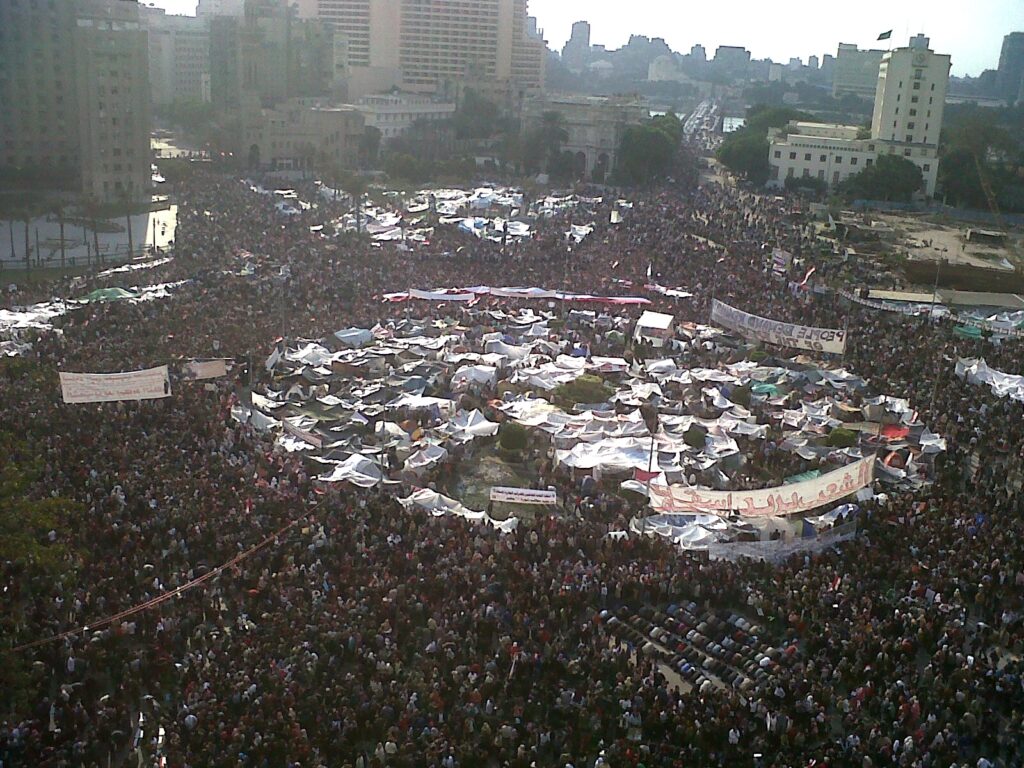
The two countries whose populations initiated the uprisings at the beginning of the Arab Spring belong to a non-hereditary category of Arab states: the “neopatrimonial” state (a term coined by contemporary political science). In these states, rulers exploit and plunder the state under dictatorial rule, but the state is not their personal property, nor is it guaranteed to be inherited by their family members (even if this is planned, as happened in Mubarak’s Egypt). This is because the state apparatus predates their rule and is independent of the individual ruler who ascends to power. In contrast, patrimonial states are characterised by state institutions that were built from the ground up or restructured by the ruling family to perpetuate its power. In both Tunisia and Egypt, the state apparatus retained historical continuity and traditions that predated the regimes of Ben Ali and Mubarak by decades. This characteristic explains why, in both countries, it was the state that overthrew the “regime”—in the narrowest sense of the term, meaning the president, his family, and closest cronies—in response to the overwhelming pressure of the popular uprising. Indeed, we saw the “people” in Egypt demanding that the backbone of the Egyptian state, that is the army, take over the task of “overthrowing the regime”, and then cheering the Supreme Council of the Armed Forces when it ousted Mubarak and assumed power.
However, euphoria soon gave way to reality. The awakening was bitter for the youth who formed the core of the uprisings in both countries. In Egypt, they found themselves facing a return to something worse than the old regime, headed by a new face, while in Tunisia, they faced a softened version of the old regime, headed by one of its oldest figures, a man nearing ninety. The lesson is clear in both cases: while, in patrimonial states, the “regime” revolves exclusively around the person of the ruler and their entourage and is organically linked to the state, making it very difficult to overthrow the regime without also overthrowing the state, as happened in Libya and as will happen in any patrimonial state where the regime is overthrown, the “regime” in neopatrimonial states transcends the ruler and their entourage, so that the ruling group becomes like the tip of an iceberg: when it falls, a new tip immediately rises to the surface of the water by virtue of Archimedes’ principle, a tip that is not qualitatively different from its predecessor.
This is because the “regime” in the neopatrimonial state, with its generally less despotic nature and its generally greater degree of corruption and plunder—for the simple reason that the rulers of the neopatrimonial state are less secure in their long-term rule—is based on a state whose institutions are riddled with despotism and corruption to the same extent as those of the patrimonial state. The only difference between the two cases is that the ruler’s power is absolute over the institutions in the patrimonial state, while, in the neopatrimonial state, the ruler is forced to compromise with them. In other words, the oligarchy holds sway in the patrimonial state, while, in the neopatrimonial state, the state apparatus is the primary power. The implication of this is that the “regime” in the latter, if understood as a despotic style of government and not as the rule of a particular group (family), is no less connected to the state than the “regime” is connected to it in the patrimonial state, and both connections are organic.
We thus return to our fundamental dilemma: the regime, in the broadest sense of the term, cannot be overthrown without dismantling the state, as long as the state and the regime that rests upon it are based on despotism and the individual appropriation of public property, whether within a patrimonial or neopatrimonial framework. This reality has become the main dilemma of the Arab uprisings, as well as of the long-term Arab revolutionary process, since the spectre of destructive chaos has become most acute in the region in light of the ongoing tragedies in Libya, Syria, and Yemen. This spectre has become the new argument with which Arab despotism attempts to legitimise itself, by presenting the people with a choice between despotism and armed chaos of the Libyan and Syrian styles.
This is an old device, theorised in the 17th century by Thomas Hobbes in his Leviathan, justifying absolute monarchy by presenting people with a choice between it and a “state of nature,” characterised by a “war of all against all” (bellum omnium contra omnes). This device did not fool the liberals of that era, foremost among them John Locke, who countered it by asserting that humans are less secure under a mighty despotism they cannot overcome than in a “state of nature” where they can defend themselves. Locke’s “state of nature” is thus less chaotic and dangerous than the one Hobbes portrayed with deliberate exaggeration.
In the Arab region, however, the device of legitimising despotism by contrasting it with armed chaos is at its strongest. Hobbes’s catastrophic scenario is almost a reality, and we have already witnessed a proliferation of cases of “war of all against all”. It is not useful or insufficient to refute this device philosophically or with any kind of intellectual argument; rather, it must be confronted on the ground. The conviction that there is an inseparable link between the regime and the state in countries where a dictatorship is intertwined with crony capitalism—a situation prevalent in the vast majority of Arab countries (with the precarious exception of Lebanon, Iraq, and Tunisia, which are not dictatorships but face different kinds of complexities)—only serves to amplify the aforementioned argument.
Let us then return to the question with which we began: is it possible to overthrow the regime without also overthrowing the state? Let us clarify this question in light of what we have discussed so far: We have shown that a radical restructuring of the state is necessary to truly eliminate the regime in the broadest sense of the term, going beyond the mere removal of the head of state and his entourage, which alone does not prevent the return of a similar regime. It is essential to remove all those entrenched in positions of power related to despotism and corruption, and to dismantle those positions while simultaneously establishing transparency and democratic oversight throughout all state institutions. This dilemma is similar to the one addressed by the Austrian-German Marxist thinker Karl Kautsky, a leading figure in the German Social-Democratic Party and the Second International during its golden age, in his discussion of the Bolshevik experience in the economic sphere (in his book The Proletarian Revolution and Its Programme). Kautsky responded to the metaphor comparing society in the face of revolution to a house needing complete reconstruction by arguing that the people have nowhere else to live during the rebuilding. They cannot therefore simply demolish the entire house and then start rebuilding it. Instead, they must demolish and rebuild it gradually so that they can continuously enjoy living quarters. This metaphor applies to the state as much as it does to the economy.
The state’s primary functions of maintaining security and managing social and economic affairs are indispensable in any transition from a despotic regime to a different one, whether liberal, progressive, or socialist. (Indeed, the need for the state during the transition to socialism is the central argument in Marxism’s refutation of anarchist thought.) While a smooth transition, in which the repressive functions of the state wither away and the process of building a new type of state is facilitated, is conceivable in countries whose people are accustomed to democracy, respect of law, and adherence to the norms of social life—a process honed through long historical experience and buttressed by a relatively high standard of living and culture—such a scenario is impossible in countries whose regimes have deliberately kept their people ignorant, poisoned their minds with various forms of fanaticism and superstition, and injected them with the most extreme forms of repression.
This leads to a society where violence permeates everything from the basic units (families, where patriarchal and gender-based violence prevails) to the highest levels, depriving it of the most basic necessities for a dignified life. In such societies, a state of lawlessness is fraught with the danger of sliding into a “war of all against all”, the spread of localised violence filling the void left by centralised violence, and the rampant plundering of resources previously monopolised by rulers. This is to say nothing of the external threats in a region characterised by a perpetual state of war between regional powers and wars of imperialist and Zionist aggression.
There is no solution to this dilemma except through an organisation capable of leading the process of revolutionary change, ensuring a controlled transition that prevents the regime’s overthrow from leading to the collapse of the entire state and a descent into chaos—as did happen in Libya, the only Arab country where the regime was radically overthrown in 2011. This means that the historical elimination of the Arab “ancien régime” requires a leadership capable of managing the two aspects of the change process: dismantling and reconstruction. The essential condition for such leadership to succeed in framing the change process while avoiding its inherent dangers is the cornerstone of revolutionary strategy as theorised by Antonio Gramsci: achieving political-cultural hegemony in society and the state in countering the hegemony of the dominant class and the existing regime. This is accomplished through a “war of positions” (in the metaphorical sense of war) that precedes the “war of manoeuvre”, i.e., the revolutionary process itself.
It necessitates that the revolutionary leadership strives to gain dominance at the base of the social pyramid in order to overthrow its apex. It requires replacing the vertical division of civil society (tribes, regions/provinces, sects) with a horizontal one (the people against the regime, the toiling masses and the disenfranchised against the cronies and ruling thieves). It also requires extending this horizontal division from civil society into the very heart of the state apparatus. The crucial issue in this context becomes the revolutionary leadership’s ability to establish its counter-hegemony within the ranks of the armed apparatuses—army and police—and to extend the social division into their ranks. This is achieved by winning the support of the rank and file and lower ranks, composed of sons of working people, and detaching them from the dominance of the elite who benefit from the regime.
This is the critical condition that makes the split of the armed forces possible during the revolution, with their rank and file joining the revolution against the regime. It goes without saying that a revolutionary leadership like the one described here would not deceive the people into believing that the military leadership stood with the revolution, as the dominant forces did in the 25 January 2011 uprising in Egypt. By chanting “The army and the people are one”, they meant the entire army, headed by the Supreme Council of the Armed Forces, while only a revolutionary minority meant by “the army” the soldiers who were present in Tahrir Square, hoping they would rebel against their leadership if ordered to suppress the protesters.
Achieving all the above conditions is what allows for a radical overthrow of the regime with the least possible material and human losses and without a complete collapse of the state’s main functions. This is certainly not easy, but it is not impossible either. The history of revolutions has witnessed several such cases, including in the Middle East the Iranian Revolution of 1979—although its leadership was Islamic fundamentalist, which ultimately led to the emergence of a reactionary regime in which the clergy replaced the Shah and his entourage. Looking at the recent history of Egypt, a state dominated by its armed forces, we see that the two most significant uprisings preceding the 25 January Revolution were the 1977 Bread Uprising under Sadat and the 1986 Central Security Forces’ uprising under Mubarak. The latter was a clearly class-based uprising of conscripts. Even amidst the current violent resurgence of despotism, Egypt witnessed police mutinies in the summer of 2015, once again revealing the class divisions that exist within the armed forces, just as they exist within society as a whole (for an analysis of Egypt’s situation and prospects, see my book Morbid Symptoms).
The future of the long-term revolutionary process that began in Tunisia in December 2010 and swept across the Arab region hinges on the ability of progressive forces to achieve a counter-hegemony within society, or to revive this counter-hegemony where it was previously achieved during the 2011 uprising before fading in the subsequent counter-revolution. This future depends particularly on the ability of the progressive forces to extend their counter-hegemony into the state apparatuses, especially the armed ones, so that they can paralyse and defeat the regime with the least possible human cost and form a provisional revolutionary government possessing the essential attributes of a state, without security breakdown, economic collapse, or a severe cost-of-living crisis. Only in this way will it be possible to overthrow the regime and begin rebuilding the state without the collapse of its vital functions, which are crucial to society.