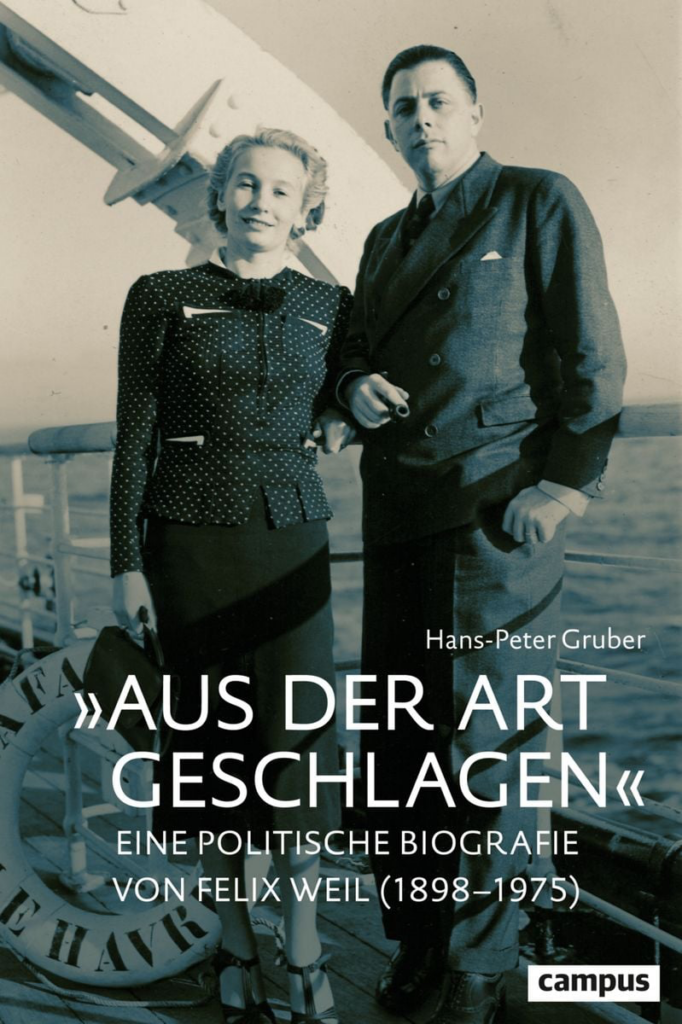
Hans-Peter Gruber is the author of »Aus der Art geschlagen« Eine politische Biografie von Felix Weil (1898–1975) (Campus, 2023) and teaches at the Hochschule für Jüdische Studien in Heidelberg. Germany. The Interview was conducted by Jacob Blumenfeld (Centre for Social Critique, Humboldt University Berlin, Germany) and Santiago M. Roggerone (Centro de Historia Intelectual, Universidad Nacional de Quilmes, Argentina)
Why did you decide to write a biography of Felix Weil? In your opinion, how does Aus der Art geschlagen [out of the ordinary] differ from the other two existing studies to date?
My decision to write a biography about Felix Weil came about in a roundabout way and was also a little “out of the ordinary”. For many years, I have been supporting a school project that deals with the Jewish history of the Kraichgau – a rural region in southwest Germany from which Felix Weil’s paternal family originates. In 2010, the director of this school project, Siegfried Bastl, gave me a plastic bag with a disorganised bundle of papers that he had received at a Weil family reunion in Florida in 2002 – with the request to “make something out of it”. This plastic bag had previously passed through several hands, but no one had been able to do anything with the contents.
For me, on the other hand, looking through these sheets triggered a very special impulse, because, in this plastic bag, there was a large part of Felix Weil’s unpublished autobiography – in fact a very advanced working version. At the time, I knew nothing about him – except that he was the son of Hermann Weil from Steinsfurt, who settled in Argentina in 1889/90 and, in 1898, the year Felix Weil was born, founded the family business Weil Hermanos y Cía. together with two brothers in Buenos Aires, which quickly became one of the world market leaders in the grain trade.
From these 340 sheets emerged a picture of Felix Weil as a complicated person with a very multifaceted but equally eventful biography. His life was torn apart and uprooted, especially as a result of the political catastrophes of the 20th century, and I was quickly motivated to look for the common thread that held it together. During my initial research, I subsequently discovered that his life had hardly been researched at that time. I was particularly surprised that in accounts of the Frankfurt Institute for Social Research, Felix Weil is often only mentioned in passing or not at all, or his role is presented in a distorted way.
Weil was instrumental in designing, founding and building the Institute with great personal commitment. Above all, he made a large sum available from his maternal inheritance by buying the building site and financing the new building and all the equipment. A remarkable detail is that he persuaded his father to finance the ongoing operations and the director’s chair with an endowment. This is particularly noteworthy because Hermann Weil was considered a conservative member of the upper middle class who had prepared numerous expert reports for the Admiral’s Staff of the Navy during the First World War, which were then partly responsible for the start of unrestricted submarine warfare – and now he was helping to finance an institute for Marxist research and teaching.
Felix Weil described the Institute as his life’s work. He was therefore not the reclusive and passive founder, but was present, active and helped to shape it. Mention should also be made of his congenial partner during the founding period, Kurt Albert Gerlach, the predestined director of the Institute. He wrote the memorandum on the founding of the Institute alone or – more likely – together with Felix Weil and was heavily involved in the initial negotiations with the relevant authorities and the university. There is also strong evidence that the idea to set it up came from him. However, he died of diabetes on 19 October 1922, so that Felix Weil was able to continue the complicated and at times nearly-collapsed negotiations alone, which ended with a ministerial decree from the Prussian Minister of Culture on 23 January 1923, thereby approving the foundation. Like Felix Weil, Kurt Albert Gerlach was pushed to the margins of the Institute’s history or completely ignored. Instead, in retrospective statements, Max Horkheimer and Friedrich Pollock – together with Felix Weil, no less – counted themselves among the founders, which they were not.
Although Friedrich Pollock was present in the founding and early phase and certainly played an important role, he was not one of the founders – and, although Max Horkheimer became the second director of the Institute in 1930/31 as Carl Grünberg’s successor at Felix Weil’s instigation, he had not really made an appearance before that.
My basic incentive for writing a biography of Felix Weil was the intention to correct this skewed image, which has become entrenched over several decades and is still being perpetuated today. The importance and difficulty of this task was shown in 2023 and 2024, in which the centenary of the founding of the Institute was celebrated: first, the First Marxist Working Week [Erste Marxistische Arbeitswoche] as a ground-breaking seminar and finally the opening of the Institute building itself. On these occasions – accompanied by several events and press articles – the role of Felix Weil was largely overlooked. This has also contributed to my ongoing efforts to convey an appropriate picture of Felix Weil’s life and work – even beyond his significance for the Institute.
There was another aspect that motivated me to write the biography. This plastic bag also contained a contract, already signed by both parties, between Felix Weil and S. Fischer Verlag in Frankfurt for the publication of the autobiography, which was to appear under the title Out of the Ordinary [Aus der Art geschlagen]. However, this never came to pass, as Felix Weil died on 18 September 1975 at his last residence in Dover, Delaware in the USA, shortly before he was able to complete his book. His wife Anne then made final changes to the manuscript for about two weeks, but the publisher refused to publish it posthumously. This rejection gave me additional incentive to use the autobiography as a key source and to make it known. That is why I adopted the title “Aus der Art geschlagen” for my book, clearly marking it as a quotation with reference to Felix Weil’s work. With this title, Felix Weil was referring to a crucial field of tension in his life – and it could hardly be formulated more aptly. On the one hand, he was already very wealthy as a young man because, together with his sister Anita, he was the main heir to the family business, which his father wanted him to continue in the role of general manager and in which he repeatedly worked in a managerial capacity at times.
On the other hand, he hated the grain trade as an immoral business – and he simply had completely different interests. He was a Marxist, a socialist and spent almost all his money on his political ideals until the end of his life.
This now leads to the question of the differences between the two monographs on Felix Weil that were published a few years after I began my own research work. One is a book that focuses mainly on Felix Weil’s significance for Argentina and which I greatly appreciate, while the other is a popular science publication that uses the appropriate stylistic devices to provide an initial overview. It goes without saying that both publications have their merits. But, with that, the key differences are already named: on the one hand, I present Felix Weil with his exceptionally cosmopolitan life in his remarkable diversity. On the other hand, I consistently follow a scientific approach. As a unique feature of my publication, I also refer to the very broad and original source base – with a great deal of material that has not been taken into account so far. I place great importance on a critical approach to the sources, because statements are often adopted without checking or in the wrong reading, resulting in a distorted picture. This careful handling of the sources is particularly necessary in the case of self-testimonies such as autobiographical material or letters – especially if they were written at a considerable remove in time from the events described. I was also driven by Pierre Bourdieu’s “biographical illusion,” which urgently warns against becoming an accomplice to the autobiographer. Therefore, in a first step, I meticulously compared the autobiographical material Felix Weil left behind in several working versions, especially as he sometimes made contradictory statements. In a second step, I then consulted further sources in order to verify the content. I was just as thorough with all other sources. As a result, my account remains free of speculation or alleged facts that could not be substantiated, or of established narratives that do not correspond to reality.
Incidentally, the extensive photographic material that I was able to compile as a result of intensive research is also one of the special sources. The 64 published images can be seen as a kind of photobiography of Felix Weil, covering many important stages and situations in his life, from his early childhood in Argentina to his old age in the USA.
A biography remains incomprehensible without family history and its formative power. It therefore plays an important role as a further distinguishing feature, with a detailed look at the life of Hermann Weil and a very special focus on the father-son relationship, which strongly shaped the biography of Felix Weil. In addition, there is a look back over several generations on both his father’s and mother’s side in order to trace how the conditions of Felix Weil’s life developed historically. This is the story of two traditional Jewish families from the southwest of Germany, which illustrates how the initially gradual and, from the end of the 19th century onward, rapid rise of the Weil family took place against the backdrop of sweeping changes within and outside Judaism and culminated in the founding of the grain trading company Weil Hermanos y Cía. This makes Jewish history and Judaism a powerful factor in my account, with implications for Felix Weil’s own life, even though he was non-religious.
Can you tell us a bit more about Weil directly, his life and legacy. Who was he and what happened to him? What were some of his contributions to 20th century culture?
Felix Weil’s most lasting contribution to the culture of the 20th century was certainly the Institute for Social Research. An institute for Marxist research and teaching was a new and innovative institution – and unique in this form. Felix Weil did not see Marxism as a political orientation, but as a discipline, comparable to any other subject taught at university. That is why he was keen to loosely affiliate the institute with the university in order to create an academic framework and lend Marxism scientific respectability. Its success proved him right. Despite hostility, the Institute enjoyed an excellent reputation thanks to its exceptionally good facilities and attracted many students, who – unusually for the time – also came from abroad in large numbers.
Felix Weil also created the institutional framework for the development of Critical Theory with the Institute, even if he had not intended it in this way. Critical Theory became known worldwide and is now an inseparable part of the history of ideas and the cultural landscape of the 20th century. Above all, he paved the way for Max Horkheimer to pursue this direction as head of the Institute, but also prepared the ground for people such as Erich Fromm, Theodor W. Adorno, Herbert Marcuse and Leo Löwenthal to make their contribution to Critical Theory on the one hand and to develop their own independent academic profile on the other.
However, Felix Weil’s role as a donor is by no means limited to the Institute, as he was a patron of the arts in a wide variety of artistic and cultural fields. He wanted to use the classic channels of art and culture – painting, theatre, fiction and presumably also the then comparatively new medium of film – to convey his political ideas in order to reach the educated middle classes and thus an audience beyond the narrow confines of the institute.
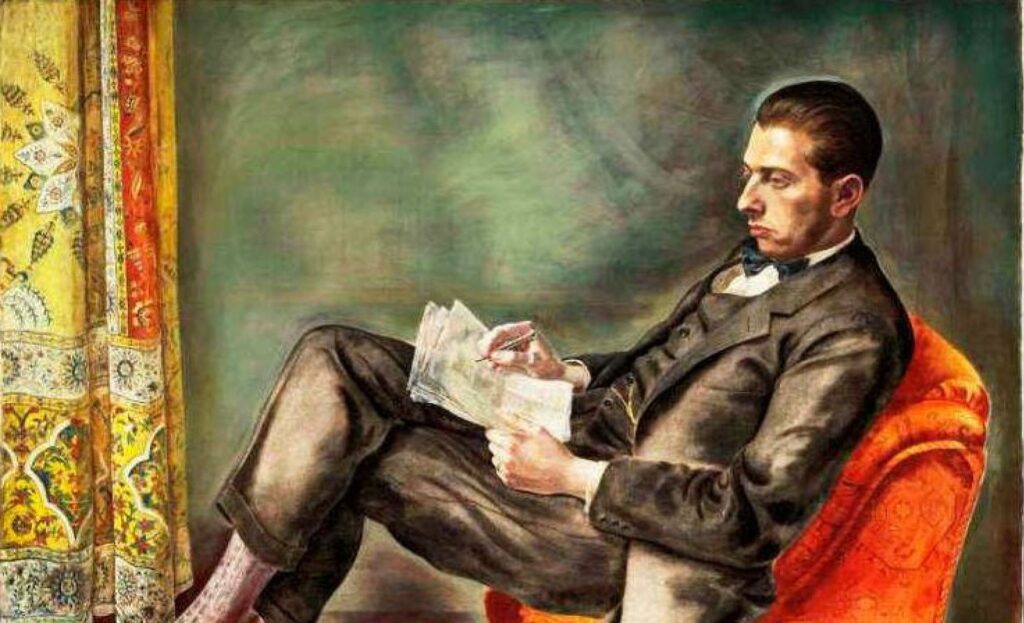
Felix Weil was fascinated by the socially critical painting of George Grosz, who, however, almost always had money worries. In 1922, Weil invited him and his wife on a luxurious vacation to Portofino in Italy to get to know him. He subsequently supported him and his style-defining art with one-off and regular monetary payments. The portrait that George Grosz painted of Felix Weil in 1926 was in his possession for a long time and is now in the Los Angeles County Museum of Modern Art.
Erwin Piscator, for whom George Grosz created stage sets as a unifying element, was the star director of political and progressive theatre in the Weimar Republic. However, his productions were very elaborate and cost intensive. When he ran out of money and was threatened with bankruptcy proceedings, Felix Weil financed the reopening of his theatre on Berlin’s Nollendorfplatz with the play The Merchant of Berlin.
In his autobiography, Felix Weil writes that he was also involved in the temporary purchase of the screening rights for the revolutionary film Battleship Potemkin by Sergei Eisenstein for German-speaking countries. However, this episode cannot be verified by other sources. Since all the other patronage activities described by Felix Weil can be proven beyond doubt, it is entirely plausible that he was involved in some form. If this is indeed the case, he made a contribution to a milestone in film history.
On the other hand, Felix Weil’s lasting cultural contributions to the publishing industry can be clearly reconstructed. During the Weimar Republic, Wieland Herzfelde’s Berlin-based Malik-Verlag was the leading publisher of left-wing, socially critical and avant-garde literature, though it also struggled with constant financial problems. Felix Weil was not the first financial backer, but he eventually provided so much funding that, from 1925, he de facto owned the publishing house, which published the works of authors such as Upton Sinclair, John Dos Passos, Maxim Gorky and Oskar Maria Graf. As with the Institute, he not only saw himself as a financial backer, but also worked there actively for a time. In 1929, Felix Weil also founded his own publishing house, the Soziologische Verlagsanstalt, primarily to publish scientific and political literature, which was difficult to find space for in the programs of other publishing houses and also in the Malik publishing house. The Marx-Engels-Archiv Verlagsgesellschaft, founded in 1924, was a joint project of the Society for Social Research (Gesellschaft für Sozialforschung) and the Marx-Engels Institute in Moscow. Felix Weil was managing director together with Friedrich Pollock and was heavily involved in the collaboration. The aim was to publish the first complete Marx-Engels edition. Felix Weil’s mediating and organisational role in the conflict-ridden and mistrustful relationship between the Moscow Institute and the Berlin archive of the SPD, where much of the required material was located, was fundamental to the realisation of this path-breaking project. Although only half a volume was published in 1927 before the collaboration ended the following year, the high editorial standards set in the process had a lasting impact on the volumes published subsequently.
Felix Weil did not start as a radical, but as the son of a multimillionaire. How did he become a socialist, one that was convinced enough to dedicate his money and time to founding an institute for Marxist research?
It is fitting to add to this question that Felix Weil chose the subtitle “Memoirs of a Red Millionaire’s Son” for his autobiography. He was thereby referring to the tension he felt between his political world view and his wealth. According to him, the November Revolution played a special role in the development of his political awareness. In his autobiography, he describes how he joined the Workers’ and Soldiers’ Council in Frankfurt on 9 November 1918, the day the German Emperor abdicated. The following day, during the night, he came across the SPD’s Erfurt Programme, which drew heavily on Marxism. He was particularly impressed by a long passage calling for the socialisation of privately owned means of production and the transformation of commodity production into socialist production. Felix Weil refers to this as his “key political experience”. He had discovered that he was a socialist, and had been for a long time – only he had not been aware of it. This political awareness – as he himself expressed – did not, of course, develop literally overnight. Instead, the roots of this development lie in his childhood in Argentina. He reports how the striking contrast between rich and poor that he experienced there made him question this inequality – and this resulted in a pronounced disposition for social justice, which also became the driving force behind his political convictions.
In particular, the close and friendly relationship with an indigenous family who worked in the Weil family household in Buenos Aires had a strong influence on him, as can be deduced from his notes. He critically questioned these social differences between the two families with his father and – according to his notes – basically did not accept them. In addition to the “key political experience” in Frankfurt, one can speak of the “key social experience” in Buenos Aires. Felix Weil reports on this family in detail. Juana was not only the cook, but also his “Indian nurse”, as Felix Weil called her. Her husband Jacinto was employed as a butler and coachman. The younger son Antonio was his schoolmate and became his most important childhood friend. The other son, Fernando, whom Felix Weil saw in the role of an older brother, became an activist in the agricultural workers’ union. His activities and later murder, as well as the continuation of his work by his younger brother, were fundamental to Felix Weil’s identification with the interests of the agricultural workers and his vehement opposition to the large landowners, which stood in stark contrast to his own background.
Felix Weil used his fortune to found a Marxist institute primarily in order to fill a gap he himself had felt during his studies of political science, which he had begun in Frankfurt in 1916. Firstly, he missed an academic institution that systematically collected and processed the extensive international literature on the theory and history of socialism and the workers’ movement. Secondly, as a direct consequence, there was nowhere any opportunity for a thorough and professional study of Marxism. For this reason, Felix Weil moved his place of study from Frankfurt to Tübingen in the summer semester of 1919, because courses on socialism were also offered there. However, as early as October he was arrested because of his political agitation – he was a co-founder of a socialist university group and then joined the Spartacist splinter faction – and was expelled from Württemberg as an Argentinian citizen. He eventually completed his studies in Frankfurt in 1920 with a doctorate on the subject of socialisation.
It should also be added that Felix Weil gave the impression that he had no particular interest in his wealth or a life of luxury. Although, for example, during the construction of the Edificio Sáfico in Buenos Aires – which was completed in 1933 as part of the restructuring of the family business – he had the top three floors converted into a spacious penthouse flat, and although he owned a small airplane and held a pilot’s license at the time so that he could visit the family estate more quickly, he generally led a rather frugal life in relation to his financial background. He was considered thrifty and took care to avoid unnecessary expenditure – his practice of sending postcards instead of letters to save on postage is legendary.
We’d like to ask about Felix Weil’s life and political activity in Argentina as well. What role did Argentina (and Latin America) play in his political and theoretical work? Did he do parallel work there to his work in Frankfurt? Did he ever intend to bring the Institute to Argentina? What happened? What were some of his Argentinian contributions? When did he leave Argentina for good and why? Does the Frankfurt School appear differently from the perspective of Weil the Argentinian?
Argentina played an important role in Felix Weil’s life in many respects – including academically. In 1940, the Latin American Economic Institute was founded in New York. Against the backdrop of external threats – above all, from expansionist National Socialism and intensified by the beginning of the Second World War – it advocated for close economic cooperation between the USA and the countries of Latin America as a defensive measure. Felix Weil was a member of the directorate and was the link to the Institute for Social Research, which had fled to New York in 1934, where Columbia University provided premises that it now shared with this new Institute. South America, and Argentina in particular, now became a focus of Felix Weil’s academic work, making him a sought-after expert in the USA on issues relating to the politics and economy of his native country.
Felix Weil’s main work is Argentine Riddle from 1944, a socio-economic and political study that is still highly regarded in specialist circles today. To accompany it, he published several journal articles on individual thematic aspects of his book. This alone shows the great importance that Argentina had for his theoretical thinking. Based on his observations on the ground, he described the country as “semi-colonial.” According to his definition of this term, a semi-colonial country is exploited by an upper class of local families – businessmen and landowners. He sees this as a crucial difference from a colonial country, which is politically dominated by another state and exploits the local population and natural wealth.
In Argentine Riddle, it becomes clear that Felix Weil took a classical approach to the development of states and societies. He regarded industrialisation as the indispensable key and necessary phase for Argentina’s future democratic development and for overcoming the military regime that had taken power following a coup on 8 June 1943 – i.e. during the period in which his book was being written. He presented this path of development as a sequence of causal links and placed high expectations on industrial workers to develop a political consciousness and organise on a mass scale, especially in trade unions. In order to achieve this goal, he also appealed to the USA, the epitome of capitalism, to make targeted investments. He made a negative distinction between “bad capital”, which aimed to achieve the highest possible profits in the shortest possible time, and the “good capital” he called for instead, which would drive forward the industrialisation of the country at significantly lower profit rates. At the same time, Felix Weil expected this to improve the socio-economic situation of the local population, whose purchasing power would increase, so that a sales market for American goods would emerge in Argentina as an incentive for these investments. In this way, Felix Weil outlined a classic development model that he believed could be applied to other countries in South America – and in principle to other continents too.
His studies on Argentina also led Felix Weil to a more precise analysis of Argentine fascism and antisemitism. He conveyed a much more differentiated picture to the American public, which – against the backdrop of the military coup of 1943 and the rise of Perón – was making a very simplistic equation between German and Argentine fascism. He came to the very cogent conclusion that Argentina was dealing with a fascism and antisemitism of its own kind, which could then be confronted differently from National Socialist Germany with its wars of aggression, war crimes and genocide.
However, the roots of Argentina’s significance for Felix Weil’s political and academic activities can be traced back much earlier than the 1940s. A few months after completing his studies in Frankfurt, Felix Weil took part in the split party conference of the USPD (the independent SPD) in October 1920, through which the KPD first became a mass party, as the left-wing splinter faction joined the Communists. There, in Halle, he came into contact with Grigory Zinoviev, the head of the Communist International (Comintern). As a result, he became a Comintern delegate for Argentina on a secret mission. At the same time, he worked his way into the family business. This was the official reason for his stay, which lasted more than a year, and represents the balancing act he so often performed in his life. The reports that Felix Weil sent to Moscow formed part of the basis of his study on the Argentine workers’ movement, which was published in 1921 and thus provides original insights.
This activity focused on the question of which existing or newly forming local organisations or parties should be admitted to the Comintern. His experiences and analyses led to a strict rejection of anarchosyndicalist positions. He rejected means of struggle such as sabotage, assassinations or violent strikes as counterproductive. Instead, he backed the Argentine Communist Party, which had emerged from a split in the Socialist Party and was ultimately admitted to the Comintern, not least due to Felix Weil’s assessments. Looking more closely, it was important to him to establish orderly structures with daily and weekly newspapers, functioning trade-union work, a youth movement and women’s groups.
Argentina also offered Felix Weil the opportunity to put his socio-political ideas into practice when he became a government employee and member of various commissions between 1932 and 1934. Although this was a right-wing, authoritarian and anti-communist government during the década infame, which, ultimately, came to power as a result of a military coup and electoral fraud, his decisive involvement in the drafting and practical implementation of Argentina’s first income tax law allowed him to realise his ideas of social justice to a certain extent. In 1933, he offered a series of lectures at the Colegio Libre de Estudios Superiores to explain this new type of legislation, primarily to a specialist audience. On the basis of this course, he also published a comprehensive commentary on the regulations.
This third extended stay by Felix Weil in Argentina, which had begun in 1930/31, ended on 26 November 1935, when he left Buenos Aires by ship and arrived in New York on 8 January 1936– interrupted by a stay in Rio de Janeiro. By far the most plausible and verifiable reason for his departure is a complaint of fraud in connection with his financial involvement in a film company that his then wife’s brother had founded together with a partner. His other brother-in-law, the third husband of his sister Anita, was the driving force behind this complaint. He had – amid slanderous accusations – launched a veritable flood of lawsuits in order to ultimately gain unlawful access to capital through Anita, as co-heir to her father who had died in 1927, and to break the contractual obligations with which Hermann Weil had arranged the Institute’s funding. This complaint in Buenos Aires ultimately proved to be irrelevant and the trial ended with an acquittal, but Felix Weil was threatened with pre-trial detention of indefinite duration, which he evaded by fleeing the country, and finally went into hiding in the south of France for about a year due to an extradition order issued to the USA. This marked his permanent departure from Argentina, even though he was there again briefly in the summer of 1938 and then, for the last time, from mid-November to mid-January 1940.
Felix Weil combined his last stay in Buenos Aires with another course at the Colegio Libre de Estudios Superiores – this time on the German war economy. He also gave a lecture at the Pestalozzi School to explain – as in his course – the economic differences between National Socialism and Bolshevism, as the two systems were often seen as similar or related.
At the Colegio, where Felix Weil taught from time to time and also offered a course on the problems of the centrally planned economy, he saw analogies to the Institute for Social Research in terms of self-image and structure, even though the focus at the Buenos Aires school was not on Marxism, but on scientific and ideological pluralism. I have not, however, come across any concrete attempts by Felix Weil to definitively transfer the Institute for Social Research to Argentina, although it cannot of course be ruled out that he explored such possibilities, especially as he was very well connected. There is no indication of this in his autobiography, although a conversation he recorded with Federico Pinedo at the beginning of 1932 leaves room for speculation.
For one, Pinedo had wished that there was an institution like the Institute in Argentina. And furthermore, he referred to a report by the Argentine ambassador in Berlin, who assumed that Hitler would come to power at the beginning of 1933. As the Institute would then quickly be closed, it would have to be taken out of Germany quickly in order to save it. Whether this also included the idea of transferring the institute to Argentina cannot be clarified.
In any case, Felix Weil did not consider Argentina mature enough at the time to actively promote socialism there – though he was referring to the founding of a publishing house, not the activities of an Institute, as his example. In addition, with the rise of National Socialism in Germany, Geneva emerged early on as the first point of refuge, and then, outside Europe, the USA came into focus as the preferred destination for exile.
If we look at Felix Weil’s activities in Argentina overall, with a focus on the 1930s, a very multifaceted spectrum is also apparent in this part of his biography. The reason for his originally much shorter planned stay in Argentina was the necessary restructuring of the family company in the wake of the consequences of the global economic crisis of 1929, which Felix Weil drove forward with economic and political foresight. The grain trade was abandoned and the capital invested instead in land for livestock farming, in industry and in the real estate sector and the construction of the Edificio Sáfico. In addition to his work as a government employee, he was again active for the Communist International and, for example, made his apartment available for a meeting between the Brazilian revolutionary Luis Carlos Prestes and August Guralsky, who had the task of winning him over to orthodox communism. In addition to this covert activity, he was publicly and visibly active in the Argentine administration and was part of a circle of intellectuals grouped around Federico Pinedo in a heterogeneous brain trust to promote reforms. He maintained close contacts with the Argentinisches Tageblatt and its editor at the time, Ernesto Alemann, who pursued a decidedly anti-fascist line directed against National Socialist Germany. The Pestalozzi School was also founded in 1934 with the support of Felix Weil as an anti-fascist counterinstitution to the German schools, which were pursuing a National Socialist and antisemitic line.
Why did Weil stay in the USA instead of returning to Frankfurt after the war, like Adorno and Horkheimer? Didn’t he become a tax instructor in California? He eventually did visit the Bundesrepublik Deutschland to teach at Ramstein, correct? Why did he do that?
A few years after the end of National Socialist rule, Felix Weil had great reservations about returning to Germany – more precisely to what was then West Germany. As late as 1959, he told George Grosz that he could not understand his decision to move to what was then West Berlin. He referred explicitly to his impressions during his stay in Germany in 1951 on the occasion of the reopening of the Institute and spoke of neo-Nazis and antisemitic relapses that he had perceived, and which prevented him from returning. Curiously, however, it was Felix Weil who had triggered the impulse for the Institute to return to Frankfurt. In mid-September 1946, he expressed his surprise in a letter to the Dean of the Faculty of Economics and Social Sciences at the University of Frankfurt that the Gesellschaft für Sozialforschung had not yet been invited to return. Subsequently, invitations to return were received from various quarters, although almost all members of the Institute’s inner circle were very sceptical or even opposed to the idea. This also applied to Adorno and, above all, Pollock, who, together with Horkheimer, eventually returned to Frankfurt with the Institute, which had been in a new building since 1951, as the original building had been severely damaged in the war. Max Horkheimer himself had initially taken a vacillating stance, but, ultimately, became the driving force behind this development, which brought him a brilliant career and great prestige in post-war Germany. He regained the professorship he had been stripped of in 1933, became Dean of the Faculty of Economics and Social Sciences, and eventually Rector of the University. He received – among other awards – the rarely bestowed honorary citizenship.
Felix Weil, on the other hand, became a sought-after expert on tax issues at local and state level in Los Angeles. He gained a high reputation with his newspaper column “Tax Facts”, which also focused on tax issues and explained reforms. In this context, he also wrote a reference book published in 1967, which served as a guide for property taxpayers when lodging a complaint. In California, Felix Weil was politically active for the Democratic Party and was also on its electoral rolls.
At the end of the 1960s, he decided to spend a longer period in the Federal Republic of Germany, which ultimately spanned the years 1969 to 1973. The main reason for this was his teaching work for the US Army at the Ramstein Air Base Education Center in Rhineland-Palatinate. He taught wide-ranging courses on real estate and property management. This was intended to make it easier for members of the armed forces to re-enter civilian life, as this teaching opened up opportunities to work in this sector after returning to the USA. This completely new course offering at the Education Center was tailor-made for Felix Weil, as it made explicit reference to Los Angeles County, where he had made a name for himself in this field.
Felix Weil’s teaching was certainly controversial in at least two respects. First, while he still saw himself as a Marxist and socialist, the New Left, especially the 1968 movement, was strongly characterised by anti-Americanism and opposition to the US military, particularly against the backdrop of the Vietnam War. As an employee of the US Army, he fitted this enemy image. Second, it was the time of the Cold War, and one can assume that there were not many Marxists and socialists in the US Army at the time. In any case, Felix Weil also tried – ultimately in vain – to use his last remaining money to revive Marxist research at the Institute for Social Research, which in his view had been pushed too far into the background.
What was his relationship to the Soviet Union, Comintern, and the Bolsheviks?
The relationship to the KPD (German Communist Party) must also be included in this question in order to fully grasp the topic. Felix Weil was quite close to the KPD after it was founded in January 1919. However, he quickly moved to the right wing of the party, particularly under the influence of Clara Zetkin. He rejected the increasing Stalinisation and Bolshevisation, as well as the authoritarianism of the Party, and this was another reason why he supported the right split-off KPD-O – the “O” stands for opposition – founded in 1929, both ideologically and financially. He did not comment extensively on the Soviet Union, but his growing rejection of this state model can already be seen in the 1920s. At the Erste Marxistische Arbeitswoche [First Marxist Working Week] in 1923, according to his autobiography, Weil expressed his remarkably far-sighted fear that the bureaucracy of the Communist Party of the Soviet Union would lead to a ruling class that did not technically own the means of production, but still had control over them, which would lead to the same thing. The so-called purges in the Soviet Union, to which companions and friends fell victim, were a deterrent for him. In regard to his relationship with the Bolsheviks, a look at his work for the Comintern in Argentina is revealing. Felix Weil advocated for the admission of the newly founded Communist Party of Argentina to the Comintern, although it wanted to retain its independence and keep the influence of the Russians to a minimum. Weil also rejected the Russians’ claims to power – those who, in his words, saw themselves as “a kind of Argentine Lenin” simply because they were Russian. Even as a delegate of the Comintern, he, ultimately, represented an undogmatic socialism that was free of doctrinism and unconditional subordination to any party discipline – and this put him in opposition to the Bolsheviks, whose representatives in Argentina also complained about him in Moscow. Against this background, it is remarkable that the Comintern only broke off contact with Felix Weil at the end of the 1930s, as he was regarded as a so-called right-wing deviant.
How does your work on Felix Weil help us rethink the pre-history of the so-called Frankfurt School and its critical theory of society? Did Felix Weil have a role not only as a benefactor but as an intellectual and theorist as well? How do you see his work, for instance, on socialisation, on economic planning, on the working-class movement in Argentina, on the Argentine Riddle? Is it part of “Frankfurt School Critical Theory”?
In my publication, Felix Weil emerges as the person who decisively conceived, shaped and built up the Institute for Social Research in its founding and early phase and thus in the prehistory of Critical Theory. His focus on a scientific and pluralistic Marxism is the starting point of a development that then led to the shaping of Critical Theory. He pursued his goal of establishing an academic platform for the research and teaching of a pluralistic Marxism not only as a founder with his finances, but above all with a great deal of personal commitment. Key milestones in its early history were largely the result of his active involvement. He financed and probably also helped organise the First Marxist Working Week. The establishment of the special library on the history and theory of socialism and the workers’ movement with its unique archive was one of his main tasks. The far-sighted appointment of Carl Grünberg, an outspoken representative of the materialist view of history, to the directorship was almost exclusively Felix Weil’s work. Grünberg brought with him his highly recognised journal Archiv für die Geschichte des Sozialismus und der Arbeiterbewegung as the future publication organ of the Institute. The collaboration with the Marx-Engels Institute in Moscow was also strongly shaped by him. These are just a few examples that make it clear that Felix Weil not only provided the necessary finances but also made crucial decisions and created the structures upon which Critical Theory developed. A crucial point to note is that the seeds of Critical Theory were not sown only with Max Horkheimer’s assumption of the directorship and his programmatic inaugural speech “The Present Situation of Social Philosophy and the Tasks of an Institute for Social Research” – as Felix Weil himself surprisingly also formulated in his autobiography. This is astonishing because the memorandum on the founding of the Institute already contains recognisable approaches that correspond to Critical Theory, such as interdisciplinarity. If we also take a letter from Felix Weil to the Prussian Ministry of Culture from that year as further evidence, in which he describes in detail the six different research priorities, then it is not only the interdisciplinary approach that stands out, but also sociology and in particular the sociological types that has just been developed from the Institute’s study led by Erich Fromm on workers and white-collar employees, and which were to become of fundamental importance for Critical Theory.
Towards the end of his life, however, Felix Weil expressed himself very negatively and in stark terms in his autobiography about Critical Theory and Max Horkheimer, who virtually personified this development while, at the same time, suppressing Marxist research and teaching. Instead, Horkheimer had invented a social philosophy, “a love affair between philosophy and sociology”, and in doing so had “unfortunately created nothing good”. Ultimately, he accused him of betraying Marxism. Felix Weil formulated his fierce criticism of Horkheimer – in which he included Friedrich Pollock – when both were already deceased, which is why, in my publication, I speak of a “posthumous rift”. There are no signs of alienation or condemnation of the direction taken under Horkheimer on the part of Felix Weil in the period before that. On the contrary: even in exile, he continued to work at the Institute. For The Authoritarian Personality, a major work of Critical Theory and part of the five-volume Studies in Prejudice, he undertook extensive editorial work and coordinated the contributions of the various authors. He translated and edited another volume from this series – Rehearsal for Destruction by Paul Massing – for German publication. He also provided editorial assistance for the unpublished but nevertheless pivotal study Antisemitism among American Labor. But Felix Weil did not make a major intellectual or theoretical contribution to Critical Theory. He was, however, indeed supposed to. Horkheimer had intended him along with Pollock to contribute to the economic section of Dialectic of Enlightenment, another key work of Critical Theory. This shows not only the interdisciplinary nature of Critical Theory, but also the high esteem in which Felix Weil was held as an economist. However, he declined – as did Pollock – as he was working intensively on his study of Argentina at the time. He was also asked to contribute an essay to a special issue of the Institute’s journal Studies in Philosophy and Social Science on the subject of “state capitalism”. This was an important and controversial theoretical issue within the Institute. Even though this special issue ultimately never came to fruition, it is clear that Felix Weil was involved in some important theoretical discussions. This is also reflected in Felix Weil’s publication Argentine Riddle, when he applies the terms “state capitalism” or “authoritarianism” to the Argentine government.
One thing I am interested in personally is Weil’s seemingly contradictory politics/roles and how to think about them together, and what that means for the Institute for Social Research and critical social theory in general. Was he a capitalist or a communist, an intellectual or a businessman?
Basically, Felix Weil was all of these things together, although further designations must be added that clearly show how multifaceted his life was. He was also a patron of the arts, Marxist, publisher, government employee, lecturer, political agitator and finally a revolutionary—even if his participation in the November Revolution lasted only two weeks according to his own account and the description of his activities has a somewhat comic quality. In somewhat exaggerated and abbreviated terms, Felix Weil can be described as either a Marxist capitalist or a capitalist Marxist.
In addition, Felix Weil was a cosmopolitan: to a large extent, by necessity, as he was persecuted by National Socialism both due to his political views and his Jewish origins. Until the end of his life, he repeatedly changed continents as the centre of his life, living alternately in Europe, North and South America, and defying categorisation by any one country or city. He certainly had a strong affinity with Frankfurt, where he lived for almost 20 years, but he was Argentinian by birth, spent around 15 formative years in Buenos Aires and became an American citizen in 1946, living for 23 years in Los Angeles alone.
One of the fundamental motivations behind my study of Felix Weil was a desire to uncover the common thread that runs through this multi-faceted life and also resolves the apparent contradictions. This involves the question of which constants can be identified in his life. First and foremost, one must mention his political convictions, which he never abandoned.
Throughout his life, Felix Weil described himself as either a Marxist or a socialist. Once he had found his political stance as a young man, he never gave it up again. This is why the subtitle of my publication describes it as a political biography – not in the sense of a biography of a politician, but of a person for whom the political became a fundamental driving force. The crucial point, however, is that something else must be added in the case of Felix Weil: he saw himself as an unorthodox Marxist, an undogmatic socialist. This is an important point, because it allowed him to react flexibly to developments that he rejected without – like some of his companions – abandoning socialism or Marxism. Although he was initially close to the KPD after the Party was founded in January 1919, he tended towards the right wing early on. However, the increasing Bolshevisation and Stalinisation of the Party quickly led him to turn away from the KPD.
Felix Weil also resolved an economic problem that he saw in socialism in an undogmatic way. He recognised early on, around 1920, that the centrally planned economy could not work. He was regarded as a very capable economist and, thanks to his studies in political science, not only had a sound theoretical basis, but was also able to gain practical experience in business through his repeated work in the family company. He was convinced that there is no economy without a market. He held that every economy, including a socialist one, needs a regulating market. Felix Weil was therefore faced with a fundamental problem. He was a socialist, but he rejected the economic pillar of this ideology, the centrally planned economy. And he went even further. He regarded capitalist economic models as superior in economic terms. As a solution, he tended towards ideas of guild socialism and economic democracy. As far as can be reconstructed, he saw the answer in consumer cooperatives that would compete with each other.
There is a second constant in Felix Weil’s biography. This is his belief in the power of education, upbringing and enlightenment. For Felix Weil, these were ultimately the only meaningful means of promoting and implementing political ideas in a targeted manner. The interplay of both constants – Marxism and socialism as well as their mediation and promotion through education – is ideally realised in the founding of the Institute for Social Research. In his words, it was to provide “education in the spirit of socialism”. Both constants also explain the many different roles that Felix Weil took on, so that his life was highly varied, but ultimately consistent and by no means contradictory.
In some of his letters to Martin Jay, late in his life, Weil contests Jay’s reading of the Frankfurt School as “Jewish,” since many of them rejected any religious labels. How should we treat the Jewish background of Weil’s family? Is it important, or a mistake to label him Jewish?
The significance of his Jewish origins is one of the most difficult questions in Felix Weil’s life. This also applies to all other members of the Institute. First of all, this has to do with Felix Weil’s self-understanding. He himself claimed that his Jewish origins did not have any formative influence on his life. He understood Judaism exclusively as a religious system to which he, as an atheist, did not feel he belonged. He was not religiously socialised either, as his parental home was also non-religious. The family did not belong to a Jewish congregation. Felix Weil described his father as either atheist or agnostic. The following statement has been handed down from him about his parents’ home: “We only observed two things from Judaism at home: Christmas and the Frankfurter Zeitung.” That is ironic distance – indeed, complete distance from Judaism. He did not go through any religious ceremonies either. To the horror of his relatives in Buenos Aires, he was not circumcised – as he noted. On the other hand, he was not baptised either, as has been claimed. So, he grew up without faith – “creedless,” as he put it. This is an important point, as he did not have to leave the religion, in this case Judaism, because he was never part of a religious community. Felix Weil remained a consistent atheist until the end of his life – another common thread running through his life. Incidentally, this is a clear difference from Max Horkheimer, who grew up in a religious home, distanced himself from it, but then, after returning to the Federal Republic of Germany, grew closer to Judaism again, found his way to the Jewish faith, joined the Jewish community in Frankfurt and also saw analogies between Critical Theory and Judaism. Felix Weil did not understand any of this at all and saw religion as a replacement for Marxism, which Max Horkheimer had in his view abandoned – indeed betrayed.
A later correspondence with Martin Jay is also very revealing of Felix Weil’s attitude in this regard. Martin Jay published The Dialectical Imagination in 1973, the first standard work on the Institute, which is still of fundamental importance today. Felix Weil read the manuscript in the run-up to publication and thought the book was quite good. However, he clearly disliked one aspect. He took issue with the fact that, when introducing the protagonists, Martin Jay always pointed out when a person was of Jewish origin. Felix Weil objected to this in very clear terms and insisted that these references to Judaism be removed. “I insist that you omit the ‘Jewish’ references”, he wrote to Martin Jay. He thought it a pure coincidence that a strikingly large number of people at the Institute were of Jewish origin. For Felix Weil, it was clear that it was only National Socialism that had declared him Jewish – and he asked Martin Jay not to do the same. He also formulated a general statement on the matter, setting out various interpretations of Judaism: “Now the question is whether you understand ‘Jewish’ as a religion or a race or nationality. I can’t imagine you, like Hitler, consider it a race.”
In his view, even his parents were no longer Jewish. They had married according to Jewish ceremony at their parents’ request but were otherwise non-religious. He therefore concluded: “I was a Jew only if you use the Hitler criterion of the Jewish grandmother.” For Felix Weil, then, Judaism was either legitimately a religion or illegitimately an instrument of National Socialism.
This is all very clearly formulated, but, at another point, Felix Weil took a more nuanced view of his Jewish origins. “Despite all my sympathy for Israel, I still don’t feel as a Jew, although I know where I come from and would never pretend to be a Goy.” So, Felix Weil certainly knew where he came from and would never have pretended to be a non-Jew. What is also noteworthy in this revealing sentence from his August 1971 correspondence with Martin Jay is the sympathy expressed for Israel at a time when the New Left had long since placed the Jewish state in the camp of the imperialists and framed Palestinian interests within the anticolonial liberation movements. But, to return to the original topic: with this sentence, Felix Weil certainly attributed a relevant role to his Jewish origins.
If you look at the environment in which Felix Weil moved, you come across a comparatively large number of people of Jewish origin. However, it is difficult to maintain a clear view because one is always forced to put things into perspective. The three people who had the most lasting influence on him academically and politically were not of Jewish origin. Firstly, Karl Korsch, a member of the KPD, who was one of the most important innovators of Marxism in the 1920s, particularly with his book Marxism and Philosophy, and who strongly influenced Felix Weil with his idea of practical socialism. Secondly, Robert Wilbrandt, a Social Democrat and professor of economics in Tübingen, with whom Felix Weil had begun his dissertation. He was a leading proponent of the idea of cooperative socialism, and it was almost certainly through him that Felix Weil came to have his doubts about planned economy models. And Felix Weil was close friends with Clara Zetkin, a founding member of the KPD and women’s rights activist. It was through her that he became close to the KPD.
Even in the heyday of his patronage activities in Berlin, it was mainly non-Jewish protagonists who stood out, whom he strongly supported and in whose environment he moved – George Grosz with his socially critical painting, Erwin Piscator with his proletarian theatre or Wieland Herzfelde with his avant-garde Malik publishing house.
More examples of this kind could be cited. A look at the Institute for Social Research, however, conveys a completely different picture – the well-known and often cited one. The majority of the Institute’s members were of Jewish origin – and this applies to Felix Weil as well as, quite exemplarily, to most of the people who became better known to the general public, such as Max Horkheimer, Friedrich Pollock, Erich Fromm, Leo Löwenthal, Herbert Marcuse and, with some exceptions, Theodor W. Adorno, whose mother was Catholic. This image is also conveyed by the two surviving photographs of the First Marxist Working Week in May 1923. Around half of the people pictured were of Jewish origin. This fact is striking because the proportion of Jews in the overall population of Germany was always very small and amounted to just under one percent at the time. The high proportion of Jews in academia, especially in sociology and then quite explicitly in the Institute for Social Research, has repeatedly been the subject of investigations, which I cannot go into in detail here. For example, the continuing consequences of centuries of professional restrictions should be taken into account, which led to a strong turn towards the liberal professions and newer scientific disciplines. The experience of antisemitism and continued marginalisation is also cited as having led to a view of society from a distance or from the position of the outsider, using the tools of sociology. Attempts at explanation were also sought in the Jewish religion, especially as Max Horkheimer himself drew connections between Judaism and Critical Theory. Critical Theory criticises society, but does not offer any alternative proposals. Horkheimer called this the “longing for the Other”. He saw in this an analogy with the biblical ban on images, and with the Jewish prohibition against naming God. Felix Weil could not comprehend this line of thought. “I cannot follow him at all”, he wrote to Martin Jay.
To come back to Felix Weil and his personal environment, it should also be noted, for example, that he was married five times – Friedrich Pollock described this as “marriage and divorce mania”. The crucial point, however, is that all his wives were of Jewish origin. It seems reasonable to assume that similar socialisation processes were responsible for this, especially as four of the women came from middle-class or upper-middle-class German-Jewish families.
Felix Weil’s scholarly engagement with Judaism and antisemitism in particular also suggests that his Jewish heritage – or, more precisely, his being forced to confront his Jewish roots due to National Socialism – did indeed play a key role for him. His evolution was similar to that of other members of the Institute. In the Weimar Republic and in the early phase of the Institute, antisemitism was not an issue. This was also due to the fact that many Marxists saw antisemitism as a crisis phenomenon of capitalism and it was assumed that antisemitism would also disappear when capitalism was overcome. A fundamental rethinking only took place with the success of National Socialism, and this only really happened in all clarity after the start of the war – especially when the atrocities of genocide became known.
How the mentality of Felix Weil changed can be seen in an exchange of letters with Max Horkheimer in March 1942, who tried to persuade him to collaborate on the Dialectic of Enlightenment. Felix Weil’s replies were steeped in defeatism. He wrote that, in three years’ time, everyone involved would be in a concentration camp anyway, and that the books they were still writing would end up on the bonfire regardless – all of it a competition with the blessed Sisyphus. This defeatism subsided but can be seen as an indication of a change in mentality, which ultimately led to antisemitism becoming an important issue. The pioneering antisemitism projects took place at the Institute during the American exile: in collaboration with the Jewish Labor Committee, the unpublished but nonetheless groundbreaking study Antisemitism among American Labor was produced. This was followed by Studies in Prejudice with the American Jewish Committee as a partner. Felix Weil also dealt independently with Argentine antisemitism and fascism in his book Argentine Riddle and in journal articles.
Finally, the possible influence of Judaism on Felix Weil’s role as a patron also raises the question of the extent to which the Jewish socialisation of his father and his Jewish ancestors in general had an impact on his own life – for example through the principle of transgenerationality, which states that experiences and behavioural patterns of previous generations have an effect on one’s own life. Hermann Weil was also a generous patron of the arts, and Frankfurt, in particular, has a distinct culture of endowments, with Jews contributing very strongly and – measured against their share of the population – highly disproportionately. This was particularly true of the endowed university founded in 1914.
There are several theories as to why the Jewish population – not only in Frankfurt, but throughout the Reich – participated so extensively in charitable foundations. I will pick out just two theses, as they apply to Hermann Weil in particular. Firstly, it was a matter of social recognition in order to compensate for continuing social discrimination despite empire-wide emancipation in 1871. Secondly, Jewish charity had a long tradition. Before gaining equal rights, Jews were excluded from all state and social institutions of the majority society and therefore had to establish their own social and welfare system in their communities. Internal community taxes were levied to finance this, but the poor relief, education and health care systems, in particular, were funded by foundations, donations and social and religious associations. Hermann Weil’s donations and foundations show, at least in part, that he was part of this tradition, although the purely religious context had already been lost in his case. The extent to which his father’s example as a patron of the arts was transferred to Felix Weil and had an effect on him cannot be clarified with ultimate certainty. However, against the background of mutual respect, mutual support and a shared interest in social issues, this idea is certainly plausible – supported not least by the fact that it was important to Felix Weil to persuade his father to finance the Institute for Social Research.
Against this entire background, it is therefore inaccurate to describe Felix Weil as Jewish. On the other hand, his Jewish origins had a clear impact, so that Felix Weil’s biography is always embedded in Jewish history. If this aspect is ignored, the biography remains incomprehensible and incomplete, even though Felix Weil was an atheist. Since, beyond his own family, by far the majority of his relatives – even in Buenos Aires – belonged to a Jewish community, Felix Weil was also, in this respect, out of the ordinary.
3 November 2024
First published: Blumenfeld, J., & Roggerone, S. M. (2025). “Fuera de lo común”. En torno a la vida y la obra de Félix Weil. Entrevista a Hans-Peter Gruber. Archivos De Historia Del Movimiento Obrero Y La Izquierda, (26), 103-125. https://doi.org/10.46688/ahmoi.n26.493
Translated from the German by Jacob Blumenfeld