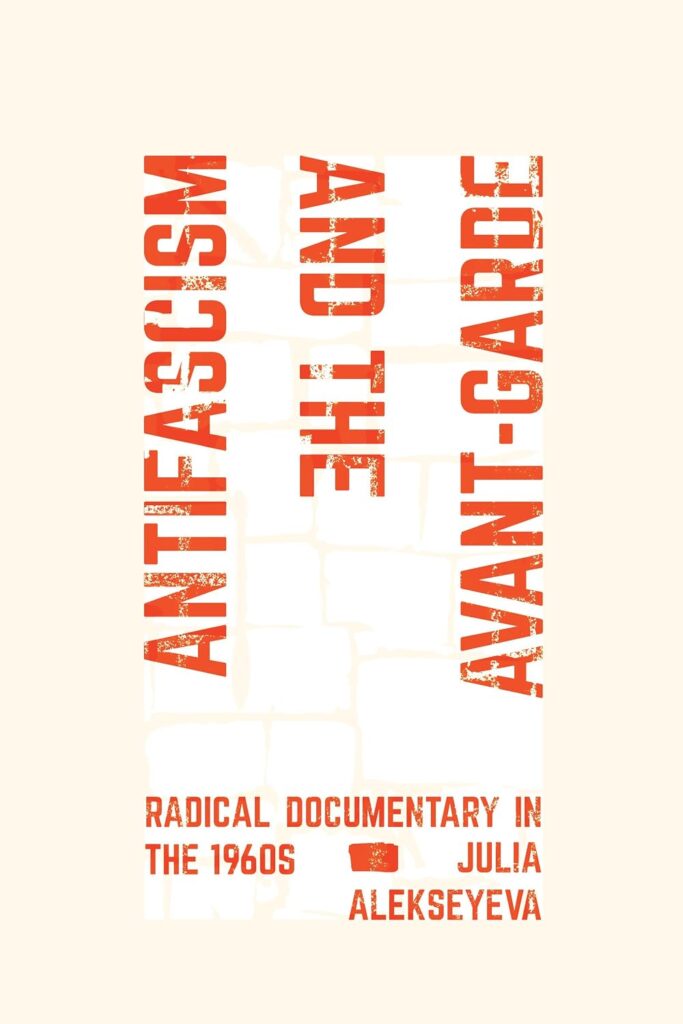
Antifascism and the Avant-Garde: Radical Documentary in the 1960s by Julia Alekseyeva. University of California Press, 2025. 264 pages.
Reviewed by Alexander Billet
It is an old story, though most likely apocryphal. Peasants, watching film for the first time, ran from the village’s makeshift theatre when confronted with footage of an oncoming train. In this story, the viewer is passive and easily led. At worst, they’re simply stupid. Either way, it was good news for whoever owned the film, or the studio that shot it. Not only does it attest to the power of the new medium, it also promises power over something.
The moving image, the capture of life on celluloid, could wield the masses’ minds. Today, the culture industry aims for a viewer just as passive, hopes their intelligence is even shallower and easily swayed. It is also, as an industry, more influential than ever before, more able to crawl into the cracks of daily life and shape it from within. There is, as the saying goes, no escaping reality. Netflix has seen to it. So have all the other big-name streaming services. All are ostensibly in the business of peddling fiction, works of entertainment and art. And, yet, in having such unprecedented access to the shape of our imaginations, they, in turn, shape our notion of the possible.
It is not merely a question of who owns it all (though the fact that David Ellison has merged several of the largest Hollywood studios, and controls two of the most influential news organisations, and is working hand-in-hand with his father’s development of artificial intelligence, is cause for more than a bit of concern). No, it is in how much of the programming itself claims a purchase on “reality.”
Around 80% of television viewers watch some form of “unscripted” programming: competition shows, true crime docuseries, or the dreaded Reality TV. If we were to categoriae “documentary” as a broad genre – the ostensibly unplanned, the “true to life” – then it is clearly more popular than ever. Why then does it feel like we have never been further from the truth? Why does every narrative seem to drift through the air of its own accord, waiting for some huckster to twist it into their preferred meanings?
Even the notion that reality can be commodified and consumed should be enough to call the very moniker of “Reality TV” into question. Even the rawest and unrehearsed sequence requires someone to press record on a camera. All entertainment is a form of labour.
Still, the pretence is powerful. Suggest consistently enough that reality acts and feels a certain way, and it might just come true. The decision to inundate the genre with frivolous and salacious gossip, next-door serial murderers, and rich people doing rich people things leaves us with the sense that reality is innately shallow, individualistic, and nothing but the glossy material that shows itself to us. It is the perfect hyperstition for the age of cryptocurrency, conspiracy theories, and authoritarian narcissism.
The ability of film to actively transform the way people see the world is seldom acknowledged. This is, of course, deliberate. Anything that draws attention to the deliberations shaping our understanding of the world is bound to raise deeper questions. Film, by virtue of how the medium operates, works on and with human consciousness in distinctive ways. Plenty of filmmakers haven’t just acknowledged this potential, but aimed it in radically different directions.
* * *
Julia Alekseyeva’s Antifascism and the Avant-Garde (University of California Press, 2025) examines work from a small number of these artists, those who thought differently. There was a time when the works of Agnes Varda, Chris Marker, and Matsumoto Toshio were lauded as innovative and revelatory well outside the ranks of film school aesthetes and underground video stores, when they reached into at least the fringes of mainstream discourse. Alekseyeva’s work strongly implies that this could be the case once again, though this would first require (among other developments) a deeper awareness of how the aesthetics of filmmaking can be challenged.
Rediscovering (and perhaps reconstructing) this lineage is not an abstract matter for Alekseyeva. An Assistant Professor of English and Cinema & Media Studies at the University of Pennsylvania, she was also born in Ukraine, the daughter of post-Soviet Jewish refugees, and is a Marxist. Between these different identities – often stereotyped as diametrically opposed to each other – perhaps it is no surprise that the author is sensitive to the matter of subjectivity and the messy questions arising from it. Her graphic novel Soviet Daughter, published in 2017, started to untangle these questions, addressing their ambiguities in a way art is uniquely equipped with.
Naturally, Antifascism and the Avant-Garde takes a more analytical and scholarly approach. Though the author has selected specific objects of study by comparing the radical and experimental filmmaking of Japan and France in the 1960s, the author’s framework is relatively capacious. Some of the directors she examines could be more easily categorised as documentary filmmakers than others. Some are undoubtedly fiction films that incorporate real-life documentary into their plots. All exemplify what she calls the “avant-garde documentary,” the blurring of the line between fiction and reality with the goal of sharpening the viewers’ critical faculties rather than dulling them.
Hovering over these case studies are Gilles Deleuze and Felix Guattari, particularly their concept of microfascism, and the subtle ways we are trained to take pleasure in domination and competitive individuality. More immediately present, however, are the work of Walter Benjamin (unsurprising given the long shadow cast by the aesthete over anything having to do with the reproducible image) and of early Soviet filmmaker Dziga Vertov.
Vertov was famously inquisitive about how his relatively new medium – its juxtapositions of content, form, and movement that had previously been impossible – uniquely impacted its audience. The author homes in on a particular shot Vertov’s Man with a Movie Camera to illustrate this:
…the eponymous cameraman shows the viewer a woman wielding a rifle during target practice. Her target is a rather silly looking cardboard cutout of a man in a top hat, emblazoned with a swastika. In other words, a fascist. Vertov cuts from fascist to woman twelve times, each shot with decreasing length and accelerated rhythm, until finally the woman pulls the trigger and, after she finally hits her target, a hidden mechanism reveals a sign; in Ukrainian, it reads Bat’ko Fashysmu, translated as father of fascism. More accurately, the term is diminutive, “Father Fascism” or “Daddy Fascism” – implying silliness alongside evil.
Alekseyeva contends that these often playful contrasts are exactly the kind that work on the audience’s psyches. As the author argues, “a central goal of avant-garde documentary filmmaking in the vein of Vertov is pedagogical and epistemological”. It is a distinctive mandate. Pedagogical: the film is employed to teach. Epistemological: the film interrogates how we know what we know in the first place. Alekseyeva’s view of film is that it is not intended to propagandise so much as work on a far more microscopic level, less showing the viewer what to think than teaching them how to think, sensitising them to the falsities of daily existence and the truths underneath.
Hence the author’s sites of inquiry. There is a particular method behind choosing France and Japan in the 1960s as film scenes worthy of analysis. Each country has had its own distinct and horrific relationship to mid 20th century fascism. Each experienced the eruptions of the 1960s in such a way that allowed workers, students, and artists to actively interrogate the parameters of daily life under the postwar consensus. To the filmmakers featured in Antifascism and the Avantgarde, it was not just that the fascist will to dominate had not vanished with the end of the war, that it was essential to the machinations of empire. Allowing the audience to peer through the ideology wasn’t down to simple facts.
* * *
Many of the examples Alekseyeva employs attempt the same kind of gesture as the example from Man with a Movie Camera. That is, they use editing techniques less to manipulate than to reveal something about the truth of capitalism and imperialism under the surface, what she calls “antifascist unveiling.” Matsumoto Toshio’s ANPO Joyaku (ANPO Treaty, 1959) literally superimposes Japanese imperialism during World War II onto American nuclear tests in the South Pacific (an unmistakable statement during mass protests against US military presence, personified in the ANPO treaty). Chris Marker’s Le Joli Mai (The Lovely Month of May, 1963) has us listen to the antifeminist ramblings of a French businessman as the camera zooms in on a spider crawling up the side of his jacket. Agnes Varda’s Salut les Cubains (Greetings Cubans, 1963) contrasts Castro’s beard with a puff of cotton candy, a whimsical gesture seemingly out of place in a “serious” documentary about the Cuban revolution.
All of these guide the viewer’s perception in unexpected directions. Each, in their unique way, situate the camera itself as a subject – similar to Vertov – rejecting the withdrawn shots of cinéma vérité and refusing any attempt on the part of the viewer to separate themselves from the action. In using the artifice of film to explode a sense of inevitability in capitalist daily life, they force the problems of that daily life underneath its naturalised sheen to the fore. But, to Alekseyeva, it is not merely that these films highlight the subtle fascisms sewn into contemporary existence. They also show an egress from that life, related not just through facts but ontology.
This is particularly present in Varda and Marker’s use of joy and play. Le Joli Mai and Salut de Cubains purposely reject the idea that documentary film’s mandate to analyse and understand should also make it dry and joyless. Shock does not necessarily imply displeasure. The surrealists knew it, and so did these filmmakers.
Marker’s equation of the businessman with the spider creeping up his sleeve is puckish and humorous. Varda, in particular, invites us to indulge in the sensuous in the context of the Cuban Revolution. This is not just in calling a child’s cotton candy “the most popular beard” in contrast to Fidel’s iconic facial hair. As Alekseyeva writes, “There is an emphasis on leisure and excess” in Varda’s film, “not as debauchery, but as the inevitable products of a communist form of government, uniquely able to provide citizens time for rest, joy, volunteer work, and cultural activity.” Later, in Salut de Cubains, we are shown footage of Sara Gómez – herself a brilliant revolutionary Afro-Cuban filmmaker – not shooting footage or agitating, but simply dancing. In this, Alekseyeva sees something paradigmatic: freedom, a rejection of misogyny through a liberated female body, a daily life that emphasises enjoyment, that sees happiness as a right rather than a pursuit.
In urging the viewer to regard these real-world possibilities, these examples also point to a fundamentally different, far more porous and dynamic conception of the relationship between reality and fiction. Yes, filmmaking is labour. It is an artifice that, should we see it as such, prevents any bourgeois pretence toward objectivity, and forces us to suppose that things could be different both within the narrative structure and “our own” world.
Ultimately, as Alekseyeva insists via the words of legendary Japanese New Wave filmmaker Hani Susumu, “There is not a clear difference between fiction and documentary.” This is a provocative statement, pointing to a very salient difference in our current moment. Our contemporary media landscape – glutted as it is with reality TV, salacious docuseries, the heightened emotional states of social media and so much else – operates according to the spectacle. It is not so much the replacement of reality with fiction as it is the elevation of certain aspects in that reality into its whole.
Whereas communicative capitalism’s version of reality and its rearranged fantasy-real dialectic aims for acceptance and passivity, Susumu’s conception – as well as that of Alekseyeva and the other filmmakers in Antifascism and the Avant-Garde – is that the imagination and intelligence of the audience can be brought along as fictive elements, allowing us to see reality as a range of possibilities, and changeable through the actions of ordinary people like the viewers themselves. In the spectacle, reality enforces the fantasy that all is whole, and the whole cannot be moved. To the revolutionary filmmaker, fantasy shows us reality’s true, naked form, and the different directions it could take.
* * *
What impact does any of this actually have on fascism, or the struggle against it? The film’s lens shows a different angle on life, its multidimensionality and possibility of difference, but what does this mean for the subject who has to live within that life? This is where the author’s use of microfascism becomes particularly salient. The concept itself can be, and is, too easily dismissed by many on the left. At first glance, it seems too adjacent to the concept of “microaggressions,” or other notional practices elevated by liberal frameworks as essential to racism and oppression at the expense of the material structures that play a far greater role in perpetuating them. It is important here – and this is echoed by Alekseyeva’s work – to distinguish between these kinds of concepts and those of Deleuze and Guattari.
The impetus behind the idea of microfascism is to identify the ways in which the subject is conditioned to police themselves and others, the ever-present “cop in your head” that spurs you to prove yourself more righteous and pure than your adversary (and at some point, everyone becomes your adversary). In some ways, the theory’s aim is the obverse and antidote to the kinds of behaviour-policing that interminably seem to be fed by the panopticons of social media and reality television. Alekseyeva quotes Deleuze and Guattari in A Thousand Plateaus (1980):
Instead of the great, paranoid fear, we are trapped in a thousand little mono-manias, self-evident truths, and clarities that gush from every black hole and no longer form a system, but are only rumble and buzz, blinding lights giving any and everybody the mission of self-appointed judge, dispenser of justice, policeman, neighborhood SS man.
Of course, these kinds of behaviours are not merely, nor even primarily, rooted in Reddit comment sections or viewership of The Real Housewives. They, and their cultural counterparts, are organic outgrowths of a society that values having and being “more”, that ultimately sees subjugation as natural and moral. And though film and art obviously can never take the place of communist organising in undoing these mental straitjackets, they do serve a role in loosening the straps, fostering what Alekseyeva, quoting Jackie Wang, calls “communist affect”.
For the avant-garde documentarist, the specific visual constructions of film, therefore – the editing, the angles, the overlap or widening of narratives, the show of reality as ultimately changeable – are aimed at the collective audience member. They are intended as a method of forging defiant subjectivity in the audience member, opening up the possibility of different forms of life and living. New modes of ontology are suggested, along with different forms of love, sexuality, solidarity, human connection and intersubjectivity.
This becomes particularly pointed in later chapters in the book, when Alekseyeva peels apart the contradictions and shortcomings in the work of other filmmakers from her chosen nations and era. There is the dicey question of “alternative Japaneseness” in Imamura Shohei’s Nippon konchuki (The Insect Woman, 1963), whether there is a national character that exists apart from militarism and alliance with empire. It is also a question posed by Kuroki Kazuo’s Tobenai chinmoku (Silence Has No Wings, 1966), which intersperses its narrative – a caterpillar’s journey from Nagasaki to Hokkaido – with footage of the 1960 mass protests against the US-Japan Security Treaty. Both films also, however, make a similar problematic turn in using the female and insect forms interchangeably, and as allegories for Japan itself.
This kind of misogyny was far from exceptional, and Alekseyeva insists that it gets in the way of creating the alternative subject. This is nowhere more obvious than in her nuanced, generous, but unflinching critique of Jean-Luc Godard. Alekseyeva particularly zooms in on his work with his Dziga Vertov Group film collective, operated with Jean-Pierre Gorin from 1969 to 1971. The films made under the auspices of the DVG are among Godard’s most didactic, bluntly incorporating Brechtian staging techniques to achieve their own Verfremsdungseffekt with aim of deliberately affecting reality.
They are also, according to Alekseyeva, some of Godard’s least enjoyable, least willing to engage in playfulness, and most misogynistic. Like Kuroki and Imamura’s films mentioned above, British Sounds (1970) uses to allegorise general political problems, even to create discomfort in the viewer, transforming the human being into little more than a device. Lutte en Italie (Struggle in Italy, 1971) presents activities commonly associated with the “feminine” – cooking, shopping for clothes – as uniquely and pointedly bourgeois. What is more, both films outright shun the sensual, asserting shock as discomfort as necessarily unpleasurable.
Even more disturbing is Godard and Gorin’s unnecessary and frankly mean-spirited Letter to Jane (1972), produced as a postscript to 1972’s Tout va Bien. The latter is undoubtedly one of Godard’s strongest, and allowed him to collaborate with Jane Fonda, who, at the time, was at the height of her own radicalism. But, writes Alekesyeva,
The film mostly comprises a photographic image of Jane Fonda in Vietnam, with Gorin and Godard supplying fifty-two minutes of oral criticism: a vicious lampooning coupled with visual analysis. The result is nothing short of hateful; in any event, the filmmakers could have chosen both Fonda and Yves Montand, her famous costar in Tout va Bien, for their scrutiny. Instead, the attacks are leveled at Fonda – a self-proclaimed leftist and humanitarian – and assume her politics are insincere. Unsurprisingly, Fonda is not given a right to respond to these allegations.
If the film was an attempt to further expose the artifice of filmmaking, to ponder the contradictions of celebrity and revolutionary commitment, the end result merely gives the audience permission to bring onscreen cruelty into real life without compunction.
At the same time, Godard’s purported disregard for the viewer’s emotional subjectivity (he once rebuked a female audience member commenting on British Sounds with a harsh “fuck your feelings”) is contradicted in the content of his and Gorin’s Vladimir et Rosa (Vladimir and Rosa, 1971). A loose, parodic retelling of the Chicago Eight trial, it sees the directors themselves dress up as outlandish figures Friedrich Vladimir and Karl Rosa, cavorting around the set, poking fun at the fictional Judge Himmler (the trial’s real-life Judge Hoffman lampooned and transformed into a Nazi). In the face of state repression and racism, Gorin and Godard see themselves uncharacteristically capable of light-hearted humour. In Alekseyeva’s estimation, it also makes for a better and more effective piece of antifascist filmmaking.
* * *
The final full chapter of the book brings matters of gendered form and ludic filmmaking techniques to a kind of singularity. How does the avantgarde documentary ultimately offer up a different, utopian way of being on a molecular level that is still collective?
Japan in the late 60s and early 70s was as rocked by protest as anywhere in Europe or North America. Student rebellions had forced the closure of university campuses nationwide. The ANPO treaty, that entrenched US presence and was resisted so fiercely in the earlier part of the decade, was still around. It was still being resisted too. Like elsewhere, these protests took on a more holistic, revolutionary zeal, using opposition to ANPO as a launchpad to reconstruct everyday life against the militarised, consumerist version being imposed on them.
The films the author focuses on in this chapter are, therefore, more aimed at reinventing the personal and interpersonal in the context of generalised and radical upheaval in society. These films injected an often dark, surreal, highly subversive, frequently queer sensibility into their form and content. Matsumoto Toshio’s Bara no soretsu (Funeral Parade of Roses, 1969) retells the story of Oedipus Rex in the context of Tokyo’s underground gay culture, and with a noted playfulness (Alekseyeva describes its tone as “ecstatic”). It intersperses its plot with candid, on-the-street interviews with members of that same subculture, as well as footage of the film’s own production. Terayama Shuji’s Sho o suteyo machi e deyō (Throw Away Your Books, Rally in the Streets, 1971) navigates the Japanese counterculture with a markedly queer gaze.
Then there is Hani Susumu’s Gozenchu no jikanwari (The Morning Schedule, 1972). After the presumed suicide of the free-spirited and chaotic Kusako, two of her friends (one a recent lover) rewatch a series of 8mm films to try to understand her inner life. Kusako is far from what we today would recognise as the tired trope of the manic pixie dream girl. She is not merely impulsive, but strong-willed and curious, eager to explore the world and herself. She is also ultimately a tragic figure, unable to see the experiment of herself as part and parcel of the world around her. She steals her friend’s pants and hat when he is not looking to dress up like Charlie Chaplin. Susumu was an admirer of Chaplin’s particularly his 1940 skewering of Hitler, The Great Dictator (Chaplin was also highly regarded by Vertov and other Soviet filmmakers, a regard that was, it bears mentioning, mutual).
But, underneath the whimsical raspberry blown in the direction of repression, there is melancholy. “Chaplin in his movies is sad, somehow” Kusako says in voiceover while we see her dance across the rocks. To Alekseyeva, the character “embodies a self-revolution by merging boundless creativity… with an extraordinary sense of play”. She is constantly experimenting, searching for a new definition of herself in relation to a world in radical flux, establishing pleasure as a cornerstone of revolutionary subjectivity. If Kusako is such a unique and (in some ways) aspirational example of personal-sexual fluidity and freedom, however, what are we then to make by her suicide?
Reading Alekseyeva’s analysis, there is something to be said of how the tensions between Kusako’s joyful experimentalism and melancholy sadness mirror the double-facing disposition of revolutionary transformation; always forward while glancing backward, with one eye toward a magnificent future and one cast backward to the memory of those who didn’t make it. It is this that renders queerness a particular kind of anachronism, outcast from history while also existing at its fulcrum.
It is here that we see Alekseyeva’s concept of intersubjective transformation – via the understanding of microfascism – illustrated most vividly. Hers is not a liberal vision that sees personal transformation as a stand-in for systemic change. Rather, it conceives of reality and the individual within it as ultimately changeable, and of a dialectic between the two (much at Deleuze and Guattari might object to such a Hegelian descriptor).
The transformational slipstream between revolutionary melancholy and revolutionary ecstasy furthermore points to another of Alekseyeva’s primary concerns. As the title of her Substack informs us, the author is “searching for re-enchantment.” To show the self, its life, and the world around them as interconnected and potentially transformed is to show the material as strangely alchemical. To use the technical particularities of filmmaking to put the chimerical human subject at the centre of this transformation furthermore inverts its apparent power, from a power wielded over consciousness and subjectivity to a power wielded by it.
* * *
It is worth considering these arguments in relation to more recent, frankly stunning examples of the antifascist avant-garde documentary. The examination of limits between reality and fiction – substantively different from the instrumentalised blurring we see in the current glut in docuseries and reality TV – is present in films like The Zone of Interest (2023). Jonathan Glazer’s use of filmic artifice to recreate a slice of life in the Höss family and its high-ranking SS patriarch deftly accentuated the story’s banality and its extreme evil. Its final incorporation of real-life footage of present-day Auschwitz’s memorial exhibitions being wiped down and vacuumed by night cleaners forces us to ask which present-day atrocities are creating the harrowing monuments for the future.
A similar porousness is present in Kaouther Ben Hania’s The Voice of Hind Rajab. This film (which, incidentally, counted Glazer as one of many executive producers) used actual recordings of the young Rajab’s phone calls to the Red Crescent to recreate her murder by the Israeli Defense Forces. Audio and visual devices periodically remind us that we are watching something that really happened, and very recently at that.
Both films deliberately puncture the veil between documentary and feature film, between reality and fiction. Both leave us with a sense of contingent temporality, though as much as a challenge to the viewer as a practical fact. Neither film allows for much in the way of radical joy (not surprising given their respective subject matters), though one has to wonder whether there is something to be said for seriousness when present-day fascism first emerges into public consciousness as the trickster. When laughter and mockery are so frequently and infamously used to urge others to join in on the exploitation, forging something like revolutionary pleasure presents a real challenge.
Indeed, much of the contemporary rubric of reality TV is designed to socialize sadism, to encourage pleasure in others’ dispossession. It is worth reminding ourselves also that the enjoyment procured from these kinds of sadistic sociality are quite thin, readymade for the never-ending series of cheap dopamine hits, akin to what Mark Fisher once called “depressive hedonia”.
Still, the challenge remains. To show not just the world but the human as mutable, existing on the same continuum of radical potential. Even if we must depart from an overglutted mainstream to find them, there are indeed examples of film which urge negation of a world as cruel as it is overproduced. The question is whether they and we can now step into the negation’s negation, the ability to imagine ourselves and the world as one big, endless series of sites for reinvention. There is no running from this train. Changing its direction is the only hope.
Alexander Billet is a writer and critic based in Los Angeles. He is the author of Shake the City: Experiments in Space and Time, Music and Crisis (second edition: 2026), and has contributed to Los Angeles Review of Books, Salvage, Jacobin, Protean, and other outlets. Read more of his work on his website. He is also active on X and Instagram.