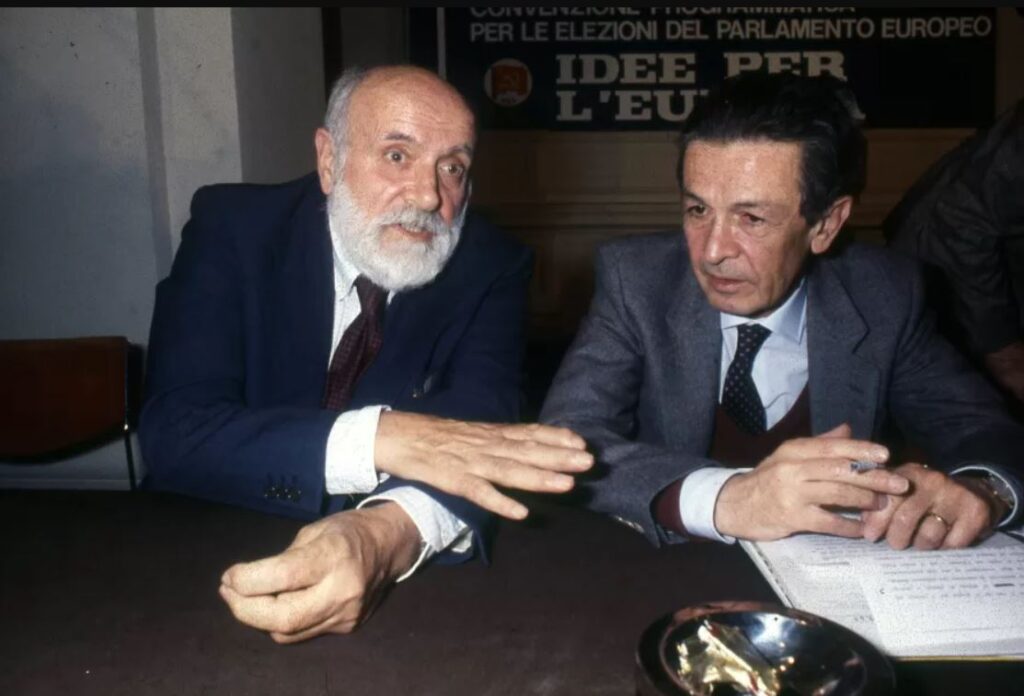
Translator’s Introduction: This text was originally published as a preface to the 2023 Spanish-language collection Berlinguer y Europa, o los orígenes del socialismo en libertad and published by Icario Editorial. Balibar released a slightly modified French version on the website AOC (Analyse, Opinion, Critique). It continues Balibar’s series of reflections on the fortunes of communist politics in the postwar era. This project dates back to the 1970s, when he developed a research programme centred on the key concepts of politics in Marxism. His approach pairs theoretical precision with an attentiveness to historical genealogies. Focusing on Italy, with nods to his experience in the French Communist Party, Balibar’s analysis of Eurocommunism offers unexpected insights into a moment buried under retrospective condescension. The failed synthesis of European construction with an alternative trajectory of communism still indicates problems of internationalism and the dismantling of what he calls the “national-social state”. As then, so now, a possible resolution would entail an expansive view of political power from below, premised on “a qualitative leap towards a larger space of representation, organisation, and struggles”.
***
The release, first in Italy, then in France, of Andrea Segre’s film Berlinguer: La grande ambition, and the debates it has sparked, draws our attention back to the Eurocommunist project, of which Berlinguer was both the theoretician and key instigator. Alongside this event, I am reprinting here – with a few changes – the main sections of a preface I wrote in 2023 for a collection of writings, correspondences, and commentaries, the centrepiece of which documents the collaboration between the general secretary of the Italian Communist Party (PCI) and Altiero Spinelli, one of the major figures of European federalism.[1] It is a matter, to my mind, of at once completing the interpretation of the Eurocommunist project through the inclusion of its properly European dimension (too often neglected in favour of Italian domestic politics and tensions within the “international communist movement”, yet which, absent this dimension, would remain unintelligible), and suggesting that this history, although belonging to a totally different conjuncture, bears useful lessons for us to orient ourselves in the critical phase that so-called “European construction” confronts today.
These two perspectives are reciprocal. The emergence of a new figure of party communism in the period of its final crisis, distinct from both the Soviet and Chinese tendencies, and capable of circumventing the logics of geopolitical “camps”, was only possible because of the development of European construction, for at least some of its initiators.[2] On the other side, overcoming the regime of “liberal-nationalist” technocracy which rules Europe today and brings about the blockage of its political institutions, in country after country, is only imaginable to the extent a transnational project of social, ecological, and participative democracy can regain substance and credibility.[3] That these two perspectives are profoundly aporetic in the world of Trump, Xi Jinping, and Putin, turning Emmanuel Macron into a geopolitical wizard and Ursula von der Leyen into the “little telegrapher” of finance capital, should not prevent us from reflecting on them and investigating their supports. A critical return to the arguments of the recent past does not replace a solution, but they can be part of a vital political memory.
The publication (in Spanish) of a collection of writings in which Enrico Berlinguer, general secretary of the PCI from 1972 until his death in 1984, analyses the political situation in Europe and discusses the prospects of European construction, accompanied by personal accounts and in-depth studies by the historian Alexander Höbel,[4] and ending with substantive excerpts from interventions by Altiero Spinelli on the politics of the Italian communists in the period of their electoral alliance with him, represents a welcome initiative. I would like to take this occasion to think through several problems that, despite the massive differences in historical conditions, warrant our interest in the initiatives and lines of questioning from this period, now half a century ago, yet which the militants of my generation still vividly remember.
One might believe that the stake of such a publication is solely that of a historiographical or archival order. But the conflict between Ukraine and Russia in this very moment, which is once again plunging the entire continent into a “hot” belligerence, with all its predictable or unpredictable consequences, has come to highlight its actuality, by showing that the “European civil war” that spanned the whole of the last century continues to rage today, beyond ceasefires and border adjustments, although its factors – nations, classes, ideologies, regimes – have undergone ceaseless reconfigurations. Everything is happening as if the confrontation between East and West, which is taking the people of Europe hostage, and especially those of its “central” region (Mitteleuropa), were escalating to extremes: what we had constantly feared during the Cold War but had been repeatedly averted. This new episode, however, carries a markedly different social content and political stakes than those of yesteryear. It will not be worthless, then, in this critical conjuncture, to reexamine in the present what the terms of political debates were in the 1970s, and especially the way which those terms articulated antagonistic choices of social and political regime in each country, with open-ended options for the transformation of Europe in a system of solidaristic nations and states – both of these questions being, obviously, dependent on the “equilibria” of the world-system on the path of globalisation. This history bears lessons that have not yet been fully drawn out.
Self-Criticism
Before launching into some speculation on these themes, I must honestly clarify two points that relativise or overdetermine the scope. I was myself a Communist during the years concerned, having been a member of the French Communist Party from 1961 to 1981, and having always continued to lay claim to that “idea”. But, despite the close links I maintained with Italian comrades from many generations and orientations, and the importance I have always accorded to the international dimension of communist commitment, I did not have the direct experience of Italian politics and its vicissitudes (some of which, as we know, were dramatic). This might have generated a biased understanding of what the “Eurocommunist” project was about, since I first saw it in the version formulated by the PCF, very different from the one the PCI supported and its general secretary theorised: a version à la française that was deeply ambivalent and even marked by duplicity at the level of its leaders (I will return to this point below). Indeed, the reading or rereading contained in the anthology has led me to rectify many of my prior judgements. There is the additional fact that, in the debates of the period, I found myself in the camp of the adversaries of Eurocommunism and, therefore, tended to exaggerate or caricature the objections to it, although I, at bottom, shared many of its motivations and even its aims. This was, first of all, due to my close collaboration with Louis Althusser, who sought to distance himself both from the positions of the PCF leadership and the “Italian line” through his interventions on the “dictatorship of the proletariat” and the “peaceful road to socialism”, in which one can hear an indirect, but actually transparent, refutation of Eurocommunism.[5] It also can be traced to the sympathy that I had (like Althusser and others, including Fernando Claudin in Spain, the historical “rival” of Santiago Carrillo and major historian of the international communist movement) for the positions argued for by the “dissident” group Il Manifesto, which took shape around Rossana Rossanda and Lucio Magri, particularly their attempt to articulate a “left-wing critique” of historical communism, traversing the separation between the social and capitalist worlds, with an essentially “non-parliamentary” strategy for the seizure of power, inverting, as it were, the tactical priorities of the institutional Communist parties.[6] I in no way disavow the positions I held or argued for in that period, but I am led to modify or reverse several of them, under the effect of the history we have lived through since then, and my own self-critical reflections on fundamental points. This does not make me a “retrospective Eurocommunist”, which would be meaningless, but it has led me to distinguish between several ways of criticising it and to re-evaluate aspects whose significance were not legible to me then.
I especially want to highlight the displacement that became clear to me apropos the way that the international and national dimensions of the passage to socialism (or, as I would say today, “socialist transition”: an aleatory process of transformation envisioned in the present rather than as a more or less straight “path” leading in stages to a mode of production to come).[7] The debates of the 1970s came after the insurrections of 1968 (in particular, the “Prague Spring” and its repression). In France as in Italy (and across all of Europe), these insurrections developed on the basis of controversies relating to the nature and evolution of “actually existing socialist” regimes, beginning with the postrevolutionary USSR. At issue was knowing which historical lessons and practical consequences could be drawn in conceiving an alternative to capitalism. The insurrections were also tied to assessments and anticipations of the effects of the “détente” between East (the Soviet bloc, to which were connected, even with serious divergences, all the communist parties except the Chinese Communist Party) and West (the camp of “liberal” capitalist regimes, entirely subsumed under the hegemony of the United States), without forgetting the uncontrollable outside that was the non-aligned Third World, which we did not yet call the “South”. In this interdependent arrangement [ensemble] presented for reflection, two types of questions persist as a discursive cleavage: the first, apparently more political, questions bearing on the relations of force and strategic games between the camps (with their turning points, like the Cuban Missile Crisis, the ups and downs of each adversary’s prestige after the repression of the uprisings of Berlin, Warsaw, Budapest, and Prague, or, on the opposite side, the mass war crimes and final retreat from the War in Vietnam, the coups d’etats that the CIA fomented in Latin America, etc.); the second, more theoretical, questions surrounding in general the modalities of the seizure of power and its exercise by the revolutionary class and its “allies”, in the perspective of a transition whose sense had been defined by the classics of Marxism, and whose modalities would have depended on the “stage” capitalism had reached.
Europe, Site of Political Transformation
In these conditions, Europe, as a “great space” [grand espace] configured by the history of its nations and peoples, by its internal splits and the blowback effect of colonial expansion on its civilisation, appeared more as a contingent framework than as a fundamental stake. This impression came to be periodically shaken, of course, by events that resonated from one end of the continent to the other, like the popular insurrections in the space of “actually existing socialism” or the fall of the Mediterranean rim dictatorships, but it was underpinned by a privileging of the national framework, as the terrain of the organisations of the workers’ movement in its confrontation with the state, towards which – paradoxically perhaps – converged both the model of building “socialism in one country” inherited from Stalinism as well as the “polycentric” demand for national paths to socialism formulated by Togliatti in his 1964 “testament”.[8] Yet, here, the signifying chain assembled by the publishers starting from Berlinguer’s speeches forces us to reconsider everything from a different viewpoint, by effectuating a true conversion of the gaze [une vraie conversion du regard]. Not only does the problem of European formation or construction – its objectives, its advances and blockages – become (or become again) a significant stake for thought, able to “fuse” the immediate strategic or geopolitical dimensions and the long-term revolutionary perspective, but it becomes clear that Europe as such, in its proper materiality, historicity, and in its potentialities and impasses alike, is the veritable site of political transformation, whose national configurations of power and social forces are only elements.
By the same token, the reading’s centre of interest is inverted: it is not so much about knowing whether or not (in the years when, as we now know, a shift in the bases and objectives of the European community was in motion, that the fall of the “social system” would hasten after 1989) Eurocommunism actually had a specifically European politics, than of knowing whether or not it contributed to setting the course, or at least attempted to do so. The very meaning of the term “Eurocommunism”[9] is then transformed: not the idea of communism such as it is proposed and sought to be implemented by Communist parties embedded in Europe, with their militants and voters who happen to be European citizens, but the idea of a communism for which European federation would constitute one of its intrinsic objectives (whence the convergence with Spinelli) and that, in turn, would make the advancement of European federalism one of its central tendencies. Between a “Europe” henceforth unified according to a new institutional formula, one that is postnational if not poststatist, and a reformed and refounded “communism”, we must, consequently, think a co-belonging, of which Eurocommunism would be the motor, or the hypothesis, in any case, the symptom.
But, here, a difficulty emerges. I earlier spoke of Berlinguer’s positions, then Eurocommunism in the broad sense, and their relationship to Europe as a political problem, but this is only a way of deferring the question of interpretation that a present-day reader will not fail to raise in reading an anthology whose elements are public texts, and even speeches: who exactly is speaking in these texts, and further, who wrote them? Is it a singular individual, a leader exploring political hypotheses and attempting to share them with comrades and counterparts (as Lenin, Trotsky, and Rosa Luxemburg once did), or the mere mouthpiece of an institution, even an apparatus, trying to adjust its tactics in a mobile conjuncture? The question is simultaneously crucial and uncomfortable.[10] It is difficult to deny that Berlinger (whom Tronti shortly before his passing saluted as the “last great breed of politician from the Italian communist tradition”)[11] strongly identified with the stated project in these official texts, of a “communism commensurate with Europe”, and forming an original relaunching of its history (even its emancipatory “tradition”), and that a subjectivity both personal and political is engaged there.[12] The same certainly cannot be said for all the leaders formed in the mould of the Comintern. Yet it must be noted that the language encountered in the texts he left behind often appears stereotyped, cautious, allusive, lacunary.[13] We might inquire why there is this ongoing discrepancy between the firmness of intention, readable between the lines, and the rigidity in expression, surprising even if we recall the langue de bois in which debates over the alternatives internal to Marxism were held in this period, which the best of its representatives did not escape.
Rather than invoke the Machiavellianism of scholarly manuals, I will propose to relate the (to my mind very real) contradiction of form and content to the fact that Berlinguer’s project, in the position he occupies as inheritor of a traumatic, haunting, but also partially repressed history, was not simply to present (or represent) an idea or “line” to debate, but to bring along with him the “party” as a whole – which not only means the PCI as a national organisation, with its several generations of militants and mass of sympathisers, but that alternative, reconstituted international that “European communists” would form, starting from those in France and Spain, in a staggering, tripartite undertaking, the direct statement of which would have appeared either as a provocation or an illusion. To build an alternative politico-cultural “hegemony” in Italy, reviving the orientations of antifascist resistance and embodying a new road to socialism; to elaborate in Europe and for Europe a left-wing, reformative “historical bloc”, articulated to mass movements (in particular, working-class trade unionism), against its technocratic, liberal, and conservative leading apparatus; finally, and above all, to turn Europe into a geopolitical force independent of the Cold War’s two camps, capable of overcoming conflict internally.
It is doubtless at this point that the limited convergence, at once quite real and always conflictual, becomes immensely clarifying at the institutional level as that of “style”. Altiero Spinelli (European Commissioner from 1970 to 1975, but also a former Communist who retained ties with some leaders of the PCI after his expulsion in 1937 for disagreements with Comintern strategy) certainly represents another politics from that of the Communists: however, his own “federal” project overlapped with Berlinger’s Eurocommunism, in which he saw, for a time at least, one of the political forces capable of modifying the process of European construction, for which he envisioned joint action with the PCI leader for the long-term. Not so much a merger or identification, in which the difference between communism and federalism would be dissolved, but much more than a quid pro quo and taking advantage of each other tactically, this alliance did not openly exclude ulterior motives, but it bore an element of shared confidence and hope that is extremely clear, even in polemic. Hence, the revelatory role that the “disjunctive synthesis” of the major stylistic differences between Berlinguer’s and Spinelli’s discourses serves in highlighting the problematic nodal points of the Eurocommunist hypothesis and in drawing out its continuing relevance. I would like to illustrate this schematically in three points.
Remaking Europe to Save Italy
The first point concerns what we might call, to borrow Fredric Jameson’s well-known turn of phrase, the vanishing European mediator in the indefinitely deferred situation of war (with several episodes of “escalation to extremes”) that characterised the international relations of the second half of the 20th century.[14] This dimension, of course, generates interesting comparisons to the present moment, taking into account the differences. All of these 1970s texts, and the very perspective of Eurocommunism, hinges on the hypothesis that the Cold War, framed on both sides as a confrontation between two camps or even two worlds, fuelled by a rivalry that extended across the entire planet and was drawn into a “exterminist” logic by nuclear weapons, but had entered into a phase of “détente” after the resolution of the 1962 Cuban missile crisis, could irreversibly lead not only toward a “peaceful coexistence”, but an international order that involved common rules and interests.[15] Since 1945, Europe had been hostage to the confrontation between the two blocs, leading to both its division (including Germany, splitting into two violently hostile states) and its subordination to imperial sovereignties. It could now escape the double bind imposed on it as a subordinate player in a global conflict, while simultaneously seeking to invent an autonomous political form for itself and to overcome national antagonisms. In return, through a “virtuous circle” which clearly constitutes Berlinguer and Spinell’s shared wager and hope, this Europe – that would be at least partially founded in an open federal structure – would itself be a powerful factor and actor in the détente.[16] This function as a “third force” or third party would be all the more efficacious if it were exercised in alliance with the progressive forces of the Third World, in search of an autonomous “path of development”, and, for this very reason, the site of violent confrontations between several worldviews and multiple imperial “projections”. It is evident that, for Berlinguer, inheritor on this point too of an Italian communist tradition of exchanges with anticolonialist movements (notably, the Algerian FLN) and was also close to the positions of the Yugoslavia federation and Tito, this junction that “decentred” the European perspective (or tried to rid it of its eurocentrism) was an essential component of the project.
I insert a personal parenthetical remark here. Once again, the importance of situating our perceptions of historical reality by taking geographical differences into account arises – even as narrow as those which separate the French situation (where I was located) and the Italian situation (where Eurocommunism found its most advanced formulation through Berlinguer) might seem. It is not that I was insensitive to the tragic dimension of Italian politics at the time, which surfaced in its discourse (contemporaneous to the “years of lead” on the peninsula), but is clear that, on this side of the Alps, we did not feel the same existential urgency that the imperative to exit the Cold War and extricate Europe from it took on for Italian Communists. Because at stake for them was not only the nuclear risk or the response to economic crisis, but the way in which the incorporation of the American military-political apparatus had subjected and corrupted the politics of Italian society (not only through the “support” provided by Washington to successive right-wing and centre-right governments in Rome, but also through the clandestine utilisation of the Mafia, even the Vatican, and the penetration of US spy agencies into all the gears of the state and especially the police and army). From this vantage point, the Spanish Communists emerging from Francoism or the Greek Communists having experienced military dictatorship had to be more receptive, but the Italian situation remains unique. Let us add that, due to the Yalta agreement, the USSR always secretly applied in Europe the direction of the US State Department against what Berlinguer would envision as the “historic compromise”: no Communist participation in the governments of the West which guaranteed in return Western non-intervention in the democratic revolutions of the East (in 1965, ‘68, and then in ‘81), but also prepared the ground for the development of terrorism and counterterrorism.[17] My sense is, therefore, that Berlinguer never wanted, through Eurocommunism, only to make (or remake) Europe in a certain fashion, but to save Italy, another terrain of encounter with Spinelli, inspired by Machiavelli. This preoccupation and feeling of urgency should be borne in mind when we seek to dispense assessments on the unforgivable quarrel pitting the PCI against the Italian “autonomist” far left, beyond the question of terrorism.[18]
Overcoming the Schism of European Socialism
This leads me to my second point: for Europe to develop in the direction of a supranational construction, involving not only states represented by their governments, but peoples expressing their demands through a federal representation “of a second order” (doubling the constitutional system internal to each state) and social movements animating what one could call – demarcating and reorienting the concept from Habermas – a “transnational popular public sphere”.[19] Berlinguer and Spinelli, doubtless, place their hopes in the emergence of a new socialist alliance at the European level, including both social-democratic parties reoriented “to the left” (leaving behind the long years of alternation or cooperation with Christian Democracy in an Atlanticist and reformist framework) and “mass” Communist parties emancipated from Soviet tutelage. They believed to see the premises for this alliance in the evolution of the North European social democrats, on the initiative of “neo-Keynesian” leaders like Olof Palme and Willy Brandt, and a certain tendency within the Socialist International (Bruno Kreisky), moving in the direction of a rapprochement with Third Worldism and European “neutrality”.[20] A great alliance thereby took shape, whose condition of possibility resided in a shared diagnosis of the crisis of liberal capitalism under US hegemony (which could be summarised in the triptych: economic “Fordism”, the financial monopoly of the dollar, and military interventionism at the borders of the Empire); its strategic aim lay in opposing nascent neoliberalism (which took advantage of the crisis to dismantle social policies and do away with more broadly what I call the “national-social state”)[21] not through a regression or restriction but a progression and expansion of social rights and public regulation of the economy (which means, simply put: capital). The deep moral sense (undergirded, in Berlinguer’s speeches, by frequent references to the spirit of the antifascist Resistance) was nothing less than the idea of “surmounting” or overcoming, through a common endeavour, the great centuries-old “schism” within the European labour movement between the idea of social reform based on parliamentary compromise and the use of the state, and that of class struggle as the driving force of social development, as crystallised by the confrontation of 1914 over “national defence” and the October Revolution of 1917, and then re-inscribed (and codified) in the system of “camps” by the relation of forces established at the end of the Second World War. The much-maligned formula of Eduard Bernstein: “the goal is nothing, the movement is everything”, must be brought together with Marx’s: “Communism is for us not a state to be created or an idea to which reality must adapt itself. We call communism the real movement that abolishes the present state of things”.[22]
It should not be avoided, however – and this is the meaning of the controversies which arose in the 1970s among Marxists and communists themselves through notions like “party of government and a “third way” between parliamentarism and proletarian dictatorship – that such a project (to say nothing of a programme) would necessarily appear, by force of circumstances and habits of thought within the Marxist tradition (at least as “codified” in its Leninist version, even among critical intellectuals as we were) more like the culmination of a process of social-democratisation of communism than a movement of radicalisation or “gauchissement” of social democracy… And the inscription of the project in the horizon of European federalism de facto did not dispel this ambiguity, but might have contributed to its intensification, understood as the political and institutional constraint that the European community in its actual, technocratic, liberal figure represented for all the citizens of Europe, especially those belonging to the “subaltern” classes.
I will limit myself to three remarks on this point.
Firstly, the way in which the positions were crystallised at the time was seriously obscured by the fact that the Communist parties (in France as in Italy) largely practised (and with some effectiveness) a reformist politics dressed up in a revolutionary language (language that was, in fact, partly crucial to class mobilisation and the establishment of a relationship of forces with the state and employer groups, what, in Machiavellian language, one might be called the “tribunal function” [fonction tribunitienne], but which also, at times, had effects of corruption and demoralisation).[23] Consequently, the “Gramscian” claim for a war of position strategy could be received either as a legitimation of reformism, adjusting the language to actual practice, or as an attempt to escape ambiguity and rethink the revolutionary perspective… But how to determine between the two interpretations in advance? It is not words that are primary here, but actions and the balance of forces.
Secondly, Eurocommunism – above all in Berlinger’s presentation – clearly carried the spirit of a subversion of the border between the two “Europes”, challenging the ideological iron curtain, if not the difference in political regimes: the “Prague Spring” sparked by the communist Alexander Dubcek before being crushed by Russian tanks is one of the sources of inspiration for Eurocommunism which, in turn, was confident by Eastern European dissidents to be a potential support [un point d’appui] for a democratic reform of “actually existing socialism”, whose echo can still be found with Gorbachev in close connection to his proposal for a “common European home”.[24] In a (pan)European perspective which is also democratic, this outlook of unification that involves greater Europe [grande Europe] (that is, it includes Russia) and gives primacy/a primary role to citizens’ initiatives, while it must be acknowledged that it was no match in the face of geopolitical “balances” (and their progressive destabilisation), it nevertheless retains a principled significance, precisely as an idea of an alternative to the logic of “camps”.[25]
From Third Way to Third Phase
But the most important and, at the same time, most hypothetical point is the way in which Berlinguer tried to displace the question of the “third way” (which harkens back to a longer story in the history of debates within the workers’ movement)[26] by substituting for it a problematic of the third phase in the history of the revolutions of the 20th century, which the Eurocommunist project should have launched, the first two phases being the foundation of the USSR after the October Revolution and then the expansion of the “socialist camp” in the aftermath of the Second World War, respectively. This displacement was obviously a provocation against the Soviet Communist Party and its satellite states, thrown in their faces during the Berlin conference of 1976, since the Soviets considered their own scenario for seizing and wielding power to be unsurpassable.[27] But this provocation involved the whole representation of historical tendencies through the long-term conflict of which the confrontation between the “camps” of the Cold War is only one episode, and, in some respects, a mere mask. The strategy of communism (Althusser) must therefore choose between repetition and innovation.
But this is also the place of the greatest equivocations, that Berlinguer’s careful oratories do not help to dissipate. On the one hand, the idea of the third phase bears both an element of continuity that is translated through the claim to the legacy of October[28] (or the insistence on the idea that in the Cold War the Soviet bloc represented in the last instance the camp of peace) and elements of rupture that challenge the idea of an organised revolutionary force that exclusively leads, in practice embodied by the single party of a Leninist type (hence the critical importance of the notion of “pluralism” deployed by Berlinguer at the PCSU’s XXV Congress, in the presence of Brezhnev and Sokolov).[29] On the other hand, the texts presented by Marcelo Belotti are striking in the deafening silence they maintain on the Sino-Soviet split and Maoist politics, which were, nonetheless, the obsession of communists of all stripes in that period, especially since the “Cultural Revolution” also presented itself as an opening and idea of a third phase in the history of communism (challenging the Eurocommunist grand narrative by offering another against it, but also proving too that the question of this rupture or renewal was indeed on the agenda). At the time of Mao’s death in 1976 (always the same pivotal date), his legacy was not yet settled. Berlinguer’s major silence on this point could be interpreted as an indication that, in even his divergence with the Soviets, they always had in common the rejection of the same adversary, but also as the symptom of the fact that the idea of the third phase carried an internal uncertainty, likely to complicate the way in which the “convergence” between the European revolution and the anti-imperialist movements that had their own idea of revolution (and of the “revolution in the revolution”) would be envisioned.
However, all of this does not minimise, but, on the contrary, accentuates, the relevance of the question the idea of a new revolutionary phase raises within the European context (a question that, it must be said, the “official” texts presented by historians and publishers do not really allow us to explore fully): in what way can the resurgence, or even the explosion, of workers’ struggles and other intrinsically “anti-capitalist” social movements in Western nations, involving a new generation of activists (the one that “made” 1968 or continued it in each country, in different ways), and the internationalisation of the objectives and organisational forms of these struggles, be considered two sides of the same problem? It must also be noted that, on this point, neither those who defended the “party-form” nor those who considered it obsolete or distorted (most of whom were, at the time, opponents of Eurocommunism, perceiving it as an administrative device [construction d’appareil] and a “compromise” with the system) have genuinely offered a solution to this dilemma.
Evil Genius
Let us finish by enumerating, without pretension to comprehensiveness, the internal contradictions of the project that the reading of these republished texts today allows us to identify (with the always slightly dubious advantage of retrospective projects of “results” and “intentions”), and which we may think explain why it was cut short.
First, there is the glaring fact that the global balance of forces and the tendencies of transformation in capitalism were not what Berlinguer believed (and on what he thought he could base his position). The Vietnam debacle had produced, on this point, an illusory effect, broadly shared by all the “antisystemic movements” across the world, that interpreted the moment as the beginning of the end for the US-led international order, in line with the enthusiasm and hopes that the Vietnamese struggle had generated.[30] Yet, right before the end of that war, the US Secretary of State Henry Kissinger, architect of counterrevolution on a global scale, had implemented a counter-strategy, specifically forming an alliance with one half of the Communist camp against the other (Beijing against Moscow), which would determine the entire direction of the following period.[31] The same goes for the “dollar crisis (or Nixon Shock)”, reinforced by the “oil shock”, which led to decisions in 1971 and 1973 that put an end to the Bretton Woods system, and which the US Treasury leveraged by rebuilding the domination of American financial institutions on more advantageous terms.[32] Imperialism was not on its last legs; it was in the process of reorganising and rearming itself.
Secondly, there is the fact (which I have already alluded to) that Eurocommunism was, paradoxically, at once antagonistic to the Soviet model and unable to extricate itself from total solidarity, and thus total dependence in relation to the USSR and the militant forces or organisations connected to it. The reasons here are complex, as they include not only taking a side against the Chinese path, but the need not to affront the shared sensibility of militants by giving them the feeling that they were going to be forced to “change camp” (a particularly acute problem in the case of the French Communist movement but pressing in Italy too). And, above all, it seems to me, there was the hope of working towards a reunification of Europe (including or not including the USSR itself) that would be achieved not (as would be the case after 1989) through the generalisation of market capitalism, but through the convergence of “reformers” within the Western Communist parties and the “popular democracies” (hence the need to share a common language with their leaders). But the reality, mirroring the American offensive across the world that would later be called “neoliberalism”, was the crushing of the Communist reformers, the “Brezhnev-era” re-Stalinisation of the Soviet system, and the burial of the spirit of Helsinki in favour of a new arms race… More than ever, “Europe” came to mean only the capitalist “little Europe”.
Thirdly, in a way that is doubtless linked to the preceding processes, the strategy of left recomposition (what could be called the Brandt-Berlinguer-Spinelli hypothesis) failed or was rapidly undermined. Here, again, of course, the reasons are manifold, including the tactics of domination and the internal power struggles within the electoral process and parliamentary politics, and even the palace coups that eliminated the “unity-oriented” socialist leaders in favour of “right-wing” competitors more closely linked to the managerial class of the new capitalism (such as Helmut Schmidt, Bettino Craxi, and Jacques Delors), and whom Brandt himself supported as president of the Socialist International until his death. But the root of the problem lies in two phenomena that act together to destabilise the classical organisational forms of social conflicts, on which Eurocommunism was closely dependent: the violence of the process of decomposition of the working class (and the “counter-society” that had formed around it, under the combined effect of industrialisation and class solidarity), engendered by nascent neoliberalism; and the crisis (after the 1960s) of the party-form, or, more broadly, of “democratically” centralised forms of political organisation, which became increasingly incapable of inspiring and linking mass mobilisations. At a time when the capitalist strategy for overcoming the crisis was producing new polarisations that revolutionised the social division of labour and consumption patterns, shifting the lines of professional division and sharpening the contradictions of society as a whole, the capacity to construct an escape route from the paralysing dilemma of refusal and compromise, previously the very objective of the activity of “class parties”, seemed to become unattainable, and even inconceivable.
PCF, Party of the Eternal Nation
In this very negative picture, I will also give special attention to the evolution of the French Communist Party and its latent, then open, conflict with Berlinguer’s orientations and formulations. This point is well known and widely studied today, but the emphasis is most often placed on the PCF’s hesitation to truly distance itself from the USSR and on the opposing directions in which the PCF and the PCI evolved in this respect, from the repression of the Prague Spring to the invasion of Afghanistan and the insurrectionary strike of the Polish dockworkers (Solidarity), including their respective attitudes towards Soviet “dissidents”. I do not understate this point, but I want to draw attention to another aspect of the problem. Unlike Berlinguer, the PCF had never felt the slightest “European federalist” temptation (with the exception of a few leaders with limited responsibilities, such as Jean Kanapa in his later years, and brilliant but isolated intellectuals, such as Jean Rony or Christine Buci-Glucksmann and her colleagues at the journal Dialectiques).[33] Consequently, the “joint declarations” between the two parties (or the three, including the PCE), which, as we know, resulted from tough negotiations, are also characterised by double-speak, or by the possibility of pulling in two opposing directions. But I believe there is a deeper level, transcending calculations of the party apparatus: the PCF’s reluctance or even hostility toward any “federalist” European policy (which, notably, includes its opposition to the idea of electing the European Parliament by universal suffrage, on which the alliance of Berlinguer and Spinelli was based) can be traced back to its deep-rooted nationalism (what we would call “sovereigntyism” today), in which the traces of the Popular Front, experienced as a return to the roots of the great revolutionary nation, those of the Resistance and the competition with Gaullism, plus the difficulties in completely repudiating colonialism (during the Algerian War), and even the imitation of the Soviet model of “socialism in one country”, were unevenly combined. But it must also be linked to the spontaneous adoption of a strategy of resistance to neo-capitalism, crystallised in the struggle against the dismantling of the “national-social” state model that, within the national framework, guaranteed the rights won by industrial wage earners. French Communists were co-founders of this model after 1945 (and it is not without equivalent, of course, in other countries). It is true that this model, although it entered into crisis at the same time as national sovereignties themselves, is historically associated with the period of greatest political effectiveness of the traditional workers’ movement. It is possible that defending its gains, which protect the working class against impoverishment and elevate it above the proletarian condition proper, requires not a fetishisation of the national framework but a qualitative leap towards a larger space of representation, organisation, and struggles (in practice: European). But it is certain that this “leap”, with the twofold wager it implied – a change of language and a change of practice – required an extraordinary effort, both organisationally and imaginatively. The French Communist Party (PCF) refused to make it, and the Italian Communist Party (PCI) failed to do so. This led the former to increasingly reluctant subordination to an increasingly “liberal” social democracy, and the latter to the fatal impasse of the “historic compromise”, for which Berlinguer also took responsibility, in what appears to us in retrospect as a desperate fuite en avant.[34]
An Encounter to Come?
This brings me back, in conclusion, to express questions rather than certainties, and to offer a final word on the articulation of the idea of communism and the idea of federalism, as embodied by Berlinguer and Spinelli, and which seemed to me to form, as an open question, the guiding thread of the anthology I am commenting on. Speaking as philosophers, we can say that these two terms historically and conceptually represent a unity of opposites. This could theoretically trigger a “dialectical” process, generating political and theoretical innovation. But this would require not only efforts of intellectual elaboration, going back to the classical sources of the definition of these categories and drawing lessons from multiple experiences that illustrate their plasticity, but also something like a meeting of their respective proponents, going beyond individual figures, even those invested with responsibilities and capable of echoing collective aspirations, therefore involving “movements”, “actors”, and historical “forces” emerging from current events, and capable, through their very encounter, of counterbalancing the most conservative and destructive tendencies of the dominant social regime. This is what ultimately did not happen in the last century, although the Italian Communist leader advanced the idea and explored its possibilities with the instruments and partners at his disposal. This is what the current situation in Europe may compel us to reconsider and revive, perhaps under other names and certainly with different priorities, although we have no guarantee that success will be any more assured today or tomorrow than it was yesterday, because the obstacles remain no less formidable. The very resistance that such an idea provokes, even among the most determined opponents of capitalist globalisation – each of whose terms is, however, a form of active negation (negation of alienation through the system of property and labour, negation of alienation through nationalist exclusion and confinement) – could then paradoxically appear as an indicator of the truth it contains. And, from this perspective, the documents compiled by Belotti and others like them would undoubtedly be of great utility.
Translated by Patrick King
[1] Member of the Italian Resistance, former communist who remained linked to some leaders of the PCI after his expulsion from the party in 1937, influenced European federalism via the Manifesto di Ventotene, written in exile with Ernesto Rossi in 1941, followed by the foundation (in 1943) of the European Federalist Movement, Altiero Spinelli was a member of the European Commission in charge of industrial policy and research from 1970 to 1975. A member of the European Parliamentary Assembly (1976-9), he was elected as a Communist-affiliated member of the first European Parliament elected by universal suffrage in 1979, and re-elected in 1984. As rapporteur of the Institutional Committee, he drafted a project for a European Union treaty, which the “Delors Commission” drew upon but reversed the priorities of, ultimately leading to the Single European Act of 1986. Upon his death in 1986, he was buried on the island of Ventotene, where he had been “confined” by the fascist regime. See Piero S. Graglia, Altiero Spinelli, Il Mulino, Bologna 2008.
[2] Carlos M. Herrera, “Forme politique et espace démocratique: d’un étatisme sans état et de son incertain dépassement”, in Une Europe politique? Obstacles et possibles, ed. Ninon Grangé and Carlos M. Herrera (Paris: Editions Kimé, 2021).
[3] See Etienne Balibar, “L’impossible possibilité de la fédération européenne: hier, aujourd’hui, demain”, Institute for European Studies, l’Université Libre de Bruxelles, “Journée de l’Europe”, 8 May 2025 (published in AOC Media, 27 and 28 May 2025).
[4] Alexander Höbel, “Berlinguer y la politica internacional” and “Enrico Berlinguer, parlamentario europeo. El dialogo con Altiero Spinelli”, in Berlinguer y Europa. By the same author, see “Il Pci e l’Urss attraverso i decennali della rivoluzione d’Ottobre (1927-1987)”, Memoria e Ricerca, 56/3, 2017.
[5] One gets a sense of this position in reading, in particular, the “Barcelona lecture” delivered by Althusser on 6 July 1976, a few days after the Conference of “communist and workers’ parties of Europe”, in (East) Berlin, where Berlinguer spoke on 30 June (see below). What strikes me today in this text is the combination of the clarity (but also extreme abstraction) of its argument for the Marxist-Leninist concept of “class dictatorship” and the confused character [caractère embrouillé] of the remarks on Gramsci’s thought and the Eurocommunist theorisation of “democratic socialism”, hypothesised as mutually related. See Louis Althusser, Les Vaches noires. Interview imaginaire, text annotated and prepared by G.M. Goshgarian (Paris: Presses Universitaires de France, 2016), 193-248. It is important to note that Santiago Carrillo’s book, Eurocomunismo y Estado (published in 1977), contains several references to the Althusserian theory of “ideological state apparatuses”.
[6] The main reference I am relying on here is the colloquium organised by Il Manifesto in November 1977 in Venice on “Power and Opposition in Postrevolutionary societies” (published in 1978 by Editions du Seuil). In his memoirs published in 2009, Lucio Magri (a founding member of the Il Manifesto group then the PDUP, who would rejoin the PCI after its renouncement of the “historic compromise” with the Christian Democrats) advances analyses of the international and national conjuncture in which the Eurocommunist endeavour took form and the reasons for its failure that I find very convincing and have influenced my argument in this text. See Lucio Magri, Il Sarto di Ulm. Una possibile storia del Pci, (Milan: Il Saggiatore, 2009).
[7] Etienne Balibar, “Régulations, insurrections, utopies : pour un ‘socialisme’ du XXIème siècle”, in Histoire interminable. D’un siècle l’autre, Ecrits I (Paris: Editions La Découverte, 2020).
[8] The Yalta “memorandum” drafted by Togliatti to present and establish the divergence between the Soviet Communist party (then led by Khrushchev) and the PCI’s respective “lines”, also known as “Togliatti’s testament”, was published by PCI leadership in the wake of its author’s death in 1964. See Le Monde, 5 September 1964 https://www.lemonde.fr/archives/article/1964/09/05/le-testament-politique-de-m-palmiro-togliatti_2128292_1819218.html.
[9] Put forth by Santiago Carrillo in 1975 and taken up in turn by Berlinguer: see Alexander Höbel’s analyses and the joint declarations of the Italian and Spanish Communist Parties in the cited collection.
[10] The juxtaposition of Berlinguer’s texts with Spinelli’s sharpens the dilemma: for, if, as is obvious, he expresses himself in a calculated manner due to his own “constituent project” [projet constituant], Spinelli nevertheless addresses himself to his interlocutors in an individual capacity, including while discussing their partly shared, partly divergent history. For further details on the distance and temporary rapprochement between the PCI and Altiero Spinelli, see Piero S. Graglia, in the cited collected, which provides details on “negotiations” and indicates the quite violent reactions provoked by this “rallying” within the Italian political class, especially in Germany.
[11] See the interview with Mario Tronti: “Il comunismo non c’è più ma mette ancora paura”, Il Riformista, 1 June 2022.
[12] Tronti again: “L’Europe qui rassemble tradition et révolution”, in La politique au crépuscule (La politica al tramonto, Einaudi 1998); and “Kommunismus oder Europa”. See too the collection edited by Jamila Mascat: Le démon de la politique (Paris: éditions Amsterdam, 2021).
[13] The volume edited by Domenech and Belotti is comprised, in part, of historical studies, and, in part, of Berlinguer’s speeches and articles (including joint declarations with the leaders of the French and Spanish Communist parties, and before the XXV Congress of the Soviet party and the meeting of European Communist parties in 1976), and, finally, Spinelli’s articles on his alliance with the PCI and their correspondence between 1977 and 1984.
[14] In his essay “The Vanishing Mediator; or, Max Weber as Storyteller”, (Ideologies of Theory, (London: Verso, 2008)), Fredric Jameson employed the expression “vanishing meditator”. I was influenced by it in L’Europe, l’Amérique, la guerre (Paris: La Découverte, 2003) to try to imagine a European politics that ran counter to the logic of imperialist wars in the Middle East.
[15] Following the expression suggested by Edward Palmer Thompson in his essay “Notes on Exterminism, the Last Stage of Civilization”, New Left Review, I/121, May/June 1980.
[16] What could be called the “Helsinki effect”, after the name of the Conference on Security and Cooperation in Europe, whose final accord was signed on 1 August 1975 by all European states including the USSR, plus the United States, which created immense hopes in “civil society” from each side of the dividing wall.
[17] The USSR’s taking sides in favour of the status quo in Europe and the pressures exerted in this direction on the Communist parties were acknowledged in a “secret report” by Jean Kanapa, head of foreign policy on the Political Bureau of the PCF in 1974. The same Kanapa pushed for the PCF to rally around a strategy of “independent” nuclear deterrence supported by the development of a French force de frappe, in the framework of the Union of the Left with the socialists. See Frédéric Heurtebize, “Détente, eurocommunisme et dépassement des blocs durant la décennie 1970: les espoirs contrariés du Parti communiste français”, in Revue du Centre d’histoire de Sciences Po, 46 (2022). We might compare this development to the formulation whose serious consequences “escaped” Berlinguer in a 1979 interview with the Corriere della sera about “socialism being easier to realise within the Atlantic Treaty than the Warsaw Treaty”. See too Frédéric Heurtebize, Le péril rouge. Washington face à l’eurocommunisme (Paris: PUF, 2014).
[18] See Romaric Godin’s recent assessment, responding in Mediapart to what he sees as a “naive” reading of Berlinguer’s politics as hostile to workers’ revolts that go beyond the unions. I can bear witness to the fact that Antonio Negri, in contrast with Tronti, never “pardoned” Berlinger for his supporting the repression of l’autonomia operaia by the state apparatus under the auspices of the “strategy of tension”. [Note by E.B., 2025].
[19] Counterpoint to the “left-wing critique” already carried out by Alexander Kluge and Oskar Negt in Öffentlichkeit und Erfahrung. Zur Organisationsanalyse von bürgerlicher und proletarischer Öffentlia premiseschkeit (Frankfurt am Main: Suhrkamp, 1972). It appeared in English as Public Sphere and Experience: Analysis of the Bourgeois and Proletarian Public Sphere, trans. Peter Labanyi, Jamie Owen Daniel, and Assenka Oksiloff (Minneapolis: University of Minnesota Press, 1993).
[20] Social Democratic Party leader then Prime Minister of Sweden, Olof Palme was assassinated in Stockholm on 28 February 1986. He fought against Nazi Germany during World War II (which, for a long time, led to him being considered as a traitor in his country). Willy Brandt became mayor of (West) Berlin then chancellor of West Germany from 1969-1974, a promoter of Ostpolitik which normalised the relations between the two Germanys and sought a negotiated end to the Cold War. Organiser of the resistance against Nazism, then leader of the Austrian Social-Democratic Party, Bruno Kreisky was chancellor from 1970 to 1983. In various capacities, their politics combined the constitutionalisation of social rights, East-West détente, and the search for a North-South development agreement. See Christine Buci-Glucksmann and Göran Therborn, Le défi social-démocrate (Paris: Editions François Maspero, 1981).
[21] Etienne Balibar, “Communism and Citizenship: On Nicos Poulantzas”, in Equaliberty: Political Essays, trans. James Ingram (New York: Columbia UP, 2014).
[22] Bernstein’s famous statement comes in the 1899 book, Die Voraussetzungen des Sozialismus und die Aufgaben der Sozialdemokratie (translated as Evolutionary Socialism), which launched the “revisionist controversy”. Marx’s statement figures in the German Ideology of 1845 (posthumously published in 1932), written in collaboration with Engels, Moses Hess, and Joseph Weydemeyer (which we now know today was not actually an unfinished book, but a draft collection of articles).
[23] See the classic text by Georges Lavau, A quoi sert le Parti communiste français ? (Paris, Fayard, 1981). Note that Lavau’s reference to Machiavelli is from the Discourses on Livy, where one finds analyses of the effects of class struggle in the Roman Republic, whereas Gramsci obviously drew inspiration from The Prince for his theorisation of the party as a “new prince”.
[24] In 1978, the Czech dissidents Zdeněk Mlynar et Jiří Hájek, spokespersons for Charter 77, saw in Eurocommunism their “best card” in the struggle against the regime (see Heurtebize, op. cit.). Mikhaïl Gorbachev used the expression “European common house” for the first time in 1984 and then more explicitly in July 1989 (on the eve of his fall) in a speech to the Council of Europe, which had invited him for its 60th anniversary. See Marie-Pierre Rey, “Gorbatchev et ‘la maison commune européenne,’ une révolution mentale et politique?”.
[25] “Alternative” is the term that gives Rudolph Bahro’s manifesto its title. Bahro was the East-German dissident imprisoned after 1977 publication in the West of Die Alternative. Zur Kritik des real existierenden Sozialismus, published in English as The Alternative in Eastern Europe, trans. David Fernbach (London: New Left Books, 1978). Bahro was freed and expelled in 1979, becoming a leader of the “Greens” and theoretician of radical eco-socialism.
[26] One thinks of the “Austro-Marxist” current (Max Adler, Otto Bauer) and the attempt to found a “Second/Two and a Half International” after 1919, trying to move beyond the communist-socialist split following the October Revolution and the nationalist turn of German Social Democracy.
[27] Held in East Berlin on June 28 and 29, 1976 after bitter negotiations, the “Conference of European Communist Parties” was supposed to propose a shared view on security in Europe. It led to a statement of disagreement between the Soviet tendency and the Eurocommunist tendency. Berlinguer’s speech, “What Is Eurocommunism?”, is featured in the anthology Berlinguer y Europa, 209-218. See also Lilly Marcou, “Vers un nouveau schisme du mouvement communiste?”, Le Monde diplomatique, May 1977.
[28] Up until the famous (late) declaration: “The progressive force stemming from the October Revolution is definitively exhausted” (15 December 1981, after the announcement of a state of siege in Poland to repress the dockworkers’ strike carried out by Solidarnosc).
[29] See Berlinguer’s speech in Berlinguer y Europa, 219-224.
[30] Giovanni Arrighi, Terence K. Hopkins, Immanuel Wallerstein, Antisystemic Movements (London: Verso, 1989).
[31] Magri is correct to emphasise this point: “Kissinger, an evil genius”, a section of Tailor of Ulm, 311.
[32] See a fine Marxist analysis in Suzanne de Brunhoff, “Les matières premières et le système monétaire international”, Revue Tiers Monde no. 66 (1976), https://www.persee.fr/doc/tiers_0040-7356_1976_num_17_66_2647.
[33] Jean Rony, a self-taught academic, had been a member of the editorial committees for the PCF journals La Nouvelle Critique and France Nouvelle before being expelled from the party in 1981 at the same time as the leading members of the movement “Pour l’union dans les luttes”. See his biography on the online Dictionnaire Maîtron du Mouvement ouvrier. Christine Buci-Glucksmann, close friend of Nicos Poulantzas (who could be considered to be the theorist of a “left Eurocommunism” and cofounder of the journal Dialectiques in 1973, had published Gramsci et l’Etat (Paris: Fayard, 1975) – published in English as Gramsci and the State, trans. David Fernbach (Atlantic Highlands, NJ: Humanities Press, 1980) – and edited the volume La Gauche, le pouvoir, le socialisme, a collective work dedicated to Poulantzas (Paris: PUF, 1983).
[34] The “historic compromise” (between the two ruling parties of Italian electoral life, the PCI and Christian Democracy), intended to bridge the gap between the communist and Catholic masses to prevent their supporting of fascism, was theorised by Berlinguer in his articles “reflecting on Italy after the events in Chile” (Rinascita, 28 Sept, 8 and 9 Oct. 1973). It lost any meaning after the assassination of Aldo Moro (9 May 1978), which allowed the right (Andreotti) to retake control of Christian Democracy. Berlinguer subsequently articulated a (self-)criticism while he engaged the PCI in supporting the last major strikes of the Italian “red years” (Fiat 1980) and in the campaign against nuclear armament (the Euromissile crisis). See the articles by Alexander Höbel, op. cit.; and on the “red sequence”, see the monumental archive-narrative overseen by Nanni Balestrini and Primo Moroni, L’orda d’oro (Milan: Feltrinelli, 1997), 171. An English translation has recently been published: The Golden Horde: Revolutionary Italy, 1960-1977, trans. Richard Braude, London, Seagull Books, 2021). Reference provided by Andrea Cavazzini in his article “Education et émancipation dans la ‘séquence rouge’ italienne. Retour sur quelques expériences”, Contretemps, February 1, 2023.