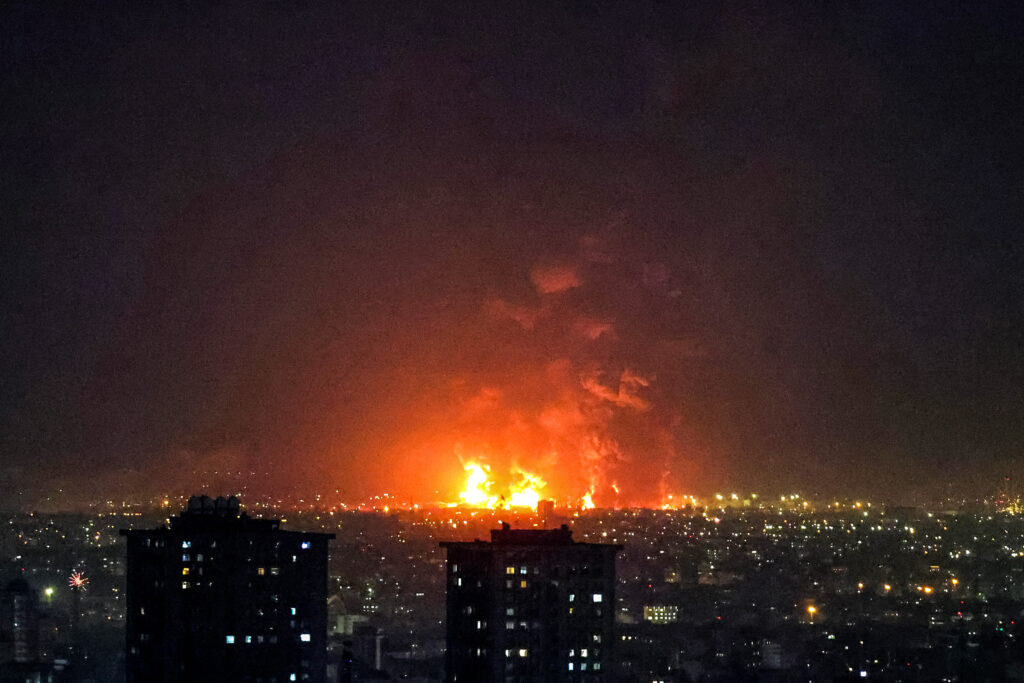
Explodable Landscapes
In a report on how much damage Iran as a country suffered in the US-Israeli aerial strikes, Iranian economist Hadi Kahalzadeh writes: ‘If this war had a hidden target, it was not Iran’s military power projection; it was the labour market that sustains the livelihoods of ordinary citizens.’ It is important to register the scope of the destruction:
War has damaged more than 125,000 residential and civil buildings, including 339 health facilities, 32 universities, and 857 schools, and has directly destroyed over 20,000 industrial units, forcing many related businesses to shut down. In other words, around 20 percent of the country’s production units have been directly damaged. Iran’s ports and transportation systems, which move essential goods and raw materials across the country, have also been heavily damaged. According to some estimates, the war has already cause[d] more than $300 billion worth of damage to civilian infrastructure alone, excluding military facilities. This staggering figure captures only the reconstruction cost, not the wider economic toll.[1]
Iran was the most sanctioned country in history before Russia was targeted for its invasion of Ukraine. If it had not been for its resources, strategies, and revolutionary energy, the ‘art of sanctions’ could have taken as barbaric a toll on Iran as it did on Iraq. Driven to self-reliance, Iran built a great deal since the 1979 Revolution on the foundations put down in earlier nation-building efforts under the shahs. Many Iranians learned about various pieces of infrastructure across Iran only when they saw the videos of their bridges, railroads, depots, and factories bombed during this war. Destroying material conditions of life on a national scale, combined with targeted killings (leaders, commanders, scientists, politicians), are becoming integral strategic choices of war. Israel has performed it in Gaza, Lebanon, and Syria. The two aspects merge in the same strategy: we hit your oppressive leaders together with the infrastructures that they use for their operations, and if they belong to your life situations, then that is too bad. Every national structure is thus regarded as material for a ‘dual use’ and thus targetable – a term deployed by the US to sanction goods that apart from their civilian uses can be used for military, nuclear purposes.[2] Corresponding to this duality imposed on contemporary ecologies is a split subjectivity with a double view through which the residents of those ecologies are asked to separate themselves from their own life conditions, neighbourhoods, families, labour power, even bodies, because all these are represented to them as sites ‘penetrated’ by their oppressive states, captured and owned by their brutal regimes.[3]
The key move in rendering Iranian cities ‘bombardable,’ semantically, discursively, and symbolically, was to enforce a rhetoric of severance: the ‘regime’ is separate from the ‘people’; a politically illegitimate structure of rule is imposed on a population as an alien force.[4] What needed to be done was, in the language of an American General writing three days ahead of the war, ‘[D]eepening the divide between the regime and the people’,[5] rendering it increasingly difficult for a society to express itself in its political structures and, more importantly, for those structures to have a society. The ‘so-called’ Islamic Republic is a ‘hostile occupying force that [has] taken hostage’ the people of Iran, words with which Reza Pahlavi himself opened his press conference in Washington DC, one week after the January 2026 extraordinary violence in Iran.[6]
Such a description of the state in Iran (and of, say, the governance in Gaza since 2006 when Hamas won the legislative elections) correlates to the strategy of decapitation that Israelis and Americans enacted in both recent wars on the country. It is as if the Iranians were made to say: Take our head (the current form of government), leave our body (the people and the infrastructure) intact, and we will grow a new one (a genuinely Iranian, monarchist regime). When this did not work, the air strikes started turning to residential buildings and sites of production. It is as if they were now declaring: If you do not separate yourself from your state, you as a people deserve the same beheading. The ‘regime change’ itself was a veil to conceal a more fundamental target: regime degradation as a way of rendering a whole social formation defective.
There is a lineage to this discourse that established the necessity of attacking Iran in the psyche of many Iranians. There are many reasons – and there will be Iranian diaspora studies in the coming years – but the least explored among them, and I believe the most consequential in terms of inscribing discourses more deeply, is how critical theory and the leftist public intellectuals understood politics and how they failed to protect it against inversions in the past few decades. The intellectuals who, before the recent war, had asked the Western Left not to devise any politics that ‘translates into support for the Iranian state’[7] (effectively calling for a form of boycott against the country), in the wake of the attacks noted its institutional character, not ‘a thin layer of despotic rulers’, but ‘a complex system with manifold centres of power’. Consequently, they argued that targeting ‘the state, the Bayt, military and energy infrastructures’ would not leave intact ‘the lives embedded within them’. In other words, the very intellectuals who once discouraged any support for the Iranian state now realised it was an imperial fiction to assume that ‘social space can be neatly partitioned into legitimate objects of violence’.[8] The state is a part of this social space. Many forces converge when it comes to this partitioning, this separating of the state from society: the warmongers, the neoliberal forces inside Iranian governance, vast strata of people, and a good number of prominent voices on the Left. With a big difference, however; some are executing it as a genocidal project, while others are playing along in what can only be called an unconscious collective desire for suicide. To use Marx’s language of theorising Bonapartism, the parcellation of the contemporary psyche has made us ‘smallholding’[9] subjects whose only capacity consists in helping target their own conditions of life. Today, this is most visible in the Middle East, and particularly in Iran.
The Exception: Iran’s Double Character
The war revealed an exceptional double character in Iran not seen in recent memory. On the one hand, Iran is defending itself against the US-Israel aggression in a way that has surprised friends and enemies, conjuring up only Vietnam’s resistance against the United States more than half a century ago. It is fighting for its autonomous refusal to be a client state in a world crushed by forms of allegiance to American and European multifaceted powers.[10] And it has done so with a dignified style denied to many countries who are suffering from ‘reduced sovereignty’, including those in the West, at least since the ‘War on Terror’.[11] It retaliated proportionally, refusing to hit schools and universities and hospitals, not mocking its genocidal aggressors. In a widely asymmetrical battlefield, surrounded by US military bases, Iran is showing what it means and what it takes to defend national sovereignty in a world where submission to circuits of capital and power has conditioned all practices of free self-government.
At the same time, this autonomy faced an opposite reality which has been working through deep layers of Iranian society and made it utterly vulnerable to forces of heteronomy. In an exceptional way, scores of Iranian people, most vocally in North American diasporic communities – which formed mostly after the 1979 revolution and diversified along class lines in subsequent cycles of uprising, suppression, and migration – called on the imperial and colonial superpowers to bomb their own home country. They celebrated the assassination of their leader and commanders.[12] This was attempted suicide, if we consider that many inside Iran also embraced the attack. The exact mechanics of how chants can translate into missiles need yet to be studied, but we do not need extraordinary methods to realise how massive gatherings under Israeli flags, with sustained funding and media campaigns over the past two decades, generated the psychosocial force for selling the war on Iran. We know that wars do not exactly need selling in the way that a previous generation of political and mediatic figures sold the sacking of Iraq. They are now doing it differently. They are successfully asking populations to demand their own destruction as a form of outsourced revolution. Despair, especially financial, is indeed a threat to society, to sovereignty itself. But no economic account alone could exhaust the causes, or reasons, for such turning against oneself.
The left has paid little attention to this dual exceptionality in the case of Iran. It is important to understand this duality. My hypothesis is that the self-harm as a collective project in the form that we witnessed in the case of Iran, exceptional as it proves to be for the time being, is going to set an example for rendering peoples suicidal in the coming war preparations.[13]
Marxists and communist thinkers have worked out their own notions of separation, of an internal (class) war. It is hard for them not to discern, within national infrastructural landscapes, class fault lines separating owners and producers, landlords and tenants, permanent companies and precarious workers, in short, the chasm between the use-value and the exchange value of almost everything. The mere possibility of the entire terrain getting destroyed overnight, however, puts the question of class struggle within a vulnerable national sovereignty in a new perspective. Living within the bombing reach of Israel and several US military sites urge us to rethink the reality of the state as an apparatus of resistance, even if this state is the ‘capitalist society’s own state’.[14]
One thinks of Fanon’s polemic; ‘These colonial subjects are militant activists under the abstract slogan: “Power to the proletariat,” forgetting that in their part of the world slogans of national liberation should come first.’[15] He is not referring to any immediate bombardment; he is, rather, discussing those urban classes that have maintained a beneficial relationship with colonial forces while also taking part politically in the process of decolonisation and the reclamation of their national independence. And Iran has never been colonised. But his warning flashes before my eyes in the moment of seeing my country randomly struck by present colonisers. So, when radical European thought speaks of the autonomy of the working classes from capital and the state, and, later, of an exodus, a desertion from the state into the autonomy of politics,[16] one could ask what sustains that from which we are to separate ourselves. The war on Iran showed me that answering this question is vital to any revisiting of the very idea of the political in a world that has witnessed the destruction of Gaza.
The Political: A War-Struck Re-evaluation
When I came of age intellectually, it was the final years of the Reformist Era in Iran and the early years of the ‘War on Terror’ in the region. Despite the appeasement policy of the reformists towards an avenging West, Iran was still given a prominent status in the ‘Axis of Evil’. Our two neighbours in the west and east were cruelly invaded. It was more than two decades later, after three or four social movements crushed and two imposed wars (plus an immigration-cum-exile) that I read Derek Gregory’s The Colonial Present, his 2004 account of how they rendered Afghanistan and Iraq bombardable.[17] He used Said, Agamben, Foucault, and critical geography to show the meticulous cultural, psychological, architectural ways in which America and Israel and Britain turned Baghdad, Kabul, and Herat into mappable, radar-and-media-legible terrains, and then into killing fields. When I saw Gregory’s use of Agamben’s figure of homo sacer, I recalled our own Tehran-based collective of translators that undertook a project of translation as a political practice and how we did not use the figure in that way. We translated and commented on works by Agamben, Badiou, Rancière, Zizek on top of Adorno, Benjamin, and Arendt, so too, I guess, did many around the globe in the early 2000s. Almost synchronously with European attempts at rethinking Marxist thought in the wake of the Soviet collapse and the triumph of what was known as liberal democracy, we tried to reanimate what was left of politics.[18]
Our little group, which attracted attention, saw but did not reflect on Iraq or Afghanistan. I knew far more about the Nazi Holocaust and the fate of the Jewish intellectuals who migrated to America than I ever knew about the Nakba and the fate of the Palestinian intellectuals. Why? An answer that many Iranians can instinctively give is because the Islamic Republic exhausted public sympathy for the Palestinian cause, which has continued to be seen through its lens. The allergy to the official discourse on Palestine, associated in the minds of many Iranians with infinite sociopolitical grievances ever since 1979, remained in place through the Gaza genocide and the two wars imposed on the country. We did defend Gaza against the occupation and bombardment after 2006, but we did not really understand how Gaza related to Iran in very tangible ways. To use a Hitchcock reference, Israel looked like that crop duster plane in North by Northwest (1959) which the character did see flying far away in the sky but paid no attention to, despite a pedestrian mentioning it as he was waiting in that deserted bus stop to meet a total stranger with clues about his predicament of mistaken identity. Minutes later, that irrelevant dot in the horizon proved the most urgent element in the screen, coming for the life of Cary Grant. Israel’s attack on Iran had been in the making for over two decades. But it never really became a theoretical question for the Iranian Left, in the same way that Zionism itself has been nearly absent from European political thought— from Adorno to Badiou. I cannot deny the sense of betrayal I felt witnessing Critical Theory’s lethargic indifference—from Tehran to Frankfurt—in the face of what they did to Gaza and Dahiyeh.
The idea of the political that my generation of intellectuals entertained was conceived of as a collective performance of freedom which was, in Alain Badiou’s description, ‘that of the distancing (mise à distance) from the State’.[19] This distance was the core of the so-called post-Marxist radical thought that came into being since at least the nineteen-eighties in Europe. Politics is not a form of management, it is not statecraft. The political delimits the power of the state, gives a measure of it, creates a space within the governability of bodies, languages, situations in which a collective subjectivity can reclaim its own conditions of existence in an infinitely creative way. Jacques Rancière defined political activity as ‘always a mode of expression that undoes the perceptible divisions of the police order by implementing a basically heterogenous assumption, that of a part of those who have no part’.[20] Mediating between citizens and the state within the policed space of the country is the function of government. Politics, as understood by Rancière, disrupts this intermediation—or in Rousseau’s terms, this ‘intermediary body established between the subjects and the Sovereign’’[21]—by constantly challenging the police order that counts, regulates, assimilates, and disperses. This is the state seen from inside. But seen from the outside (an angle usually overlooked by our radical thinkers) the state as the ‘metastructure of the historical-social situation’[22] is sovereignty: a unitary whole with protected borders. Rousseau calls it the body politic in its active mode, or power when it is in competition with other powers.[23] Rancière’s Disagreement does not discuss war as a possibility between states. Indeed, neither Rancière or Badiou shows any systematic interest in the defining impact of this external competition on the destiny of the political.
When one reads Michel Foucault’s lectures now after the third war imposed on Iran and repeated attacks on Lebanon (let alone the kidnapping of the Venezuelan president), one is bound to realise one thing: the state of relative security that the thinkers of political autonomy sensed ever since the end of the Second World War owed much to the balance of forces generated between multiple individual sovereign states sitting next to one another. At least in Western Europe. ‘We are now dealing with absolute units, as it were, with no subordination or dependence between them, at least for the major states, and—this is the other aspect or side of the historical reality on which all this is articulated—these units assert themselves, or anyway seek to assert themselves, in a space of increased, extended, and intensified economic exchange.’[24] I have shown elsewhere how this notion of a multiplicity of states in the open, ungovernable space of global history left Hegel’s late theory of the state open-ended, generating the conditions for ‘Politik’—the concept of politics that took another generation to be adopted in Europe’s social-republican and socialist language.[25] In a critical review of Hegel’s practical philosophy, Arnold Ruge wrote in the 1840s, ‘our time is political, our politics wants the freedom of this world. We no longer build on the church-state, but on the worldly state, and interest in the public essence of state freedom grows with every breath of the humanity.’[26] Replacing the older concept of patriotism in the age of revolutions (and just before the rise of Realpolitik in the wake of their failures a decade later), Politik now means active participation in public life, a passionate interest in history, and, more importantly, attention to the lives of the foreign states. Though the states in Europe did wage devastating wars in the inter-state realm of world history, the nature of the relationship between them remained a controlled rivalry of forces, that is, a competition. Foucault describes the political life in the West in this way: ‘This transition from the rivalry of princes to the competition of states is undoubtedly one of the most fundamental mutations in both the form of Western political life and the form of Western history.’[27] I submit that it was in the inter-statal spaces created by these competitive acts of statecraft that the ‘political’ in modern European thought was staged.[28]
In this regard, it is fruitful to revisit the most innovative account of the political that went on to inform radical European thought, and Iranian post-1990s intellectual trajectories no less: autonomia operaia’s (workers’ autonomy) conceptions of politics. The post-WWII idea of the autonomy of workers was born in the large factories of Northern Italy and continued to flourish amid the frustrations that the Italian working-class struggles witnessed vis-a-vis capital and state co-options of their efforts for gaining minimum victories. Mario Tronti envisioned a revolutionary process that could see ‘the working class increasingly become what it actually is: a ruling class on its own—specifically political—terrain and a conquering power which, in destroying the present, takes revenge for a whole past (and not merely its own) of subordination and exploitation.’[29] Terrain is the operative concept here. It is a zone of collective acts of ensuring life within the socio-political dominion but inherently connected to the sites of production, factories. For all its defeats, the workerists’ idea of separation from both capital and the state found its way into the new conceptions of the political and the language of political activity ever since.
Sylvère Lotringer’s description could have come right out of a page of an Iranian intellectual commenting on the 2009 Green Movement or a 2022 ‘Woman, Life, Freedom’ activist’s book: ‘Political autonomy is the desire to allow differences to deepen at the base without trying to synthesize them from above, to stress similar attitudes without imposing a “general line,” to allow parts to co-exist side by side, in their singularity.’[30] When this new ‘social subject’ is repressed by the state, it turns to the international community for condemnation: ‘The State selected its battleground and carefully weighed its weapons. The State’s blitz on Autonomy violates Human Rights. It should be condemned internationally.’[31] Other mediations are needed to substantiate this, but I discern a point of lineage of today’s politics of dissent and desertion in this early radical formulation. Much of the intellectual activities on the left in Iran after 11 September 2001 internalised this theatre of the political. Heirs to the conceptions of civil society that emerged in the 1980s and 1990s, the idea of the ‘power of the powerless’, the part of the no parts, the voice of the voiceless, we intellectuals in the Farsi-speaking world understood critical theory as a staging of the political as the play of forces within the framework of a state that, though it was repressive, satisfied the condition of safety and security for a society to assert itself. Until the bombs fell.
Fascism that shook the foundations of many European states including Germany and Italy itself does not appear to have been received by postwar radical thinkers as an existential threat to which your neighbour or far-away countries can expose yours. It appears to have been understood as a threat that your own national state can impose on you. Can we say that political autonomy within nation-states took for granted a NATO-secured contract that guaranteed no invasion, no civil war? The further east in Europe one goes, the clearer it becomes that unified national sovereignty is not a given historical fact. The shock of the Russo-Ukraine war can be felt against such a backdrop. That radical thinkers feel obligated, in the face of the Russian invasion of Ukraine, to speak of the necessity to defend Europe’s ‘emancipatory enlightenment’[32] against the ‘axis of Iran-Russia-Venezuela’ sheds light on a long-standing, unexamined undercurrent of national security. This assumption, previously under-theorised in radical accounts of politics, is surfacing today.
I am not using a genetic technique to render ineffective or irrelevant critical theories of politics by reducing them to the condition of national sovereignty, state, geography, or even capital. If anything, I believe there is a strict antinomy between the claim of self-determination, as politics proper calls for, and the conditions of the possibility of that claim.[33] Our acts of autonomy emerge from within circumstances that work as both enabling and limiting conditions. Precisely because the relation is an antinomy — for which there are philosophical, indeed metaphysical reasons that need to be unpacked— neither those claims nor these conditions can turn into the dominant mode of explanation. Facing this antinomy defines our style of thinking about politics.
For this reason, the relation between politics (or class struggle) and the state (or anti-imperialism) as its condition of possibility does not have to be caught up in the contradictions that it has become customary to ascribe to ‘campism’. The term is meant to capture a political alignment on the left based on the geopolitical division of major state forces into opposing camps, most famously China, Russia, and Iran versus the United States and the European Union. The -ism here indicates that the left prioritises the opposition between states and not forces of production and the relations of production within each state. Campists, therefore, it is said, lose sight of the real terrains of struggles.
Internationalism is offered as an antidote because it supposedly understands the connectedness of class struggles through and across state oppositions.[34] If the equalised balance of powers that Europe enjoyed in the post-war order—the continental multipolarity which sustained the political desire for liberty—can be achieved on a global or regional level so that no superpower can casually bomb a country, then conditions for an internationalism of struggles can arise. If not, then any talk of internationalism assumes what it has yet to prove. The anti-‘campist’ rhetoric of rendering political subjects mentally stateless with the promise of re-connecting them internationally rests on a fantasy of global connectivity; it counts on infrastructure put into place by states, on fibre-optic cables laid down by capital. Its constant invocation of the prefix ‘trans-’ (systemic, institutional, national, regional) sounds like a state of trance.[35] It keeps silent about what it knows it must presuppose. Against this, it is urgent today to understand that the project of the ‘Greater Israel’ will not wait for he Western Left to complete its ritual acceptance of guilt from the (mainly diasporic) Iranian Left for not recognising the authenticity of Iranian labour and women’s movements.
The stateless subjects split
Hardt and Rezai preface a dossier on Iran by reminding us: ‘[T]he war against Iran is not an exception—it is a mirror of a world increasingly governed through war, fear, and necropolitics. To confront this, we must turn not to the language of statecraft, but to the insurgent vocabularies of the people: women, workers, students, stateless subjects who articulate life against death, solidarity against domination.’[36] I have argued earlier in this essay for a certain exceptionality that we must affirm when it comes to Iran. What is significant in this formulation, however, is how it encapsulates much of the (Western and Iranian) leftist stance on Iran at least since the ‘Woman, Life, Freedom’ movement in 2022. In particular, the expression ‘stateless subjects’ is noteworthy. Opposed to statecraft, it means to signify the excluded groups of people, especially refugees. But, in practice, the ‘stateless subjects’ can also mean what it says: subjectivity bereft of the state. Hardt and Mezzedra’s 2024 New Left Review piece on ‘Global War Regime’ has been cited by many Iranist leftists for articulating why defending the Iranian state in any anti-imperialist direction is problematic.[37] Those leftists who now criticise what they describe ‘campism’ along the lines of the article cite the following passage: ‘Rather than supporting Iran and its allies, even rhetorically, an internationalist project should instead link Palestine solidarity struggles to those such as the ‘Woman, Life, Freedom’ movements which challenged the Islamic Republic.’[38] Disclosing the premises of both quoted passages is essential, as they illuminate tropes widely used across the Left.
The authors, when summoning the ‘Woman, Life, Freedom’ movement as a challenge to the Islamic Republic, are turning a social movement into an anti-‘regime’ device in a way that is not far from the strategy of ‘degrading the regime’ that the American General quoted above suggests. Prominent Iranian critical theorists, Emadian and Farhadpour use the same lines by Hardt and Mezzadra, and, thereby, while warning against reducing politics to war, as subversive ‘localist’ perspectives do, they nevertheless implicitly endorse the weaponisation of social movements against the political structures of their country.[39]
Comparing Iran with Palestine is tantamount to comparing Israel with the Islamic Republic and the Palestinians with Iranians. What is implicated in such a comparison is that Iran’s government stands in relation to its own people as Israel stands in relation to Palestine, that is, as a colonial force. Implying that Iranians’ intra-statal political struggles are anti-colonial resistance (a trope used by Reza Pahlavi as well as voices on the radical Left) is the outcome of many anti-‘campist’ critics. So, when Emadian and Farhadpour promise that ‘Internationalism, as what sutures or anchors multiple struggles from different territories, emerges precisely at the juncture when all local politics and genealogies face their internal inconsistencies and become split’,[40] we need to immediately pose the question: What is split into what? And on what terrain do these struggles get anchored in a way that does not involve calling the fighters from the tunnels only to expose them to blows of annihilation?
The Iranian Left, taking its cues from the Western Left, has avoided taking any issues with any of the inconsistencies of Iran’s internal struggles—or those of other territories— for fear of being labelled an apologetic of ‘internal repression’. My contention is that there was something in the nature of recent social movements in Iran that has turned them into an apparatus of collective self-harm, a pathology that will not be unique to Iran. Iranians’ collective protests in the past four years have adopted forms and mindsets that heightened their own vulnerability while demanding foreigners to intervene. That many Iranians asked for bombs to solve their internal problems has to do with the ways we have described, understood, and framed those problems to ourselves and, more importantly, to Western observers. (And, in this respect, writing this very essay feels slightly awkward.) The question is not to allow some ‘discomfort with Hamas or the Iranian State’[41] or even harsh critique of them. Rather, the crucial question is how to prevent our forms of becoming political and our critiques of the state from rendering us defenceless.
If ‘woman’ is the signifier for all exclusions in post-Revolution Iran and the most fitting name for political subjectivation in this context’,[42] then is it not precisely for this reason that ‘woman’ became, at once, a sign under which Iran was attacked? We should not forget how easily the movement’s slogan could be inscribed on the wall of a destroyed house in Gaza by the Israel-based reporter with the notorious Iran International – the megaphone for grooming Iranians into accepting the bombing of their own neighbourhoods. There was a reason why the movement failed to gather enough discursive symbolic force to stop this progression.
The ‘Woman, Life, Freedom’ movement embodied the spirit of the horizontal, of rhizomatic growth. It is important to discern multiple vectors in the movement. There was a real, quasi-revolutionary women’s movement against the mandatory hijab with a deep performativity that has been transforming affective, aesthetic, and embodied vistas of Iranian society. Precisely because of this immense, unprecedented social force thus released, the movement at once became weaponised against the country. Today, the very notion of ‘manipulation’ or ‘co-option’ of social movements for the purpose of imperialist domination needs to be revisited. Even though enormous funding helped to amplify anti-regime voices in the diaspora, the way the ‘Woman, Life, Freedom’ movement became the vehicle of subversion goes beyond that. It stems from the forms of desire and the subjectivity that it has produced.[43] We see a deep anti-authoritarian, autonomous tendency in individuals who, under the pressure of an authoritarian, culturally insecure governance, became radicalised without becoming politicised. The ideal of the post-68 cultural politics of transgression has mutated into a wildly parricidal revolt against the state. Iranian cinema shows the extent of this desire to kill the father in contemporary Iranian culture (The difference from the diaspora, of course, is that the characters do it with their own hands without begging international forces to do it for them.[44]) But, combined with Israel’s systematic decapitation strategies, this parricide has assumed a military character. A version of what Eyal Weizman calls ungrounding in his account of the destruction of Gaza has been going on in recent Iranian psycho-national life.[45]
There is much injury in Iran’s recent political history, and this has made it painful to put our fingers on an otherwise socially victorious movement to show how it internalised the desire of the forces that sought the sacking of Iran. But the dark sides of contemporary social movements should also interest a sympathetic Left because the ‘stateless subject’ they have fostered is transforming the landscapes of contemporary radical politics. This is a split subject that does not own up to the conditions of the possibility of the terrain on which it moves. It is called on to look at the landscapes of its country and to see half of it as targetable, explodable. The parallax view that the critical thinkers employ for their internationalist approach proves to be a split view imposed on the subjects who disown their political structures as alien to them.
I say this not from the perspective of the state; not from the perspective of any dying patriarchy that needs to be defended against a reckless youth. I am trying to say so from within a political commitment to understanding the irresistible nature of contemporary Iranian women’s movement with its immense social power. If ‘woman’ does not reclaim the state, the wars will not end. Behrooz Ghamari argues that the 1979 Revolution in Iran had a paradoxical effect with regard to women – who, incidentally, instaged the first intra-revolutionary opposition to the revolution in their famous 1980 International Women’s Day protest against mandatory veiling. In the new ‘Islamicised’ public spaces, ‘the state became the ultimate guardian of patriarchy and by becoming so, paradoxically, sanctioned an unprecedented mobility among rural and urban women’.[46] Thanks to the cultural, religious safety of such spaces, more women could participate in the rebuilding effort after the Revolution, especially during the Iraq-Iran War that soon erupted. Therefore, women on the ground since at least the 1980s have ‘historically created the conditions of possibility for their protests’[47] in 2022. If women posed the greatest prewar challenge to the Islamic Republic, could it be argued that the apparently patriarchal independence project of 1979 Revolution, in the specific form it went on to assume, had to exclude ‘woman’? Any answer to this question will be consequential. However, my provisional answer: It did not have to.
Disowning the androcentric state with all its maddening faults can run the risk of exposing our terrains of internationalism to be occupied by legions of NGOs, and AI-generated neoliberal market-oriented spaces that claim to cater to women and all names of the excluded.[48] Our movements would thus become dislodged from their ties to the life-worlds of Iranian and Afghan women and planted in Washington and New York. These movements have the capacity to reclaim politics, to re-organise sites of production, service, and care, without undermining national sovereignty.
Owning the War
The main problem besetting internationalism today – the call for reconnecting terrains of struggle beyond demands of national sovereignty – is that it makes the left incapable of relating to the wars imposed on the countries in the region. By leaving the fighting to others, it loses sight of the danger its peoples are facing, mis-recognising its own people as alien in the same way that it alienates itself from its structures of governance. During the war, every night, diverse groups of people, albeit mostly religious people with hijabs, took to the streets of Tehran in order to prevent any violent uprising of the type that took place in January following Pahlavi’s call for overthrowing the state. In naming them, keywords used by media and scholars include ‘supporters of the Islamic Republic’, ‘the system’s social base’, ‘progovernment mobilisation’. There is always this ‘regime’ that demonically organises through networks of mosques, campuses, councils.[49] The monism in the conception of the ‘Iranian regime’, taken sociologically and anthropologically, only matches that behind the decapitation strategy: Behead the regime in order to prevent its body politic from producing any threat. While they beheaded the Iranian polity, the body went into the streets to defend its polity, and it succeeded. The Left cannot alienate itself from these people. What if there is another way of relating to the state that is not politicidal?
Iran’s state formation has been called an ‘oxymoronic union between an anti-West religiopolitical rhetoric and a pro-capitalist economy’.[50] There is a reason why, so frequently, the one side of the ‘oxymoron’ is named ‘rhetoric’. Iran has really stood up against imperialism. Why should the Left deny it after years of disavowing it? Is this not up to critical theory to articulate this apparent contradiction? Iran stands up against America and yet it is deeply inscribed in a very Americanised neoliberal project of rendering national sovereignty inoperative. Contradictory forces are at work in Iran. Theoretical work and organising efforts to advocate for labour against all odds are being performed inside Iran without overlooking how imperial forces can abuse those efforts. Unlike the critics of campism, there are thinkers and activists who are fighting on both fronts: defending Iranian state-and-popular resistance against the West and defending the working classes against Iran’s massive turn to the cutting of subsidies, commodification of social institutions, and de-statification of the state in its public obligations. Even though free trade dominates social imaginary and political speech in the country, ways are being found for resolving the antinomy imposed by ‘neoliberal imperialism’[51] in a changing world order, and this means that there is a will for such coming resolutions.
The Left is worried about the war undoing civil society and class struggle. There is real anxiety: ‘War reverses the achievements of years of class struggle and popular politics within Iran.’[52] The excuses for repression, executions, and imprisonment increase in the face of an imposed war. But this does not have to be the only horizon. If there is any chance for popular politics with a prospect of winning some of the upcoming struggles for liveable wages and justice, it lies in facing this war, joining people who are willing to claim back the streets. It is in response to the war that a society can revisit its own modes of existence. The Left must understand this. In the final hours of the forty-day war, when the US President threatened Iran as a nation with total annihilation, Iranians created human chains on the bridges and around cultural and military sites to shield their infrastructure.[53] There are directions and intensities in such spontaneous acts that could transform our models of political participation. Even class struggles can be activated within this war-struck terrain. I do not know how exactly. I do not anticipate it to be non-violent. But, if it is to remain relevant, the Left must realise the urgency of facing such a question, instead of finding refuge in phantasies of suicidal anti-statism. It must own the conditions for whatever possibility is available. As the jailed leader of the Greek Communist Party Nikos Zachariadis wrote in his open letter urging to defend a dictatorially ruled Greece against the attacks of a Fascist Italy in October 1940: ‘The reward for the working people and the capstone of today’s struggle will be a new Greece of work and freedom liberated from any foreign imperialist dependence with a true popular culture.’[54]
This war is going to be with us for a long time to come, even if it has paused now. Ceasefires, negotiations, and deals are increasingly proving to be the enemy’s cyclical means for recalibrating to strike again and again.[55] The recent history testifies to this. War is our foreseeable horizon, from Lebanon to Iran (and soon maybe Turkey), as long as genocidalism remains the order of the day. We must devise even better ways of articulating what the enemy wants to do to peoples in the region than the non-leftist forces have found thus far. Faith is not something one can contrive up for strategic reasons. We either have it or not. But if there is any chance to render less obscure the ‘Islamist subject’, ‘this contemporary of a politics of emancipation’,[56] who learned to know the enemy better than my generation of secular intellectuals, it is to think and feel with this subject in order to gain insight into the madness, and the methodology, of genocidal forces. Critical theory has genuine devices for disclosing how, beyond mediatic manipulations, the enemy is reaching into the core of subjectivity, personal and collective, weaponising its desires against its survival. The cure for the left melancholy we can no longer afford lies right here. ‘War is always the war of the other’, but ‘the other inside me’,[57] the other living on my block or in the southern neighbourhoods or cities. Iran can offer lessons on both colonial patricide and anti-colonial resistance, self-harm and healing. In the coming wars, we need strategies rooted in concepts and faith that can offer not only perspective into an increasingly more elusive totality ruling over our fragmented worlds, but also a feeling of the self as a non-split subjectivity living in real ecologies and in bodies with real organs.
Bibliography
Badiou, Alain. Being and Event. Translated by Oliver Feltham. Continuum, 2005.
Badiou, Alain. ‘The Political as a Truth Procedure.’ Lacanian Ink. https://www.lacan.com/badtruth.htm.
BBC News. ‘Iranians Form Human Chains at Bridges and Power Plants.’ April 6, 2026. YouTube video, 5:00. https://www.bbc.com/news/videos/c4g5j33p6vno.
Bou Ali, Nadia. ‘Dispatches from Beirut II.’ Communis, April 13, 2026. https://communispress.com/dispatches-from-beirut-ii/.
Cesarale, Giorgio, and Matteo Pasquinelli. ‘The Algorithm and the Antichrist: Political Theology at the Sunset of Silicon Valley.’ e-flux Journal, no. 164 (June 2026). https://www.e-flux.com/journal/164/6776901/the-algorithm-and-the-antichrist-political-theology-at-the-sunset-of-silicon-valley.
Çubukçu, Ayça. ‘Notes on Campist Internationalism.’ Verso Blog, January 26, 2026. https://www.versobooks.com/blogs/news/notes-on-campist-internationalism.
Emadian, Baraneh. ‘Another Hour of Revolt.’ Portolan, January 20, 2026. https://portolan-journal.org/?post=another-hour-of-revolt.
Emadian, Baraneh, and Morad Farhadpour. ‘Transpositions of the State Form and Perils of Radical Politics in the Wake of the Twelve-Day War.’ South Atlantic Quarterly 125, no. 1 (2026). https://doi.org/10.1215/00382876-12477741.
Fanon, Frantz. The Wretched of the Earth. Grove Press, 1963.
Foucault, Michel. Security, Territory, Population: Lectures at the Collège de France 1977–1978. Edited by Michel Senellart. Translated by Graham Burchell. Palgrave Macmillan, 2007.
Foucault, Michel. Society Must Be Defended: Lectures at the Collège de France 1975–1976. Translated by David Macey. Picador, 2003.
Fraser, Nancy. ‘Feminism, Capitalism and the Cunning of History.’ New Left Review, no. 56 (March/April 2009). https://newleftreview.org/issues/ii56/articles/nancy-fraser-feminism-capitalism-and-the-cunning-of-history.
Galili, Yair. ‘Operation Rising Lion: Israel, the US, and Iran in the Age of Strategic Deception and Psychological Warfare.’ Contemporary Review of the Middle East 13, no. 1 (2026). https://doi.org/10.1177/23477989261448609.
Ganji, Iman, and Bahar Noorizadeh. ‘Iran’s Three Body Problem: Notes on the Current Uprising.’ n+1, January 16, 2026. https://www.nplusonemag.com/online-only/online-only/irans-three-body-problem/.
Ganji, Iman, and Bahar Noorizadeh. ‘Night of the Two Suns: Notes on the Imperial War on Iran.’ n+1, March 26, 2026. https://www.nplusonemag.com/online-only/online-only/night-of-the-two-suns/.
Ghamari-Tabrizi, Behrooz. ‘Iran and the Price of Sovereignty: What It Takes Not to Be a Client State.’ CounterPunch, December 25, 2025. https://www.counterpunch.org/2025/12/25/iran-and-the-price-of-sovereignty-what-it-takes-not-to-be-a-client-state/.
Ghamari-Tabrizi, Behrooz. The Long War on Iran: New Events, Old Questions. OR Books, 2025.
Gregory, Derek. The Colonial Present: Afghanistan, Palestine, Iraq. Blackwell, 2004.
Hardt, Michael, and Sandro Mezzadra. ‘A Global War Machine.’ Sidecar / New Left Review, May 9, 2024. https://newleftreview.org/sidecar/posts/a-global-war-machine.
Hardt, Michael, and Antonio Negri. Empire. Harvard University Press, 2000.
Hardt, Michael, and Farnoush Rezai. ‘Iran Beyond the Exception.’ South Atlantic Quarterly 125, no. 1 (January 2026): 181–183. https://doi.org/10.1215/00382876-12189525.
Herzog, Michael. ‘On War with Iran, a US-Israel Division of Labor?’ The Washington Institute for Near East Policy, February 25, 2026. https://www.washingtoninstitute.org/policy-analysis/war-iran-us-israeli-division-labor.
Kahalzadeh, Hadi. ‘Airstrikes Targeting Iranian Industry Put Millions of Jobs at Risk.’ Bourse & Bazaar Foundation, April 12, 2026. https://bourseandbazaar.substack.com/p/strikes-on-iranian-industries-have.
Khani, Saber, and Mohammad Ali Kadivar. ‘Sanctuaries or Battlegrounds? State Penetration in Places of Worship, University Campuses, and State Bureaucracy for Pro-Government Mobilization: Evidence from Iran (2015–2019).’ Comparative Political Studies 57, no. 10 (August 2023). https://doi.org/10.1177/00104140231194.
Kadivar, Mohammad Ali. ‘Why the Iranian Regime Owns the Streets.’ Journal of Democracy, April 9, 2026. https://www.journalofdemocracy.org/online-exclusive/why-the-iranian-regime-owns-the-streets/.
Kianpour, Amir, and Morteza Samanpour. ‘Many Shades of Campism: An Internationalist Critique.’ Portolan, November 11, 2025. https://portolan-journal.org/?post=many-shades-of-campism-an-internationalist-critique.
Lotringer, Sylvère, and Christian Marazzi. ‘The Return of Politics.’ In Autonomia: Post-Political Politics, edited by Sylvère Lotringer and Christian Marazzi, 8–21. Semiotext(e), 1980.
Marx, Karl. ‘The Eighteenth Brumaire of Louis Bonaparte.’ In Marx & Engels Collected Works, vol. 11, 99–197. International Publishers, 1979.
Mehrgan, Omid. ‘Rendering Tehran Bombardable: Notes on a Self-targeting Subjectivity.’ Parapraxis, March 2, 2026. https://www.parapraxismagazine.com/articles/rendering-tehran-bombardable.
Mehrgan, Omid. ‘The Political Modes of Translation in Iran: National Words, Right Sentences, Class Paragraphs.’ In The Routledge Handbook of Translation and Activism, edited by Rebecca Gould and Kayvan Tahmasebian, 193–211. Routledge, 2020.
Metelkin, Vladimir. ‘Slavoj Žižek’s Not-So-Intellectual Trenches.’ September, May 6, 2026. https://september.media/en/articles/zizek-trenches-en.
Nakhaei, Nima. ‘Imperialism and Resistance in the Middle East: A Theoretical Catharsis in the Making?’ Journal of Labor and Society 26, no. 1 (2023): 1–13. https://doi.org/10.1163/24714607-bja10111.
Pahlavi, Reza. ‘Press Conference on Iranian National Revolution.’ Washington, DC, January 16, 2026. Reza Pahlavi YouTube Channel. Video stream. https://www.youtube.com/live/GIYZhaoiFYU.
Rancière, Jacques. Disagreement: Politics and Philosophy. Translated by Julie Rose. University of Minnesota Press, 1999.
Rousseau, Jean-Jacques. Of the Social Contract and Other Political Writings. Translated by Quintin Hoare. Penguin Books, 2012.
Seymour, Richard. ‘The Atrocity Exhibition: On Perpetrators’ Salvage.’ Salvage, October 14, 2025. https://salvage.zone/the-atrocity-exhibition-on-perpetrators/.
Shohadaei, Setareh. ‘Can Intersectionality Save Us? Phallogocentric Feminisms and the Desire for Identity.’ Hypatia 40, no. 4 (2025): 849–865. https://doi.org/10.1017/hyp.2024.99.
Sotiris, Panagiotis. ‘The Authoritarian and Disciplinary Mechanism of Reduced Sovereignty in the EU: The Case of Greece.’ In States of Discipline: Authoritarian Neoliberalism and the Contested Reproduction of Capitalist Order, edited by Cemal Burak Tansel, 115–134. Rowman & Littlefield, 2017.
Toscano, Alberto. Communism in Philosophy: Essays on Alain Badiou and Toni Negri. Brill, 2025.
Tronti, Mario. Workers and Capital, Verso Books, 2019. ProQuest Ebook Central, https://ebookcentral.proquest.com/lib/nyulibrary-ebooks/detail.action?docID=6062270.
Virno, Paolo. A Grammar for the Multitude: For an Analysis of Contemporary Forms of Life. Translated by Isabella Bartoletti, Piero Cevolin, and Albert Casciero. Semiotext(e), 2004.
Weizman, Eyal. Ungrounding: The Architecture of Genocide. Penguin Books, 2026.
YouTube. ‘Iranians Around the World Celebrate Killing of Ayatollah Khamenei.’ ABC News channel, February 28, 2026. YouTube video. https://www.youtube.com/watch?v=8_AiSeYsDeA.
Zachariadis, Nikos. ‘Open Letter of the General Secretary of the KKE to the People of Greece.’ October 31, 1940. Marxists Internet Archive. https://www.marxists.org/archive/zachariadis/1940/10/31.htm.
[1] Hadi Kahalzadeh, ‘Airstrikes Targeting Iranian Industry Put Millions of Jobs at Risk,’ Bourse and Bazar Foundation, April 12, 2026. https://bourseandbazaar.substack.com/p/strikes-on-iranian-industries-have
[2] Richard Seymour, ‘The Atrocity Exhibition: On Perpetrators’ Salvage, October 14, 2025. https://salvage.zone/the-atrocity-exhibition-on-perpetrators/
[3] ‘State penetration’ is a term used in scholarship about Iran. See for example, Saber Khani and Mohmmad Ali Kadivar, ‘Sanctuaries or Battlegrounds? State Penetration in Places of Worship, University Campuses, and State Bureaucracy for Pro-Government Mobilization: Evidence from Iran (2015–2019)’ Comparative Political Studies, no. 57: 10, August 18, 2023. https://doi.org/10.1177/00104140231194
[4] Omid Mehrgan, ‘Rendering Tehran Bombardable: Notes on a Self-targeting Subjectivity,’ Parapraxis, March 2, 2026. https://www.parapraxismagazine.com/articles/rendering-tehran-bombardable
[5] Michael Herzog, ‘On War with Iran, a US-Israel Division of Labor?’ The Washington Institute for Near East Policy, February 25, 2026. https://www.washingtoninstitute.org/policy-analysis/war-iran-us-israeli-division-labor
[6] Reza Pahlavi, ‘Press Conference on Iranian National Revolution’, Washington, DC, January 16, 2026. Pahlavi YouTube Channel, published 2026. https://www.youtube.com/live/GIYZhaoiFYU.
[7] Iman Ganji and Bahar Noorizadeh, ‘Iran’s Three Body Problem: Notes on the Current Uprising’, n+1, January 16, 2026. https://www.nplusonemag.com/online-only/online-only/irans-three-body-problem/
[8] Iman Ganji and Bahar Noorizadeh, ‘Night of Two the Suns: Notes on the Imperial War on Iran’, n+1, March 26, 2026. https://www.nplusonemag.com/online-only/online-only/night-of-the-two-suns/
[9] Karl Marx, ‘The Eighteenth Brumaire of Louis Bonaparte’, in Marx & Engels Collected Works, volume 11, New York: International Publishers, 1979, p. 187.
[10] Behrooz Ghamari Tabrizi, ‘Iran and the Price of Sovereignty: What It Takes Not to Be a Client State‘, Counterpunch, December 25, 2026.
Iran and the Price of Sovereignty: What It Takes Not to Be a Client State
[11] Panagiotis Sotiris, ‘The Authoritarian and Disciplinary Mechanism of Reduced Sovereignty in the EU: The Case of Greece’ in States of Discipline: Authoritarian Neoliberalism and the Contested Reproduction of Capitalist Order, Rowman and Littlefield, 2017.
[12] ‘Iranians around the world celebrate killing of Ayatollah Khamenei’, February 28, 2026, ABC News. Youtube Channel. https://www.youtube.com/watch?v=8_AiSeYsDeA&t=5s
[13] On 8 March, during the second week of the war, a video emerged that showed hundreds of Canadian Iranians gathering the day before in front of Vancouver Art Gallery. This was organised as a show of gratitude to the aggressors to Iran for having killed the country’s Supreme Leader Ayatollah Khamenei. The strikes on Minab’s elementary school killing 186 children had already taken place. Responding to the cheer leader’s ‘Thank you!’, they raised their right hands straight to the air and then lowered them quickly while chanting ‘Trump’, ‘Bibi’. The similarity to the Nazi style of hailing the Führer was remarkable. But there was another element in the spectacle that remained hidden in plain sight: nearly all the men and women in the chanting group held a cell phone in their moving hands with their flashlights on. It is this very device, a portable apparatus, that mediated their coming together to cheer the powers that have bombed their own country. It is as if they were exhibiting the tools that weaponised their voice, words, images, and presence against their own conditions of (national) existence. Smart phones offered them all the analyses, imagery, narratives needed to talk them into performing such an incredible act of collective suicide. And these devices are in the hands of almost all nations. Why shouldn’t they work on them in the same way they worked on Iranians?
[14] Mario Tronti, Workers and Capital, Verso, 2019. ProQuest Ebook Central, https://ebookcentral.proquest.com/lib/nyulibrary-ebooks/detail.action?docID=6062270, p. 255.
[15] Franz Fanon, The Wretched of the Earth, Grove, 1963, p. 22
[16] See Michael Hardt and Antonio Negri, Empire. Cambridge, MA: Harvard University Press, 2000, p. 212; Paolo Virno, A Grammar for the Multitude: For an Analysis of Contemporary Forms of Life, trans. Isabella Bartoletti et al, New York: Semiotext(e), 2004.
[17] Derek Gregory, The Colonial Present: Afghanistan, Palestine, Iraq, Blackwell, 2004.
[18] For an account of that project, see Omid Mehrgan, ‘The Political Modes of Translation in Iran: National Words, Right Sentences, Class Paragraphs’, in The Routledge Handbook of Translation and Activism, ed. Rebecca Gould and Kayvan Tahmasebian, London: Routledge, 2020.
[19] Alain Badiou, ‘The Political as a Truth Procedure’, Lacanian ink, https://www.lacan.com/badtruth.htm. See Metapolitics, New York: Verso, 2005.
[20] Jacques Rancière, Disagreement: Politics and Philosophy, trans. Julie Rose, Minneapolis: University of Minnesota Press, 1999, p. 30.
[21] Jean-Jaques Rousseau, Of the Social Contract and Other Political Writings, trans. Quintin Hoare, Penguin, 2012, p. 21.
[22] Alain Badiou, Being and Event, trans. Oliver Feltham, London: Continuum, 2005, p. 93.
[23] Rousseau, Of the Social Contract, p. 93.
[24] Michel Foucault, Security, Territory, Populations: Lectures at the Collège de France 1977-1978, ed. Michael Senellart, trans. Graham Burchell, New York: Palgrave, 2007, p. 291.
[25] Omid Mehrgan, The Narrowest Path: Antinomies of Self-Determination in Four Aesthetic Studies, Chicago: Haymarket, 2025, pp. 101-07.
[26] Arnold Ruge quoted in Mehrgan, The Narrowest Path, p. 104.
[27] Foucault, Ibid., p. 294.
[28] For an account of how the war, expelled to the limits of the state, paradoxically returned to the historical-political discourse on society, see Michel Foucault, Society Must Be Defended: Lectures at the Collège de France 1975-1976, trans. David Mackey, picador, 2003, chapter three.
[29] Tronti, Workers and Capital, p. 268.
[30] Sylvere Lotringer and Christian Razzi ‘The Return of Politics’, in Autonomia: Post-Political Politics, Semiotext(e), 1980, p. 8.
https://files.libcom.org/files/Autonomia%20-%20Post-Political%20Politics%20(reduced).pdf
[31] Lotringer and Razzi, ‘The Return of Politics’, p. 9.
[32] See Vladimir Metelkin, ‘Slavoj Žižek’s Not-So-Intellectual Trenches’, May 6, 2026. https://september.media/en/articles/zizek-trenches-en
[33] Mehrgan, The Narrowest Path, ibid.
[34] Michael Hardt and Sandro Mezzadra, ‘A Global War Machine,’ Sidecar / New Left Review, May 9, 2024. https://www.radiozamaneh.com/734994/
[35] Giorgio Cesarale and Matteo Pasquinelli, “The Algorithm and the Antichrist: Political Theology at the Sunset of Silicon Valley,” e-flux journal, no. 164 (June 2026), https://www.e-flux.com/journal/164/6776901/the-algorithm-and-the-antichrist-political-theology-at-the-sunset-of-silicon-valley.
[36] Michael Hardt and Farnoush Rezai, “Iran Beyond the Exception”, South Atlantic Quarterly 1 January 2026; 125 (1): 181–183. doi: https://doi.org/10.1215/00382876-12189525
[37] For works published in English, see for example, Amir Kianpour and Morteza Samanpour, ‘Many Shades of Campism: An Internationalist Critique’, Portolan. November 11, 2025, https://portolan-journal.org/?post=many-shades-of-campism-an-internationalist-critique; Baraneh Emadian and Morad Farhadpour, ‘Transpositions of the State Form and Perils of Radical Politics in the Wake of the Twelve-Day War’, South Atlantic Quarterly, 2026; 12477741. doi: https://doi.org/10.1215/00382876-12477741
[38] Hardt and Mezzadra, ibid.
[39] Emadian and Farhadpour, ‘Transpositions of the State Form,’ p. 667.
[40] Emadian and Farhadpour, ‘Transpositions of the State Form,’ p. 670.
[41] Ayça Çubukçu, ‘Notes on Campist Internationalism’, Verso Blog, 26 January 2026. https://www.versobooks.com/blogs/news/notes-on-campist-internationalism?srsltid=AfmBOoofY-M2BwZyMjYGOepF4W8kc1WOQtAdiMnuz91MXFAElmcENnqP
[42] Baraneh Emadian, ‘Another Hour of Revolt’, Portolan, 20 January 2026 https://portolan-journal.org/?post=another-hour-of-revolt
[43] As Shohadaei argues, ‘[The] relationship between feminism and power is not simply one of appropriation, cooptation, or ‘elite capture,’ […] identity politics presuppose an automatic and unexamined epistemological move from the structure of political injury to the structure of political subjectivity. It is this move from oppression to identity that I find to be structurally situated within masculinist desire and therefore to be constitutive limitations of identity politics, particularly within feminist theory.’ Setareh Shohadaei, ‘Can Intersectionality Save Us? Phallogocentric Feminisms and the Desire for Identity’, Hypatia. 2025; 40(4):849-865. doi:10.1017/hyp.2024.99.
[44] See, for instance Baradaran-e Leila (Leila’s Brothers) by Saeed Roustayi 2022, and Pir-pesar (The Old Bachelor) by Oktay Baraheni, 2024.
[45] Eyal Weizman, Ungrounding: The Architecture of Genocide, London: Penguin, 2026.
[46] Behrooz Ghamari, The Long War on Iran: New Events, Old Questions, New York: OR Books, 2025, p. 213.
[47] Ghamari, ibild, p. 217.
[48] See Nancy Fraser, ‘Feminism, Capitalism and the Cunning of History’, New Left Review, 56: March/April 2009. https://newleftreview.org/issues/ii56/articles/nancy-fraser-feminism-capitalism-and-the-cunning-of-history
[49] Mohammad Ali Kadivar, ‘Why the Iranian Regime Owns the Streets?’, Journal of Democracy, April 9, 2026. https://www.journalofdemocracy.org/online-exclusive/why-the-iranian-regime-owns-the-streets/
[50] Emadian and Farhadpour, ‘Transpositions of the State Form,’ p. 668.
[51] See Nima Nakhaei, ‘Imperialism and Resistance in the Middle East: A Theoretical Catharsis in the Making?’, Journal of Labor and Society, 26(1), 2023, 1-13. https://doi.org/10.1163/24714607-bja10111
[52] Emadian and Farhadpour, ‘Transpositions of the State Form,’ p. 672.
[53] ‘Iranians form human chains at bridges and power plants’, 6 April 2026, BBC News. Youtube Chanel. https://www.bbc.com/news/videos/c4g5j33p6vno
[54] Nikos Zachariadis, ‘Open Letter of the General Secretary of the KKE to the People of Greece’, 31 October 1940. https://www.marxists.org/archive/zachariadis/1940/10/31.htm#1. With thanks to Panagiotis Sotiris who brought this to my attention in a private correspondence.
[55] The defence scholarship in Israel affirms that negotiations were intended to give an impression of ‘strategic calm’ with the military escalation ‘unlikely’. Yair Galili, ‘Operation Rising Lion: Israel, the US, and Iran in the Age of Strategic Deception and Psychological Warfare’, Contemporary Review of the Middle East, 1:10, 2026. DOI: 10.1177/23477989261448609
[56] Alberto Toscano, Communism in Philosophy: Essays on Alain Badiou and Toni Negri, London: Brill Historical Materialism Book Series, 2025, p. 109.
[57] Nadia Bou Ali, ‘Dispatches from Beirut II’, Communis, April 13, 2026, https://communispress.com/dispatches-from-beirut-ii/