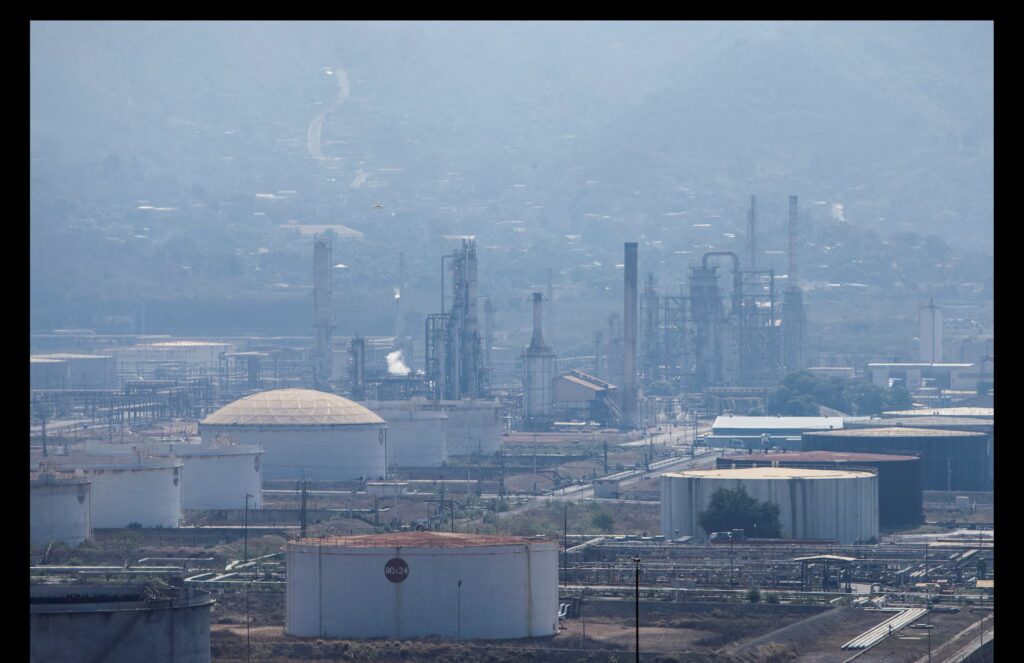
Following the United States’ military invasion of Venezuela on 3 January 2026, Venezuela’s oil sector is undergoing widespread transformation. US sanctions against Venezuela have been lifted, and reforms in and outside of Venezuela establish US control over oil production and sales. Oil production is increasing, though Venezuela’s trading partners have changed to adhere to the conditions set out in US licences. Overall, there is a greater role for foreign private capital in the hydrocarbons sector. With these developments, there is renewed international attention on Venezuelan oil.
Venezuela holds the world’s highest proven oil reserves with 303 billion barrels, totalling 17 percent of the world’s oil. Much of this is extra heavy crude, making extraction and refinement costly and technologically intensive. Oil, as commodity, has shaped national class relations and the state since Venezuela began exporting oil in the 1920s. Oil has facilitated capitalist development in Venezuela and has been used as a geopolitical tool. It has made Venezuela an attractive site for foreign investors. Foreign participation in Venezuela’s oil sector has been constant, but it has not been consistent. As will be shown below, in some periods, the state has had greater control over oil operations and captured a greater proportion of oil profits, while, in others, it is the oil companies who have held greater power. The price of oil and the cycles of boom and bust that accompany volatile commodity markets have influenced economic and social conditions in Venezuela.
The aftermath of the US invasion should therefore be understood within the history of Venezuelan oil development. But it must also be distinguished for its direct form of intervention into the Venezuelan economy and as an attack on national sovereignty.
An Oil-Dependent Economy
Foremost to understanding the volatility of Venezuela’s economy is its status as an oil-dependent country. Oil dependence began in Venezuela in the 1920s, after the discovery of abundant and easily extractable oil reserves. Foreign oil companies have been involved in the sector since the beginning, having taken up dictator Juan Vicente Gómez’s call for foreign investment in the 1910s. At that time, investment conditions favoured international oil companies that were granted concessions to large tracts of land, and that retained a large proportion of oil profits.
Growing demand for oil in international markets meant that the oil sector was far more profitable than existing agricultural production, including coffee – Venezuela’s main export at the time. The oil sector drew capital and labour to it, expanding as other sectors contracted. The disproportionately large oil sector affected the country’s exchange rate, making imported goods more affordable than those produced locally – the Dutch disease phenomenon. The fledgling oil industry facilitated state centralization. Power became centralised in the state as the government negotiated conditions of foreign investment, while also representing the interests of the Venezuelan nation.
The ongoing relationship between international oil companies and the Venezuelan state can be understood using Marx’s theory of rent. Marx argues that rent is the economic form of the relationship between capitalist and landlord, where the landlord has exclusive access to land that capitalists require to produce. Under capitalism, nature is thereby commodified and given an economic value, and access to nature is sold to capitalist producers. In the contemporary global oil market, differential rents are based on variances in the natural productivity of land and degree of capital investment between extractive sites. Cumulatively, these differences influence prices of production across oil fields. In the Venezuelan case, the state holds subsurface rights, and grants oil companies access to proven oil reserves and to new potential sites of extraction. International oil companies pay a share of differential rents to the Venezuelan landlord state for access to the land and the oil within it.
Most of the country’s national income comes from oil, with state-collected oil rents being distributed to other productive and social sectors. State-directed rent distribution provides subsidies to industrial production. It provides rent distribution via preferential exchange rates to a merchant class importing goods, food and medicine. The state also provides subsidies to the public through high levels of public sector employment, as well as through subsidised food prices and social services. When oil prices are high, the economy does well and all social sectors benefit from rent distribution. When oil prices decline, government spending becomes unsustainable. This leads to increases in poverty and social inequality, and often an increase in foreign investment that is meant to offset the limitations of state spending.
Who Controls the State Controls Venezuelan Oil
The Venezuelan state, therefore, plays an active role in the economy, collecting the majority of national revenue and distributing it across industries and social sectors. It negotiates the conditions of oil extraction, including who participates and what proportion of oil profits accrue to the state in the form of rent. The state mediates between various international and national interests using rules solidified in legislation and contracts with international oil companies. This means that who controls the state controls oil and the profits it generates.
State policy, however, is not directed by government alone. It is also influenced by geopolitics and prices in the global oil market, as well as by internal class politics. For example, Venezuela’s oil sector was nationalised in 1976. This coincided with high oil prices during the 1973 oil embargo and with oil-exporting countries broadly calling for oil sector nationalisations. It also coincided with a growing middle class in Venezuela, who along with oil workers and other sectors of the working class, wanted to keep oil revenues in the country to facilitate national development. The 1976 nationalisation created the state-owned oil company PDVSA. Subsequently, the Venezuelan government under Carlos Andrés Pérez undertook a sweeping programme of national capitalist development representative of the oil nationalism at the time.
In the late 1980s, low oil prices and high government debt prompted the Venezuelan government to accept a structural adjustment package with the IMF. Certain components of oil exploration, excavation and production were privatised as a condition for accessing international credit. Oil refineries were constructed abroad, including refineries in Europe and Citgo in the United States. This increased the proportion of oil profits that were transferred out of the country. Neoliberal austerity measures, including cutbacks to social spending, led to growing social inequality and poverty rates. Ultimately, the class compromises and democratic stability that had characterised the country since democracy was established in the 1950s became unsustainable.
Mass protests against neoliberal restructuring – like the Caracazo – gave way to new political parties and candidates. Hugo Chávez’s MVR (Movimiento Quinta República; Fifth Republic Movement) was one party that offered an alternative to mainstream party politics, and Chávez was elected as President in 1998. When oil prices rose rapidly in the 2000s, the Chávez government renegotiated foreign participation in the oil sector and increased state control over oil. Contracts with foreign oil companies were renegotiated in 2006 to give PDVSA a majority share in all oil operations. The Hydrocarbons Law was amended to increase royalty payments to the state per barrel of oil, including a higher royalty rate should the price of oil be over $100 USD per barrel. Government revenues were directed towards policies meant to undo the negative social and economic effects of neoliberal capitalism.
From Hugo Chávez to the Present
Oil prices and national and international relations of power have, therefore, converged to favour national capitalist development in some periods, and, in other periods, to favour foreign capital. Uniquely under the Hugo Chávez government, rent distribution benefited popular class sectors and social movements. Chávez sought to achieve what he called Twenty-First Century Socialism. This included improving social conditions by increasing public sector employment, subsidising the cost of basic goods, and providing social services like free healthcare and education. It included increasing political participation by funding communal councils and communes that would localise decision-making in communities. It also included productive investment in national companies and in cooperative production with the goal of ending oil dependence. This programme of rent collection and distribution was made possible by strong support for the Chávez government. It followed a series of public and social movement responses against an opposition-led coup, oil lockout and recall referendum challenging Chávez’s presidency.
International oil companies fared poorly under the Chávez government. Their profits were reduced, as was their share of existing oil operations vis-à-vis the state. In 2006, the government started renegotiating contracts with foreign oil companies according to a provision in the 2001 Hydrocarbons Law that gave the state a controlling interest in oil operations. Some companies chose to leave Venezuela when the government started to exercise its right to majority ownership. The international arbitration awards that oil companies are now seeking to collect from Venezuela are the outcome of arbitration cases from this period.
Despite the social achievements of the Chávez government, its extensive spending commitments alongside declining oil prices set the stage for economic difficulties under the Nicolás Maduro government. Economic diversification and state decentralisation policies were ultimately unsuccessful, which reinforced oil dependence. When Maduro became President in 2013, he did not have the same popular support as Chávez. The opposition led a series of parliamentary and extra-parliamentary efforts to destabilise the government starting in 2015. Opposition member and leader of the National Assembly, Juan Guaidó, declared himself the legitimate President of Venezuela in 2019. This was supported by countries across Europe and the Americas, along with several countries in Africa and Asia and several international organisations, including the Lima Group coalition. US authorities recognized Guaidó as the legitimate President, calling for regime change in Venezuela.
In addition to these political interventions, the US imposed economic sanctions against Venezuela and various government officials in 2017 and 2019. These sanctions cut off Venezuela from international credit and from US oil export markets. Sanctions contributed to a lack of state funds to maintain upgrades in the oil sector and to declining food and medical imports. These problems exacerbated Venezuela’s economic challenges, setting the stage for mass migration out of the country and a humanitarian crisis. At the same time, low oil prices, and economic mismanagement and illicit use of funds by bureaucratic and military sectors contributed to economic decline. The government began implementing reforms that deviated from Chavismo in order to evade sanctions and diversify the economy. The Anti-Blockade Law of 2020 opened the country to select foreign investment in order to increase state revenues. The Law of Special Economic Zones of 2022 similarly sought to attract foreign investment by providing tax breaks and other economic incentives.
Venezuelan oil production declined significantly by 2025 due to crumbling oil infrastructure, while storage facilities were full due to export restrictions. The US invasion was accompanied by a discourse that the US government would restart oil production with the assistance of US oil companies, for the purpose of supplying US oil markets at affordable rates. Interim Venezuelan President Delcy Rodríguez has cooperated with the US government to expand foreign investment. Two legal changes since 3 January set the groundwork for US and other foreign companies to participate in Venezuelan oil production: amendments to Venezuela’s Hydrocarbons Act and General Licenses granted by the US Department of the Treasury.
The Hydrocarbons Act was amended in January 2026 to expand conditions for foreign participation. Foreign companies can now hold a controlling interest in extractive operations and sales, and they capture a greater percentage of profits per barrel of oil extracted vis-à-vis the state. The new law limits national sovereignty by allowing disputes to be settled by outside arbitration. These amendments expand on the Productive Participation Contracts that were introduced as part of the 2020 Anti-Blockade Law under the Maduro government.
Shortly after the amendments to the Hydrocarbons Law were passed, the US Treasury Department began issuing a series of General Licenses that undo many of the restrictions imposed under the 2017 and 2019 Venezuela-related sanctions. The General Licences dictate which markets Venezuelan oil and minerals reach. They allow transactions involving extraction, storage, sale and transportation between the Government of Venezuela and US entities, amongst other select non-US companies. At the same time, the licences prohibit transactions with entities in Russia, Iran, Korea, Cuba and China. This is notable, given that China became Venezuela’s main oil export market after sanctions cut off the country from the US market. In addition to hydrocarbons, the US Department of the Treasury has issued licences that open up the country to foreign investment related to Venezuela’s airline, telecommunications and mining, amongst other industries.
Venezuelan oil sales are now mediated by international companies. Global commodities traders Vitol and Trafigura are responsible for marketing and selling Venezuelan oil after entering into agreements with the US government in January 2026. These agreements allow Vitol and Trafigura to buy oil that was previously blocked by sanctions, and to trade oil held by PDVSA or other companies. The agreements were meant to provide a temporary solution to quicky sell Venezuelan oil, drawing on Vitol and Trafigura’s existing networks of tankers and storage facilities in the Caribbean. The traders continue to sell Venezuelan oil, however, with no end date in sight. In May 2026, a third oil trading firm – the US’s GE Warren – also began exporting Venezuelan oil.
Additionally, the US Department of the Treasury now controls profits from Venezuela’s oil sector. US Executive Order 14373 provides that payments for all oil transactions must be deposited into US Treasury accounts, with the United States government holding funds ‘solely in a custodial and governmental capacity’ (Section 4(b)). The first profits in 2026 from Venezuelan oil sales were deposited in a US bank account in Qatar – based upon the claim that the money would be more secure from Venezuelan creditors – before a portion was transferred to private banks in Venezuela. Subsequently, profits have been transferred directly to a US Treasury Account. With minimal information on the system established to sell Venezuelan oil, collect revenue and use funds, there have been increasing calls for an audit of this system by US lawmakers. These audits are especially important given that both Vitol and Trafigura have been prosecuted for bribery in a number of countries.
Venezuelan Oil Production in 2026
At first, the General License restrictions led to a decline in Venezuelan oil exports, which fell by 6.5 percent in February 2026. During this time, increased shipments to the US and Europe did not offset the loss of the Chinese market. With disruptions to oil supply via the Strait of Hormuz, buyers in Asia and Europe began diversifying their sources of oil. Venezuelan oil exports have risen for three consecutive months since then, with the top buyers being the US at about 558,000 barrels per day (bpd) in May 2026, followed by India with 427,000 bpd, and Europe with 169,000 bpd.
In the US, Chevron – currently the only US company with extracting capabilities in Venezuela – imports about 250,000 bpd. With an oil refinery in Pascagoula, Mississippi, Chevron can extract Venezuelan oil, process it, and sell on the US market. Other US companies are buying Venezuelan oil from domestic producers. This serves a number of US refineries, almost 70 percent of which run most efficiently with heavier crude oil found in Venezuela. In India, the country’s top private refiner, Reliance Industries, has become one of the three biggest buyers of Venezuelan oil. It has purchased cargoes sold by Chevron, Vitol and Trafigura.
After amendments to the Hydrocarbons Law and US General Licenses, non-US companies still operating in Venezuela also began increasing their involvement in oil and gas production. In March 2026, Spanish company Repsol and Italian company Eni signed a strategic agreement with PDVSA to strengthen natural gas operations at the Cardón IV asset, which is 50 percent owned by each company. In April, Repsol signed another agreement to regain operational control and increase oil production through the Petroquiriquire joint venture, which is 60 percent owned by PDVSA and 40 percent by Repsol. Most recently, in June, Repsol signed a memorandum of understanding with PDVSA to develop a new area called Horcón, located southeast of Lake Maracaibo. Future Repsol plans include exploring offshore gas opportunities in collaboration with PDVSA.
Additionally, there are plans to overhaul Venezuela’s oil and gas infrastructure relying on private capital and data innovation. Global energy technology company SLB signed a memorandum of understanding with PDVSA in June 2026 that spans exploration, oil field development and production. The MOU focuses on digital transformations in Venezuela’s oil and gas sector, relying on AI and connected data.
Combined, the amended Hydrocarbons Law, General Licenses and Executive Order increase US, and other foreign private participation in the oil sector. They also increase US control over oil sector development and profits, and the proportion of oil profits accruing to foreign private capital. The General Licenses in particular, along with changing geopolitics, are shaping conditions of foreign direct investment in Venezuela, while also circumscribing the country’s export markets. The present reforms, therefore, undo the accomplishments of the Chávez era relating to national oil ownership and control over the hydrocarbons sector. However, US intervention has an additional effect on Venezuelan political economy. In previous periods, oil reforms that facilitated social development in Venezuela were driven by national class struggles to use oil wealth to benefit Venezuelans. These struggles led to a transition to democracy in the 1950s, to oil nationalisation and capitalist development in the 1970s, and to reforms associated with Twenty-First Century Socialism in the 2000s. The US’s control over oil and intervention in the Venezuelan state circumvents Venezuela’s democratic process and separates class struggle from political decision-making. To date, there has been no movement towards holding democratic elections in Venezuela. Democratic renewal will depend on free elections and on political engagement with Venezuela’s popular classes and social movements.
Kristin Ciupa is the author of The Political Economy of Oil in Venezuela: Class Conflict, the State and the World Market (Brill, 2026). This article draws on arguments from the book.