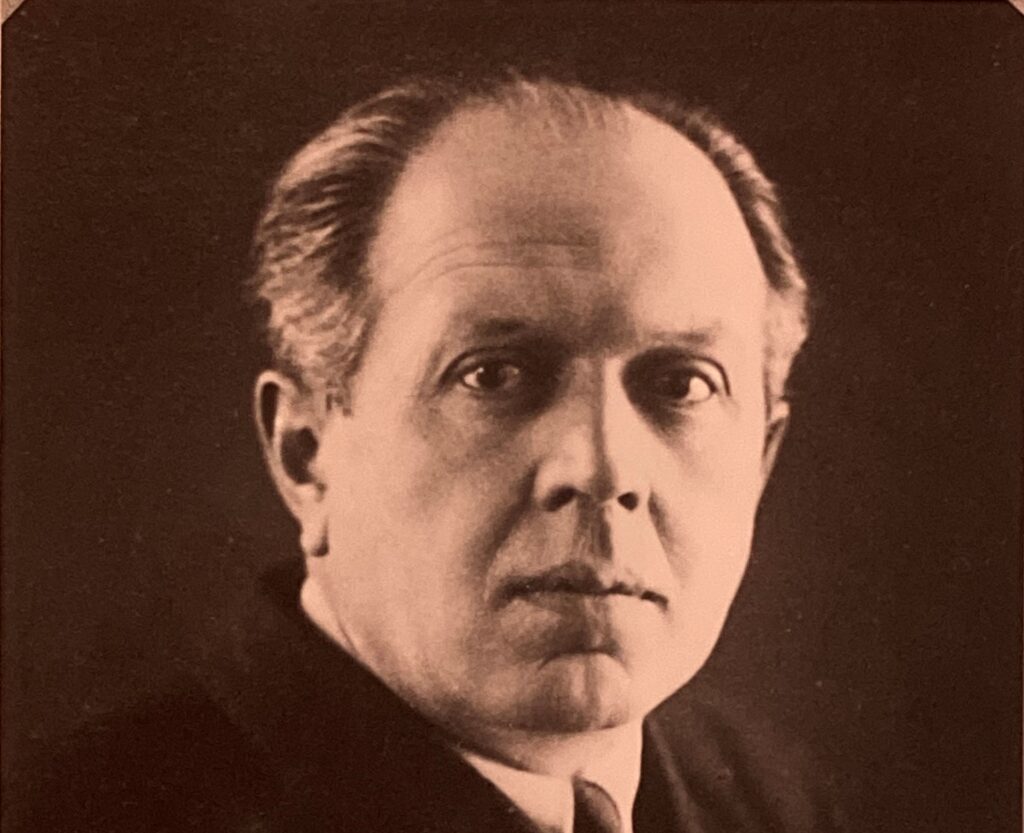
World history would have turned out differently without Fritz Platten (1883-1942). This Swiss communist is today best remembered as the organiser of the ‘sealed train’ that brought Lenin and his comrades across Germany to participate in the Russian Revolution. A short while later, Platten likely saved Lenin from an assassination attempt. Like many communists, Platten was murdered by Stalinism.
Born in a working class family, Platten became politically active at a young age. As an apprentice in the Escher Wyss & Cie industrial company he organised what was said to be the first strike by apprentices. Through the ‘Club of International Socialists’ in Zürich, Platten met comrades from Latvia. When in 1905 revolution broke out in the Tsarist empire, they asked Platten to smuggle pistols and propaganda materials to Riga. Platten remained in Riga and, in May 1907, was arrested during a police raid. Accused of membership in the illegal Social-Democratic party, he risked eight to twenty years of forced labour. After eight months in prison, he fell gravely ill and was released on bail. The bail was paid by Lina Hait, the daughter of an affluent family. The two married sometime later. Platten finally managed to flee Latvia with the help of sailors who hid him on a boat destined for Hamburg. In 1908, Platten, ‘the only Swiss socialist to have participated in the first Russian Revolution’, returned to Switzerland.[1]
After his return to Switzerland, Platten took on different leadership roles in the socialist and workers’ movement. In 1912, workers called a 24-hour general strike in Zürich in response to an attempt to ban pickets. One participant in the strike later described Platten as ‘our general’, going from picket line to picket line in the only still operating taxi. Platten also played a significant role in the nationwide general strike of November 1918. The Swiss Social-Democratic Party had decided to commemorate the first anniversary of the October Revolution with public meetings and a manifesto. The manifesto, said to be drafted by Platten, called on the Swiss working class to take its place in the new international, come to the rescue of the endangered October revolution and throw of its own yoke.
This declaration caused the Zürich municipality to ask the army to be stationed in the city. Several workers were shot as the army dispersed a demonstration. A 1978 Soviet publication gushed about how Platten. ‘the workers’ leader known to everyone in Zürich’, had supposedly walked up to the soldiers ‘unarmed, his head proudly raised, bravely heading towards the danger’ to convince them to cease firing. After five days, the general strike was called off. At the first Congress of the Communist International, Platten blamed the failure of the movement on the wavering attitude of the strike leadership and its unwillingness to call for workers’ militia. For his part in the strike, Platten was sentenced to eight months in prison. Platten’s last major contribution to the Swiss workers’ movement was his participation in the founding of the Swiss Communist Party.
Platten served his prison sentence only in 1920 as at the time of the trial he was in Russia. It seems Lenin’s attempt to help Platten by asking A.M. Lezhava, the People’s Commissar for Foreign Trade, to name him as the Soviet trade representative and thereby grant him immunity did not succeed. Platten had known Lenin since 1915 and the conferences of Zimmerwald and Kienthal. The Swiss Social Democrats were not officially participating in the Zimmerwald meeting but allowed their members to participate on an personal basis. Platten did participate in the 1916 Kienthal conference as a representative of the Swiss party. In both cases, he supported the revolutionary Left.
After the February revolution, exiles from the Russian empire in Switzerland had organised the ‘Central Committee for the Return Home of Political Refugees from Russia in Switzerland’. This committee represented 560 exiles from over 10 different organisations, ranging from anarchists to Trotsky’s Nashe Slovo group, Mensheviks, Bolsheviks and Poale Zion. The Committee asked another Swiss socialist, Robert Grimm, to help with their return home. Grimm, sympathetic to the left wing of the Mensheviks, attempted to arrange legal permission from the Provisional Government for the exiles to return. As time went on, Lenin and other radicals grew impatient and to suspect that Grimm and the Mensheviks were deliberately delaying their return. Hence, the radicals asked Platten to help organise their passage through Germany in ‘personal capacity’. Aided by contacts of Karl Radek, who would join the travel, it was agreed with German authorities that the exiles would be allowed to pass without being asked for names and that ‘those travelling through should enjoy the protection of extraterritoriality and nobody would be entitled to enter into negotiations of any sort with them during their journey’.[2] Platten travelled along with the exiles to personally guarantee that they would follow the conditions imposed on them.
After this voyage, Platten would return several times to Russia. In 1918, Platten and Lenin attended a parade of the Red Army in Petrograd. The car the two travelled in after the parade was fired at in an assassination attempt. According to the investigative report, ‘in a reflex Platten pushed down Lenin’s head, and a bullet grazed Platten’s hand that at this moment was on top of Lenin’s head’.
In 1923, Platten started to work for Willi Münzenberg’s aid organisation Internationale Arbeiterhilfe (IAH). Among other activities, the IAH supported the modernisation of Soviet agriculture and Platten became the chairperson of an agricultural cooperative in Nowa Lawa, made up of Swiss Communists who had moved to the Soviet Union. The cooperative, intended to show the potential of modern techniques, however struggled to be productive in the harsh conditions of the Volga region. The next year, Platten’s report of the famous train journey was published in Münzenberg’s Neuen Deutschen Verlag to counter accusations that Lenin and the other Bolsheviks had acted as ‘agents’ of Germany.
In the early thirties Platten lived in Moscow where he worked as a translator, language instructor and research specialist for the Agrarian Institute. Platten briefly returned to Switzerland in 1931 for what would be his last visit. He campaigned for the Swiss Communists, praising the Soviet Union’s supposed achievements with regard to living conditions, health care and education. His partner at this time was the Swiss Communist Berthe Zimmermann (1902–1937) who worked in Moscow for the International Liaison Department of the Communist International. During the Stalinist terror, Zimmerman was accused of espionage and killed. Platten refused to denounce his wife and was himself arrested in March 1938. He was sentenced to four years of hard labour.
The exact pretext for his arrest in unclear. A former student of Platten at the Institute for Foreign Languages later wrote that the Institute’s director announced the ‘unmasking’ of Platten as a Gestapo spy. According to another report, the espionage charge was dropped and Platten was sentenced for ‘unauthorised possession of a firearm’; a pistol from the Civil War he kept as a souvenir. Basing himself on the narrative of another prisoner, Roy Medvedev in Let History Judge wrote that Platten was indeed initially accused of having been a German spy and this already since 1917; ‘In spite of savage torture, he refused to sign the deposition because it would have cast a shadow on Lenin. Finally, he and the investigator compromised: he would confess to spying for some country other than Germany – the United States or Argentina, my source does not recall exactly which’.[3]
As a foreigner and someone with a leadership role in the pre-revolutionary movement, Platten belonged to different groups that were especially hit hard by the Stalinist terror. Regardless of this, his fate would probably have been sealed because, as chair of the Moscow ‘Club of German Communists’, Platten had in 1928 expressed support for the Left Opposition before being forced to renounce his position.
On 22 April 1942, Platten perished in a Stalinist prison camp in Nyandoma in North-West Russia. The official cause of death was ‘heart failure’, an often-used excuse. Years later, his son was told that Fritz Platten, the man who had saved Lenin’s life, had been shot there. In 1956, Platten was rehabilitated and a street in Nyandoma was named after him. The memorial plaque described him as a ‘friend and fellow fighter of Lenin’ but did not mention how he had died.
[1] J.F. Anders, ‘Zur Biographie von Fritz Platten’, p. 135 in: Fritz Platten, Lenins durch Deutschland im plombierten Wagen, Frankfurt am Main: ISP-Verlag, 1985. The following narrative is based mainly on the biographical sketch by Anders.
[2] Karl Radek, ‘Through Germany in the Sealed Coach’, (1924), online: marxists.org/archive/radek/1924/xx/train.htm.
[3] Roy Medvedev, Let History Judge. The Origins and Consequences of Stalinism, Oxford: Oxford University Press, 1989, p. 514.