Introduction:
SPIC (Soviet Power = Inclusive Cabinet) vs. SPAN (Soviet Power = Agreement Nullified)
All Power to the Soviets! (Vsia vlast sovetam!) is one of the most famous political slogans of all time. No one disputes the crucial role it played in the Russian revolution of 1917. Starting as a marginal and rejected slogan in March and April, it gradually acquired support among the mass soviet constituency: the workers, soldiers, sailors and peasants who elected the soviets and other organisations of ‘revolutionary democracy’.[1] After the kornilovshchina of late August, the shift toward the slogan All Power to the Soviets became an avalanche, climaxing with the Second Congress of Soviets on 25-26 October and the installation of a new revolutionary vlast deriving its legitimacy exclusively from the soviets.
But what exactly did this slogan mean? What did the Bolsheviks say when they explained and defended the slogan to their mass audience? What meaning did the mass soviet constituency give to this slogan when they expressed their support? These are key questions for any interpretation of the October revolution. The mainstream of Western academic scholarship on the October revolution gives a precise and unchallenged answer to these questions. In the authoritative words of Alexander Rabinowitch (my emphasis):
The Bolsheviks conducted an extraordinarily energetic and resourceful campaign for the support of Petrograd factory workers and soldiers and Kronstadt sailors. Among these groups, the slogan ‘All Power to the Soviets’ signified the creation of a democratic, exclusively socialist government, representing all parties and groups in the Soviet and committed to a program of immediate peace, meaningful internal reform, and the early convocation of a Constituent Assembly. In the late spring and summer of 1917, a number of factors served to increase support for the professed goals of the Bolsheviks, especially for transfer of power to the soviets.[2]
For ease of discussion, I created an acronym for this definition of soviet power: SPIC, that is, Soviet Power = Inclusive Cabinet. According to this definition, soviet power was not merely exclusive (none but socialists in the government, so that representatives of elite ‘census society’ need not apply), but inclusive (the government cabinet must include representatives of all shades of socialist/soviet opinion). This definition, we are told, is what the Bolsheviks preached and what their listeners heard and believed in.
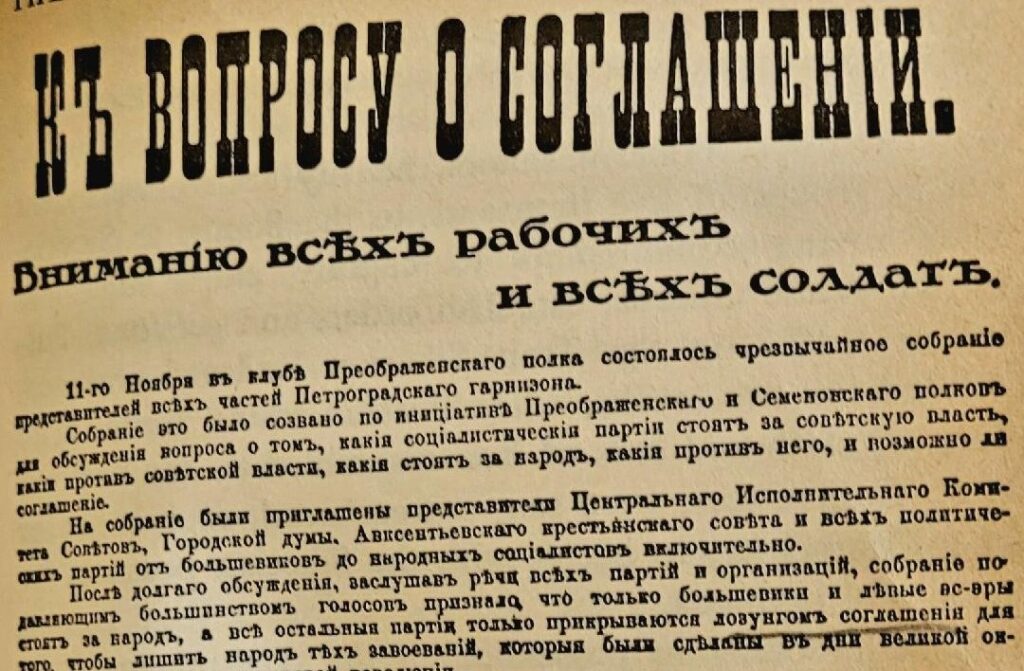
Another approach to ascertaining the meaning of soviet power is suggested by a remark by Lenin, looking back in spring 1918 at his dispute with Kamenev and Zinoviev in October 1917. According to Lenin, the mistake of his two party comrades was their underestimation of popular support for soviet power: they ‘focused on details without seeing the main thing: the soviets had come over from agreementising [soglashatelsvo] to us’.[3] According to Lenin, then, rejection of ‘the agreement [soglashenie]’ was equivalent to support for soviet power. My acronym for this definition of soviet power is SPAN: Soviet Power = Agreement Nullified. Thus, we have two clashing theories about how the soviet constituency understood soviet power: SPIC vs. SPAN.
The ‘agreement [soglashenie]’ to which Lenin refers was the pact originally struck between the Petrograd Soviet and the nascent Provisional Government during the February revolution. According to this agreement (or ‘pact’ or ‘treaty’ or ‘arrangement’), the Provisional Government would work to achieve essential revolutionary goals, and the soviets would provide the government with crucial mass legitimacy. Somewhat later, the underlying agreement was embodied in a coalition cabinet that united – or, perhaps better, brought together – socialists from the soviet parties alongside representatives of census society.
From the very beginning of the revolution – before Lenin’s return to Russia – the Bolsheviks had rejected the agreement tactic, on the grounds that the clashing class interests of the two partners (revolutionary democracy vs. census society) ensured that there would be no serious progress toward revolutionary goals. As Lev Kamenev said at the All-Russian Conference of Soviets in March (prior to Lenin’s return):
Our attitude toward the Provisional Government at the present moment can be expressed this way: we foresee inevitable clashes, not between individuals, not between official bodies, not between groups, but between the classes of our Russian revolution. We therefore should direct all our forces toward supporting – not the Provisional Government, but – the embryo of a revolutionary vlast as embodied by the Soviet of Worker and Soldier Deputies, which sits here in our person.[4]
The Bolsheviks therefore gave the contemptuous labels ‘agreementising [soglashatelstvo]’ and ‘agreementisers [soglashateli]’ to the tactic that Menshevik leader Irakli Tsereteli approvingly called ‘the path of agreement’.
The heated dispute within the soviet system over the status of the agreement points to a paradox in the SPIC definition asserted by the historians. According to the pro-agreement socialists, a coalition government was needed in order to bridge the demarcation line separating revolutionary democracy from census society. It followed that such a coalition was absolutely necessary for the salvation of the revolution and of Russia itself. But, according to the SPIC definition of soviet power, pro-agreement socialists had to be included in any anti-agreement cabinet – that is, in a government that rejected any sort of coalition whatsoever with census society! We must ask: Was a government cabinet that contained both pro- and anti-agreement socialists politically – indeed, even logically – viable?
How do Western historians respond to this obvious question? We turn to their works and quickly discover that the question is not even asked, much less answered. Of course, the historians are familiar with the term soglashatelstvo [agreementising] as well as with the heated disputes over the status of the coalition. Yet, when they come to talk about the October revolution and the meaning of soviet power, the whole issue drops out of sight. We, therefore, need to give an extended definition of SPIC: ‘soviet power equals an all-inclusive cabinet (regardless of position on the agreement issue)’. The point about the agreement tactic is in parentheses because this proviso is only implied rather than explicitly stated by historians.
A further word of explanation about the alternative SPAN definition will be helpful. This definition – ‘agreement nullified’ – is not merely a negative one, since the agreement tactic was seen as the principal obstacle to achieving concrete revolutionary goals. According to this logic, then, repudiating ‘agreementising’ would enable immediate revolutionary measures with the status of state decrees, especially about peace and land.
A long line of distinguished historians of the Russian revolution follows Rabinowitch and makes the following strong claim: the mass soviet constituency and the Bolshevik party at large defined soviet power as a ‘broad multiparty coalition’, one that would include both pro-agreement and anti-agreement socialists. My counterclaim is equally strong. I do not say that the importance of the SPIC definition has been overblown, or misinterpreted, or that it was only one among other definitions. Based on my reading – unsystematic over the years, but lately more focused – the SPIC definition did not exist. No one defined ‘soviet power’ in this way.
The reader will, I am sure, respond: if the SPIC definition is so baseless, how does it come about that it enjoys unchallenged support from professional academic historians? How could they have possibly misread the evidence in so blatant a way? These are very good questions indeed! After I realised that my colleagues were seeing things in the evidence that I could not see – and, conversely, they did not see things that I thought were glaringly obvious – I started to dig around in the historical literature in an effort to answer them. I now think that I have found the answer, and a strange and unsettling tale it is.
There is no trace of the SPIC definition in the primary sources, in memoirs of 1917, or in the historical literature prior to 1955. Somehow, this allegedly widespread definition of soviet power escaped the attention of John Reed, W.H. Chamberlin, Isaac Deutscher, Merle Fainsod, Sergei Melgunov, E.H. Carr, David Shub, among others. The Left SRs are said to have been the most ardent advocates of the SPIC definition, yet the Left SR leader Isaac Steinberg failed to mention it in his memoir of the revolutionary year (as discussed in Part IV).
In 1955, Leonard Schapiro published The Origin of the Communist Autocracy and, here, we find the claim about the SPIC definition put forward for the first time.[5] His finding was based on an out-and-out misreading of a single document. From its inception, the SPIC definition was closely tied to an effort to discredit the Second Congress of Soviets by portraying it as a bait-and-switch operation. The bait was the SPIC definition: a soviet government that included representatives of all shades of socialist opinion. The switch was engineered by Lenin and Trotsky, who had a secret agenda of imposing something very different, namely, a one-party and/or personal dictatorship. These leaders exploited missteps by ‘moderate’ socialists at the Second Congress to gain illegitimate support for their bastard version of soviet power. The fact that the Second Congress installed an all-Bolshevik cabinet is presented as indisputable proof that the Congress betrayed the wishes of the soviet constituency and was therefore deeply illegitimate. So runs the bait-and-switch narrative first found in Schapiro.
The bait-and-switch narrative remains, to this day, the almost unchallenged interpretation of the October revolution. It is propagated both by historians hostile to the Bolsheviks and those sympathetic to them. Just for this reason, we should all be aware of its Cold War origins. In Schapiro’s telling, the SPIC definition and the bait-and-switch narrative had a blatantly anti-Bolshevik thrust and its explicit aim was to delegitimise the Second Congress. As such, it was immediately picked up by other Cold War scholars: Oskar Anweiler (1958), Robert Daniels (1960 and 1966), Bertram Wolfe (1966), John Keep (1976), and Alexander Rabinowitch (1976). Owing to Rabinowitch’s authoritative endorsement and his hard-to-explain status as a ‘revisionist’ post-Cold War historian, the SPIC definition became an unquestioned fact for historians up the present day.
The original evidence – a tabulation of questionnaires filled out by delegates at the Second Congress – was forgotten, and a variety of other claims and misapprehensions took its place. But examination of the secondary literature fails to turn up any unambiguous – or even somewhat ambiguous! – concrete examples of anyone saying, in so many words, ‘I and others define soviet power as a broad multiparty coalition that includes both pro-agreement and anti-agreement socialists in the government cabinet.’
The flip side of the dominance of the SPIC definition and the corresponding bait-and-switch narrative is the invisibility of the SPAN definition and the central role of the agreement issue. The SPAN definition that foregrounds the agreement issue is part and parcel of a narrative interpretation of the October revolution to which I give the title ‘As Advertised’: a conscious contrast to ‘Bait and Switch’. As the evidence shows, the Bolshevik party’s message to the soviet constituency was that soviet power meant a revolutionary vlast that excluded any representative of census society, one that would therefore be able to take immediate and decisive action. The party ran on this platform, and the Second Congress put it into practice. There was no secret agenda on the part of Lenin and Trotsky, there was no manipulative substitution at the last moment. If you want to delegitimise the Second Congress, attack its policies, but do not make up melodramatic stories about an cynical bait-and-switch operation.
All of us who seek a grounded interpretation of the October revolution are faced with a heavy task. We have to learn to see things that we have never been told about, and (much more difficult) to not-see things that respected authorities have assured us were there. This double task explains the unusual construction of the present essay, which employs a technique I call the narrative zoom lens. Consider a cinematic portrayal of a huge battle – say, the battle on the ice in the Eisenstein/Prokofiev film Alexander Nevsky (1938). We start with a long shot that gives us a panorama of the two armies as the attack begins. When the clash of armies takes place, we get a montage of medium shots that show furious combat and close-ups of two individuals fighting hand to hand. We sometimes zoom in on extreme close-ups of a hand holding a sword or a horse’s stirrup, and then pull back to more panoramic shots. We sometimes see individual leaders, and sometimes anonymous masses.
The narrative zoom lens employed here strives to emulate this montage technique. Starting off with a short but panoramic view of 1917 as a whole, we focus on duelling scenarios of events in September/October, after which we zero in on particular debates and even on one particular word. We alternate between showing what is there (the SPAN definition of soviet power) and showing what is not there (the SPIC definition). An overall survey of the evidence for both interpretations is given, alongside some suggestions about useful primary sources in English. My hope is that diligent readers, after wading through all the detail, will retrace their steps and return to the panoramic view of the two demarcation lines and the forces that gave rise to the fundamental clash over the agreement issue.
Table of Contents
Part I: Two Political Demarcation Lines in 1917. Part I consists of a brief schematic representation of the dynamics of the agreement issue throughout the revolutionary year. The primary demarcation line in Russian society was ‘revolutionary democracy’ vs. ‘census society’. The secondary demarcation line within the soviet system arose out of clashing responses to the inescapable problem of dealing with the primary demarcation line.
Part II: Dueling Scenarios of the October Revolution: ‘Bait and Switch’ vs. ‘As Advertised’. In Part II, the currently dominant bait-and-switch narrative is presented in the form of fifteen ubiquitous propositions found in the historical literature. I then present my own ‘As Advertised’ scenario in the form of fifteen counterpropositions. Citations from their respective accounts of the October revolution reveal that Leonard Schapiro (seen as the quintessential Cold War historian) and Alexander Rabinowitch (seen as the quintessential post-Cold War historian) agree point by point on both the SPIC definition and the bait and switch narrative.
Part III: A Glance at the Evidence: SPIC vs SPAN. Part III explains my harsh charge against Schapiro’s misreading of his evidence. I then briefly survey some of the vast evidence supporting the SPAN definition. The relevant writings of two Bolshevik leaders – Lenin and Stalin – are shown to be valuable primary sources that are easily available in English translation.
Part IV: Odnorodnoe: Who Supported a Broad Multiparty Socialist Coalition? In Part IV, the narrative zoom lens focuses on a single term that had a brief career as a buzzword in the fall of 1917: odnorodnoe [homogeneous]. Using this word as a lens, new light is thrown on debates at the Democratic Conference in September as well as the various negotiations aimed at widening the newly installed Soviet government in November. The historians believe that when activists called for a ‘homogeneous’ vlast or government, they meant the SPIC definition. I show that the activists meant the SPAN definition.
***
Part I: Two Political Demarcation Lines in 1917
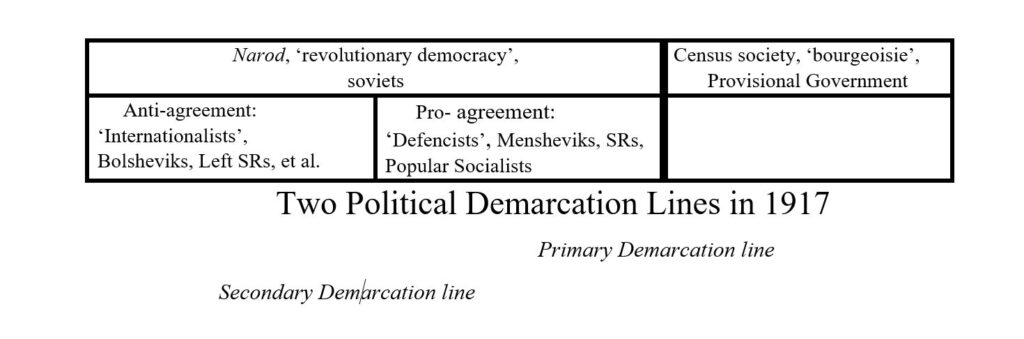
The primary demarcation line (thick in the chart) divides Russian society as a whole: the line between the narod (the common people) versus ‘census society’ (educated, elite, propertied) society. The secondary demarcation line (narrow in the chart) divides the parties in the soviet system over the question of how to deal with the primary demarcation line.
The key question: Given the primary demarcation line that separates revolutionary democracy and census society, what is the most secure basis for an effective yet revolutionary vlast (power, sovereign authority)?
The answer adopted at the beginning of the revolution: The vlast was created on the basis of a voluntary soglashenie (agreement, working arrangement, treaty) between the Petrograd Soviet and the Provisional Government, whereby the government carried out revolutionary goals in return for crucial support from the soviets. This political agreement later took the form of a coalition government, and, so, ‘coalition’ became a semi-synonym for the underlying agreement.
Clashing attitudes toward this agreement gave rise to the secondary demarcation line within revolutionary democracy (my chart does not represent the analogous secondary demarcation line within census society). The two opposed camps both accepted the de facto sovereignty of the soviets (what I call the unwritten constitution of the soviet system): both sides assumed that the soviets and the right and the duty to make this fundamental choice about the nature of the vlast. The central arguments of the two opposed camps are as follows:
Pro-agreement (Mensheviks, SRs, Popular Socialists): a vlast based on the agreement can and must work, because a homogeneous vlast – that is, one recruited exclusively from only one side of the primary demarcation line – will be unable to cope and will inevitably collapse.
Anti-agreement (Bolshevik party, Left SR faction, Menshevik-Internationalist faction): Any government based on the agreement, especially in the form of coalition, will inevitably fail, because of the chasm separating the outlook and the interests of the narod from those of census society. The vain attempt to carry out the revolutionary programme by means of such an agreement will lead to political crisis after crisis. Instead of a fatally heterogeneous coalition-type vlast, we need one recruited exclusively from the popular side of the primary demarcation line. Such a homogeneous government will face no serious internal obstacle to carrying out the revolutionary goals of peace and land.
Was a ‘moderate’ or ‘compromise’ solution possible between these two camps, that is, between those who thought that the absence of coalition was a disaster for the revolution vs. those who thought that any coalition was a disaster for the revolution? In logic or in practice, there was no coherent or concrete tactic that could mediate between these two fundamentally opposed outlooks. Therefore, the centrist position in 1917 (especially the SR Centre led by Chernov) was based mainly on decidophobia, that is, an attempt to evade a clear answer, perhaps in the hope of preserving party unity, or perhaps because both alternatives (coalition and soviet power) seemed distasteful. But, as the year proceeded, the attempt to bridge a chasm with a band-aid failed more and more spectacularly, and the Menshevik and SR parties fell apart.
In March, the anti-agreement forces were a small minority, although they made a spirited showing at the All-Russian Conference of Soviets at the end of the month, under Kamenev’s leadership. All Bolshevik leaders (very much including Lenin) were surprised and shocked by this unexpected minority status, and in response, they made the Bolshevik adjustment: no attempt to replace the Provisional Government with soviet power until the anti-agreement message commands a working majority from the soviet constituency.
Throughout the year, we may picture the secondary demarcation line as moving steadily to the right, that is, more and more of the soviet constituency agrees with the anti-agreement definition of the situation. This process accelerates after the kornilovshchina (the abortive military coup at the end of August). The working majority for the anti-agreement message demanded earlier by the Bolshevik adjustment now seemed to be at hand, although the exact nature of the called-for response was a difficult judgment call, leading to disputes among Bolshevik leaders.
After the Second Congress of Soviets in late October, the secondary demarcation line turns into revolutionary barricades, separating those who were ready to take up arms to defend soviet power from those who were ready to take up arms to overthrow it. The serious efforts to widen the base of soviet power that were undertaken immediately after the Second Congress did not rest on the hope of a compromise between socialists on opposite sides of the secondary demarcation line, but rather on the hope of the conversion of at least some pro-agreement socialists over to an anti-agreement position that accepted ‘the conquests of October’.
Part II: Dueling Scenarios of the October Revolution:
‘Bait and Switch’ vs. ‘As Advertised’
Introduction
Part II is devoted to an overview of events leading up to the declaration of soviet power at the Second Congress in October 1917. The format is two duelling scenarios, one that expresses a strong historical consensus and another that challenges this consensus on the basis of my research.
I first present a scenario of the October revolution based on the SPIC definition, in the form of fifteen propositions. I then present my own SPAN-based scenario, consisting of fifteen point-by-point responses to these fifteen propositions. Of course, I do not expect any converts to my scenario merely on the basis of this cursory presentation. I then document adherence to the SPIC definition with the help of representative comments from Leonard Schapiro and Alexander Rabinowitch that illustrate each of the fifteen propositions. One aim is to show how very little Rabinowitch’s overall interpretation of the October revolution differs from his Cold War predecessors.[6] But I could easily document all fifteen propositions with quotations from almost any scholar in the field.
For the most part, the illustrative comments are taken from Schapiro’s Origin of the Communist Autocracy (1955) and Rabinowitch’s The Bolsheviks Come to Power (1976).[7] For one or two propositions, I use Schapiro’s 1960 book The Communist Party of the Soviet Union and Rabinowitch’s The Bolsheviks in Power (2007). Only in his later book does Rabinowitch discuss the second session of the Second Congress and the subsequent negotiations over a soviet cabinet. My quotations from Bolsheviks in Power are taken from the opening and the final paragraphs of the first chapter.[8]
In one case, I admit that my memory misled me. I discovered no comments in either Schapiro or Rabinowitch confirming Proposition Eleven, according to which delegates to the Second Congress were surprised and shocked by the all-Bolshevik government announced at the second session. Of course, the sense of scandal allegedly felt by the delegates follows quite logically from their alleged loyalty to the SPIC definition. This logical deduction allows John Keep (1976) and Sheila Fitzpatrick (2022) to state as fact that the delegates were indeed surprised, and so I have cited them here. Since Keep is conventionally seen as a Cold War historian and Fitzpatrick is conventionally seen as a post-Cold War ‘revisionist’, their comments serve to illustrate my thesis about the historiographical continuity about the October revolution from 1955 to the present.[9]
I believe that, even standing alone, the material presented here shows that the SPIC definition (Soviet Power = Inclusive Cabinet) played and still plays an essential role in the dominant bait-and-switch interpretation of the October revolution. My quotations also show the strong similarity in the picture of the October revolution given to us by Schapiro and by Rabinowitch, even though they would both no doubt be highly displeased by this fact. In the quoted passages, neither Schapiro nor Rabinowitch make any reference to the fundamental dispute within the socialist camp over the agreement issue: this absence is entirely typical of their work and the historical literature in general. I earnestly hope that the SPIC scenario as presented here describes today’s academic consensus accurately and without caricature – but I very much welcome feedback (destructive criticism particularly welcomed!) if I have unwittingly and unwillingly distorted anyone’s position.
The SPIC Scenario in 15 Propositions
Act One, Pre-Congress: The Bait
- The SPIC formula (Soviet Power = Inclusive Cabinet) represents the way that the mass soviet constituency defined the ‘soviet power’ slogan; it was the central motive for their support of this slogan.
- The Bolsheviks themselves propagandised this definition of soviet power.
- Lenin and Trotsky had a secret agenda: they were viscerally opposed to SPIC and were determined to impose a one-party and/or personal dictatorship, but they cannily kept such views to themselves.
Act Two, Second Congress: The Switch
- Martov advocated a SPIC-type government at the beginning of the Second Congress.
- His proposal to this effect received unanimous approval from the Congress delegates.
- Thus, the Bolshevik-majority Congress endorsed de facto the SPIC definition.
- The walkouts by the Mensheviks and SRs were an understandable reaction to violations of soviet democracy.
- Nevertheless, the walkouts were a tactical error that enabled the bait-and-switch operation.
- Trotsky ‘exploited’ the opportunity handed to him in order to use his demagogic gifts to consign both Martov and SPIC to the garbage heap of history.
- The over-emotional delegates now cursed what they had lauded only minutes before, undoing their own endorsement of SPIC.
- The delegates were surprised and scandalised by the all-Bolshevik government announced at the second session of the Congress.
Act III, Post-Congress: The Defeat of the Moderates
- The Second Congress was immediately followed by various attempts to rectify the situation and reimpose SPIC (by Left SRs, Vikzhel, ‘moderate Bolsheviks’).
- Lenin’s ingrained intolerance led him to crush these attempts by sheer force of will.
- The resulting defeat of ‘the Bolshevik moderates’ doomed the only hopeful outcome of the Russian Revolution.
The Moral of the Story
- Even though the delegates at the Second Congress voted heavily in support of the new government and thereby set a ‘seal of legality’ on the uprising, the Congress was profoundly illegitimate, due to the bait-and-switch operation that killed an otherwise viable all-inclusive multiparty coalition.
The Alternative SPAN Scenario in 15 Counterpropositions
Act One, Pre-Congress: The Bolsheviks channel mass disillusionment with ‘the path of agreement’
- The SPAN formula (Soviet Power = Agreement Nullified) represents the way that the mass soviet constituency defined the slogan of ‘soviet power’; it points to the central motive for their support of this slogan.
- The Bolsheviks consistently propagandised the SPAN definition and no other.
- Lenin and Trotsky had no secret agenda: they led the way in propagandising the SPAN definition and their actions did not contradict their words.
Act Two, The Second Congress: As Advertised
- At the Second Congress, Martov did not advocate a government cabinet that included representatives from all parties but, rather, a halt to the uprising (in his opinion, an ‘armed conspiracy’) that would allow negotiations among an ill-defined group of ‘democratic’ organisations, with the aim of coming up with a vlast acceptable to all participants, including the Provisional Government itself.
- Martov also made a proposal to prioritise discussion of a peaceful solution to the ongoing crisis; this agenda proposal received unanimous approval at the behest of the Bolshevik leader Lunacharsky, who saw the advantage for the Bolsheviks of forcing the pro-agreement parties to defend themselves in front of hostile delegates.
- In no way did the Congress endorse the SPIC definition, because (a) it was never proposed, (b) it would have been roundly defeated if it had been proposed, and (c) the SPIC definition ignores the clash between pro-agreement and anti-agreement parties that was being dramatically acted out at the Congress.
- The principal motivation for the walkouts by the Mensheviks and the SRs (as stated by Sukhanov as well as most other observers) was their continued loyalty to the agreement tactic and to a coalition with census society, plus the glum realisation that they were now a distinct minority at the Congress and in the capital Soviets.
- The walkouts did not affect the main outcomes of the Congress: support for the uprising and for the arrest of the Provisional Government, support for the decrees on land and peace, support for the new all-Bolshevik cabinet.
- Trotsky said nothing that he had not said many times before; he did not consign Martov to the ‘garbage heap’ (or ‘dustbin’) of history; he hoped to entice the Left SRs to join the new government; he strongly emphasised the standard Bolshevik line that the party was always open to an alliance with fellow anti-agreement groups.
- The delegates, although indeed highly emotional, acted consistently and in accordance with their beliefs.
- The delegates were not shocked, surprised or scandalised by the all-Bolshevik cabinet, although, of course, they hoped for the broadest possible base of support (emphasis on ‘possible’) for the new anti-agreement vlast.
Act Three, Post-Congress: Defence of the ‘Conquests of October’
- The post-Congress negotiations were aimed at conversion, not compromise, that is, they tried to provide an off-ramp for repentant pro-agreement socialists in the hope that they would join in defence of soviet power.
- A basic consensus in principle united Lenin and Kamenev at this time: yes to broadening the base of soviet power and to including sincere anti-agreement groups such as the Left SRs, no to attempts to undo the ‘conquests of October’ (by repudiating or mitigating the Congress decrees or by reverting to some sort of pro-agreement tactic). The clash between them, during the confusing life-and-death scramble in the first days after the Congress, came about when they accused each other of violating this consensus.
- A large-scale multiparty coalition that attempted to yoke together pro-agreement and anti-agreement socialists was impossible, and it would not have prevented any tragedies if it had been possible.
Moral of the Story
- Like it or not, the Second Congress was a legitimate [polnomochen] expression of the soviet system, according to rules that had been in operation since February; the Bolsheviks did not deceive the delegates with a bait-and-switch operation but acted pretty much as they said they would; the delegates made their choices with their eyes open. There are plenty of fact-based reasons for opposing soviet power without conjuring up a mythical SPIC definition and an unrecognisable portrait of events at the Second Congress. Those who feel sympathetic to the October revolution yet still endorse the bait-and-switch interpretation should reflect on its Cold War origins.
The SPIC Scenario in the Words of Schapiro (1955) and Rabinowitch (1976 and 2007)[10]
Act One, Pre-Congress: The Bait
1. The SPIC formula (Soviet Power = Inclusive Cabinet) represents the way that the mass soviet constituency defined the slogan of ‘soviet power’; it points to the central motive for their support of this slogan.
Schapiro (1955):
In a referendum on the question of the form of government which was taken among the delegates of the Second Congress of Soviets, the great majority declared themselves for ‘All Power to the Soviets’, while quite a few specified more precisely what was really the same view, that ‘Government must be a coalition’, or a ‘coalition of all parties without the Kadety’ … Almost the entire Bolshevik party, therefore, took it for granted that the slogan ‘All Power to the Soviets’ would now be implemented and that the government formed would reflect the party composition of the Soviet Congress.
Rabinowitch (1976):
An overwhelming number of delegates … came to Petrograd committed in principle to supporting the transfer of ‘all power to the soviets’, that is, the creation of a soviet government presumably reflective of the party composition of the congress.
2. The Bolsheviks themselves propagandised this definition of soviet power.
Schapiro (1955):
Trotsky … worked to create the belief that the revolution was an assumption of power by an organ rightfully claiming to speak in the name of the masses, the Congress of Soviets … It was therefore thanks to Trotsky that the October Revolution developed along the line in which the seizure of power was cloaked under a cover of democratic action. This corresponded to the views of the not inconsiderable section of the Bolshevik leadership which still visualized the socialist revolution in semi-parliamentary terms. It also corresponded to the mood of the Bolshevik rank and file, and to that of wide sections of the population for whom the Soviets represented the only tangible symbol of authority.
Rabinowitch (2007):
As the Second All-Russian Congress of Soviets closed on the morning of 27 October and delegates from around the country departed from Smolny, most of them, including Bolshevik moderates, expected that once tempers cooled the Sovnarkom[11] would be restructured according to the model reflected in the party’s pre-October program, that is, as a multiparty, exclusively socialist coalition government reflecting the relative strength of the various parties and groups in the Congress of Soviets at its start.
3. Lenin and Trotsky had a secret agenda: they were viscerally opposed to SPIC and were determined to impose a one-party and/or personal dictatorship, but they cannily kept such views to themselves.
Schapiro (1955):
Neither Lenin nor Trotsky had the slightest intention of setting up a coalition rule of Bolsheviks and socialists, if it could be avoided. But Lenin had refrained from stressing his intentions to his party, while Trotsky had used every endeavor to make the seizure of power appear as an assumption of power by the Congress of Soviets.
Rabinowitch (1976)
[The non-Bolshevik ‘moderate socialists’] played directly into Lenin’s hands, abruptly paving the way for the creation of a government which had never been publicly broached before – that is, an exclusively Bolshevik regime.
Act Two, Second Congress: The Switch
4. Martov advocated a SPIC-type government at the beginning of the Second Congress.
Schapiro (1955):
Martov proposed to deal in the first instance with the question of the formation of a united democratic government of all socialist parties in order to avert bloodshed.
Rabinowitch (1976):
Most of the congress delegates had mandates to support the creation by the congress of a coalition government of parties represented in the Soviet … Martov’s motion was directed toward that very end.
5. His proposal to this effect received unanimous approval from the Congress delegates.
Schapiro (1955):
[Martov’s] suggestion was immediately welcomed on behalf of the Bolshevik fraction by Lunacharsky, and was adopted unanimously.
Rabinowitch (1976):
The congress documents indicate as well that Martov’s proposal was quickly passed by unanimous vote … it was also apparently well received by many Bolsheviks.
6. Thus, the Bolshevik-majority Congress endorsed de facto the SPIC definition.
Schapiro (1955):
Sukhanov, Vol. VII, p. 199, noted that Martov’s proposal was followed by loud applause, since ‘evidently many, many Bolsheviks had not absorbed the teaching of Lenin and Trotsky and would be glad to follow this path’.
Rabinowitch (1976):
The congress documents indicate as well that Martov’s proposal was quickly passed by unanimous vote. No sooner had the congress endorsed the creation of a democratic coalition government by negotiation, however, than a succession of speakers, all representatives of the formerly dominant moderate socialist bloc, rose to denounce the Bolsheviks.
7. The walkouts by the Mensheviks and SRs were an understandable reaction to violations of soviet democracy.
Schapiro (1955):
Representatives of each of these parties [Mensheviks and SRs] now declared that their party refused to be associated with an armed conspiracy which was a violation of Soviet democracy, and which threatened civil war. By way of protest, they stated, they would leave the Congress.
Rabinowitch (1976):
In response to the uprising now openly proclaimed by the Military Revolutionary Committee, the Mensheviks and SRs had moved rightward …
When one recalls that less than twenty-four hours earlier the Menshevik and SR congress fractions, uniting broad segments of both parties, appeared on the verge of at long last breaking with the bourgeois parties and endorsing the creation of a homogeneous socialist government pledged to a program of peace and reform, the profound impact of the events of October 24–25 becomes clear.
8. Nevertheless, the walkouts were a tactical error that enabled the bait and switch operation.
Schapiro (1955):
But the next move by the Mensheviks and Socialist Revolutionaries [the walkout] played right into Trotsky’s hands and gave him the opportunity for which he was waiting.
Rabinowitch (1976):
One can certainly understand why the Mensheviks and SRs reacted as they did. At the same time, it is difficult to escape the conclusion that by totally repudiating the actions of the Bolsheviks and of the workers and soldiers who willingly followed them, and, even more, by pulling out of the congress, the moderate socialists undercut efforts at compromise by the Menshevik-Internationalists, Left SRs and Bolshevik moderates. In so doing, they played directly into Lenin’s hands.
9. Trotsky ‘exploited’ the opportunity handed to him in order to use his demagogic gifts to consign both Martov and SPIC to the garbage heap of history.
Schapiro (1955):
Trotsky was not slow to exploit the advantage which the inept move of the socialist parties offered. Were the Bolsheviks, he asked, whose rising had been victorious, to conclude an agreement with ‘mere broken fragments, miserable bankrupts, whose part is ended and who are destined for where they belong, – the waste-paper basket of history’?
Rabinowitch (1976):
[The moderate socialists] played directly into Lenin’s hands, abruptly paving the way for the creation of a government which had never been publicly broached before – that is, an exclusively Bolshevik regime … The departure of the moderates offered an opportunity which could now be exploited to consolidate the break with them.
10. The over-emotional delegates now cursed what they had lauded only minutes before, undoing their own endorsement of SPIC.
Schapiro (1955):
The departure of the socialist delegates also produced a change in the temper of the Bolsheviks in the Congress. Lunacharsky, who not many minutes before had welcomed Martov’s suggestion, now enthusiastically supported Trotsky’s resolution.
Rabinowitch (1976):
Before long, many of the delegates who now either ignored or booed Kapelinsky [spokesperson for the Menshevik Internationalists] would regain interest in seeking an accommodation with moderate groups. But for the moment, in their initial ecstasy over the apparently painless triumph over the Kerensky regime, they were in no mood to do so.
11. The delegates were surprised and scandalised by the all-Bolshevik government announced at the second session of the Congress.
John Keep (1976):
An overwhelming majority of delegates were in favor of the slogan ‘all power to the soviets’. Yet, as we know, they read their own meaning into this phrase: a coalition of all the left-wing parties represented in the soviet movement. Thus the problem facing the Bolsheviks on 25 October was to secure from a body so constituted an unequivocal declaration of support both for their coup and for the formation of an all-Bolshevik government – something that was bound to shock as well as excite the average delegate, to whom both events came as a surprise.
Sheila Fitzpatrick (2022):
A surprise awaited those who thought that ‘all power to the soviets’ meant that some soviet body – the Petrograd Soviet, perhaps, or some executive agency elected by the Congress of Soviets – would take over the leadership of the country. It turned out – and many Bolsheviks were among those surprised – that the new government was to be a Council of People’s Commissars (in effect, a state cabinet) whose just-appointed members were read out to the congress by Lenin’s spokesman: all were Bolsheviks, with Lenin as chairman. The Bolsheviks had taken power.
Act III, Post-Congress: The Defeat of the Moderates
12. The Second Congress was immediately followed by various attempts to rectify the situation and reimpose SPIC (by Left SRs, Vikzhel, ‘moderate Bolsheviks’).
Schapiro (1955):
[There was a] desire inside the Bolshevik party for a coalition with the other left-wing parties … In the protracted negotiations which followed, Lenin and Trotsky played for time; but to many of the other Bolshevik leaders the negotiations appeared as an honest attempt to form a broader coalition, and thereby to avert civil war and minority rule by force.
Rabinowitch (2007):
The severe setback that Bolshevik moderates suffered at the opening session of the Second All-Russian Congress of Soviets did not end their efforts, or those of other left socialist groups, to form a multiparty, homogeneous socialist government at the Soviet Congress and in its immediate aftermath. During these days, they sought to restore the movement toward creation of a broad socialist coalition that had been destroyed by the violent overthrow of the Provisional Government engineered by Lenin just before the opening of the Congress of Soviets.
13. Lenin’s ingrained intolerance led him to crush these attempts by sheer force of will.
Schapiro (1955):
At this point Lenin, who had hitherto taken no part in the discussions on coalition, intervened in the councils of his party … None of the dissident Bolsheviks had the capacity for leadership or the courage to assume it at so critical a moment. Had there been such a leader, prepared to defy Lenin, he would have been sure of a wide following in the upper ranks of the Bolshevik party.
Rabinowitch (2007):
The period between 25 October and 4 November 1917 marked a major turning point in the development of the Russian revolution. During this time, the movement toward the creation of a multiparty, exclusively socialist government by the Second All-Russian Congress of Soviet of Workers’ and Soldiers’ Deputies was stopped, and an all-Bolshevik government was established … The most important factor shaping these developments was Lenin (supported by Trotsky) – his supreme confidence in his ability to gauge the revolutionary situation in Russia and internationally, his iron will and dogged determination to achieve his goals irrespective of the strength of the opposition, his consummate political skill, and his lack of scruples.
14. The resulting defeat of the moderates doomed the only hopeful outcome of the Russian Revolution.
Schapiro (1960):
To many of Lenin’s followers it seemed evident that if the Bolsheviks persisted in their refusal to share power with the two major socialist parties, behind whom stood large sections, the majority indeed of the population, the prospect of a civil war was inevitable. Several Bolshevik leaders were in favor of a broader based government which would include the socialists.
Rabinowitch (1976):
Only the creation of a broadly representative, exclusively socialist government by the Congress of Soviets, which is what they [the soviet constituency] believed the Bolsheviks stood for, appeared to offer the hope of insuring that there would not be a return to the hated ways of the old regime, of avoiding death at the front and achieving a better life, and of putting a quick end to Russia’s participation in the war.
The Moral of the Story
15. Even though the delegates at the Second Congress voted heavily in support of the new government and thereby set a ‘seal of legality’ on the uprising, the Congress was profoundly illegitimate, due to the bait-and-switch operation that killed an otherwise viable all-inclusive multiparty coalition.
Schapiro (1955):
The resolution of the truncated Congress to seize power into its hands was adopted with only two dissenting votes and twelve abstentions. It was an academic resolution, because power had already for some time been in the hands of the Bolshevik party and its organization. But its significance as a symbol was immense. As Trotsky all along intended, it set the seal of legality on an armed insurrection. Moreover, it enabled the Bolsheviks to claim the right to wield popular power by themselves.
Rabinowitch (1976):
The argument has been made that the belated uprising of October 24-25 was of crucial historical importance because, by impelling [sic!] the main body of Mensheviks and SRs to withdraw from the Second Congress of Soviets, it prevented the creation by the congress of a socialist coalition government in which the moderate socialists might have had a strong voice. In so doing, it paved the way for the formation of a soviet government completely controlled and dominated by the Bolsheviks. The evidence indicates that this was indeed the case.
On the Meaning of Soviet Power: Part III
A Glance at the Evidence: SPIC vs. SPAN
Reviewing the evidence for the SPIC definition – that is, the assertion that the Bolshevik party and the mass soviet constituency defined ‘soviet power’ as a broad inclusive coalition of all the socialist parties – presents a challenge, because there isn’t any! All I can do is point out this absence and explain when, where, why, and by whom this legend got started. Looking back, we observe two fateful missteps: Leonard Schapiro in 1955 and Alexander Rabinowitch in 1976. In the first section of Part III, I will set out the facts of the case as concisely as possible.
Reviewing the evidence for the SPAN definition, whereby the core meaning of ‘soviet power’ is the nullification of the agreement tactic, in the expectation that decisive revolutionary action would follow, presents a challenge of a different sort: there is too much of it! Setting out the full range of relevant evidence would entail writing the political history of Russia in 1917 from February to October.
In order to keep things manageable, therefore, I will focus on two sources of highly relevant information. We want to know how the mass soviet constituency defined soviet power. The place to start, surely, are the resolutions passed by local soviets, by regional soviet congresses, by mass rallies at factories, by army committees, by peasant organisations and other voices from below, especially in September/October 1917. These resolutions are, at present, the best available evidence for the outlook of the mass soviet base.
Sources that meet this description are, unfortunately, available only in Russian. But we are also told that the Bolshevik party itself propagated the SPIC definition. We should therefore expect to find this definition when the Bolshevik leaders directly addressed the workers, soldiers and peasants. And, luckily, for other reasons, the relevant writings of Lenin and Stalin are easily available in English translation. Although the attention of historians has been overwhelmingly directed at disputes within the Bolshevik party, we will be rewarded if we look at less familiar writings by Lenin and Stalin in which they directly spell out the message that the Bolsheviks wanted to send to the soviet constituency.
Schapiro’s Fateful Misstep: The Origin of the SPIC definition
In 1955, in his pioneering study The Origin of the Communist Autocracy, Leonard Schapiro made the following unprecedented assertion:
In a referendum on the question of the form of government which was taken among the delegates of the Second Congress of Soviets, the great majority declared themselves for ‘All Power to the Soviets’, while quite a few specified more precisely what was really the same view, that ‘Government must be a coalition’, or a ‘coalition of all parties without the Kadety’.
Almost the entire Bolshevik party, therefore, took it for granted that the slogan ‘All Power to the Soviets’ would now be implemented and that the government formed would reflect the party composition of the Soviet Congress.[12]
The words I have italicised mark the fateful first appearance of the SPIC definition: Schapiro equates the slogan ‘all power to the soviets’ and the slogan ‘government must be a coalition’. These two slogans, he tells us, express ‘what was really the same view’. The only evidence cited by Schapiro for his new finding is a single table found in an essential documentary collection on the Second Congress, published in the Soviet Union in 1928.[13] Here is the chart in its entirety:
Questionnaire of the Congress of Soviets
Opinion of local soviets about the construction of the vlast.
- The full vlast to the Soviets: 505
- The full vlast to the democracy: 6
- The full vlast to the democracy with censitarian elements, excluding Kadets: 21
- The vlast must be based on a coalition: 55[14]
- The full vlast to a coalition government, responsible before a legislative/consultative pre-parliament: 3
Not filled out: 3
Total: 673
This table does not really tell us very much. It is not (contrary to Schapiro’s description) a ‘referendum’ that tells us the opinion of the delegates themselves. As the title of the chart plainly tells us, the delegates are providing information about the position of local soviets. Although the figures we find in the chart may give us a reassuring sense of exactitude, it is hard to say what, if anything, they quantify in the real world. The number ‘505’, for example, cannot be either the number of local soviets who supported soviet power or the number of delegates who supported this slogan.
Most importantly, the chart merely lists the various slogans then circulating about ‘the construction of the vlast’ (which is not quite the same thing as Schapiro’s rendition ‘form of government’). But it does not provide any explanatory gloss on the political content of the slogans, since this was assumed to be common knowledge. Therefore, the chart provides no independent evidence for any interpretation of the meaning of the slogans.[15]
According to Schapiro’s reading of this chart, Slogan D (‘the vlast must be based on a coalition’) is nothing more than a more precise expression of Slogan A (‘the full vlast to the Soviets’). But this equation shows that Schapiro completely misunderstood the actual political meaning of the listed slogans. Far from being two expressions of the same views, Slogans A and D are polar opposites that had fought a pitched battle since February. ‘The full vlast to the Soviets’ (Slogan A) is the core anti-agreement slogan, whereas ‘the vlast must be a coalition’ (Slogan D) is the core pro-agreement slogan. Only someone unaware of the deep-seated clash over the agreement tactic could have equated the two.
In the second sentence of this fateful passage, Schapiro dials the SPIC definition up to ‘11’: he now says that ‘almost the entire Bolshevik party’ were adherents of the SPIC definition. He further specifies that almost the entire party wanted a cabinet that reflected ‘the party composition of the Soviet Congress’. I honestly do not know where Schapiro got this idea about reflecting the party composition of the Congress, since nothing in the cited evidence – or anywhere else – even hints at it.
I do not think I am indulging in unwarranted psychological speculation if I observe that Schapiro clearly wants to believe that ‘all power of the soviets’ expressed a deep hankering for a broad multiparty coalition. If a multiparty coalition is the meaning of soviet power, the Second Congress is automatically discredited, since it installed an all-Bolshevik cabinet. No wonder that Schapiro’s alleged discovery was gratefully picked up in the following years by his fellow Cold War historians. All cite Schapiro as an authority, quote his words directly or indirectly, cite only the same kind of uninformative Congress questionnaire as evidence, and retell the bait-and-switch narrative with relish.[16]
Rabinowitch’s Fateful Misstep
Most of these Cold War historians are not read today, but the same cannot be said of Alexander Rabinowitch. As Barabara Allen observes, ‘Alexander Rabinowitch’s books, Prelude to Revolution and The Bolsheviks Come to Power, are still unsurpassed [and] historians agree that there have been no breakthroughs’ since their publication. Rabinowitch’s basic paradigm has been no more than ‘enhanced’ in various ways.[17] For this reason, his 1976 endorsement of the SPIC definition in his classic study The Bolsheviks Come to Power constitutes the second fateful misstep that has doomed our understanding of the October revolution. Here is the crucial passage (I have italicised the key words):
Because delegates, upon arrival at Smolny, were asked to fill out detailed personal questionnaires, we can ascertain not only the political affiliation of most of them, but also the character of each of the 402 local soviets represented at the congress and its official position on the construction of a new national government.[18] Tabulation of these questionnaires reveals the striking fact that an overwhelming number of delegates, some 505 of them, came to Petrograd committed in principle to supporting the transfer of ‘all power to the soviets’, that is, the creation of a soviet government presumably reflective of the party composition of the congress.
Eighty-six delegates were loosely bound to vote for ‘all power to the democracy,’ meaning a homogeneous democratic government including representatives of peasant soviets, trade unions, cooperatives, etc., while twenty-one delegates were committed to support of a coalition democratic government in which some propertied elements, but not the Kadets, would be represented. Only fifty-five delegates, that is, significantly less than 10 percent, represented constituencies still favoring continuation of the Soviet’s former policy of coalition with the Kadets.[19]
As we see, Rabinowitch’s argument is based on the same chart as Schapiro, but now with the numbers provided.[20] The flurry of exact figures gives a patina of factual objectivity to what is really an arbitrary interpretation. We note, however, that Rabinowitch silently corrects Schapiro’s spectacular misunderstanding of Slogan D (‘the vlast must be a coalition’) and correctly glosses it as ‘favoring continuation of the Soviet’s former policy of coalition with the Kadets’ – that is, the direct opposite of ‘all power to the soviets’.
Otherwise, Rabinowitch’s discussion mostly adds to the confusion about the Second Congress (for example, the phrase ‘coalition democratic government’ is close to meaningless). But, unfortunately, the correction of Schapiro’s original mistake about coalition government did not lead Rabinowitch to reject the conclusion that Schapiro derived from this same mistake. On the contrary, Rabinowitch goes on to give the SPIC definition an authoritative endorsement: he defines ‘all power to the soviets’ as ‘the creation of a soviet government presumably reflective of the party composition of the congress’.
The proviso about ‘the party composition of the congress’ shows that Rabinowitch had Schapiro in front of him as he wrote, as this assertion appears nowhere else. Rabinowitch’s uncritical acceptance of the SPIC definition is not a small or inconsequential error. On the basis of his belief that the mass soviet constituency and the Bolshevik party itself defined soviet power as a broad multiparty coalition, Rabinowitch threw his full weight behind the Cold War narrative of the Second Congress as a manipulative bait and switch operation. The Second Congress may have voted in the new all-Bolshevik cabinet with tremendous enthusiasm, but (we are told) this fact is now irrelevant when assessing its democratic legitimacy. What the delegates really wanted was a broad multiparty coalition, they did not get it, end of story.
The SPIC definition of soviet power implies that any soviet government that did not include representatives of pro-agreement socialists – much less a government composed entirely of Bolsheviks – was necessarily illegitimate. Rabinowitch’s endorsement of this highly implausible claim cemented its unchallenged status up to the present day.[21]
Resolutions on the Meaning of ‘Soviet Power’
Vtoroi vserossiiskii sezd Sovetov [Second All-Russian Congress of Soviets] is the title of a documentary collection published in the Soviet Union during the anniversary year of 1957. For shorthand, we will refer to it as Second Congress 1957.[22] The Cold War historians mentioned in the previous section commonly cite this extremely valuable collection (including Schapiro in books published after 1957).[23] Their attention is exclusively focused on ten or so pages giving the results of questionnaires circulated at the Congress. Like the chart cited by Schapiro, we find here only the verbal formulae, without any gloss on their concrete political meaning. There is indeed much to learn from this material, but the definition of soviet power is not one of them.
As it happens, Second Congress 1957 also contains one hundred fifty or so pages filled with direct evidence: 155 resolutions from September/October 1917 passed by local soviets, by regional soviet congresses, by mass rallies at factories, by army committees, and even by some peasant organisations.[24] This material remains an unsurpassed foundation for a documented answer to the question: how did the soviet constituency define soviet power? Unfortunately, historians have passed over this vital evidence in silence.
Of course, these resolutions are not the spontaneous effusions of the people; they were drafted by professional Bolshevik activists. Nevertheless, they were tailored to appeal to the soviet constituency, and they were approved in September and October when earlier they had been rejected. Although we cannot rely on the Soviet editors to give us a fully representative selection, we can, in my opinion, rely on the textual accuracy of any one document. Although our findings may well not be the last word on the topic, they will certainly be a far better first word than erroneous conclusions drawn from a single uninformative questionnaire.
The first thing we observe from a survey of these resolutions is the complete absence of the SPIC definition. None of these resolutions so much as mentions a broad multiparty coalition as a goal. In fact, the whole topic of party representation in the projected revolutionary government is simply not present. Of course, we cannot rule out the possibility that such resolutions exist. But recall what we are told by the historians when they affirm that the SPIC definition was the heart of the Bolshevik message and that the Bolsheviks themselves overwhelmingly supported it. If we find no trace of such a definition in more than 150 resolutions from a wide variety of local soviets and mass rallies, I think we should look askance at these confident claims.
The ubiquitous leitmotif of the resolutions is the angry rejection of soglashatelstvo, ‘agreementising’ and, therefore, anger at the soglashateli, ‘agreementisers’. These expressive words were the insulting labels for the hitherto popular agreement tactic and the hitherto majority Soviet leadership of the Mensheviks and SRs.[25] Resonating throughout these texts is a cry of exasperation: ‘six [or, later, seven] months!’ During the whole period starting from the February revolution (the resolutions loudly complain), the agreementising leaders urged support for the Provisional Government, and what is there to show for it? Nothing except economic collapse and counterrevolutionary attempts by census society such as the abortive Kornilov coup.
Two illustrative examples from this flood of resolutions will show the frame of mind, one written by and for the relatively sophisticated activists in Moscow, and the second expressing more directly the outlook of the mass base. On 5 September, in the immediate aftermath of the Kornilov adventure, the Moscow Soviet passed a resolution that was among the first indicators of a new majority status for the Bolsheviks. According to the resolution, the Provisional Government, ‘founded on the principle of agreementising and concessions’, had revealed a complete inability to repress the counterrevolution, and indeed seemed to be in an open league with it. The only way out was therefore ‘a decisive struggle for the vlast by the representatives of the proletariat and the revolutionary peasants’. Such a vlast would ‘immediately’ take various urgent measures. The list of the proposed measures was Bolshevik boilerplate that shows up in many resolutions during this period. Always prominently included in such lists was immediate publication of the secret treaties, immediate proposal of a general democratic peace, immediate land to the peasants, and the guaranteed convocation of the Constituent Assembly.[26]
Much closer in time to the actual assumption of soviet power on 25/26 October is a short resolution passed on 17 October by soldiers on the Western front. Almost the entire text consists of one long monster sentence. Without trying to reproduce the convoluted syntax, the following line of thought can be discerned. The new coalition slapped together in September by Kerensky and the agreementisers (‘conscious or unconscious betrayers of the revolution’) is doing absolutely nothing. Our basic hope for the revolution – the end of the cursed war – is nowhere near realisation. We call for a Congress of Soviets ‘to take the vlast in its hand, and, after publishing the secret treaties concluded by the Allied governments, immediately announce conditions for a democratic peace and an immediate armistice on all fronts’. This army unit will support with its strength only such a Congress.
Such are the demands of one army unit, undoubtedly reflecting some very widespread attitudes. The war is the only issue mentioned. Clearly, for these soldiers, peace was the overriding issue, and soviet power the only way to achieve it.[27]
Let us remind ourselves of what the historians tell us that we can expect to find in these resolutions:
As the flood of post-Kornilov political resolutions revealed, Petrograd soldiers, sailors, and workers were attracted more than ever by the goal of creating a soviet government uniting all socialist elements. And in their eyes, the Bolsheviks stood for soviet power – soviet democracy.[28]
As we have seen, we find no trace of this putative ‘attraction’ in this corpus of resolutions. But the problem goes deeper than merely the absence of the SPIC definition. We find in these resolutions not only an angry rejection of ‘agreementising’ and ‘agreementisers’, but also a demand for ‘immediate’ government action on pressing issues, especially ending the war. A resolution passed on 21 October by a ‘congress of worker organisations’ in Simbirsk province, for example, stated that the revolution and the country were in a ‘tragic position’; the counterrevolution was on the attack. The resolution then put the blame squarely on ‘the criminal agreementising tactic of the [governmental] parties: the Socialist Revolutionaries and the Social-Democratic defencist Mensheviks’.[29] Just how likely is it, we may ask, that the workers who passed this resolution also insisted that any soviet government worthy of the name must include the ‘criminal’ pro-agreement SRs and Mensheviks? How likely is it that these workers saw a cabinet that roped together clashing points of view as a guarantee of immediate action?
Confident factual assertions about the popularity of ‘a soviet government uniting all socialist elements’, then, are not based on documentary evidence. They are deduced with strict logic from the basic axioms of the bait-and-switch paradigm. If the very meaning of soviet power was an all-inclusive socialist cabinet, and if Bolshevik delegates to the Second Congress revealed in a questionnaire their burning desire for such a government, and if Martov’s alleged proposal at the Second Congress to create an all-inclusive cabinet received enthusiastic and unanimous approval – than, of course, mass resolutions favouring soviet power in the lead-up to the Second Congress must have revealed that (in Rabinowitch’s words) the soviet constituency were ‘attracted more than ever by the goal of creating a soviet government uniting all socialist elements’. How could it be otherwise?
SPIC vs. SPAN: did the Bolsheviks and the soviet constituency define ‘soviet power’ as a broad multiparty socialist coalition? Or did they define it as the rejection of the agreement tactic, accompanied by a demand for immediate state action from a vlast that excluded any censitarian influence? Evidence for each of these two warring hypotheses can be found in Second Congress 1957. The evidence for the SPIC definition, despite the historical consensus supporting it, rests, ultimately, on a single uninformative and misinterpreted chart. And, as we shall see in Part IV, no new evidence has taken its place.
In contrast, overwhelming evidence for the SPAN definition can be found in the 155 resolutions passed by local soviets, by regional soviet congresses, by mass rallies at factories, by army committees, and by peasant organisations. There is no trace of any call for a broad multiparty coalition, much less a suggestion that such a coalition was the only legitimate form of soviet power. We also do not find any mention of ‘socialist revolution’ as opposed to ‘bourgeois-democratic revolution’: an important aspect of this material that we should not overlook.
What we do find is angry rejection of the agreement tactic, scorned now as ‘agreementising’, as well as condemnation of the former majority socialist leaders, scorned now as ‘agreementisers’. Coupled with this desperate anger is a fervent hope that an anti-agreement vlast, one that excluded ‘bourgeois’ influence, would be able to take immediate measures to achieve key goals of the revolution.
Further Reading: Some English-Language Sources
In the previous section, I translated into English the single document on which the mighty pillar of the SPIC consensus rests so shakily, and I contrasted it with the flood of resolutions from below that support the SPAN definition. Unfortunately, I do not know where non-Russian-speaking readers can gain access to a wide range of resolutions and other material from below.[30] The historians inform us, however, that the Bolsheviks themselves propagated the SPIC definition. It follows that a directly relevant primary source, easily available in English for other reasons, are the writings from fall 1917 of two top Bolshevik vozhdi, Lenin and Stalin.[31]
The historians tell us that Lenin had a secret agenda of thwarting the goal of an inclusive cabinet, and, for this reason, we should not expect to find his real views expressed in his writings. I myself believe that Lenin was rather painfully sincere. Be that as it may, if the historians tell us true, we should expect to find at least lip service to the SPIC definition. I am now in course of preparation of a documentary handbook on Lenin’s political message throughout the year. Here, I will merely list a few short and often overlooked articles devoted by Lenin to an exposition of what he considered to be the core of the Bolshevik message sent to the people he most wanted to convince.
The Dual Power (O dvoevlastii) (April 1917)
Political Parties in Russia and the Tasks of the Proletariat (April 1917)
A Basic Question (April 1917)
Lessons of the Crisis (April 1917)
Introduction to the Resolutions of the 7th (April) Conference (May 1917)
- Tsereteli and the Class Struggle (April 1917)
Bolshevism and the ‘Demoralisation’ of the Army (June 1917)
Three Crises (July 1917)
Lessons of the Revolution (July 1917)
Tasks of the Revolution (September 1917)
Lenin’s writings in September/October have, of course, been pored over because of the overwhelming interest in the endlessly relitigated issue of the armed uprising. I suggest that, for the present, we bracket this no doubt fascinating issue, and, instead, poke around to see if we can shed light on a crucial background question, namely, how Lenin himself defined ‘soviet power’. As an illustration, let us glance of Lenin’s rather long polemical piece published in late September: ‘Can the Bolsheviks Hold on to the State Vlast?’
Even the title of Lenin’s essay presents difficulties for the idea that Lenin was hiding his desire for a Bolshevik-dominated government while officially preaching the SPIC definition. Lenin explains his title by recalling one of the most famous political incidents of the year. At the First Congress of Soviets in June, Tsereteli claimed in a speech that there did not exist in Russia any party that would take on the responsibility of the vlast all by itself, and Lenin shouted from the audience ‘Oh yes there is!’ (Est’ takaia partiia). In September, he explains why he now recalls this incident:
But let me begin with a word or two about the first of the questions mentioned – will the Bolsheviks dare take the entire state vlast in their hands alone? I have already had occasion, at the All-Russia Congress of Soviets, to answer this question in the affirmative in no uncertain manner by a remark that I shouted from my seat during one of Tsereteli’s ministerial speeches.
And I have not met in the press, or heard, any statements by Bolsheviks to the effect that we ought not to take the vlast alone.[32] I still maintain that a political party—and the party of the advanced class in particular—would have no right to exist, would be unworthy of the name of party, would be a pitiful nothing in every respect, if it refused to take the vlast when opportunity offers.
In the sentence I have italicised, Lenin speaks not only for himself but for Bolsheviks as a whole. Lenin’s assertion would seem to do fatal damage all by itself to the bait-and-switch paradigm.
In his account of the Second Congress, Rabinowitch remarks that the walkout by Mensheviks and SRs was a tactical error because it undercut efforts at compromise and, in this way, the moderate socialists ‘played directly into Lenin’s hands, abruptly paving the way for the creation of a government which had never been publicly broached before – that is, an exclusively Bolshevik regime’ (my emphasis).[33] As we see, Lenin did broach this topic, not only for himself, but for the party as a whole. But by now we have learned that even the most confident assertions by the historians need to be fact-checked.
‘Can the Bolsheviks Hold on to the State Vlast?’ has another attractive feature for any diligent student of the revolution who is confined to English-language sources. Lenin starts off his fifty-page polemic with page-long excerpts from three newspapers representing a broad spectrum of political outlooks: the liberal Kadet party (Rech), the Socialist Revolutionaries (Delo naroda), and the ‘half-Bolsheviks’ (Maxim Gorky’s newspaper Novaia zhizn). The small group of intellectual socialists gathered around the editorial offices of Novaia zhizn were called ‘half-Bolsheviks’ because they were determined foes of the coalition and yet dubious about the Bolsheviks themselves. Lenin’s extensive quotations from these three sources thus give us a good sense of how a wide range of political outlooks defined soviet power at this crucial juncture.
Let us now turn to Stalin’s editorials for Pravda (for censorship reasons, Pravda came out under various titles during this period). From August through October, Stalin was one of the few senior Bolshevik leaders left at large. As a result, he stepped somewhat outside his usual wheelhouse and wrote a great many newspaper editorials. Most of these are unsigned, and therefore meant to be authoritative party opinion. These writings are a valuable resource for us because, as Isaac Deutscher put it, Stalin’s work in the party newspaper’s offices meant that ‘he spoke with the voice of the party, mainly in anonymous editorials’.[34]
The interest of these editorials for us, then, is not that they express Stalin’s personal point of view, but precisely because they are anonymous, that is, the official voice of the party. If the Bolsheviks defined ‘soviet power’ as a broad multiparty coalition, then, of course, we will find the SPIC definition reflected in these editorials that were designed to provide essential guidance to party agitators. (If not, why not?) Here is a list of eight editorials that focus specifically on the meaning of soviet power (I hope later to provide a more extended commentary).
- Either/Or, 25 August
- Against Agreements, 31 August
- Second Wave, 9 September (signed K. Stalin)
- Two Lines, 16 September
- All Power to the Soviets!, 17 September
- The Revolutionary Front, 17 September
- Vlast of the Soviets, 13 October
- What Do We Need?, 24 October
I will restrict myself here to a brief look at two of these items. Early in the series is a short lead editorial from 31 August 1917. When it was first published, this article was entitled ‘Against Agreements’ [Protiv soglashenii]. Since the agreement tactic was the centre of attention in 1917, everyone knew what Stalin meant. Decades later, when the article was reprinted in Stalin’s Collected Works, the editors realised that readers might be rather confused by a polemic against ‘agreements’ in general. They therefore changed the title to ‘Against an Agreement with the Bourgeoisie’ [Protiv soglasheniia s burzhuaziei]. While it is somewhat unsettling to realise that the editors are fiddling with the original text, this particular change seems harmless enough. More damage is done by the title found in the official English edition: ‘Against Compromise with the Bourgeoisie’. ‘Against compromise’ suggests an intolerant attitude in general. The more accurate translation ‘Against Agreements’ correctly denotes opposition to a specific concrete policy. (Translating soglashenie as ‘compromise’ instead of ‘agreement’ is a very widespread practice that only obscures the real issues.)
The centrality of the agreement issue is well brought out by this short piece. We are told that the triumph of the revolution was not secure, despite the victory over Kornilov. Why? Because, instead of a merciless struggle with the gentry landlords and the capitalists, ‘the agreementisers negotiate with them [and] the defencists are arranging an agreement with them’:
It is time to stop this crime against the revolution! It is time to say resolutely and irrevocably that we need to fight enemies, not make agreements with them!
Against the landlords and capitalists, against the generals and bankers; for the interests of the narody of Russia, for peace, for liberty, for land! — that is our slogan.
A break with the bourgeoisie and the gentry landlords—that is the first task.
Formation of a government of workers and peasants— that is the second task.
Please note that agreementising is here called a crime, so that the rejection of any agreement with census society is the priority task. Only after this break with the censitarians and the agreement tactic does the creation of a worker/peasant vlast become possible. Unsurprisingly, then, we do not find the slightest promise of a government that would actually include these criminal agreementisers.
Weeks later, on 24 October – the day of the armed uprising and one day before the opening of the Second Congress – there was published in Pravda a lead editorial entitled ‘What Do We Need?’ According to this editorial, the soviet constituency made a big mistake back in February/March, when it tolerated the existence of a censitarian government. But now, in October, ‘this mistake must be rectified at once.’ Even as the change in the vlast was taking place on the streets and at the Congress, Stalin sets out once more what people had a right to expect from soviet power. Let us read this list and ask ourselves whether it represents merely bait that was about to be switched at the Second Congress:
The present impostor government, which was not elected by the narod and which is not accountable to the narod, must be replaced by a government recognised by the narod, elected by the representatives of the workers, soldiers and peasants, and accountable to these representatives …
Workers, soldiers, peasants, Cossacks and all the toilers!
Do you want the present government of landlords and capitalists to be replaced by a new government, a government of workers and peasants?
Do you want the new government of Russia to proclaim, in conformity with the demands of the peasants, the abolition of any right of the gentry landowners to the land and to transfer all the gentry landowner land without compensation to peasant Committees?
Do you want the new government of Russia to publish the tsar’s secret treaties, to declare them invalid, and to propose a just peace to all the belligerent nations?
Do you want the new government of Russia to put a thorough curb on the organisers of lockouts and the profiteers who are deliberately fomenting famine and unemployment, economic disruption and high prices?
If this is what you want, muster all your forces, rise as one man, organise meetings and elect your delegations and, through them, lay your demands before the Congress of Soviets which opens tomorrow in the Smolny …
The vlast must pass into the hands of the Soviets of Worker, Soldier and Peasant Deputies.
The vlast must consist of a new government, elected by the Soviets, recallable by the Soviets, and accountable to the Soviets.
Only such a government can ensure the timely convocation of the Constituent Assembly.
We look at Stalin’s list of promises, and we look at the Second Congress, and we note a strange thing. The Second Congress did replace a coalition government with an anti-agreement government based on the soviet system, it did abolish gentry landownership, it did publish the secret treaties, it did make a peace offer to all belligerents, it did undertake to oversee elections to the Constituent Assembly, it did initiate anti-speculation repression. All of these policies may have been utterly disastrous, leading Russia down the wrong path – we can discuss this question at length. What we cannot say is that the Bolsheviks pulled a bait and switch. They promised the soviet constituency that they would do these things, and they did them.
Conclusion
In 1955, Leonard Schapiro published what is undoubtedly the two most important sentences in postwar historiography on the October revolution:
In a referendum on the question of the form of government which was taken among the delegates of the Second Congress of Soviets, the great majority declared themselves for ‘All Power to the Soviets’, while quite a few specified more precisely what was really the same view, that ‘Government must be a coalition’, or a ‘coalition of all parties without the Kadety’.
Almost the entire Bolshevik party, therefore, took it for granted that the slogan ‘All Power to the Soviets’ would now be implemented and that the government formed would reflect the party composition of the Soviet Congress.[35]
Here are the points we need to keep in mind about this passage:
- It constitutes the very first appearance of the SPIC definition (‘Soviet Power = Inclusive Cabinet’). No trace of it can be found earlier.
- Schapiro had no genuine evidence for his unprecedented assertion but relied on a single uninformative chart that he blatantly misinterpreted.
- From its inception, the SPIC definition had an obvious attraction for Cold War historians: it automatically discredited the Second Congress. The Congress installed an anti-coalition government that contained no pro-agreement socialists and was composed only of Bolsheviks – in other words, definitely not a broad coalition of socialists that reflected the party composition of the Congress itself. Therefore, according to the SPIC definition, the Second Congress did not really install soviet power!
- As such, the SPIC definition was enthusiastically endorsed by a generation of Cold War historians as part and parcel of the delegitimising bait-and-switch narrative of the October revolution. Genuine evidence for the SPIC definition was still not forthcoming.
- In 1976, Alexander Rabinowitch made the SPIC definition central to his interpretation of how the Bolsheviks came to power. Due to his unrivalled authority among historians, the SPIC definition today enjoys an unchallenged status, embraced by historians of otherwise opposing political views.[36]
- The claim that that mass soviet constituency, along with the Bolshevik rank-and-file, defined ‘soviet power’ as an inclusive cabinet is repeated as established fact in work after work, but no new real evidence has been found (as shown in Part IV).
- Evidence relevant to the meaning of soviet power is not hard to find, and it overwhelmingly supports the SPAN definition: Soviet Power = Agreement N In the eyes of the soviet constituency, the agreement tactic had proved to be a spectacular failure, so that an anti-agreement vlast appeared to be the only alternative. I close with John Reed’s eloquent observation on the background of the October revolution: ‘The impotence and indecision of the ever-changing Provisional Government was an argument nobody could refute.’[37]
Part IV
Odnorodnoe
or, Who Supported a Broad Multiparty Socialist Coalition?[38]
In early August 1917, the Left SR activist Isaac Steinberg introduced a new word into Russian political vocabulary that was destined to have its fifteen minutes of fame and then to retire from the scene.[39] Steinberg drafted a resolution supported by the left minority at the Seventh Council of the Socialist Revolutionary Party in which he used a word that he seems to have liked: odnorodnoe, or ‘homogeneous’.[40] ‘Fifteen minutes’ is ungenerous: ‘two weeks’ is more accurate. The first week was in mid-September, when Irakli Tsereteli made it the centre of debates during the Democratic Conference; the second week was at the beginning of November when it was used in the Vikzhel slogan ‘odnorodnoe government, from the Bolsheviks to the Popular Socialists’. By mid-November, its meteoric career was essentially over.
In his monograph on factional fights within the SR party, Oliver Radkey comments on the use of this word by the emergent Left SRs: ‘The left [in September] stood on its formula at the [earlier party conference] Seventh Council: an end to coalition, the construction of a homogeneous socialist government (just how a union of Marxists and Populists – or, for that matter, of one set of SRs with another – would be homogeneous they never explained)’.[41]
Radkey’s comment brings out three themes of my essay. First, historians understand ‘homogeneous’ in a very inclusive sense – as ‘including all sorts of socialists’ – rather than the exclusive sense of ‘nobody but socialists’. Second, there is something peculiar about this usage, since Russian socialists of the time were a pretty heterogenous bunch on a great many fundamental issues. Third, Radkey’s tone of voice points to the wider historiographical implications of how we understand ‘homogeneous’. Radkey seems rather sceptical about the viability or even possibility of a government coalition made up of these fractious factions. In contrast, a currently strong historical consensus uses odnorodnoe as a key proof of the following claim: a broad multiparty socialist coalition was not only possible, but practically inevitable, given the deep support for this goal. Indeed, such a coalition was an integral part of the very meaning of ‘soviet power’.[42] Only one influential leader was against, even if secretly: N. Lenin.
I first interested myself in delving into the word history of odnorodnoe out of the same sense of puzzlement that we saw in Radkey. Why did anyone use ‘homogeneous’ to describe a government containing both Bolsheviks and Popular Socialists, two parties on the extreme opposite ends of the socialist spectrum? But I soon realised that the historiographical stakes were unexpectedly high. As readers will discover, this word history is not just an arcane footnote but, in fact, involves fundamental issues of our interpretation of the October revolution. Briefly and dogmatically: the currently dominant school of academic history of the October revolution insists strongly on very wide support among party leaders and the mass soviet constituency for a broad multiparty socialist coalition. Furthermore, this assertion is crucial to the central conclusions advanced by this school.[43] In turn, the empirical support backing up this claim is crucially based on a misunderstanding of how odnorodnoe was used in the political debates of 1917. An accurate understanding of odnorodnoe reveals it to be an exclusive rather than an inclusive term, so that advocacy of odnorodnoe government did not imply advocacy of a broad multiparty coalition. Such a coalition was one possible form of odnorodnoe government, but only one. Our word history will show how debates around odnorodnoe revealed, not any sort of consensus, but deep fractures. Odnorodnoe shows, in fact, why the failure to create a broad multiparty coalition was not due to Lenin’s machinations, but, rather, to genuinely irreconcilable differences (to use the language of the divorce courts).
Sources
The basic data for my word-history comes from flagging instances of odnorodnoe found in various published document collections. I have relied most heavily on the ROSSPEN volumes for the Mensheviks, SRs and Left SRs in 1917.[44] The invaluable month-by-month Khronika series from the 1920s provided essential context. If these collections happen to be digitally searchable, I can claim to be comprehensive, but not otherwise. Non-Russian sources are, for the most part, unusable, due to translation problems. The other main source is accounts by eyewitnesses, preferably published before these issues become over-politicised (that is, prior to late 1924). These memoirs are useful even if they do not use odnorodnoe. For example, the word cannot be found Nikolai Sukhanov’s account, showing that an extremely well-informed observer could discuss the issues without resorting to this particular term.[45] Of special interest here are later accounts by Left SRs (as discussed in the epilogue to this essay).
Much of my argument depends on claims about what is not in the sources. We can certainly draw appropriate conclusions if people frequently use odnorodnoe but never make any connection to, say, a broad multiparty coalition. Nevertheless, negative claims about the absence of anything are inherently more provisional than more positive claims: perhaps the very next document will furnish a counterexample. Readers should insert appropriate language whenever I make these kinds of negative claims, for example, ‘in the sources available to me’.
In interpreting data about word usage, there are a few useful rules of thumb. The activists whose usage we are tracking rarely, if ever, slowed down long enough to say ‘let’s define our terms – here’s what I mean by odnorodnoe’. We can only glean meaning through use and context. Furthermore, we need to look at how the word is used in debates over contested issues. Fortunately, tracking down the meaning of an individual term often provides a guide to what was at stake in these debates. And, of course, we must be alert to the rapid changes in the overall political context. The biggest such change in our case is the establishment of an all-Bolshevik government by the Second Congress.
Finally, we need to make an elementary distinction in the possible rationale for the post-Congress slogan ‘odnorodnoe government from the Bolsheviks to the Popular Socialists’. I have yet to read a secondary account that is explicit about the following distinction. Here are two contrasting reactions to an all-Bolshevik government (my paraphrase):
‘A broad multiparty coalition that includes all socialist parties is part and parcel of my definition of soviet power. Without such a coalition, soviet power is not legitimate. It doesn’t matter about the particular views of, say, the Popular Socialists: they are socialists, and therefore they must be included.’
‘I am a loyal supporter of soviet power, that is, a vlast that is based on the revolutionary classes, excludes all censitarian influence, and takes decisive action to achieve common revolutionary goals. Such a vlast needs all the help it can get, and I urge all soviet parties to join in the struggle. Many of my erring comrades previously supported a coalition with censitarian forces, but the bankruptcy of this tactic is now so evident that I am sure they will enthusiastically support soviet power. We should certainly make very effect to remove any hindrance caused by secondary issues, by misunderstandings or by our own tactlessness. No one, not even the Popular Socialists, should be excluded – if they are willing to defend the conquests of October.’[46]
As I mentioned, academic historians do not discuss or bring out this essential distinction (I am open to counterexamples!). Nevertheless, their texts lead us to believe that the first of these alternative approaches to soviet power (a government including all socialists) was widespread. Michael Melancon is more emphatic than most, but I doubt if today’s historians would disagree with his assertion that there was ‘virtually ubiquitous support just before, during and after the October Revolution for an “all-socialist government from the Bolsheviks to the Popular Socialists’”.[47] I maintain that, on the contrary, it is next to impossible to find anyone supporting this ‘inclusive’ alternative.
Odnorodnoe, Soglashenie and the Demarcation Line
Odnorodnoe is unambiguously translated as ‘homogeneous’.[48] The Russian word is a calque formed ultimately on the Greek word ‘homogenes’: homo turns into odno and genes turns into rod. Although I am not a native speaker living in 1917, I venture to speculate that odnorodnoe packs somewhat more punch than the Latinate ‘homogeneous’ (our English word comes to us via medieval Latin). Odno is not just ‘the same, equal, like’, but ‘one and the same’. The Russian rod is closer than the European gen to emotional words that stress kinship, such as rodnoi or rodina. And, when odnorodnoe is spoken aloud, an echo of narod can be heard.[49]
There is a tendency in the English-language scholarly literature to avoid ‘homogeneous’ and to use ‘all-socialist’ as a translation equivalent.[50] This is unfortunate for a number of reasons. First, if we say ‘all-socialist’, we are talking about a very heterogeneous group of people (as Radkey pointed out). Furthermore, as we shall see, odnorodnoe government is not confined to the socialists: the censitarians could also form a homogeneous government from their own ranks. Finally, and most importantly, ‘all-socialist’ is ambiguous between an exclusive meaning (a government consisting only of socialists, excluding censitarians) and an inclusive meaning (representing all socialists). These are very different projects, but historians tend to mush them together without analysis. As we shall see, odnorodnoe was not ambiguous in this way. It has one meaning: ‘no one but socialists’. It was introduced into political discourse as a way of rejecting coalition, and nothing more.
Any human group deemed to be homogeneous is actually heterogeneous along many dimensions: gender, age, nationality, religion and so forth. A group is seen as similar, then, in regard to some single characteristic that serves to contrast it with other groups: this contrast then serves as a demarcation line that defines what is seen as homogeneous. In the case of Russia in 1917, the relevant demarcation line arises out of the issue of the agreement or soglashenie between the narod and census society. Odnorodnoe’s history is thus closely intertwined with soglashenie and it cannot be treated separately.[51] A short introduction to soglashenie is therefore required.
In just about all other contexts, soglashenie is translated into English as ‘agreement’. When it appears in a political context, historians often resort to inaccurate and at best approximate paraphrases: ‘compromise’ or ‘conciliation’. Among other problems, these renderings break the connection of the political metaphor with the common, everyday word soglashenie – a word that in 1917 was at the centre of political discourse.
Soglashenie, in 1917, referred centrally to the agreement, the working arrangement, between the Petrograd Soviet (later, Central Executive Committee) and the Provisional Government. This working agreement was deemed necessary precisely because of the perceived gulf that divided the narod (or revolutionary democracy) and census (educated, elite, ‘bourgeois’, etc.) society. Those who opposed this agreement as doomed to failure labelled its defenders as ‘agreementisers [soglashateli]’ who were guilty of the sin of ‘agreementising [soglashatelstvo]’. (See Part I of this essay for more details.) These terms are ubiquitous in Soviet historical literature about 1917. I have long insisted on the centrality of the agreement issue, and I suspect that I am viewed in some quarters as therefore sharing the partisan hostility mandatory for Soviet scholars. I therefore stress that this term was used by all participants in the politics of the time. The Menshevik leader Tsereteli called for ‘the path of agreement’ as the only way forward, while Lenin and the Left SRs excoriated it – but both camps made it the centre of their definition of the situation.[52]
Starting in May, a full-fledged government coalition became the incarnation of the soglashenie. Nevertheless, everyone understood that the status of the soglashenie was the underlying source of controversy. One of the things I learned from the present investigation is how central the soglashenie – the term and the issue – remained in September/October. As divisions grew within revolutionary democracy, calls were made for a soglashenie to bridge this gap as well (for example, Tsereteli at the Democratic Conference). In fact, during the post-Second Congress debates on enlarging the government, the goal was more often defined as an inter-socialist soglashenie than as an odnorodnoe government.
I present the word history of odnorodnoe in the form of four snapshots at crucial junctures: the original Left SR resolutions in August and September; the Democratic Conference in mid-September; the Vikzhel slogan after the Second Congress; the fade-out of odnorodnoe during November.
Snapshot One: Left SR Resolutions, August/September
Although the term can be found occasionally in earlier contexts, odnorodnoe became prominent on the political stage in in early August, when we find it in a resolution drafted by Isaac Steinberg at a SR party meeting. This resolution presented the view of a left-wing minority that was rapidly growing in visibility and influence. The resolution was defeated, but the narrow split – 54 votes for the pro-agreement majority resolution, 35 votes for Steinberg’s resolution – shocked all observers, including the Left SRs themselves.[53] The Steinberg resolution was a response to the official majority resolution and to its defence of the soglashenie and of ‘coalition government’. In most ways, the leftist minority resolution was a completely standard statement of the anti-agreement message propagated from the beginning of the revolution by Bolsheviks and Left SRs, only now embellished by the disappointing results of two coalition governments. According to the resolution, ‘coalition government’ was directly responsible for the ‘catastrophic position of the Russian revolution’. The resolution goes on to list all the ill consequences of coalition rule in domestic and foreign policy. It then sets out all the radical measures that a genuinely ‘revolutionary vlast’ would put into practice: offers of immediate peace negotiations, strengthened ‘land committees’ in the countryside, ‘revolutionary kontrol’ over economic production, and so forth. The resolution also called for ‘an end to the persecution of the parties of the left wing of revolutionary socialism (Bolsheviks and SRs)’.
The first step to solving the present crisis, then, is to abandon coalition government. Odnorodnoe makes its auspicious entry to order to make this point (odnorodnoe emphasised in original)
Noting the collapse of all attempts of creating a coalition vlast of any kind at the height of the ever-sharpening class struggle – a vlast capable of carrying out the program just outlined – the Seventh Council of the SR Party finds that the solution of the basic problems of the Russian revolution are possible only with the establishment of an odnorodnoe vlast, relying on the revolutionary toiling classes of the country. This vlast can only be a vlast of the revolutionary democracy itself, answerable to the Soviet of workers, soldiers and peasant deputies and the democratic organ of local self-government.
The resolution ends with a plea to ‘worker, peasant and soldier democracy’ to rally round the ‘soviets of worker, soldier, and peasant deputies’ in order to resist the Provisional Government’s ‘counterrevolutionary and anti-democratic actions’.[54]
Although odnorodnoe was something of a verbal innovation, it was not a policy innovation. No gloss or explanation of the new term is provided in the resolution, because everyone understood exactly what was meant: an anti-coalition government recruited exclusively from the popular side of the demarcation line that divided Russian society. The resolution is directly aimed at the right wing of the SR party, and Steinberg did not muddy his message by insisting on right-wing participation in any odnorodnoe government. To repeat (not for the last time): the SRs in August were debating whether there should be an anti-coalition vlast based on the soviets – not the exact partisan make-up of this vlast.
What, then, was the point of Steinberg’s verbal innovation? The vivid adjective odnorodnoe expressively brought out a central aspect of the anti-agreement message. A soglashenie between narod and census society – and therefore, any coalition government – must necessarily fail because the two sides had deeply opposed class interests. A coalition is, therefore, heterogeneous in the most basic sense. But only groups with similar class interests and world outlooks could provide support for an effective revolutionary vlast. This anti-agreement message had already been powerfully stated by Kamenev in March on the eve of Lenin’s return:
The issue is not that the Provisional Government is composed of these individuals or those, but rather, that it represents the interests of a certain class of society – one that does not cease to be a specific class with its specific interests, even though ten or twelve [individual] representatives make this or that declaration.
We need to say to the narod that if the government is tied by its interests to English and French capitalism, then we cannot give our confidence to specific individuals. Political parties and assemblies [such as this one] do not judge according to specific individuals, but according to the class nature of those strata to which a given individual belongs.[55]
A month after the August SR gathering, a similar resolution was offered to the Petrograd SR conference on 10 September – but, this time, the resolution passed handily. Odnorodnoe here made a second, and possibly very influential, appearance. As usual, odnorodnoe must be seen in the context of a head-on clash with the pro-agreement wing of the party. S. Maslov spoke for these defenders of the coalition: ‘The vlast must be based on a coalition, since the transfer of the plenitude of the vlast into the hands of the democracy will bring with it a refusal of confidence. A socialist cabinet would be powerless to bring the country out of its ongoing deep crisis.’[56] Pitirim Sorokin, at the very right end of the party spectrum, also made his opposition to a non-coalition government by using a word very similar to our hero, namely, odnoobraznoe [uniform]:
Creating an odnoobraznoe government would not give us much of anything … Russia is now in such a condition that there is already talk of kicking us out of the ranks of the Allies – and that spells ruin for the country … We need to create a vlast capable of compelling all classes of the population to fulfil their duties.[57]
Sorokin did not concern himself about exactly who would staff the odnoobraznoe government that appalled him, because any such government would be disastrous. And, of course, he himself did not have the slightest intention to support, much less join, any such government. Any putative ‘broad multiparty coalition’ that wanted to include Sorokin in its cabinet was going to have wait a long time.
The SR newspaper Delo naroda described the opposing left critique in the following terms:
The extreme left speakers declared that, at the present time, it was necessary to break with the bourgeoisie, and the whole vlast should be transferred to the Soviets. The speakers argued that the vlast must rely on the organised strata of the democracy, since at this moment of the sharpening of the class struggle, any agreementising with counterrevolutionary elements would be ruinous for the revolution. The speakers demanded the end of capital punishment and pointed to the necessity of cutting off [otsechenie] the right wing of the party.[58]
Note, first, the absence of any reference to a possible coalition within revolutionary democracy. Note, second, the call for cutting off the party’s right wing.[59] We may ask: wouldn’t it have been rather schizoid for the Left SRs to call for expelling the right wing from the party and insisting on its inclusion in any odnorodnoe government worthy of the name? Logically possible, perhaps, but neither politically nor emotionally. We should keep this call for otsechenie in mind when we look at debates after the Second Congress.
The resolution passed by the Petrograd SR conference itself differs little from the earlier August resolution (I am not sure who drafted the September resolution). We find a familiar litany of talking points: the six-month experience of the revolution shows the disastrous results of any ‘conciliation [primirenchestvo]’ or ‘soglashenie with the bourgeoisie’. Therefore, ‘as it organises the central state vlast at the present time, the democracy should build it on the principle of odnorodnost and its answerability to the central organs of revolutionary democracy … In order to have genuine guarantees for the responsibility and answerability of the new government, there must be convoked an All-Russian congress of the Soviets of workers, peasant and soldier deputies’.[60] Up to now, odnorodnoe seems to have been largely confined to debates within the SR party.[61] These debates were, in essence, a reflection of the larger clash over the soglashenie, although with a distinctive party vocabulary. But odnorodnoe was now on the eve of much greater renown.
Snapshot Two: The Democratic Conference
The Democratic Conference that took place in Petrograd from 14 to 22 September was a creative attempt to square the circle: create a strong and effective vlast that would be widely recognised as legitimate, thus enabling it to carry out a vigorous democratic policy, while still avoiding civil war. The initiators of the Conference – the Central Executive Committees of the Worker/Soldier and Peasant Soviets – had no doubt that the Conference they called into being was a legitimate source of power [istochnik vlasti] that had the right to reform or even replace the Provisional Government. They also hoped that the Conference would endorse their own pro-coalition policies. They sought to expand the representation of revolutionary democracy by bringing in new recruits who (not entirely by coincidence) were thought to be supporters of the coalition (e.g., the cooperatives).[62]
Observers were struck by the seeming chaos of the Conference and what Sukhanov called the ‘kaleidoscope’ of clashing opinions. And yet these same observers also stressed that ultimately there was only one issue, one choice: coalition or not coalition? And, on this issue, the Conference was split down the middle.[63] And, since the stated goal of the Conference was to provide a united front behind whatever choice was made, the Conference was universally judged to be a failure. Out of the many scathing post-mortems published at the time, I choose these remarks by the very well-informed French journalist Claude Anet, a staunch anti-Bolshevik:
The Conference was convoked to create a strong vlast [pouvoir]. But how can an assembly that is itself anarchic, that is made up of parties who cannot come to an agreement even within themselves – how can such an assembly arrive at an agreement on the general directives of their activity? None of the proposed programmes have been seriously studied or established, the spirit of discipline does not exist, everyone is sure they alone are right – how could this assembly give to the vlast a force that it does not have in itself? To give life to others, you must have life yourself.[64]
For us, the main interest of the Democratic Conference is this odd and unappreciated fact: in the Conference debates, most speakers framed the basic choice facing the meeting as ‘coalition vs. odnorodnoe government’. How did this come about? Why did this hitherto almost exclusively Left SR term come suddenly to be so popular? The answer is quite straightforward: Menshevik leader Tsereteli used odnorodnoe in his opening speech as a way of framing the main issue of the Conference. The choice Tsereteli presented to the Conference was: either coalition or an odnorodnoe government.
Tsereteli had only mentioned the term in passing previously, so where did he pick up the term to make his central political argument? One possible answer is the Left SR resolution of the Petrograd SRs discussed earlier, since the resolution had just passed a few days before the Conference. Tsereteli may have seen its use of odnorodnoe as a vivid expression of an increasingly influential outlook that he needed to combat. [NB: the word was used by Rozhkov in a Menshevik conference in August attended by Tsereteli.] Another possibility is an editorial published by the defencist Menshevik newspaper Den on 7 September. The editorial rejected the whole idea of the Conference as an attempt ‘to monopolise the creation of the Government’ (in other words, this right-Menshevik group rejected the assumption of de facto sovereignty that guided those who initiated the conference). Even worse, if the Conference actually decided to form ‘an odnorodnoe socialist cabinet’, this would be a signal for civil war and an ‘urgent mobilisation of counterrevolutionary forces’ who would then easily acquire a wide social base. Anticipating Tsereteli, the Den editorial opposed coalition government to two kinds of odnorodnoe government:
An odnorodnoe bourgeois government as well as an odnorodnoe socialistic government would be powerless in the matters of organicing the defence of the country or of safeguarding it against an economic disorder and would throw Russia into the abyss of a new civil war.[65]
Whatever his source, Tsereteli evidently saw the metaphor of homogeneity as a way of putting his own pro-agreement case: he contrasted a homogeneous censitarian vlast with a homogeneous socialist vlast and declared both to be gateways to civil war. Only a coalition vlast could possibly be both effective and peaceful.[66] (Neither Tsereteli nor anyone else seems to have followed out the metaphor by labelling a coalition vlast as ‘heterogeneous’, and, indeed, this label appears dicey for defenders of coalition.)
Tsereteli’s opening speech came at the end of the first session of the Democratic Conference on 14 September. The second sentence of the speech stated the issue bluntly: ‘Those who subject the coalition government to criticism draw the following conclusion: the time has come to replace our basic policy and, instead of a coalition vlast, recognise the necessity of an odnorodnoe vlast.’ Tsereteli did not further elaborate on what he meant by odnorodnoe, because the essentially negative meaning of the term was clear to all: a vlast that rejected any coalition or soglashenie with census society. Any concrete details about the make-up of such a vlast could wait until after this basic choice was made.
Tsereteli’s speech set the terms for all further debate, so that most other speakers rushed to announce whether they stood for coalition or for odnorodnoe government. Neither Tsereteli nor other speakers used odnorodnoe to mean anything more definite that ‘no coalition or soglashenie with census society’. For illustrative purposes, here is a small sample, taken from Rudneva’s blow-by-blow account. The Left SR N.N. Alekseev bitterly recalled the increase in the fixed price of bread (it was doubled in late August) that (he complained) was carried out in the interests of the bourgeoisie. He charged that the bourgeoisie was not capable of abandoning class interests, so that bourgeois participation in the work of the government had made the vlast unstable and shaky. ‘This has been devastating in the village, and the only way out now is a vlast that is odnorodnoe and not a coalition.’ In strong contrast, the Right SR Pitirim Sorokin protested in strong terms against the creation of an odnorodnoe vlast and defended a coalition with all the forces of the country. Rudneva adds that Sorokin’s speech ‘drew loud protests from the Bolsheviks who were present’.[67]
If a person had specific ideas about how an odnorodnoe government would look, they had to be explicitly spelled out, since nothing concrete was implied by odnorodnoe all by itself. But finding any concrete discussion of any such ideas in the available material is no easy task. Some speakers used the phrase ‘odnorodnoe socialist cabinet [ministerstvo]’ and others used the phrase ‘odnorodnoe democratic cabinet’. But exactly what these phrases were intended to convey was left extremely vague. I am far from sure they were ever meant to contradict each other. Some speakers made a rhetorical plea to the Conference itself to establish here and now an ‘odnorodnoe democratic vlast’ on the basis of the groups thereat represented. But since everyone quickly realised that this would not and even could not happen, such pleas remained in the realm of the rhetorical.
Some flavour of the Conference is provided by a few examples. Boris Bogdanov was definitely a ‘white crow’: a defencist Menshevik who called for an odnorodnoe vlast! He had arrived at the conclusion that any coalition between the democracy and census society could not effectively prosecute the war. He therefore made the following plea:
The only way out is this: the vlast must not be based on a coalition, but rather the vlast must pass into the hands of the democracy – not to the Soviet of Worker and Soldier Deputies, but into the hands of the democracy, which is quite fully represented here today. The government must be formed here.
By a very unfortunate quirk of historiography, this statement is commonly attributed to none other than Lev Kamenev.[68] And if you attribute to Kamenev the views of a defencist Menshevik, then naturally you will regard him as a ‘moderate Bolshevik’. Getting an undistorted picture of this Bolshevik spokesman in September/October is even more urgent than getting a proper picture of odnorodnoe, but this is a job for the future. For the present, let the following statements that are genuinely by Kamenev suffice. He told the Conference that ‘when the Democratic Conference was gathering, we predicted that it would not be in a position to solve the question of the vlast that the All-Russian Congress [of Soviets] was called upon to solve.’
Given the urgency of the national crisis, Kamenev called upon the Conference to create ‘an odnorodnoe democratic cabinet’, but added some hefty caveats: ‘Of course, we do not reject our own point of view, namely, that the vlast should be created by the Soviets.’ If a Conference-created anti-coalition government did in fact carry out a radical democratic policy, the Bolsheviks pledged not to resist it – at least, not until the upcoming Soviet congress. Any odnorodnoe vlast created by the Conference would then have the ‘possibility of presenting itself to the Congress of Soviets and seeking support there’.[69]
One person who appreciated Kamenev’s offer for what it was worth was Fyodor Dan, the Menshevik leader. Looking back at the Conference in 1923, he wrote:
Kamenev talked a lot about the necessity of ending the coalition; he tried to persuade the presidium of TsIK to take the vlast in its own hands, promising the support of the Bolsheviks for such a government based on the democracy. So I asked him point blank: would the Bolsheviks commit to supporting the new government until the Constituent Assembly? After a conference of the Bolsheviks among themselves, Kamenev answered in their name that they undertook to support a government based on the democracy, but not all the way up to the Constituent Assembly, rather, only until the Soviet Congress – that is, for something like three or four weeks.
This was open mockery and, of course, there could be no question of actually creating such a vlast-for-a-day, especially since, even in the best case, what all this ‘support’ meant under the specified conditions was a commitment to refrain from any attempt at armed overthrow, up until the upcoming Congress – and that’s all.[70]
We now turn to a crucial contested issue. I respond here to Rex Wade, given his stature as a historian of 1917. Rex Wade asserts that the Left SRs, in particular, made a strong plea at the Democratic Conference for a broad multiparty coalition among socialists; this factual assertion is deeply intertwined with his overall interpretation of the October revolution.
The influential Left SRs were focused on forming an exclusively socialist, but genuinely multiparty, government based on a broad spectrum of socialist parties. They had argued for such a government at the Democratic Conference and at the Preparliament, without success, and now turned to the Congress of Soviets as the vehicle for creating it. Left SRs were convinced that any solution to the crisis of power and to the social and economic problems and the war required an all-socialist government based on soviets. The Bolshevik leaders in Petrograd could not ignore the Left SRs’ opinions, given their popular support in the garrison and factories.[71]
I call your attention to a few features of this passage. First, ‘all-socialist’ is equated with a broad multiparty coalition, and not just an exclusively socialist government. Note also the emphasis on parties. As we have seen, there were indeed questions about which organised groups in revolutionary democracy should be represented in a soviet legislature, and exactly how this incorporation was to be accomplished – but this is an entirely different issue from deciding what parties should participate in a government cabinet. Finally, observe Rex Wade’s stress on the clash between Bolsheviks and the Left SRs. He implies that the Bolsheviks did not want an ‘all-socialist government’, but they were forced to pretend to pursue it by the popular Left SRs.
Looking over the material available to me about the Democratic Conference, I see no evidence of any discussion of multiparty cabinets: the issue simply did not arise. I conclude that Rex Wade’s confident assertion is based on the presence of the term odnorodnoe. And, indeed, the Left SR Boris Kamkov did say (at an SR party caucus on 20 September) that practically all local political organisations spoke out for the creation of an odnorodnoe vlast. Kamkov made his point with the help of odnorodnoe – but, as we have seen, so did everybody else. The question arises: did Left SR spokesmen use the word differently from all the other speakers who employed the word as a way of declaring support or opposition to coalition government? Did Left SR spokesmen in any way spell out a vision of broad multiparty coalition?
The answer to both these questions is ‘No’. Top leaders such as Spiridonova, Kamkov and Karelin as well as more rank-and-file Left SRs (such as N.N. Alekseev, quoted above) all used odnorodnoe in a straightforward way to show their opposition to coalition.[72] I can give just a couple of illustrative comments. Karelin’s standard critique of the coalition is enlivened by a vivid metaphor of its inherent instability:
It is clear that as long as the vlast is going to balance itself on the sharp edge of two lances aimed at each other, its politics will be the politics of zigzags – without a defined content and without relying on the sympathy of the wide masses. [Therefore, the creation of an odnorodnoe vlast is necessary.] If our conference will cope with the task of creating a vlast that can rely only on the strength and the forces of the democracy, then we can have faith that the salvation of the country will be achieved.[73]
Kamkov issued a challenge to ‘the moderate wing of revolutionary democracy’ in a way that implied solidarity with the Bolsheviks, their partners on the left. According to Kamkov, the pro-agreement forces faced a choice: remain loyal to their censitarian partners or wake up and smell the revolution. What was it to be: a coalition with them or a coalition with us?
Between these two forces, you, the moderate wing of revolutionary democracy, must make a choice. This isn’t demagogy, but the actual and real position of things. The kornilovshchina and the course of the Russian revolution these past six months has determined these forces in clear fashion. The majority of the actual and true [истинной] revolutionary democracy must say its imperious and categorical word: the politics carried out by the coalition cabinet is a politics of the ruin of the Russian revolution.
Can we interpret Kamkov’s challenge as a plea to pro-agreement forces: please join us in an anti-coalition government, because without you, we won’t have genuine soviet power! Or is it more natural to see Kamkov’s message as ‘join us or get left behind!’ We see the beginnings of a new definition of ‘true’ revolutionary democracy, according to which revolutionary democracy is restricted to anti-agreement forces. In this same speech, Kamkov went on to argue that a much more radical set of revolutionary measures was also required to rekindle mass enthusiasm: ‘Implementing such a programme will create a wide base for the revolution. It will be unconquerable.’ Rex Wade tells us that, in September/October, the alternative to the Provisional Government was seen as either a ‘broad socialist coalition’ or as ‘a radical Soviet government’. If these were, in fact, the alternatives, then Kamkov supported the radical soviet government and not the broad socialist coalition.
To conclude our discussion of the Democratic Conference, we turn to the man who gave us odnorodnoe in the first place: Isaac Steinberg. In his account written in 1918 – after he left the Soviet government – Steinberg describes the Democratic Conference as fundamentally a clash between pro-agreement and anti-agreement forces in which the Bolsheviks and the Left SRs presented a united front.[74] He neglects to mention any push for a broad multiparty coalition. Today’s historical consensus describes the Democratic Conference as an event that almost achieved a broad multiparty coalition.[75] In contrast, Steinberg presents it as an event where the two demarcation lines – the primary one between narod and census society, along with the secondary one within revolutionary democracy itself between pro-agreement and anti-agreement forces — grew even stronger in a way that foreshadowed the barricades of the future:
There were also divisions [at the Democratic Conference] within the extreme wing of the democracy, the wing that demanded an odnorodnoe socialist vlast. While one section stood for a vlast based on the Democratic Conference itself, a larger section demanded a vlast based on the Soviets. But, as we have said, the basic division was: for or against coalition? [Steinberg’s emphasis].
On this issue, the moderate and the extreme democracy divided into two irreconcilable camps, and there was no middle line between them. Just as it was useless to look for a middle line between the two camps present at the State Conference [in August] (the bourgeoisie and the democracy), now, [at the Democratic Conference], it was too late to search for a middle line between the two wings of the democracy.[76]
Snapshot Three: The Vikzhel Slogan
On the second day of the Second Congress of Soviets (26 October), it was announced that the composition of the new government cabinet would consist entirely of Bolsheviks. In one way, this result is hardly surprising, since, at the time of the Congress, the Bolsheviks were the only major political party that officially supported an anti-coalition government. The official stand of the other three major socialist parties – Mensheviks, SRs, and Popular Socialists – was vehemently opposed to any such government in any form. The Bolsheviks invited one large anti-agreement political grouping – the Left SRs, not yet a separate party – to join the cabinet, but they refused, for reasons examined below.
Yet the present academic consensus invites us to consider this one-party cabinet as inherently scandalous, as a betrayal of the very idea of soviet power.[77] Part of this attitude evidently stems from the wisdom of hindsight and from conflating the one-party cabinet of October 1917 with the one-party dictatorship erected during the Civil War. But, if one-party cabinets equal one-party dictatorships, most of us live under dictatorships! And in fact, the one-party cabinet announced at the Second Congress did not violate the usual norms of Western parliamentary practice.[78]
According to the historians, the mass soviet constituency was scandalised by the Bolshevik cabinet because they applied their own deep-felt norm of a broad multiparty coalition. And, indeed, there was a huge push in the days following the Second Congress to enlarge the Cabinet and bring in more parties, plus a widespread exasperation with political parties that seemed to stand in the way. This push led to intense negotiations propelled by Vikzhel’s slogan ‘odnorodnoe government, from the Bolsheviks to the Popular Socialists’; it also led to a stormy if fleeting political crisis within the Bolshevik party.
We nevertheless need to inquire into the actual motivation and thinking behind this push. An obvious question presents itself: did anyone really support the proposition that an odnorodnoe socialist government was duty-bound to include leaders and parties who were passionately opposed to odnorodnoe government? I have yet to find in the academic literature any explicit attempt to confront this question (perhaps readers of this essay can help me find such a discussion). But historians certainly give the impression that the correct answer to the above question is ‘yes, in fact, just about everybody’.
As an example of this answer, I give below a passage by Michael Melancon from an impressively researched article on the Left SRs in October.[79] Rex Wade cites this article in support of his assertions about wide support for a broad multiparty coalition. I applaud Michael Melancon’s discussion, because he comes closer than most to setting forth the concrete reality hidden behind the bland phrase ‘multiparty coalition’. All the more revealing is his failure to confront our seemingly obvious question. (Michael Melancon’s list of individual leaders is carefully chosen to represent a full spectrum of socialist parties and factions. To bring this out, I have added bracketed labels for each of the named leaders.)
Legitimate questions arise about the viability of the Left SR plan for an all-inclusive Socialist government: Could Lenin, Trotsky, Kamenev [Bolsheviks], Kamkov [Left SR], Chernov [centrist SR], Martov [left Menshevik], Dan [centrist Menshevik], Avksent’ev [right SR], Skobelev [right Menshevik], and Peshekhonov [Popular Socialist] have worked together?
Regardless, a broad Socialist government would have commanded enormous support in Russia. The national railroad and postal-telegraph unions, the national labor union movement and numerous factories, soviets, and soldiers’ committees communicated their wish for a government of all the Socialists. During the negotiations themselves, delegates from factories, garrison units, and the fronts arrived to demand an agreement. Advocates saw it as their one chance to keep democracy unified to prevent the horrors of civil war, certainly the leitmotif of Left SR analysis. Lenin and Trotsky held that civil war was inevitable, and Lenin lectured the party not to fear the conflict. For him civil war demarcated old from new, a sine qua non of revolution.[80]
I would be somewhat surprised if any current historian disagrees with Michael Melancon’s underlying assumption that an all-inclusive government was a paramount, high-priority value in and of itself for the soviet constituency, regardless of the political views of the various socialist parties. In response to Michael Melancon, I shall set out the thinking of Left SR leader Boris Kamkov, as given in his opening report at the first party congress of the as yet unfledged Left SRs (19-28 November 1917). My research for this essay convinces me that a new look at Vikzhel, at the inter-party negotiations on enlarging the cabinet, and at the squabbles within the Bolshevik leadership, are all urgently needed. Here, we must restrain ourselves to the contested Left SR outlook.
Michael Melancon gives a list of the organised supporters of a broad united front. Kamkov gives a similar list, but he adds a crucial qualifier: a highly desirable outcome would be ‘if the platform of the Second Congress united all the socialist parties, all the professional and trade union organisations such as the railroad and postal-telegraph unions, after old mistakes were forgotten’ [my emphasis] [81]. Kamkov and the other Left SRs wanted to include parties and organisations in the cabinet only after they renounced their earlier erring pro-agreement ways.
Let us take a look at Michael Melancon’s list of leaders and ask whether the former pro-agreement leaders had in any way indicated a change of heart. Michael Melancon does not even ask this question and, in so not doing, he is representative of most academic historians. What about Nikolai Avksentiev, the SR chair of the Executive Committee of the peasant soviets and a fierce pro-agreement orator? According to Kamkov, the Left SRs never even entertained hopes about including such die-hard leaders such as Avksentiev in their government. A more plausible candidate for abandoning previous views is the centrist Menshevik Fedor Dan – but Kamkov tells us that whether Dan himself joined up was very much a secondary issue. What about Peshekhonov and the Popular Socialists? Although the slogan ‘odnorodnoe, from the Bolsheviks to the Popular Socialists’ is often quoted, few people writing about these events seem to have inquired into the views of this party and its leader. A recent biography of Peshekhonov answers this question: he and his party throughout this period were energetically opposed to any odnorodnoe anti-coalition government.[82]
I have composed an extensive paraphrase of Kamkov’s report to the Left SR party congress and his rationale for the Left SR quest to find an agreement [soglashenie] that would unite socialist parties in support of the new vlast. In the Appendix, I give substantial excerpts from the actual speech; the aim here is to bring out the flow of the argument. Here is my paraphrase:
Before the Second Congress of Soviets, we were against an armed uprising as unnecessarily provocative, but we quickly saw that the actual uprising was not a Bolshevik adventure but rather fated to be. The uprising installed what everyone passionately desired with growing impatience: an odnorodnoe vlast that excluded census society and therefore would be able to take real steps toward realising the radical revolutionary program that alone could save the country and the revolution. The new vlast created by the Second Congress thus represented the collapse of the soglashenie – the main roadblock to effective revolutionary government.
Nevertheless, the armed uprising gave the pro-agreement, right-wing socialists a talking point that seemed to justify their hostility to the new vlast. Furthermore, we were getting enormous pressure from below: ‘you socialists stop your squabbling and get together behind the new vlast. We want all parties to present a united front in favour of the new odnorodnoe vlast.’ During the months since February, the mass soviet constituency had to learn by bitter experience that the liberals couldn’t be trusted; now they need time to learn that right-wing socialists also could not be trusted. In essence, the agreementisers left the ranks of revolutionary democracy.
But, in order to speed up this learning process, we need to show the mass constituency that it is not us, the defenders of the Second Congress and ‘the conquests of October’ – Bolsheviks and Left SRs – who prevented the desired united front. We therefore went to great pains to show that anyone who accepted the idea of an odnorodnoe government and who supported the programmatic decrees issued at the (legitimate) Congress of Soviets would not be excluded. In this way, it became clear to everybody that the real roadblock was the pro-agreement defencists who refused to admit their past mistakes.
To tell the truth, we did think that the many previously pro-agreement socialists would genuinely see the error of their ways, given that the urgent need for an odnorodnoe socialist vlast was blindingly obvious – at least, to us and to the Petrograd workers and soldiers. But our tactic did not depend for its validity on this belief in the reasonability of our opponents. And of course, we never believed that fiercely pro-agreement socialists such as the right SR leader Avksentiev would ever join up – we weren’t that naïve!
At one point in our talks at the Second Congress, Lenin asked us: ‘do you really believe you can find a common language with the likes of Dan and Liber?’ – that is, with more centrist pro-agreement socialists. Our answer was that it didn’t matter whether we had a common language with the pro-agreement leaders. Our aim was to go over their heads and recruit to our side their followers, after the followers realised who was really to blame for preventing a united revolutionary front.
Some top echelon Bolshevik leaders showed their support for our efforts, even to the extent of demonstrative resignation. We were grateful for this support because it helped our effort to show the world who was really to blame for disunity – that is, not the Bolsheviks! So, on the surface, it might seem our tactic failed: we didn’t get a united revolutionary front in support of the Second Congress and its decrees. But, in actuality, it succeeded, because the mass soviet constituency did come to realise that the stumbling block was in fact the right-wing, pro-agreement, anti-odnorodnoe government socialists who became increasingly open about their counter-revolutionary aims. Revolutionary democracy can still become be united – but without these leaders who have written themselves out of it.
Thus Kamkov. Let us draw out some implications of his argument. The most important one is this: the Left SRs took the Vikzhel slogan seriously but not literally. They wanted to get as many parties as they could to support the ‘conquests of October’ – but not at the expense of making essential concessions to pro-agreement, anti-odnorodnoe forces. Diehard pro-agreement socialists such as Avksentiev would not even be invited into the allegedly all-inclusive government. If individual centrist leaders such as Dan refused to enter the government, that would be regrettable but no big loss. Kamkov acknowledged the enormous pressures coming from below, but he felt that they arose from a misapprehension by the mass soviet constituency of the forces at play. The Left SRs therefore accepted the Vikzhel project as a way of shifting blame – or, more high-mindedly, to woo the mass soviet constituency away from pro-agreement leaders. The bottom line: a broad multiparty socialist coalition was never an independent value, an end in and of itself, but valued only as a means to get the greatest amount of support for beleaguered soviet power and for the decrees of the Second Congress.
To sum up: the Left SRs did not want a coalition that included both anti-agreement and unrepentant pro-agreement forces; they did not want to compromise with the pro-agreement forces they had been battling all year long; they wanted these forces to convert and to renounce past errors. They saw no point in asking the new vlast to include representatives of all shades of socialist opinion: they had opposed previous coalitions precisely because they had tried to reconcile the irreconcilable.
Michael Melancon writes that ‘the leitmotif of Left SR analysis’ was their desire to ‘prevent the horrors of civil war’; similar statements are easily found in the historical literature. Such statements need to be very heavily qualified. Left SRs such as Kamkov made a distinction between civil war (bad) and class struggle (good). As far as I can make out, ‘civil war’ here means shooting, if necessary, fellow members of revolutionary democracy, while ‘class struggle’ means shooting, if necessary, members of census society. The one was a tragedy, the other was only to be expected. And, if civil war did come to revolutionary democracy – well, that was tough luck, but entirely due to unrepentant pro-agreement forces who were ready to use force to overthrow soviet power. Such was the actual Left SR point of view about civil war.
Speaking more generally, the Russian socialists who were genuinely against civil war – at least, as most of us understand the term – were the pro-agreement socialists, who condemned odnorodnoe government on principle. In contrast, the socialists who called for an odnorodnoe vlast knew perfectly well any such vlast would enrage census society – and why wouldn’t it? And these pro-odnorodnoe socialists also knew that an exclusively socialist government would never gain support even from large chunks of revolutionary democracy, such as the cooperatives. It is therefore unclear why anti-agreement pro-odnorodnoe socialists such as the Left SRs should be complimented for their opposition to civil war.
Snapshot Four: Odnorodnoe after the Second Congress
Previous to the Second Congress, the meaning of odnorodnoe was anchored by two demarcation lines: the line dividing narod and census society, and the line dividing pro-agreement and anti-agreement socialists. Those who supported an odnorodnoe government thereby signified that they took these demarcation lines seriously: they were opposed to a soglashenie between narod and census society, and they were opposed to pro-agreement socialists. In autumn 1917, these lines were not getting fainter, but even more salient.
In the debates within revolutionary democracy, odnorodnoe had an entirely negative meaning: a cabinet or government of vlast that did not contain any representatives of census society. If anyone had a more specific and concrete vision of an odnorodnoe government, they had to spell it out, since the word itself gave no clue. But this happened rarely, since the overwhelming question on the agenda was ‘should we end any coalition and establish an odnorodnoe vlast?’ – it was not ‘what are the precise details of an effective odnorodnoe vlast?’ Striking by its absence was any debate or discussion about which parties should be in the government.
The Second Congress set up an anti-coalition government that made a claim to be a ruling vlast and as such tolerated no rivals. Suddenly the precise details of an odnorodnoe government became the centre of attention, and the question of party participation became inescapable. Nevertheless, odnorodnoe retained its essentially negative definition (no coalition), and the rule still applied: if you had ideas about the specifics of an odnorodnoe government, you had to spell them out. The Vikzhel slogan is a good example, since it can be unpacked as follows: the question of whether to have an odnorodnoe vlast has been settled [NB: not the case, as we shall see!]. The best kind of odnorodnoe government is one that unites revolutionary democracy by including all parties in the cabinet.
A slight modification of the old rule should be noted. Because of the intense interest in the Vikzhel negotiations, odnorodnoe became a buzzword and a shorthand for their particular slogan. We therefore sometimes find odnorodnoe by itself used to refer to the Vikzhel formula of an all-inclusive government. But, as this section will show, odnorodnoe was still mainly used to mean ‘not a coalition with census society’ and nothing more.
Those political groups who were fiercely pro-coalition and anti-odnorodnoe in earlier debates continued to reject any kind of odnorodnoe government. The defencist Mensheviks made a number of appeals and resolutions to this effect. On 28 October, Petrograd defencist Mensheviks issued a proclamation advising that the creation of an odnorodnoe government would be an insane and ruinous step. To create such a government now, when the country was uniting around Kerensky and the Provisional Government [!], meant hampering the fight against the Bolsheviks and setting off civil war.[83] A few days later, another appeal called for the creation ‘in company with all creative forces, both from the democracy and from censitarian Russia’, of a fully national [obshchenatsional’naia] vlast that could save the country from both the Bolsheviks and the Germans. Efforts to create an odnorodnoe government were doomed to failure and frustration.[84]
Those political groups who had previously advocated odnorodnoe government – mainly the Bolsheviks and the Left SRs – continued to do so. Now, however, they had a concrete, living, functioning (just barely) and odnorodnoe government to defend. These activists were not reluctant to tell the world that ‘we too want a government of all parties from Bolsheviks to Popular Socialists’ – but they were always quick to add ‘under the following conditions’. These conditions were straightforward and understandable: legitimacy of the Second Congress, the right of the new Central Executive Committee to create a government with any party composition it saw fit, the preservation of the Congress decrees on peace and land, and a dedicated fight against counterrevolution. Some tinkering with, say, the composition of the CEC was permissible, but anything that threatened what was called ‘the conquests of October’ was unacceptable.[85]
Thus, Kamenev’s opening statement at the first session of the Vikzhel negotiations was that ‘a soglashenie [between socialist parties] was necessary and possible on the basis of [emphasis added] of the specific programme put forward by the Congress of Soviets’ as well as the answerability of the government to the soviets (including peasant soviets).[86] At the following session, he insisted that ‘we must enlist in the government those elements in which the proletariat can have faith’.[87] Of course, Kamenev didn’t think the proletariat could ever have faith in the defencist Mensheviks we have just quoted nor in the fiercely anti-odnorodnoe Popular Socialists.
A third category was former pro-agreement socialists who now suddenly now declared themselves supporters of an odnorodnoe government. But they, too, immediately set conditions. At the opening session of the Vikzhel talks (29 October), the representative of the hastily formed Committee of Salvation of the Fatherland and the Revolution, bluntly announced his preferred kind of odnorodnoe government: ‘an odnorodnoe cabinet without Bolsheviks’.[88] The centrist Menshevik Dan, also speaking as spokesman for the Salvation Committee, asked for public support by all soviet parties for an odnorodnoe government. He quickly specified: it would be a government ‘without censitarian elements and without Bolsheviks’. This Committee undertook to ‘suggest’ [!] to Kerensky that he transfer the vlast over to this new odnorodnoe government. Dan went on to argue that any government that included Bolsheviks would not be recognised by ‘the population’ — and obtaining that recognition was the whole point of an all-socialist coalition.[89]
A small group calling itself the United Social-Democratic Internationalists was mainly confined to the editorial offices of the newspaper Novaia zhizn. If there was a group who genuinely thought that an all-party government was feasible, these would be the ones. And, yet, they too had their conditions. At the same opening session, A.A. Blium, the group’s representative, gave an acute analysis of the ongoing debate. He first called attention to the ‘unexpected spectacle [оригинальное зрелище]’ of SRs and defencist Mensheviks who were now portraying themselves as advocates of odnorodnoe government. ‘Just two or three days ago, they would never have thought of it. True, these moderate [= pro-agreement] parties are [only] talking about a socialist cabinet without Bolsheviks – but at least they’re talking.’
Blium proceeded to make a case for including the Bolsheviks. He did not argue that excluding them was a contradiction in terms, given the definition of odnorodnoe – a perfectly reasonable argument if odnorodnoe really did mean a fully inclusive cabinet. His case was more practical and resembled Kamkov’s argument examined above. He started off by saying that ‘all of us’ condemn the methods used in the Bolshevik uprising as ‘deeply undemocratic’. Nevertheless! Tossing out the Bolsheviks meant that the Mensheviks and the SRs would also be wiped out, because, like it or not, the uprising [выступление] of the Bolsheviks was also the uprising of the workers and soldiers. The proletariat would not accept any soglashenie among socialists if the only practical result was that the agreementisers of yore were replaced by those who would simply strengthen the vlast of the rich and the ‘gentry landowners [pomeshchiki]’ as well as desiccate the slogans of peace and land.[90]
Blium came close to saying that the slogan of odnorodnoe government was inadequate: it had now to be supplemented by loyalty to the conquests of October, especially the decrees passed by the Second Congress. His comments are an indication of a more general trend: the intense discussion around odnorodnoe government did not bring people together, but, rather, demonstrated to all and sundry that the previous demarcation line between pro-agreement and anti-agreement was alive and well. The conflict within revolutionary democracy was not one that could be solved with good will and mutual concession, since it arose from profound differences in political outlook and in social support. The demarcation lines of the past were morphing into the barricades of civil war.
One result of this process was the demise of odnorodnoe as a useful term in political discourse. Documentary collections such as the Khronika series show a sharp drop off after the first week or so in November. More and more, the only instances of our targeted word are found in resolutions passed by local soviets not yet ready to commit themselves to one side or other of the barricades. We can illustrate the disappearance of odnorodnoe by looking at resolutions and appeals emanating from both sides in early November and then comparing them to later resolutions that make the same point, but in harsher terms – but no longer invoking odnorodnoe government.
We earlier looked at resolutions of the defencist Mensheviks that condemned odnorodnoe government – with or without Bolsheviks – in no uncertain terms. Later statements from this group (a report by Aleksandr Potresov on 18 November, an appeal issued on 20 December) make the same case, but sans ‘odnorodnoe’.[91] Only coalition could save the country by enlisting all the ‘living forces’ to resurrect the Russian state. Any anti-coalition government would isolate the proletariat. Any move towards a separate peace must be opposed. ‘Vikzhel tactics’ are denounced, although without using the O-word. The demarcation line now runs straight through the Menshevik party itself. The defencist resolutions drip with rage against the ‘half-hearted semi-Bolsheviks’ who disgraced Menshevism by ‘striving toward agreementising with Bolshevism’. Thus, the defencist Mensheviks gladly used a term coined by Bolsheviks in order to drive home their view that the gulf between pro-agreement Mensheviks and anti-agreement Mensheviks was now impassable.
In the immediate aftermath of the Second Congress, the pro-agreement socialists were sure that the Bolsheviks had isolated themselves within revolutionary democracy. By the end of the month, they realised with gloomy foreboding that it was they who were isolated. Potresov described ‘two principles’ in conflict: the state outlook vs. anarchy, buntarstsvo and elemental outbursts. For the time being, anarchistic tendencies had the upper hand: ‘As a consequence of the democracy’s backwardness, lack of culture and lack of organisation in general, its advanced circles [Menshevik workers] who stand on the state point of view have been pushed into the background by the elemental movement of the wide masses.’[92]
It is a long-held axiom in academic studies that the Mensheviks stood for worker ‘spontaneity’ while the Bolsheviks stood for rigid, ideological ‘consciousness’. Potresov had an entirely different interpretation, contrasting the Bolshevik-led tidal wave of elemental [a better translation of stikhiinyi than ‘spontaneous’] anger vs. the beleaguered ‘vanguard of revolutionary democracy’ and its ‘conscious’ Social-Democratic outlook. (I believe Potresov is much closer to the truth about Menshevism vs. Bolshevism than the familiar textbook interpretation – and not only in 1917.)
On 3 November, at a session of the Vikzhel negotiations, a delegate from the Putilov factory announced that the factory workers were horrified by bloodshed and therefore ‘we demand an odnorodnoe socialist government, as Vikzhel has called for. We demand a speedy soglashenie between the parties’.[93] The accompanying resolution further stated that a cabinet consisting of all socialist parties was necessary. This is the sort of data that is marshalled to demonstrate the mass support for a broad multiparty coalition (for example, see the Melancon passage cited at the beginning of the previous section). But let us look closer at the resolution. According to the Putilov workers, a soglashenie was attainable ‘under the following conditions’:
- Recognise the decrees of the soviet government
- A fierce fight with counterrevolution
- Second Congress as the sole source of legitimate power [istochnik vlasti]
- Government answerable to the Central Executive Committee
5 and 6. The CEC should refuse representatives from any organisation not in the soviets, but it should also expand to include, for example, the peasant soviets
- The ‘peasant worker government’ should take decisive action against ‘speculation’.
This list of conditions is a useful summary of what was meant by the ‘conquests of October’. The Putilov workers had yet to learn that a soglashenie with all socialist parties was not attainable ‘under the following conditions’. A truly homogeneous government could only be attained by recruiting those on one side or the other of the demarcation-line-turned-barricades.
When the mass soviet constituency did realise this sad (from their point of view) fact, they (by and large) unhesitatingly chose the conquests of October over the will-o’-the-wisp of an all-inclusive government. A poster reproduced as an illustration by John Reed in Ten Days that Shook the World illustrates the new outlook. According to Reed, the poster reported the results of a ‘great soldier meeting’ of the Petrograd garrison on 11 November as part of mass protests against the resignation of top Bolshevik leaders from the new government. Comparing this resolution with the earlier Putilov resolution, we see that the content is the same, except now there is no longer any demand for an all-inclusive government – quite the contrary! Reed’s poster furnishes an appropriate conclusion to our word history, since the absence of odnorodnoe in this text signals the end of that expressive word’s brief hour in the political spotlight.[94]
On the Question of an Agreement
To the Attention of All Workers and All Soldiers.
November 11th, in the club of the Preobrazhensky Regiment, was held an extraordinary meeting of representatives of all the units of the Petrograd garrison.
The meeting was called upon the initiative of the Preobrazhensky and Semionovsky Regiments, for the discussion of the question as to which Socialist parties are for the power of the Soviets, which are against, which are for the people, which against, and if an agreement between them is possible.
The representatives of the Tsay-ee-kah, of the Municipal Duma, of the Avksentiev Peasants’ Soviets, and of all the political parties from the Bolsheviki to the Populist Socialists, were invited to the meeting.
After long deliberation, having heard the declarations of all parties and organisations, the meeting by a tremendous majority of votes agreed that only the Bolsheviki and the Left Socialist Revolutionaries are for the people, and that all the other parties are only attempting, under cover of seeking an agreement, to deprive the people of the conquests won in the days of the great Workers’ and Peasants’ Revolution of October.
Here is the text of the resolution carried at this meeting of the Petrograd garrison, by 61 votes against 11, and 12 not voting:
“The garrison conference, summoned at the initiative of the Semionovsky and Preobrazhensky Regiments, on hearing the representatives of all the Socialist parties and popular organisations on the question of an agreement between the different political parties finds that:
“1. The representatives of the Tsay-ee-kah, the representatives of the Bolshevik party and the Left Socialist Revolutionaries, declared definitely that they stand for a Government of the Soviets, for the decrees on Land, Peace and Workers’ Control of Industry, and that upon this platform they are willing to agree with all the Socialist parties.
“2. At the same time the representatives of the other parties (Mensheviki, Socialist Revolutionaries) either gave no answer at all, or declared simply that they were opposed to the power of the Soviets and against the decrees on Land, Peace and Workers’ Control. “In view of this the meeting resolves:
“1. To express severe censure of all parties which, under cover of an agreement, wish practically to annul the popular conquests of the Revolution of October.
“2. To express full confidence in the Tsay-ee-kah and the Council of People’s Commissars, and to promise them complete support.’
“At the same time the meeting deems it necessary that the comrades Left Socialist Revolutionaries should enter the People’s Government.”
Epilogue
We have two accounts of 1917 written by Left SRs in 1918, after the party had left the government: a short sketch by I. Leontev and a book-length account by Isaac Steinberg.[95] If a broad multiparty coalition was a central Left SR value, these two authors practised selective amnesia, for there is no mention of such a value in either historical account. Various explanations can be given for this absence, but the fact is worth noting.
Steinberg’s very useful book-length essay contains a critique of the slogan of odnorodnoe government as it was used prior to the Second Congress (his narrative stops at the Second Congress so that he has nothing to say about the Vikzhel negotiations). He writes that this slogan had been revolutionary in its day and a step forward, but, looking back, it was ‘repeated by many influential strata without sufficient understanding of its deep sense’. Based on the current academic literature, we would expect him to go on to say something like: ‘we sincerely pushed for a broad multiparty coalition, but circumstances forced us to join in a two-party government’. His actual critique is quite different (I quote his words): ‘An odnorodnoe government made up of moderate [= pro-agreement] socialist ministers, answerable, let us say, before something like the Democratic Conference, might simply continue the wavering and indecisive policies of any coalition government. But this formula [odnorodnoe government] was nevertheless revolutionary in its day.’[96]
Steinberg describes a government without Bolsheviks or Left SRs that was still odnorodnoe under the meaning of the act – just so long as the government excluded all representatives of census society. But simply excluding those on the wrong side of the demarcation line between narod and census society was not enough. Looking back, Steinberg realised that, for such a government to fulfil its expectations, it would also have to exclude those on the wrong side of the demarcation line within revolutionary democracy, that is, the one between pro-agreement and anti-agreement socialists. Thus, in his brief comment, Steinberg confirms the major findings of the present essay.
Let us sum up. According to the most influential American academic historians about the October revolution, there was very widespread support in September and October 1917 for a broad multiparty socialist coalition. This factual assertion plays a crucial role in their overall interpretation. But there is very little evidence confirming the existence of this widespread support – unless the word odnorodnoe counts as such evidence. My investigation shows that this is not the case. In fact, the history of odnorodnoe brings out the process by which deep pre-existing divisions laid the groundwork for civil war.
Odnorodnoe was coined in August/September by Left SRs who used it to describe the alternative to coalition and, more fundamentally, to the soglashenie between the soviet system and the Provisional Government. As such, it was taken up by Tsereteli in his opening remarks to the Democratic Conference in mid-September – but now used to defend the coalition. In the debates of the Conference, speakers used odnorodnoe to indicate their stand on the central issue facing the assembly: whether to have a government that included representatives of census society, or a government that excluded them. There was no debate or discussion about the desirable party makeup of any odnorodnoe government at this time: that was an issue for the future. During this period, odnorodnoe was a divisive term two times over: it insisted on the chasm between revolutionary democracy and census society, and it energetically attacked the right wing of revolutionary democracy for its support of coalition.
After the Second Congress, odnorodnoe again became the centre of attention via the Vikzhel slogan: ‘odnorodnoe government, from the Bolsheviks to the Popular Socialists’. But this slogan represented only one possible version of an odnorodnoe, that is, an anticoalition, government. Other versions were bruited, for example, odnorodnoe government without Bolsheviks. The Left SRs took the Vikzhel slogan seriously but not literally: they never believed that literally all pro-agreement socialists would renounce their earlier support for coalition. Their main aim was to demonstrate to the mass soviet constituency that the unrepentant pro-agreement socialists were to blame for the split and thus for the brewing civil war within revolutionary democracy. Like the Bolsheviks, they invited all parties to join the new government – if they were ready to defend the conquests of October.
The intense search in early November for a soglashenie that would unite all socialist parties led paradoxically to the realisation that the earlier division over the agreement issue had inevitably morphed into the deadly barricades of civil war. This realisation led to the rapid demise of odnorodnoe as a buzzword. After mid-November, we hear very little of it. As Steinberg says, it was a revolutionary demand – in its day.
The title of Part IV is: Who Supported a Broad Multiparty Socialist Coalition? We are now in a position to answer: nobody.
Appendix
Excerpts from Boris Kamkov’s Report to the First Congress of the Left SRs
[Source: ROSSPEN, Partiia levykh sotsialistov-revoliutsionerov, vol. 1 (2000), pp. 99-107. For an extensive paraphrase of Kamkov’s argument, see the main text.]
We thought that, after the left wing of revolutionary democracy united with the right wing, there would be no return to the coalition. When the first burst of indignation against what [the pro-agreement socialists] called Bolshevik adventurism, they would understand that the crux of the matter was not adventurism but, rather, the underlying reasons that made the uprising possible – that created the support for the uprising and made it understandable. The crux of the matter is that the uprising found a response all across Russia, in a huge majority of the toiling masses. And we were convinced that, after a small delay, [the pro-agreement socialists] would accept a platform that is not the platform of a faction or a party, but the platform of history, and then they too would take part in the creation of the new vlast.
And even now there is no doubt in our minds that this would have been the most desirable outcome, if all the socialist parties united on one platform – the platform of the Congress of the Soviets of Worker and Soldier Deputies that advanced specific demands about peace, land, worker legislation, the timely convocation of the Constituent Assembly. Or this: if the Congress platform united all the socialist parties, all the professional and trade union organisations such as the railroad and postal-telegraph unions, after old mistakes were forgotten.
Only through common efforts could we have created a vlast about which no one could say that this is only the vlast of a separate party. Rather, they would say: yes, this is not the coalition vlast [of yore], but rather the vlast of revolutionary democracy. Anyone who belongs to revolutionary democracy is obliged to support this vlast, because against it are ranged only enemies of the revolution, enemies of the democracy …
What mattered was not whether [pro-agreement leaders such as] Liber-Dan [contemptuous slang treating two Menshevik leaders as one iconic pro-agreement figure] and Gotz agreed to a specific political platform – what mattered was demonstrating to all toiling Russia why the soglashenie between the various Central Committees didn’t happen. Our task was this: to make sure that the responsibility for civil war did not lie on the Executive Committee of the Congress of Soviets, nor on individual political parties (the Bolsheviks and the Left SRs). The civil war was inevitable and came about in due course, and the historical responsibility for it did not lie on us.
105-6: We knew that defencists such as Avksentiev would not go along with any honest democratic coalition, but our task was to create a platform that would isolate these irreconcilable groups to such an extent that the unity of revolutionary democracy would occur over their heads. We said: ‘Are you ready to sign this platform? If so, we will create a new government, starting with the Popular Socialists and ending with the Bolsheviks’ …
At the united session [at the Second Congress] of the Central Committees [of the Bolsheviks and the Left SRs], Lenin asked in disbelief if we would really find any common language with Liber-Dan. We responded that we weren’t talking to them, but rather to that part of revolutionary democracy that was still inclined to support these leaders, because they hadn’t yet fully grasped their political position. These people would turn away from them when they saw – not merely that we had taken not even one unacceptable step, nor had we sharpened the internal contradictions that the course of the revolution had created within the democracy itself – but that, in fact, we had fulfilled with honour the great task dictated to us by an overwhelming majority of revolutionary democracy. And, if we are not in a position to fulfil this task, the responsibility lies with the resistance of those political groups that have proved themselves bankrupt. But we will create a united revolutionary front over the head of those organisations that no longer have ties to the masses [низы].
[1] A complication not discussed here: the canonical three-word verbal formula – Vsia vlast sovetam! – was not itself coined until late April/early May. Nevertheless, Bolsheviks and others stood for the policy behind the slogan from the beginning of the revolution. See Lih, ‘Biography of a Slogan’, originally posted 2017, at https://links.org.au/all-power-soviets-biography-slogan .
[2] Alexander Rabinowitch, The Bolsheviks Come to Power (New York: W. W. Norton, 1976), p. 311.
[3] Lenin, ‘The Revolutionary Phrase’, published 21 February 1918. Note that Lenin seems unaware that he had deep theoretical differences with Kamenev and Zinoviev, as we are assured by Trotsky and later by Rabinowitch.
[4] This quotation from the debates at the All-Russian Conference of Soviets at the end of March can be found in my unpublished essay ‘The Kamenev-Tsereteli Duel at the March Soviet Conference’, available at https://www.academia.edu/84274680/Kamenev_and_Tsereteli_Duel_March_1917_Analysis .
[5] Leonard Schapiro, The Origin of the Communist Autocracy: Political Opposition in the Soviet State: First Phase 1917-1922 (Cambridge: Harvard University Press, 1955), pp. 66-8.
[6] I must acknowledge here my debt to my colleague Kees Boterbloem, who opened up this possibility for me (of course, he is not answerable for what I have done with his insight).
[7] Leonard Schapiro, The Origin of the Communist Autocracy: Political Opposition in the Soviet State: First Phase 1917-1922 (Cambridge: Harvard University Press, 1955), pp. 66-8; Alexander Rabinowitch, The Bolsheviks Come to Power: The Revolution of 1917 in Petrograd (New York: Norton, 1976), pp. 290-304.
[8] Leonard Schapiro, The Communist Party of the Soviet Union (London: Methuen, 1960); Alexander Rabinowitch, The Bolsheviks in Power: The First Year of Soviet Rule in Petrograd (Bloomington: Indiana University Press, 2007). The Prologue to Bolsheviks in Power is a useful summary of Rabinowitch’s overall interpretation of 1917 and reveals his strong commitment to the SPIC definition.
[9] John Keep, The Russian Revolution: A Study in Mass Mobilization (New York, W. W. Norton: 1976) (the passage quoted here comes from p. 313); Sheila Fitzpatrick, The Shortest History of the Soviet Union (Columbia University Press, 2022) (the passage quoted here comes from pp. 29-32). See also Rex Wade: ‘The new government was, unexpectedly, made up entirely of Bolsheviks. This had not been envisioned in the many debates about a Soviet, all of which had assumed some kind of multiparty socialist government’ (The Russian Revolution, 1917, pp. 239 ff.) (Cambridge, UK: Cambridge University Press, 2000); page references are to the third edition of 2017.] As shown in Part III, ‘Glancing at the Evidence’, Wade’s confident assertion about ‘the many debates’ is baseless.
[10] Quotations from Origin come from pp. 52-68; quotations from The Bolsheviks Come to Power come from pp. 292-304, 314. (Schapiro did not capitalise ‘Bolshevik’ when used as an adjective; I have silently corrected this idiosyncratic quirk.)
[11] Council of People’s Commissars, that is, the cabinet of the new Soviet government.
[12] Leonard Schapiro, The Origin of the Communist Autocracy: Political Opposition in the Soviet State: First Phase 1917-1922 (Cambridge: Harvard University Press, 1955), pp. 66-8.
[13] Vtoroi Vserossiiskii s’ezd sovetov R. i S. D., ed. K. G. Kotelnikov (Moscow: Gosizdat, 1928), p. 107.
[14] Vlast’ dolzhna byt’ koalitsionnoi.
[15] A full examination of the various slogans would be an excellent introduction to the nuances of the political struggle in fall 1917, but we cannot allow ourselves to be diverted. Suffice it for the present to say that Slogans A and B were competing anti-agreement slogans, while Slogans C, D, and E were competing pro-agreement slogans.
[16] Oskar Anweiler, Die Rätebewegung in Russland 1905-1921 (Leiden: E. J. Brill, 1958); see the English edition The Soviets: The Russian Workers, Peasants, and Soldiers Councils, 1905-1921 (New York: Pantheon Books, 1974), p. 193; Daniels, Conscience of the Revolution (Cambridge: Harvard University Press, 1960), p. 64; Bertram Wolfe in Revolutionary Russia, ed. Richard Pipes (New York: Doubleday, 1969); John Keep, The Russian Revolution: A Study in Mass Mobilization (New York, W. W. Norton: 1976).
[17] Barbara C. Allen, ‘Lenin and the Bolsheviks in 1917’, in The Bloomsbury Handbook of the Russian Revolution, ed. Geoffrey Swain et al. (2023), p. 139. Allen’s otherwise informative article on the historiography of Bolshevism in 1917 does not mention any study earlier than Rabinowitch. (I am mentioned in the article as someone who tweaks the basic Rabinowitch paradigm. When I wrote the articles cited by Allen, I thought the same.)
[18] This sentence way overstates the information that can be gleaned from the various questionnaires of which we have knowledge.
[19] Alexander Rabinowitch, The Bolsheviks Come to Power: The Revolution of 1917 in Petrograd (New York: Norton, 1976), pp. 290-304, fn. 46 on p. 396.
[20] The numbers cited by Rabinowitch come from the single chart used by Schapiro and not the questionnaires cited in his footnotes.
[21] See Part II of this essay for documentation of Rabinowitch’s bait-and-switch narrative.
[22] Vtoroi Vserossiiskii S’ezd sovetov rabochikh and soldatskikh deputatov: Sbornik dokumentov, eds. A.F. Butenko and D.A. Chugaeva (Moscow: Gosizdat: 1957).
[23] Leonard Schapiro, The Communist Party of the Soviet Union (New York: Random House, 1960), p. 172.
[24] Second Congress 1957, pp. 85-226 (this documentary collection also contains close to 200 post-Congress mass resolutions that shed considerable light on our topic).
[25] The following paragraphs are taken from my chapter in the forthcoming Cambridge Companion to Lenin.
[26] Second Congress 1957, pp. 90-2.
[27] Second Congress 1957, p. 177.
[28] Rabinowitch, Bolsheviks Come to Power, p. 167. Rabinowitch gives no quotes or other illustrative documentation.
[29] Second Congress 1957, pp. 196-7.
[30] The standard documentary collection in English is Browder/Kerensky, The Russian Provisional Government (Stanford: Stanford University Press, 1961). While extremely valuable, this massive collection contains next to no resolutions from below.
[31] English translations of the writings of these two leaders are freely available online, making further references unnecessary. Perhaps surprisingly, only a few of Trotsky’s 1917 writings are now available in English (I hope to remedy this situation). Trotsky’s later writings do not accurately reflect what he said and wrote in 1917; for further discussion, see Lars Lih, https://johnriddell.com/2017/10/25/the-character-of-the-russian-revolution-trotsky-1917-vs-trotsky-1924/ .
[32] Obviously, Lenin was unaware that Kamenev and the ‘Bolshevik moderates’ had always energetically opposed this possibility. Or so we are told by Trotsky, Schapiro and Rabinowitch.
[33] Bolsheviks Come to Power, p. 294. See also Rex Wade: ‘The new government was, unexpectedly, made up entirely of Bolsheviks. This had not been envisioned in the many debates about a Soviet, all of which had assumed some kind of multiparty socialist government’ (The Russian Revolution, 1917, pp. 239 ff.) (Cambridge, UK: Cambridge University Press, 2000); page references are to the third edition of 2017. Compare the statement made on 30 September at the regional Congress of Soviets of the Moscow region by the defencist Menshevik Iosif Isuv: ‘Let’s not mince words: the transfer of the vlast to the Soviets is the transfer of the vlast to the Bolsheviks’. See Revoliutsia 1917 godu glazami sovremennikov, tom 3, ed. V.V. Zhuravlev (Moscow: Politicheskaia entsiklopediia, 2017), p. 53 (an extremely valuable three-volume series of newspaper articles and conference debates).
[34] Deutscher, Stalin: A Political Biography (Oxford: Oxford University Press, 1949), p. 175.
[35] Leonard Schapiro, The Origin of the Communist Autocracy: Political Opposition in the Soviet State: First Phase 1917-1922 (Cambridge: Harvard University Press, 1955), pp. 66-8. I pass by two further misrepresentations. First, the chart plainly says that it shows the opinion of local soviets about ‘the construction of the vlast’, whereas Schapiro presents the results as the opinion of the Congress delegates themselves. Second, although Schapiro puts them in quotes, the words ‘of all parties’ do not appear in the chart nor is there a hint of any such demand.
[36] For more discussion of this paradoxical situation, see my interview in Crisis and Critique, Volume 11 / Issue 2, 20-12-2024 (placed online February 2025), https://www.crisiscritique.org/).
[37] John Reed, Ten Days that Shook the World, Chapter I, ‘Background’ (originally published 1919).
[38] This paper was first presented at the Conference of the Study Group of the Russian Revolution in Southampton January 2024.
[39] [Further research has complicated this picture, since odnorodnoe was indeed used very occasionally in the first months of the revolution, for example, to describe the Provisional Government prior to coalition. My picture of odnorodnoe in its days of glory during the fall months is not affected.]
[40] I speculate on Steinberg’s idiolect because he used odnorodnoe several times in non-political contexts in his later account Ot fevralia po oktiabr 1917 g. (Berlin: Skythen, 1920) (written in 1918).
[41] The Agrarian Foes of Bolshevism: Promise and Default of the Russian Socialist Revolutionaries February to October 1917 (New York: Columbia University Press, 1958), p. 403.
[42] I now label this definition of the meaning of soviet power as ‘the SPIC definition’ – SPIC stands for ‘Soviet Power = Inclusive Cabinet.’ Parts II and III of this essay give the historiographical background.
[43] Note how Rex Wade argues for his version of what Lenin ‘realised’: ‘Soviet power, however, was an ambiguous slogan, meaning different things to different people. For most it meant the Soviet in some way taking power and replacing the current “coalition” government (one including nonsocialists) with a new multiparty all-socialist government … Lenin realized that even the more moderate wing of his own party supported the idea of a broad multiparty socialist government. Lenin had to move before that happened and the party found itself merely a part, perhaps even a minority part, of such a government.’ Rex Wade, The Russian Revolution, 1917 (Cambridge, UK: Cambridge University Press, 2000), 212, 221-4 (page references are to the third edition of 2017). Wade deduces Lenin’s outlook, not from his actual pronouncements, but on various factual claims about the political context that are simply not true.
[44] The series of the Russian Political Encyclopedia (ROSSPEN) on the non-Bolshevik parties are an invaluable and still underused source. The volumes used in this essay are Mensheviki v 1917 godu (Moscow: Progress-Akademia, 1994-1997) in three volumes (the third volume in two parts); Partiia sotsialistov-revoliutsionerov, vol. 3 (2000); Partiia levykh sotsialistov-revoliutsionerov, vol. 1 (2000).
[45] Sukhanov, Zapiski revoliutsii, Kn. 6 and 7.
[46] My description of the second alternative is based primarily on Boris Kamkov’s report to the first Left SR party congress (19-28 November 1917), as discussed in more detail later on.
[47] Melancon, ‘The Syntax of Soviet Power: The Resolutions of Local Soviets and Other Institutions, March-October 1917’, Russian Review, Vol. 52, No. 4 (October 1993), pp. 486-505. As often, ‘all-socialist’ is used here to translate odnorodnoe. In my reading of the sources, I have seen no example of the slogan quoted by Melancon before Vikzhel issued its ultimatum on 29 October.
[48] I use the form odnorodnoe because it grammatically agrees with pravitelstvo, government. Of course, this form is incorrect when it is used as an adjective for vlast, but I hope the reader will forgive this solecism.
[49] According to the Le Robert historical dictionary of the French language, ‘homogène’ was used in the eighteenth century to describe that which exhibited ‘une grand harmonie, une grande unite entre ses divers éléments’.
[50] For example, Michael Melancon writes that ‘the Left SRs popularized the famous term odnorodnaia sotsialisticheskaia vlast’ (roughly “all-Socialist government”).’ Melancon, ‘The Left Socialist Revolutionaries and the Bolshevik Uprising’, in Vladimir Brovkin, The Bolsheviks in Russian Society: The Revolution and the Civil Wars (New Haven: Yale University Press, 1997), 66-7.
[51] The reverse is not true: the status of the soglashenie was a central theme throughout the year.
[52] Worthy of note: both the Kadets and the defencist Mensheviks later adopted the Bolshevik term ‘agreementising’ to describe conflicts within their own parties.
[53] Material on the Seventh Council, 6-10 August 1917, can be found in ROSSPEN, Mensheviks, 3:1, pp. 715-21 and Radkey, Agrarian Foes, pp. 374-85.
[54] Efforts to see this appeal to the revolutionary democracy as a whole as a rebuke to Bolshevik narrowness (Radkey, 403) are unconvincing. Both Bolshevik and Left SRs wanted a ‘worker-peasant vlast’; both Bolsheviks and Left SRs assumed that the path to such a vlast lay through the existing soviets (in particular, a second national congress).
[55] Kamenev’s remarks come from the All-Russian Conference of Soviets at the end of March 1917, where he played the role of Bolshevik spokesman. For full texts and references, see my paper (available on academia.edu) ‘The Tsereteli-Kamenev Duel at the All-Russian Conference of Soviets: Full Text’ (2020).
[56] ROSSPEN, Socialist-Revolutionaries, p. 760.
[57] ROSSPEN, Socialist-Revolutionaries, p. 760.
[58] ROSSPEN Socialist-Revolutionaries, pp. 756-7 (published 12 September 1917).
[59] Chernov’s response is revealing: ‘Do you think that cutting off Babushka, A.F. Kerensky and N.D. Avksentev is a painless operation? I have no intention of destroying the building that we, a handful of people, built up stone by stone. I conjure you in the name of a person who gave much in his time: don’t go down the path of schism!’ (ROSSPEN Socialist-Revolutionaries, p. 757).
[60] ROSSPEN Socialist-Revolutionaries, pp. 757-8
[61] In an extensive collection of Bolshevik documents from September/October, I found one example of odnorodnoe, from a rally organised by the Bolsheviks in Pskov, dated 18 September. The resolution glosses odnorodnoe as ‘coming from the depths [недр] of revolutionary democracy’; there is no mention of party representation. Otherwise, the resolution is completely typical (see the further discussion of such resolutions in Part III of this essay). Vtoroi Vserossiiskii S’ezd sovetov rabochikh and soldatskikh deputatov: Sbornik dokumnetov, eds. A.F. Butenko and D.A. Chugaeva (Moscow: Gosizdat: 1957), pp. 111-2.
[62] Besides the ROSSPEN volumes, the essential source for the Conference as a whole is S.E. Rudneva, Demokraticheskoe soveshchanie sentiabr 1917 g.: Istoriia foruma (Moscow: Nauka, 2000). Rudneva gives a detailed paraphrase of every speech, plus invaluable context. Useful source material can also be found in Iz istorii borby za vlast v 1917 godu: sbornik dokumentov (Moscow: Russian Academy of Sciences, 2002).
[63] For statistics on the split, see Lih, ‘All Power to the Democracy! Was There a Martov Alternative in 1917?’, in the German language collection Julius Martow: Revolutionär jenseits der Karikatur, ed. Hjalmar Jorge Joffre-Eichhorn (Lulu, 2025).
[64] Claude Anet, La revolution russe: Chroniques 1917-1920 (Paris: Phebus 2007), originally published 1918, p. 416 (my translation). Anet’s detailed observations on the Democratic Conference are invaluable. For other non-Bolshevik judgments from September 1917 on the Democratic Conference, see Russkoe slovo [censitarian] (Rudneva, 181-3); Rabochaia gazeta [official Menshevik] (ROSSPEN, Mensheviks 3:1, pp. 384-6); Russkie vedomosti [censitarian], Den [right Menshevik], Volia naroda [right SR], Delo naroda [official SR] (all of these in Browder/Kerensky, The Russian Provisional Government [Stanford University Press, 1961], 3:1691-4), and Sir George Buchanan, UK ambassador to Russia (My Mission to Russia, vol. 2 [London: Cassell and Co, 1923], p. 188-9). These negative judgments cannot be dismissed as due to ‘Leninist triumphalism’ or the wisdom of hindsight.
[65] Browder/Kerensky, 3:1670-1 (I have back-translated ‘homogeneous’ and ‘homogeneously’ to odnorodnoe).
[66] ROSSPEN, Mensheviks 3:1, p. 206.
[67] Rudneva, 163, 170.
[68] Based on this bogus Kamenev quote, Rabinowitch asserts that ‘Kamenev was speaking out … against an exclusively soviet regime’ (Rabinowitch, The Bolsheviks Come to Power: The Revolution of 1917 in Petrograd (New York, Norton, 1976), p. 178). For another authoritative source giving this false portrait of Kamenev, see Browder/Kerensky, 3:1682; for further details on the origin of this misattribution, see ROSSPEN, Mensheviks, 3:1, 51, 194 and Iz istorii borby.
[69] Rudneva, 189-90, 195-8.
[70] Ф. Дан, ‘К истории последних дней Временного правительства’, Летопись Революции, кн. I, Берлин, 1923., reprinted in Revoliutsiia 1917 goda v glazami ee rukovoditelei, ed. D. Anin (Rome: Edizioni Aurora, 1971), p. 377. At the Democratic Conference itself, Martov made similar dismissive comments about Kamenev’s proposition (Rudneva, 196 and ROSSPEN Mensheviks, 3:1, p. 259).
[71] Elsewhere, Wade puts it this way: ‘At the Democratic Conference, the Left SRs pushed hard for formation of a multiparty all-socialist government’ (Russian Revolution, 226-7, 213).
[72] The available sources do not show any mention of odnorodnoe by Spiridonova.
[73] Rudneva, 118. I have bracketed a key sentence because Rudneva did not quote it directly, but there is little doubt that she reports Karelin’s actual words.
[74] ‘Kamenev, representing the Bolsheviks, and Spiridonova, representing the left SRs who appeared at this Conference completely separate from the right section of the party, categorically came out against coalition.’ He goes on to quote Kamenev, Spiridonova and Kamkov, in that order (Ot fevralia, p. 104).
[75] Rex Wade: Lenin ‘realized that the Bolsheviks had to move quickly because the Menshevik and SR Parties were turning toward their left wings and moving toward the idea of an all-socialist government – the recent Democratic Conference had nearly achieved that. If a new effort were successful, that would placate one of the most insistent popular demands and eliminate one of the mainstays of Bolshevik agitation’ (Wade 221-4). As we see, Rex Wade reconstructs what Lenin ‘realized’ without any further documentary basis than the non-existent ‘popular demand’ for a broad multiparty coalition. See also Daniel Orlovsky, ‘The Provisional Government: A Centennial View’, Russian History 45 (2018).
[76] Steinberg, Ot fevralia, 106
[77] Rex Wade: ‘Lenin faced an attempt to alter the political composition of the government which would rob him of the fruits of his audacity and luck. The idea of a multiparty socialist government had broad support, including some within the Bolshevik leadership. It was, moreover, what the workers and soldiers had meant when they demanded Soviet power’ (Rex Wade, 245).
[78] As a result of Canada’s parliamentary election in 2021, the Liberal party had just under one-third of the popular vote, even less than the rival Conservatives. They nevertheless obtained a plurality of seats in the House of Commons, but not a majority (160 out of 338 seats). Despite these unimpressive majority credentials, the Liberals had a monopoly of Cabinet seats – and no one thinks it’s scandalous! Furthermore, one man, Justin Trudeau, fired and hired Cabinet members at will.
[79] Melancon, ‘The Left Socialist Revolutionaries and the Bolshevik Uprising’, in Vladimir Brovkin, The Bolsheviks in Russian Society: The Revolution and the Civil Wars (New Haven: Yale University Press, 1997).
[80] Melancon, ‘The Left Socialist Revolutionaries, p. 75. Michael Melancon tells us that an all-inclusive socialist government would have commanded wide support ‘regardless’ of legitimate doubts about its viability! But lack of viability leading to a perpetual krizis vlasti had been a central charge against coalition government for months.
[81] ROSSPEN, Left Socialist Revolutionaries, pp. 99-107.
[82] Olga Protasova, A.V. Peshekhonov: Chelovek i epokha (Moscow: ROSSPEN, 2004). The Popular Socialists refused to participate even in the Vikzhel negotiations. During the Civil War, Peshekhonov did change his views and did give support to Soviet power; see Lih, ‘Bolshevism’s “Services to the State”: Three Russian Observers’ (Revolutionary Russia 28:2, 2015).
[83] ROSSPEN, Mensheviks, 3:2, pp. 267-8.
[84] ROSSPEN, Mensheviks, 3:2, pp. 285-6 (3 November).
[85] We have no space here to examine the internal Bolshevik debates on this issue, except to say that everybody accepted the above framework.
[86] ROSSPEN, Mensheviks, 3:2, p. 603 (‘on the basis’ = na pochve).
[87] ROSSPEN, Mensheviks, 3:2, p. 610.
[88] ROSSPEN, Mensheviks, 3:2, p. 603.
[89] ROSSPEN, Mensheviks, 3:2, p. 608-9.
[90] ROSSPEN, Mensheviks, 3:2, p. 604.
[91] ROSSPEN, Mensheviks, 3:2, pp. 323-5, 566-8.
[92] ROSSPEN, Mensheviks, 3:2, p. 324.
[93] ROSSPEN, Mensheviks, 3:2, p. 622-3.
[94] I use the translation found in Ten Days, except that ‘November’ is returned to the ‘October’ of the original Russian. John Reed, Ten Days that Shook the World, ed. Bertram Wolfe (New York: Vintage Books, 1960): facsimile of document on p. 363, translation on p. 387, and Reed’s comment on p. 361. (The caption in Ten Days reads: ‘Announcement, posted on the walls of Petrograd, of the result of a meeting of representatives of the garrison regiments, called to consider the question of forming a new Government.’)
[95] Steinberg, Ot fevralia; I. Leontev, ‘Ocherk vosniknoveniia partii Levykh Sotsialistov-Revoliutsionerov’, in ROSSPEN, Left SRs, pp. 695-700. Leontev traces the 1917 demarcation line over the agreement issue back to prewar splits in international Social Democracy; he dismisses the Democratic Conference as the event that crushed for good any chance that the Right SRs would ever free themselves from bondage to the defencist Mensheviks. He uses odnorodnoe only in a rapid list of events following ‘the fall of the agreementising government’; I am unable to draw conclusions about his attitude toward the Vikzhel talks from this brief mention.
[96] Steinberg, Ot fevralia, 104-6.