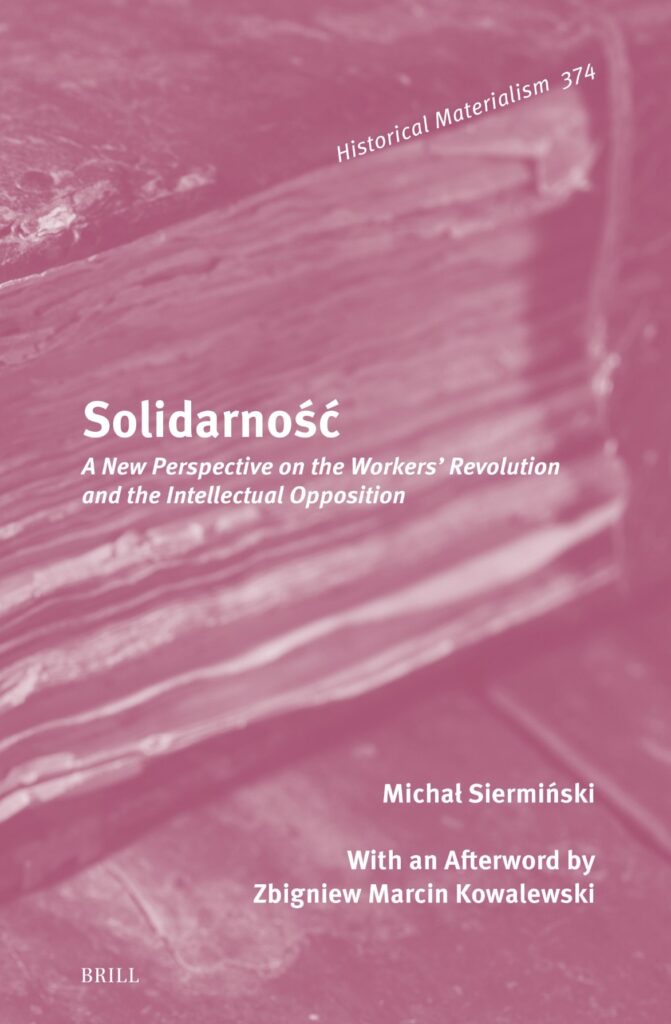
Michał Siermiński
Biographical Note
Michał Siermiński, Ph.D. (1989) is a research fellow at the Institute for the History of Science of the Polish Academy of Sciences and the Gabriel Narutowicz Institute of Political Thought. He works mainly on the history of the People’s Republic of Poland and other countries of the Soviet bloc.
Readership
This book is especially relevant to those interested in labor history, grassroots activism, Eastern European politics, and working-class studies.
Table of Contents
Acknowledgements
Prologue: On the ‘Exogenous’ Sections in What Is To Be Done?
1 The Russian Revolution of 1905
Introduction: The Polish Revolution of 1980–81
1 ‘The Opposition Brought Consciousness to the Spontaneous Workers’ Movement’
2 Workers’ Autonomy
1 March 1968 – The End of Marxist Revisionism and the Mythical Birth of the Democratic Opposition
1 Introduction
2 Kuroń, Modzelewski and the komandosi
3 The March Shock
4 A Pogrom-like Atmosphere
5 The Great Disillusionment
6 An Overlooked Rebellion
7 Birth of a Myth
2 The Turn to National Tradition and the Internalisation of the Ethos of the ‘Classical’ Polish Intelligentsia
1 Introduction
2 The ‘Classical’ Polish Intelligentsia
3 New Ideological Lineages
4 Guardians and Defenders of Values
5 ‘The Psychology of Servitude’
3 The Period from December 1970 to August 1980
1 Introduction
2 The Winter Breakthrough
3 ‘A Characteristic Silence from the Polish Intelligentsia’
4 June 1976 and the Birth of KOR
5 The Concept of Civil Society
6 Taking the Programme to the Workers
7 Containing the ‘Explosion’ of Public Anger
4 The Solidarność Revolution: Problematic Comradeship
1 Introduction
2 August 1980
3 Delight, Hopes, Expectations
4 ‘Self-Limiting Revolution’
5 The Bydgoszcz Confrontation
6 The Struggle for Self-Management
7 The Concept of National Government
Conclusion
1 National-Civic Solidarność
2 Workers’ Solidarność
Afterword – Workers and Bureaucrats: How Exploitative Relations Emerged and Functioned in the Soviet Bloc
Zbigniew Marcin Kowalewski (translated by Maciej Zurowski)
1 The Irreversible Fracturing of the Workers’ State
2 From Workers’ Bureaucracy to Thermidorian Bureaucracy
3 The Construction of the Stalinist Bureaucracy and the Consolidation of the Mode of Exploitation
4 The Stalinist Structural Assimilation of the East European Periphery
5 The Soviet Bloc: The Question of the Mode of Production and Modes of Exploitation
6 The Struggle for Surplus Product and for Control over Labour Processes
7 Conclusion: There Was a Way out of the Vicious Circle
References
Bibliography
Index