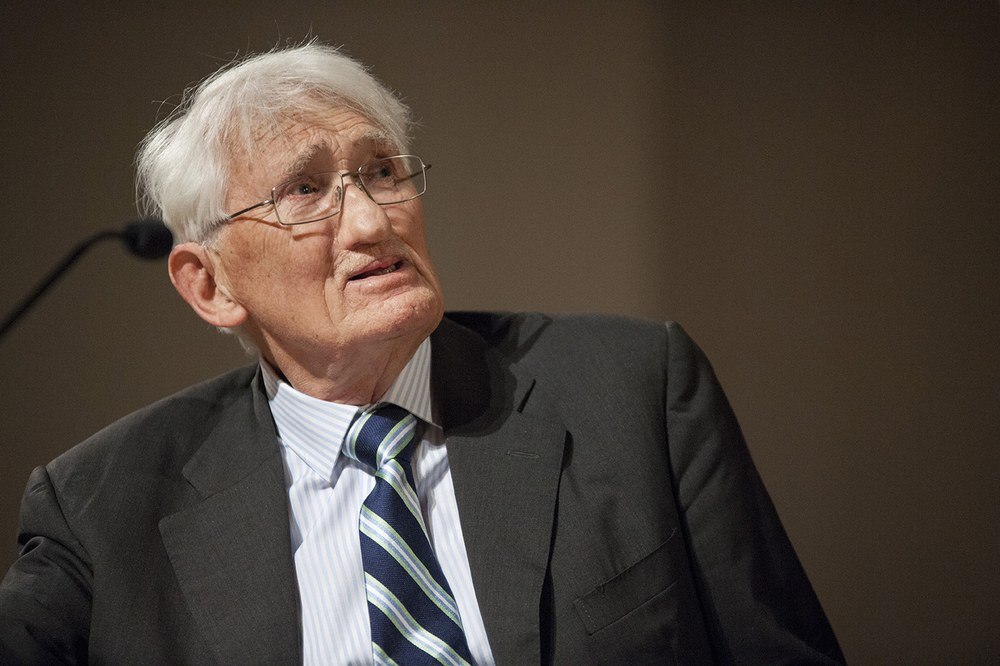
On 14 March 2026, Jürgen Habermas passed away in his long-time home of Starnberg, Germany. He was 96 years old. Born in Düsseldorf on 18 June 1929, and raised in Gummersbach in a family with ties to the Nazi regime, he belonged to the generation that witnessed National Socialism’s downfall, experienced the liberation of Germany, and was subsequently compelled to endure the stifling atmosphere of postwar restoration — the lack of accountability, the silence surrounding Nazi crimes, and the persistence of authoritarian attitudes beneath a formal commitment to democracy.
The Right, in particular, referred to his generation as the ‘Flakhelfer generation’, invoking the anti-aircraft auxiliary force into which many German boys and young men were conscripted. That generation was widely regarded as a product of the re-education efforts carried out by the American occupation. Habermas did not treat this claim as an accusation — rather, he understood its reactionary implication, namely that he, like others of his generation, had been subjected to anti-national brainwashing by the victors of the Second World War. Indeed, he placed great value on West Germany’s links to the West, commitment to democratic deliberation, and the American pragmatism of Charles Sanders Peirce, George Herbert Mead, or John Dewey, whose books were of central importance to his understanding of democracy and the public sphere.
Leaving Bonn, where he earned his doctorate with a dissertation on Schelling under Erich Rothacker, who had vied with Martin Heidegger for the position of Minister of Science under Hitler, Habermas arrived at the Institute for Social Research led by the left-wing Jewish exiles Max Horkheimer and Theodor W. Adorno in the 1950s to acquaint himself with empirical social research. He contributed to the Institute’s studies on the political potential of students with essays in which the arguments found in his later theories already began to form.
This theoretical-political constellation would shape his thinking and his politics as an intellectual. He moved between the circle of critical theory in Frankfurt and the more conservative circle around Rothacker, Hans-Georg Gadamer, and Reinhart Koselleck in Heidelberg. Their journal Archiv für Begriffsgeschichte was oriented toward reviving the nineteenth-century tradition of intellectual history (Geistesgeschichte) and hermeneutics, conducting research on the public sphere in the tradition of Carl Schmitt.
It was in this context that Habermas’s critical study on the Structural Transformation of the Public Sphere emerged. Due to political reservations, Horkheimer declined to grant Habermas a Habilitation, the precondition to obtaining a professorship in the German university system — in his eyes, Habermas was too strongly oriented toward the Vormärz, the period of history preceding the 1848 Revolution. This was then done by the Marxist scholar Wolfgang Abendroth in Marburg. Habermas was subsequently appointed professor of philosophy in Heidelberg in 1961. Just a few years later, in 1964, he returned to the University of Frankfurt as Horkheimer’s successor, where he taught not only philosophy but also sociology at the seminar of the Institute for Social Research.
Against a Divided Modernity
Politically, Habermas was close to the peace movement and the Socialist German Student League (SDS), which he continued to support after the Social-Democratic Party passed a resolution barring dual membership in the two organisations. He remained a committed ally of the student protest movement in its initial phase. Not least because of this political stance, he was regarded, alongside Adorno and Horkheimer, as one of the intellectual mentors of the student movement and a leading representative of critical theory.
Raising awareness, engaging in discussion, and politicising issues became the critical yardstick for an entire generation of West Germans who turned against the manipulative practices of the right-wing Axel Springer media group and the culture industry and instead hoped, through what Habermas called the exercise of the ‘non-coercive force of the better argument’, to educate, dialogically shake up ossified institutions, change attitudes and mentalities, and ultimately establish relationships free from domination.
Habermas developed the foundations of his particular brand of critical social theory and practical philosophy within a broad-based research programme, beginning with his treatise on the public sphere as well as the two essay collections Theory and Practice and Knowledge and Human Interests, his engagement with the ‘linguistic turn’, symbolic interactionism and interpretive sociology, and his often idiosyncratic engagement with Marx, Weber, Durkheim, and systems theory.
Significant parts of his work take on what he called ‘divided modernity’, which, according to his diagnosis, occurs in actually existing bourgeois society when the efficiency of functional, systemic processes develops in a one-sided manner and practical questions of how we as a society wish to and should live are neglected. In doing so, Habermas underlined the continuities stretching from Nazism through the institutionalism of Arnold Gehlen and Hans Freyer, the technocratic conservatism of former Nazi supporters such as Helmut Schelsky, to the systems theory of Niklas Luhmann.
He criticised the complementary bourgeois practice of artificially generating meaning through appeals to historical tradition, the nation, family, and community, as pursued by authors such as Hermann Lübbe, Odo Marquard, or Ernst-Wolfgang Böckenförde, who lamented the erosion of traditional ethics. He did not reject either of these positions critical of modernity outright but, instead, practised a ‘redemptive criticism’ intended to integrate these theorems into a critical theory developed in line with the changing times.
In the wake of the experience of Nazism, critical theory was to contribute to an understanding of philosophy and science that insisted these disciplines should be neither partisan nor activist (‘German Philosophy’, ‘German Physics’). Nor, however, should they be value-neutral and limit themselves to merely technical solutions, participate in pseudoscientific human experiments, or cultivate a detached stance toward democracy.
Habermas’s work was shaped by the quest to reconcile and transcend these conflicting demands. As his magnum opus, The Theory of Communicative Action, demonstrates, he found a solution in the intrinsic connection between the public sphere and the communicative processes of the natural community of speakers. Here, in the lifeworld, autonomous functional rationality of action in the economic system and strategic action in the political-administrative system were to be continually re-anchored to the unity of an overarching communicative action.
For a Democratic Capitalism
Habermas is widely regarded as a representative of the second generation of critical theory, and he was friends with Adorno, Herbert Marcuse, and Leo Löwenthal. Nevertheless, he exhibited little desire to continue the Frankfurt School of thought, as was indicated by his 1971 move from the University of Frankfurt to the Max Planck Institute in Starnberg. Regarding the Frankfurt School as outdated in light of ongoing social change, he shifted from a Marxist paradigm focused on value theory and social labour to the paradigm of communicatively-mediated intersubjectivity as a mode of socialisation.
In this way, he developed his own form of critical theory and, in repeated attempts to establish a discourse-ethical foundation for moral norms, revitalised a form of moral philosophy oriented toward Kantianism. His conception of democracy is procedural: within procedures, the procedures themselves, the issues on the agenda and the actors, become the subject of an argumentative search for universalistic solutions. These procedures are stabilised in the corresponding mindset of constitutional patriotism.
That said, his plea for a deliberative theory of democracy was not merely consensus-oriented. Habermas himself was combative, initiating or intervening in a number of public debates that decisively shaped the self-understanding of the Federal Republic. His theory was equally well acquainted with conflict. For, in his eyes, the political system, proceeding from the lifeworld, was to be publicly besieged through argumentation, protest, and acts of civil disobedience in order to limit — through continuous democratic correction — the dysfunctional consequences of the capitalist economic system and the colonising consequences of the welfare state, namely consumerism and bureaucratisation.
Where he observed intellectual tendencies that, in his view, threatened normative achievements and universalism, he played the role of a judge protecting the boundaries of reason, drawing decisive and often hostile, exaggerated boundaries, particularly in his criticism of the Left, social movements, poststructuralists, as well as of young and neoconservatives. Based on universalist moral norms, which he saw as embedded in relationships of understanding, his theory cultivated a kind of nonpartisan, adjudicatory position that sought to defend the achievements of democratic welfare-state capitalism.
In his view, a European constitution would elevate said capitalism to the next evolutionary stage and curb the sorts of authoritarian tendencies that had repeatedly emerged in Germany since the nineteenth century. The fact that the defender of the European Union against right-wing tendencies in France was to be Macron, whom Habermas publicly endorsed — a politician who implemented neoliberal policies and confronted the Yellow Vests protest movement with brutal force — was indicative of a failure that Habermas himself was compelled to acknowledge in his final writings.
The Limits of Habermas’s Universalism
Habermas’s theory proved to be outdated as far back as 1982, when his magnum opus, an attempt to demonstrate that the welfare state represented the pinnacle of social evolution insofar as communicative action itself took on the universal form of a democratic society, was first published. It lacked the conceptual apparatus to grasp the material and value-based processes of capitalism, social labour, the dynamics of economic and ecological crisis, changes in gender relations, and the experience of a society shaped by migration.
It was precisely the universalism of communicative action — institutionalised in the capitalist welfare state — that posed a limitation in this regard. Habermas’s theory represented the West — he incorporated feminist or postcolonial objections only to the extent that universalist norms could be found within the protests of the women’s movement or the traditions of the colonised themselves. Habermas attempted to retroactively incorporate into his theory emancipatory claims he had not originally considered, in order to repeatedly write them off in a universalist manner. His was less and less a theory of society and more and more a commitment to the moral-philosophical endeavour of continually re-justifying universalist norms in a more effective fashion.
His theory had proven too successful in its shift from a theory of capitalism to a theory of modernity and abandoned too many tenets of critical and Marxist theory. It was too well-crafted to be amenable to correction. Ultimately, his theory also represented a variant of the end of history — not in the empirical sense, of course, but in the normative sense. It was not interested in overcoming capitalist relations, but in the establishment of full modernity: that is, the development of practical discourses able to steer functional systems in a way that preserves autonomy and avoids damage to the lifeworld.
Habermas’s universalism and his engagement with German history led him to adopt questionable bellicose positions. He acted as a moderating influence when it came to military support for Ukraine, while remaining silent on Israeli war crimes in Gaza. This attitude proved relatively inconsequential for his international success since the 1990s. He stood for a critical theory that targeted political action and democracy. It promised intellectuals eager for modernisation a connection to modernity, to industrial development, and to democratic civil society.
Habermas was an impressive academic teacher: strict, challenging, yet also stimulating and attentive. He possessed an incredible ability to quickly recognise and reconstruct arguments. For decades, the Federal Republic of Germany was reflected in his love of discussion and debate. He symbolised both the conservative and the progressive aspects of the German postwar period. He embodied, whether in his theory, his publications for outlets such as Suhrkamp Verlag or Die Zeit, or, in his very person, West Germany’s liberal-progressive, welfare-state-democratic compromise.
It is thus fitting that he was honoured more often than not as the philosopher of the Federal Republic of Germany. It is unique and quite extraordinary that a society should define itself so thoroughly through the thinking of a single person. In that sense, with the death of Jürgen Habermas, more than just a person or a philosopher has gone — a historical figure of this society’s self-understanding has reached an end.
Translated by Loren Balhorn.