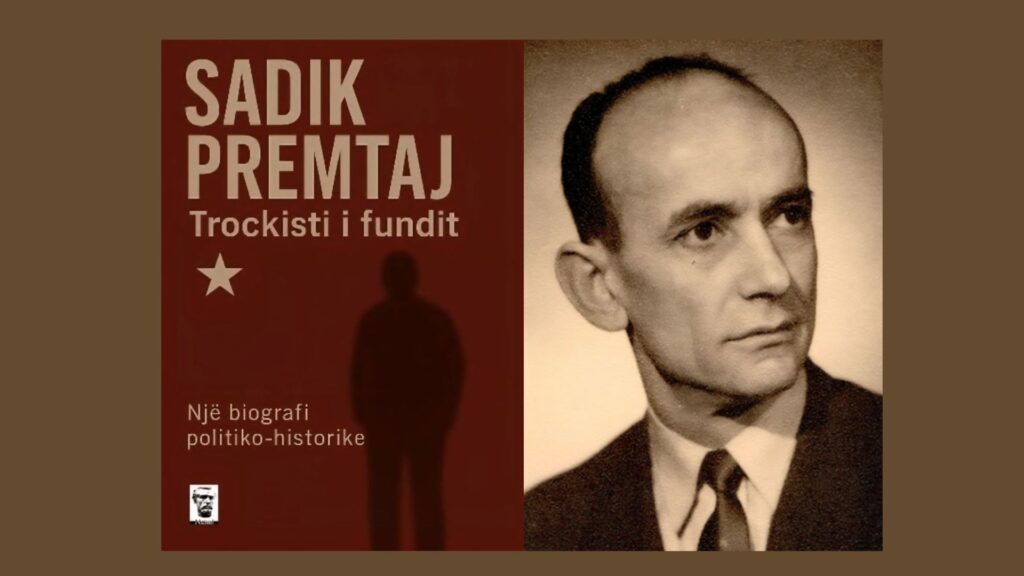
Marenglen Kasmi, Sadik Premtaj: Trockisti i Fundit (Sadik Premtaj: The Last Trotskyist), Naimi Publishing, Tirana, 2025.
Reviewed by Tevfik Rada
Little known today, Sadik Premtaj is nonetheless a crucial figure for understanding the early years of the Communist Party of Albania (CPA). Under the pseudonym Xhepi (meaning “pocket” in Albanian), he was labelled a “Trotskyist” by Enver Hoxha’s clique: a characterisation which, after discovering the Fourth International in exile, Premtaj came to recognise as accurate. According to the official historiography of the Albanian Labour Party, he was a class enemy, an intellectualist, a reactionary, a spy. Enver Hoxha was so fixated with him that, in his tome on the formation of the Party, Kur Lindi Partia (When the Party Was Formed), he cited Premtaj’s name nearly 200 times. Postcommunist historiography, on the other hand, dug up many previously repressed figures and moments, this time stripping off any relevant communist legacy. In these accounts, Premtaj became a moral dissident against the horrors of the Hoxha’s regime.[1] In the West, he initially became known through his article “Stalinism and Communism in Albania”, written in the twilight of the Tito-Hoxha split, and published under the pseudonym X.Y.Z. in the Fourth International’s journal in French (1948) and in English (1949). The text was reprinted in both languages during the 1990s and was a crucial intervention for understanding the Stalinist beginnings of the CPA. His memoirs were published in 1988 in Sous le Drapeau du Socialisme. In 2000, Paolo Casciola compiled Premtaj’s memoir and his “Stalinism and Communism in Albania,” and published them together with brief texts by Guy Prévan, Michel Raptis, and Agim Musta.
Marenglen Kasmi’s book, Sadik Premtaj: Trockisti i Fundit (Sadik Premtaj: The Last Trotskyist, Naimi Publishing, Tirana, 2025), aims to reconstruct Premtaj’s life alongside the political context in which he lived. The book brings to light many new documents on Premtaj, primarily from the public archives in Albania, but also from the private archive of Premtaj’s brother. These documents allow a reconstruction of Premtaj’s political engagement with Albanian communism. For the same reason, however, the book sheds little light on his political life after his interest in writing on Albania waned following the regime’s reconsolidation in 1956. The book also discusses Premtaj’s half-brother, Zija Lepenica, who was imprisoned in Hoxha’s Albania for nineteen years solely because of his familial connection to Premtaj. After going into exile in Paris in 1944, Premtaj was never able to return to his homeland before his death in 1991. According to his close friend Michel Pablo, he nevertheless visited Greece several times and viewed Albania from Corfu.[2] He was separated from his family for the rest of his life and never had the opportunity to see either his wife or his daughter, whom he never met.
Kasmi’s recent works on the National Liberation War, as well as on the syndicalist movement in Albania, stand in contrast to the current anti-communist official historiography. Whatever its limitations, his book on Premtaj, unlike that of the overwhelming majority of historians in Albania, does not take anti-communism as its starting point. Nor is it Hoxha-apologetics. As he notes, Sadik Premtaj embraced an alternative revolutionary politics of Marxism and was critical of Stalinism. This makes Sadik a unique figure in Albania, where almost all of Hoxha’s exiles were or became nationalist and reactionary.
Sadik Premtaj was born in 1914 (although he officially used 1915 as his birth year) in the small village of Gjorm, near Vlorë. He never saw his father, who had left his pregnant wife to fight in the Ioannina War and died there. Sadik’s family, like most of the people in his village, were poor farmers with a small plot of land. He spent his early years in Gjorm in poverty. He later received a scholarship to study at the Technical School in Tirana, founded by the American Red Cross in the early 1920s. The language of instruction at the school was English where he graduated in 1938 as a geodesist. By that time, he had already witnessed many tumultuous political events in Albania. In 1928, Ahmed Zogu declared himself King of Albania. To sideline Yugoslav influence, numerous concessions were granted to Italian capital. During the interwar period, Albania had the least developed economy in the Balkans. Precapitalist social relations remained largely intact. Agriculture was dominated by large landowners under the çiftlik system, and industrial development was negligible. Tribal structures persisted, particularly in the northern regions of the country. Despite attempts at industrialisation and land reform in the 1930s, these efforts were largely symbolic. Social antagonisms endured, and the condition of the peasantry worsened. King Zogu’s reign ended in April 1939, when Italy occupied the country.
Albania, as a periphery of the periphery, represents a peculiar case in the history of communism in the Balkans. During the interwar period, the country’s most pressing issues, that preoccupied communists and other progressive currents, were the wretched conditions of the poor peasantry and the looming danger of colonialism. The weak capitalist relations and near absence of an industrial working class posed an additional challenge for communists. Moreover, under the repressive police regime of King Zogu, they had little opportunity to organise. Unlike in other Balkan countries, an Albanian Communist Party was not formed until 1941.
While the first Albanian communist movement was formed in exile after the defeat of Fan Noli’s short-lived government in 1924, it had limited impact within the country. By the mid-1930s, several small communist groups existed in Albania, but they were unable to agree on a common political programme for unification. Among these, the Korça Group was the most prominent. It brought together ideologically disparate people, ranging from adherents of the Comintern line to those closer to social-democratic positions. Koço Tashko, who had studied in Moscow with several other Albanian communists in the late 1920s, represented the Comintern orientation in the group. He was the link between the older generation of Albanian communists in exile and the newer militants at home. The communist groups active in Tirana suffered severe repression from Zogu’s police following the Fier uprising in 1935 and were largely suppressed. The Zjarri Group, active in Tirana, was formed in the mid-1930s in Athens around Andrea Zisi. Its members identified themselves as “Archeo-Marxists”. Zjarri adopted a passive political stance throughout the 1930s and programmatically refused both to join other communist groups and to engage in revolutionary practice. The Shkodra Group, also formed in the mid-1930s, largely held the view that class relations in Albania were not yet ripe for a classical communist movement. Prior to colonial rule, some of its members even believed that an Italian invasion could have positive effects by developing capitalist relations and the workers’ movement. Among the group’s members were two Kosovo Albanians, Fadil Hoxha and Emin Duraku. They served as a link to the Communist Party of Yugoslavia (CPY), which was also operating illegally and was, both practically and theoretically, far more experienced than the Albanians. It was through this connection that two Yugoslav emissaries, Dušan Mugoša and Miladin Popović, were sent to Albania in 1941 to put an end to the factional struggles among the groups and to unify them into a Communist Party. However, Mugoša and Popović did not represent the CPY in Tirana but, rather, the Comintern, as they made clear during the meeting.[3] The party was founded clandestinely in an old house in Tirana by the above-mentioned groups, with the exception of the Zjarri Group. One of the groups invited to the first meeting was the Youth Group where Premtaj was active as a young militant.
How does one become a communist in a country like Albania during the 1930s? The Albania of Ahmed Zogu, as we mentioned, was marked by deep social contradictions. In an extremely backward country where more than 80 percent of the population was illiterate, Zogu’s dictatorial regime, relying on Italian protection abroad and police control at home, almost did not alter social relations inherited from the late Ottomans, nor it could industrialise the country. For this, a segment of the young intellectual circles despised Zogu’s regime. They were, at the same time, critical of the petit-bourgeois nationalist intellectuals that sought to preserve a strong leadership in the name of resisting a possible colonial domination by Italy. Fuelled by hatred of feudal relations, the colonial threat, Zogu’s regime, and the petit-bourgeois intellectuals, a segment of the youth turned toward socialism, largely driven by romantic impulses. Some of the leftist literature was also being smuggled into the country. In the mid-1930s, together with his friend Anastas Lula, and some others Premtaj created a communist cell in the school which later became a part of the Youth Group. In his memoirs, written in Albanian in 1950 and not published in any other language, Sadik Premtaj cited Maxim Gorky’s novel Mother (quite popular among progressive intellectuals in Albania despite Zogu’s repeated attempts to ban it) as his first encounter that “opened [his] eyes to revolutionary work” (p. 332). He also mentions that during this period Youth Group was able to acquire several Marxist books including Capital, The Origin of the Family, The State and Revolution and Anti-Dühring among others. During this time, Luarasi translated Anti-Dühring into Albanian which he disseminated among his friends. In another memoir, Premtaj recounts how he first became a fervent anti-monarchist in the mid-1930s, when two dozen intellectuals and shopkeepers were arrested in Albania as part of an alleged assassination plot against King Zogu.[4] He mentions encountering a brochure by Kropotkin in Albania, which proved to be an enthusiastic revelation for him. Premtaj also notes that much Marxist literature was circulating clandestinely in Albania at the time. His comrade Anastas Luarasi was a more experienced communist who had come from the Korça Group and he was helpful for the Marxist education of Premtaj. They translated and secretly published works by Marx and Lenin, and even the military writings of Trotsky, without being aware that the latter had become a persona non grata.[5] The emphasis on the translation of the Marxist literature into Albanian and strengthening of the theoretical side was the characteristic of the Youth Group.
Albanian historiography is still torn by the obsession of the formation of the Albanian Communist Party and the Yugoslav emissaries’ role in it. The most detailed account of this episode is given by Kristo Frashëri’s unparalleled book Historia e lëvizjes së majtë në Shqipëri 1878 – 1941 (The history of the left-wing movement in Albania 1878 – 1941). Frashëri (1920-2016), himself a young communist from the Youth Group during the formation of the CPA, later became a prominent historian in the Socialist Albania. In his book, Frashëri devotes nearly one hundred pages to the few nights during which the CPA was formed, recounting them with measured precision. For several nights in a small house in Tirana, eighteen communists argued and fervently discussed the political and organisational orientation of the future Party. From the choice of a small Ottoman house in Tirana for the meeting, the arrangement of the room, and the logistics behind the clandestine meeting; to the tense dynamics among the eighteen participants (including the Yugoslavs, Premtaj, Luarasi, Hoxha, and Tashko); to the languages they used to communicate, the fate of the stenographic records, and the heated, at times relentless and eruptive, debates that occasionally had to be interrupted by the guard outside, who feared the Italian police might hear the noise; to the ideological divisions among the groups, Mugoša’s and Popović’s attitudes toward the others, and their preference for Hoxha from the Korça Group as the leader of the Party, whom they saw as an intellectual untainted by earlier factional struggles: All of this is presented in Frashëri’s book in an almost cinematographic atmosphere[6].
During the Party’s first meeting, the conflict between the Youth Group and the Yugoslavs became apparent. Mugoša criticised the Youth Group’s “intellectualism,” particularly their emphasis on the translation of the Marxist literature into Albanian, and their reluctance to work directly with workers. In his later memoirs, Sadik clarified this issue by arguing that the Yugoslavs failed to understand Albania’s specific social reality, in which the working class was almost non-existent. Under such conditions, he maintained, intellectuals necessarily had to play a central role in translating Marxist ideas to the masses. The first composition of the party bureaucracy also reflected social differences between intellectuals (Enver Hoxha was originally a teacher) and workers (Koçi Xoxe, purged and executed in 1948, was a tinsmith). Ironically, “the workers’ wing” was mainly purged during Hoxha’s reign.
Kasmi argues that, thanks to the Yugoslav emissaries’ role, the first Resolution of the Communist Party of Albania (14 November 1941) was drafted on the basis of the Yugoslav model, which was at the time Stalinist. According to him, this marked the CPA’s proper Stalinisation and constituted the source of Premtaj’s dissent. Going even further, Kasmi suggests that the organisational structure inherited from the CPY became the foundation for the purges that Hoxha would later carry out against the party members. Whatever the limits of this interpretation, the fact remains that the CPA was born as a Stalinist party without having a real chance to discuss its political and organisational aspects. The lack of working-class movement at this time and the clandestine nature of the organisation added to the deformed structure of the Party. Under the harsh conditions of occupation, and the urgency of the liberation, there was no tolerance for internal criticism. Premtaj and Luarasi, who were sceptical of the Yugoslav emissaries’ involvement, were soon expelled from the Party. Anastas Luarasi was killed, while Premtaj was forced to flee to Paris in 1944.
However, what Kasmi’s archival-based study reveals is that Premtaj’s communist militancy continued in Albania until 1944, and that his dismissal from the Party was not initially clear to him. In 1942, the National Liberation Movement (NLM) was formed on the initiative of the CPA, which turned the tide in their favour. The same year, Sadik was sent to Vlorë by the Central Committee to carry out agitational work. There, he helped establish the first councils in the villages of the Vlorë region, initially referring to them as soviets. Following criticism from the Yugoslav emissaries that this was not the most effective strategy for winning over the peasantry, he was compelled to abandon the term. A gifted orator, Sadik was able to attract large numbers of peasants to the National Liberation Movement and to disseminate what were perceived as “his ideas”. This was made possible in part by the relatively weak organisational control of the Party in the area. Alarmed by his growing political influence, the Party launched a campaign against so-called “Trotskyist” elements, a label under which both Sadik and Anastas were subsumed. Between January and September 1943, thirty-two party members were expelled as supporters of Sadik Premtaj, and a further seven were expelled for “inactivity” and “serious mistakes”. Enver Hoxha’s visit to Vlorë in May 1943, undertaken in order to “crush Sadik Premtaj’s faction,” occupies a central place in his book Kur lindi Partia (When the Party Was Born)[7]. As a result of the campaign against the Vlorë district, twenty-five members were expelled from the local branch, that is, more than 16 percent of its local membership. Seven of those expelled were executed, while four fled abroad.
As Kasmi also shows, Enver Hoxha’s attack against Premtaj relied on personal accusations of careerism and served to divert conflicts away from their real social and political content. However, Sadik was not the only one critical of the Party’s centralisation in the hands of a few figures. Sejfulla Malëshova, a veteran Albanian communist who had returned from Moscow to join the movement in 1943, immediately recognised that the concentration of decision-making excluded broader participation of the members and undermined trust towards the Party’s structures (pp. 140-141).
What the book is less successful at is evaluating the political traditions and their transformations in relation to concrete historical developments. Both Malëshova and Premtaj’s positions stand in a vacuum, as a moral and an instinctive reaction against injustice. The relationship with Balli Kombëtar (National Front, from now on BK) represents the most heated moment of ideological confrontation in this regard. BK was a nationalist organisation, formed in 1942, initially opposed to the Italian occupation by creating a broad national alliance, including the reactionary landlords. However, it became a collaborator with the Fascists during the German occupation. In August 1943, BK organised a meeting with the NLM in the village of Mukje. Known as the Mukje Agreement in history, both sides initially agreed to cooperate against the occupiers. Soon, however, the alliance was broken by the communists, and Enver Hoxha later had to acknowledge his error in this matter. The failure of the Mukje Agreement is still a heated debate among Albanian historians. Losing his support within the NLM, Premtaj approached BK, apparently aiming to create an autonomous communist bloc within it. His short resolution from late 1943, “The Resolution of the True Albanian Communist Organisation” (pp. 158-160), is an important but little-known testimony to this episode. Calling the CPA’s methods “terroristic à la fascist”, the Resolution called for the creation of a new, “true” Communist Party to fight both the Nazis and the internal traitors, and to organise according to cell structures. Among other points, it advocated full collaboration with BK, as long as the Party was not forced to compromise its principles. Moreover, it stood for the creation of an “independent, ethnic [this word was added later on with a pencil], and democratic” Albania with agrarian and industrial reforms. Kasmi interprets this as evidence of an alternative communist project pursued by Premtaj, one that diverged from the rigid “Stalinist” ideology of the CPA. It reflected, according to him, a more open approach to nationalism and a more educational engagement with the masses. The nationalist and reformist tone of Premtaj’s resolution and its limits for an “alternative” communist project is not really discussed. Sadik’s collaboration with BK later became a point of criticism within Albanian communist historiography. In exile, Premtaj would reject the idea of collaboration and openly criticise BK. The problem, however, is that Kasmi does not situate Premtaj within alternative political currents or explore the nuances between them. Instead, he merely emphasises that the Resolution’s call to fight the internal traitors reflects the looming influence of Stalinism in Premtaj. Kasmi suggests that Premtaj’s tragedy lies in the tension between his desire for reform and his reliance on traditional methods. Kasmi’s mere focus on organisational structure leads him to remain silent on the political content and strategic dimension of revolutionary activity in the context of Albania’s specific social conditions. Contrary to his belief, pluralism in organisational structure does not automatically amount to a critique of Stalinism. His misleading dichotomy (between a rigid Stalinist and a decentralised non-Stalinist structure) partly stems from Kasmi’s limited understanding of Stalinism, which, according to him, reveals itself merely on the issue of how the postrevolutionary situation is handled. Stalinism, he contends, aims to continue the internal class struggle and purges even after the revolution.
Sadik Premtaj, along with many other socialists, nationalists, collaborators etc. escaped Albania in 1944, before the country’s liberation. After a journey through Italy and France, with the help of the Italian and French communists (who had no idea about the internal fights of the CPA) he settled in Paris in 1947, where he would spend the rest of his life until 1991. Premtaj worked as a cleaner in a textile factory, later as a metalworker, then at an insurance company, and finally at the FNAC, where he remained until his retirement in 1979.[8] When he settled to Paris, a community of Albanian immigrant workers, who had arrived in France during the interwar period due to economic conditions, was already established. Among them were also political exiles, including the left-wing supporters of Fan Noli. While the nationalist and anti-communist groups quickly became influential within the Albanian diaspora, Premtaj rejected any collaboration with them. Instead, a year after his arrival, he joined the Fourth International, though the details of his entry remain unclear. It is ironic that the moment Premtaj recognised himself in the Trotskyist movement is absent in Kasmi’s book. A hint is provided by René Dazy who wrote that, during this period, Premtaj met two Trotskyist workers in the factory near Paris where he was working, who gave him a copy of La Vérité to read. Premtaj discovered that the journal had a similar critique of Stalinism which he had developed through years. Reportedly, Premtaj said, “I made contact with the Trotskyists. I talked at length with one of them, Pierre Frank, and I discovered that I had really been a Trotskyist as the Stalinists had claimed in Albania.”[9]
The book does a better job in the parts revealing Premtaj’s engagement with Communist Party of Yugoslavia following the Tito–Stalin split. Ironically, while his main dissent during the formation of the CPA had been his critical stance toward Yugoslav involvement, Premtaj now considered the possibility of collaboration. In 1948, Vasil Gërmenji, an Albanian teacher and statesman who had settled in Marseille in 1939, fought in the French National Liberation, and later became active in the BK organisation in exile, wrote to Premtaj evaluating possible strategies for exiled and disaffected Albanian communists. He suggested that Yugoslavia’s support could be decisive in overturning the political situation in Albania. According to Gërmenji, in such a scenario, they would preserve the social reforms implemented by Enver Hoxha, allow private initiatives in a controlled manner, and eliminate the police regime. If Tito were willing to entertain such a proposal, Sadik Premtaj declared to Gërmenji, he was prepared to go to Belgrade to negotiate with CPY (pp. 196-197). However, a major obstacle existed: Dušan Mugoša’s critical evaluation of Premtaj and the Youth Group was already circulating in Yugoslavia. In the Yugoslav partisan and historian Vladimir Dedijer’s book on Yugoslav–Albanian communist relations, Premtaj was portrayed in an unfavourable light.[10] Premtaj then wrote directly to the Central Committee of CPY for assistance, declaring his loyalty to communism and anti-Stalinism and refuting the criticisms levelled against him by Mugoša. He recommended consulting Xhavit Nimani and Fadil Hoxha, his Kosovo Albanian comrades now holding high positions in the CPY, for accurate information about his historical record. Premtaj reiterated his critical stance toward the Soviet Union and expressed his hope that the CPY would embody the vanguard of the international proletariat. He declared his readiness to cooperate with the CPY to overthrow the leadership of the CPA. The CPY requested an autobiography from him and asked what he was willing to do for Yugoslavia. After several months of silence, Premtaj also wrote to Xhavit Nimani, seeking comradely assistance in resolving the matter. It appears, however, that he never received a response.[11]
Premtaj’s hopes for collaboration with the CPY proved futile. At the same time, his involvement was sufficient for the CPA to declare him a Yugoslav agent. The CPA was closely monitoring Premtaj through his agents in France. In 1951, an Albanian emigree living in Paris attempted to assassinate Premtaj on the orders of CPA officials. The sole Albanian Trotskyist was struck in the head with an axe, barely surviving the same fate as his ideological mentor. The hired assassin, Xhelal Bajrami, was a veteran of the Spanish Civil War. He quickly fled to Albania after the attempt, where he died a couple of years later. There were at least two other such attempts. The third was supposedly planned by a man named Koço Gjini from Albania, who, once in Paris, regretted his decision and returned home, only to find himself imprisoned.[12]
In 1956, as de-Stalinisation was underway in the Eastern Bloc, Premtaj saw another opportunity for a revolutionary transformation in Albania. Indeed, Khrushchev’s thaw had briefly shaken even the Albanian bureaucracy. On 14–15 April 1956, at the 20th Congress of the CPA, some members criticised the Party’s parochialism, bureaucratisation, nepotism, increasing violence, restrictions on freedom of speech, and other systemic problems. Hoxha and his clique quickly regained control, purging and punishing the critical voices. Kasmi notes that, during this period, Premtaj, as a member of the Fourth International, wrote an appeal addressed to Albanian communists. Kasmi cites archival material from a dossier created specifically on Sadik Premtaj in Albania, but he does not specify where the appeal was published or sent.[13] In any case, Premtaj’s appeal is very important, since it demonstrates a level of ideological maturity at this point. In the text, he called for fuller independence of the Party and unions from the state; the formation of democratically elected committees in factories; elimination of bureaucratic privileges; repeal of reactionary laws, including those affecting women’s liberation; freedom in the creation of literature and art; and a call to a truly revolutionary and internationalist foreign policy.[14]
In another section of the appeal, Premtaj assessed the reality of Hoxha’s Albania. While he called on the Albanian masses as the true achievers of the revolution, he did not deny the positive social transformations the country had undergone. It is worth quoting his statement in full:
Despite the shortcomings, mistakes, faults, crimes, privileges, and the deformation of the socialist regime by Stalinist bureaucrats, nevertheless, thanks to the planned economy, Albania has made in ten years progress that the rotten regimes of the past would not have achieved even in fifty years. The construction of factories and power plants, agrarian reform and land canalisation, construction of roads and bridges, increase in the number of schools, and the fight to eradicate illiteracy are the work of the new regime in Albania. The tragedy is that the bureaucracy has benefited far more from all these advances than the people themselves. To benefit from these advances and go even further, the only remedy is to purge the Party and the government of Stalinist bureaucrats. (pp. 284-285)
Premtaj was convinced that, behind the curtain of privileged Stalinists, true communists still existed in Albania who required a revolutionary vanguard to reform the political bureaucracy. He argued that the failure to achieve this until now was due to the harsh security system in the country. At this point, it seems that Premtaj was more familiar with the Fourth International’s analysis of Eastern European regimes as a deformed workers’ state.
After the reconsolidation of the bureaucracy in 1956, Premtaj lost hope for political transformation in Albania. Kasmi notes that he instead turned his attention to other issues within the Fourth International, and later with Pablo’s group. However, he does not give more details on this relationship. Was Premtaj politically active in any capacity after 1956? Did he maintain contact with other political figures? The period from 1956 to 1990 (when Premtaj’s brother visited him in Paris) is absent from the book. This omission highlights the limits of the Albanian archives, which probably only tracked Premtaj while he posed a threat to the Albanian regime. The book largely ignores the non-Albanian contacts and his engagements in Paris.
This absence, however, is symptomatic of contemporary Albanian historiography, which is often dominated by crude empiricism and methodological nationalism. Throughout the book, Kasmi attempts comparative analyses, but they remain abstract, offered merely to suggest transhistorical affinities among communist organisations in Europe. As a result, these comparisons are superficial and have no explanatory value. Moreover, the book does not really answer its central question: What was specifically Trotskyist about Premtaj? If it was his later involvement with the Fourth International, Kasmi fails to fully illuminate this connection. If it was his pursuit of an alternative communist project rooted in a critique of Albanian Stalinism, the book does not clearly situate this project or differentiate it from other non-Stalinist, social-democratic, Bukharinist, or nationalist currents. This deficiency, as noted above, stems from the weak conceptual treatment of Albanian Stalinism, which is often reduced to authoritarianism and the absence of internal party pluralism. As Premtaj observed, the Albanian communist movement was still in its embryonic stage when it became infected with Stalinism. Kasmi’s book does not test or explore this idea in relation to the specific social conditions of Albania.
Today, the history of the CPA is often part of a spectacle in Albanian media. It is more than usual to see official Albanian historians in TV programmes, having endless conspiratorial discussions about the Party’s creation, Mukje agreement, Enver Hoxha’s rise to power, personal espionage, internal gossip within the Stalinist bureaucracy, political purges, secret correspondences, and many more. While there is a fascination with analysing and criticising the Stalinist regime, there is almost no engagement with the theoretical or conceptual tools needed to understand it as a political and social structure. Trotsky’s works, of course, were banned in “socialist” Albania. Yet, despite the brilliance of his critique of Stalinism, his ideas have scarcely reached the country in the “postcommunist” period. A quick survey shows that almost none of his works have been translated into Albanian, except for his widely circulated reports on Serbian atrocities against Albanians during the Balkan Wars and his exposure of the secret London Treaty. One should keep this arid vacuum in mind while reading Kasmi’s work on Premtaj.
Refercences
Kaloçi, Dashnor 2017, Sadik Premtja: Historia e Panjohur e Një Disidenti (Sadik Premtja: Unknown History of a Dissident), Onufri, Tirana.
Raptis, Michel 2000, ‘Le Printemps Arrive aussi à Tirana’ (‘Spring is also Arriving in Tirana’), in Casciola, Paolo (ed.), Sadik Premtaj, Les Gangsters d’Enver Hoxha à l’oeuvre: La Lutte entre stalinisme et trotskysme en Albanie (Enver Hoxha’s Gangsters at Work: The Struggle Between Stalinism and Trotskyism in Albania), Quaderni Pietro Tresso, Florence.
Frashëri, Kristo 2006, Historia e lëvizjes së majtë në Shqipëri 1878–1941 (The History of the Left-Wing Movement in Albania 1878–1941), Akademia e Shkencave e Shqipërisë, Tirana.
Premtaj, Sadik 2000, ‘Au File de ma Memoire’, in Casciola, Paolo (ed.), Sadik Premtaj, Les Gangsters d’Enver Hoxha à l’oeuvre: La Lutte entre stalinisme et trotskysme en Albanie (Enver Hoxha’s Gangsters at Work: The Struggle Between Stalinism and Trotskyism in Albania), Quaderni Pietro Tresso, Florence.
Hoxha, Enver 1981, Kur lindi Partia (When the Party Was Formed), 8 Nëntori, Tirana.
Prévan, Guy 2000, ‘Sadik Premtaj’, in Casciola, Paolo (ed.), Sadik Premtaj, Les Gangsters d’Enver Hoxha à l’oeuvre: La Lutte entre stalinisme et trotskysme en Albanie (Enver Hoxha’s Gangsters at Work: The Struggle Between Stalinism and Trotskyism in Albania), Quaderni Pietro Tresso, Florence.
Alexander, Robert J. 1991, International Trotskyism, 1929–1985: A Documented Analysis of the Movement, Duke University Press, Durham, NC.
Dedijer, Vladimir 1949, Jugoslovensko-albanski odnosi (1939–1948): Na osnovu službenih dokumenata, pisama i drugog materijala (Yugoslav-Albanian Relations (1939–1948): Based on Official Documents, Letters and Other Material), Borba, Zagreb.
Musta, Agim 2000, ‘Une Tentative Inconnue D’Assassiner Sadik Premta (An Unknown Attempt to Assassinate Sadik Premtaj)’, in Casciola, Paolo (ed.), Sadik Premtaj, Les Gangsters d’Enver Hoxha à l’oeuvre: La Lutte entre stalinisme et trotskysme en Albanie (Enver Hoxha’s Gangsters at Work: The Struggle Between Stalinism and Trotskyism in Albania), Quaderni Pietro Tresso, Florence.
[1] For a rather recent source on Premtaj which includes the copies of many documents on his political life and activity: Kaloçi 2017.
[2] Raptis 2000, p. 28.
[3] Frashëri 2006, p. 178.
[4] Premtaj 2000, p. 20.
[5] ibid. p. 21.
[6] Frashëri 2006, pp. 173-271.
[7] Hoxha 1981.
[8] Prévan 2000, p. 27.
[9] Cited in Robert 1991, p. 33.
[10] Dedijer 1949.
[11] Premtaj’s full letter to the Yugoslav embassy as well as to Xhavit Nimani can be found in Kasmi’s book in pp. 198-202 and pp. 210-214
[12] Musta 2000, p. 33.
[13] Prévan says that this appeal was sent to the Albanian embassies and Albanian political organisations. Prévan 2000, p. 28.
[14] Parts of the appeal is published by Kasmi in pp. 278-285.