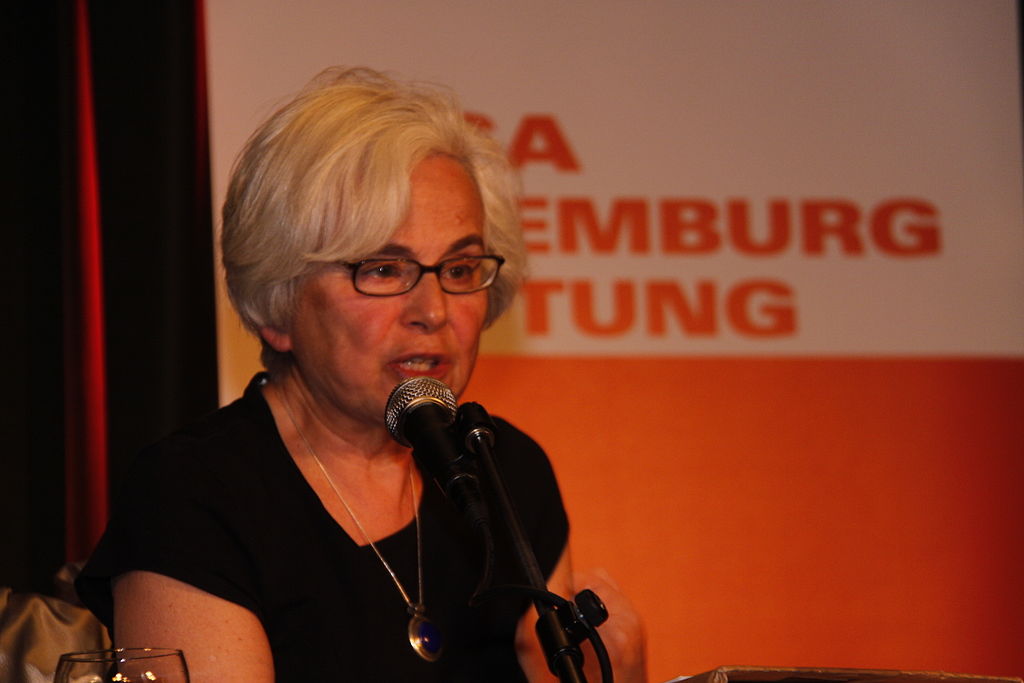
On 14 January 2016, Ellen Meiksins Wood died in Ottawa, after a long struggle with cancer. Ten years can feel like a blink in political time, given how quickly crises multiply and vocabularies decay. Ten years can also feel like an era, given how easily intellectual life learns to live without its best antagonists. An anniversary invites commemoration, although commemoration often arrives already domesticated, reduced to a few adjectives, a canonisation, a quiet absorption into ‘influence’.
Wood’s work resists that domestication because it was never written as the cultivation of influence. It was written as part of an argument about where capitalism originates and how, about how and why democracy is organised as social power, about what democracy can mean under capitalist social relations, and about how historical materialism can be used to reveal and repoliticise what is at stake in texts, institutions, and political languages.[[1]] Vivek Chibber’s obituary captured the spirit of that project with bracing clarity, describing Wood as a thinker of ‘extraordinary range’ who never relented in her commitment to socialist politics.[[2]] Range mattered to her, although discipline mattered more, and range without historical specificity becomes a touring lecture, impressive and weightless at once. Wood did not treat Marxism as a moral vocabulary or a set of inherited positions. She treated it as a method that either explains social power concretely or fails.
This short memorial returns to Wood’s legacy by focusing on her approach to political theory and the comparatively understudied method she and Neal Wood developed, the social history of political theory.
The discipline of historical specificity
Wood was trained as a political theorist [[3]] and became, over time, one of the most formidable Marxist historians of political ideas. York University’s memorial note, written immediately after her death, described a scholar whose work insisted on the importance of political processes and class conflict in shaping historical change.[[4]] That phrasing can sound generic until one remembers how rare it is in academic life for such commitments to survive professional incentives. The same note also emphasised her careful historical work on the specific emergence of capitalism in England, and her insistence that democracy is fought for from below rather than benevolently granted from above.[[5]]
Wood’s discipline was also visible in what she refused to do. She had little patience for large claims unmoored from historical specificity, and even less for accounts of capitalism that treated it as a transhistorical synonym for ‘markets’. The effect of that refusal was bracing. It kept her arguments grounded in determinate social relations, and it made polemic with her unusually productive, because it compelled others to argue historically rather than rhetorically.
That discipline was real, and it gave her work its coherence. Wood’s eight major works intervene in different debates, yet they turn on the same insistence that Marxism lives or dies as method. Historical materialism, for her, names a way of repoliticising material conflict, tracing how struggles over social property relations and the organisation of life leave their imprint in institutions, historical narratives, and the conceptual architectures that political theory later presents as sophisticated reason.
Reading political theory under historical pressure
In the conventional pedagogy of the history of political thought, political theory is staged as an elevated conversation, unfolding across centuries in a realm slightly above history. The protagonists change, the familiar rubric persists, and concepts appear as if they were designed for examination: liberty, equality, justice, sovereignty, obligation. The canon becomes a curated space in which texts are handled as objects of interpretation, while the conflicts that made them urgent are filed away as background.
A museum can be instructive and still make the past feel safe. Wood wanted political theory to be put back under historical pressure.
Her question, posed in different ways across her writing, can be staged as a provocation. Why do some concepts become politically urgent at specific moments, and why do they take the forms they do? A second provocation follows immediately. Whose problem is being solved when a theorist ‘solves’ a political problem? A third emerges once one stops treating the canon as a polite seminar. What forms of life are being defended, what forms of dependency are being naturalised, and what kinds of conflict are being managed when political theory speaks in the language of universals?
Once those questions are asked, ‘context’ starts to look less like background and more like the terrain of engagement on which thinking becomes necessary.
Wood’s distinctive refusal was directed at two familiar reductions.
One reduction treats political ideas as autonomous discourse. The task becomes to reconstruct language, intention, rhetorical setting, and the immediate field of intellectual debate. This approach, which largely became mainstream with the emergence of the Cambridge School and its currents, can produce exquisite readings of texts and still leave one unsure why certain arguments mattered enough to be written, circulated, feared, or adopted.
A second reduction moves in the opposite direction. Political theory becomes mere ideology, an epiphenomenon of social structure, an elegant rationalisation for domination. This approach, commonly associated with structuralist and ‘orthodox’ Marxisms, can produce satisfying denunciations and still leave one unsure how concepts are made, contested, revised, and weaponised across time. Domination is real, although political thought rarely functions as a single-purpose instrument. The ruling class itself argues; subordinate groups borrow, twist, and re-deploy ideas; crises force improvisation; political languages travel to places their authors never intended.
The social history of political theory is a wager against both reductions. It keeps the text alive as text, treats it as an intervention, and refuses to let interpretation become a substitute for explanation.
The wager: what ‘social history of political theory’ means
The phrase, the social history of political theory, can sound like a subfield, a brand name, a polite synonym for ‘contextualism’. It is none of those. At its core sits a simple insistence. Political theory is produced inside historically specific relations of power and dependence, and it acts back on those relations by shaping how conflict is named, argued over, and made legitimate.
Ellen Meiksins Wood (and Neal Wood) turned that insistence into a method with a recognisable sequence of moves. A social history of political theory reading works in three stages.
First, it reconstructs the historically specific contradictions of a social formation, the moments when settled arrangements are forced into visibility as stakes of struggle. These are the conjunctures in which political language thickens and theory proliferates, because conflicts over authority, dependence, and social reproduction can no longer be absorbed as habit.
Second, it traces how class positions and social property relations are politically constituted inside those contradictions. This is where ‘context’ stops being scenery. The question becomes how people gain access to the conditions of life, how surplus is extracted, how coercion is organised, and how membership is demarcated. Liberal common sense likes to treat property as pre-political and politics as a later interference. The social history of political theory refuses that comfort and treats property, power, and political authority as mutually constitutive elements of a social order.
Third, it reads political arguments as historically situated interventions in these conflicts. Political theory becomes a form of practical-intellectual labour that translates material antagonisms into political-philosophical problematics, then offers determinate resolutions in the idioms of legitimacy, liberty, sovereignty, order, and rights. Abstraction does not remove history. It is one of the ways history is fought.
This is also where Wood’s work is easiest to misunderstand. A social history of political theory reading does not claim that thinkers simply ‘express’ their class position like an accent. It claims something more concrete and more demanding. Concepts respond to pressures that are social before they are philosophical, even when they arrive dressed as timeless reason.
Consider the canonical themes that never leave the syllabus. Liberty, citizenship, sovereignty, representation, property, virtue, rights. A display-case approach treats them as permanent topics with different answers. A social history of political theory reading treats them as historically specific problem-languages, vocabularies forged in attempts to organise real conflicts over who rules, who works, who pays, who fights, who belongs, and who can be compelled.
One can offer a few glimpses without turning them into scholarly demonstrations, simply by keeping the historical coordinates in view. In moments of democratic turbulence, think of the classical Athenian polis, where popular rule and its antagonists made political theory obsess over the competence of ‘the many’, the moral dangers of dependency, and the institutional devices capable of containing collective power.[[6]] In moments of state crisis, such as the seventeenth-century English breakdown of authority that forms the backdrop to so much modern political argument, theory tightens around sovereignty, obedience, order, and the legitimacy of force. In moments when property relations are being reorganised, as in early-modern England’s long transformation of agrarian relations and forms of dependence, theory becomes saturated with claims about consent, improvement, rights, and the limits of government. These thematic shifts register the conflicts that make certain abstractions feel necessary.[[7]]
Wood’s gift was to make those registrations readable as history, not just as rhetoric. In doing so, she also connected her wider Marxist claims back to her interventions in political theory. Capitalism’s specificity, the centrality of social property relations, and the pressures of market dependence stop being background theses and become reading instruments.[8] They prevent ‘context’ from dissolving into atmosphere, because they force a hard question that follows you into every canonical text. How do people gain access to the means of life, under what coercions, and with what consequences for politics?
Neal Wood: the duet behind the method
A commemorative post about Ellen Meiksins Wood can easily turn into a single-name monument. In the field of political theory, though, it is necessary to acknowledge Neal Wood—her partner, collaborator, and a major political theorist in his own right—who played a foundational role in shaping the approach that later became associated so strongly with Ellen’s name. Trained in the history of political thought and known for combining scrupulous scholarship with a decidedly left intellectual temperament, he brought to the canon a rare blend of archival seriousness and political impatience.[[9]] Following his scholarly polemics in the early 1970s, his 1978 essay [[10]], ‘The Social History of Political Theory’ and 1984 chapter ‘the Question of Method’, remains the clearest early statement of both the problem and the possibility.[[11]]
More than a collaboration, their duet mattered in at least three ways. First, it established a refusal. The field of political thought did not need more pious reconstructions of what a thinker ‘really meant’ inside a narrow discursive setting. It also did not need more functionalist reductions in which texts exist only to serve domination. It needed a way to read political theory as an active element of social life, entangled with the organisation of property, power, and conflict.
Second, it modelled a practice. The social history of political theory is not a mood, and it is not achieved by sprinkling ‘context’ over interpretation. It demands historical reconstruction, attention to forms of dependency, institutional arrangements, conflicts over authority, and the lived stakes that make political languages travel. That demand helps explain why the approach is often admired and less often adopted.
Third, it made collaboration visible. Ellen Meiksins Wood and Neal Wood co-authored major works, including The Trumpet of Sedition, and they inhabited an intellectual milieu in which debates about democracy, class, and historical specificity were inseparable from political commitments.[[12]] The method they developed carries that imprint.
What still matters, ten years on
Anniversaries tempt nostalgia, and nostalgia is the enemy of a materialist reading practice. The question is whether the social history of political theory still sharpens our grasp of the present. It does, because contemporary politics is saturated with abstractions that present themselves as timeless principles while doing very particular work.
In the recent times, in international politics, ‘democracy’ circulates as a moral credential, a badge of legitimacy that can be displayed or withdrawn, often without reference to the distribution of power it names. ‘Freedom’ is regularly narrowed to lifestyle and choice, as if it were detachable from relations of dependence. ‘Markets’ are invoked as nature or necessity, even when they operate as coercive social organisation. ‘Sovereignty’ and ‘rights’ circulate as pure normativity, as if they were not political achievements that have been fought for, defended, eroded, and selectively granted. What you get is a political vocabulary increasingly detached from the relations that give it meaning.
Wood’s work helps reattach vocabulary to social life without collapsing it into social life. A social history of political theory reading does not treat ideas as epiphenomenal decoration. It treats them as historically active, and therefore as inseparable from power in the contexts that produce their authority.
This is also where Wood’s wider Marxist contributions return as more than a list of topics. The Retreat from Class (1986) was not a complaint about fashion. It was a defence of historical materialism as an explanatory method, and a defence of class as a way of naming structured conflicts that persist even when political language tries to forget them.[[13]] Her interventions on capitalism’s origins, in The Origin of Capitalism (1999), were never antiquarian, because the stakes were always political, whether capitalism is natural and inevitable or historically specific, made through particular social property relations, and therefore open to political contestation.[[14]] And Empire of Capital (2003) refused the comforting illusion that capitalist power becomes less coercive as it becomes more ‘economic’, reminding us that a market that compels remains a regime of power even when it arrives without a uniform.[[15]]
Readers encountering Wood for the first time sometimes look for a single ‘Woodian thesis’ that can be summarised and applied. A better expectation is to treat her work as a discipline of questions that makes political theory readable as a record of conflict. The questions are not difficult to state:
- What forms of dependency organise this society, and how are they justified?
- Who controls access to the conditions of life, and through what institutional powers?
- What conflicts are visible, and what conflicts are being displaced into moral language?
- What does a theorist treat as natural or necessary?
- Which political actors are imagined as competent, virtuous, dangerous, corrupting, incapable?
- What kind of order is being built, defended, or challenged through the argument?
A reader can ask these questions in Athens, Florence, Paris, London, or any contemporary capital.
An anniversary ends, although a reading practice can continue. Ten years after Ellen Meiksins Wood’s death, the best commemoration is not agreement, it is use.
References
Abele, Frances, George Comninel and David McNally, 2004, ‘A Tribute to Neal Wood’, Studies in Political Economy, 73:1, 15–25, https://doi.org/10.1080/19187033.2004.11675149.
Abele, Frances, George Comninel and Peter Meiksins, 2016, ‘Socialism and Democracy: The Political Engagements of Ellen Meiksins Wood’, Studies in Political Economy, 97:3, 320–36, https://doi.org/10.1080/07078552.2016.1249124.
Bridgeland, G. and B. Jones, 2003, ‘Neal Wood’, The Guardian, 9 October, available at https://www.theguardian.com/news/2003/oct/09/guardianobituaries.highereducation1.
Chibber, Vivek, 2016, ‘An Obituary by Vivek Chibber for Ellen Meiksins Wood’, Verso Books, 15 January, available at https://www.versobooks.com/en-gb/blogs/news/2433-an-obituary-by-vivek-chibber-for-ellen-meiksins-wood.
Wood, Ellen Meiksins, 1972, Mind and Politics: An Approach to the Meaning of Liberal and Socialist Individualism, Berkeley: University of California Press.
Wood, Ellen Meiksins, 1986, The Retreat from Class: A New ‘True’ Socialism, London: Verso.
Wood, Ellen Meiksins, 1988, Peasant-Citizen and Slave: The Foundations of Athenian Democracy, London: Verso.
Wood, Ellen Meiksins, 1991, The Pristine Culture of Capitalism: A Historical Essay on Old Regimes and Modern States, London: Verso.
Wood, Ellen Meiksins, 1995, Democracy against Capitalism: Renewing Historical Materialism, Cambridge: Cambridge University Press.
Wood, Ellen Meiksins, 1999, The Origin of Capitalism, New York: Monthly Review Press.
Wood, Ellen Meiksins, 2003, Empire of Capital, London: Verso.
Wood, Ellen Meiksins, 2008, Citizens to Lords: A Social History of Western Political Thought from Antiquity to the Late Middle Ages, London: Verso.
Wood, Ellen Meiksins, 2012, Liberty and Property: A Social History of Western Political Thought from the Renaissance to the Enlightenment, London: Verso.
Wood, Ellen Meiksins and Neal Wood, 1997, A Trumpet of Sedition: Political Theory and the Rise of Capitalism, 1509–1688, New York: New York University Press.
Wood, Neal, 1973, ‘Books in Review: History of Political Philosophy’, Political Theory, 1:3, 341–43.
Wood, Neal, 1976, ‘Books in Review: The Machiavellian Moment by J.G.A. Pocock’, Political Theory, 4:1, 101–04.
Wood, Neal, 1978, ‘The Social History of Political Theory’, Political Theory, 6:3, 345–67.
Wood, Neal, 1984, John Locke and Agrarian Capitalism, Berkeley: University of California Press.
York University, 2016, ‘Passings: Political Theorist and Socialist Historian Ellen Meiksins Wood’, YFile, 18 January, available at https://www.yorku.ca/yfile/2016/01/18/passings-political-theorist-and-socialist-historian-ellen-meiksins-wood/.
[[3]] Wood’s early formation as a political theorist is visible in Mind and Politics (1972), an expanded version of her doctoral dissertation and an early statement of her critical approach to political philosophy. See Meiksins Wood 1972.
[[7]] See Meiksins Wood 2008 and Meiksins Wood 2012.
[[8]] See Meiksins Wood 1991, pp.81-94 and Meiksins Wood 1995, pp.19-48.
[[9]] See Abele, Comninel and McNally 2004, pp. 15–6 and Bridgeland and Jones 2003.
[[10]] For the earlier polemics of Neal Wood see Neal Wood 1973, pp. 341–43 and Neal Wood 1976, pp. 101–04.