Adapted and translated by Gregor Benton and Ingrid Hanon
This note by Roberto Fineschi, here adapted, first appeared in Karl Marx, Il Capitale, vol. 1, edited by Roberto Fineschi and translated by Stefano Breda, Roberto Fineschi, Gabriele Schimmenti, and Giovanni Sgrò, Turin: Einaudi, 2024, pp. xxxiv-xlii.
Everyone knows the wordplay “traduttore-traditore (translator-traitor)”: valid in general, it is particularly relevant in the case of Marx and even more so in that of Capital. Marx’s style is that of a scientist and person of learning, but, at the same time, that of one who revels in the brilliance of a seasoned publicist. His language reflects this background, juxtaposing the rigour of systematic argument with polemical sarcasm, a strictly dialectical lexicon with salacious banter, and the linguistic geometries of philosophical German with polyglot slang. It is difficult to render all this in translation. We have done everything possible to reflect the liveliness of his style. As for the more strictly scientific issues, we thought it necessary to devote a few pages to explaining the translation of certain key terms. The choices made in this new edition are in fact linked to the problems that emerged from a comparison of existing translations and the methodological problems that developed in parallel with the publication of the new historical-critical edition. Translating a certain term often implies interpretative choices; if that is inevitable, it seems only fair to make that clear. Below, the reader will encounter a list of fundamental categories, for each of which an Italian translation and theoretical justification is provided. In this way one has the possibility, at least in the case of the concepts listed, to go back to the German and, even where one might disagree with the translator, to know what the category in question is.[1]
Allgemeines, besonderes, einzelnes. Marx showed an interest in these three categories (and the terms derived from them) at least as early as 1857. In the 1857-58 Manuscript,[2] he used them to articulate the concept of “capital”.[3] There was later a discussion about their abandonment and various positions emerged. The fact remains that there is a clear reference to these categories starting with the very first general outline of Capital. Evidently, the three terms refer back to the division of Hegel’s general theory of concept and syllogism.[4] In view of the context of origin, the most natural translation of the three terms would thus appear to be “universal – particular – singular [universale – particolare – singolare]”, adopted, for example, by Verra in his version of the encyclopaedic Logic.[5] These categories are also used in Capital in key roles; think, for example, of the allgemeines Äquivalent, usually translated as “general equivalent [equivalente generale]”, following Roy’s French translation, and later taken up in Engels’ English translation. The German term means, in effect, both “general [generale]” and “universal [universale]”, so one should be able to choose; the fact remains that Marx also uses it in Capital with reference to “particular [particolare]” and “singular [singolare]” precisely as the conceptual framework of the development of the form of value; that suggests that it should be rendered “universal [universale]”. To avoid burdening the reader, however, it is sometimes translated in non-categorical expressions as “in general [in generale]”, “generally [generalmente]”.[6] As far as einzeln is concerned, one is often forced to translate it as “single [singolo]” rather than “singular [singolare]”. At the start of the book, for example, Marx introduces the einzelne Ware, the “singular commodity [merce singolare]”, which is clearly related to money, which will be the allgemeine Ware, the “universal commodity [merce universale]”. If we juxtapose “commodity” [merce] and “singular” [singolare], however, it would seem in Italian to be a commodity with particular and somewhat strange characteristics, not so much a logical category. It will therefore generally be translated as “singular [singolare]” and, when the Italian does not allow this term to be used, as “single [singolo]”. In German, however, it is always einzeln. As for besonderes, it is always translated as “particular [particolare]”.
Arbeiter. Arbeiter is a term tied to a systematic ambiguity. Literally, it designates “he who works [colui che lavora]”, the “worker [lavoratore]”,[7] based on the mechanical derivation of a noun from the verb “to work” by adding the suffix -er. In German, however, it also means “factory worker [operaio]”. One and the same word therefore indicates: 1) the factory worker [operaio di fabbrica]; 2) the non-factory worker [lavoratore non-operaio] within the capitalist mode of production; 3) workers [lavoratori] who existed in times other than capitalist times; and 4) the categorical determination of an individual who works, without any historically determined connotation. If, depending on the context, 1) can easily be translated as “factory worker” [operaio] and 2) and 3) as “workers [lavoratori]”, the problem arises when 1) and 4) overlap, i.e., when Marx speaks concretely of a factory worker [operaio] in relation to laws of the functioning of capital which, although referring in the specific case to the factory worker [operaio], apply beyond the factory worker. If, for Marx, the problem does not exist, because Arbeiter means both, for us to translate in certain cases with “factory worker [operaio]”, even where talking about a factory worker, would cause us to lose sight of the fact that that law applies beyond the involvement of a factory worker. For this reason, in cases of this kind, we prefer to use “worker [lavoratore]” (e.g., when Marx is speaking of the calculation of the rate of surplus value, the determination of wages, unemployment, etc.). In general, however, readers should bear in mind that, in German, one is dealing in all cases with the same word, Arbeiter, so it is up to them to interpret it differently whenever they see fit.
Arbeitslohn. Literally, it would mean “compensation for labour [compenso del lavoro]”, the transfigured and apparent form of the “value of labour power [valore della forza-lavoro]”. In such a formulation, the mystification at the phenomenal level of the original category is more evident. However, since the expression “wages of labour [salario del lavoro]” is cumbersome, we decided to translate Arbeitslohn simply as “wages [salario]”, except in specific chapters in which the concept is explained.
Basis, Grundlage. The two terms might appear to be synonymous. In this translation, however, we chose to keep them distinct, by translating them as “base [base]” and “foundation [fondamento]”.
Beziehung, Verhältnis. Beziehung is translated as “relation [relazione]”. Beziehen, however, is rendered as “refer [riferire or riferirsi]”, frequently in the reflexive form. It was decided to retain this usage as it immediately recalls the terminology current in Hegelian translations. Verhältnis and sich verhalten are rendered by “relationship [rapporto]” and “relate [rapportarsi]” (more rarely with “behave [comportarsi]”).[8]
Darstellung, Vorstellung, repräsentieren. The use of these terms seems explicitly linked to Hegelian categorisation. In the afterword to the second German edition of Capital, Marx refers to the distinction between Darstellungsweise (“mode of exposition [modo d’esposizione]”) and Forschungsweise (“mode of research [modo di ricerca]”).[9] The former, the “mode of exposition [modo di esposizione]”, is said by Marx to be the properly scientific method and does not consist simply in presenting ready-made results; it is rather a process that is constituted in the unfolding, not the unfolding of something that is already done. As such, it is the method of Hegel,[10] except that Hegel, according to Marx, was an idealist because the process of the Idea in this way would actually produce material reality, instead of reproducing it in thought[11] (I do not go into the rights and wrongs of this judgement by Marx). The term darstellen is commonly translated into Italian as “represent/representation [rappresentare/ rappresentazione]”. Vorstellung, on the other hand, is quite different, in that it indicates how the process appears on the phenomenal level to the agents who are its bearers but of which they do not make science, of which they rather merely grasp the manifestation. This second term is also habitually translated as “representation”. To translate the two terms in the same way is to be avoided, for it introduces an ambiguity absent in the German text and cumbersome at the interpretative level, between Darstellung and Vorstellung. To translate darstellen/Darstellung, other editions have sometimes used “present oneself/presentation [presentarsi/presentazione]”. But even this solution is unconvincing, for it seems to suggest that acquired results are being shown, while it is precisely the process of exposition that leads to the acquisition of results. Further ambiguity arises because of the presence of the verb repräsentieren or vertreten, its synonym, both of other editions which mean “represent [rappresentare]” in the sense of “being representative [essere rappresentante]” of something and which has also often been translated as “represent [rappresentare]”. Here, a decision was taken to adopt distinct translations for all three terms, in order to avoid any possible ambiguity: Darstellung = “display, exposition [esposizione]”; sich darstellen = “display oneself [esporsi]”; Vorstellung = “representation [rappresentazione]”; vorstellen = “represent [rappresentare]”; and repräsentieren = “being representative [essere rappresentante]”.
Erscheinung, erscheinen, Schein, scheinen. These terms are also clearly of Hegelian derivation. Erscheinung is, at least from Kant onwards, “phenomenon [fenomeno]”. It is, in Hegel, the necessary manifestation of the essence, the way in which essence manifests itself at the phenomenal level. The phenomenon is thus not mere semblance or inessential surface, but precisely the way in which essence is configured at the level of existence, and this configuration is as necessary as abstract essence; it is thus their connection that is essential, the one cannot exist without the other. The phenomenon is the dimension of the manifestation of essence. If, on the other hand, we take the phenomenal manifestation alone and consider it essential, we have the “semblance [parvenza]”, the Schein.[12] Of the various ways chosen in the past to translate these terms, the most frequently adopted was “appear [apparire]” for erscheinen and “seem [sembrare]” for scheinen. This choice, not through the fault of the translator but because of the semantic possibilities offered by the Italian term (in truth, the problem is found not only in Italian), has led to many bad interpretations. Indeed, appearance has often been taken as inessential in the face of essence, as a bad way of being of it, when, in fact, the phenomenon is a necessary way of being of the essence. Or, vice versa, it has been claimed that essence can manifest itself phenomenally as such, i.e., one tried to work at the phenomenal level with categories relating to essence. To avoid this problem, I decided to systematically eliminate “appear [apparire]”, which can be an ambiguous term, and to adopt the solution applied by Verra in his translation of the Encyclopaedia, by rendering erscheinen as “manifest itself [manifestarsi]”. Erscheinung was rendered “phenomenon [fenomeno]”, with “phenomenal [fenomenico]” as the adjective. Scheinen is translated by “seem [parere]”, Schein by “semblance [parvenza]”.
Form, formal, formell. Again, a Hegelian distinction. “Formal [Formale]”, in the sense of Formbestimmung, determination of form, does not have a negative sense as it might seem to have in Italian. The Form is, in this case, a key category in the conceptual framework of the theory. It is not here to be considered as form separated from content, as a merely formalistic treatment. This second sense is instead expressed by formell, which means precisely unilateral and non-essential consideration of the matter. The latter term will therefore render this second negative sense, whereas “form [forma]” and “formal [formale]” will be used in the first sense.
Gegensatz, Entgegensetzung. Gegensatz is translated as “opposition [opposizione]”, Entgegensetzung as “counterposition [contrapposizione]”, entgegengesetzt as “counterposed [contrapposto]”. In order to render adequately the active aspect of the oppositional relationship, the adjective gegensätzlich is translated not with “opposed [opposto]” but with “oppositional [oppositivo]”. In some cases, the result in Italian created difficulties, which were solved ad hoc by adding the German in brackets. For Gegensatz, “antagonism [antagonismo]” was intentionally avoided, as this would be a significant semantic shift, loading the term with immediate political values; instead, it has substantially logical value in the functional determination of categories. For Gegensatz, “antithesis [antitesi]” is also avoided, again because it is a politically loaded term. In other respects, it would refer to the second moment of the “Hegelian” method, when it should be known by now that thesis/antithesis/synthesis have little to do with Hegelian theory.
Gegenständlich, objektiv, Gegenstand/Objekt. Objektiv is translated by “objective [oggettivo]” and gegenständlich and derivatives by “objectual [oggettuale]”. Objektiv alludes to the objective character, which does not depend on the subject, of a process. “Objectual [Oggettuale]” and derivatives are very frequent, especially in the first chapters; the term literally means “being in front [lo stare di fronte]” of the thing. The verb vergegenständlichen, often used in relation to the action of working, means “to render oneself objectual [rendersi oggettuale]”, “to make oneself an object [farsi oggetto]” that stands in front. The same distinction recurs for the noun pair Gegenstand and Objekt. The latter recurs very rarely, so they are both translated as “object [oggetto]”, while adding the German in square brackets in the latter case.
Gleich, Gleichung, Gleichheit, gleichsetzen. Gleich is translated as “equal [uguale]”; to maintain the internal cross-references between the various terms adopted by Marx, Gleichung is translated as “equality [uguaglianza]”. For the verb gleichsetzen, I preferred “to set equal [porre uguale]” to “equalise [uguagliare]” or “equate [equiparare]”. The term in fact means “to put on an equal footing [mettere alla pari]”, in the sense of “to regard as equal [considerare alla stessa stregua]”. The value relation does not simply show an equality that already exists in itself between the value of commodities; this relation is constitutive of that equality, i.e., the being-value subsists only insofar as different things are considered equal as values. Only in this reciprocal relation do they have value as things of the same nature, not outside of it, and therefore it is only in it that their being equal as value subsists (which does not create their magnitude of value but makes that magnitude count as value). We are therefore confronted not by a mere quantitative relationship but, first and foremost, by a qualitative one. Products per se are not values and only their relationship as commodities qualitatively posits their equality.[13] I translate Gleichung as “equality [uguaglianza]”, i.e., the relationship x commodity A = y commodity B, and Gleichheit, i.e., the concept indicating the quality of being equal, as “equality [eguaglianza]”. Especially in the first chapter, Marx uses expressions such as Rockgleiches and other similar terms that are substantivations (nominalisations) of compound adjectival forms (noun + adjective), strange in themselves even in German, and that mean, in the example given, “something equal to a coat”. In order to maintain the strongly estranging effect of this very peculiar expression, it will be rendered as “coat-equal [abito-uguale]” and so on, as appropriate.
Naturwüchsig. Before Marx, this term was rarely used in philosophical language. Marx uses it to refer to something that is spontaneously generated as opposed to a plan or rational organisation of society. However, it refers not to an absolute “spontaneity [spontaneità]” but to one relative to a specific context. It is rendered by “spontaneous [spontaneo]”; however, bear in mind that spontaneity is not born from a general nature, but from the nature of the categorial system in which the category develops.[14]
Quantum, Quantität. Marx generally uses “quantity [quantità]” when referring to the concept in general and quantum (plural quanta) when speaking of a delimited quantity. Since the occurrences of Quantität are minimal, we translate both terms with “quantity [quantità]”, to make the writing less cumbersome.
Sache, sachlich, Ding, dinglich. In Marx, there does not seem to me to be a differentiation in the use of Sache and Ding, both of which are usually translated as “thing [cosa]”. Marx usually seems to use Ding (and its derivatives) when speaking of the social relation that becomes thing, but there are also occurrences of Sache in this sense. In German, Sache also means the quid of the matter; only in a couple of passages in the first German edition does Marx refer to Sache becoming Ding,[15] i.e., to the social relation as a whole, which constitutes the quid of simple circulation, which with fetishism is ossified into a thing, into the crude materiality of a physical object. However, the difficulty of finding two different terms and their prevalent synonymy has led to both being translated as “thing [cosa]”. In those cases, however, where we have Sache (and its derivatives), we add the German term in brackets, in order to make the difference anyway accessible. More difficult to solve are the adverbial and adjectival forms sachlich and dinglich, which occur frequently in the first part, for which there is no equivalent in Italian. Depending on the circumstances, they are translated as “of thing [di cosa]”, “in form of thing [in forma di cosa]”, etc., with the German in square brackets in the case of sachlich. In some cases, in the second part, the term had the sense of “material [materiale]” and is translated accordingly, with the German in brackets.
Schranke, Grenze. Marx seems to preserve the Hegelian distinction between “inner limit [limite interno]” – Schranke, i.e., the intrinsic logical determination/limitation of a concept in its systematic development – and “external limit [limite esterno]” – Grenze, understood in the sense of “boundary [confine]”. It was initially planned to use “limit [limite]” for the former and “boundary [confine]” for the latter, but this distinction proved impossible to apply across the whole text in a consistent manner. It was then decided to always use “limit [limite]”; in the case of Grenze, the German term will also follow in square brackets. Where the Italian allowed, we used “boundary [confine]” for Grenze.
Stoff, Materie, stofflich, materiell, Materiatur. In Capital, the term Materie appears very rarely, so, usually, the word Stoff is translated as “matter [materia]”. The same word is used to translate Materie, but, in that case, the German is indicated in brackets. On the other hand, both stofflich and materiell occur frequently: the former mainly with reference to words such as “content [contenuto]” and “wealth [ricchezza]”, the latter more generally in relation to both abstract concepts such as the life process and more concrete terms such as “thing [cosa]”, etc. Given that Italian only has the term “material [materiale]” to render the two German words adequately, I decided to translate both with “material [materiale]”, adding the German in the case of materiell and derivatives to make the difference in the original in any case clear. On the other hand, “material [materiale]” as a noun translates German Material. The case of Materiatur is special. The term is unusual even in German and Marx uses it almost exclusively with reference to the commodity-equivalent in which abstractly human labour becomes objectual, materialises. In order to maintain the particularity, the derivative “materiatura” is used.
Stoffwechsel, Formwechsel. Stoffwechsel has been translated in the past as “organic interchange [ricambio organico]” or “metabolism [metabolismo]”. Marx often uses it in connection with Formwechsel, with an obvious interplay between the two types of Wechsel (Eng. “change”), material and formal. Stoffwechsel is translated as “organic material interchange [ricambio materiale organico]”, to be considered in relation to Formwechsel, “formal interchange [ricambio formale]”. However, “formal interchange [ricambio formale]” is too cumbersome, so, for the sake of readability, I preferred “change of form [cambiamento di forma]”.
Umkehren, Verkehren. The terms in question are relevant because they deal with classical interpretative issues such as “inversion [inversione]” and “reversal [capovolgimento]”. It is therefore good to make them explicit; Umkehren and derivatives: “invert [invertire]”; Verkehren and derivatives: “reversal [capovolgere]”. The term umgekehrt, often found discursively, is rendered where appropriate as “vice versa”.
Unterschieden, verschieden. The two terms (and their various derivatives) are translated as “distinct” and “different” respectively, following the relevant translations of Hegel’s texts.
Veräusserung, entäussert, Entfremdung. Veräusserung (with its derivatives) means “alienation [alienazione]”. The term has no metaphysical or existential connotations but refers to the legal meaning of the alienation of a good or asset. Marx makes use of a second term, Entäusserung, which can also mean “alienation” – to which extent it would be a perfect synonym of the first[16] – in a particular sense. It can in fact also mean “renounce [rinunciare]”, “strip off [spogliarsi]”, “denude oneself [denudarsi]” [of] one’s own original form. In the context of the metamorphosis of the commodity, the past participle entäussert is used above all in reference to money, meaning that it is the commodity that has stripped itself of its original corporeal form, or has assumed the “naked” form of money. Money is the “stripped [spoglia]” (entäussert) form of the “alienated” (veräussert) commodity; but therefore, as well as alienated, also “stripped [spogliatasi]”. It should be pointed out that there is no occurrence of the term in the sense of alienation as in early manuscripts. There are (rare) occurrences of “estrangement [estraniazione]”, Entfremdung, in that sense, and of the adjective fremd. Fremd has various meanings in German that are impossible to render with a single Italian [or English] term. It is therefore translated, depending on context, as “others’”, “foreign”, “stranger”, “extraneous” [altrui, straniero, estraneo]. For the verb entfremden, it was decided to use the expression “make extraneous [rendere estraneo]”.
Verkörpern/inkarnieren, einverleiben. The first two terms are used as synonyms. They express the concept of “incarnating [incarnarsi]”, of “becoming the body [farsi corpo]”, of the value that comes to exist concretely in commodity bodies. The term has an explicit theological echo. The third term, on the other hand, indicates the “incorporation [incorporazione]” of labour in an object, i.e., the mixing and objectualising of labour in it and with elements of it.
Wirklich, Wirklichkeit, verwirklichen, reell, Realität, realisieren. In Hegel, we are familiar with the distinction between Wirklichkeit, as reality in act, “effectuality”; and Realität, “reality” as quality in the mere form of existence. Here, it has been decided to use “effectual reality [realtà effettuale]” for Wirklichkeit and “reality [realtà]” for Realität. Wirklich will be rendered by “effectual [effettuale]” – sometimes by “effective [effettivo]”, especially in adverbial form in all cases where “effectually [effettualmente]” seemed doubtful. Reell and real will both be rendered as “real [reale]”. Verwirklichen is translated as “make effectual [rendere effettuale]” and Verwirklichung as “effectual realisation [realizzazione effettuale]”. Realisieren and Realisierung, on the other hand, will be rendered as “realise [realizzare]” and “realisation [realizzazione]”.
Go back to the main page: ‘Dossier: Marx, MEGA and MEGA-Marx’
Notes
[1] On rare occasions, the Italian language does not permit the use of the terms indicated; in such cases, the German has been retained in square brackets.
[2] (Translators’ note) The 1857-58 Manuscript, also known as the Grundrisse, is a collection of notebooks in which Karl Marx drafted the ideas for his critique of political economy, later the basis of Capital.
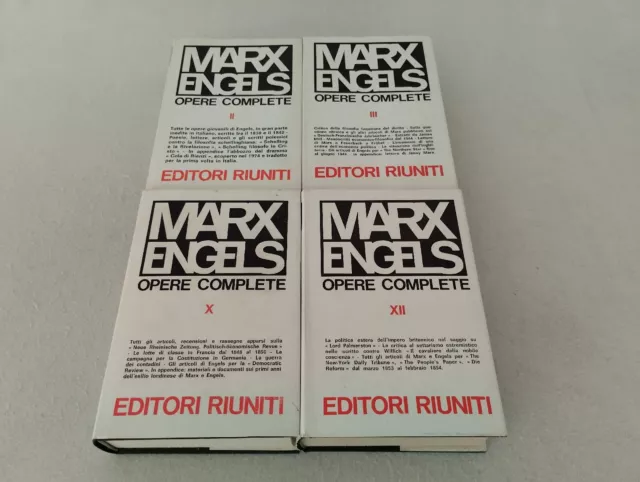
[3] These are essentially two indexes – MEOC [Marx-Engels. Opere complete] XXIX, pp. 194-95, 206 – in which Marx outlines the overall exposition of the book on capital. He envisages an articulation according to the categories of universal/general – particular/singular.
[4] Cf. G.W.F. Hegel, Science of Logic, Rome-Bari: Laterza, 1988 (or. ed. 1812-16), pp. 677 ff. It is well known that Marx wrote to tell Engels that re-reading the Logic had helped him greatly in his work (he was writing the 1857-58 Manuscript). Cf. Marx’s letter to Engels of 16 January 1858 (MEOC XL, p. 273).
[5] V. Verra and A. Bosi, Enciclopedia delle scienze filosofiche in compendio, Parte prima. La scienza della logica (Encyclopaedia of the Philosophical Sciences in Outline, Part 1, The Science of Logic), Turin: UTET, 1981-2002, (or. ed. 1830), §§ 163 ff.
[6] A case in point, for example, is the “universality of capital” or “capital in general”, where, in German, we always have allgemein.
[7] (Translators’ note) In Italian, a distinction exists between lavoratore (worker) and operaio (factory worker), as in other neo-Latin languages such as French (travailleur/ouvrier) and Spanish (trabajador/obrero). While lavoratore denotes any person who works, including across different historical modes of production, operaio typically refers to a wage worker engaged in industrial or manual labour within the capitalist mode of production. This distinction is largely absent from English, where the term worker tends to cover both senses, or where a compound noun is required as an equivalent to ouvrier, obrero, or operaio, such as manual worker, industrial worker, or factory worker. Although English lacks a direct equivalent for this lexical distinction, a partial parallel exists in the conceptual differentiation – often invoked in Marxist literature – of labour and work. According to Engels, work refers to human activity in general, across all social formations, whereas labour designates the historically specific form of work under capitalism that produces value. While this distinction does not map directly onto the Italian terms, it has nonetheless informed our translation choices: lavoratore is rendered as worker, even though labourer might appear a more literal choice, based on its derivation. Furthermore, the use of labourer to translate lavoratore may be misleading, as in English the term tends to denote a narrower category, typically someone engaged in physical, often unskilled, manual labour. It is, for example, commonly used in reference to agricultural labourers.
[8] (Translators’ note) English does not have two different common words for Beziehung and Verhältnis. To maintain this difference, the German has, where appropriate, been added in brackets.
[9] Cf. p. 17 in this edition.
[10] Cf. Hegel, Encyclopaedia cit., § 18; see also Science of Logic, pp. 492-93 and 955-56.
[11] See p. 17 in this edition.
[12] Cf. Hegel, Science of Logic, pp. 559-60.
[13] In the 1872-75 French translation of Capital, Roy endeavoured to express this concept in the following passage: “It is only the exchange that brings about this reduction by placing the products of the most diverse labour in the presence of one another on a plane [pied] of equality.” This is a passage from the 1871-72 Manuscript, which in a more precise translation from German reads: “The reduction to this abstractum of equal human labour of the concrete different private labours is only accomplished through exchange, which in fact places the products of different labours on an equal footing with one another”.
[14] Here we see the problematic nature of the concept of “nature” in Marx, which takes on, in my opinion, at least in Capital, two antipodal meanings. The term is, on the one hand, associated with the frequent expressions “law of nature” or elsewhere “social law of nature”. Here, Marx does not mean by this term physical nature, or worse still a phantom state of nature, as opposed to social laws; in fact, in general, he refers to certain mechanisms that are established and realised given certain objective conditions (which can be as much natural as social or socio-natural, thus pertaining to what Hegel would call “second nature”) irrespective of the arbitrariness or particular will of the individuals who find themselves acting within them. The law therefore necessarily operates on the basis of its own nature. It seems almost a classical meaning of the term, in the sense of De rerum natura. After all, this law also acts as a law of nature in the sense of blind and iron necessity. In this sense, “nature” has a strong historical-social connotation because it is linked to the “natural” functioning, “according to its own nature”, of a given system characterised socially and historically. In other cases, however, he also uses the term “nature” to say that social laws appear to be laws of nature, not in the sense that they follow a certain necessary nature, but that social laws appear to be properties of things in their “natural” physicality. In the latter case, the flattening of the historical and social dimension to the physical-natural functioning of objects as such is evident. This is the core, first of commodity fetishism and then of capital fetishism. However, Marx always uses Natur and here we will remain faithful to his ambiguous choice, by always translating it with “nature”.
[15] Cf. p. 963 in this edition.
[16] We have uses with this meaning in the unpublished sixth chapter and in internal quotations from Per la critica dell’economia politica [A Contribution to the Critique of Political Economy].