The second Marx-Engels-Gesamtausgabe has enjoyed a degree of popularity in Italy since the late 1970s.
When its publications began in 1975, Editori Riuniti, a publisher directly linked to the Italian Communist Party, was publishing an Italian edition of Marx’s and Engels’ Opere complete in 50 volumes (MEOC), modelled on the structure of the English Collected Works but translated from the German. Some volumes incorporated new MEGA content;[1] however, the editorial plan was not updated, particularly with regard to the ‘economic’ legacy, which would have entailed the most substantial changes. Only 32 of the planned 50 volumes appeared between 1972 and 1991, when the edition was abandoned due to the political and ideological crisis within the Italian Communist Party.[2]
However, information about the new critical edition was shared before the MEGA publications began. One of the first to engage with this was Gian Mario Bravo, who reviewed MEGA’s 1972 Probeband in Critica marxista. He also had the opportunity to present the major editorial project to the Italian public.[3] Later, Erich Kundel in Rinascita and Mario Cingoli in Rivista critica di storia della filosofia provided further details about the overall project.[4] In 1983, in Rome, on the occasion of the centenary of Marx’s death, the Basso-Issoco Foundation organised a conference entitled La nuova edizione della MEGA (The New MEGA Edition). A report on the event was published in Critica marxista by Nicola De Domenico.[5]
An important moment in the process of familiarising Italian readers with the philological results of the MEGA was the translation of works by some of its most prominent editors, particularly Vitaly Vygodsky[6] and Walter Tuchscheerer.[7]
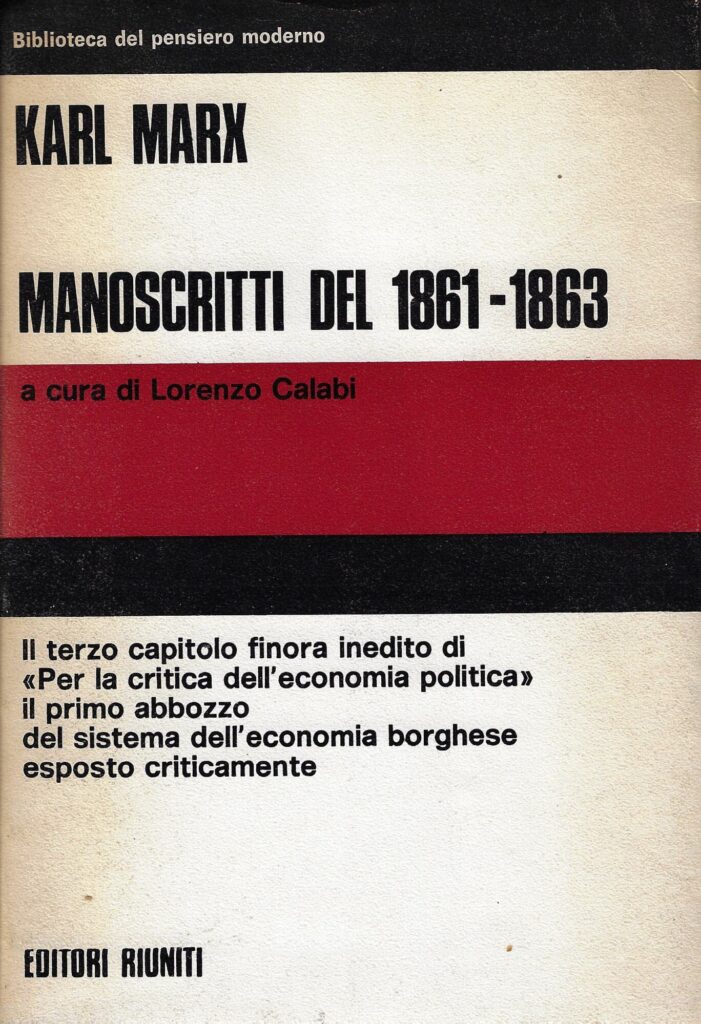
At that time, there were few translations of previously unpublished texts; one of these was the section of the 1861/63 Manuscript preceding Theories of Surplus Value, edited by Laura Comune Compagnoni.[8] The volume was published by Editori Riuniti in 1980, though not as part of the aforementioned Opere complete. It is introduced by a valuable essay by Lorenzo Calabi, who addresses, from a theoretical perspective, a range of problems concerning the genesis and structure of the text: commodities as the economic cell from 1859 onwards, the Grundrisse as the first draft of a systematic theory, and the 1861/63 Manuscript as the point at which the theories of average profit and rent are developed. The author recognises that these manuscripts can only be properly understood if read as stages in a process with both a past and a future.[9]
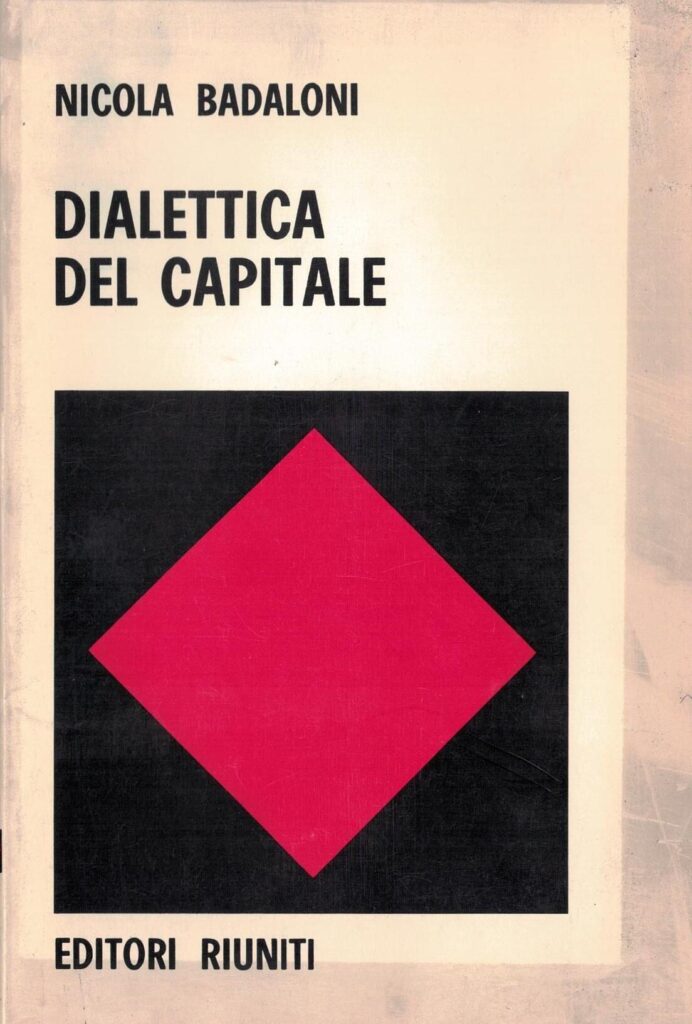
In the same years, Nicola Badaloni wrote an important essay on this manuscript[10], where he investigated the concept of ‘subsumption’. Drawing on the Hegelian logic of judgement, especially reflective judgement, Badaloni argued that Marx’s judgement is not grounded in necessity. As a result, the subsumption of the labour process under the process of valorisation is not absolute; it is not a judgement of inherence. Rather, it is a historical and transitory circumstance.[11] The Hegelian transition from reflective to necessary judgement, by contrast, would be metaphysical, as it would hypostatise subsumption.[12] For Badaloni, the historicity of models lies in the way content is distorted by historical forms and their internal legalities, in a process that ultimately reveals how these forms are themselves dissolved and overcome, thereby reaffirming the content.[13]
A comprehensive understanding of the MEGA edition and the debates surrounding its publication also emerges in the work of Gian Mario Cazzaniga[14] and Alessandro Mazzone[15]. Cazzaniga reconstructs Marx’s Stufentheorie, focusing on the relationship between the ‘function’ assumed by the agents of production within the process of reproduction and the ‘conflict’ into which they enter at a certain stage of development. He considers the opposition between the logical and the logical-historical methods to be outdated, favouring the former. In his view, the linear succession of ‘history’ is meaningless in itself; only a theoretical model enables us to grasp the specificity of a historical epoch. This approach, he argues, is not vulnerable to charges of relativism, since Marx consistently maintains that the development of the productive forces represents the continuity across different historical phases. It is rooted in the growing social capacity to meet human needs and to mediate the organic exchange with nature. The epochal outcome of this process is an increase in free time through the social reduction of necessary labour.
Cazzaniga distinguishes between general and particular laws, mediated through the unfolding of the labour process—specifically, through cooperation and large-scale industry.[16] The labour process itself, which is a constant feature of every mode of production, is immediately dual: on the one hand, it is the outcome of natural evolution; on the other, it transforms both nature and itself as one of its own moments. At a lower level of abstraction, however, we must analyse how human beings are the result of the social process of reproduction, which is the true subject of organic metabolism. The potential character of the elements of the labour process becomes actual only in specific historical forms; their various combinations determine the differences between modes of production, and subsequently between social formations. The elements of the labour process are formally always the same, but they become an actual process only within a specific technical configuration, which itself bears a distinct historical meaning.[17]
In this respect, the productive forces are the material bearers of the relations of production. This makes it possible to identify more clearly the specific character of a mode of production: it is a particular form of the labour process in which a development of the productive forces takes place. In the abstract labour process, productivity is expressed as the degree of social division of labour; in the process of social reproduction, it appears as the technical foundation of social production. In this way, social institutions are formed. In its development, this complex relationship presents itself as a contradiction, the potential resolution of which lies in the unfolding of those very relationships.[18]
In order to understand the laws of motion of the capitalist mode of production, Mazzone draws on the central categories of formed content (Forminhalt) and form-determination (Formbestimmung). The form-determinations of capital are, in fact, nothing other than its various modes of operation, subsumed within the process of the formed content through which capital manifests and unfolds itself. The content of this process is the universal — labour as such — but the concept of productive forces and the mode of production cannot be directly deduced from it. Such an approach would not move beyond the abstract, intellectualist deduction of a mere aggregation of ‘ones’. The universal conceived in this way is nothing more than an abstraction, the fixation of a moment within the overall process of production.
Consistent with the Hegelian framework, in Marx too the universal appears in the particular as a process of self-transcendence: it overcomes its determined form in order to assume another that better corresponds to its own nature — in this sense, it is a Forminhalt, or formed content. Thus, in the capitalist mode of production, labour is abstractly human, but it is secondarily and concretely human in its historical configuration. This configuration is characterised by the generalisation of productive activity as an autonomous end, and therefore by the ‘position of individual labour as universal and vice versa’. This implies that human labour acquires a new form of movement that alters the relationship between the subject and object of activity. The capitalist mode of production is therefore nothing more than an epochal phase in the broader history of labour.
Alessandro Mazzone was, in particular, the key figure linking Italian Marxian scholarship with the MEGA editors, due to his sustained collaboration and personal friendships with many of them since the early 1970s.
In 1995, in Milan, on the occasion of a conference marking the centenary of Engels’s death, Rolf Hecker, one of the most important editors of the second section of the MEGA (on Capital and its preparatory works), focused on the editorial work and its exegetical consequences.[19] The author developed a series of distinctions between Marx’s original manuscripts, on which the ‘second fiddle’ worked, and the printed edition published in 1894, emphasising two key interpretative shortcomings. First, there is the mistaken approach to the relationship between the ‘logical’ and the ‘historical’, which has led many interpreters to read the logical development of the theory of capital from a historicist perspective. Second, the invention of ‘simple commodity production’ has replaced Marx’s category of ‘simple commodity circulation’, further contributing to the interpretation of the first part of Capital as a description or theory of a pre-capitalist historical phase whose laws would no longer apply to actual capitalism.
From 1999 and consistently throughout the following decade, the journal Marxismo oggi focused on the MEGA and its publications, largely thanks to contributions from Roberto Fineschi and, later, Giovanni Sgro’ and Tommaso Redolfi Riva. In issues 1–2 of 1999, two articles by Rolf Hecker and Roberto Fineschi introduced the themes, structure and status of the edition to a broader public.[20] These initial occasional contributions became a regular feature in subsequent years, with several articles appearing up to 2010.
The general title of issue no. 1, 2003, was “The Status of the Critical Edition of Marx’s and Engels’ works”, featuring a contribution by R. Fineschi and M. Sylvers: “Novità dalla Marx-Engels-Gesamtausgabe (MEGA). La grande edizione storico-critica va avanti”, pp. 87–129.
In issue no. 1, 2007, this presence became a more or less regular column titled ‘Novità dalla MEGA’. In this particular issue, R. Fineschi’s piece “La MEGA impresa” appears on pp. 85–96, alongside an interview with M. Neuhaus and G. Hubmann, then director and vice-director of the project at the Academy of Sciences of Berlin and Brandenburg.
In issue no. 1, 2008, the general title was “Nel cantiere delle opere di Marx ed Engels”, and the entire column ‘Novità dalla MEGA’ featured several contributions by Fineschi, Sgro’ and Redolfi Riva (pp. 49–113).
Finally, issue no. 3, 2010, included contributions by Fineschi, Sgro’ and Redolfi Riva on Capital Book II and the related debate in Italy and Germany (pp. 31–105).
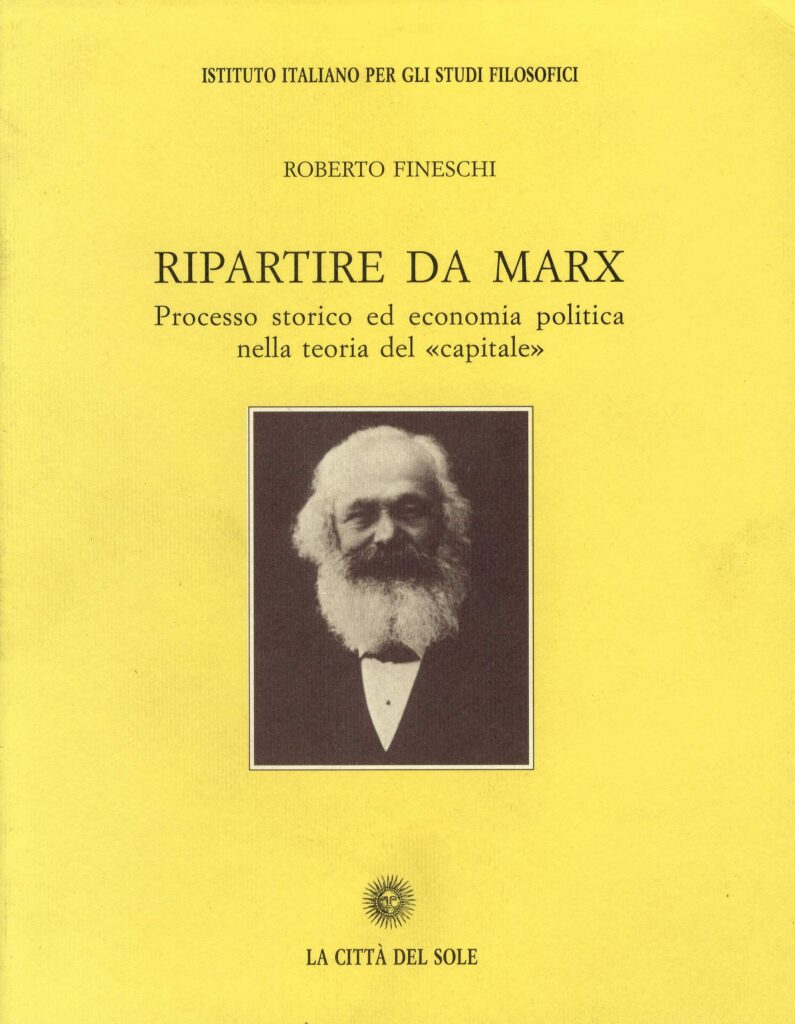
In 2001, Roberto Fineschi published a book grounded in the MEGA and its surrounding debate; it remains, and likely still is, the most important Italian study consistently based on the critical edition. The work is devoted to the problem of the ‘logical structure of the concept of capital’—particularly in relation to Hegelian dialectics—and its levels of abstraction. It presents an analysis at the intersection of economics and philosophy, addressing in particular the value-form analysis and the transformation problem, the structural changes in Marx’s concept of Capital over time, the systematic dialectics of the system as a whole, and more.[21]
During those years, there were also contributions that might be termed ‘informative’, such as book presentations, reviews, and similar material.[22]
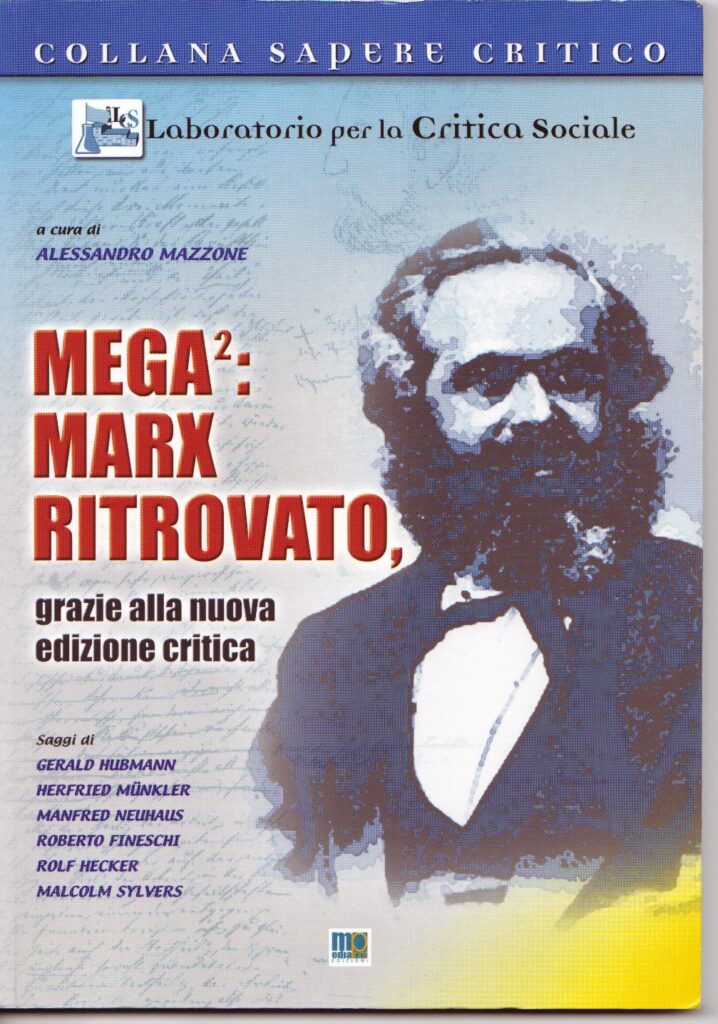
Alongside Fineschi’s book, a turning point was the 2002 collection of essays edited by A. Mazzone, titled MEGA2, Marx ritrovato.[23] The volume provided Italian readers, for the first time, with a comprehensive overview of the project which, in addition to editorial information, also presented debates on specific topics and perspectives. Thanks in part to the collaboration of scholars directly involved in the edition, the contributions represented the most advanced level of international research. While Alessandro Mazzone’s introduction sought to convey the historical significance of a project that, more than a hundred years after the authors’ deaths, finally aimed to publish their complete legacy, the articles endeavoured to introduce Italian readers to the broad thematic scope of the MEGA. Contributors included Neuhaus, Hubmann, Fineschi, Sylvers, and Hecker.
In the early 2000s, a research project of ‘national interest’ was funded by the Italian Office for University and Research. Several Italian universities, including Milano Bicocca, Bergamo, Siena and Venice, collaborated to investigate the post-Hegelian period and, in particular, to continue the publication of the former Editori Riuniti Italian edition of Marx’s and Engels’ Collected Works based on the new MEGA materials.
Within this project, volume XXII appeared in 2008, containing works from the period 1870–1871, specifically Engels’ notes on war. It was edited by Marco Vanzulli, with translations by Stefano Bracaletti, Vittorio Morfino, Marco Vanzulli and Ferdinando Vidoni.[24]
A significant part of this project was a new edition of Capital, Volume 1. It included not only the traditional fourth German edition of 1890 but also the most relevant variants from the first, second and third German editions, as well as those from the French edition. Italian readers were also provided with the first translation of the manuscripts Ergänzungen und Veränderungen zum ersten Band des Kapitals (1871/1872) and a new version of the so-called unpublished sixth chapter (the Results). This edition finally appeared as volume XXXI in 2011, published by La città del sole in Naples. It was edited by Roberto Fineschi with the collaboration of Giovanni Sgro’.[25]
As part of that project, in 2008 the universities of Bergamo and Siena organised an international conference in Bergamo, promoted by Riccardo Bellofiore and Roberto Fineschi, both members of the International Symposium on Marxian Theory. In addition to the regular members of the symposium, important MEGA editors and contributors such as Roth and Hecker were invited. Heinrich also contributed.[26]
Starting in the early 2000s, another scholar with a different intellectual background and perspective began working within the MEGA environment: Marcello Musto. While Mazzone, Fineschi and others, following the tradition of Vygodskij, Tuchscheerer and the MEGA editors, sought to ‘reconstruct’ Marx’s legacy based on the new materials, Musto was more interested in exploring alternatives. He approached the new manuscripts with greater flexibility, arguing that Marx was implicitly critical not only of future Marxisms but also of several of his own classic ideas. From this perspective, the MEGA serves as a source of materials that need not be used solely to pursue a coherent reconstruction of Marx’s work but rather to open up new understandings of Marx. In particular, Musto investigated the concept of alienation and the writings of the late Marx.[27]
In those years, several publications based on or related to the MEGA appeared. Fineschi published a book on the Marx-Hegel relationship in light of the new editorial findings[28], as well as a collection of essays on the MEGA edition and the related debate.[29] Sgro’ also compiled his contributions from various years into a single volume.[30]
The bicentenary of Marx’s birth in 2018 was marked by numerous conferences, in which the MEGA played a partial but notable role. However, it was evident in most of these events that the edition remains insufficiently known or considered, even among specialists.
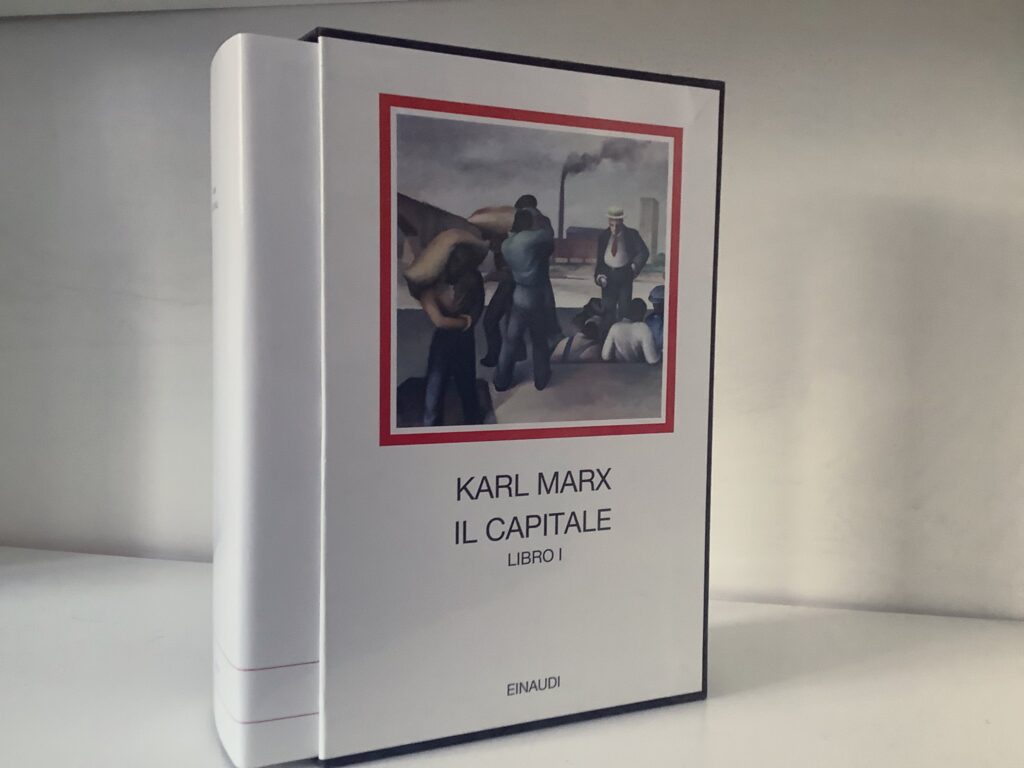
One of the most significant outcomes of this development is the publication of a completely revised version of Capital, Volume I by Einaudi, one of Italy’s most prestigious publishers. Featuring a new translation by Stefano Breda, Roberto Fineschi, Gabriele Schimmenti and Giovanni Sgro’, and edited by Fineschi, the book is a thoroughly revised and refined edition of the 2011 version published by La città del sole.[31] It has been positively received, with numerous reviews and comments in the main national press.
All these activities and publications have increased the popularity of the edition in Italy. However, I would argue that the MEGA and its innovations are still not sufficiently known among social scientists. The hope is that, thanks to the publication of the first volume of Capital by a renowned publisher such as Einaudi, awareness of these philological innovations and their significance for the interpretation of Marx will grow.
Go back to the main page: ‘Dossier: Marx, MEGA and MEGA-Marx’
Notes
[1] In particular vol. 1,with works from the period 1835-1843, edited by Gian Mario Bravo and Mario Cingoli (published in 1980).
[2] Recently the political group and publisher Lotta Comunista has re-published the old 32 volumes and edited the missing 18 ones, following the old plan with some additions from the MEGA.
[3] G.M. Bravo, “La nuova MEGA”, in Critica marxista, n. 6, 1973, pp. 208-211.
[4] E. Kundel, ‘Tutto Marx e tutto Engels in cento volume”, in Rinascita, n. 47, 2 dicembre 1977, p. 40. M. Cingoli, “La nuova MEGA”, in Rivista critica di storia della filosofia, 1978 (33), pp. 247-250.
[5] N. De Domenico, “Sull’edizione critica delle opere di Marx ed Engels (MEGA)”, in Critica marxista, XXI, n. 2-3, 1983, pp. 213-218.
[6] Vitalij S. Vygodskij, Introduzione ai “Grundrisse” di Marx, ed. and trans. by Cristina Pennavaja, Firenze, La nuova Italia, 1974. Vitalij S. Vygodskij, Il pensiero economico di Marx, trans. by Valeria Borlone, Roma, Editori Riuniti, 1975.
[7] Walter Tuchscheerer, Prima del Capitale: la formazione del pensiero economico di Marx (1843-1858), trans. by Lapo Berti, Firenze, La Nuova Italia, 1980.
[8] Karl Marx, Manoscritti del 1861-1863, trad. di Laura Comune Compagnoni, Roma, Editori Riuniti 1980.
[9] Cfr. L. Calabi, “Introduzione a Karl Marx”, Manoscritti del 1861-1863, Roma, Editori Riuniti 1980.
[10] Cfr. N. Badaloni, Dialettica del capitale, Roma, Editori Riuniti, 1980.
[11] Badaloni, Dialettica del capitale, pp. 10–13.
[12] Badaloni, Dialettica del capitale, pp. 49–51.
[13] Badaloni, Dialettica del capitale, p. 12.
[14] G.M. Cazzaniga, Funzione e conflitto. Forme e classi nella teoria marxiana dello sviluppo, Napoli, Liguori, 1981.
[15] Cfr. A. Mazzone, La temporalità specifica del modo di produzione capitalistico, in: Marx ed i suoi critici, Urbino, Quattroventi, pp. 224-60.
[16] Cazzaniga, Funzione e conflitto, pp. 11-13.
[17] Cazzaniga, Funzione e conflitto, pp. 32, 258–9
[18] Cazzaniga, Funzione e conflitto, pp. 28ff.
[19] R. Hecker, “Engels editore del Capitale”, in Friedrich Engels cent’anni dopo. Ipotesi per un bilancio critico, a cura di M. Cingoli, Milano, Teti, 1998, pp. 312-323.
[20] R. Hecker, “Un resoconto bibliografico della ricerca su Marx ed Engels e della pubblicazione delle loro opere in ambito internazionale”, in Marxismo oggi, no. 1-2, 1999, pp. 175-198, R. Fineschi, “Karl Marx dopo l’edizione storico-critica (MEGA2): un nuovo oggetto di ricercar”, ivi, pp. 199-239.
[21] R. Fineschi, Ripartire da Marx. Processo storico ed economia politica nella teoria del “capitale”, Napoli, Istituto Italiano per gli Studi Filosofici –La Città del Sole, 2001. A second edition with the title La logica del capitale. Ripartire da Marx appeared in 2021 in Naples for the Istituto Italiano per gli Studi Filosofici.
[22] B. Bongiovanni, “Leggere Marx dopo il marxismo. Per una storia della Gesamtausgabe”, in Belfagor, 5/1995, pp. 579-591. B. Bongiovanni, “Da icona a classico, ‘Io non sono affatto marxista’”, in L’indice dei libri del mese, n. 7-8, 2001, p. 9; M. Sylvers, “Come Marx e Engels hanno lavorato: le loro biblioteche e l’edizione storico-critica delle loro opere (MEGA)”, in Studi Storici Luigi Simeoni, vol. LI (2001), pp. 115-134; Id., “Uomini colti ed impegnati”, in L’indice dei libri del mese, n. 7-8, 2001, p. 8 (Recensione del vol. MEGA III/10, Corrispondenza settembre 1859-maggio 1860).
[23] MEGA2: Marx ritrovato, a cura di A. Mazzone, Roma, Mediaprint 2002. In 2013, the book was reprinted with a new introduction by R. Fineschi.
[24] K. Marx, F. Engels, Opere, vol. XXII: luglio 1870-ottobre 1871, Napoli, La città del sole, 2008.
[25] K. Marx, Opere, vol. XXXI: Il capitale, vol. I: Il processo di produzione del capitale, Napoli, La città del sole, 2011.
[26] The proceedings were published in English: Re-reading Marx. New Perspectives after the Critical Edition, ed. by R. Bellofiore and R. Fineschi, Basingstoke, Palgrave, 2009.
[27] Among his publications, translated in several languages, see in particular Ripensare Marx e i marxismi. Studi e saggi, Roma, Carocci, 2011, Karl Marx. Biografia intellettuale e politica (1857-1883), Torino, Einaudi, 2018, L’ultimo Marx. Biografia intellettuale (1881-1883), Roma, Donzelli, 2023 (new edition). He also published reviews of MEGA-volumes on magazines such as Critica marxista and edited collections of essays on Marx.
[28] R. Fineschi, Marx e Hegel. Contributi a una rilettura, Roma, Carocci, 2006 (new edition: Marx e Hegel. Fondamenti per una rilettura, Napoli, La scuola di Pitagora, 2024).
[29] R. Fineschi, Un nuovo Marx. Filologia e interpretazione dopo la nuova edizione storico-critica (MEGA2), Roma, Carocci, 2008.
[30] Giovanni Sgro’ MEGA-Marx, Napoli, Orthotes, 2016. Giovanni Sgro’ has also realised new editions of the Manuscripts of 1844 (K. Marx, Manoscritti economico-filosofici del 1844, a cura di F. Andolfi e G. Sgro’, Napoli, Orthotes, 2018, and of the Results (K. Marx, Risultati del processo di produzione immediato, introduzione e traduzione di G. Sgro’, Napoli, La città del sole, 2018).
[31] K. Marx, Il capitale. Libro I: Il processo di produzione del capitale, a cura di R. Fineschi, trad. di S. Breda, R. Fineschi, G. Schimmenti e G. Sgro’, Torino, Einaudi, 2024.