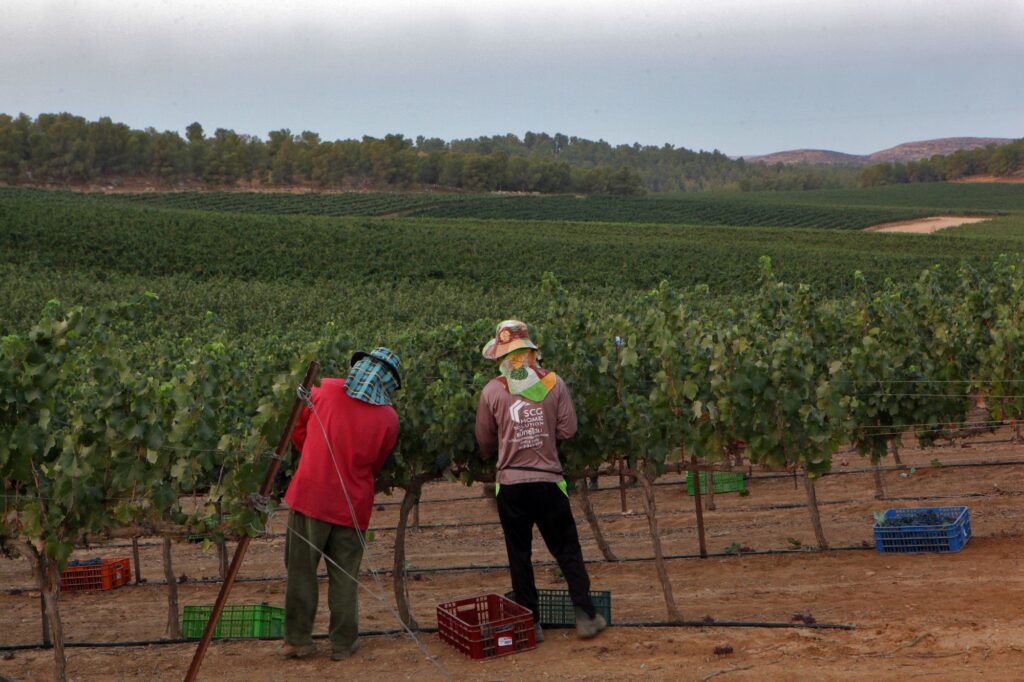
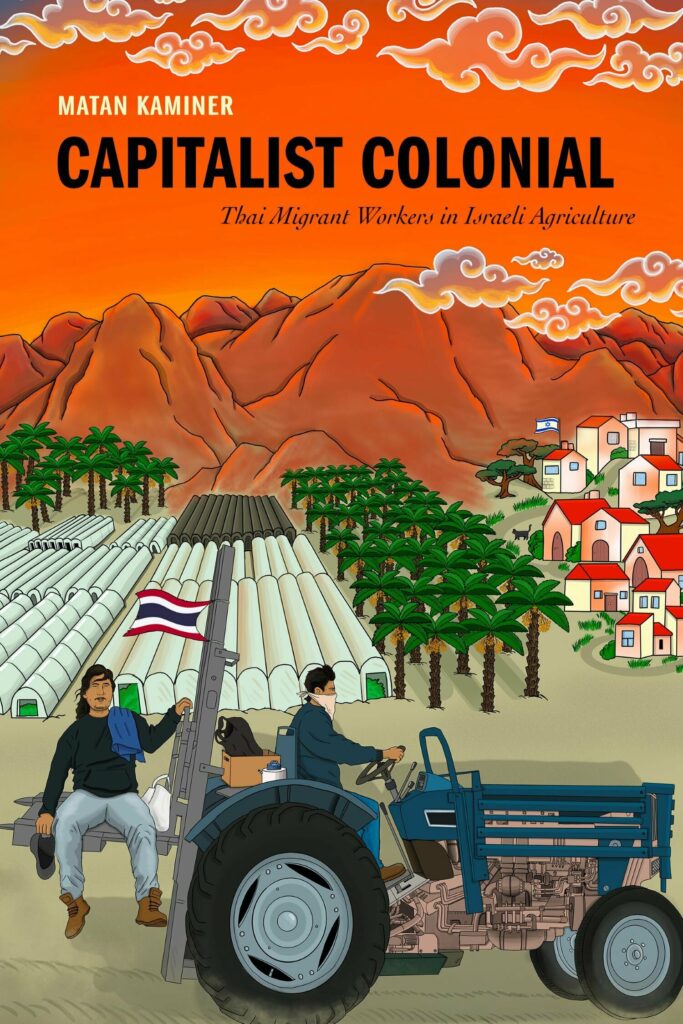
Matan Kaminer, Capitalist Colonial: Thai Migrant Workers in Israeli Agriculture, Stanford University Press, 2024.
Reviewed by Heba Taha
As Israel’s genocide against Palestinians in Gaza continued to escalate, many people found themselves feeling either subdued by the imperialist war machine or engaging in wishful thinking about its imminent collapse. While there have been notable and significant mobilisations seeking to achieve this disruption, ranging from strikes to acts of sabotage to mass demonstrations in the West where Israel continues to have significant support from governments, the genocide lasted two years, the killings continue and the war machine is seemingly intact. This is not because of an invincibility of Zionism; it is an indication of Israel’s privileged position in a global system of imperialism and capitalism, in which genocide has become a mechanism of profit-making.[1]
To disrupt and organise against the genocidal war machine, it is necessary to understand the internal mechanisms of Israeli violence, which span historic Palestine, and are intertwined with the global capitalist system. This includes the Israeli state’s relationships with both capital and labour. Matan Kaminer’s book Capitalist Colonial: Thai Migrant Workers in Israeli Agriculture offers a way to understand a range of key questions relating to contemporary Israeli political economy. How has Israel sought to shield itself from the disruptive potential of Palestinian workers? How are dynamics of racialisation reproduced in labour structures under Israeli settler colonialism? What is the relationship between rampant, seemingly mundane dynamics of exploitation and the workings of global capitalism?
Readers may be surprised that a book dealing with Thai migrant workers in Israeli agriculture can contribute to answering such broad questions on the economic mechanisms of settler colonialism. But Kaminer’s study, which is both historical and ethnographic, addresses core questions about the relationships between Zionism and capitalism, and the tensions of enacting ideologies associated with the Zionist labour settlement movement. Examining the agricultural settlement of the Wadi ‘Arabah (an extremely dry area in the south of the country), Kaminer locates it within a longer political and ecological history of Zionism. The book connects how labour functions in relation to Zionist and capitalist imperatives.
The book operates on numerous scales: the micro-level setting of a community in the ‘Arabah and the daily interactions between Thai migrant workers and their Jewish-Israeli managers; the state level, focusing both on Thailand and Israel, and their strategies and planning as well as the bilateral relations between them; and finally, the global level, where the interaction between capitalism and coloniality produces an unjust international order. Not only is the author comfortable tackling these different scales, but he also demonstrates that the separation between them is artificial, and that any such analytical distinctions should be collapsed.
The principal focus on labour is combined with an analysis of the land over time, and Kaminer makes it clear that an analysis of land and labour in Israel cannot be divorced from central questions over Zionist colonisation of Palestine. While Palestinian workers are not the subject of the book, their determined resistance to settler colonialism operates as a point of departure for much of Kaminer’s empirical material:
In the Zionist case, the tenacity with which the indigenous Palestinians managed to hold on to their land made the need for a class compromise between proletarian and bourgeois colonizers particularly pronounced. Residing at the very center of the Afro-Eurasian landmass, Palestinians were not vulnerable to the communicable diseases carried by settlers, as the indigenous peoples of Australia and America had been. Moreover, on the eve of colonization, Palestinian agricultural and pastoral producers were already integrated into regional trade networks and showed substantial initiative in responding to the pressures and opportunities which came along with this integration. Finally, under Ottoman rule, and to an eroding but still significant extent under the British Mandate, the complex communal arrangements by which Palestinian peasants regulated land tenure continued to carry the force of law, making the alienation of their property difficult. (p. 30)
The book builds on research arguing that settler-colonial entities, Israel included, may seek to both exploit and eliminate indigenous people, according to the context, and that these processes thus need to be understood within a context and logic of capitalist accumulation.[2] Through an empirical study of the Thai migrant labour force in Israel, Kaminer effectively shows how Israel has managed to do both, beyond the perspective of settler colonialism as automatically eliminationist. The story of the book, then, is much more than simply a snapshot of the dynamics of Thai migrant workers in the ‘Arabah in the contemporary period; it is a story of Israel’s colonisation of Palestine and its continuation in the present. The book effectively connects the specific case of Thai workers in the ‘Arabah to the history of colonising Palestinian land, and to the simultaneous inclusion and exclusion of Palestinian workers. This operates through exploitation and dependency, which concurrently take place alongside exclusion from labour, land, and life, as Palestinians face dispossession and death.
By the mid-1990s, there were 20,000 Thai workers in Israel. They are regularly paid only around 70 percent of the official minimum wage, and their movements are often placed under surveillance and curtailed by employers, who consistently violate legal protections and regulations that seek to ensure workers’ dignity (pp. 5, 95). The alienation of Thai workers seems to be a precondition: the entire purpose of hiring them is the assumption that they cannot make a political claim over the land they farm. They are meant to be an apolitical labour force, isolated and hidden away from the public eye, which enables their hyper-exploitation. The concealment of Thai workers intertwines with a fundamental Zionist ideological motive. In Kaminer’s words, ‘This isolation also serves the interest of the farm sector in protecting its image as a pillar of the Zionist project by keeping migrant labor out of the public eye and rendering it politically innocuous’ (p. 5.) It hides the lack of ‘Hebrew labour’ working or ‘redeeming’ the land, an objective that was prioritised by the Zionist movement since the second wave of settlers in the early twentieth century (p. 31).
This ideology of ‘Hebrew labour’ has a long history, with significant consequences for Palestinians. Many Palestinians of ’48, who found themselves within the State of Israel after the Nakba, saw their land expropriated and faced processes of proletarianisation as Israel sought to prioritise Jewish employment.[3] The ideological motivation to exclude Palestinian workers would be combined with a securitised rationale during the First Intifada, affecting Palestinian workers from the West Bank and the Gaza Strip, which Israel colonised in 1967. Palestinians from these territories were also unequally integrated into the labour market, and their mobility was controlled by checkpoints and a permit regime.[4] Alongside their political exclusion from agriculture, Palestinians were strategically recruited into sectors like construction and concentrated into low-wage labour. Thus, at different junctures, Zionists sought to replace or exploit ‘Arab labour’, seen as both cheap – i.e., strategic – and dangerous – i.e., threatening the project of colonisation and Israeli security. The elimination of Palestinian workers has never truly succeeded, and the Unity Intifada strike in 2021 across all of historic Palestine attested to the continued relevance and power of Palestinian labour.[5]
Kaminer’s fieldwork moves between the Arabah and Isaan, the region in Thailand where the overwhelming majority of workers come from. He shows that the selection of Thai workers as ‘guests’ in Israel is not a historical coincidence. It results from a confluence of factors, such as the history of commodity agriculture within the world-system. Furthermore, Kaminer shows that this arrangement between the Israeli and Thai governments – a top-level, bureaucratic arrangement – expresses a punitive logic towards ‘rebellious’ populations in both countries. It allows Israel to discipline colonised Palestinians who continue to reject the normalisation of Zionist colonisation and their subjugation within it – a condition that the rest of the world has accepted and endorsed. But it also enables the Thai state to shape Isaanites, with whom it has clashed in a familiar story of a paternalism towards rural subjects deemed inferior and hierarchically integrated in the capitalist system. Isaanites have been ‘exposed for several generations to ecological despoliation, racial discrimination, and methods of political repression ranging from coercive indoctrination, through assassination to an all-out counterinsurgency and economic development’ (pp. 5-6).
In carrying out the analysis, the book is deeply attentive to the agency of Thai workers within this oppressive structure. They are not merely an invisible or nameless workforce that is imported to replace Palestinians. Although Kaminer anonymises the village in which he conducted fieldwork to protect his interlocutors, the book contains rich accounts of how the work happens, following what a typical work-day would look like, but also how workers carry out the physical labour, along with detailed descriptions that bring to life the environment and landscapes in which the work is being carried out. Furthermore, through fieldwork in Isaan, the book shows complicated lives and family networks, refusing to abide by depictions of migrant labourers as uprooted or out of place.
Much like the book’s fluid movement across borders, between Israel/Palestine and Thailand, it also moves across different disciplines. An anthropologist, Kaminer takes culture seriously, seeking to reconcile it with a materialist analysis. The objective of the book is to bring these two seemingly discrete worlds – of anthropology and political economy – together, highlighting to both sets of audiences what is at stake in this conversation. For a Marxist audience, the strength of the book lies in its ability to lay out domination on a micro-level, yet still effectively connect these stories to the larger histories and ongoing processes of settler colonialism and capitalism. The book demonstrates that cultural norms – described as ‘interaction ideologies’ – are part of systems of domination.
In the Introduction, Kaminer lays out his core argument: that capitalist exploitation and settler colonial domination are intertwined and must be studied together through ethnographic attention to everyday interactions. The remainder of the book is comprised of three historical chapters and three ethnographic ones, along with a conclusion.
The historical chapters situate Thai labour in Israel in the context of the Zionist labour settler movement, Thai-Israeli relations, and the cultural and material registers structuring these relations. The first chapter provides historical context on the settlement of the Arabah, showing how Zionist ideologies of ‘Hebrew labour’ clashed with economic reliance on the indigenous Palestinian labour force, precipitating this turn to Thailand for labour. The second chapter thus connects rural poverty and political marginalisation in Thailand’s Isaan region with Israel’s desire for fresh workers for its agricultural industry. It focuses on the emergence of the Thai-Israeli labour corridor, through global forces that produced a labour regime linking the two regions. The chapter contains a fascinating discussion on individuals such as Thai general Pichit Kullavanijaya and his ‘Frontier Settlement Project,’ for which he sought Israeli state assistance. While the plan did not materialise, these personal relations would become significant for migration diplomacy, and it illustrates the intellectual backdrop against which the political relations were taking place. In the third chapter, Kaminer outlines the shift from ‘Hebrew labour’ to migrant labour during the 1990s.
The ethnographic chapters follow the everyday experiences of Thai workers in Israel, showing how agricultural labour reproduces social difference. Chapter 4 sketches out a typical day at Kaminer’s ethnographic site, revealing encounters and negotiations between racialised workers and managers. It illustrates that everyday bodily practices and limited spoken contact, through a pidgin language, play a role in the labour process. The chapter reminds us that racialisation and exploitation affect not only Palestinians, but also others deemed outsiders in Israel. Chapter 5 analyses how Israeli settlers try to ‘save face’ by hiding their reliance on migrant labour, maintaining an image of self-reliance, thereby enabling the settler colonial fantasy of ‘making the desert bloom.’ Chapter 6 explores how interaction ideologies, such as Thai ethics and ideas of karmic reciprocity and duty to family, shape migrant behaviour and sustain the labour system.
In the Conclusion, Kaminer reflects on the role of anthropology in exposing structures of domination and imagining alternatives rooted in the moral worlds of the dominated. Although it is only eight pages, it is easily the most powerful part of the book, representing a culmination of the arguments Kaminer makes throughout. The conclusion is deliberately designed to inspire the reader, taking on the political project of imagining potential decolonisation. The book is motivated not only by intellectual curiosity but also an ethical commitment. Kaminer reflects thoughtfully on the problems of advocating for Thai equal rights within Israel: on the one hand, policy actors with good intentions have highlighted that they are being subjected to wage theft, but on the other, they continue to adopt a language that sees Thai workers as outsiders.
Kaminer reminds readers that we have an intellectual responsibility to not lose sight of the alternative world that we would like to see exist. He points out that there could be a decolonised, democratic, socialist structure to replace the current political structure – which is colonial, racial, and capitalist. He suggests that we need to think beyond the existing grammars of bi-nationalism and even the nation-state, with its fetish of racial purity. Instead, we must consider possibilities of solidarity across difference, resisting isolation and emphasising an interconnected struggle:
Imagine a decolonized, democratic, socialist Arabah shared by Bedouin [Palestinians], Jews, and Isaanites, incorporating agriculture, pastoralism, tourism, and other pursuits and committed to ensuring the long-term conditions of human flourishing rather than those of the colonial, racializing nation-state or the capitalist world-system! Such an imaginative intervention certainly goes beyond the disciplinary boundaries of anthropology as conventionally conceived, and infeed beyond the boundaries of this book. But far-fetched as this speculative vision may seem, my point is that it does not have to come out of nowhere, but can be derived, through a sort of immanent radicalization, from the very ideologies that have contributed to making the Arabah what it is today. (p. 175)
How can we envision decolonisation when we think of groups that do not fit the dominant binaries of Israel and Palestine? And more pressing, reading the book now, what does this practically mean for Palestinians facing genocide?
Today, it is especially important to take this democratic decolonial imaginary seriously. But I was left wondering whether this process can be concurrent to the dismantling of the oppressive structure that leads people to leave their homes to become migrant labourers. Our radical imaginations thus need to be extended to the conditions that lead to the presence of Thai workers in Israel/Palestine – an undertaking that is barely allowing them to stay afloat. Indeed, this book shows that the depth of this issue goes beyond what is happening within the borders of Palestine/Israel.
Meanwhile, the radical imagination described in the Conclusion can conflict somewhat with the depictions of possibilities, or the openings for change, throughout the book, which appear limited. At various junctures, Kaminer seems to imply that things cannot change now, that the situation appears stuck where it is at the present, and there actually is not much room for change. The book is, as mentioned, mindful of the agency of the Thai workers, even within highly oppressive conditions where the power structures are fundamentally tilted against them. For example, the author shows, convincingly, how they would game the system of labour migration to send family members and to negotiate within the available parameters (p. 152). In addition, this shows how the relationship between the Israeli managers and the Thai workers is not one in which the workers are powerless. Their agency is everywhere, including, for example, a striking case of a manager attempting to relay instructions and being blatantly ignored (p. 109).
This begs the question of how we can destabilise a system outlined by the author, which appears quite robust. Of course, we need to envision alternatives, but perhaps we also need more direct action, more of a reminder of our own agency and our ability to change systems that will always seem all-encompassing and capable of self-reproducing. This is no doubt motivated by the precise moment we are living, namely the conditions of genocidal Israeli violence against Palestinians, which, while not inevitable, seemed to have always been lurking below the surface. Even if the system is not ready for change, the fact is that for many people, for Palestinians, there is no choice. It is a system that has been literally killing them.
The book will be of interest not only to those aiming to better grasp the mechanisms of Israeli domination, including genocide, but also to those interested in environmental history and political ecology, labour, and the intersection between Marxism and anthropology more broadly. It will appeal to readers interested in the connections between labour, migration, colonialism, and capitalism, especially those who appreciate ethnographic and theoretically rich analysis. In addition to scholars, the book is well-suited for activists and organisers who will also enjoy its grounded critique and its exploration of possible ruptures within systems of domination.
References
Albanese, Francesca 2025, “From economy of occupation to economy of genocide”. Report of the Special Rapporteur on the Situation of Human Rights in the Palestinian Territories Occupied Since 1967 (A/HRC/59/23).
Englert, Sai 2020, “Settlers, Workers, and the Logic of Accumulation by Dispossession”. Antipode 52:6: 1647-1666.
Farsakh, Leila 2005, Palestinian Labour Migration to Israel: Labour, Land and Occupation. Routledge.
Jiryis, Sabri 1973, “The Legal Structure of the Expropriation and Absorption of Arab Lands in Israel”. Journal of Palestine Studies 2:4: 82-104.
Nabulsi, Jamal 2024, “‘To stop the earthquake’: Palestine and the Settler Colonial Logic of Fragmentation”. Antipode 56:1: 187-205.
Tatour, Lana 2021, “The ‘Unity Intifada’ and ’48 Palestinians: Between the Liberal and the Decolonial.” Journal of Palestine Studies 50:4: 84-89.
Samed, Amal 1992, “The Proletarianization of Palestinian Women in Israel”. Middle East Research and Information Project (MERIP) 50: 10-15+26.
Shalev, Michael 1992, Labor and the Political Economy in Israel. Oxford University Press.
Zureik, Elia 1976, “Transformation of Class Structure among the Arabs in Israel: From Peasantry to Proletariat”. Journal of Palestine Studies 6: 39-66.
[1] Albanese 2025.
[2] Englert 2020.
[3] Jiryis 1973, Zureik 1976, Samed 1992, Shalev 1992.
[4] Farsakh 2005.
[5] Tatour 2021, Nabulsi 2024.