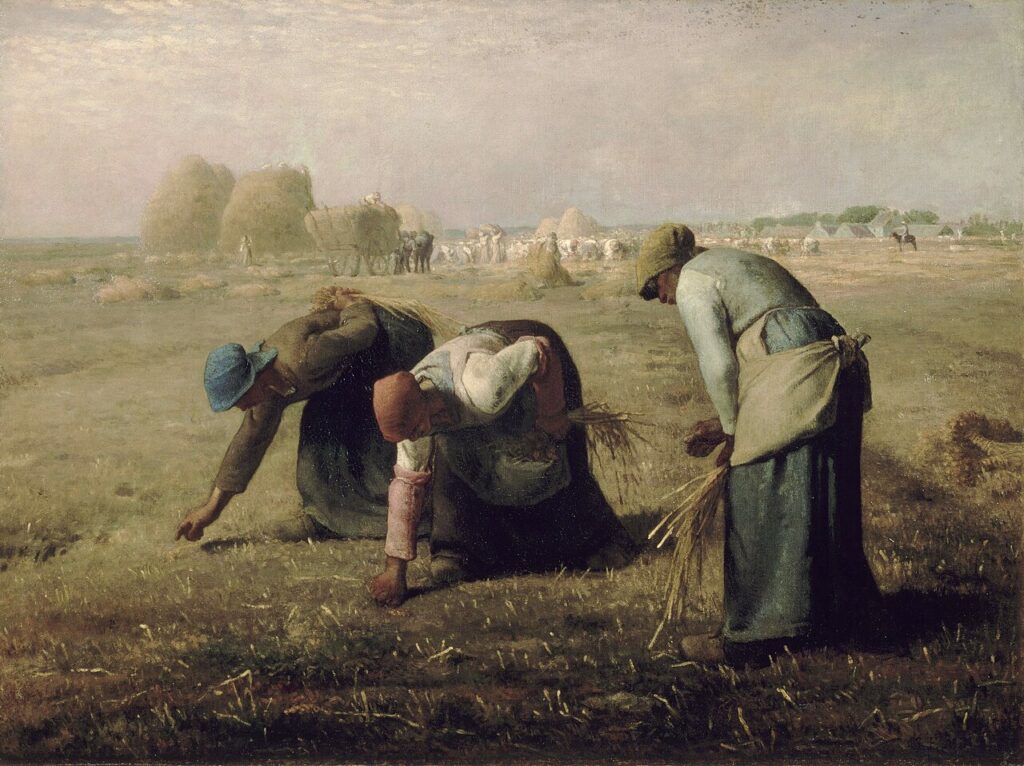
By the end of 2015 some forty percent or more of China’s rural workforce was thought to consist of roughly 250 million peasant migrants known as mingong, a cross between nongmin (peasant) and gongren (worker). They are ‘socialist’ China’s version of Fanon’s ‘wretched of the earth’, a drastically uprooted peasantry forced to survive on ‘dirty, dangerous and demeaning’ jobs in mining, construction and other sectors and seen by state and middle class alike as a ‘tidal wave’ threatening to flood their cities (Schultz 2018). In films like Still Life (by the brilliant director Jia Zhangke), they are neither peasants nor workers but a massive reservoir of commodified bodies with no real sense of their past lives, since the places they grew up in lie effaced in submerged landscapes, and no sense of a future either. What makes this vision of China so appealing as a description of what capitalism has and will come to mean for what Marx called the ‘peasant nations’ is the sheer speed (and bureaucratic purpose) with which much of this dystopian future is being unfolded before us.
In the broader historical perspectives that agrarian history opens out on to, the peasantry thus seems today like a vanishing ‘theoretical object’. In Jia’s films they are the ‘elderly relics of the Maoist era, but without their previous power and authority’ (Schultz). What this brief essay tries to do is offer a range of readings that brings the more classic, historical peasantry back into focus. It is not primarily a guide to works of agrarian history, since most of the readings deal in one way or another with the impact of capitalism on the peasantry and on the countryside more widely. In doing this, however, I have also tried to shed light on agrarian classes that cannot strictly be defined as peasants, either because they are landless or because, like Harriet Friedmann’s American family farmers, their survival and growth depends on their being able consciously to compete successfully with capitalist enterprises. All the same, the core of the essay lies in Section III and, along the way, I have disentangled the different levels at which ‘capitalism and the countryside’ can be studied.
I. Preliminaries
General collections & surveys: Scott, The Peasantries of Europe from the Fourteenth to the Eighteenth Centuries and the second, expanded edition of Shanin’s Peasants and Peasant Societies (Shanin 1987) are both excellent collections; the massive recent Handbook of Critical Agrarian Studies deals with a very wide range of topics; then there are contemporary regional surveys like Ayeb and Bush (2019) and Rigg (2020); and at least one concise introduction to various debates in agrarian studies, Bernstein (2010). The leading journals are Journal of Peasant Studies and Journal of Agrarian Change. Terry Byres, author of our only full-length comparative study of ‘capitalist agrarian transitions’ (Byres 1996), was a founding editor of both journals.
Probably the only country in Europe for which a continuous history of the peasantry can be written from the thirteenth century to the eighteenth (when it finally disappeared, forced out of existence by a last round of enclosures) is England – see Titow (1969), Smith (1998), Campbell (2005), Allen (1992), Whittle (2000), Neeson (1993) (in that order), and, by way of a postscript, Howkins (2003). Next to Bob Allen’s book and the one by Neeson, the 1990s saw at least two other seminal contributions: Faith (1997) on the earlier, mainly Anglo-Saxon, centuries in England, and Freedman (1991) on the enserfment of the Catalan peasantry. Chapter 1 in Hilton (1973) is, by far, the best short introduction to the peasantry in the west. Johansen (1988) constructs a solid case for the dispossession of the peasantry in the later centuries of medieval Islam (the Mamluk and Ottoman periods).
Colonial impacts have been described in detail by (mostly) historians: Poncet 1962 (Tunisia), Gibson 1964 (Mexico), Bourdieu and Sayad 1964 [2020] (Algeria), Taylor 1972 (Mexico), Jennings 1976 (New England), Ngo Vinh Long 1991 (Indochina), Baker 1993 (Central Provinces, India), Hardiman 1996 (Western India), Mousa 2006 (Palestine), Nadan 2006 (Palestine), Fields 2017 (Palestine), Ali (2018) (Bengal), and Shokr (2025) (Egypt), nearly all of which can very largely be read as histories of dispossession. Moneylenders flourished throughout colonial South Asia. Cheesman (1997) describes the banias’ ‘commanding economic position’ in Sind, where the bulk of the debt was held against the estates of Muslim zamindars who were known as waderos. Baker’s monograph on the northern Central Provinces is our best account of how the British revenue system worked to allow for the amassing of land by moneylenders and the widespread impoverishment that ensued in the ‘terrifying decade’ of the 1890s.
The classic question that was posed in the last decades of the nineteenth century was “What would happen to the peasantry with the growing impact of capitalism?” By the last decades of the twentieth century, this focus had largely been displaced by a rather different question – “What happens to agriculture with the growing penetration of industrial capitals?” In the decades after 1945, it was the late 1960s and 1970s that saw a resurgence of interest in peasant studies, related, no doubt, to the (in Europe largely academic) attraction of Maoism in the 1960s and the success of the Vietnamese in expelling the French and then defeating the world’s most formidable power. Wolf’s Peasant Wars, which appeared in 1969, was emblematic of this moment. Henry Bernstein’s interview (in Capps and Campling 2016) conveys a vivid sense of the intellectual atmosphere in those decades.
Capitalism, peasants, family farms. This complex of themes can be seen through at least four lenses or in four different ways: (i) the competitive decline of family farms, (ii) differentiation of the peasantry, (iii) the subsumption of household production by capital, and (iv) the much wider process of the capitalist transformation of agriculture itself.
In his writings on France, Marx saw the peasantry as a class, one defined by its fragmentation and localism as well as its hostility to all other classes, and referred to its enslavement by capital. The defining image is that of smallholders saddled with mortgages, ‘ruined by debts, at odds with society and authority’. All posterity seems to have retained from those passages of the Eighteenth Brumaire is his description of the mass of France’s peasantry resembling a ‘sack of potatoes’. Yet Marx veered round to a less condescending view later in life; for the various drafts of his reply to Zasulich, see Shanin (1983). Rejecting any false notions of inevitability, in 1881 he saw the Russian rural commune (mir) as containing the potential for a direct transition to ‘large-scale co-operative labour organised on a large scale’. The assumption was that Russia would see a socialist revolution in the coming years.
II. Classic Texts and Writers
Engels’s Bauernfrage, his tract on the Peasant Question in France and Germany, was written in 1894 against the background of German agrarian lobbies that sought to draw the small peasants to their side. ‘By small peasant we mean here the owners or tenant – particularly the former – of a patch of land no bigger, as a rule, than he and his family can till, and no smaller than can sustain the family’ (Engels 1990; MEW 22, p. 488). These were farm sizes that required no recourse to the employment of labour and were sufficient to sustain farm families in an average year. It’s worth clarifying, therefore, that this is not how later Marxists would define the poor peasantry and what Engels is talking about is what later writers usually see as a middle peasantry. (The ‘middle’ peasants who figure in the tract are a more substantial stratum and almost always coupled with big peasants.) If this is correct, it is extraordinary that, in the section on Germany, Engels should go on to say, ‘we consider the small peasant living by his own labor as virtually belonging to us’, meaning a constituency socialists would have to address the way they addressed the mass of workers. Small peasants were ‘irretrievably doomed’ under capitalism. On the other hand, ‘No lasting revolutionary transformation is possible in France against the will of the small peasant’.
What emerged more broadly from the classical discussion that began soon after Engels were three strands of theory represented by Kautsky, Lenin and Chayanov respectively. Kautsky (1988; orig. 1899) was at pains to reconcile the plain fact of the survival of the peasantry with the general outline of Marx’s theory. The strategy he chose in doing this was his emphasis on capitalism in agriculture following its own laws (cf. Watts 2023), not simply replicating those of industry, and it is this that has made his analysis so attractive to more recent scholars working on contemporary agriculture, especially those in the US. If Kautsky was an agrarian fundamentalist, profoundly impressed by large holdings and giant estates and their use of economies of scale and management, he was as concerned to demonstrate why the survival of large numbers of small owners (over 5 million of them in Germany by 1895) was rooted not in any economic or technical superiority but in the ability of these households to drive themselves (their children included) and tighten their belts (what Kautsky calls ‘overwork’ and ‘underconsumption’) when confronting the competition of bigger, more efficient producers. (Both Allen 1992 and Bray 1986 can be used to qualify this picture in different ways.) Kautsky was convinced that Europe’s small peasants were worse off even than most wage-labourers, but willing to acknowledge that such farms were not in the process of disappearing. He was prescient in other ways, too, for example, suggesting that ‘[w]here this industrialisation of agriculture does not entirely eliminate the smallholder, it binds him to the monopsonist power of the factory and converts him into a serf of industrial capital, working to its requirements’–a remarkable anticipation of trends that became widespread almost a century later.
Chayanov’s systematic elaboration of the theoretical categories appropriate to this sort of small to middling peasantry opened a wholly new perspective on the calculations that were being made in family-labour farms, where the crucial consideration was the trade-off between the degree of household demand satisfaction and the degree of drudgery involved in working the family any harder (Chayanov 1966). As economists discovered later, the ‘backward-sloping supply curve’ characteristic of peasant household behaviour when the latter is not constrained by contracts is strong evidence in favour of this view. Nor did Chayanov deny that ‘social differentiation’ could occur among peasant households but he argued that the way to establish that (and establish how important it was) was not statistics on sown acreage but, as he wrote, by ‘direct analysis of capitalist factors in the organization of production, i.e. hired labour on farms’, a perfectly orthodox criterion, even if the forms of exploitation ranged more widely, as the Agrarian Marxists began to realise.
Chayanov’s approach is more meaningful than the fiction (Marx’s, Theories of Surplus Value 1, p. 408) of seeing the small peasant as a capitalist, wage-earner and (‘perhaps’) landowner all rolled into one (e.g. Gibbon and Neocosmos (1985), who propound a theory of ‘capitalist petty commodity production’ that generates the wholly implausible picture of middle peasants as both capitalists and wage-labourers and sees even poor peasants as ‘petty capitalists’; not so Luxemburg (1963): ‘it is an empty abstraction … to conceive of the peasant as entrepreneur, wage labourer and landlord all in one person … (what is peculiar to the peasant in an economic sense is) the very fact that… he is not a representative of capitalism at all but of simple commodity production.’). In any case, it makes no sense to keep contraposing Chayanov to Marx (cf. White 2018 for the same view), not least because he fully accepted Marx’s categories and analysis and used them, for example, when analysing the role of trading firms in the Russian countryside; cf. the following passage in his book on peasant cooperatives: ‘Capitalism, owing to the technical conditions which we have described, was unable to organize agriculture according to the principles of horizontal concentration and invariably looked for other ways of gaining control over the anarchy of agriculture and of organizing it according to capitalist principles. Instead of the not very well-suited forms of horizontal concentration, the gaining of control took the form of vertical concentration’ (Chayanov 1991 [1926], pp. 5–6).
It is worth clarifying that, in the 1890s, Lenin did not argue that ‘differentiation’ leads to distinct classes (in The Development of Capitalism in Russia, he scoffs at the term ‘differentiation’) but that the dissolution of the peasantry does so. The key marker of that was the disintegration of the middle peasantry, something that clearly did not happen in the years that followed (Shanin 1972, mapping the more likely patterns of mobility among Russian peasant households). Lenin’s last statement of how he saw classes in the countryside was written in 1920 as ‘draft theses on the agrarian question’ for presentation at the Second Congress of the Comintern (Lenin 1966). These were meant to cover the whole of Europe and contained a broad outline of six agrarian classes (of which the first three were said to be ‘the majority of the rural population in all capitalist countries’) – 1. agricultural wage-labourers of various kinds, 2. semi-proletarians, 3. small peasants, 4. middle peasants, 5. big peasants, and 6. estate-owners). Leaving the agricultural wage-labourers aside, within the mass of the peasantry proper there were thus four classes or strata – semi-proletarians, small peasants, middle peasants and big peasants – with very clear demarcations between them, and some version of this would become canonical in later Marxist writings, starting, of course, with Mao Zedong and the Hunan report in early 1927 (‘There are three kinds of peasants, the rich, the middle and the poor peasants’, a step back from his own more nuanced analysis of 1926, which remained untranslated till Schram 1969 [at pp. 241–6]). Much more interesting is a later work of Mao’s that was never published in his lifetime. The Report from Xunwu, scheduled to appear in 1937, was eventually published only at the end of 1982. It is, as its translator says, an ‘extraordinary document’, Mao claiming that, as late as 1930, ‘I still did not completely understand the problem of China’s rich peasants. At the same time, in the area of commerce, I was a complete outsider’. It confirms, if confirmation were needed, that the vast mass of China’s rural population consisted of poor peasants (seventy per cent of the county’s rural households in his enquiries) and that the purely landless (those without access to tenancies) were of no importance. Among landlords, the ‘progressive’ element were described as those ‘who have been influenced the most by capitalism… Most of them have merchant backgrounds’. Among the poor peasants, the Report distinguished no fewer than four layers, of whom the great majority (60 per cent) were landless households whose only asset was an ox. Towards the end, Mao notes that men and women had very different attitudes to divorce, and that the Xunwu County Soviet in one of its district meetings had endorsed the slogan ‘Absolute freedom in divorce and marriage’, despite the fact that, among the poor peasants, married men were strongly opposed to the right to divorce, since the work done by women was crucial to the survival of such households. Poor peasant women, Mao had claimed in the essay on Hunan, had ‘more power to make decisions in family affairs’, and ‘enjoy[ed] considerable sexual freedom’ (Schram 1969, p. 258, translating the original version of the report. Hu 1974 is a rare discussion of this topic.)
Truong Chinh and Vo Nguyen Giap (1937) used both expressions ‘class’ and ‘strata’ when describing the peasantry of Indochina, arguing that ‘In class terms, peasants are members of the rural petty bourgeoisie, that is to say, a class of people who own some means of production used to support themselves’, but that this class was ‘divided into several strata’ – landless peasants, poor peasants, middle peasants, and rich peasants. The fluidity of these distinctions is clear from their statement that the poorer middle peasants (trung nong ngheo) were scarcely any better off than the two categories below them. The point to note in this analysis is that the country’s innumerable tenants (ta dien) were included under landless peasants and therefore seen by them as part of what they called ‘the proletariat in the countryside’. It was the presence of this massive landless element that explains the widespread support for the Việt Minh soon after it was formed in 1941. (Much of the field research that Giap did for The Peasant Question was probably done under the academic cover of collecting data for Pierre Gourou’s monumental thesis Les paysans du delta Tonkinois (1936), see Kleinen (2005) for this suggestion. On the rice economies of Asia, by far the most coherent account is Bray 1986, who shows why ‘[e]ven today, wet-rice economies still prove remarkably resistant to the transition to capitalist farming’.)
The stratification of the peasantry and of agrarian classes more widely takes a wide variety of forms depending on where and when it occurs. In Russia in the 1920s, it was discussed not in terms of the emergence of capitalists and proletarians as fully formed classes but of ‘class groups’, that is, groups ‘sharing certain class tendencies’ or groups ‘defined by their class tendencies’, following Kritsman’s ideas. The essential reference here, to the work of Kritsman and his school, is Cox and Littlejohn (1984). The greater mass of rural households, some sixty per cent, were thought to belong to a ‘middle peasantry’, known in Russian as serednyak. Lewin (1966; 1968) is lucid on the bafflement caused by the identification of classes in the Soviet countryside, not least of who counted as a capitalist and how widespread that layer was. Crucially, Lewin notes that there were no hard and fast boundaries between different ‘strata’ of the peasantry in the 1920s.
In Russia, after the revolution, agrarian structure was largely coterminous with the peasantry and peasant stratification, since the large estates had been seized by the Bolsheviks or the peasantry directly (seventy-five per cent of all estates had been confiscated by February 1918) and the aristocracy had fled or ceased to exist. Conze’s famous essay on the liberal agrarian reforms of the mid-nineteenth century (Conze 1969) maps more typical situations. Central Europe emerges as a vast patchwork of agrarian structures defined by very different degrees of class-division within the peasantry in each of his broad regions. In Bavaria and the Alps the medium and substantial peasantry was described as ‘a class clearly distinct from smallholders and landless people’; in Lower Saxony and Westphalia, ‘a wide social gulf existed between the substantial and medium peasants on one side and the agrarian proletariat’; in Prussia, ‘the peasantry emerged weakened and changed from the decades after 1816’, succumbing to the expansion of large estates; in Estonia and Latvia a substantial peasant class had holdings that ranged from 20 to 60 hectares, while allotment holders and the landless predominated numerically; in Congress Poland, by 1846, forty per cent of the rural population was landless, many forced to migrate overseas or work as seasonal labourers on the estates in central and eastern Germany; and so on.
Staying with agrarian structures in this sense, in pre-famine Ireland, Clark (1978) identifies at least five ‘classes’, after explaining how he constructs these, that is, by triangulating between ‘(1) whether or not they controlled land and if so how much of a working day they spent on land that they controlled… (2) how much land they controlled, which is the critical difference between small and large landholders; and (3) the nature of the control they exercised over land, which underlies the difference between tenants and owners’. On this view, Ireland’s small farmers (those with less than 20 acres) had more in common with labourers of one kind or another than with large farmers, and some ‘three-quarters of the adult male agricultural labour force belonged to the rural poor’. In Vietnam in the 1930s, the agrarian structure comprised chiefly landowners (dien chu) and tenants (ta dien), and the vast majority of peasant families were effectively landless (see Ngô Viñh Long 1991). And, in Iran, nothing like a peasantry was even discernible between the extremes of large landowners (῾umdeh malek) who owned entire villages, smaller town-based landlords (khurdeh malek) who owned portions of different villages, and the great mass of sharecroppers and landless labourers who kept those other classes alive (Lambton 1969 is the classic study), at least until the land reforms of the 1960s and 1980s restored a semblance of peasant farming to the heart of Iran’s agriculture, with large numbers of small and middle peasants emerging beneath a handful of ‘large peasant owners’ with 25 acres or more. Mostafa Azkia has argued that the way the Islamic land reform of 1980 was implemented reflected a compromise that ‘favored the Council of Guardians’ view of minimizing the amount of land to be distributed’, so that ‘a potentially radical land reform was transformed into a conservative one’, with less than 6 percent of all rural households counting as beneficiaries of the postrevolution land-distribution programme (Azkia 2002). (The basic study of the first and seemingly more sweeping reform, with the overwhelming majority of peasants acquiring ownership rights of what were essentially mere subsistence holdings and the mass of agricultural labourers driven into even greater destitution, is Hooglund 1982). In India, the post-Independence land reforms made a huge difference to revitalising a middle peasantry which was also drawn largely from the middle castes such as Jats and Yadavs. See Brass (1981) for their political strength in the north Indian states of UP and Bihar and for how caste overdetermines class relations between the peasantry and the landless, e.g. ‘All the landed castes share an interest in thwarting the economic and political demands of the low castes, but the votes of the latter are numerous and can be decisive in many constituencies in U.P.’
III. Capitalism & the Countryside
There are three distinct strands in this literature (each indicated by Roman numerals in brackets), the first discussing classic forms of capitalist agriculture (which is what ‘agrarian capitalism’ should strictly refer to), the other two more modern variants of the same. To start with, nothing is more confusing than lumping very different sorts of enterprises under the general label ‘family farm’. As Watts had to point out in the Handbook, there is ‘considerable heterogeneity in what constitutes a family farm’. The same expression has been used to cover Chayanov’s family-labour farm, the quintessential peasant farm; commercial agricultural households such as the American family farms of the northern plains whose wheat poured into world markets from the last quarter of the nineteenth century (Friedmann 1978; 1980); modern British family-farm businesses that outsource effective management to industrial and finance capitals (Marsden 1984; Marsden et al. 1986) (here, one is dealing with capitalist farming which is based on the family); American family farmers who are ‘essentially workers’ (Vogeler 1981), and so on.
(i) Family farms & agrarian capitalism
Allen (1992), Shaw-Taylor (2005, 2012), Marsden (1984, 1986). The most direct investigations of this are those by Allen and Shaw-Taylor. Allen (1992) dated the destruction of the English peasantry to the late seventeenth and eighteenth centuries. Richard Smith concludes his own chapter in Tom Scott’s collection (Smith 1998) by saying, ‘the present discussion … sees no case for not regarding England unambiguously as a peasant society in which “owner-occupancy” reached its apogee early in the seventeenth century’. All of which is a substantially different account of England’s agrarian history and the rise of capitalism to the one argued or implied in Brenner’s work.
The fact that agrarian capitalisms only develop where conditions are most favourable (in terms of soil quality, reclamation, markets, etc.) means that their distributions are always geographically uneven. England, with its north/south contrast is an obvious case of this. ‘By the middle of the nineteenth century agrarian capitalism and family farming had very distinctive regional geographies’ (Shaw-Taylor 2012). South-eastern England was where the large capitalist farms were found, south and east of a line from Norfolk to Dorset. In contrast, ‘if family farms survived in large numbers anywhere in mid-nineteenth century England’, they did so across large parts of the north and north-west (Shaw-Taylor 2005). Capitalist farms are defined here as farms ‘sufficiently large that the majority of labour would have had to be supplied by wage labour’. The key variable is the ratio of labourers to farmers rather than farm size, although the latter obviously influences the former. Any ratio above two to one is treated by Shaw-Taylor as capitalist. And the dominance of farms dependent on wage-labour is seen as a distinctively English characteristic compared to the Continent where family farming was more strongly entrenched. It is worth adding that Shaw-Taylor (2012) adds important correctives to Allen’s book, lowering his acreage thresholds for what would or would not count as a peasant farm. ‘Allen has almost certainly substantially overestimated the size of farms that could be farmed without recourse to hired labour in the south midlands in the early modern period.’
Elsewhere, estates structured their capitalist relations differently. For various accounts of this, see Schissler (1978), Owen (1981), and Robles-Ortiz (2009), who deal with Prussia, Lower Egypt and Central Chile respectively, discussing mainly estates that employed some form of service tenancy (Instleute, tamaliyya and inquilinos were all labour tenants). Robles-Ortiz shows that the mechanisation of the haciendas from the close of the nineteenth century had a crucial impact on the agricultural sector, contributing to the ‘proletarianisation’ of inquilinos and the extension of wage-labour. Owen notes that the estate owners could ‘use the labor of the tenants’ wives and children’ at discounted rates of pay. The subtitle of his paper, ‘Capitalism of What Type?’ implied a conscious effort to break with binary ways of thinking (yes/no answers) when faced with the question “Was it capitalism?” (The subtitle was a covert reference to an earlier paper by the Egyptian Marxist Anouar Abdel-Malek, where the latter had argued that with Egypt’s integration into the world market in the late nineteenth century, ‘the whole socio-economic structure had shifted to a new level, i.e., capitalism’, concluding, ‘Not “feudalism”; but then, if capitalism, of what type?’) Frank Snowden’s Apulia with its razor-sharp division between the latifondisti and the giornatari (day labourers) gives us a third version of what agrarian capitalism could look like. Here, the mass of casual workers ‘lived not on the land but in large agro-cities’ that were populated ‘almost exclusively by farm workers’ (Snowden 1986). A broadly similar picture was true of southern Spain, where wage-employment on the estates (cortijos) consisted of casual labour working in gangs of 20 to 25 men or women for short spells of a few weeks. Martinez-Alier (1971) described Andalusian latifundismo as ‘wage-labour latifundism’. In short, on the wider canvas of a global history, agrarian capitalism took very different forms and the English version, however we construe that, is scarcely a paradigm of its evolution.
As the dissolution of the peasantry in the form Lenin had once envisaged became less and less obvious across much of the twentieth century, two alternative models were developed from the late 1970s and in the 1980s. Both were grounded in Capital and suggested new characterisations of ‘simple commodity production’ (Mooney 1988 being an excellent example of the latter).
(ii) The subsumption of simple commodity producers by capital
This can also be described as peasant commodity production being ‘reproduced in subordination to capital’, the extent of subordination varying from, say, trader-moneylenders subjecting indebted households to the regular exaction of their crops (this is capital subsuming the labour process ‘as it finds it’) to the much tighter forms of control that affect growers ‘contracted as household units of production’ (Watts 1994). That Marx saw the former, looser end of this spectrum of control as a form of capitalist domination is clear from Theories of Surplus Value 3, p. 188: ‘In this case [meaning the Irish small tenant] profit is called rent, just as it is called interest when, for example, as in India, the worker (although nominally independent) works with advances he receives from the capitalist and has to hand over all the surplus produce to the capitalist’. In Marx’s day, cotton, opium and indigo were all grown on the advance system, with Marx even willing to allow that the opium advances embodied a circulation of capital. Chowdhury (1964) discusses the way advances were used in the Bengal indigo trade to bind peasants to the planter’s factory. Planters were convinced that having cultivation done by households on their own lands under contract was much cheaper than hiring wage labourers – as one planter told the Indigo Commission (1860), ‘the natives will not value the labour of themselves and families at anything, while working for themselves, whilst they charge very highly and do very little if hired for money by Europeans’. Unpaid family labour was the decisive consideration for capital.
Bernstein (1977), Banaji (1977), Roseberry (1978), Cowen (1979, 1981), Williams (1981) are the main contributions here. Goodman and Redclift (1981) have an early discussion of some of this literature, extending it to Latin America. Chayanov had described this form of subsumption of household producers as ‘vertical capitalist concentration’ and seen it as characteristic of the way commercial firms dominate the peasantry. Cowen (1981) was an early description of the system and by far the most sophisticated theoretically. Against the orthodoxy about the economic dissolution of the peasantry, he showed that in parts of postwar Kenya a regeneration of the peasantry was made possible as the advanced, international layers of capital promoted contract farming with firms like Brooke Bond. Cowen argued that ‘household production has been expanded as an integral part of the development of capitalism’, that, in sectors like dairy cattle and tea, ‘middle peasant production was reproduced in subordination to capital’, but also that ‘The expansion of commodity production provided a space in which households were able to resist direct proletarianisation’. This was seminal work and it was done in Nairobi in the 1970s. In his study of the differential capitalist organisation of the tea industry in China and India, Liu (2020) has two chapters discussing the way rural household labour was integrated into supply chains dominated by powerful Shanghai firms known as ‘tea warehouses’, the livelihoods of several millions of tea growers depending on the circulation of their loan drafts to inland merchants.
(iii) Capital & modern agriculture
Goodman et al. (1987), Mann (1990), Little & Watts (1994), and Lewontin (1998). In line with the argument that Goodman and his colleagues would lay out in their book, Goodman and Redclift (1986) redefined real subsumption to mean the ‘transformation of agriculture into an industrial process’. Goodman, Sorj and Wilkinson (1987) is groundbreaking. It remains by far the most compelling account of what modern agriculture has come to mean (and leads naturally to the various contributions in Kimbrell 2002, which is subtitled The Tragedy of Industrial Agriculture). They argue that the long-run tendency of capital is ‘to eliminate the labour process as a “rural” or land-based activity’, suspending the purely natural, biological processes that govern agriculture. Barriers to accumulation are thus only really removed when industrial capitals are able to ‘reduce or weaken the importance of nature in rural production’ (this strategy is ‘appropriationism’) or eliminate the natural base of production altogether either ‘by using nonagricultural raw materials or by creating industrial substitutes for food or fibers’ (‘substitutionism’). In short, ‘for capital, the central constraint is not the (limited) autonomy of the farmer or owner-operator but the inability to eliminate the risks, uncertainties and discontinuities intrinsic to a natural or biological production process’.
Studies of contract farming can flow from either of the above models (ii) – (iii), the first more narrowly focussed on labour processes and the control of labour. The crux is that ‘contract farming disguises a wage relationship between buyer and grower, so that peasants are relegated to being hired hands on their own land’ (Little and Watts, Living Under Contract).
Taking North America specifically, one of the earliest analyses of US agriculture can be found in Lenin’s study of 1915, which argued strongly against studying capitalist farms in terms of acreage rather than output values (Lenin 1964). Recent studies include Vogeler (1981), Davis (1980), Buttel (1983), and Wright (1988), of whom the last presents a much less sanguine picture of family farming than does Friedmann. So too does Adelman (1994), writing ‘the family farm, faced with increasing capital costs, required extensive credit to keep it in operation’ (p. 213). To summarise some of this work briefly: Davis (1980) sees contract farming in the US extracting surplus-value from family farms, with farming based on a capitalist labour-process, where work intensity and the length of the production period are controlled through the use of piece-wages. He describes the farm family as ‘a propertied labor force that is non-unionized, self-directed, and willing to work without the guarantees of minimum wage, job security, insurance, and other benefits’. Buttel (1983) captures the decline of commercial family farming, working from the bimodalism that began to characterise US agriculture in the 1970s, in other words, the dominance of a large-scale (capitalist) sector, a ‘subfamily’ sector supporting itself on off-farm income, and a declining middle segment of American farming comprising the traditional ‘independent, full-time, medium-sized family farm’. Buttel makes what he calls the ‘crucial point’ that, ‘while family farmers are by no means inherently politically reactionary, neither are they inherently progressive’. Against the classical picture of the spread of capitalism in agriculture (namely, agrarian capitalism or what Chayanov called ‘horizontal concentration’), Lewontin (1998) argues that, in the US, it was the commercial use of biotechnology that played the decisive role in extending the control of capital over agricultural production by securing the subordination of growers to seed companies. Moreover, this became part of a much wider process of vertical integration of farm production, not least of the kind embodied in contract farming. Lewontin, a Marxist and well-known biologist, defined proletarianisation to mean the farmer’s comprehensive loss of control over the labour-process, with the control of inputs and farming practices entirely in the hands of industrial capital.
By far the best survey of contract farming is the long essay by Watts (1994), which shows that contracts can cover growers of very different economic statuses, from large capitalist growers and ‘prosperous’ middle peasants to impoverished peasant households. And, while it may help to think broadly in terms of different models of contract farming (led, say, by states, agribusinesses, and merchant capitals respectively), the same international firms can employ a ‘vast array of contracts’ not restricted to any given social form. Oya (2012) reinforces the point about the irreducible heterogeneity of contract farming arrangements, but adds that, from the standpoint of private businesses, in much of Africa such farming is thought to be unsustainable unless firms are able to enjoy a degree of monopsony power over growers. The fact that this was because of what Oya calls the ‘risk they face in losing the advances given to thousands of hard-to-monitor outgrowers’ only goes to underscore what I myself once described as the ‘partial and unstable character of the capitalist’s control’ in the way subsumption is structured outside tightly defined industrial contexts of the kind discussed by Watts (2004) in connection with large U.S. integrators and the agro-food chains they dominate (Banaji 1977, cf. Theory as History, p. 97).
The sheer complexity of the business models now encapsulated in modern agribusinesses is nicely illustrated by Bernhold and Palmisano (2022), analysing the investment strategies of a giant Argentinian business with roots in a family of big landowners. And finally, adding to the convoluted nature of the transformations that are currently underway, there’s the kind of recent penetration of agriculture and farming by contemporary forms of finance capital (investment banks, institutional investors, private equity, etc.) discussed in Clapp and Isakson (2018).
IV. Classes of Labour
This was mooted initially (Bernstein 2006) to cover those sections of the peasantry that can be described as ‘marginal’, in the sense that their holdings no longer yield a sufficient income for the family, forcing them to seek employment elsewhere to cover the bulk of their subsistence. In India, marginal farmers and landless labourers today form the bulk of the rural labour-force, households with holdings below 2 acres having expanded rapidly in the 1980s and 1990s. However, I have suggested that Bernstein’s concept can usefully be extended to cover a much wider range of rural classes and strata, from middle peasants who work the land entirely or largely with family labour (Engels’ small peasantry) and poor peasants as conventionally understood to a mass of rural workers comprising small tenants, sharecroppers, workers permanently resident on estates (colonos, peones and inquilinos in the Latin American literature), and so on. Of course, also included among these ‘classes of labour’ would be the landless agricultural workers who, unlike tenants and others, have no access to land and look for work wherever they can find it. It is these completely landless workers, those with no access to land, who tend to embody pure models of class struggle, e.g. Cardoza (1982) on the braccianti, largely because, unlike tenants, labourers have no direct stake in the land they farm (Bray 1986 makes this point). In Italy, it was the countryside that secured the first major gains for Fascism as small farmers, sharecroppers and other ‘intermediate agricultural classes’, strongly wooed by the fasci (Corner 1975), deserted the Socialist unions and landless workers from the end of 1920 in northern provinces like Ferrara, where the divisions between the landless and the others ran deeper.
It is worth noting that many of those just described as ‘rural workers’ self-identified as peasants rather than workers, they retained a peasant consciousness, if one can call it that, since they worked the estates along with their families and fought hard to retain their status as employees with access to estate resources such as subsistence plots and grazing rights. (See Martinez-Alier (1973; 1977), Bertram (1974), Maltby (1980), and Jacobsen (1993) on the huacchilleros or shepherds on the livestock haciendas of the Peruvian sierra and their resistance to wage-labour; and Keegan (1987) and Bradford (1987) on South-African labour-tenants, e.g., Keegan: ‘Most black workers on white-owned farms would have regarded themselves as essentially members of peasant households who were providing tenant labour as rent to the white holder of land on which they lived’, or Bradford: ‘Although blacks living on farms were being proletarianized, their struggles often still centred around their status as tenants rather than labourers’). In these cases, and the case of rural workers more generally, ‘proletarianisation’ takes on a more specific meaning, not the usual one of independent producers being driven off the land (losing their own farms) to become wage-labourers, but the progressive loss of rights that ensued as agrarian employers began to rationalise production in the wake of growing international competition from the end of the 1870s. Rural workers faced worsening conditions as farm sizes were drastically cut, work controls tightened, and eviction formally conceded to employers as their ‘sole means of restoring discipline’. Snowden (1979) refers to the ‘emergence in sizeable numbers from the end of the century of a variety of new sub-categories of semi-proletarianised mezzadri’, who no longer lived on their plots but commuted to the land from neighbouring villages or from labourers’ barracks and had, crucially, ceased to work in family units. Bradford documents a similar offensive against black labour-tenant families in South Africa in the 1920s, with the ICU waging struggles that were ‘permeated with a spirit of peasant insurgency’. And, in Alabama in the 1930s, black share-tenants faced mass evictions as cotton acreage was cut in half and the owners of large plantations switched to the use of hired labour. The Share Croppers’ Union was an organisation of black tenant farmers and agricultural workers, with a strong presence of women, that was driven into decline by those massive transformations as well as the ‘white chauvinism’ of the Popular Front (Kelley 1990).
V. Farm Servants, Day Labourers, Migrant Workers
Some of the best studies include Martinez-Alier (1971), Newby (1977), Carter (1984), Snowden (1986), Anthony (1997), Mitchell (1996), Street (2004), Breman (2019), and Linhart (2023; orig.1980). That landlessness is a purely modern phenomenon is an Arcadian myth. Brent Shaw calculated that something like half a million seasonal workers were needed to handle the massive grain harvests in Roman North Africa (Shaw 2013). And the numerous large estates that dominated the Mediterranean in the late empire were worked by labourers (coloni) who were essentially landless. Their modern counterparts, the tens of thousands of migrant workers who harvested California’s wheat crop in the ‘flat, hot plains of the Central Valley’ during the wheat boom of the late nineteenth century, are the subject of Richard Street’s vivid and beautifully written history. This was a ‘large-scale, mechanized industrial farming system’ where men ‘routinely worked twelve to fourteen hours a day’ in lethal conditions (‘Throughout the 1870s, hundreds of men died annually in thresher engine explosions, and hundreds more were maimed and crippled’), and against a background of widespread unemployment. Street does not shy away from the racism against Chinese and Japanese farmworkers that ‘permeated the unemployed masses’.
Today, indeed for the greater part of the postwar period, the biggest single issue confronting agricultural workers has been unemployment. In Martinez-Alier’s Spanish field study, demands for the expropriation of estates (reparto) were ‘always made on the grounds that unemployment would diminish’. There was a strong feeling of solidarity among labourers, which involved ways of behaving that were seen as conducive to more employment. When asked whether a redistribution of land would be better ‘in comunidad or in parcelas’, most workers answered that dry land estates were best run by cooperatives of labourers, while the irrigated land could always be parcelled out. Colectividad was their expression for ‘a system under which an estate would be taken over by a group of labourers, all earning a daily wage and, at the end of the year, what would be left over and above would be distributed among the members’ (Martinez-Alier 1971). Nothing illustrates the heterogeneity that has always defined agricultural workers as a class than comparing those Andalusian labourers with the Suffolk farm-workers behind Newby’s more famous study The Deferential Worker (Newby 1977). With the rural working population shrinking dramatically in post-war Britain, there were fewer workers on each farm, while rapid mechanisation (combine harvesters especially) brought greater isolation in the labour-process. However, the feature that struck Newby most is that with the proportion of farm-workers living in tied housing actually increasing by the 1970s, the surviving farm-workers were more dependent than ever on their employers, especially in remote rural areas: ‘the threat of eviction hangs over all workers’. And although ‘[l]iving on a farm … engenders a much greater identity between farmer and worker than is typical in large-scale industry’ (Newby’s italics), the final conclusion of the study is interesting: ‘the deference of the agricultural worker is more apparent than real and the image of the agricultural worker as the deferential worker par excellence is due more to the powerlessness of his situation which hinders any overt expression of dissatisfaction than to a genuine endorsement of his own inferior position in society’ (p. 406).
VI. Agrarian and Political Struggles
Wolf (1969), Malefakis (1970), Davidson (1974), Loveman (1976), Scott (1985), Carr (1987), Davidson (1982), Bradford (1987), Kelley (1990), Zappi (1991), Jodhka (2021), MacMaster (2022) are all relevant here. Davidson (1982) summarises the debate between Bordiga and Gramsci, underscoring the latter’s position that ‘simple anti-capitalist slogans would not work among the peasantry’. Gramsci described the poor peasantry of the South as ‘the most revolutionary class after the proletariat’ and advocated the slogan for a workers’ and peasants’ government. To combat the hold of Fascism, it was essential for the PCI to build alliances in the South. ‘The peasants had to be won, and in Italy won from the Fascists, if a revolution was to be made’. And the line reaffirmed at the party’s Basle Congress in 1928 included the demand for land to the peasants. Carr (1987) is a brilliant survey of agrarian radicalism in postrevolutionary Mexico. On the Laguna cotton estates, many of the tens of thousands of seasonal workers (bonanceros) who would gravitate there from July to November are described as supporting the peons or resident labourers during the great strikes of 1936, an exceptional case of solidarity among very different categories of workers. Among Latin-American Communist parties, the Mexican party was ‘the first to develop strong roots within the peasantry’, building these initially in the densely populated western and eastern areas of central Mexico where indigenous villages survived in greater numbers, then extending its base to a Laguna ravaged by the depression, where, in the mid-thirties, it established mixed unions (sindicatos de obreros y campesinos) on the haciendas. In the general strike of 1936, more than 150 estates were involved. What eventually emerged from those estates were ejidos where some section of the landless were ‘repeasantised’.
MacMaster (2022), a remarkable work, reconstructs the rural background of the Algerian Revolution through the prism of two massifs north and south of the Chelif valley, mountains where, by 1961, after five years of counterinsurgency, some 75 per cent of the peasantry was forcibly removed to camps in a movement the French called regroupements. Bourdieu described those mass displacements as ‘among the most brutal known to history’. Over two million peasants were uprooted and another one million fled to urban shanty towns, while their hamlets in the mountains were declared ‘forbidden zones’. Yet MacMaster insists that ‘peasants were not simply passive objects of French power’ and shows in detail in what sense this was true. He shows how a major part of the Algerian Communist Party (PCA) was forced to abandon its anti-peasant purism and extend the war into the mountains, which explains ‘why the rank and file in rural Algeria were able to merge so rapidly into the FLN and ALN in July 1956’. About Bourdieu, MacMaster writes: ‘Bourdieu, like many “Marxisant” historians and sociologists of the 1960s, followed the orthodox socialist perspective that illiterate, subsistence peasants were incapable of developing a political consciousness … Bourdieu, like the Communist Party, denied agency to the peasantry and thus reinforced the widespread view that they were not meaningful actors in the anti-colonial struggle’. In short, War in the Mountains destroys the ‘orthodox interpretation of the Algerian peasantry … as an inert mass …devoid of political consciousness and unable to determine a destiny that was always decided by others’.
When Fanon (1967) famously wrote that the peasantry of Algeria constitutes ‘the only spontaneously revolutionary force of the country’ (p. 98), not only was his context Algeria and the revolutionary struggle against French rule, but the key term in that fateful sentence was surely the word ‘spontaneously’. The peasants’ hatred of the system was not the product of long years of patient education and revolutionary work by middle-class intellectuals, but an attitude endemic to the culture and lived experience of a class that had been massively dispossessed in the nineteenth century and then subjugated time and again in what Mostefa Lacheraf described as a ‘conquest without end’. (Fanon’s line on the peasantry and his views about the ‘redemptive force of armed struggle’ are themes that run through Shatz’s new biography, Shatz 2024.) For Bourdieu, what Algeria inherited by the start of the 1960s was a ‘broken and marginalized peasantry’ that had lost its bearings. Déracinement exactly captured the state of existential homelessness that some two million Algerian peasants had been condemned to since 1957 as part of France’s flailing counterinsurgency (Bourdieu and Sayad 1964; 2020). Bourdieu was appalled by Fanon’s positions and would attack them repeatedly over the decades that followed. In one of these later attacks (a 1994 interview) he even suggested that ‘It was the Chinese myth that was forced on Algerian reality’, implying (quite wrongly, of course) that Fanon’s position was a Maoist one. A former student of Bourdieu, Fanny Colonna, would later write that Bourdieu’s image of Algeria’s peasants was a ‘model of radical deprivation of the peasantry’ that ‘left the peasants’ own cultural resources entirely out of the picture’. Its fatal presumption was that ‘the peasants were not in a position to reflect critically on their own lives’ (Colonna 2009). Clegg (1971) read Algeria’s autogestion in strictly class terms; for a different, more plausible view, see Stone (2024). And his assessment of Fanon, which is consistently hostile, shows just how confused the Left’s ‘objectively/subjectively revolutionary’ trope really is, since he simultaneously affirmed and denied the ‘objectively’ revolutionary role of the Algerian peasantry, with starkly opposing statements at pp. 100, 180. (See Knauss 1977 on how Algerian peasants viewed their lot after the Revolution.)
James Scott’s ideas about ‘the silent and anonymous forms of class struggle that typify the peasantry’ (Scott 1985) were built around an ethnography of class conflict in a small village in Malaysia’s Muda irrigation district that had seen the introduction of large combine harvesters and a dramatic fall in the employment and earnings of small tenants and landless labourers. And Wolf, Peasant Wars is certainly still worth reading, even if its central thesis about middle-peasant protagonism in modern peasant movements has often been rebutted, e.g. by Charlesworth (1980) and Pouchepadass (1981). Closer to Wolf’s general model than to Scott’s, the peasant uprisings in 1960s Portuguese Africa prompted Basil Davidson’s interesting essay characterising those struggles as ‘modernising peasant movements’ whose success necessarily required a transition from mass support to active participation (‘cultural and political far more than military’) by the peasants themselves. In Brazil, the Movement of Landless Rural Workers (Movimento dos Trabalhadores Rurais or MST for short) emerged in the 1980s to build a substantial base among the rural poor, chiefly through land occupations and the communities that came out of them via expropriations and settlements (assentamentos). Wright and Wolford (2003) and Carter (2010) discuss the MST as much more than a purely agrarian struggle, viewing it, as much, as a model of public activism and grassroots democracy in a society where degrees of class repression and inequality are broadly in the same league as India’s. At a different level from all of the above, Martinez-Alier (2002) deals with environmental struggles led by peasants.
Rural exodus began in a big way in the last decades of the nineteenth century. To take a particularly striking case of this, between 1876 and 1905, Calabria lost over a third of its entire population to emigration to the Americas, with ‘peasants’ (contadini) accounting for sixty percent of those flows and landless labourers for another fifteen (Cinanni 1975). The theme of exodus is mapped in different ways by Kazemi (1980) for Iran, Seddon (1981) for Morroco, Lora-Wainwright (2012) for China, and Gaggio (2016) for Tuscany. The massive waves of cross-border migration that sustained much of the postwar boom in Europe drew on what John Berger would describe as ‘millions of peasants migrating to countries with which they have had no previous connection’ (Berger and Mohr 1975). By the 1960s, sociologists had coined the term ‘sub-proletarians’ (sous-prolétaires) for these unintegrated sectors of the working class who, for Bourdieu, were simply urban counterparts of a deracinated peasantry, permanently haunted by unemployment and immune to revolutionary politics (Bourdieu 1962; 2013). In Europe, the decline and abandonment of rural jobs was widespread by the 1950s. Gaggio deals with the rapid demise of sharecropping in post-war Italy. The exodus would subsequently become widespread in most parts of the world, with small and ‘marginal’ farmers having to sustain their involvement in farming through off-farm employment. On how diversification of the farm economy affects the peasantry, see Elson (1997), Zhang (2015), and Rigg (2020).
VII. ‘Marx in the Field’
The title of Mezzadri (2021), a wide-ranging collection of essays that starts from a vision of fieldwork as a kind of research that works through the abstractions of theory to enrich and develop them further, as the fieldworker learns something new about the world by engaging with it. This is closer to what Marx in the Grundrisse calls ‘capital in its reality’. In Mezzadri’s collection, where what matters is the movement from the abstract to the concrete, class, capital, and circulation are all brought into sharper focus, Susan Newman’s chapter on the coffee trading companies being a brilliant example of this. Mencher (1974), Gough (1981), Hill (1982), Hart (1986), Stolcke (1988), Jeffrey (2001), Lerche (2003), Harriss-White (2008), and Tsing (2015) were all based on exemplary field-studies. Harriss-White analysed the circulation of capital within rice markets in what was then West Bengal as a chain in which Marwari commercial firms in control of the rice mills borrowed from banks and the money market to lend to paddy purchasing agents who advanced cash loans to farmers for repayment at post-harvest market-prices. As in so much of Indian agrarian history, ‘the main objective of moneylending was to secure supplies in crowded markets’. Mencher (who died in August this year) pointed out that, in much of South India, even poor peasants ‘do not see a commonality of interest with the landless’, explaining this in part by the degree to which agrarian relations were permeated by caste. Kathleen Gough’s fieldwork in Tamil Nadu was done in 1951 and 1952. Reflecting on those years, she wrote: ‘My greatest difficulty was in persuading the landlords to let me visit the Harijan streets, an act strictly forbidden to Brahmans and avoided by Non-Brahmans’. She goes on to say, while the ‘flogging of agricultural laborers continued into the 1950s’, one of her two fieldwork villages (the one called Kirippūr) recognised that ‘the days of tying men to coconut trees and flogging them were ended’, attributing this to the absence of a discernibly dominant caste of landlords in that village and to the presence of the Communists there. Since the 1950s the most serious challenge to upper-caste dominance in India has come from the dalits of UP, who were mostly agricultural labourers in transition to non-agricultural work. Jens Lerche’s paper is a minute description of the dramatic changes this brought in one east UP village where ‘abuse, violence and rape appear[ed] to belong to the past’, when he studied it in the 1990s. Jeffrey showed how entrenched the power of the Jat rich peasantry remains in the districts further to the west in western Uttar Pradesh. Ramakumar (2017) has a fine analysis of how a major explosion of communal violence in one west UP district in 2013 (the victims were largely landless Pasmanda, viz. lower caste, Muslims) reflected the combined impact of the self-organising of the Jat peasantry through the BKU and the khaps and the BJP’s successful penetration of both khaps and BKU in the 2000s.
Van Onselen’s biography of Kas Maine, a black South African sharecropper, shows how tightly patriarchy was woven into the lives of sharecroppers and labour tenants (the group I called ‘rural workers’), since women were bound by contracts entered into by their husbands, as were sons and daughters by their fathers, and, of course, none of this transpired seamlessly. Van Onselen had described himself writing the biography ‘within a broadly defined Marxian approach’, and what emerges is the social history of a dying peasantry seen through the microscope of one family in the western Transvaal.
References
Abdel-Malek, Anouar 1970, ‘Sociology and Economic History: An Essay on Mediation’, in M. A. Cook, ed., Studies in the Economic History of the Middle East from the Rise of Islam to the Present Day, Oxford: Routledge, 2014, pp. 268–82.
Adelman, Jeremy 1994, Frontier Development: Land, Labour, and Capital on the Wheatlands of Argentina and Canada, 1890–1914, Oxford University Press.
Akram-Lodhi, A. Haroon and Kristina Dietz, and Bettina Engels, and Ben McKay, (eds.) 2021, Handbook of Critical Agrarian Studies, Elgar.
Ali, Tariq Omar 2018, A Local History of Global Capital: Jute and Peasant Life in the Bengal Delta, Princeton University Press.
Allen, Robert C. 1992, Enclosure and the Yeoman, Oxford University Press.
Anthony, Richard 1997, Herds and Hinds: Farm Labour in Lowland Scotland,1900–1939, Tuckwell Press.
Ayeb, Habib and Bush, Ray 2019, Food Insecurity and Revolution in the Middle East and North Africa: Agrarian Questions in Egypt and Tunisia, Anthem Press.
Azkia, Mostafa 2002, ‘Rural Society and Revolution in Iran’, in Eric Hooglund (ed.), Twenty Years of Islamic Revolution: Political and Social Transition in Iran since 1979, Syracuse Univ. Press, pp. 96–119.
Baker, David 1993, Colonialism in an Indian Hinterland: The Central Provinces,1820-1920, Oxford University Press, Delhi.
Banaji, Jairus 1977, ‘Modes of Production in a Materialist Conception of History’, Capital and Class, 3: 1–44.
Banaji, Jairus 1980, ‘Summary of Selected Parts of Kautsky’s Agrarian Question’, in Harold Wolpe (ed.), The Articulation of Modes of Production: Essays from “Economy and Society” (Routledge, 2023), 45–92; first in Economy and Society 1976.
Banaji, Jairus 2010, Theory as History: Essays on Modes of Production and Exploitation, Brill.
Berger, John and Mohr, Jean 1975, A Seventh Man: The Story of a Migrant Worker in Europe, Penguin Books.
Bernhold, Christin and Tomás Palmisano 2022, ‘Capital Concentration in and through Class Differentiation: A Case Study from Pampean Agribusiness’, Journal of Agrarian Change, 22/2: 341–61.
Bernstein, Henry 1977, ‘Notes on Capital and Peasantry’, Review of African Political Economy, 4, 10: 60–73.
Bernstein, Henry 2006, ‘Is There an Agrarian Question in the 21st Century?’, Canadian Journal of Development Studies, 27, 4: 449–60.
Bernstein, Henry 2010, Class Dynamics of Agrarian Change, Halifax, NS: Fernwood.
Bertram, I.G. 1974, ‘New Thinking on the Peruvian Highland Peasantry’, Pacific Viewpoint, 15, 2: 89–110.
Bourdieu, Pierre and Sayad, Abdelmalek 1964, Le déracinement. La crise de l’agriculture traditionnelle en Algérie, Éditions de Minuit.
Bourdieu, Pierre and Abdelmalek Sayad 2020, Uprooting: The Crisis of Traditional Agriculture in Algeria, ed. P.A. Silverstein, tr. Susan Emanuel, Polity Press.
Bourdieu, Pierre 1962, ‘Les sous-prolétaires algériens’, Les Temps Modernes, 199 (Dec.): 1030–51.
Bourdieu, Pierre 2013, Algerian Sketches, ed. Tassadit Yacine, tr. David Fernbach, Polity Press.
Bradford, Helen 1987, A Taste of Freedom: The ICU in Rural South Africa, 1924-1930, Yale University Press.
Brass, Paul R. 1981, ‘Congress, the Lok Dal, and the Middle-Peasant Castes: An Analysis of the 1977 and 1980 Parliamentary Elections in Uttar Pradesh’, Pacific Affairs, 54, 1: 5–41.
Bray, Francesca 1986, The Rice Economies: Technology and Development in Asian Societies, University of California Press.
Breman, Jan 2019, Capitalism, Inequality and Labour in India, Cambridge University Press.
Buttel, Frederick H. 1983, ‘Beyond the Family Farm’, in Technology and Social Change in Rural Areas, ed. G.F. Summers, Westview Press, pp. 87–107.
Byres, Terence J. 1996, Capitalism from Above and Capitalism from Below: An Essay in Comparative Political Economy, Macmillan.
Campbell, Bruce M. S. 2005, ‘The Agrarian Problem in the Early Fourteenth Century’, Past and Present, 188: 3–70.
Capps, Gavin and Liam Campling 2016, ‘An Interview with Henry Bernstein’, Journal of Agrarian Change, 16, 3: 370–89.
Cardoza, Anthony L. 1982, Agrarian Elites and Italian Fascism: The Province of Bologna, 1901–1926, Princeton University Press.
Carr, Barry 1987, ‘The Mexican Communist Party and Agrarian Mobilization in the Laguna, 1920–1940: A Worker-Peasant Alliance?’, The Hispanic American Historical Review, 67, 3: 371–404.
Carter, Ian 1984, ‘Unions and Myths: Farm Servants’ Unions in Aberdeenshire,1870–1900’, in T. M. Devine, ed., Farm Servants and Labour in Lowland Scotland, 1770–1914, Edinburgh: John Donald Publishers, pp. 213–25.
Carter, Miguel 2010, ‘The Landless Rural Workers’ Movement and Democracy in Brazil’, Latin American Research Review, 45: 186–217.
Charlesworth, Neil 1980, ‘The “Middle Peasant Thesis” and the Roots of Rural Agitation in India, 1914–1947’, Journal of Peasant Studies, 7, 3: 259–80.
Chayanov, A.V. 1966, The Theory of Peasant Economy, edited by Daniel Thorner, Basile Kerblay and R.E.F. Smith, Homewood, IL: R.D. Irwin for the American Economic Association.
Chayanov, Alexander 1991, The Theory of Peasant Cooperatives, tr. David Wedgewood Benn, introduced by Viktor Danilov, Ohio State University Press; orig.1926.
Cheesman, David 1997, Landlord Power and Rural Indebtedness in Colonial Sind, 1865–1901, Curzon Press.
Chowdhury, Benoy 1964, Growth of Commercial Agriculture in Bengal, 1757–1900, Calcutta: Indian Studies Past and Present.
Cinanni, Paolo 1975, Emigrazione e imperialismo, Second edition, Rome: Editori Riuniti.
Clark, Samuel 1978, ‘The Importance of Agrarian Classes: Agrarian Class Structure and Collective Action in Nineteenth-Century Ireland’, British Journal of Sociology, 29, 1: 22–40.
Clapp, Jennifer and Isakson, S. Ryan 2018, Speculative Harvests: Financialization, Food, and Agriculture, Fernwood Publishing.
Clegg, Ian 1971, Workers’ Self-Management in Algeria, Monthly Review.
Colonna, Fanny 2009, ‘The Phantom of Dispossession: From The Uprooting to The Weight of the World’, in Jane Goodman and Paul Silverstein, eds., Bourdieu in Algeria: Colonial Politics, Ethnographic Practices, Theoretical Developments, University of Nebraska Press, pp. 63–93.
Conze, Werner 1969, ‘The Effect of Nineteenth-Century Liberal Agrarian Reforms on Social Structure in Central Europe’, in European Economic History 1789–1914, eds. F. Crouzet, W. H. Chaloner, W. M. Stern, Edward Arnold.
Corner, Paul 1975, Fascism in Ferrara, 1915–1925, Oxford University Press.
Cowen, Michael 1981, ‘Commodity Production in Kenya’s Central Province’, in J. Heyer, P. Roberts and G. Williams (eds.), Rural Development in Tropical Africa, St. Martin’s Pess, pp. 121–42.
Cowen, M.P. 1903, Capital and Household Production: The Case of Wattle in Kenya’s Central Province -64, University of Cambridge, Ph.D. dissertation, 1979.
Cox, Terry and Littlejohn, Gary 1984, Kritsman and the Agrarian Marxists, Frank Cass & Co.; Routledge, 2015.
Davidson, Alastair 1982, The Theory and Practice of Italian Communism, Vol. I, Merlin Press.
Davidson, Basil 1974, ‘African Peasants and Revolution’, Journal of Peasant Studies, 1, 3: 269–90.
Davis, John E. 1980, ‘Capitalist Agricultural Development and the Exploitation of the Propertied Laborer’, in Frederick H. Buttel and Howard Newby, eds., The Rural Sociology of the Advanced Societies: Critical Perspectives, Croom Helm, pp. 133–153.
Djurfeldt, Göran 1982, ‘Classical Discussions of Capital and Peasantry: A Critique’, in Rural Development: Theories of Peasant Economy and Agrarian Change, ed. John Harriss, Hutchinson, pp. 139–59.
Elson, R.E. 1997, The End of the Peasantry in Southeast Asia: A Social and Economic History of Peasant Livelihood, 1800–1990s, Macmillan.
Engels, F. 1894, The Peasant Question in France and Germany, in Marx & Engels Collected Works, Volume 27: Engels 1890-1895, Lawrence & Wishart, 1990.
Faith, Rosamund 1991, The English Peasantry and the Growth of Lordship, Leicester University Press.
Fanon, Frantz 1967, The Wretched of the Earth, preface by Jean-Paul Sartre, tr. Constance Farrington, Penguin Books.
Fields, Gary 2017, Enclosure: Palestinian Landscapes in a Historical Mirror, University of California Press.
Freedman, Paul 1991, The Origins of Peasant Servitude in Medieval Catalonia, Cambridge University Press.
Friedmann, Harriet 1978, ‘World Market, State, and Family Farm: Social Bases of Household Production in the Era of Wage Labour’, Comparative Studies in Society and History, 20, 4: 545–86.
Friedmann, Harriet 1980, ‘Household Production and the National Economy: Concepts for the Analysis of Agrarian Formations’, Journal of Peasant Studies, 7, 2: 158–84.
Friedmann, Harriet 1987, ‘The Family Farm and International Food Regimes’, in T. Shanin, ed., Peasants and Peasant Societies: Selected Readings, Second edition, Blackwell, pp. 247–58.
Gaggio, Dario 2016, The Shaping of Tuscany: Landscape and Society between Tradition and Modernity, Cambridge University Press.
Gibbon, Peter and Michael Neocosmos 1985, ‘Some Problems in the Political Economy of “African Socialism”’, in Henry Bernstein and Bonny K. Campbell, eds., Contradictions of Accumulation in Africa: Studies in Economy and State, Sage, pp. 153–206.
Gibson, Charles 1964, The Aztecs under Spanish Rule: A History of the Indians of the Valley of Mexico, 1519–1810, Stanford University Press.
Goodman, David and Michael Redclift 1982, From Peasant to Proletarian: Capitalist Development and Agrarian Transitions, New York.
Goodman, David and Michael Redclift 1986, ‘Capitalism, Petty Commodity Production and the Farm Enterprise’, in G. Cox, P. Lowe and M. Winter, eds., Agriculture: People and Policies, Allen & Unwin, pp. 20–40.
Goodman, D. and Sorj, B. and Wilkinson, J. 1987, From Farming to Biotechnology: A Theory of Agro-Industrial Development, Blackwell.
Gough, Kathleen 1981, Rural Society in Southeast India, Cambridge.
Hardiman, David 1996, Feeding the Baniya: Peasants and Usurers in Western India, Oxford University Press, Delhi.
Harriss-White, Barbara 2008, Rural Commercial Capital: Agricultural Markets in West Bengal, Oxford University Press, Delhi.
Hill, Polly 1982, Dry Grain Farming Families, Cambridge University Press.
Hilton, Rodney 1973, Bond Men Made Free: Medieval Peasant Movements and the English Rising of 1381, Temple Smith.
Hooglund, Eric J. 1982, Land and Revolution in Iran, 1960–1980, University of Texas Press.
Howkins, Alun 2003, The Death of Rural England: A Social History of the Countryside since 1900, Routledge.
Hu, Chi-hsi 1974, ‘The Sexual Revolution in the Kiangsi Soviet’, The China Quarterly, 59: 477–90.
Jacobsen, Nils 1993, Mirages of Transition: The Peruvian Altiplano, 1780–1930, University of California Press.
Jeffrey, Craig 2001, ‘“A Fist Is Stronger than Five Fingers”: Caste and Dominance in Rural North India’, Transactions of the Institute of British Geographers, 26, 2: 217–36.
Jennings, Francis 1976, The Invasion of America: Indians, Colonialism, and the Cant of Conquest, W.W. Norton.
Jodhka, Surinder S. 2021, ‘Why Are the Farmers of Punjab Protesting?’, Journal of Peasant Studies, 48, 7: 1356–70.
Johansen, Baber 1988, The Islamic Law of Land Tax and Rent, Croom Helm.
Kautsky, Karl 1988, The Agrarian Question, 2 vols., tr. Pete Burgess, Pluto Press.
Kazemi, Farhad 1980, Poverty and Revolution in Iran: The Migrant Poor, Urban Marginality and Politics, New York.
Keegan, Timothy J. 1987, Rural Transformations in Industrializing South Africa: The Southern Highveld to 1914, Macmillan.
Kelley, Robin D. G. 1990, Hammer and Hoe: Alabama Communists during the Great Depression, University of North Carolina Press.
Kimbrell, Andrew 2002, Fatal Harvest: The Tragedy of Industrial Agriculture, Island Press.
Kleinen, John 2005, ‘Tropicality and Topicality: Pierre Gourou and the Genealogy of French Colonial Scholarship on Rural Vietnam’, Singapore Journal of Tropical Geography, 26, 3: 339–58.
Knauss, Peter 1977, ‘Algeria’s “Agrarian Revolution”: Peasant Control or Control of Peasants?’, African Studies Review, 20, 3: 65–78.
Lambton, A.K.S. 1969, Landlord and Peasant in Persia: A Study of Land Tenure and Land Revenue Administration, Oxford University Press.
Lenin, V.I. 1964, ‘New Data on the Laws Governing the Development of Capitalism in Agriculture’, Collected Works, Vol. 22, Moscow, pp. 13–102.
Lenin, V.I. 1968, Notebooks on the Agrarian Question 1900–1916, Collected Works, Vol. 40, Moscow.
Lenin, V.I. 1966, ‘Preliminary Draft Theses on the Agrarian Question [June 1920]’, Collected Works, Vol. 31, Moscow, pp. 152–64.
Lerche, Jens 2003, ‘Hamlet, Village and Region: Caste and Class Differences between Low-Caste Mobilization in East and West UP’, in Roger Jeffery and Jens Lerche, eds., Social and Political Change in Uttar Pradesh: European Perspectives, Manohar, pp. 181–98.
Lewin, M. 1966, ‘Who Was the Soviet Kulak?’, Soviet Studies, Oct., 18, 2: 189–212.
Lewin, M. 1968, Russian Peasants and Soviet Power: A Study of Collectivization, Northwestern University Press.
Linhart, Robert 2023, The Sugar and the Hunger: An Inquiry into the Sugar Regions of Northeastern Brazil, tr. John M Floyd and Emilio Sauri, Rab-Rab.
Liu, Andrew 2020, Tea War: A History of Capitalism in China and India, Yale University Press.
Lora-Wainwright, Anna 2012, ‘Rural China in Ruins: The Rush to Urbanize China’s Countryside Is Opening a Moral Battleground’, Anthropology Today, 28,4: 8–13.
Loveman, Brian 1976, Struggle in the Countryside: Politics and Rural Labor in Chile, 1919–1973, Indiana University Press.
Luxemburg, Rosa 1963, The Accumulation of Capital, tr. Agnes Schwarzschild, Routledge and Kegan Paul.
MacDonald, J.S. 1963, ‘Agricultural Organization, Migration and Labour Militancy in Rural Italy’, Economic History Review, New Series, 16, 1: 61–75.
MacMaster, Neil 2020, War in the Mountains: Peasant Society and Counterinsurgency in Algeria, 1918–1958, Oxford University Press.
Malefakis, Edward E. 1970, Agrarian Reform and Peasant Revolution in Spain: Origins of the Civil War, Yale University Press.
Maltby, Laura 1980, ‘Colonos on Hacienda Picotani’, in B. S. Orlove and G. Custred, eds., Land and Power in Latin America: Agrarian Economies and Social Processes in the Andes, Holmes and Meier, pp. 99–112.
Mann, Susan Archer 1990, Agrarian Capitalism in Theory and Practice, University of North Carolina Press.
Marsden, Terry 1984, ‘Capitalist Farming and the Farm Family: A Case Study’, Sociology, 18, 2: 205–24.
Marsden, Terry and Munton, Richard and Whatmore, Sarah and Little, Jo 1986, ‘Towards a Political Economy of Capitalist Agriculture: A British Perspective’, International Journal of Urban and Regional Research, 10, 4: 498–521.
Martinez-Alier, Juan 1971, Labourers and Landowners in Southern Spain, Allen & Unwin.
Martinez-Alier, Juan 1973, Los huacchilleros del Perú: dos estudios de formaciones sociales agrarias, Instituto de Estudios Peruanos and Ruedo Ibérico.
Martinez-Alier, Juan 1977, ‘Relations of Production in Andean haciendas: Peru’, in Kenneth Duncan, Ian Rutledge and Colin Harding, eds., Land and Labour in Latin America: Essays on the Development of Agrarian Capitalism in the Nineteenth and Twentieth Centuries, Cambridge University Press, pp. 141–64.
Martinez-Alier, Joan 2002, The Environmentalism of the Poor: A Study of Ecological Conflicts and Valuation, Elgar.
Mencher, Joan P. 1974, ‘Problems in Analysing Rural Class Structure’, Economic and Political Weekly, 9, 35: 1495–503.
Mezzadri, Alessandra (ed.) 2021, Marx in the Field, Anthem Press.
Mitchell, Don 1996, Lie of the Land: Migrant Workers and the California Landscape, University of Minnesota.
Mooney, Patrick H. 1988, My Own Boss? Class, Rationality, and the Family Farm, Westview Press.
Mousa, Riyad 2006, ‘The Dispossession of the Peasantry: Colonial Policies, Settler Capitalism, and Rural Change 1918–1948’, PhD dissertation (University of Utah).
Nadan, Amos 2006, The Palestinian Peasant Economy Under the Mandate: A Story of Colonial Bungling, Harvard University Press.
Neeson, J. M. 1993, Commoners: Common Right, Enclosure and Social Change in England,1700–1820, Cambridge University Press.
Newby, Howard 1977, The Deferential Worker: A Study of Farm Workers in East Anglia, Allen Lane.
Susan Newman, ‘Marx on the Bourse: Coffee and the Intersecting/Integrated Circuits of Capital’, in Mezzadri (ed.) 2021, pp. 91–102.
Ngô Viñh Long 1991, Before the Revolution: The Vietnamese Peasants under the French, New York.
Onselen, Charles van 1996, The Seed is Mine: The Life of Kas Maine, a South African Sharecropper, 1894–1985, Farrar, Straus and Giroux.
Owen, Roger 1981, ‘The Development of Agricultural Production in Nineteenth-Century Egypt: Capitalism of What Type?’, in The Islamic Middle East, 700–1900: Studies in Economic and Social History, edited by A.L. Udovitch, Princeton University Press, pp. 521–46.
Oya, Carlos 2012, ‘Contract Farming in Sub-Saharan Africa: A Survey of Approaches, Debates and Issues’, Journal of Agrarian Change, 12, 1: 1–33.
Poncet, Jean 1962, La colonisation et l’agriculture européennes en Tunisie depuis 1881. Étude de géographie historique et économique, Mouton.
Pouchepadass, Jacques 1981, ‘Peasant Classes in Twentieth Century Agrarian Movements in India’, in E. J. Hobsbawm et al., eds., Peasants in History: Essays in Honour of Daniel Thorner, Oxford University Press, Delhi.
Ramakumar, R. 2017, ‘Jats, Khaps and Riots: Communal Politics and the Bharatiya Kisan Union in Northern India’, Journal of Agrarian Change, 17, 1: 22–42.
Rigg, Jonathan 2020, Rural Development in Southeast Asia: Dispossession, Accumulation and Persistence, Cambridge University Press.
Robles-Ortiz, Claudio 2009, ‘Agrarian Capitalism and Rural Labour: The Hacienda System in Central Chile, 1870–1920’, Journal of Latin American Studies, 41, 3: 493–526.
Roseberry, William 1978, ‘Peasants as Proletarians’, Critique of Anthropology, 3–18.
Schissler, Hanna 1978, Preußische Agrargesellschaft im Wandel, Vandenhoeck & Ruprecht.
Schram, Stuart R. 1969, The Political Thought of Mao Tse-Tung, Penguin.
Schultz, Corey Kai Nelson 2018, Moving Figures: Class and Feeling in the Films of Jia Zhangke, Edinburgh University Press.
Scott, James C. 1985, Weapons of the Weak: Everyday Forms of Peasant Resistance, Yale University Press.
Scott, Tom 1998, The Peasantries of Europe from the Fourteenth to the Eighteenth Centuries, Addison Wesley Longman.
Seddon, David 1981, Moroccan Peasants: A Century of Change in the Eastern Rif 1870–1970, Dawson.
Shanin, Teodor 1972, The Awkward Class. Political Sociology of Peasantry in a Developing Society: Russia,1910–1925, Oxford University Press.
Shanin, Teodor 1983, Late Marx and the Russian Road: Marx and ‘the Peripheries of Capitalism’, Monthly Review Press.
Shanin, Teodor 1987, Peasants and Peasant Societies: Selected Readings, Blackwell.
Shatz, Adam 2024, The Rebel’s Clinic: The Revolutionary Lives of Frantz Fanon, Farrar, Straus and Giroux.
Shaw, Brent D. 2013, Bringing in the Sheaves: Economy and Metaphor in the Roman World, University of Toronto Press.
Shaw-Taylor, Leigh 2005, ‘Family Farms and Capitalist Farms in Mid Nineteenth-Century England’, The Agricultural History Review, 53, 2: 158–91.
Shaw-Taylor, Leigh 2012, ‘The Rise of Agrarian Capitalism and the Decline of Family Farming in England’, The Economic History Review, 65, 1: 26–60.
Shokr, Ahmad 2025, Harvests of Liberation: Cotton, Capitalism, and the End of Empire in Egypt, Stanford University Press.
Smith, Richard M. 1998, ‘The English Peasantry, 1250-1650’, in Tom Scott, ed., The Peasantries of Europe from the Fourteenth to the Eighteenth Centuries, Addison Wesley Longman, pp. 339–71.
Snowden, Frank M. 1979, ‘From Sharecropper to Proletarian: The Background to Fascism in Rural Tuscany, 1880–1920’, in John A. Davis, Gramsci and Italy’s Passive Revolution, Croom Helm.
Snowden, Frank M. 1986, Violence and the Great Estates in the South of Italy: Apulia, 1900–1922, Cambridge University Press.
Verena Stolcke 1988, Coffee Planters, Workers and Wives: Class Conflict and Gender Relations on São Paulo Plantations, 1850–1980, Macmillan.
Stone, Livia 2024, ‘Autogestion: Correcting the History of Self Management’, Left History: An Interdisciplinary Journal of Inquiry and Debate, 26, 2: 51–76.
Street, Richard Steven 2004, Beasts of the Field: A Narrative History of California Farmworkers, Stanford University Press.
Taylor, William B. 1972, Landlord and Peasant in Colonial Oaxaca, Stanford University Press.
Titow, J.Z. 1969, English Rural Society, 1200–1350, Allen & Unwin.
Chinh, Truong and Vo Nguyen Giap 1974, The Peasant Question, tr. and introduced by Christine Pelzer White, Cornell University Press.
Tsing, Anna Lowenhaupt 2015, The Mushroom at the End of the World: On the Possibility of Life in Capitalist Ruins, Princeton.
Vogeler, Ingolf 1981, The Myth of the Family Farm: Agribusiness Dominance of U.S. Agriculture, Westview Press; Routledge, 2019.
Watts, Michael J. 1994, ‘Life under Contract: Contract Farming, Agrarian Restructuring, and Flexible Accumulation’, in Living under Contract: Contract Farming and Agrarian Transformation in Sub-Saharan Africa, edited by Peter D. Little and Michael J. Watts, University of Wisconsin Press, pp. 21–77.
Watts, Michael J. 2004, ‘Are Hogs like Chickens? Enclosure and Mechanization in Two “White Meat” Filières’, in Alex Hughes and Suzanne Reimer, eds., Geographies of Commodity Chains, Routledge, pp. 39–62.
Watts, Michael 2021, ‘The Agrarian Question’, in Akram-Lodhi et al. (eds.) 2021, pp. 53–66.
White, Ben 2018, ‘Marx and Chayanov at the Margins: Understanding Agrarian Change in Java’, Journal of Peasant Studies, 45, 5–6: 1108–26.
Whittle, Jane 2000, The Development of Agrarian Capitalism: Land and Labour in Norfolk, 1440–1580, Oxford University Press
Williams, Gavin 1981, ‘The World Bank and the Peasant Problem’, in J. Heyer, P. Roberts and G. Williams (eds.), Rural Development in Tropical Africa, St. Martin’s Press, pp. 16–51.
Wolf, Eric R. 1969, Peasant Wars of the Twentieth Century, Harper & Row; Faber, 1973.
Wright, Gavin 1988, ‘American Agriculture and the Labor Market: What Happened to Proletarianization?’, Agricultural History, 62, 3: 182–209.
Wright, Angus and Wendy Wolford 2003, To Inherit the Earth: The Landless Movement and the Struggle for a New Brazil, Food First Books.
Zappi, Elda Gentili 1991, If Eight Hours Seem Too Few: Mobilization of Women Workers in the Italian Rice Fields, State University of New York Press.
Zedong, Mao 1990, Report from Xunwu, translated, with an introduction and notes, by Roger R. Thompson, Stanford University Press.
Zhang, Qian Forrest 2015, ‘Class Differentiation in Rural China: Dynamics of Accumulation, Commodification and State Intervention’, Journal of Agrarian Change, 15, 3: 338–65.